A surreal and darkly humorous vision, David Lynch's Eraserhead (1977) has been recognised as a cult classic since its breakout success as a midnight movie in the late 1970s.
Claire Henry's study of the film takes us into its netherworld, providing a detailed account of its production history, its exhibition and reception, and its elusive meanings. Using original archival research, she traces how Lynch took his nightmare of Philadelphia to the City of Dreams, infusing his LA-shot film with the industrial cityscapes and sounds of the Callowhill district. Henry then engages with Eraserhead's irresistible inscrutability and advances a fresh interpretation, reframing auteurism to centre Lynch's creative processes as a visual artist and Transcendental Meditation practitioner. Finally, she outlines how Lynch's 'dream of dark and troubling things' became a model midnight movie and later grew in reputation and influence across broader film culture.
From the opening chapter on Eraserhead's famous 'baby' to the final chapter on the film's tentacular influence, Henry's compelling and authoritative account offers illuminating new perspectives on the making and meaning of the film and its legacy. Through an in-depth analysis of the film's rich mise en scène, cinematography, sound and its embeddedness in visual art and screen culture, Henry not only affirms the film's significance as Lynch's first feature, but also advances a wider case for appreciating its status as a film classic.
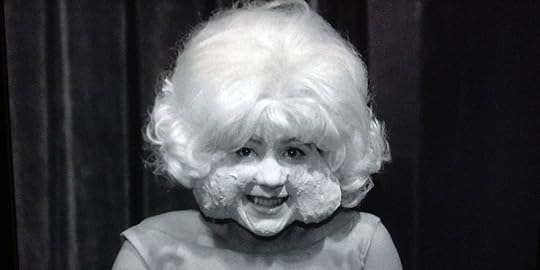
Once I went to see The Warriors, Walter Hill’s tough tale about street gangs, and hey, it turned out it was part of a double bill and the first film up was something I never heard of called Eraserhead. Even now I can remember the creeping feelings of bewilderment, irritation, disbelief and a horrible disgust and dread that got worse and worse as the slow black and white movie unreeled. When the Lady in the Radiator started edging to the side of the little stage she was standing on in order to squish the awful sluglike creatures that kept falling from out of camera range whilst winsomely trying to smile bravely and continue with her song
In heaven, things are really fine You got your good things and I’ve got mine
and all the time the cheeks on her face grotesquely distorted by some kind of growths, I wanted to leave, this was not a horror film, this was some kind of experiment designed to induce a panic attack. It was awful.
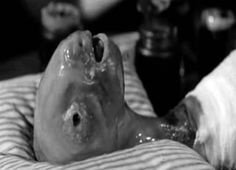
If the art of cinema is to induce particular emotions in an audience, this movie is the purest of cinema, and even now you’d be hard pressed to find a movie this oppressive and unpleasant. This is not a horror movie where people get chopped up or eaten, this is a movie where a dreadfully deformed baby is left in the care of a frightened father. The baby has become pretty famous
and David Lynch has resolutely never explained what the horrible thing actually was (some kind of actual animal foetus seems to be the best guess).
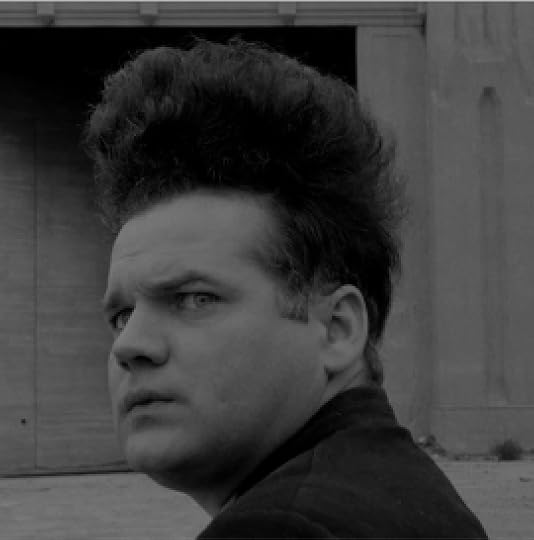
The movie was really David Lynch’s student project and it kept growing until it became a feature, and because of one thing and another, and another, and another it took FIVE years to finish, and the small but dedicated crew and the actors had to be available for the whole of the five years leading Jack Nance to remark “David Lynch, the only guy who shoots a movie one frame at a time”. Poor Jack, he had to maintain that mad haircut for five years.
This book has some good information in it but every other sentence is like this one
The spatial and material focus has sought to reveal the mechanics of Lynchian world-building that are grounded in physical places and collaborative relationships, as opposed to the common auteur narrative of a filmic world sprung from the subconscious of a singular visionary genius.
I happen to believe you can write about film without having to perpetrate sentences like that. There's absolutely no need for it.
Stumbled on this volume at Green Apple Books in San Francisco while on vacation. And because I have a tattoo in homage to Eraserhead on my forearm (a Ticonderoga Eraserhead over a black-and-white checkered bubble, my own design, thank you, I love it) I instantly bought it. I've seen the film a few times but nothing reminds me of how much I love it as much as my first viewing: several years ago for my husband and my horror movie month. As someone with anxiety, and with a degree in audio engineering, the sounds of this film sucked me in instantly. I couldn't look away. I had never seen anything like it, until I watched it again, and then again.
This volume taught me things I didn't know, and reminded me of a lot of stuff I did, about the making, release, reception, circulation, and legacy of a film unlike any other. When I tell people about Eraserhead my disclaimer is: it's often a hard sell, even for Lynch fans; it is not for everyone. (What I should say is...it's barely for anyone.) Friendly to its audience, assuming nothing, but not snotty or assuming, Claire Henry clearly loves the film and knows her stuff. I look forward to discovering more BFI Classics editions.
One obvious question for Aussie author Claire Henry is how, for David Lynch’s masterful 1977 ‘unclassifiable and indecipherable‘ debut film, can you possibly write a 100+ page critique? No matter, Henry does a very decent job here of ‘glossing over’ Lynch’s notorious reluctance to give any clue as to the meanings of any of his films (and, in particular, here Henry’s 1st chapter dedicated to the ‘meaning’ of Eraserhead’s ‘mutant alien baby’) and instead, references many (but, crucially, not too many!) other critics’ attempts at rationalisation, provides much intriguing insight into how Lynch’s obsessions with dreams, meditation and art can be used to ground Eraserhead, plus sections on the film’s initial critical reactions, its place in the world of the midnight movie and finally its legacy.
Along the way, I discover (things that a ‘Lynch fanatic’ – of which there are, of course, legions – would know already) to my surprise that the film took Lynch and his close-knit team of collaborators nigh on five years to complete (an ‘analogue’ working method that Lynch would never experience again the closer he got to Hollywood machinations). Also, that it was Lynch’s discovery of meditation – transcendental meditation, specifically – that encouraged the filmmaker to lighten the film’s (exclusive) focus on ‘dark nightmare’ by adding the Lady in the Radiator (‘In Heaven’) sequence (an absolute highlight in my book). Unsurprisingly, Henry’s section on initial press reaction reveals a largely negative response, with liberal use of ‘sickening bad taste’ and ‘repugnant’, eerily reminiscent of the outrage prompted by Michael Powell’s (later to be acknowledged ‘years ahead of its time’ classic take on potential cinematic perversion) Peeping Tom.
Henry’s succinct account of Lynch’s innovative debut should keep fans onside.
I’ve always had a soft spot for “Eraserhead,” and I still maintain that David Lynch has never made a better film. Claire Henry’s monograph on the picture makes a good case for its excellence – she doesn’t appear to see any flaws in it, although I differ with her there – and probes it from many angles, from its unusual production circumstances to its similarly offbeat reception history and the multitudinous varieties of interpretation to which it has been subjected over the years; to her credit, she refrains from an exegesis of her own, preferring to rest content with the film’s inspired mysteriousness, which is my approach as well . It’s amusing to read that Henry discovered it during a babysitting gig (!) and wrote this book when becoming a mother (!) for the first time. Auspicious circumstances indeed. This is another solid entry in the ongoing BFI Film Classics series, and I wonder what David makes of it, if he’s read it, Of course he may never crack its covers, and that’s certainly his privilege.
This was great. It wasn't at least telling a story in a fictional sense so I obviously won't review that bit of it. It tells a very interesting take just on the philosophical themes that the movie seems to present. It does shoot itself in the foot a bit by refusing to take sides on anything, including the very own opinion it presents. It doesn't elaborate on the production of Eraserhead as much as I would've wished but whatever. Anyway yeah, it's a decent book that elaborates a bunch on the philosophies that may or may not be present in Eraserhead and a little on its production. You should know from that description whether this book is for you or not. Anyway, if you're thinking of reading this I would recommend picking it up as it is very much worth the read. Merry eve of Christmas eve everyone!! I met my goal for 2023!! I can't describe how happy I am right now. Happy Holidays to you all!!
This entire review has been hidden because of spoilers.
"It was like sitting next to a power station with a radio and getting nothing but static."
Sometimes BFI classics are personal experiences, underlying what the films means to the author. Sometimes they are a heavy academic investigation. Sometimes, like this one, they are wonderfully both.
There is a lot to think about, a lot to consider, about a much loved, much discussed, but sometimes impenetrable film...Lynch's debut that took him 5 years to make. Claire Henry takes this on without any fear, but then sprinkles her love for the film throughout, keeping it readable, engaging and though provoking. Heavy with text, with well selected stills to emphasise points and sections of the film, the book has a multitude of interesting references beyond what you may find in a book about Lynch.
I love Lynch, including ERASERHEAD. But the BFI series is hit or miss, and this is ok but nothing special. The first chapter is great the 2nd and the final one, while focused, are fairly familiar and accessible information. The 3rd chapter, interpretively focused, adds interesting critical and theoretical tidbits, but ultimately refuses to pursue any potential readings…because the film resist determinate readings. I get the point, but a whole chapter of “no reading really sticks” is irritating and kinda useless. Lynch is famously abstract, but you ha=e to do something with it.
Totally forgot to finish this. I started it last May when I went to Italy and never read the second half. Fantastic analysis of one of my favourite films (and filmmakers) of all time. Claire Henry has a firm grip on what makes the impact of this film everlasting. Long live Eraserhead!
a really nice & easy read but unfortunately not much more! enough substance to enjoy your time with it but not enough to really take away with you afterwards. good research, some interesting talking points etc.. just a pleasant homage to a great film!
*3.5 🌟 A perfect summation of how any attempt of synopsis or narrative explanation to this work is an act of futile reduction and how this film stands as the ultimate experience movie