

What do you think?

Margaret of Austria: Governor of the Netherlands and Early 16th-Century Europe's Greatest Diplomat
𝗠𝗮𝗿𝗴𝗮𝗿𝗲𝘁 𝗼𝗳 𝗔𝘂𝘀𝘁𝗿𝗶𝗮 was the most significant political negotiator of early 16th century Europe. About as Austrian as French fries are French, she was born in Brussels in 1480, raised in France, married and widowed in Spain, then married and widowed again in Savoy by age twenty-four.
In 1506 Margaret’s life turned upside down when her brother Philip of Burgundy unexpectedly died in Spain. With their mother Juana of Castile insane, four children, heirs to the Habsburg empire, were left behind in the Burgundian-Habsburg Netherlands.
Margaret stepped in and took the reins.
Appointed by her father, Maximilian I, Margaret became governor of the Netherlands, then widened her role to broker the 1508 Treaty of Cambrai where Europe’s princes united against Venice.
Ferdinand of Spain, Henry Tudor then Henry VIII of England, Louis XII of France, and Louise de Savoy for Francis I all came to the negotiation table that Margaret oversaw. Under her deft diplomacy princes saw reason and wars were averted.
Enjoying political power, Margaret avoided remarriage. Then Henry VIII's right hand man Charles Brandon turned her world upside down.
Margaret's court attracted Europe's brightest, including the young Anne Boleyn. Yet halfway through her rule Margaret was ousted by enemies. She won back her position with a comeback strategy as astute today as it was in 1517.
Journey to the Renaissance with Margaret of Austria, who shot the fortunes of the House of Habsburg to the stars while setting a winning precedent for female rule in the Netherlands.
In 1506 Margaret’s life turned upside down when her brother Philip of Burgundy unexpectedly died in Spain. With their mother Juana of Castile insane, four children, heirs to the Habsburg empire, were left behind in the Burgundian-Habsburg Netherlands.
Margaret stepped in and took the reins.
Appointed by her father, Maximilian I, Margaret became governor of the Netherlands, then widened her role to broker the 1508 Treaty of Cambrai where Europe’s princes united against Venice.
Ferdinand of Spain, Henry Tudor then Henry VIII of England, Louis XII of France, and Louise de Savoy for Francis I all came to the negotiation table that Margaret oversaw. Under her deft diplomacy princes saw reason and wars were averted.
Enjoying political power, Margaret avoided remarriage. Then Henry VIII's right hand man Charles Brandon turned her world upside down.
Margaret's court attracted Europe's brightest, including the young Anne Boleyn. Yet halfway through her rule Margaret was ousted by enemies. She won back her position with a comeback strategy as astute today as it was in 1517.
Journey to the Renaissance with Margaret of Austria, who shot the fortunes of the House of Habsburg to the stars while setting a winning precedent for female rule in the Netherlands.
429 pages, Kindle Edition
Published March 7, 2023
About the author
Rozsa Gaston
19 books102 followersROZSA GASTON writes books on women who reach for what they want out of life. Her focus is on 16th century European female rulers.
GASTON studied history at Yale, and then received her master's degree in international affairs from Columbia. She lives in Bronxville, NY with her family. Be sure to follow her on Bookbub for the latest on special offers. https://www.bookbub.com/authors/rozsa...
Her motto? History matters.
GASTON studied history at Yale, and then received her master's degree in international affairs from Columbia. She lives in Bronxville, NY with her family. Be sure to follow her on Bookbub for the latest on special offers. https://www.bookbub.com/authors/rozsa...
Her motto? History matters.
Ratings & Reviews
Friends & Following
Create a free account to discover what your friends think of this book!
Community Reviews
Displaying 1 - 30 of 66 reviews

June 28, 2023
Brussels, 1480. Rozsa Gaston’s Margaret of Austria grabbed my attention upon reading this title as this is royal person about which I knew nothing, and I have always enjoyed reading about ‘the royals’.
I began my royal reading with a book about Anne Bolelyn, and to my surprise Anne and her father, Thomas, appear in Gaston’s book, but back to Margaret of Austria. What an amazing woman she was!
Born to the head of the House of Burgundy (Mary the Rich, her mother) and head of the House of Hapsburg (Maximilian I of Austria, her father). Margaret’s life is one of incredible ‘fortune’ and ‘misfortune’. Thus, it is no surprise that her motto became “Fortune, misfortune, fortifies one”. Margaret’s brother, Philip, became Philip the Handsome when grown to adulthood, and marries Juana
of Castile. There is quite a story in this marriage! Margaret, after two marriages resulting in widowhood at 24 years old, becomes the governor of The Netherlands and “early 16th-century Europe’s greatest diplomat”. The author provides a ‘cast of characters’, maps, pictures, and an ‘explanation of Burgundy’ which is extremely helpful to the reader. A great read! 5 stars!
I began my royal reading with a book about Anne Bolelyn, and to my surprise Anne and her father, Thomas, appear in Gaston’s book, but back to Margaret of Austria. What an amazing woman she was!
Born to the head of the House of Burgundy (Mary the Rich, her mother) and head of the House of Hapsburg (Maximilian I of Austria, her father). Margaret’s life is one of incredible ‘fortune’ and ‘misfortune’. Thus, it is no surprise that her motto became “Fortune, misfortune, fortifies one”. Margaret’s brother, Philip, became Philip the Handsome when grown to adulthood, and marries Juana
of Castile. There is quite a story in this marriage! Margaret, after two marriages resulting in widowhood at 24 years old, becomes the governor of The Netherlands and “early 16th-century Europe’s greatest diplomat”. The author provides a ‘cast of characters’, maps, pictures, and an ‘explanation of Burgundy’ which is extremely helpful to the reader. A great read! 5 stars!

April 26, 2023
Mighty Margaret
I'm never disappointed by Rozsa Gaston's books. She writes with the perfect balance of dialogue and description. This is the first book I've read about Margaret of Austria and what an incredibly impressive woman she was. Margaret possessed strength, humor, compassion, diplomacy and smarts beyond compare. Put this book on your reading list!
I'm never disappointed by Rozsa Gaston's books. She writes with the perfect balance of dialogue and description. This is the first book I've read about Margaret of Austria and what an incredibly impressive woman she was. Margaret possessed strength, humor, compassion, diplomacy and smarts beyond compare. Put this book on your reading list!

Read
November 1, 2022𝟵.𝟱 𝗢𝗨𝗧 𝗢𝗙 𝟭𝟬 𝗳𝗿𝗼𝗺 𝗧𝗵𝗲 𝟮𝟬𝟮𝟯 𝗕𝗼𝗼𝗸𝗟𝗶𝗳𝗲 𝗣𝗿𝗶𝘇𝗲 𝗳𝗼𝗿 𝗠𝗔𝗥𝗚𝗔𝗥𝗘𝗧 𝗢𝗙 𝗔𝗨𝗦𝗧𝗥𝗜𝗔
#Tudor #Renaissance #historicalfiction #womeninhistory #publishersweekly #BooklifePrize
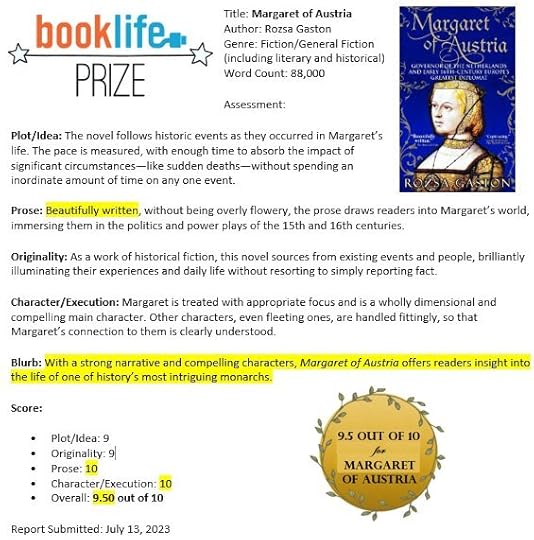
𝟮𝟬𝟮𝟯 𝗕𝗼𝗼𝗸𝗟𝗶𝗳𝗲 𝗣𝗿𝗶𝘇𝗲
Plot/Idea: 9 out of 10
Originality: 9 out of 10
Prose: 10 out of 10
Character/Execution: 10 out of 10
Overall: 9.50 out of 10
Assessment:
Plot/Idea: The novel follows historic events as they occurred in Margaret’s life. The pace is measured, with enough time to absorb the impact of significant circumstances—like sudden deaths—without spending an inordinate amount of time on any one event.
Prose: Beautifully written, without being overly flowery, the prose draws readers in to Margaret’s world, immersing them in the politics and power plays of the 15th and 16th centuries.
Originality: As a work of historical fiction, this novel sources from existing events and people, brilliantly illuminating their experiences and daily life without resorting to simply reporting fact.
Character/Execution: Margaret is treated with appropriate focus and is a wholly dimensional and compelling main character. Other characters, even fleeting ones, are handled fittingly, so that Margaret’s connection to them is clearly understood.
Blurb: With a strong narrative and compelling characters, Margaret of Austria offers readers insight into the life of one of history’s most intriguing monarchs.
#Tudor #Renaissance #historicalfiction #womeninhistory #publishersweekly #BooklifePrize
𝟮𝟬𝟮𝟯 𝗕𝗼𝗼𝗸𝗟𝗶𝗳𝗲 𝗣𝗿𝗶𝘇𝗲
Plot/Idea: 9 out of 10
Originality: 9 out of 10
Prose: 10 out of 10
Character/Execution: 10 out of 10
Overall: 9.50 out of 10
Assessment:
Plot/Idea: The novel follows historic events as they occurred in Margaret’s life. The pace is measured, with enough time to absorb the impact of significant circumstances—like sudden deaths—without spending an inordinate amount of time on any one event.
Prose: Beautifully written, without being overly flowery, the prose draws readers in to Margaret’s world, immersing them in the politics and power plays of the 15th and 16th centuries.
Originality: As a work of historical fiction, this novel sources from existing events and people, brilliantly illuminating their experiences and daily life without resorting to simply reporting fact.
Character/Execution: Margaret is treated with appropriate focus and is a wholly dimensional and compelling main character. Other characters, even fleeting ones, are handled fittingly, so that Margaret’s connection to them is clearly understood.
Blurb: With a strong narrative and compelling characters, Margaret of Austria offers readers insight into the life of one of history’s most intriguing monarchs.

April 24, 2023
A wonderful tribute
This book quickly became a favorite and likewise, Rozsa Gaston is a new favorite author of mine! In the last couple of years I've noticed historical fiction (at least in the time period I read/study, 14th-16th century Europe) has been lacking much dialogue between the characters but that is not so in this novel. There's plenty of dialogue, character development, historical accuracy, and just all around great writing.
I also particularly appreciated the maps and portraits that are interspersed throughout the book at relevant passages, rather than in one of two groups of images in the middle or back of the book. This was so helpful and a great idea that I hope more authors start doing!
Thank you Ms Gaston for a wonderful read, I am off to spend time with Anne in your other series 😊
This book quickly became a favorite and likewise, Rozsa Gaston is a new favorite author of mine! In the last couple of years I've noticed historical fiction (at least in the time period I read/study, 14th-16th century Europe) has been lacking much dialogue between the characters but that is not so in this novel. There's plenty of dialogue, character development, historical accuracy, and just all around great writing.
I also particularly appreciated the maps and portraits that are interspersed throughout the book at relevant passages, rather than in one of two groups of images in the middle or back of the book. This was so helpful and a great idea that I hope more authors start doing!
Thank you Ms Gaston for a wonderful read, I am off to spend time with Anne in your other series 😊

September 2, 2023
“Fortune, misfortune, fortifies one.”
--personal motto of Margaret of Austria
The scion of a powerful political dynasty, Margaret of Austria was born into a world where royal women were political tokens. Marriages were a tool, negotiated for the acquisition of territory or to cement a military alliance. Margaret rose above this distinction and emerged as a powerful leader in her own right. Rozsa Gaston presents Margaret as a political powerhouse in the 16th Century. At a time when women in positions of authority were rare, Margaret stood out as an able administrator and dynamic figure. Margaret of Austria: Governor of the Netherlands and Early 16th Century Europe’s Greatest Diplomat is presented as a linear drama, heavily supported by historical fact. The first part of the book contains a brief history of her early life before jumping into the dramatic narrative. This gave me pause. History dramatized is often sullied by an excess of creative license. I was pleasantly surprised. The events are real. The people are real. The story is dramatized but historically accurate.
A Tale of Two Houses:
Born in 1480 to Archduke Maximillian of Austria (House Habsburg) and Duchess Mary of Burgundy (House Burgundy), Margaret was the second and last child the couple would have. Not all royal marriages were marriages of convenience. Mary and Maximillian were a happy couple. Through their union they ruled Burgundy, Austria and territories stretching to the border of France. However, happiness is often followed by tragedy. In 1482, Mary died from injuries sustained after falling from a horse. At the age of 23, Maximillian was a heartbroken widower with two children to raise. Margaret and her brother Phillip were left in the care of their step grandmother, Mary of York—who happened to be the sister of Edward IV and Richard III of England.
Fille de France:
Due to their marriage contract, Maximillian could not inherit his wife’s domain. At this point in history, Burgundy was a vast stretch of territory consisting of parts of Belgium, the Netherlands, Luxembourg, and the Duchy of Burgundy itself. King Louis XI of France wanted all of Burgundy to himself. To avoid war with France, Maximillian proposed a marriage alliance. The 1482 Treaty of Arras contracted Margaret (age 3) to marry Charles the Dauphin (age 13). In exchange, Maximillian received control of a large swath of Burgundy. This accord unified the House of Valois (the French ruling family) with the Habsburg dynasty. Phillip became Duke of Burgundy, though his father ruled the territory until he came of age. Margaret was sent as a “daughter of France” to experience life at the French court.
The Sour Grapes of Politics:
The marriage to Charles was not to be. Charles became King of France in 1483. Due to his minority, the country was ruled by his elder sister Anne and her husband Peter, the Duke of Bourbon. Margaret was unaware that international politics were about to rob her of her destiny. The sudden death of the Duke of Brittany in 1488 left his 11-year older daughter as heir to the throne and gave Anne an opportunity to acquire more territory. Cancelling the marriage contract with Margaret, Anne arranged for Charles to marry the heir to the Duchy of Brittany in 1490.
To Reign in Spain?
Incensed by the treatment of his daughter, Maximilian sought new alliances. Spain, a rising power player, seemed the best option. Maximillian proposed a joint betrothal—his son Philip the Handsome (Duke of Burgundy) to Princess Juana of Castille and Margaret to John (Prince of Asturias). They were married in 1497. Prince John died a few months after their wedding and Margaret gave birth to a stillborn child. She returned to the Netherlands in 1499 in time to participate in the christening of her nephew, Charles. When Queen Isabella died in 1504, her daughter returned to Spain to claim the crown—and Phillip became King of Castile by virtue of his marriage. He died in 1506.
Leader in Her Own Right:
Charles was now the Duke of Burgundy but was too young to rule the country. Maximillian (Now Holy Roman Emperor) appointed Margaret as Regent. She quickly got to work governing the province, raising taxes to support her father’s military campaigns, and enacting a foreign policy that sought to avoid the myriad political schisms troubling Europe at the time. She served as an intermediary for her father and her nephew’s subjects and even assisted with organizing an alliance against potential French aggression. She kept the Netherlands as neutral as possible in several conflicts that occurred during her tenure. She supported the arts and ensured that her nephew was educated by the very best tutors she could find. In 1530, Margaret of Austria died.
Analysis:
Margaret of Austria: Governor of the Netherlands and Early 16th Century Europe’s Greatest Diplomat is a fascinating story. The book starts out with an historical examination of Margaret’s early life. The narrative switches tone from historical analysis to dramatization, heavily influenced by history. The omniscient narrator sets the scene, providing context and even a glimpse at what the characters are thinking. Rather than have the narrative from the first-person perspective, the author elected to examine Margaret’s feelings and emotions in this voice. This is a departure from historical fiction based around a central figure but works well with this narrative. While a work of fiction, the events have been painstakingly researched and more accurate than similar works of the genre. There is no detectable trace of artistic license taken with the historical facts. The thoughts of the central figure have been gleaned from extant writing and are used for dramatic effect. Margaret of Austria emerges as a powerful political figure who overcame the limitations placed on her by society to make an impact.
I received an advance review copy for free, and I am leaving this review voluntarily.
--personal motto of Margaret of Austria
The scion of a powerful political dynasty, Margaret of Austria was born into a world where royal women were political tokens. Marriages were a tool, negotiated for the acquisition of territory or to cement a military alliance. Margaret rose above this distinction and emerged as a powerful leader in her own right. Rozsa Gaston presents Margaret as a political powerhouse in the 16th Century. At a time when women in positions of authority were rare, Margaret stood out as an able administrator and dynamic figure. Margaret of Austria: Governor of the Netherlands and Early 16th Century Europe’s Greatest Diplomat is presented as a linear drama, heavily supported by historical fact. The first part of the book contains a brief history of her early life before jumping into the dramatic narrative. This gave me pause. History dramatized is often sullied by an excess of creative license. I was pleasantly surprised. The events are real. The people are real. The story is dramatized but historically accurate.
A Tale of Two Houses:
Born in 1480 to Archduke Maximillian of Austria (House Habsburg) and Duchess Mary of Burgundy (House Burgundy), Margaret was the second and last child the couple would have. Not all royal marriages were marriages of convenience. Mary and Maximillian were a happy couple. Through their union they ruled Burgundy, Austria and territories stretching to the border of France. However, happiness is often followed by tragedy. In 1482, Mary died from injuries sustained after falling from a horse. At the age of 23, Maximillian was a heartbroken widower with two children to raise. Margaret and her brother Phillip were left in the care of their step grandmother, Mary of York—who happened to be the sister of Edward IV and Richard III of England.
Fille de France:
Due to their marriage contract, Maximillian could not inherit his wife’s domain. At this point in history, Burgundy was a vast stretch of territory consisting of parts of Belgium, the Netherlands, Luxembourg, and the Duchy of Burgundy itself. King Louis XI of France wanted all of Burgundy to himself. To avoid war with France, Maximillian proposed a marriage alliance. The 1482 Treaty of Arras contracted Margaret (age 3) to marry Charles the Dauphin (age 13). In exchange, Maximillian received control of a large swath of Burgundy. This accord unified the House of Valois (the French ruling family) with the Habsburg dynasty. Phillip became Duke of Burgundy, though his father ruled the territory until he came of age. Margaret was sent as a “daughter of France” to experience life at the French court.
The Sour Grapes of Politics:
The marriage to Charles was not to be. Charles became King of France in 1483. Due to his minority, the country was ruled by his elder sister Anne and her husband Peter, the Duke of Bourbon. Margaret was unaware that international politics were about to rob her of her destiny. The sudden death of the Duke of Brittany in 1488 left his 11-year older daughter as heir to the throne and gave Anne an opportunity to acquire more territory. Cancelling the marriage contract with Margaret, Anne arranged for Charles to marry the heir to the Duchy of Brittany in 1490.
To Reign in Spain?
Incensed by the treatment of his daughter, Maximilian sought new alliances. Spain, a rising power player, seemed the best option. Maximillian proposed a joint betrothal—his son Philip the Handsome (Duke of Burgundy) to Princess Juana of Castille and Margaret to John (Prince of Asturias). They were married in 1497. Prince John died a few months after their wedding and Margaret gave birth to a stillborn child. She returned to the Netherlands in 1499 in time to participate in the christening of her nephew, Charles. When Queen Isabella died in 1504, her daughter returned to Spain to claim the crown—and Phillip became King of Castile by virtue of his marriage. He died in 1506.
Leader in Her Own Right:
Charles was now the Duke of Burgundy but was too young to rule the country. Maximillian (Now Holy Roman Emperor) appointed Margaret as Regent. She quickly got to work governing the province, raising taxes to support her father’s military campaigns, and enacting a foreign policy that sought to avoid the myriad political schisms troubling Europe at the time. She served as an intermediary for her father and her nephew’s subjects and even assisted with organizing an alliance against potential French aggression. She kept the Netherlands as neutral as possible in several conflicts that occurred during her tenure. She supported the arts and ensured that her nephew was educated by the very best tutors she could find. In 1530, Margaret of Austria died.
Analysis:
Margaret of Austria: Governor of the Netherlands and Early 16th Century Europe’s Greatest Diplomat is a fascinating story. The book starts out with an historical examination of Margaret’s early life. The narrative switches tone from historical analysis to dramatization, heavily influenced by history. The omniscient narrator sets the scene, providing context and even a glimpse at what the characters are thinking. Rather than have the narrative from the first-person perspective, the author elected to examine Margaret’s feelings and emotions in this voice. This is a departure from historical fiction based around a central figure but works well with this narrative. While a work of fiction, the events have been painstakingly researched and more accurate than similar works of the genre. There is no detectable trace of artistic license taken with the historical facts. The thoughts of the central figure have been gleaned from extant writing and are used for dramatic effect. Margaret of Austria emerges as a powerful political figure who overcame the limitations placed on her by society to make an impact.
I received an advance review copy for free, and I am leaving this review voluntarily.

July 12, 2025
The 16th century was dominated by powerful women who left their indelible mark on European history. Take, for example, the aunt of Charles V, the Holy Roman Emperor. No, not Catherine of Aragon, the first wife of Henry VIII. I am talking about a woman who was the daughter of Emperor Maximilian I, was married three times, had no children, and helped raise her nephew Charles V, was an essential part of the Ladies’ Peace, taught Anne Boleyn how to live at court, and was a patroness of the arts and literature. Of course, I am talking about Margaret of Austria, the Governor of the Netherlands. A formidable woman who saw much change and chose to be part of politics, even though she was a woman. Her remarkable story is told in Rozsa Gaston’s novel, “Margaret of Austria: Governor of the Netherlands and Early 16th-Century Europe’s Greatest Diplomat.”
I would like to thank Rozsa Gaston for sending me a copy of this novel. I am someone who is always looking for a new aspect of the 16th century. I have heard about Margaret of Austria from other books about Anne Boleyn and the 16th century, but I did not know much about this woman. When Gaston asked if I would like to read and review her novel, I jumped at the chance to read it and learn more about her.
Gaston begins her novel with a chart of important figures that would be featured in this story, which was helpful for me as a reader. Then, we get some basic background information about Margaret of Austria, the daughter of Maximilian I of Austria and Mary of Burgundy (known as Mary the Rich). Margaret’s brother was Philip the Handsome, who was expected to inherit their father’s throne. Margaret was destined to be a bride for King Charles VIII of France, so she left her native Netherlands for France at a young age. Our story begins with Charles VIII rejecting poor Margaret because he was already married to Anne of Brittany. Rejected, Margaret goes home, where another marriage is arranged. Her brother Philip would marry Juana of Castile, and Margaret would travel to Spain to marry Juan, Prince of Asturias. This marriage would not last long as Juan would die young.
Her final marriage would be to Philibert of Savoy, which turned into a love match, but Philibert would die a few years into their marriage. Heartbroken, Margaret goes to live with Philip and Juana, which is a mistake because they are constantly at odds. When Philip dies unexpectantly, Juana, no matter how her mental state may be, rules Castile while her eldest son Charles lives with Margaret. Margaret becomes the Governor of the Netherlands for Charles until he is old enough to rule. For the remainder of her life, politics would play a major part in Margaret’s life as she saw issues like the Great Matter, the Sack of Rome, the League of Cambrai, the rise of Martin Luther, and the Ladies’ Peace.
Margaret of Austria was such a powerful woman who would do anything for her family and her beloved Netherlands. To stand toe to toe with some of these major political figures as a woman during the 16th century took guts, but Margaret showed how formidable she was. Gaston does an excellent job telling Margaret’s story, so much so that I want to read more books about her life. Suppose you want to learn more about the life of Margaret of Austria. In that case, I highly recommend you read “Margaret of Austria: Governor of the Netherlands and Early 16th-Century Europe’s Greatest Diplomat” by Rozsa Gaston.
I would like to thank Rozsa Gaston for sending me a copy of this novel. I am someone who is always looking for a new aspect of the 16th century. I have heard about Margaret of Austria from other books about Anne Boleyn and the 16th century, but I did not know much about this woman. When Gaston asked if I would like to read and review her novel, I jumped at the chance to read it and learn more about her.
Gaston begins her novel with a chart of important figures that would be featured in this story, which was helpful for me as a reader. Then, we get some basic background information about Margaret of Austria, the daughter of Maximilian I of Austria and Mary of Burgundy (known as Mary the Rich). Margaret’s brother was Philip the Handsome, who was expected to inherit their father’s throne. Margaret was destined to be a bride for King Charles VIII of France, so she left her native Netherlands for France at a young age. Our story begins with Charles VIII rejecting poor Margaret because he was already married to Anne of Brittany. Rejected, Margaret goes home, where another marriage is arranged. Her brother Philip would marry Juana of Castile, and Margaret would travel to Spain to marry Juan, Prince of Asturias. This marriage would not last long as Juan would die young.
Her final marriage would be to Philibert of Savoy, which turned into a love match, but Philibert would die a few years into their marriage. Heartbroken, Margaret goes to live with Philip and Juana, which is a mistake because they are constantly at odds. When Philip dies unexpectantly, Juana, no matter how her mental state may be, rules Castile while her eldest son Charles lives with Margaret. Margaret becomes the Governor of the Netherlands for Charles until he is old enough to rule. For the remainder of her life, politics would play a major part in Margaret’s life as she saw issues like the Great Matter, the Sack of Rome, the League of Cambrai, the rise of Martin Luther, and the Ladies’ Peace.
Margaret of Austria was such a powerful woman who would do anything for her family and her beloved Netherlands. To stand toe to toe with some of these major political figures as a woman during the 16th century took guts, but Margaret showed how formidable she was. Gaston does an excellent job telling Margaret’s story, so much so that I want to read more books about her life. Suppose you want to learn more about the life of Margaret of Austria. In that case, I highly recommend you read “Margaret of Austria: Governor of the Netherlands and Early 16th-Century Europe’s Greatest Diplomat” by Rozsa Gaston.
January 7, 2023
The book was interesting from the point of view that I did not know much about the Low Countries in the 1500’s. However, it felt like the author simply made a list of each time she found Margaret of Austria’s name and the incident, then wrote a chapter about it. There is not a lot of continuity except chronologically and there are often repeats of events using different words a few pages later. There is no character development or building up of context around the events. At times, the author mixes what they perceive as early modern language construction with present day language construction (I don’t think “just back off” or “I will get on this right away” we’re used much then). And, it’s just me, but still there are many typos throughout and, for a book billed as being about a strong and powerful woman, most of the decisions she made in the book were suggested to her by male councilors.
I received an advance review copy for free, and I am leaving this review voluntarily.
I received an advance review copy for free, and I am leaving this review voluntarily.

March 23, 2023
I won a Kindle copy of Margaret of Austria through a giveaway on Goodreads and I couldn't have been more excited! Thank you to Rozsa Gaston :)
I have read many books about the Tudors and have decided to branch out to learn more about other key players during this time period. Margaret of Austria was a fascinating individual. I feel Rozsa Gaston really brought her to life. We get to experience her heartbreaks, understand her great political mindset, and just overall get to witness her strength of being a woman during a time when women were thought to be severely inferior to men.
Through this book, we also get a glimpse of Juana of Castile, also known as Juana the Mad. After reading Gaston's writing style, I think she could do a novel about her justice.
I have read many books about the Tudors and have decided to branch out to learn more about other key players during this time period. Margaret of Austria was a fascinating individual. I feel Rozsa Gaston really brought her to life. We get to experience her heartbreaks, understand her great political mindset, and just overall get to witness her strength of being a woman during a time when women were thought to be severely inferior to men.
Through this book, we also get a glimpse of Juana of Castile, also known as Juana the Mad. After reading Gaston's writing style, I think she could do a novel about her justice.
March 8, 2023
A captivating novel told with rich layers of historical detail, Rozsa Gaston’s Margaret of Austria highlights the tenacity, resilience, and grace of a woman who crafted a unique role for herself in a time of patriarchal dominance, allowing her the freedom, power, and respect that few women in history have known. The drama weaves together Margaret’s part as a political pawn; her years of love forsaken, love found, and love lost; and the turmoil created by her extended family. All while capturing the nuanced details and motives that spurred Margaret’s decisions. I highly recommend this novel as an accurate and entertaining foray into the history of Margaret of Austria.

July 11, 2024
Interesting historical fiction !!
Margaret of Austria lived during the 16 th Century. She was the most effective leader of those times, governing several places before serving as the governor of the Neverland’s. An excellent negotiator she arranged treaties to bring peace to Europe and was instrumental in helping her nephew become the leader of the Holy Roman Empire. (time of Henry the 8th, Martin Luther, and the Spanish explorers!!!
Margaret of Austria lived during the 16 th Century. She was the most effective leader of those times, governing several places before serving as the governor of the Neverland’s. An excellent negotiator she arranged treaties to bring peace to Europe and was instrumental in helping her nephew become the leader of the Holy Roman Empire. (time of Henry the 8th, Martin Luther, and the Spanish explorers!!!
February 25, 2025
wonderful woman wonderfully written
This was a lovely and your through glimpse into Margret’s life. I appreciate the time taken to explore her life. I look forward to reading more by this author.
This was a lovely and your through glimpse into Margret’s life. I appreciate the time taken to explore her life. I look forward to reading more by this author.

April 23, 2023
Another great book by a terrific author! Thanks Jessica for recommending this!
August 16, 2023
Great story if a powerful woman
February 17, 2023
Margaret of Austria, an over-looked historical figure, who lived in the dynamic first half of the 16th century, comes to life in Rozsa Gaston's new historical novel about her. For those who may not be familiar with Margaret, the author has included maps and images that provide a visual context that effectively complement the story. Margaret's life, especially her role as governor of the Netherlands, offers an insider's perspective on historic events with consequences that reverberate to this day.

February 21, 2023
Roza Gaston takes a look at Margaret of Austria, who is often overlooked in history as one of the great Renaissance rulers. At age 11 was jilted by the Prince of France. They had an arranged marriage, but this didn't seem to stop Margaret. She went on to find the love of her life, in her old childhood friend, Phillip of Savoy. She suffered the death of 2 husband's and the death of a child, but she went on to do amazing things for the European continent.
The book is a historical fiction that Gaston researched well. It made me feel like I got to know Margaret of Austria. I could feel her pain, anguish, joy and triumphs. I rooted for her. Even though she didn't have children, she took on 3 of her brothers children, one of which ended being Charles V of the Holy Roman Empire.
If you enjoy historical fiction, I think you would enjoy this one. It had me going down to the internet rabbit hole.
Thanks to Book Sirens, and Gaston for the Kindle Version of the book. All thoughts and opinions are my own.
🙃 Happy Reading 🙃
#Booksirens
#RozaGaston
The book is a historical fiction that Gaston researched well. It made me feel like I got to know Margaret of Austria. I could feel her pain, anguish, joy and triumphs. I rooted for her. Even though she didn't have children, she took on 3 of her brothers children, one of which ended being Charles V of the Holy Roman Empire.
If you enjoy historical fiction, I think you would enjoy this one. It had me going down to the internet rabbit hole.
Thanks to Book Sirens, and Gaston for the Kindle Version of the book. All thoughts and opinions are my own.
🙃 Happy Reading 🙃
#Booksirens
#RozaGaston
March 13, 2023
excellently written
Enjoyed this beautifully written story of a strong but passionate woman. A book of political courage, personal joy and sorrow. A historical book that moves along quickly without drawing one into wordless stagnation.
Enjoyed this beautifully written story of a strong but passionate woman. A book of political courage, personal joy and sorrow. A historical book that moves along quickly without drawing one into wordless stagnation.
January 12, 2023
A Diplomat for the age
Margaret of Austria by Rozsa Gaston is a perfect companion to Jonathon Jordan's "The War Queens." Margaret's battlefields were the council rooms in Europe ranging from the Low Countries to Spain. Read this for a better understanding of the economic and political issues that set the stage for the 100 Years War of religion in the 1600s.
Margaret of Austria by Rozsa Gaston is a perfect companion to Jonathon Jordan's "The War Queens." Margaret's battlefields were the council rooms in Europe ranging from the Low Countries to Spain. Read this for a better understanding of the economic and political issues that set the stage for the 100 Years War of religion in the 1600s.

October 19, 2024
This book opens the door into the world of Margaret of Austria. Stepping into few first pages - and we are already at the “la petite reigne” court - gay, carefree, promising bright future... then we follow to Burgundy, Spain, Savoy... each journey is a joy mixed with sorrow, a loss mixed with a new opportunity.
Margaret of Austria was the daughter of Mary of Burgundy and Maximilian the Holy Roman Emperor, she was married three times, almost queen of France, almost queen of Spain (Castile and Aragon) and actual Duchess of Savoy as well as effective governor of the Netherlands.
She did not have children, losing her husbands very young, nevertheless brought up two generations of Hapsburg princes and princesses, most notably her nephew, future Charles I of Spain and Charles V, Holy Roman Emperor.
Her loyalty to her family, her astuteness in government, her ability to listen to concerns of others brought long time of peace and prosperity for the Netherlands.
Rozsa Gaston’s book is a beautiful combination of fiction and non-fiction. Chronological historical events and life path of Margaret of Austria are intertwined with her thoughts, dialogues, feelings and emotional experiences.
The maps and photographs vastly increased the feeling of being immersed in the time period and walking alongside Margaret through her life.
Highly recommend this book to medieval and Renaissance history fans.
Margaret of Austria was the daughter of Mary of Burgundy and Maximilian the Holy Roman Emperor, she was married three times, almost queen of France, almost queen of Spain (Castile and Aragon) and actual Duchess of Savoy as well as effective governor of the Netherlands.
She did not have children, losing her husbands very young, nevertheless brought up two generations of Hapsburg princes and princesses, most notably her nephew, future Charles I of Spain and Charles V, Holy Roman Emperor.
Her loyalty to her family, her astuteness in government, her ability to listen to concerns of others brought long time of peace and prosperity for the Netherlands.
Rozsa Gaston’s book is a beautiful combination of fiction and non-fiction. Chronological historical events and life path of Margaret of Austria are intertwined with her thoughts, dialogues, feelings and emotional experiences.
The maps and photographs vastly increased the feeling of being immersed in the time period and walking alongside Margaret through her life.
Highly recommend this book to medieval and Renaissance history fans.

July 12, 2025
[I'm sometimes asked by other book reviewers to write (or significantly contribute to) a review that they can then submit to other websites under their own names. This is one of those. - Avril]
I didn’t know much about Margaret of Austria before reading this, but what a life she led! This book pulled me in right from the start and never let go. It reads like historical fiction, but everything feels real and deeply researched. The writing is smooth and really brings her world to life.
Margaret goes through so much — from being betrothed at age three, to getting jilted by a French king, to losing her young husband and child, and still rising to become one of the most powerful women in Europe. What I loved most was how strong and steady she is, no matter what life throws at her. You really feel like you’re inside her head, watching her grow wiser and tougher with each chapter.
There’s romance, heartbreak, royal drama, and a lot of powerful women in the mix. I especially enjoyed the parts with Anne of Brittany and Queen Isabella — the way these women handle power and politics was fascinating. But Margaret steals the show. She’s sharp, warm, funny at times, and incredibly determined.
If you enjoy stories about real women in history who made an impact, you’ll love this. It’s well-written but not overly academic. Honestly, I wish more history books were like this. Definitely worth reading.
I didn’t know much about Margaret of Austria before reading this, but what a life she led! This book pulled me in right from the start and never let go. It reads like historical fiction, but everything feels real and deeply researched. The writing is smooth and really brings her world to life.
Margaret goes through so much — from being betrothed at age three, to getting jilted by a French king, to losing her young husband and child, and still rising to become one of the most powerful women in Europe. What I loved most was how strong and steady she is, no matter what life throws at her. You really feel like you’re inside her head, watching her grow wiser and tougher with each chapter.
There’s romance, heartbreak, royal drama, and a lot of powerful women in the mix. I especially enjoyed the parts with Anne of Brittany and Queen Isabella — the way these women handle power and politics was fascinating. But Margaret steals the show. She’s sharp, warm, funny at times, and incredibly determined.
If you enjoy stories about real women in history who made an impact, you’ll love this. It’s well-written but not overly academic. Honestly, I wish more history books were like this. Definitely worth reading.
February 27, 2023
As a big fan of historical fiction that delves deeply into the nuances of early modern European diplomacy and court intrigue, I was very pleased to win this book in a Goodreads giveaway. I was already somewhat familiar with this historical period beforehand (although the author provides just enough context to navigate through the book, some prior knowledge is definitely useful), but I knew very little about Margaret of Austria specifically. Gaston conveys much of Margaret’s political skills in a series of chapters that cover the various political and personal problems she faced first as a potential marriage candidate and then as a governor in her own right over the Habsburg Burgundian territories.
While the book lacks a little in style, it provides an excellent characterization of Margaret herself. The elemental connection she shared with her native Burgundy, along with her ability to understand and placate the needs of the disparate Dutch provinces under her governorship, was intrinsic to her hold on power. With her tact, discretion, grace, self-command, and the ability to give people what they want without being manipulative or unfair, she comes across as the consummate politician and leader. I thought highly enough of this book that I will try to check out more of Gaston’s work in the future.
While the book lacks a little in style, it provides an excellent characterization of Margaret herself. The elemental connection she shared with her native Burgundy, along with her ability to understand and placate the needs of the disparate Dutch provinces under her governorship, was intrinsic to her hold on power. With her tact, discretion, grace, self-command, and the ability to give people what they want without being manipulative or unfair, she comes across as the consummate politician and leader. I thought highly enough of this book that I will try to check out more of Gaston’s work in the future.

February 1, 2025
A hybrid historical novel-biography, written not in Hilary Mantel-style prose that could have been a script for Richard Burton and Helen Mirren (not that there's anything wrong with that!), but in a simple, accessible prose. You and your teenager could read this together and both thoroughly enjoy it. Also, Gaston explains some of the mysteries of Western Europe through this one extraordinary woman, imagining dialogue, having her sigh with heavy burdens, and explaining her devotion to ideas we may find baffling.
I wrote a little poem:
Margaret of Austria
Ruled the Netherlands
Often from from France
For her nephew in Spain
(I may kee working on it!)
I wrote a little poem:
Margaret of Austria
Ruled the Netherlands
Often from from France
For her nephew in Spain
(I may kee working on it!)

January 12, 2023
A nicely written and well researched novel detailing the life of another little-known woman in history. The aunt, and guardian, of Charles I, Holy Roman Emperor and father-in-law of Mary 1 of England. Margaret ruled the Netherlands for the majority of her life, brokered the "ladies peace," and raised several generations of Hapsburgs to go on and rule in their own rights.

July 13, 2025
Incredible Story!
Wonderfully written! This story about a powerful woman in history was engaging. From age three to becoming one of the most powerful women in Europe. A must read for my daughters.
Wonderfully written! This story about a powerful woman in history was engaging. From age three to becoming one of the most powerful women in Europe. A must read for my daughters.

February 19, 2023
Amazing read about an amazing woman. This book delivers in every way possible!

May 10, 2023
Another outstanding work of historical fiction by a talented author. I say it a lot, but I will say it again. I am SO glad I found these books!

February 5, 2023
NOTE: I was given early access to this arc in exchange for writing an impartial review. Thank you booksirens and Renaissance Editions. Publication Date: March 7, 2023.
One thing I admire about author Rosza Gaston is her commitment to telling stories of important WOMEN in history who have traditionally gotten little or no attention. Margaret of Austria is one of these women. (Anne of Brittany another.) And I most definitely learned a lot about Margaret in this novel. Hers is a fascinating story but the novel itself was just so-so.
First, to set the stage, who was Margaret? During the 16th century, Archduchess Margaret of Austria was solo governor of the Hapsburg Netherlands at two different times. She was also widowed twice after two short marriages to John, Prince of Asturias and Philibert II, Duke of Savoy. It's her second marriage that gives her another title she's known by - Margaret of Savoy.
Margaret was also surrounded by many impressive A-List royals.
• Her father was Maximilian I, Holy Roman Emperor.
• Her mother was Mary, Duchess of Burgundy.
• Her brother, Phillip the Handsome married Queen Juana (the Mad?).
• Her mother-in-law is Queen Isabella of Ferdinand and Isabella fame.
• Her childhood friend turned out to be the mother of the future King Francois I of France.
• Margaret is a surrogate mother to her nephew who becomes Charles V.
• She is courted by King Henry VII of England.
• Queen Anne Boleyn was once her lady-in-waiting.
But what makes Margaret so historically noteworthy is her finely honed strategic skills and business acumen -- that she consistently put to work in the service of her people -- thereby helping them thrive and remain at peace. Also, her ability to negotiate resolutions to long-standing disputes between foreign powers (i.e. Treaty of Cambrai). Quite an accomplishment at a time when women were seldom permitted to rule alone.
Unfortunately I found the book reads more like a non-fiction biography (even a textbook at times) than historical fiction. Lots of recitation of facts and dates about battles and meetings and little success in getting inside Margaret's head. What was it like to be a woman ruler moving through decidedly patriarchal societies? How did the men around her handle her wielding such power? Where did her wisdom, skill, and good sense come from? All questions that weren't answered.
There's also a lack of subtlety in the story. The omniscient narrator makes sure to explain everything quite directly to the reader. But for me, I think the main problem with this narrator was TELLING me everything Margaret felt and thought, rather than the author allowing me to hear it from Margaret herself.
Bottom line: if you're interested in learning more about Margaret of Austria and many of the players of her era, this may be one of your only opportunities. But maybe keep your expectations modest.
One thing I admire about author Rosza Gaston is her commitment to telling stories of important WOMEN in history who have traditionally gotten little or no attention. Margaret of Austria is one of these women. (Anne of Brittany another.) And I most definitely learned a lot about Margaret in this novel. Hers is a fascinating story but the novel itself was just so-so.
First, to set the stage, who was Margaret? During the 16th century, Archduchess Margaret of Austria was solo governor of the Hapsburg Netherlands at two different times. She was also widowed twice after two short marriages to John, Prince of Asturias and Philibert II, Duke of Savoy. It's her second marriage that gives her another title she's known by - Margaret of Savoy.
Margaret was also surrounded by many impressive A-List royals.
• Her father was Maximilian I, Holy Roman Emperor.
• Her mother was Mary, Duchess of Burgundy.
• Her brother, Phillip the Handsome married Queen Juana (the Mad?).
• Her mother-in-law is Queen Isabella of Ferdinand and Isabella fame.
• Her childhood friend turned out to be the mother of the future King Francois I of France.
• Margaret is a surrogate mother to her nephew who becomes Charles V.
• She is courted by King Henry VII of England.
• Queen Anne Boleyn was once her lady-in-waiting.
But what makes Margaret so historically noteworthy is her finely honed strategic skills and business acumen -- that she consistently put to work in the service of her people -- thereby helping them thrive and remain at peace. Also, her ability to negotiate resolutions to long-standing disputes between foreign powers (i.e. Treaty of Cambrai). Quite an accomplishment at a time when women were seldom permitted to rule alone.
Unfortunately I found the book reads more like a non-fiction biography (even a textbook at times) than historical fiction. Lots of recitation of facts and dates about battles and meetings and little success in getting inside Margaret's head. What was it like to be a woman ruler moving through decidedly patriarchal societies? How did the men around her handle her wielding such power? Where did her wisdom, skill, and good sense come from? All questions that weren't answered.
There's also a lack of subtlety in the story. The omniscient narrator makes sure to explain everything quite directly to the reader. But for me, I think the main problem with this narrator was TELLING me everything Margaret felt and thought, rather than the author allowing me to hear it from Margaret herself.
Bottom line: if you're interested in learning more about Margaret of Austria and many of the players of her era, this may be one of your only opportunities. But maybe keep your expectations modest.
March 22, 2023
In a world where history is written by men about men, it is refreshing to find a book about one of many strong women of this era. Margaret was born into the Hapsburg family which ruled much of Europe from the 15th into the 20th century, her mother was a Princess of Burgundy.
Engaged to the young dauphin of France as a child, she avoided that marriage only to become married to the son of the royal family in Spain, about the same time as her narcissistic brother married Juana princess of Spain.
Widowed a few years later after the death of her daughter, Margaret went onto marry Philip of Savoy, brother to her childhood friend. In this marriage she learnt diplomacy and the art of management when running the Kingdom of Savoy.
Widowed again at 24, her father appointed her as governor of the Netherlands about the same time she assumed guardianship of 4 of her brother’s children upon his death. She managed the 17 regions which then made up the Netherlands, and became a skilled negotiator, Ferdinand of Spain, Henry Tudor then Henry VIII of England, Louis XII of France, and Louise of Savoy for Francis I all came to Margaret’s negotiation table.
All this alongside raising the children who went on to become Charles V, Holy Roman Emperor King of Spain, her nieces married into the French, Danish and Hungarian royal families, her influence spread wide.
The assassination of the last of ruling Hapsburgs in Sarajevo triggered the Great War in 1914.
I really enjoyed this book, covers an era in history which fascinates me, although I’d heard of Margaret of Austria, I didn’t know much about her. This book drew out many emotions, as I lived some of her emotions with her. As always when I find a historical person of interest poor google gets a battering as I continue research.
So why not 5*? Maybe more of a fact book than fiction. To me it didn’t flow as a novel, more a series of chapters about different episodes in her life. The constant theme for much of the book was managing her father, and when he died family remained the theme. Most of the book is fact, with maybe only private dialogue as fiction, there is a fair bit of repetition – mainly around the three women who inspired her.
If you like to read this period of history, definitely a recommend.
Engaged to the young dauphin of France as a child, she avoided that marriage only to become married to the son of the royal family in Spain, about the same time as her narcissistic brother married Juana princess of Spain.
Widowed a few years later after the death of her daughter, Margaret went onto marry Philip of Savoy, brother to her childhood friend. In this marriage she learnt diplomacy and the art of management when running the Kingdom of Savoy.
Widowed again at 24, her father appointed her as governor of the Netherlands about the same time she assumed guardianship of 4 of her brother’s children upon his death. She managed the 17 regions which then made up the Netherlands, and became a skilled negotiator, Ferdinand of Spain, Henry Tudor then Henry VIII of England, Louis XII of France, and Louise of Savoy for Francis I all came to Margaret’s negotiation table.
All this alongside raising the children who went on to become Charles V, Holy Roman Emperor King of Spain, her nieces married into the French, Danish and Hungarian royal families, her influence spread wide.
The assassination of the last of ruling Hapsburgs in Sarajevo triggered the Great War in 1914.
I really enjoyed this book, covers an era in history which fascinates me, although I’d heard of Margaret of Austria, I didn’t know much about her. This book drew out many emotions, as I lived some of her emotions with her. As always when I find a historical person of interest poor google gets a battering as I continue research.
So why not 5*? Maybe more of a fact book than fiction. To me it didn’t flow as a novel, more a series of chapters about different episodes in her life. The constant theme for much of the book was managing her father, and when he died family remained the theme. Most of the book is fact, with maybe only private dialogue as fiction, there is a fair bit of repetition – mainly around the three women who inspired her.
If you like to read this period of history, definitely a recommend.

February 5, 2023
The novel follows the Hapsburg princess from the age of eleven to her death in December of 1530. She was raised in France where she received an education in humanist teachings as well as drawing, dancing, painting and music. The early chapters focus on the aristocratic duty to marry well in order to maintain a prestigious lineage or political advantage. Margaret is a widow when her father, Maximilian, arranges for her to wed Philibert of Savoy to prevent the French from moving into the Italian peninsula. Later chapters reveal the delights of palace intrigue in a court ruled by a woman remarkable for both her business sense and ability to function as a master negotiator.
Gaston tells this story in the third person through Margaret’s point of view. There is a heavy emphasis on dialogue and narrative to carry the plot forward. The pleasure in this book is in watching how Margaret maneuvers slippery foreign diplomats to maintain peace and keep the provinces of the Netherlands together. Where the dialogue adds a fast pace to hold the reader’s attention, there is little in the way of description or imagery to engage the reader’s senses. Margaret of Austria is an impressive woman by any standard and Gaston is to be congratulated for reminding us of the courage of women leaders like her who have often been pushed to the margins of history books.
I received an advance review copy in exchange for an honest review.
September 18, 2025
This is a very strange mix of a biography and historical fiction and it does neither of those things well. The death of her first husband Juan, subsequent stillbirth, mourning of both and leaving Spain for Burgundy takes place in 1 1/2 pages; this leaves no room for any emotion. It felt more like skimming through aspects of her life interspersed with strangely casual dialogue, including Philip the Handsome complaining that his wife Juana was “mooning like a cow in heat” over him.
The narration was very strange as well with comments completely taking you out of any feeling this is a historical fiction, such as when describing the Treaty of Cambrai “it was the first moment of European unity of the 16th century, the seminal beginning of European coalition politics”. Who exactly is telling us this?? Margaret?? This continues with skimming over any relationship Margaret has to others, all of which is told instead of shown. Margaret thinks well of her godmother and step-grandmother Margaret of York and the “happy memories” of her - yet we are never shown any memories, and the narrative immediately moves on in the next sentence.
I really thought I would enjoy this, which is why I was so confused by the quality, I really can’t feel that I can rate in more than 1 stars for how frustrating of a reading experience it was.
The narration was very strange as well with comments completely taking you out of any feeling this is a historical fiction, such as when describing the Treaty of Cambrai “it was the first moment of European unity of the 16th century, the seminal beginning of European coalition politics”. Who exactly is telling us this?? Margaret?? This continues with skimming over any relationship Margaret has to others, all of which is told instead of shown. Margaret thinks well of her godmother and step-grandmother Margaret of York and the “happy memories” of her - yet we are never shown any memories, and the narrative immediately moves on in the next sentence.
I really thought I would enjoy this, which is why I was so confused by the quality, I really can’t feel that I can rate in more than 1 stars for how frustrating of a reading experience it was.
August 27, 2026
Margaret of Austria by Rozsa Gaston offers an engaging portrait of one of the most influential female political figures of Renaissance Europe. Margaret's remarkable life is especially fascinating because she navigated marriages, bereavements, royal responsibilities, and international politics while establishing herself as a formidable diplomat in a world largely controlled by men.
What stood out to me most is the extent of Margaret's political influence. Her appointment as governor of the Netherlands placed her in a remarkable position of authority, and her role in negotiations involving some of Europe's most powerful rulers demonstrates how effectively she used diplomacy to protect the interests of the Habsburg dynasty.
The book also brings the Renaissance court to life through the influential figures surrounding Margaret, including Henry VIII and the young Anne Boleyn. Margaret's ability to recover her position after being pushed aside by political enemies adds another compelling dimension to her story. With its combination of European history, royalty, diplomacy, ambition, and an extraordinary woman who helped shape the political landscape of her era, this is an interesting choice for readers fascinated by overlooked figures in history.
What stood out to me most is the extent of Margaret's political influence. Her appointment as governor of the Netherlands placed her in a remarkable position of authority, and her role in negotiations involving some of Europe's most powerful rulers demonstrates how effectively she used diplomacy to protect the interests of the Habsburg dynasty.
The book also brings the Renaissance court to life through the influential figures surrounding Margaret, including Henry VIII and the young Anne Boleyn. Margaret's ability to recover her position after being pushed aside by political enemies adds another compelling dimension to her story. With its combination of European history, royalty, diplomacy, ambition, and an extraordinary woman who helped shape the political landscape of her era, this is an interesting choice for readers fascinated by overlooked figures in history.
Displaying 1 - 30 of 66 reviews