Jump to ratings and reviews
Rate this book

Visual Complex Analysis: 25th Anniversary Edition

Rate this book
FROM THE

The new Foreword by Sir Roger Penrose is only available through the "Read Sample" attached to the Kindle edition; for some reason, it is not included in the free sample for the paperback.

All legitimate copies of VCA produced by Oxford University Press are crisply printed on high-quality paper.  If you obtain a shoddily printed copy, it's a please return it and purchase a genuine OUP copy.

****************************************************************************************************
The fundamental advance in the new 25th Anniversary Edition is that the original 501 diagrams now include brand-new captions that fully explain the geometrical reasoning, making it possible to read the work in an entirely new way―as a highbrow comic book!

The 25th Anniversary Edition also features a new Foreword by Sir Roger Penrose, as well as a new Preface by the author.

Complex Analysis is the powerful fusion of the complex numbers (involving the 'imaginary' square root of -1) with ordinary calculus, resulting in a tool that has been of central importance to science for more than 200 years.

This book brings this majestic and powerful subject to life by consistently using geometry (not calculation) as the means of explanation. The 501 diagrams of the original edition embodied geometrical arguments that (for the first time) replaced the long and often opaque computations of the standard approach, in force for the previous 200 years, providing direct, intuitive, visual access to the underlying mathematical reality.
 
REVIEWS FROM THE BACK

"I was delighted when I came across Visual Complex Analysis. As soon as I thumbed through it, I realized that this was the book I was looking for ten years ago."
Ed Catmull, former president of Pixar and Disney Animation Studios
 
"Visual Complex Analysis is a delight, and a book after my own heart. By his innovative and exclusive use of the geometrical perspective, Tristan Needham uncovers many surprising and largely unappreciated aspects of the beauty of complex analysis."
Sir Roger Penrose
 
"If your budget limits you to only buying one mathematics book in a year then make sure that this is the one that you buy."
Mathematical Gazette
 
". . . it is comparable with Feynman's Lectures on Physics. At every point it asks "why" and finds a beautiful visual answer."
Newsletter of the European Mathematical Society
 
". . . an engaging, broad, thorough, and often deep, development of undergraduate complex analysis and related areas from a geometric point of view. The style is lucid, informal, reader-friendly, and rich with helpful images (e.g., the complex derivative as an "amplitwist"). A truly unusual and notably creative look at a classical subject. "
Paul Zorn, American Mathematical Monthly
 
"Newton would have approved . . . a fascinating and refreshing look at a familiar subject . . . essential reading for anybody with any interest at all in this absorbing area of mathematics. "
Times Higher Education Supplement
 
"It is . . . a special pleasure to see Tristan Needham's Visual Complex Analysis with its elegantly illustrated visual approach."
Ian Stewart, New Scientist
 
"The new ideas and exercises bring together a body of information potentially invaluable to researchers in fields from topology to number theory . . . this is only the beginning of a long list of famous facts for which Needham offers attractive visual proofs . . . Cauchy's theorem is a satisfying you can see the contribution to the integral from each infinitesimal square vanish before your eyes."
Frank Farris, American Mathematical Monthly
 
"The arguments constructed are highly innovative; even veterans of the field will find new ideas here. . . .This is a special book. Tristan Needham has not only completely rethought a classical field of mathematics but has presented it in a clear and compelling way.  Visual Complex Analysis is worthy of the accolades it has received."
MAA Reviews

720 pages, Paperback

Published February 28, 2023

Loading...
Loading...

About the author

Tristan Needham

5 books29 followers

Ratings & Reviews

What do you think?
Rate this book

Friends & Following

Create a free account to discover what your friends think of this book!

Community Reviews

5 stars
17 (65%)
4 stars
8 (30%)
3 stars
1 (3%)
2 stars
0 (0%)
1 star
0 (0%)
Displaying 1 - 1 of 1 review
Profile Image for Brok3n.
1,588 reviews124 followers
September 21, 2025
To really understand complex analysis

My path to Tristan Needham's Visual Complex Analysis began in the early 2000s. I was active on MySpace. There was a Mathematics Discussion Group there. I was at the time a self-taught math enthusiast. I was always aware that most of the folks in the group knew more than I about math, in particular certain subjects that every undergrad math major learns.

One of these subjects was analysis. (A warning here: I'm going to use several ordinary English words that have special meanings to mathematicians. I'll distinguish them with italics on first use. Analysis is that branch of mathematics that studies continuous spaces.) Folks in the group were given to praising Walter Rudin's Principles of Mathematical Analysis as the best real analysis textbook. (Real numbers, to a mathematician, are all of what you probably think of as ordinary numbers, 2, 1/2, 1.95, π, etc.)

So I got myself a copy of Rudin. I was disgusted. I particularly remember reading this definition of a "Compact Set":
2.32 Definition A subset K of a metric space X is said to be compact if every open cover of K contains a finite subcover.
I knew the technical meaning of every term in that definition, but I still didn't know what it meant. That is, I had no mental image of what a compact set looked like, or how it differed from sets that were not compact. And Rudin had no interest in helping me to form such an image. There is, I believe, exactly one picture in the entire text.
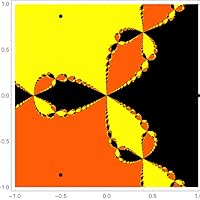
I'm sorry if it sounds childish, but I like picture books. I especially like picture books about math. I think it is unconscionable, even borderline insane, to teach analysis without pictures.

Thus, when I saw the title Visual Complex Analysis, I was primed to be interested. I got it (the original 1997 edition). It did not disappoint. It contained 501 illustrations, most of them hand-drawn, and is a model of clarity. It is also, unmistakably, a labor of love. Needham is a student of the Great Geometer Roger Penrose, and loves geometry with the passion of [choose your favorite cliché].

I must, however, warn readers of one limitation. VCA is not a good textbook from which to learn real analysis. This is a little surprising, since complex analysis encompasses real analysis. (Complex numbers are formed from real and imaginary numbers. Imaginary numbers are numbers that, when multiplied by themselves, give a negative result. Thus i × i is -1. The imaginary numbers are no less real, in the ordinary English sense of the word "real", than the real numbers. Real, imaginary, and complex are entrenched historical terminology that we're just stuck with.)

You would naturally expect complex analysis to be more complicated and difficult than real analysis. But it is not! Something extraordinarily magical happens when you form the complex numbers by adding the imaginary numbers to the reals. Almost everything becomes simpler and makes more sense. This is especially true of geometry.

You might think, "Well, in that case do I really need real analysis?" You do, if you want to talk to real mathematicians. Real analysis is a kind of rite of passage. It is also a thing of extraordinary beauty, in a way that VCA elides. For instance, Cantor's Diagonal Theorem, which many mathematicians (I might be one of them) regard as the most beautiful theorem in all of mathematics, appears nowhere in VCA.

For real analysis, I recommend instead Stephen Abbott's Understanding Analysis. Are there pictures? Of course!

Blog review.
Displaying 1 - 1 of 1 review