

What do you think?

Nourishment
With her children evacuated and her husband at the front, Tory Pace is grudgingly sharing the family home with her irascible mother. As Tory works at the local gelatine factory - doing her bit for the war effort - her mother has established herself as matriarch and together they are doing as well as could be expected in difficult times.
Paperback
First published August 19, 2010
About the author
Gerard Woodward
31 books69 followersGerard Woodward (born 1961) is a British novelist, poet and short story writer, best known for his trilogy of novels concerning the troubled Jones family, the second of which, I'll Go To Bed at Noon, was shortlisted for the 2004 Man-Booker Prize.[1] He was born in London and briefly studied painting at Falmouth School of Art in Cornwall. He later attended the London School of Economics, where he studied Social Anthropology, and Manchester University, where he studied for an MA in the same subject. In 1989 he won a major Eric Gregory Award for poets under thirty and his first collection of poetry, Householder, won the Somerset Maugham Award in 1991. His first novel, August, was shortlisted for the Whitbread Award. In 2011 he was writer in residence at Columbia College, Chicago. He is currently Professor of Fiction at Bath Spa University.
Ratings & Reviews
Friends & Following
Create a free account to discover what your friends think of this book!
Community Reviews
Displaying 1 - 30 of 74 reviews

December 30, 2012
‘Vertiginous’ – what a fine word – a word to add to the lexicon, or was it ‘verdigris’? One means to induce dizziness, the other the poisonous green rust found on brass and copper. Why didn’t I earmark the page since the word was to be the starting point of my reflection back over this excellent novel from English writer Gerard Woodward. But I suppose I didn’t know that then. The word stuck in my memory, but then as happens with age one’s mind addles. No matter, they both could be to do with where the author’s heroine of sorts, Tory, ‘serves out time’- in an underground London comfort station, a toilet where the one of the above confused words is used in description several times. It all bought to mind another place filled with the vertiginous verdigris of my youth.
Set during the years of last century’s second great conflict, and the immediate post war period, as so often happens to me on reading a novel these days, ‘Nourishment’ induced some of my own post war memories to return from a hazy half-forgotten past. It was the toilet imagery that caused me to recall another underground collection of vestibules – an excellent v word too – far away from the blitzified streets of Tory’s world.
The immense struggle between nations of the 1940s had only nibbled at the edges of Australia’s own home front, in the form of some Japanese bombing of the north. For my island, the sighting of a few submarines and a solitary spotter plane was all. But Woodward’s novel refreshed some of my earliest memories of my own post war world – one that contained another sulphuriously pungent orifice under a street in my Tasmanian coastal town of birth. Aligned was a recollection of a sootily sinister (to me) character who paraded on that street, and a few of the thoroughfare’s other childhood attractions.
I’d only been down into the bowels of that below street fetid ablutions room a few times when really, really desperate. Such were the stories told of the happenings in there, and the foul stink that emanated up from the place, it really petrified me. I preferred to ‘hang on’ as my home was only a few blocks away up a hill, but on a couple of occasions I didn’t make it. I fell short. When I did succumb to urgent bodily callings I became so vertiginous from the odure of that hole in the road that I rushed through my business and rushed out.
It did, to my infantile mind, seem to be home to at least one denizen whose features appeared to be entirely subterranean. He was always around that loo, and I encountered him frequently on my trail home from my school further up the street. He never touched me, and I cannot recall him ever uttering a word to me. Yet he gave me the heebie geebies – he was the stuff of nightmares. He was scrawny and he walked with a pronounced limp. He seemed very old to me then, but looking back, may only have been thirty or forty. His oily hair was in the short back and sides style still in evidence for some at the time. His plaid shirt, voluminous trousers and tight fitting suit jacket were covered in a greasy sheen, as seemed to be his skin. My most vivid recollection of him is of his teeth. They looked tinged with verdigris, and were in rodent formation with thick yellow detritus where they hit the gum. They were, plainly put, vile – and so was he. He was almost as foul a creation as one of the author’s in the form of the woeful, woebegone ex-POW afflicted on Tory as her husband.
This street of bad dreams, conversely, had its attractions. In close proximity to the underground latrines was a lolly shop. With our current obsession with a germ free existence it beggars the mind the thought of a journey into that sweet shop from having done one’s ones and twos, of clutching in unwashed fingers a penny to purchase from the temptations offered there, then popping with the same fingers into one’s mouth one’s purchase for delightful mastication. It is lucky that any of my generation made it through. Enclosing the confectioners on all sides was the town’s cavernous picture theatre. On a Saturday afternoon it was the place to be; filled with fitful lads, cuddling couples and a fug of cigarette smoke. Ushers paraded up and down with torchlight directed at perceived inappropriateness, and missiles purchased from the candy stall would be hurtling trough the smog. There were shops such as RR Rex and Sons, ships’ chandlers, and Genders, nut and bolts merchandisers, along the street where my father seemed to spend an inordinate amount of time searching out just the right bits for a current project, me in tow. At the roadway’s bottom corner was the Club Hotel, still an icon of the district, from whence happily inebriated drinkers hoppily emerged as we left our afternoons of cowboy serials and B-grade horror. To me all this didn’t seem too different to Tory’s 1950s environs.
This book was a cheapie from a big bin of remaindered tomes in Shiploads, a Hobartian discount store. It was largely full, it seemed, of Scandinavian translations that had not sold in the wake of ‘The Millennium Trilogy’ and ‘Wallander’, but this book was a much different affair judging by its back cover blurb and glowing accolades from UK printed media. As it turned out, it is a black hued gem!
Woodward’s imagining starts out in the bleakest of ways with Tory, and her mum, on a quest for meat. The product of this sets the tone for often bizarre events to follow. Later came an affair with her rich wartime boss, resulting in an addition to the family awaiting his ‘father’s’ return from incarceration in Germany. It is a novel of the power of letters and the power of pornography at a time when the latter wasn’t overloading the ether. It is an account of the damage fathers can inflict on their progeny. Donald, like my imagining of the loo-loiterer, is a truly odious being; self absorbed, a rat with an eye to the main chance. Like in the case of so many others, the war created a monster. He was a constant hindrance to Tory’s efforts to keep the family together in parlous times, as well as to keeping a handle on her own sanity.
Mount Street in Burnie probably had only a little of the austerity of Tory’s starveacre high streets, but compared to contemporary consumer overkill, the same blandness seemed to dominate. But the novel itself is anything but bland. Peopled by characters ranging from the poignant (son Tom particularly), to the downright odd, there is even a hint of a lesbian relationship for Tory with antipodean Grace. Mum also has her own secrets. Despite its often raw subject matter, which occasionally borders on the absurd, Woodward’s prose sparkles in its deftness for carrying a sustained tone of grimness – and if that reads as oxymoronic, it is a further testament to the writer’s craft.
My underground toilet is long gone, as are the movie house, the lolly shop and the other mentioned businesses. The Club Hotel still stands augustly on its corner, but now houses a pizza franchise. My home locale has a bit of struggle town about it, but it survives and its folk are, like many in Woodward’s book, resilient and adaptable. There are still too many ‘Torys’ there trying to keep it all together, often standing between booze/drug addicted fathers and their children - so nothing much changes. What Tory shows at the end of her journey is what it can take to render change in one’s own circumstances, but she was a woman of resolve. For many there is no way out.

April 27, 2015
Gerard Woodward is able to take the thoughts of ordinary people and the minutiae of their everyday lives and make them extraordinary. It's a talent he shares with Rachel Joyce, Elizabeth Taylor and Barbara Pym. He's also come up with a new angle on the WW2 home front novel and on the aftermath of war. We learn so much about the privations and pre-occupations of Blitz-beleaguered Londoners in the wryly comic first part of the novel. Things turn much darker later on as the housewifely heroine deals with tragedy and deceit, some of it of her own making. One query: did captured allied lieutenants and captains get sent to Stalags, as Woodward writes, or, as officers, go to Oflags?
September 3, 2011
Read a plot summary of this book, and it sounds really racy. As it turns out, it's not very explicit (is that good news or bad?). If you're worried about it making you squirm, or about your family members being horrified to discover your true reading taste, don't. I appreciated the quirkiness that peppers the story, and the way in which we come to know the main character, Tory Pace. When we first see her, it is through her mother's eyes. She seems rather a pathetic, mousy woman. But she turns out to be strong, willing to take on unglamorous work, a good mother. And she has some spunk after all.

March 4, 2012
I enjoyed reading Nourishment, the story is a fabulous read. At its heart, it is about the effect WW2 had on the lives of families and especially on women coming to terms with having their husbands gone for a very long period of time and after the war, having changed men arriving home and the societal pressures that expected that things would return to normal.
Nourishment is not as dry as this however, and Woodward has injected dark humor and rich imagination into the telling of Tory Pace's experiences of family, relationships and life. A thoroughly nourishing read.
Nourishment is not as dry as this however, and Woodward has injected dark humor and rich imagination into the telling of Tory Pace's experiences of family, relationships and life. A thoroughly nourishing read.

April 20, 2015
I loved the humour in this book, which one wouldn't expect to find in a World War II setting! The opening chapters, about Mrs. Head and what happens after the local butchers is bombed during a raid, is most memorable - and not for the reason you might think! And then there are the letters...
A truly enjoyable read which focuses on the story of one woman and her family, and life for them, during and after World War II.
A truly enjoyable read which focuses on the story of one woman and her family, and life for them, during and after World War II.

October 3, 2016
Audiobook3-1/2 out of 5 stars
The first 2/3 of the book was great, I couldn't wait to see what would happen to Tory now that she didn't have her dead weight of a husband around. But then a friendship turned strange and she kind of meandered around turning away from an old love but to do what? I just didn't like the ending so I gave it 1/2 a star less.
The first 2/3 of the book was great, I couldn't wait to see what would happen to Tory now that she didn't have her dead weight of a husband around. But then a friendship turned strange and she kind of meandered around turning away from an old love but to do what? I just didn't like the ending so I gave it 1/2 a star less.

July 24, 2022
What the hell
September 26, 2021
Smart, witty, fun, sad, and beautifully written.

November 6, 2014
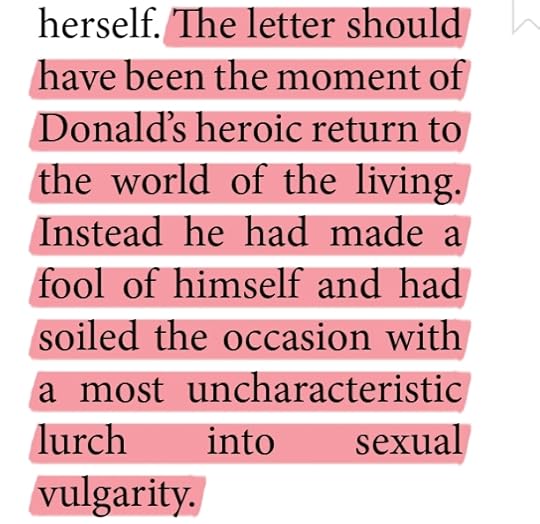
*‘What do you mean, too good for you?’
‘Let me put it this way, Tory. I’ve always felt that you are made of gold while I am a man of lead.’
* ‘You are an ideal of goodness,’ he said, ‘the lost half of my spirit double …’
She didn’t know, quite, what he meant by this, but she loved the words.
* As their marriage progressed Tory slowly began to feel it wasn’t love she was experiencing, rather a sense of awe and admiration.
* Perhaps under the welter of so much sugar his lustiness might dissolve. She would bombard him with sweet and sticky things so that he could forget about his other desires.
* She didn’t mind; in fact, she liked it. She looked forward to the appearance downstairs of Branson’s worried little face every evening, and of their quiet, soothing conversations upstairs later. She always felt disappointed when he did finally fall asleep, and would sometimes cough or clear her throat to prolong his wakefulness a few seconds longer. (How she loved the response in his eyes when she did this, their sudden opening without focus, and then, by ever narrowing degrees, their slow reclosure.)
* She had never realized quite what a pensive place a lavatory was, how conducive to thought. It wasn’t simply that it provided her with long stretches of solitude, punctuated only by the echoey clip-clop of some old girl coming down the stairs to spend a penny, but that it was a place removed from the real world in a most decisive and concise way. A bit like a nunnery, Tory imagined. It was also a good place to manage grief. Surely no one, no matter how sharply bereaved can dwell too long on their loss when they are confronted with such sights as a public lavatory affords.
* Yes, he was an old man but, gosh, those muscled limbs of his, the strength in them. She remembered how vast he had seemed, nude in the little cottage bedroom, like a giant folded up and tucked into a shoebox.
* ‘I have become stronger,’ said Tory, abstractedly, almost to herself.
‘Well, that’s what gyms are for. I must say, your prettiness hasn’t diminished one bit. It has increased, if anything.’
‘I prefer to be called beautiful.’
‘Let me put it this way, Tory. I’ve always felt that you are made of gold while I am a man of lead.’
* ‘You are an ideal of goodness,’ he said, ‘the lost half of my spirit double …’
She didn’t know, quite, what he meant by this, but she loved the words.
* As their marriage progressed Tory slowly began to feel it wasn’t love she was experiencing, rather a sense of awe and admiration.
* Perhaps under the welter of so much sugar his lustiness might dissolve. She would bombard him with sweet and sticky things so that he could forget about his other desires.
* She didn’t mind; in fact, she liked it. She looked forward to the appearance downstairs of Branson’s worried little face every evening, and of their quiet, soothing conversations upstairs later. She always felt disappointed when he did finally fall asleep, and would sometimes cough or clear her throat to prolong his wakefulness a few seconds longer. (How she loved the response in his eyes when she did this, their sudden opening without focus, and then, by ever narrowing degrees, their slow reclosure.)
* She had never realized quite what a pensive place a lavatory was, how conducive to thought. It wasn’t simply that it provided her with long stretches of solitude, punctuated only by the echoey clip-clop of some old girl coming down the stairs to spend a penny, but that it was a place removed from the real world in a most decisive and concise way. A bit like a nunnery, Tory imagined. It was also a good place to manage grief. Surely no one, no matter how sharply bereaved can dwell too long on their loss when they are confronted with such sights as a public lavatory affords.
* Yes, he was an old man but, gosh, those muscled limbs of his, the strength in them. She remembered how vast he had seemed, nude in the little cottage bedroom, like a giant folded up and tucked into a shoebox.
* ‘I have become stronger,’ said Tory, abstractedly, almost to herself.
‘Well, that’s what gyms are for. I must say, your prettiness hasn’t diminished one bit. It has increased, if anything.’
‘I prefer to be called beautiful.’

December 30, 2011
Gerard Woodward’s Letters from an Unknown Woman was a quick read, but disappointing. A dust jacket blurb described it as a “black comedy.” It started that way promisingly, but wandered off into being neither darkly funny nor thoughtfully serious. The conclusion is unsatisfactory, as if he ran up against a deadline and simply quit the novel. He is certainly not a John Barth or a Bulgakov. At best, it could be called uneven. Another Goodreads reviewer described it as “slight in general.” I agree. I must, however, give Woodward credit for one of the best names for a literary character is quite some time – the ill-fated butcher, Icarus Dando.

February 12, 2013
Disliked this book from almost the first chapter, the characters were so repellent. And yet the story had me drawn in. Glad I've finished it. Not sure i would say i enjoyed reading it but i hung in till the end. Found it rather disjointed with story arcs begun and left hanging and some characters rather two dimensional. Still, it certainly painted a vivid picture of WWII London and it's shadier characters.

January 24, 2013
Mixed feelings -- Interesting and unusual plot, but seemed choppy---the passages of time were not handled well. And the ending just fell of the last page with a plop--I turned the page, expecting more. Then I checked to make sure that the last couple pages weren't stuck together. I just thought, "That was it??"
Read
June 16, 2012Not really what I expected. Bit tedious.

March 26, 2014
Loved this novel, it was darkly funny and a little twisted. I was so sad it ended I hope that he has written another

October 8, 2014
This was a really interesting book. Sad, but the clear writing and odd turns kept me interested.

July 20, 2015
I was very impressed with this book! It was very entertaining with humor and devastation's and the struggles in war times. It was hard to put this book down!

April 21, 2026
It's 1941 and Tora Pace has sent her 3 children away to the English countryside to keep them safe. Her mother has returned to stay with her while her husband Donald is away at war. She has taken a job at a gelatin factory. It is weeks before she finally gets a letter from her husband only to find out he is a prisoner of war. He implores her to write him racy smutty letters. She is aghast and tells him no. At the factory Tora befriends the owner and they become lovers. Suddenly, she is able to write the torrid letters Donald wanted. But, the letters and the relationship both stop when Tora falls pregnant. She goes into hiding and when she returns, she concocts a story about finding an abandoned baby after a blitz bombing. In 1945 the children are back and Donald returns crippled and a very changed man. He is mean spirited, knows the boy is not his child and refuses to even try getting any kind of work. He forces their oldest boy to leave school to work in a tire factory. Unknown to Tora, Donald publishes a book of the letters. When she discovers this, she is devastated. Eventually she forces him out of the house and begins a writing career of her own.

May 25, 2017
Gerard Woodward writes so well about families - the things that bind them together and the things that threaten to pull them apart. His extraordinary trilogy about the Jones family and their relationship with alcohol is one of the best family sagas I've read, and won Woodward a Booker Prize shortlist place for I'll Go to Bed at Noon.
Nourishment has a similar quirky, tragicomic feel. At the heart of the novel is the relationship between Tory Pace and her husband Donald, who for the first third of the book is incarcerated in a German prisoner of war camp. Having heard nothing from him for months she assumes he is dead, but out of the blue receives a disturbing letter from him, making unusual and unreasonable demands. From this one letter, the rest of the novel flows, taking in the postwar return of Donald from Germany and her children from evacuation in the countryside. Full of twists and turns, unexpected relationships and family surprises and a barbed dark humour, Nourishment considers just what the human body needs to grow and thrive, both physically and mentally,
Nourishment has a similar quirky, tragicomic feel. At the heart of the novel is the relationship between Tory Pace and her husband Donald, who for the first third of the book is incarcerated in a German prisoner of war camp. Having heard nothing from him for months she assumes he is dead, but out of the blue receives a disturbing letter from him, making unusual and unreasonable demands. From this one letter, the rest of the novel flows, taking in the postwar return of Donald from Germany and her children from evacuation in the countryside. Full of twists and turns, unexpected relationships and family surprises and a barbed dark humour, Nourishment considers just what the human body needs to grow and thrive, both physically and mentally,

April 12, 2020
Nourishment is set in the backdrop of London during World War II, a world dominated by food rationing, children evacuees, the constant threat of bombing and husbands away fighting the war effort. The ultimately stoic protagonist, Tory, faces all of this with great dignity and aplomb. That is until her husband, a prisoner of war, starts sending requests for her to send dirty letters, the dirtiest she can imagine. She is utterly affronted and refuses...at first.
Gerard Woodward is the kind of writer I aspire to be. He finds just the right balance of pace, with truly authentic characters, beautiful prose and a plot that twists and turns in a most gentlemanly fashion.
I found it slightly surreal to find myself immersed in a story set against London in the Blitz, whilst the UK was on lockdown due to the COVID-19 pandemic. There are similarities but also a stark contrast. I have come away feeling grateful my generation had this particular catastrophe to deal with.
In summary, Nourishment is a highly entertaining, witty read and I thoroughly recommend it.
Gerard Woodward is the kind of writer I aspire to be. He finds just the right balance of pace, with truly authentic characters, beautiful prose and a plot that twists and turns in a most gentlemanly fashion.
I found it slightly surreal to find myself immersed in a story set against London in the Blitz, whilst the UK was on lockdown due to the COVID-19 pandemic. There are similarities but also a stark contrast. I have come away feeling grateful my generation had this particular catastrophe to deal with.
In summary, Nourishment is a highly entertaining, witty read and I thoroughly recommend it.

July 16, 2017
Nourishment was an interesting novel which I enjoyed reading, though it did not blow me away. There were some points where I didn't know where it was going, which hampered my reading a bit (and you could maybe say it us a bit slow to get going) but it is an interesting look at how someone of the 1940's might act and behave in that situation - not only having your husband in a prisoner-of-war camp, but also the everyday of having to get food and materials in a time of rationing and bombings. But then the request comes from Tory's husband and her moral standards are challenged when she has to decide whether to comply or not. It seems to centre around Tory's navigation of the world around her and the moral restrictions placed on women as opposed to the realities they often face, including loneliness and our own sexual drives and need for pleasure. An interesting work, worth a go.

June 8, 2017
The only good thing to say about this book is that the book jacket blurb writer deserves a humongous raise. This book was nothing like what the blurb indicated. It was also NOT humorous or comic. It WAS tedious, monotonous, and "not good enough" (that might be a spoiler - it is a line from the book). I love books about WWII. I love books about marital relationships. I love books that provoke deep thought or present situations in bizarre ways. But, there is absolutely no cohesiveness to this story and the character development is non-existent. If you read the blurb and think you are picking up a slightly racy, beach read, RUN AWAY! This is not the book you are seeking.
February 23, 2021
Having read and thoroughly enjoyed Woodward's trilogy about the dysfunctional Jones family (Autumn, I'll Go To Bed at Noon and Curious Earth), Nourishment was a must read for me. I wasn't disappointed. I laughed, cried, felt despair and frustration at the life of our heroine Tory and her family.
Characters are beautifully drawn and the writing turns the story of an ordinary, mundane family surviving the Second World War into something extraordinary.
No spoilers from me, just be prepared to both laugh out loud and cry at twists and turns of Tory's life.
So next on my list is Caravan Thieves and then other than his poetry there are sadly no wonderful novels by this author.
Characters are beautifully drawn and the writing turns the story of an ordinary, mundane family surviving the Second World War into something extraordinary.
No spoilers from me, just be prepared to both laugh out loud and cry at twists and turns of Tory's life.
So next on my list is Caravan Thieves and then other than his poetry there are sadly no wonderful novels by this author.
November 11, 2021
Not really a comedy - although definitely black. (I am referring to the Daily Mail review quotation from the cover.) A meaty book. Food for thought. Everything I think to say seems to refer to food. Unintended.
Definitely a solid satisfying read. I don't know if this is a plot reveal, but the husband really is a jerk.
I will be recommending this to friends. Especially Anglophile friends.
So difficult to encapsulate this book in one sentence. It was full of surprises.
Definitely a solid satisfying read. I don't know if this is a plot reveal, but the husband really is a jerk.
I will be recommending this to friends. Especially Anglophile friends.
So difficult to encapsulate this book in one sentence. It was full of surprises.

July 12, 2020
Strange book. Lots of things mentioned suddenly disappear or just fizzle out, never sure what point is being made. In the story she writes a novel vaguely about her life but she struggles to know where to go with her story - this feels like that novel! Mildly funny in places but more sad and hopeless. Ok but not brilliant, certainly not compelling.
January 11, 2023
There is much to like about this book - wonderfully written and quite humorous in parts. The last quarter of the novel doesn't quite sustain the momentum built up by the earlier parts. Nevertheless, I thoroughly enjoyed it!

July 27, 2025
I wish I'd like this book as the reviewers did. I did have high hopes about this book when I read the plot on the back sounded wonderfully eccentric and full of dark comedy.
Sadly, the book felt rather flat for Me and I didn't invest in the characters Story.
Sadly, the book felt rather flat for Me and I didn't invest in the characters Story.

January 7, 2020
This chaps books are incredible. Quiet, simple story but very moving and funny.

January 12, 2020
One moment was quite a shock! Good read although seemed to lose it's way a couple of times.
May 3, 2021
A masterclass in storytelling: the characters were as vibrant as the plot, which gently unravelled to a satisfying conclusion.
September 27, 2021
Brilliant writing and plot not at all what I expected actually became better.
Displaying 1 - 30 of 74 reviews