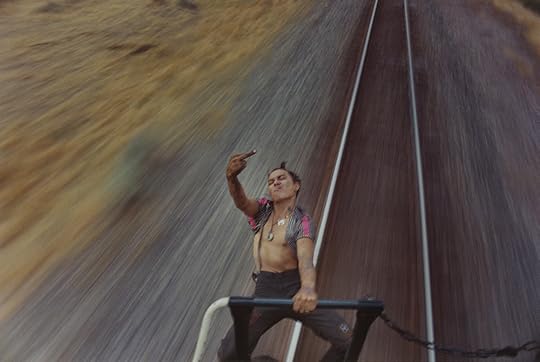
Vollmann is a relentlessly curious, endlessly sensitive & unequivocally adventurous examiner of human existence. He's investigated the causes & symptoms of humanity's obsession with violence (Rising Up & Rising Down), taken a personal look into the hearts & minds of the world's poorest inhabitants (Poor People), & now turns his attentions to America itself, to our romanticizing of freedom & the ways in which we restrict the very freedoms we profess to admire. For "Riding Toward Everywhere," Vollmann himself takes to the rails. His main accomplice is Steve, a captivating fellow trainhopper who expertly accompanies him thru the secretive waters of this particular way of life. Vollmann describes the thrill & terror of lying in a trainyard in the dark, avoiding the flickering flashlights of railroad bulls; the gorgeously wild scenery of the American West as seen from a grainer platform; the complicated considerations involved in trying to hop a moving train. It's a dangerous, thrilling, evocative examination of this underground lifestyle, & it's one of Vollmann's most hauntingly beautiful narratives. Questioning anything & everything, subjecting both our national romance & our skepticism about hobo life to his finely tuned, analytical eye & the reality of what he actually sees, he carries on in the tradition of Huckleberry Finn, providing a moving portrait of this strikingly modern vision of the American dream.
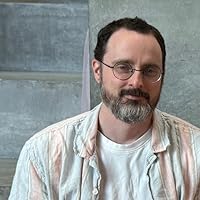
William Tanner Vollmann is an American author, journalist, and essayist known for his ambitious and often unconventional literary works. Born on July 28, 1959, in Los Angeles, California, Vollmann has earned a reputation as one of the most prolific and daring writers of his generation.
Vollmann's early life was marked by tragedy; his sister drowned when he was a child, an event that profoundly impacted him and influenced his writing. He attended Deep Springs College, a small, isolated liberal arts college in California, before transferring to Cornell University, where he studied comparative literature. After college, Vollmann spent some time in Afghanistan as a freelance journalist, an experience that would later inform some of his works.
His first novel, You Bright and Risen Angels (1987), is a sprawling, experimental work that blends fantasy, history, and social commentary. This novel set the tone for much of his later work, characterized by its complexity, depth, and a willingness to tackle difficult and controversial subjects.
Vollmann's most acclaimed work is The Rainbow Stories (1989), a collection of interlinked short stories that explore the darker sides of human nature. His nonfiction is equally notable, particularly Rising Up and Rising Down (2003), a seven-volume treatise on violence, which was a finalist for the National Book Critics Circle Award.
Over the years, Vollmann has continued to write prolifically, producing novels, short stories, essays, and journalistic pieces. His work often delves into themes of violence, poverty, and the struggles of marginalized people. He has received several awards, including the National Book Award for Fiction in 2005 for Europe Central, a novel about the moral dilemmas faced by individuals during World War II.
Vollmann is known for his immersive research methods, often placing himself in dangerous situations to better understand his subjects. Despite his literary success, he remains somewhat of an outsider in the literary world, frequently shunning public appearances and maintaining a low profile.
In addition to his writing, Vollmann is also an accomplished photographer, and his photographs often accompany his written work. Painting is also an art where's working on, celebrating expositions in the United States, showing his paintings. His diverse interests and unflinching approach to his subjects have made him a unique voice in contemporary American literature.
Riding Towards Everywhere I haven’t read nearly enough Vollmann and I intend to remedy this. This is Vollmann’s account of riding the rails in America. There is a touch of On the Road about this, but not for the teenage, for the middle-aged. The dedication at the beginning sums it up:
This book is dedicated to STEVE JONES who never pretended that he or I were hobos and who therefore coined the word fauxbeaux who turned fifty riding the rails with me. Who was riding the rails with me as I turned forty-seven, Who never made me feel guilty for saying That this or that train was too fast for me, And who is the finest Christian who ever bought me a cigar, drank my booze or shouted fuck! into the diesel-scented night.
Riding the rails is much more an established tradition than in the UK, mainly because of the sheer size of the rail network in the US. There is a long history going back into the nineteenth century and later with authors like Jack London (who is referenced regularly), during the great depression and with musicians like Woody Guthrie and Johnny Cash.
Vollmann has long chronicled the lives of the poor, oppressed and disenfranchised and his penchant for riding the rails allows him to continue this. He does it with vivid prose at times mixed in with the earthiness:
“We rushed on. A flare of evening sun in the Gabilan Range (pink chalcedony), the white loveliness of rainbirds blowing spray in elongated flower petals, the Sierra de Salinas to the west, the leaden darkness of a lettuce field, all these perceptions granted to me right next to the freeway became my loveliest treasures which I hope to hoard right up to the cemetery lights amidst the last golden-green of the fields”
Vollmann has no plan when he goes train hopping, he actually doesn’t care where he ends up. What he is aiming for is Cold Mountain, a sort of idyll which the New York Times review describes thus:
“Cold Mountain represents for Vollmann an idyllic destination, an American nirvana, a vanished paradise of manly freedom and personal liberty.”
This isn’t entirely fair because although Vollmann’s company is generally male, this is nothing gendered about this. Vollmann does nostalgia for the old days very well, but he is not taken in by it:
“Would I really have preferred my grandfather’s time, when Pinkertons were cracking Wobblies over the head, or my father’s, when Joe McCarthy could ruin anyone by calling him Red?”
Vollmann asks himself plenty of questions as he travels along and this quote illustrates his distinction between citizens (usually in italics) and hobos and concerns a bearded hobo called Emmanuel:
“And I wonder what it means that I am willing to consider Emmanuel my brother, whereas to him I am but a citizen to be begged from, avoided or duped? But then I think: Do I really consider him my brother? Would I leave my backpack with him? Would I trust him to sleep beside me in a boxcar and not go for my throat with his new sharp knife? And if not, could it be that my various books, written in the belief that we are all members of the same human family, are either hypocritical or else as ghostly as boxcars slowly trundling through the northern darkness”
It is Vollmann’s reflectiveness that lifts this above the ordinary type of travelogue: “Precisely because it perishes, each moment deserves eternal memorialization.” There is also a very clear anti-authoritarian feel to it as well and Vollmann rails against unnecessary laws which limit those on the outside of society and oppress them. He relishes the brushes with railroad security and trying to avoid them. Vollmann is no daredevil and he is unable to jump on and off trains as adeptly as his friend Steve, having recently broken his pelvis and as he says himself he is; “a cautious, even timid soul who makes himself pull off one stunt after another for his own good”. There are some poignant and telling photographs at the end of the book taken by Vollmann on his travels. I like Vollmann’s relentless curiosity and his insistence in bringing to our attention those who society would rather ignore.
I liked this book more than the three stars may lead one to believe. I couldn't give it more than three because I don't think this is a 'book', it's kind of like a really good magazine article with some rambling essays tacked on. I'm not actually sure who the audience for this book is. Vollmann fanatics? Are there that many of them?
For a couple of years I had a mild to more than passing interest in hopping trains. I never actually did it, but it was something that I thought about trying. I romanticized the idea of it. I rode my bike down to the tracks and snooped around, and like my ideas of one day living in Portland or Richmond, Virginia; I put those actual execution of the idea into the area of the past marked, could have probably done it but now it's too late.
Like Vollmann's, my dreams of boxcars were dreams of escape. I wanted out of the tedium of my own particular rural//suburban landscape. I don't know where I pictured the rails taking me away towards. Vollmann calls the place Cold Mountain, after something that Kerouac mentions somewhere. If I had thought I was heading anywhere towards Kerouac I'd have taken off running in some other direction. At the time I may have thought that the act itself of stealing a ride on a freight train would have been liberating, but I wouldn't have expected to find any illumination among the characters one can imagine meeting along the way. It is here I and Vollmann split ways.
Vollmann is regrettably a progeny of Kerouac. Those writers who revel in submerging themselves among the genius of the outcasts. I don't see the genius in the burned out, the drop out, the hippie that has been stoned for the past twenty years, the guy who has had his brain fried so severely on LSD that he can barely function anymore, the liberated souls who scowl at you for having a job while holding their hand out saying gimme. I don't know where freedom really lies, but I've yet to see it in the drop-outs that I've known. In the runaways. In the people who are so proudly workless but still have to live off the toil of others like filthy fucking capitalists. Fuck Kerouac and Dean Moriarity and the myth of freedom that comes from getting a ride from someone else who can drive you really fast towards your next reckless adventure with no regard for anything besides yourself and your limited hedonistic point of view (which really how different is that from a rich fuck who vacations luxuriously amidst third world squalor in whatever is the hip place to goto this year? It's just a difference of means with the same myopic view of number one and the need for pleasurable fulfillment. (Now, am I saying that homeless people are having fun? No. Very few people try to find wisdom or romanticize a homeless down and out person who is struggling to feed their family and survive, it is always the whisky drinking, no one can tell me what to do because I'm free type that gets romanticized)).
The problem with part of the book was that it was too romantic in ways that I find to be the same as fawning over the antics of whatever rich and famous idiot of the month does. Vollmann is smarter than me, so he probably knows something about freedom and stuff that I don't know, and he probably has a better chance than I do of ever finding even part of an answer to the whole quandary that we find ourselves in, but that aside I think he could have flushed out the book more. There are interesting things mentioned that the reader is flashed a glimpse of but then left to go hit up wikipedia to find out more about. Who would think that in a Vollmann review it would be necessary to say, I wish he would go into more detail. C'mon, you know you have more than 180 pages (less when you take all the blank pages between the chapters out) on this topic. It makes me feel like the book is unnecessary, like a magazine article that's been given some filer.
The book is good, but it could have been so much more.
This work started off as a short 50 page essay on hopping freight trains that was published in Harpers. Vollmann subsequently added 11 chapters to make up a book of 190 pages (plus photos and miscellanea).
It's not a major work by any means. However, it is worth reading, especially as an introduction to his body of work, because of what it reveals about Vollmann's personal politics.
For all of the sex in his other works, he is never particularly romantic or tender in his portrayal of any type of relationship.
This work reveals a far more tender side of Vollmann (assuming he is the first person narrator of this work of non-fiction).
It doesn't matter so much that the people for whom he feels tenderness are his father and grandfather, two or three males he rides the rails with, and occasionally his young daughter. It's a side of him we haven't seen much of.
An Outlaw for a Year (or More)
The aim of the exercise was to catch freight trains around America, in the manner of the hobos of the first half of the 20th century.
Vollmann learns the ropes from a 50 year old accomplice, Steve Jones, who is careful to differentiate them from real hobos, by calling themselves "fauxbeaux". They can't pretend to be hobos. Instead, they only need to be a little pretentious.
There are two types of person on the trains: the ones who have nothing; and the ones who are there because they wanna be, i.e., because they choose to be there.
The first are more or less homeless or have no alternative. The second have homes and families, leave them for a defined period, go wherever the trains take them, and if they get too far away from home, catch Greyhound buses or planes back home. The first etch obscene or racist graffiti in the wooden walls of the boxcars. The second publish books about their experience, describing it in terms of Heraclitus and Hemingway, Mark Twain and Jack London, Jack Kerouac and the poet Cold Mountain. The first climb onto moving freight trains. The second "clamber" onto stationary ones.
Apart from Steve and a few other mates, few genuine hobos warm to Vollmann. He's 30 years older than most of them, or ten years younger. If not for Steve's presence, they would steal his personal possessions (though perhaps not his orange bucket). They think he's a cop, a security guard, a "bull". They don't trust him. He's an Other. He's a "citizen".
Ironically, this is the word Vollmann uses to differentiate himself from other members of the broader community, no matter how conformist or contrarian.
To the hobos, he is either law-abiding or a law-enforcer. It doesn't make much difference. However, what he admires about them is that they are "outlaws".
The epigraph is a quote from Mark Twain's "Tom Sawyer":
"They said they would rather be outlaws a year in Sherwood Forest than President of the United States forever."
This is a pretty good summary of what I find least satisfying about Vollman's writing, or at least what has emerged more and more about his moral or political vision the more I have become familiar with it: the appeal of the transgressive action doesn't follow from the intrinsic nature of the action that society happens to regard as transgressive; its appeal derives from the very fact that it has been deemed transgressive or immoral or illegal.
It took me several books to work out that this was Vollmann's underlying philosophy. It finally hit me in "The Royal Family". There, it finally became obvious that the reason that there were no loving relationships, no examples of Mitsein or "being-with" between ordinary people or "citizens" was that he is more interested in outlaws than in-laws.
For all of the adulation of his fan club, I am clearly not the only reader who has felt this way about his writing.
In fact, this is the first book where he has actually tried to confront this criticism or scepticism head-on. And that, ultimately, is the reason why the book is worth reading.
His fan club tries to sweep the criticism under the carpet. Vollmann tries to address it directly. This is what I respect about him and this work, even if I disagree with both.
"I Am My Father's Son"
Although the essay on Freight Trains purports to be about riding the rails, it actually reveals more about Vollmann's family (I'm assuming that this essay hasn't been fictionalised and that we can associate the first person narrator with Vollmann).
The essay begins with the self-evident statement that Vollmann is his father's son. Within a couple of pages, he elaborates that he is "not exactly my father." They are different. He is not a carbon copy of his father.
This is a credit to both of them. However, it's also attributable to his grandfather, i.e., his father's father.
Vollmann compares the three generations in terms of their relative individualism and contrarianism:
"My father grew up in an era when to be an American -a white American, at least - was to be yourself. In some respects his generation was more ignorant, complacent, self-centred and parochial than mine. For better or for worse, it actually believed in progress, which is to say that it was also more sure of itself, comparatively self-reliant and accordingly less corrupted by toadying - more American in the best sense.
"My grandfather's time must have been even more individualistic...[he] laid down opinions without great reverence for the judgment of others...does contrarianism equal freedom of thought? I prefer my grandfather's abrasive and frequently tedious self-assertion to my neighbour's equivalently wrongheaded chorus. But should I label him the less conformist? He once told me that if I had been his son he would have beaten my differentness out of me. It was his faith that American authority could do no wrong...As for my father, his epoch was the heyday of the Organisation Man, and he respected rules, hierarchies and technocratic methods more than he knew; he simply happened to be good enough to make some of the rules."
There is a degree of self-centredness, individualism and contrarianism in all three men. However, it didn't preclude the two older ones playing substantive roles within mainstream society. It turns out that Vollmann's grandfather was a machinist in the railways. His father (since deceased) was an academic and co-author of a definitive textbook on supply chain management.
His father believed in the legalisation of drugs. He hated organised religion. He voted Republican most of his life, but hated George Bush. He refused to return to their favourite bakery after he was reprimanded for getting out of the queue to talk to his son ("Give some people a little power and they turn into Nazis, don't they?")
Vollmann comments:
"People don't dare anymore to talk back the way he used to...I am less proud than he, more submissive - or maybe more indifferent...I work hard, make money, not as effectively as my father did but well enough to get by."
Presumably, his income reflects his unwillingness to work outside the world of writing, journalism, photography and art.
Citizens and Good Germans
For all of the talk of Vollmann's empathy with people, he is selective in the targets for his affection. He speaks with arrogance and condescension of ordinary working people as "functionaries" and "citizens" (even though he accepts that, if he can't be a genuine hobo, he must therefore be a citizen, too. Hence, he can't bring himself to hate mere citizens). Security guards and bulls, people who are employed to protect private property from damage and people from injury, are the "enemy". He describes these functionaries with flashlights as "good Germans".
Vollmann says, "I gaze around this increasingly un-American America of mine, and I rage."
The things he singles out for his rage are compulsory belt-buckling on school buses, female teachers being sent to prison for having sex with their pupils, long, loud and authoritarian safety announcements on airplanes, the confiscation of cars used by men to pick up prostitutes, his inability to check a prostitute into a hotel without a credit card.
Vollmann's problem is with authority:
"These men in uniform...were islands of authority in the night, with immense theoretical power over us...this was their property, their station, and we were trespassing on it but they could not see us. When they turned and went back indoors, I felt as if I could fly."
Vollmann's father thought he should cool it. An ex-lover felt he should "play the game a trifle." And he recognises that from time to time, he does play the game: "When I pick up prostitutes, I use somebody else's car" (possibly his wife's?).
Like Tears in Rain
What drives Vollmann? What is it that he doesn't have? What is it he needs?
"All I know is that although I live a freer life than many people, I want to be freer still; I'm sometimes positively dazzled with longing for a better way of being."
Some of what Vollmann experiences and describes with his freedom is beautiful:
"We saw dolphins leaping beneath the moon...A shooting star fell whitely and with astonishing speed toward the fog bank and burned out. We both felt happy again...The whistle fraily waivered, then strengthened almost as rapidly as that shooting star had sped; here came the rush of steel wind! Screeching in our faces, the train flew past."
For a moment, I imagine Rutger Hauer as Roy Batty in "Blade Runner":
"I have...seen things you people wouldn't believe...Attack ships on fire off the shoulder of Orion. I watched c-beams glitter in the dark near the Tannhäuser Gate. All those… moments… will be lost in time, like [small cough] tears...in...rain. Time...to die..."
Vollmann doesn't just seek beauty, though. He has to get there illegally. He can't drive or catch a bus down to the beach, so he can see dolphins. He can't just walk outside of his home and look at the stars in the sky. That would be a yawn.
He needs to feel that he is "riding toward everywhere." This mythological everywhere is symbolised by "Cold Mountain". Vollmann has never been there. He might never get there. He can't describe it. It's ineffable. However, what it isn't is here. It isn't home. It isn't where his family is. Because that implies the pain of obligation, not freedom:
"All I can think is: I've got to get out of here. I've got to get out of here."
Ultimately, though, Vollmann recognises that, the longer he lives, the closer he gets to Everywhere, this place where there is no obligation, only freedom, and it seems to me that it is mightily like Death.
"I've Got to Get Out of Here"
Vollmann mentions this desire to get out of here several times in the book.
Earlier, he quotes Thomas Wolfe, apparently approvingly:
"To every man the right to live, to work, to be himself, and to become whatever thing his manhood and his vision can combine to make him - this, seeker, is the promise of America."
To which Vollmann adds:
"Who am I that in my yearning for America I cry over and over: I've got to get out of here?"
Like his father, Vollmann imagines himself a maverick, but is actually a citizen, only he is less a citizen than his father.
Being a citizen doesn't imply that you have to put up and shut up. It doesn't preclude taking action to improve your lot or the lot of others.
Perhaps, Vollmann would take some action if he knew what he was unhappy with. However, apart from the targets of his rage already mentioned, he acknowledges that:
"My critique of American society remains fundamentally incoherent."
At least he recognises it, and I can't disagree with him.
The Romanticisation of Illegality
Vollmann also notes another criticism which I have mentioned: his "romanticism of illegality".
He refers to the source of this concept in a footnote on the last page of his first essay. However, you can tell that he hasn't truly grasped the significance of the issue as it applied in its original context and as it might apply to himself.
The source of the concept is Georg Lukacs' essay "Legality and Illegality":
"There are, it is true, periods in every revolution when a romanticism of illegality is predominant or at least powerful. But for reasons which we shall discuss in what follows, this romanticism is quite definitely an infantile disorder of the communist movement. It is a reaction against legality at any price and for this reason it is vital that every mature movement should grow out of it and this is undoubtedly what actually happens."
Somebody else has presumably suggested that Vollmann suffers from this infantile disorder of romanticising illegality.
Vollmann's response is to call Lukacs "a pious Marxist [who] disdains to feel pleasure."
Thus, Vollmann's implicit response is that what matters to him is the pursuit of (his own) pleasure. It doesn't matter that the activity itself might be illegal or infantile.
My argument is simply that the pleasure of the activity seems to be secondary to its illegality, immorality or transgressiveness.
Vollmann is more interested in outlaws than in-laws.
However, his response to Lukacs reveals another aspect of his thought which I find lacking.
Lukacs' immediate concern was the efficacy of the revolution or the particular political action.
Whatever your views about revolution, the broader concern is the efficacy of political action by whatever means.
Lukacs was effectively saying that illegality for the sake of illegality can ruin the cause of the political action. In other words, the means can undermine the cause.
This is more or less the main argument between the Communist vanguard and Anarchists who would join the revolution.
In the Russian Revolution, the Communists suspected the Anarchists (and other Communists) of this infantile disorder, and ruthlessly weeded them out, for fear that the cause would suffer. Inevitably, this approach reflected in the authoritarianism and brutality of the post-revolutionary regime, the dictatorship of the proletariat.
However, Lukacs' point remains that, as a strategy or tactic, the romanticism of illegality is counter-productive to political action.
As Vollmann acknowledges, his political critique is fundamentally incoherent. Hence, it's impossible to determine what political action it requires.
Either way, his romanticisation of illegality is both politically ineffective and, ultimately, pleasure-driven. There's nothing wrong with that, but it doesn't make Vollmann a moral or political visionary. Quite the opposite, in fact.
EXTRAS:
Elegy for the Children of Two Parents from Our School 2006
What if your father died hopping trains Just to get a few more thrills? What if your mother set herself alight In her backyard in the hills?
Take It Easy [Apologies to Jackson Browne]
Well, I'm riding on the rails In the company of males, Even so, I've got women on my mind: One that wants to blow me, Two that wanna own me, One more that's a fan of mine.
Take it easy, take it easy. Don't let the sound of freight train wheels Drive you crazy. Lighten up while you still can. Don't even try to understand. Just find a place to store your bag And take it easy.
Well, I'm waiting on the platform In Phoenix, Arizona, When I see a dream in front of me: It's a fine black whore, Peekin' out, behind a boxcar door, Slowin' down to take a look at me.
Come on, baby, don't say maybe. I gotta know if your sweet love Is gonna save me. We may lose and we may win. But I'll never be here again, Babe, open up, I'm clamberin' in, So we can take it easy.
Then through a vaginal cut in the red rock, our freight train pulled us up into the sky, with small pines on either side of the tracks, and the entire world was red like Bryce Canyon or Zion.
I am nearly sure I saw WTV and his family, a short while back in Atlanta, as we were preparing to fly to London. I didn't approach him but now I wonder if he was struggling with an interior urgency: I need to get out of here.
Not what I expected. Riding Toward Everywhere is less sociology than travel. Well, it is actually less travel than a memoir. The use of that term has to be inflated in this context, for this is really a long article for a periodical allowed to drift from its own momentum. Despite that, I found and allow what some may regard as padding. it is quite good at times. This isn't a history of riding the rails, but a few snapshots of its contemporary configuration larded with oral history a few dozen photographs.
Riding Toward Everywhere, William T. Vollman's non-fiction account of hopping freight trains and attempting to understand the hobo lifestyle, seems to fit rather snugly into the author's thematic obsession with fringe-dwellers and failures. It's the archetypal form of marginal social life. Or at least it's a lifestyle that Vollmann sees as being dramatically demarcated from that of any normal U.S. citizen. Poverty doesn't even explain why one would engage in such a dangerous and illegal activity. Riding the rails takes one who understands their social position, and wants to run with the possibilities of living a life with nothing to lose, no home to go back to, and a vast country to move around in.
As is the case with much of Vollmann's investigative journalism, he attempts to wholly immerse himself in the perspective of his subjects. For Riding Toward Everywhere he enlisted the support of a man named Steve as a traveling companion, a forty-something architect from Sacramento, and one of Vollmann's close friends. The pair did have the modern luxuries of cellphones, money for train tickets, car rides from friends, and most importantly, knowledge of the fact that the lifestyle that they are experiencing is merely a visitation; they're essentially tourists of depravity and hard-living. Which almost makes this book a sort of companion piece to his previous piece of non-fiction entitled Poor People, an exploration of the meaning of poverty; its lowest depths, and the circumstances that seem to create such a destitute quality of life. And once again, Vollmann addresses the inadequacy of how incapable his brief experience is, of truly capturing what it means to experience the suffering of his typical lower class subjects, or in the case of Riding Toward Everywhere, what it truly feels like to "catch out". This is also illustrated in several interview passages throughout the book in which a hobo refuses to be questioned (even in exchange for money), or berates Vollmann for being a "citizen", or a "stupid college kid". For readers familiar with Vollman's journalistic approach, this should be nothing new, and certainly shaky grounds for any polemical attacks against his writing for being unsympathetic. Such accusations are far-removed from the truth of his motivations as a journalist.
Their journey is an intrinsically Western one. A majority of the destinations stand as the epitome of Vollmann's idea of what the west is. Most of the more lucid accounts of actually riding on a freight train occur in California and Oregon. Montana, Wyoming, Idaho, and Washington are also mentioned, and one gets the impression that for Vollmann "everywhere" essentially implies a departure from social restrictions, not only analogous to manifest destiny, but a basic need to get lost, one wholly symptomatic of those who desire to rebel, and ultimately refuse to stay put and build upon a responsible, civilized life. No mere coincidence that the most strongly emphasized danger of freight hopping mentioned in Vollmann's book is that of the railroad bulls; who, depending on the location can be either sympathetic or violent to a life-threatening degree. There is also the matter of the FTRA (Freight Train Riders of America), a notorious gang of freight train hoppers who find inspiration in tyrannical armies such as the S.S. All stand as examples of appealing mortal danger in Vollmann's eyes.
Vollmann is often incapable of excluding his own subjective stance, or even his personal presence from most of his journalism. This is in part, his failing as a journalist, and at the same time, what makes his non-fiction so unique and engaging. Riding everywhere, he wants to discover what he can never possibly understand, regardless of how many adventures he takes in the fashion of a hobo, or how many hobos he offers money to in exchange for illuminating stories. In the first chapter when he describes the importance of his relationship to his father and his grandfather, and what his feelings about post-9-11 America are, he reminds the reader of his status as nothing but that of a square, a true citizen ...
"My father, I am sorry to say, now believes that I should cool it. (I've told you that he and I both hate the President. But I would like to see the President in prison.) It may well be that I am a sullen and truculent citizen; possibly I should play the game a trifle. But I do, I do: When I pick up prostitutes I use somebody else's car."
... surely he understands the inherent restrictions of his understanding, and this apprehensive attitude informs his approach to analyzing his subject matter.
Understanding the role that his literary forefathers played in the historical romanticization of "riding the rails" is of significant importance to Vollmann's personal relationship with the actual experience. Of course, several literary giants of the past have explored this American pastime; Vollmann mentions Kerouac, Twain, and London as the most relevant examples of those who rode to everywhere. His use of allusion to these men is motivated by his own acknowledgement of just how important it is to know the land; in Twain's case the Mississippi River and his relationship with it and knowledge of it in Life on the Mississippi, Cold Mountain as described in the case of the Dharma Bums by Jack Kerouac, and for London, the compliments that he receives from bulls on his ability to hop a freight. These are geographical locations of which control is literally impossible. This certain impossibility of understanding and being able to navigate the North American landscape is also exemplified in several interviews that Vollmann has with veteran hobos, and they explain to him that riding the rails is never something that one really understands or learns how to do well; it's merely something that people do, it's a gamble at best.
Since Vollmann actually spent a substantial amount of time hopping freight trains, Riding Toward Everywhere reads like a dreamy journal kept by a man who's sublime bemusement with the subject matter at hand hinders him from keeping an organized and detailed summary on the history of riding the rails. The overwhelmingly interactive nature of this project makes the resultant writing fragmented, opaque, and at times, a little too digressive. Understandable, when one considers the fact that most of this information had to be experienced in a pretty unpleasant physical and mental state, and that Vollmann could really only create a rhetorical facsimile of what must have been a truly ineffable experience. It's also a rather short read, something relatively uncommon in Vollmann's oeuvre, and certainly detrimental to the description of the almost inexpressible essence of train-hopping that Vollman was trying to offer here. Still, it's a record of an experience that most contemporary journalists would not be willing to undergo, and it's occasionally so sad and self-aware that the ride one takes with Vollmann's non-fiction is one charged with pathos and a sincere attempt to understand what it truly means to get lost.
For the detractors of Vollmann as the exploiter of whores, enfant terrible, provocateur, et. al., I kindly turn your attention to this lovely little book. This is High Romance, WTV-style. Think of it as his love letter to America. Chockablock with gorgeous writing that would put many Naturalists to shame, the brief Riding Toward Everywhere also (typically) finds Vollmann associating with the Others of society. Perhaps untypically, he lets us in on his personal life (a divorce-wanting wife, his daughter) in such a way that it unguards you with its frankness.
All of the writing about Nature—and there is a lot—is highly-evocative, exquisite. His interactions with hoppers (of which he wisely never regards himself; he knows he’s adopting a lifestyle which he can jump out of at anytime) and their stories are of the heartbreaking variety. Which is, in a way, the subtext: as we are all in pain, why do we add to each others? The bits about his father are deeply affecting and show yet another dimensionality to this, in my opinion, truly GOOD human being. And if he's not good, he's in search of becoming. Can I say the same for myself? Vollmann’s ability to sympathize and forego judgment remains singular in literature. This is a book of sweet waters, a paean to Yawp and awe.
This little book is as American as apple=pie. You can't read it without thinking of... well, just listen to this collection of old railroad songs by The Norman Luboff Choir, just listen to that Big Rock Candy Mountain :: https://www.youtube.com/watch?v=fOW21... This is probably my favoritest folk album of all time.
I originally selected this to take with me on a train trip in 2013, the year I was going to go on a train trip right before a conference in California, also the year I was planning to read a book from every state. Oh, how plans can derail (har har) - I had to cancel my entire trip, never made plans for another train trip (sad), so this book has been sitting around and I decided to finally give it a read.
I come to William T. Vollman from a weird perspective - I have never read his fiction, although he has been on my radar because of several interviews on KCRW Bookworm. Those interviews have not necessarily increased my desire to read his books. But then I came across one of his articles in Harper's, about requesting the information the government had collected on him via the Freedom of Information Act. You can read it here - Life as a Terrorist: Uncovering My FBI File.
I enjoyed his damn the man perspective in that essay, and I would say that same voice comes through in this book. This book itself is really more of an expanded essay, and it feels like it - the first "chapter" is the original essay, and is the strongest, most cohesive part of the book. The others are varied in length (some are only 2 pages) and then there are 100 pages of photos at the end.
Basically Vollmann decides, as an older man, to start jumping on and off freight trains in order to write about it. He has romanticized it and pictures himself as Jack London or Jack Kerouac (both are mentioned frequently) except when things don't go well, he hops on a plane or gets his daughter to pick him up, so it's not... quite like an actual experience. He does acknowledge this and calls himself and his friend Steve "fauxbaux" instead of hobos, the word he uses to refer to those who do jump on and off (catch or "catch off") freight trains as their lifestyle. His word, their word, a word I tend to think of as an impolite term, but I will use it since he does.
And hobo is the contrast to citizen, ie: someone who lives within the rules and policing of society. On the grid, complying, the masses. The hobo fancies him or herself as separate or better than the citizen but also has been dismissed and ignored by the citizen. Vollmann is able to speak to some hobos with remarkable stories, but most of the time he is feared and threatened. I couldn't help but think of reading George Orwell's diaries about his time tramping around, when he spent several years living and working, moving from place to place, actually became a tramp in order to write about it. Vollmann's book feels shallow because it is. It is still interesting, but he does not have his own deep experience of this lifestyle. I was hoping for more, and took note of several memoirs of actual hobos, particularly those published in the early decades of the 20th century when this was a more common way of life.
"Isn't going anywhere the same as going nowhere? [...] Isn't running away from everything the same as running toward everything? In which case, isn't fear the same as happiness? Would I be riding the freight trains if I wasn't trying to escape something?"
While reading this book, I couldn't stop thinking of Peter Matthiessen's wonderful The Snow Leopard, though they are very different. But they're both pilgrims, both running away from something but also toward something, however unnameable. Matthiessen is primarily interested in connecting with an elusive higher power, whereas Vollmann is a pragmatic atheist in search of connection with other weirdos, degenerates, and vagrants. I prefer Matthiessen's sincere spirituality to Vollmann's nihilism.
But Vollmann's prose is a delight. I had the image of his work being difficult, long-winded, tortured, but it was surprisingly beautiful, concise and intriguing. I'll be trying some of his fiction soon.
This was the first Vollmann I ever read, years and years ago. I was attracted to it more for the subject matter than the author.
I used to have friends who got around by hopping freight trains. It's a horribly inefficient way to travel, and sometimes when getting off or on people have been known to slip and lose a digit. All the same, impossible not to feel tempted.
Never been much of a Kerouac or Dean Moriarity fan, but have always been interested in the road, marching to a different beat, and eating off the land. The people Vollmann highlights here do not exactly fit the exacting romance I hold so dear. What William does achieve however is making me listen to him and actually focus on what he has to say. And that is good writing, no matter the subject or obsessions posed on his page. I read this book much as a slow-moving train. The sway and rhythm soothed me, and the certain-to-come rain failed to dampen my days like it might have his. I did feel sodden however with the pain of loss presented through the characters he met along the rails and diners and ditches on the way to his own Cold Mountain, the satori Kerouac strove for.
I never could have gotten to Cold Mountain because I lack Cold Mountain’s mind. I love cities as much as solitude, prostitutes as much as trees…But as Vollmann finishes, saying …Sometimes when I ride to Everywhere I believe in Cold Mountain.
This entire review has been hidden because of spoilers.
This is easily the best Vollmann I have ever read, and I highly recommend starting here rather than with Atlas or Imperial, which is where I began.
If you have read the other two works I've read, you'll notice many of the ideas, fonts, and dialogue formatting are very similar to Riding Toward Everywhere.
I liked the continuous referencing of American authors, as he is one as well, most notably Thomas Wolfe, the only American mention not included in the Library of America canon, yet.
He even references Imperial County at one point.
That said, Vollmann is good so far, but I haven’t found anything great, and I am hopeful I'll find my personal favorite sooner rather than later.
Traveling is a fools paradise says Emerson and I pray to be a fool. p56
In this well put together collection of essays and ruminations WV proves himself to be a delightful road companion: considerate, patient, with a good eye for fleeting beauty framed through the door of a boxcar.Lyrical, literate, sometimes dreamy, sometimes gritty (a whole chapter on graffiti porn) VW's writing is always in the vivid present, even as he swings back and forth in time.
What if I am not here because I am not myself? p113
A nimble mind, VW has faced the limitations of his body and its particular demands, accepting with wistful grace that he is no longer young. He also seems to know his place.
Yes,I live in a frame! How can I enter the picture itself? p87
Inspired certainly by Kerouac London, and more local legends, VW is his own man, never derivative. These messages from the fringe are a tribute to a rugged lifestyle, occasionally, thrillingly, experienced by WV in his search for authenticity.
Evoking Cold Mountain, that quasi-celestial Zen sanctuary, he wonders
Who am I? Where am I? What should I carry with me?p181
The photos included are further testimony of the trust and rapport he found on the way, and document his trip. He has been past Nowhere, at the very least, and is still moving at his own pace.
it'd been a long while since i've spent time with vollmann but i was glad i did. there's a slippery but wise, wise but slippery, and overall generous morality of his that i can't help but admire. and there's a beauty here i think of like walser's: all over sparking with insight, sweet and sad and willing to be true to his own emotions despite those being against trends, risking and at home in shame and humiliation ... in the past i thought the quip of carole maso's of various self-important doorstoppers as "Thousand-page novels, tens and tens of vollmanns—I mean volumes" was an accurate crack, but these days I like the flow of Vollmann, and i find he ages better than the others in that ilk. before HILLBILLY ELEGIES and STRANGERS IN THEIR OWN LAND there was RIDING TOWARD EVERYWHERE. and he was prescient enough to be thinking of fascism as returning nightmare in EUROPE CENTRAL before most. ... stumbled across this randomly while ducking into a public library to use the bathroom and waiting in line. god save the browse.
Rarely, if ever, have I taken such a rapid and intense dislike for an author and a book as I did for the egocentric and pretentious Vollmann and his 'let me dip my toe in hoboism' waste of paper. His tone is obnoxiously affected and bombastic, his attitude toward his subject matter couldn't be more condescending if he were visiting a human zoo, and his sense of his own eloquence is criminally overambitious. I detest people who want to experience a fringe of society, but only in the safety of knowing it isn't their real life. George Plimpton bought his sports dreams, many journalists attempt to say they've 'tasted combat' (from behind their lens at a safe distance), and every element of society has its 'hangers-on'. The late gasbag Hunter Thompson found out how dangerous this type of voyeurism can be when he was beaten senseless by Oakland Hell's Angels. Vollmann played it safer and paid rail riders to tell him stories for the most part. What resulted is an exploitative and self-serving waste of anyone's time but Vollmann's.
I'll write more later This book is about a particular fear and feeling. Vollmann describes an America, shortly after 9/11 and in the grips of George W and his tightened security. Vollmann feels and senses a loss of freedom, and longs to regain it by riding the rails. He quotes from Hemingway, Thomas Wolfe, and Kerouac's On the Road with respect to their own attempts to leave somewhere and reach Everywhere. but where is that? Can you ever attain Everywhere? What is it we are longing for? What does it mean to be free? The writing is good, especially his lyrical description of riding the trains and seeing the night sky or lying under a eucalyptus.
Took a little hiatus from The Dying Grass to read this. I’d take a ride with WTV anywhere. Only feedback, I’m a sucker for as much WTV as possible. Could’ve been longer. But, I’ll tackle Imperial in September.
Life got you down? Maybe you need to become a hobo!
Vollmann's optimism about people and his search for freedom in hopping trains infuses a book that might be seen as depressing. Because most of these people have nothing, and are shunned by the "citizens" they meet, to say nothing of the train bulls who arrest them, kick them off freights, and run them from yard and camps.
But for Vollmann, a little kindness goes a long way, and the feeling of sneaking onto a boxcar as it leaves a yard for who knows where is worth the discomfort and danger. Nearing fifty, with bad eyesight, a broken pelvis and a loss of balance from a series of small strokes, Vollmann's tales of train-hopping are exciting, lovely and often a little sad. He measures his own experiences against those of Twain, Hemingway, Jack London and Kerouac, never really caring what direction the train will take him, as long as it goes, taking him a little closer to a kind of American freedom that he feels is nearly extinct in our time.
Embittered by the policies of the Bush administration, disillusioned by the general fear growing within our society and slowed by age and poor health, National Book Award Winner William T. Vollmann sets out on a series of freight trains through the Western United States. He has no destination in mind, only a yearning to discover something pure, something American in the best sense of the word.
His is not the life of one of the real, hard-up hobos, whom he describes throughout Riding Toward Everywhere with a sense of pity. Instead, he enjoys the ease and freedom that comes with being a "fauxbeau" -- someone who has a line of credit and a stable income and rides the rails for the sheer hell of it, always knowing that he can jump off at the next stop, get a hot meal and a motel room, and then take a plane or Amtrak home.
But as Vollman travels along the coast, through the mountains and across the deserts, the landscapes he describes are more personal than physical. The prose is a rambling meditation on that inner space that separates one person from another. "How can I say what I saw, heard, smelled, tasted and felt," he asks. "You may have visited Wyoming; you have probably seen grass; very likely you've followed a fence; you could be familiar with the outlines of antelopes. But have you seen what I've seen? Did I see what Steve saw?"
Like a freight train suddenly switching tracks, the narrative changes course seemingly at random. At one moment, we are contemplating the stars from a moving train in California. The next moment, we are somewhere in Vollmann's past, walking the rail yards of Portland with a former lover or imagining the life of a Northern California rancher.
Riding Toward Everywhere could just have accurately been titled Writing Toward Everywhere. The prose leads us from here to there to everywhere in between, and is filled with dreamy superlatives and childlike -- at times almost childish -- imaginings. But ultimately, the book is about one man's search for his own personal paradise, however fleeting it may be. It is also a call for all of us to defy our fears and find our own sources of bliss. "I go my own bumbling way," he writes, "alone or in company, beset by my lapses in bravery, energy and charity, knowing not precisely where to go until I am there. That afternoon I was there, and those Wyoming hours have crystallized within my memory into a jewel of infinite depth, whose contemplation brings me joy."
i suspect i've been pre-ordained to like Vollmann. by the time you hear he's a graduate of Deep Springs College, a mysterious all-boys only two-year program that then puts the graduates into harvard, yale, chicago etc., and then that he bounced around Afghanistan before Osama bin Laden showed up, it's clear this is an outlaw intellect, a minstrel writer. in some deep-in-the-Rocky mountains cowboy college, friendships are born and the plumbs of one's soul tried. Deep Springers are required by the college compact (tuition is free), to grow their own food, brand their own calves, groom their own horses. the connection between soil, beef, the ranch is supposed to forever imprint its graduates with a separation from society, an appreciation for the depths of one's soul; probably Republican politics.
based on this "legend" factor, I've kept an eye on whatever Deep Springs impact has had on my own life (very little). one guy I met knew how to Tuvanian throat sing and majored in classics (another 'deep soul' subject). the other is, so to speak, Vollmann, who I haven't met per se, but probably been name dropped thirty times before I read a single word of his. so objectively I didn't know all of the DS mystique, i guess I would find this a competent 3/5 "magazine article" as another reviewer called it. however, since Vollmann is Vollmann and irreplaceable, 4/5.
a bright guy rides the rails, soliloquizes the mountains the skies, tries a bit to sell the idea of freedom. the random railriders and hitchhikers Vollmann meets are not glorified into 'beatific holymen' that Kerouac did in the 1950s, but they are not entirely dismissed as layabouts and workshirkers middle america finds them.
there are dissenters-- but the short book does work, is a competent+ piece of work
“He who forsakes Plastic America receives in exchange a corduroy sky of slanting rain.”
Riding Towards Everywhere is a memoir of train hopping - a dying art even in the early 2000s. The book is about the American Dream, and the people who choose not to participate in its quest.
Vollmann was in his 40s when he embarked upon this journey, and talks all about the aches, pains and dangers of injury that he happily endured for this experience. But he goes a bit further than that too. Some of the confessions in here reminded me of what Denis Johnson would call “spiritual pushups” - proudly recounting your most embarrassing sins. This book could have even been called Train Dreams.
That tension between aspiration and interruption runs throughout. Vollmann frequently contemplates the meaning of life, only to be rudely interrupted by some uncaring critter, logistical problem or physical ailment.
On an egalitarian stage, Vollmann frequently quotes Thomas Wolfe, Hemingway, Jack London and a few other great American writers alongside the memoirs and stories from train hoppers themselves. In doing so, he situates himself at the tail end of a long and dying American tradition full of various risks (medical, social, judicial) in pursuit of some kind of freedom.
I just finished reading this a few minutes ago and in about 30 minutes that madman Vollmann will be here talking about catching out.
This book is pretty amazing.
What's it about?
A lot of things. The decline of the American West. The decline of the American hobo. The decline of dreams. At times this, to me, is a very depressing book. A particular section titled, "I've got to get out of here" was tough to get through. Even though its only 6 pages.
Lines like, "Reconsidered in this light, Hemingway's great novels, which all revolve around journeys, bear ominous witness; for it can be argued that each journey is a quest for death..."
a little later he writes..."The answer must be that Hemingway could not bring Everywhere into a more than temporary glimmer of being. There might have been somewhere to go beyond out of here, but even if he found it, he could not keep it. When I imagine him fitting that double-barreled shotgun against his head, I wish for him what I do for all his heroes when they reach their final page: the sudden feeling of release and freedom when the last caboose whipped past."
Well I took too long writing about that stuff and he is almost here now, so I shall talk about the happy stuff later.
Like the stuff about the search for Cold Mountain and Diesel Venus.
***UPDATED*** ***The happy stuff***
Vollmann likes to mention over and over again his "themes". Early on in the book he takes a moment to apologize for this. "If I make this point too often for your taste, I apologize; this book has a few points to make."
He writes about the search for Cold Mountain. His search. My search. Your search. "The Tang Dynasty hermit-poet Cold Mountain, who was named after the wild place he inhabited, wrote: People ask the way to Cold Mountain. Roads fall short of Cold Mountain. Ice stays all summer; fog dims the dawn sun. How did someone like me get here? Our minds are different. Otherwise you could get here, too."
For him its hopping trains and traveling towards everywhere. Which is nowhere, right? Occasionally I had to set the book down and remind myself what that meant. I'm not sure I even know. But I like to think that I know. He writes also about the search for Diesel Venus. A woman. His woman. My woman. Your woman. "There are two things that put a man on a train-a woman or war." This section of the book follows after his "I need to get out of here" section. To find out who Diesel Venus is and who your Diesel Venus may be, sorry, you have to pick up the book.
I was born in Salinas, Caifornia. Lived for a while in Gilroy, San Luis Obispo, and just outside Sacramento. This makes the book even more sweet for me. Vollmann does an excellent job of bringing me back to those days. From the garlic in the air that takes me right into Gilroy. The hills and valleys in Salinas with its lettuce fields. Great. Great. Great. Many of his adventures lead him outside California and his descriptions are just as beautiful. From the sound of it, we are lucky he even came back. I think his Cold Mountain is out in the Mid-West somewhere. Vollmann did mention tonight, that he would be traveling the rails in Canada soon and everyone is invited.
The book contains some pretty rad photos that were taken out on the road. Pictures of hobos he met, friends he caught out with, train stations, train tracks, graffiti, landscapes, waitresses, and bulls.
And finally, just like I quoted him many times in my review, Vollmann takes many quotes from many of our finest travelers. Twain, Thoreau, Kerouac, Hemingway, London, Wolfe(Thomas) and the people he met along the way. I love that stuff.
Kelly is the best of my apartment-mate John's friends from Manitoba. The two of them met while at the Winnipeg bookstore where Kelly still works. His job sees him down in Chicago and on one of our couches for booksellers' conventions regularly. When he comes he brings books like this one.
At first I didn't expect to read it. Yet the reading of one history after another led me to want a break, something light, so I looked at Vollman's book. Well, it wasn't a novel--it's about riding the rails. I'm interested in the Wobblies as well as in the whole social scene of our country's later Depression, so I gave it a try.
The first fifty pages were elegant, read in one session while abed, preparing to sleep. There wasn't much of any history, but the descriptions were evocative. Unfortunately the rest of the book was pretty much the same and it got boring after a while. What might have been a nice mid-length essay for The New Yorker had gone just a bit too far. Some history of the bindlestiffs of the teens or thirties, or of the railways themselves, would have grounded the thing in something more substantial than the author's rather narrow, personal perspectives.
I love this book because it told me something about America I didn't know, and now will do my best not to forget. As for its formal, aesthetic virtues as a text, it is a nearly ideal demonstration of how to frame an intensely personal experience within a literary, political and socio-economic context without abrading any of its numinous qualities.
I have also read J. R. Moehringer's scathing review of this book in the NY Times, and found it wonderful: delicious, punchy and hilarious.
I recommend both, if only as a lesson in the genre confusion that results when someone mistakes an essay for a memoir.