Lloyd Llewellyn-Jones tells a sweeping narrative history of Persia. It’s a fantastic feat. He’s taking the “corrective history” approach, deciding that Persia has too long been victim to having its history told by vindictive, prejudiced outsiders, like hateful Greeks. This kind of corrective history brings with it some issues, mostly of a subjective nature. As long as they’re accounted for the end result here is fantastic. Unfortunately, for much of the book it’s unclear what sources are being used, since Llewellyn-Jones claims the Greeks and most outsiders are not reliable. Instead we are to hear Persian history from the people themselves. But as he tells us, they did not keep accurate history, and were more inclined to legend and fable and narrative. This has held true for most of Iran’s existence, and even today its people look back on the Persian empire mostly through the lens of myth and legend.
Llewellyn-Jones does not clarify exactly what most of his Persian sources are except for the many excerpts from royal tombs or inscriptions, for example. But he offers a compelling narrative history that proves immersive and easy to follow. Strangely, he still refers to Ancient Greek sources often throughout the book. He treats them as authoritative if they support the picture he is trying to paint, but as questionable and to take lightly when they do not support that picture. There’s got to be more to it, but we are not shown much behind the curtain to learn why some sources are valid and others are not. For example, Herodotus’s story of Xerxes fawning at a tree and ornamenting it in celebration is seen by Llewellyn-Jones, like many of Herodotus’s stories, as a story not to take seriously, although we don’t really know why. We are told the story is packed with anti-Persian sentiment and is mocking their eccentric fondness of trees. However, as Llewellyn-Jones describes this Persian attitude toward such trees, we learn that the events may in fact have gone as Herodotus reported them.
Llewellyn-Jones wants to set the record straight and like some other historians, gets a little too close to his subject such that he feels the need to take their side in a yawning battle through history, to defend them from imaginary enemies, and justify their atrocities while bemoaning far lesser atrocities from said enemies. These lopsided and odd decisions aside, which pop up many times, the book is excellent.
We witness Medes and Persians and the establishing of the Persian empire. This is the first book on ancient civilizations I’ve read to give more than a passing mention of the Elamites, who are mentioned in all these books but little seems to be known. Llewellyn-Jones suggests they might be the next discovered civilization. I hope so, because a book-length treatment of this group I have only heard about in the background would be a welcome addition to any study of Mesopotamia.
Anyway, this is a gripping narrative history of the Achaemenid empire, its absolute monarchy and its inner working, its numerous conquests. We study Cyrus’s rule, his invasion and conquest of Babylon, his revisionist history and his propaganda framing the conquest as liberation, his quiet death that is never mentioned in official records. Then we see his son Cambyses as the next ruler, follow his attack on Egypt. We learn of Darius’s rise to power and numerous conquests. Through these great rulers we watch the expansion of the Persian empire.
Darius was a master propagandist. Like many rulers, he had his own alternative facts as his official history. Xerxes, one of his many sons, rises and crushes the Egyptian rebellion. Many other uprisings occurred during Xerxes’ reign, most notably in Babylon. It may have been the strain of Darius’s imperialism pushed to its limits. But as we are told, Persian empire was like Assyrian empire, choosing not to impose their values or beliefs or customs on conquered people. The Persians allowed their subjected people to maintain their ways of life in ways later empires would not.
Xerxes’s attempted but failed conquest of Greece foments in the Greek people a long lasting hostility toward Persia that would one day see its completion in the form of Alexander and his conquest of the Persians. Herodotus is our main source for the details of this campaign, and Persia is suspiciously quiet about this war, perhaps because they lost. The person responsible for Xerxes’s murder remains an open question, but a lone Babylonian source blames the son and next king - Artaxerxes I.
Royal nomadism was perhaps unique to Persia at the time, with the movement of the court throughout the lands. The Persian kings took their whole empire on the road. This occurred too in the empire’s final push against conquest, allowing Alexander to capture most of Darius III’s harem and his royal tent. In great detail the movement of these Persian courts is described and we see how it must have appeared, learn who was involved, and begin to understand the technicalities of such an undertaking.
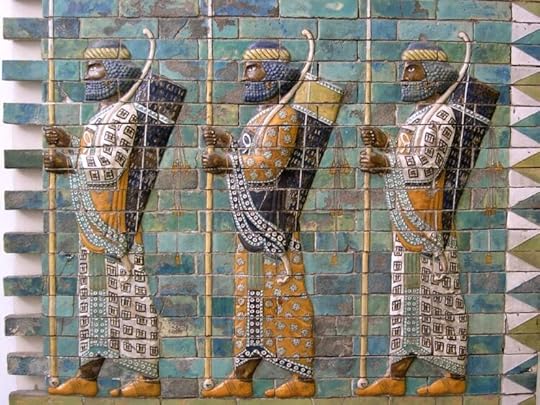
The construction of the empire’s incredible palaces and gates and gardens is explained. It was a brilliant, magnificent empire with elaborate art and sculpture and larger than life exhibits of royalty and power in its halls. The role of slavery to build the empire is also discussed. Like the Assyrians and Babylonians before them, the Persians uprooted and displaced entire communities of people for forced labor, breaking apart families, dispersing people to where they could best be used. And as Diodorus of Sicily records during a campaign with Alexander the Great, many slaves would be mutilated, being left only with the parts of their bodies necessary for carrying out their skill. There may be exaggeration in this, but it is not clear how much. One thing we can say for sure is that modern Iranians looking at Cyrus the Great as a hero of human liberation and an enemy of slavery are mere fictions that have been blended into the public consciousness as truth. Although, as Llewellyn-Jones clarifies in his epilogue, if your choices are to hail the ancient past empire of Persia as some kind of model for moving forward, or to submit to the oppressive modern Islamist theocracy of Iran, the former certainly seems the more glorious and liberating option.
The transfer of power in Persia was messy, usually violent, and increasingly complicated as the empire aged. After Cyrus the Great, his son Cambyses II took the throne with little fuss. After Cambyses’s leg wound and infection he died, leaving a void that was briefly filled by his brother Bardiya, but this was ended by Darius the Great, the lance-bearer of Cyrus. Darius ruled at Persia’s peak and for a long time. His son Xerxes took the throne and was eventually assassinated, possibly by his son Artaxerxes who became king. Artaxerxes’s death led to his son Xerxes II taking the throne for a mere 45 days before being assassinated by his half brother, Sogdianus. Sogdianus ended up as king for less than a year before being executed by a method of ash suffocation as a prisoner by his half brother, Ochus — who would take the throne as Darius II.
The transition from Darius to Artaxerxes II is a rare example of an uncontested transfer of power, but the gutless and heartless Artaxerxes II, known as a gentle ruler but apparently impotent in justice, saw in his own lifetime his son Ochus leave a trail of bodies in his quest toward the throne, murdering his own brothers to get there. Ochus took the throne as Artaxerxes III and immediately called for the murder of all his brothers and an enormous number of other royalty, including his sister who had championed him toward the throne. Artaxerxes III was eventually murdered too, after a long successful campaign of resubjugation of Egypt. The Achaemenid dynasty was perpetually drenched in its own blood.
The royal harem made the Persian great king, in essence, the dynastic stud. But the harem did not serve a purely sexual function as later Orientalism once suggested. It played a role in politics and allowed for a complex hierarchy across multiple bloodlines branching from the king. Concubines, consorts, wives, and slaves made up the polygynous harem. Its role in the royal court was still one of certain power, as the women had access to the king, but also because they enabled the continuation of powerful rulers through birth. In Persia, these women’s power was amplified by obscurity and being away from the public eye, unlike in our own celebrity-obsessed culture in which fame, publicity, and power are virtually synonymous. Royal mothers were often in charge of the harem, holding a privileged place of power and influence over the king. As in other cultures incestuous unions were common in the Achaemenid dynasty, with kings marrying sisters and daughters in order to keep the bloodline pure and narrow.
Wives and concubines of the kings had enormous influence, as seen in Atossa, who was wife to both Cambyses and Darius, and mother of Xerxes, and the brutal Amesteis, Xerxes’s wife, who plotted with fierceness against all enemies of Persia or the royal family, and most ruthless and cold blooded of them all, Parysatis, wife of Darius II. Like Anestis before her, Parysatis delighted in having enemies, real and imagined, tortured and executed. Some of these executions, like the Ordeal of the Boats, were about as cruel and gruesome as one could dream up. Entire families would be murdered in horrific ways just to ensure no one was left alive to avenge the death of a rebellious or difficult official.
These women tended to adore their sons who they then championed and supported to become king, crushing any opposition they saw, and going to great lengths to orchestrate themselves and their chosen son into the seat of power.
Parysatis’s favorite son Cyrus the Younger led his troops against his brother and king, Artaxerxes II. When Cyrus was killed and his rebellion was vanquished, Parysatis spent the next years of her life systematically murdering everyone she saw as responsible for her son’s death, including champions and heroes of the war defending Artaxerxes, while the king was too impotent a ruler to stop her and protect the men who had saved his realm. He failed to even protect his own wife, who was eventually poisoned by his mother, before Parysatis was slapped on the wrist with an exile to her rich family’s Babylonian lands.
Eunuchs served various roles in the Persian empire, and could even possess military or governmental power. Throughout multiple reigns eunuchs played critical roles in coups, assassinations, and in the case of eunuch Artaxores, even attempting to take the throne for himself — caught only after asking a woman to produce a fake beard for him so that he would look the part. Eunuchs were involved in many of the disruptive power shifts of the empire, and were responsible for the deaths of multiple kings. One eunuch ruled through the king he placed on the throne — Bagoas, the same eunuch who murdered Artaxerxes III. More than an “orientalist fantasy” of the eunuch puppet-master, and Llewellyn-Jones is always quick to dismiss orientalist fantasies, this authentic event also resulted in the puppet king being slain by the same eunuch, as well as his whole family for good measure.
One of the highlights here is the study of Persian religion, and the role of Ahuramazda in Persian theism, who was the template for the Jewish/Biblical God, particularly the features of perfection and goodness, and his role as the creator of all. Darius, as other kings before and after, saw himself as an extension of Ahuramazda, going so far as to emulate the god’s look in stone carvings. If Ahuramazda was the Persians’ God, their Satan was Angra Mainyu, also called Ahriman, leader of demonic hordes, a force of darkness, a dweller of an abyss of endless dark, creator of ‘non-life’, the diametric opposition to Ahuramazda.
To protect the entirety of his creation from Angra Mainyu’s evil immaterial form, residing parasitically in living things, he created a group of Amesha Spentas, Bounteous Immortals: Vohu Manu (Good Thoughts), Asha Vahishta (Best Righteousness), Spenta Armaiti (Holy Devotion), Khsathra Vaiyra (Desirable Dominion), Haruvatat (Wholeness), and Amertat (Immoetality). It was the king’s job to maintain pursuit of the Truth, to follow Ahuramazda’s path. Ahuramazda’s prophet was Zarathustra, or Zoroaster in Greek, thought to have been born sometime between 1200 and 1000 BC. Zoroastrianism exists to this day, though in a greatly changed form, owing to its necessary conformity to larger traditions, religious institutions, and cultures to remain relevant. It is not really clear if the Achaemenids were Zoroastrians. Zarathustra or his teachings were never mentioned in any ancient king’s work.
An engrossing book, a history told like an epic. At times Llewellyn-Jones appears to read the minds of ancient figures, and we must assume he is using some artistic freedoms to write a compelling story. It does not appear he invents anything or speculates too far outside what is defensible from the known sources paired with human nature. He has a talent for tying together an assortment of threads and details in a way that makes a moving, immense, coherent, complex story. He loves the subject and sees the glory and grandeur in it, and captures it expertly.