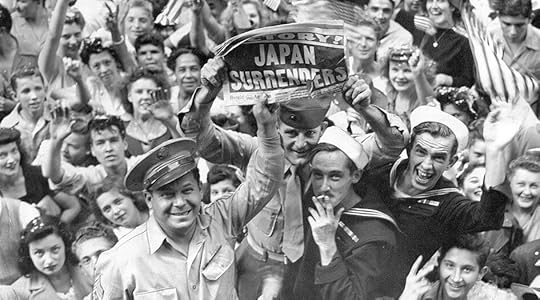
1945 a világ újkori történelmében talán az első globális mérföldkő volt – írja a világhírű, magyar származású amerikai történészprofesszor könyvében, amely e sorsdöntő esztendővel foglalkozó történelmi esszé. John Lukacs rövid áttekintés után felvázolja azoknak a politikusoknak a portréját, akiknek nézetei és döntései meghatározták a világ sorsát: Hitlerét – „mindent egybevetve Hitler mégiscsak államférfi volt"; Churchillét – „1945-ben, élete hetvenedik évében öreg, megfáradt ember képét mutatta, de a világot még mindig messze tekintően és dacosan szemlélte"; Rooseveltét -„Gondolkodása elfogadta és tükrözte kora liberális Amerikájának általánosan elfogadott elveit"; Sztálinét „Nyugati szövetségesei nem eléggé értették meg…, hogy Sztálin a Szovjetunió nagy visszhangot keltő háborús győzelmei ellenére is mennyire bizonytalan"; Trumanét „Korlátai körének korlátai voltak". Ezután elsősorban a korabeli véleményformáló hetilapok alapján áttekinti az amerikai közvélemény és néphangulat főbb jellemzőit: „Mit gondoltak az amerikaiak 1945-ben, amikor a világ urai voltak?" Könyvének második, személyes hangvételű részében a szerző felidézi, miket tapasztalt fiatalemberként az ostrom utáni Budapesten, milyennek látta az amerikaiakat, angolokat, oroszokat, kommunistákat, opportunistákat, s hogyan jutott arra a döntésre, hogy hazáját és családját elhagyva Nyugatra meneküljön.
Lukacs was born in Budapest to a Roman Catholic father and Jewish mother. His parents divorced before the Second World War. During the Second World War he was forced to serve in a Hungarian labour battalion for Jews. During the German occupation of Hungary in 1944-45 he evaded deportation to the death camps, and survived the siege of Budapest. In 1946, as it became clear that Hungary was going to be a repressive Communist regime, he fled to the United States. In the early 1950s however, Lukacs wrote several articles in Commonweal criticizing the approach taken by Senator Joseph McCarthy, whom he described as a vulgar demagogue.[1]
Lukacs sees populism as the greatest threat to civilization. By his own description, he considers himself to be a reactionary. He claims that populism is the essence of both National Socialism and Communism. He denies that there is such a thing as generic fascism, noting for example that the differences between the political regimes of Nazi Germany and Fascist Italy are greater than their similarities.[2]
A major theme in Lukacs's writing is his agreement with the assertion by the French historian Alexis de Tocqueville that aristocratic elites have been replaced by democratic elites, which obtain power via an appeal to the masses. In his 2002 book, At the End of an Age, Lukacs argued that the modern/bourgeois age, which began around the time of the Renaissance, is coming to an end.[3] The rise of populism and the decline of elitism is the theme of his experimental work, A Thread of Years (1998), a series of vignettes set in each year of the 20th century from 1900 to 1998, tracing the abandonment of gentlemanly conduct and the rise of vulgarity in American culture. Lukacs defends traditional Western civilization against what he sees as the leveling and debasing effects of mass culture.
By his own admission a dedicated Anglophile, Lukacs’s favorite historical figure is Winston Churchill, whom he considers to be the greatest statesman of the 20th century, and the savior of not only Great Britain, but also of Western civilization. A recurring theme in his writing is the duel between Winston Churchill and Adolf Hitler for mastery of the world. The struggle between them, whom Lukacs sees as the archetypical reactionary and the archetypical revolutionary, is the major theme of The Last European War (1976), The Duel (1991), Five Days in London (1999) and 2008's Blood, Toil, Tears and Sweat, a book about Churchill’s first major speech as Prime Minister. Lukacs argues that Great Britain (and by extension the British Empire) could not defeat Germany by itself, winning required the entry of the United States and the Soviet Union, but he contends that Churchill, by ensuring that Germany failed to win the war in 1940, laid the groundwork for an Allied victory.
Lukacs holds strong isolationist beliefs, and unusually for an anti-Communist émigré, "airs surprisingly critical views of the Cold War from a unique conservative perspective."[4] Lukacs claims that the Soviet Union was a feeble power on the verge of collapse, and contended that the Cold War was an unnecessary waste of American treasure and life. Likewise, Lukacs has also condemned the 2003 invasion of Iraq.
In his 1997 book, George F. Kennan and the Origins of Containment, 1944-1946, a collection of letters between Lukacs and his close friend George F. Kennan exchanged in 1994-1995, Lukacs and Kennan criticized the New Left claim that the Cold War was caused by the United States. Lukacs argued however that although it was Joseph Stalin who was largely responsible for the beginning of the Cold War, the administration of Dwight Eisenhower missed a chance for ending the Cold War in 1953 after Stalin's death, and as a consequence the Cold War went on for many more decades.
Ez nem háborús szakirodalom, hanem pont az ellenkezője: egy könyv arról, mi történik, amikor hat év permanens háború után egyszerre csak béke lesz. Ami csaknem ugyanolyan problémás helyzetet szül, mint amikor még ágyúval lehetett csúzlizni egymásra – mondhatni, a béke tulajdonképpen a háború folytatása, csak más eszközökkel. Lukacs a tőle megszokott magas minőségben mélázgat arról, hogyan látták a kortársak 1945-öt, a „nulla évet”, mire készültek, mit értettek félre és végül mi valósult meg a sok magasztos ideából. Történelemszemléletének egyik érdekes vonása már a szerkesztésben is tetten érhető: a kötet zömét ugyanis a háború meghatározó államférfiainak (Churchill, Hitler, Roosevelt, Sztálin és Truman) portréja alkotja, amit esetleg (amennyiben szükséges) a körülöttük képződött kör bemutatása egészít ki. Mert ugye az van, hogy Lukacs a klasszikus Plutarkhosz-i szemléletet viszi tovább, ahol az egyén (vagyis a vezető) karizmája kiemelkedően fontos szerepet játszik a történelmi folyamatok alakulásában. No most ebben a kérdésben én polemizálnék Lukaccsal, szerintem ugyanis időnként túldimenzionálja ezt a hatást – akárhogy is, ez a tényekre támaszkodó, de finoman pszichologizáló megközelítés nagyon élvezetes jellemrajzokat eredményez.
Lukacs élvezetessége amúgy elsősorban annak köszönhető, hogy – ezt talán mondtam már, de most mondom még egyszer – az általam ismert történészek közül ő az egyik legjobb stiliszta. Csinos, hajlékony klasszikus prózát művel, amit akkor is öröm olvasni, amikor különben vitatkoznék azzal, amit mond. Ez a stílus leginkább az utolsó hosszabb lélegzetvételű írásban tündököl teljes fényében, ahol Lukacs személyesebb hangot üt meg, és elbeszéli saját ’45-ös tapasztalatait – eltávolodik a történészi szereptől, és „civil” emlékezővé válik, ezzel pedig minden eltűnik belőle, ami ellentmondásra ingerel, és csak annyi marad, hogy: szép. Árad ilyenkor belőle valami kellemes, polgári konzervativizmus, amiben a határozott vélemény megfér a kulturált vitára való készséggel. A Lukacs-i konzervativizmus egyik alapja az, amit ő „intellektuális ochlofóbiának, tömegiszonynak” nevez – a meghatározó trendek, tömegdivatok iránt érzett szkepticizmus, ami azonban sosem fordul át fanatizmusba*. És hát ez az, ami úgy hiányzik a mai közbeszédből, mint egy falat kenyér. Nem kizárt, hogy épp azért veszem időnként elő újra és újra Lukacsot, hogy ebben lubickoljak.
* Ez alól az egyetlen kivételt a kortárs művészetek felé mutatott értetlensége jelenti – egy alkalommal például sikerül egy mondatban lekutyaütőznie Vonnegutot és Pynchont, ami az én szememben meglehetősen csökött irodalmi ízlésről tanúskodik. Hát még amikor tán legkedvesebb írómat így jellemzi: „…az olvasható, de kiállhatatlan Nabokov, a nyelv Fabergéje”! Igaz, a történésznek nem is kell legyen irodalmi ízlése.
Apparently this is one of the less-know and read books of John Lukacs, the later historian, who fled communist-turning Hungary in 1946. The book has 2 parts, the first is trying to analyze why 1945 was a pivotal year in world politics, more important in fact that any other year or significant date before. He is trying to do this via painting a picture of the most important contributors to this year: Hitler, Stalin, Churchill, Roosevelt and Truman. These are insightful and enjoyable reads, giving many interesting tidbits of information, although nothing that we have not read before. There's a deterministic view here that these personalities defined this given year, the ones leading up to it and by virtue the decades that followed in world politics.
His general idea is that barring Churchill, noone knew exactly what they wanted to achieve, but were swept by the current, trying to feel what the other side would do (mostly in the American-Soviet relations). Churchill is painted as the only one realizing what the Red Army occupation would mean to Central Europe but Roosevelt (or Eisenhower for that matter) not interested in this part of Europe, therefore their slow advancement through Germany and not reaching Prague or Vienna to save them from the Soviets.
I enjoyed reading Lukacs's analysis of Truman and how the US popular sentiment defined the politics then and later, how that meant that the US acted late on stopping the Soviets while it was possible. Truman later inaugurated his much more confrontational doctrine, but that was too late to save Czechoslovakia, Hungary or even Poland integrated behind the Iron Curtain.
The 2nd part of the book (only 50 pages or so though) was much more genuine, as Lukacs describes his own experiences of 1945 Budapest, how the Red Army came through and what life in general was like in those days. He describes how later on the British and American delegations arrived and set up shop, how everyone wanted to get close to them one way or another. He overall has an excellent view of Americans (hardly surprising), a moderate but well-intentioned view of the British and an almost brute-like, uncivilized and insecure description of the Russians, which all seem pretty generalized. I wasn't there though and he was, so I have absolutely no basis to criticize him in this regards.
Overall a good read, definitely adds much colour for those interested in WWII and why the Cold War happened like it did, how it felt like from Hungary back then and why our current world is still struggling on with the systemic legacy of 1945. (disfunctionality of the UN etc...)
April 2014: date I did not finish this book either. Barely a third of the way in and I realized I could not wade through the horrors of 1945 to the end of the book which offered some hope. Reading about rape as a weapon of war on all sides (and that's only one chapter) is virtually debilitating. That said I wish I had the stamina to finish this book. If nothing else it showed me the fallacy of the idea that wars end on the day a treaty is signed.