First edition of this fascinating compilation of British railway disasters. The book traces the gradual development of various safety measures that have made railway travel safer, from time interval blocking and telegraphic train orders to CTC, the introduction of air brakes, track circuiting, personnel changes, and locomotive design and construction. The author uses several well-known disasters such as Abbots Ripton, Armagh, Hawes Junction and the Battersea and South Croyden collisions, as ways to analyze what has gone wrong, the measures that have been taken to prevent similar accidents, and how even full-designed safety systems can still sometimes fail. Illustrated with black and white photos. 170 pages.
Oswald Stevens "Ossie" Nock was a British railway signal engineer and senior manager at the Westinghouse company. He is best known for his prodigious output of publications on railway subjects, including over 100 books, as well as a large number of more technical works on locomotive performance.
When I picked up Historic Railway Disasters, I was attracted by the idea that there might be more details about the train crash where Charles Dickens was so heroic, climbing out of the window and saving passengers at much risk to himself, and nearly losing one installment of his only manuscript of his final completed novel, “Our Mutual Friend” in the process. According to his son, he never fully recovered emotionally, and was always nervous whenever travelling by train afterwards. This event is certainly covered, although from a technical rather than a personal point of view.
The book is jam-packed with technical detail. It must be a real treat for railway buffs or historians who have a special interest in British Rail. It was published in 1966, and although revised to cover some later accidents, the disasters described all fall within the period of time since the beginning of the railways, and the early development of major railway companies in Great Britain and Ireland. It also includes the time of the (much-missed by me) “British Railways” organisation, the system of nationalised railways which started in 1948, and was eventually disbanded and privatised in 1994. It covers many of the major accidents in the United Kingdom from the earliest days of the railways, and describes a small number of more minor accidents in great detail. Those with prior knowledge in this area may be surprised that some of the more famous accidents have not been included, in favour of others. The author, O.S. Nock, explains in his preface that he selected those which he considered more interesting technically.
It is not however a technical manual as such, and anyone with a modicum of interest in railways will probably find something of interest. Sometimes the Victorian railway staff had made mistakes, which nowadays seem unbelievably remiss, in hindsight, and given our current knowledge. Safety procedures which seem obvious to us would sometimes in the early days be ignored by the railway owners. Sometimes this was out of genuine ignorance, but often it was for selfish reasons and business greed. We occasionally learn the personal tragedies which resulted from the railway accidents.
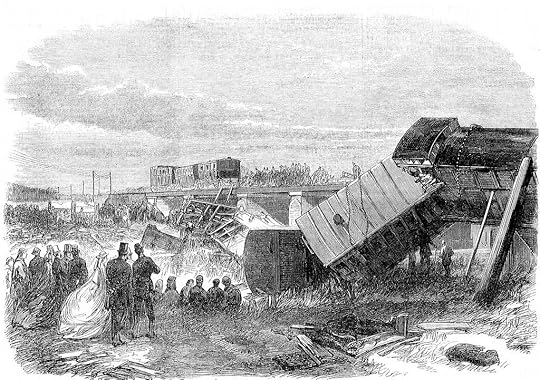
Here is the illustration which particularly interested me, from the Staplehurst Railway Crash of 9th June 1865:
Staplehurst rail crash - Engraving from the “Illustrated London News”
Historic Railway Disasters describes this episode as follows:
“Near Staplehurst the line crosses a small stream called the Beult on a bridge so low that a traveller of today would hardly realise that there was a bridge at all. But in June 1865 this bridge was the precise site of a track repair which involved renewing some of the bridge timbers. With present-day regulations and present-day traffic, such a job as resleepering is done only on Sundays.”
I was fine up to this point, but then I began to struggle:
“In this early case it involved taking out the rails and replacing the longitudinal timber baulks by new ones. There were 32 of these baulks to be replaced, and the bridge foreman and his leading carpenter had systematically replaced one baulk after another between the passage of trains.”
The author goes on to explain that on the day of the accident only one baulk was left to replace. Although the foreman and his team were well aware of the Tidal Boat train, and the variations in time when it should pass, on that particular day the foreman happened to look up the wrong date:
“after the previous train had gone according to schedule, and the signals he could see from the bridge replaced to the ‘clear’ position, under the usual ‘open block’ then operating, he and his men got to work, removed the rails, and set about replacing the timbers beneath … up came the Tidal train at full speed … there was not a hope of the train being able to stop. The train came to a gap in the rails, crashed down on the iron girders of the bridge and ploughed its way along … the engine and the first two carriages got across to the far side and came to rest on the ballast of the far embankment with one of the carriage perched in a most precarious position on the end of the bridge. But the couplings broke between the second and third carriages. The impact fractured the cast iron bridge girder; the third carriage swerved to the left, and once it was detached from the portion of the train still coupled to the engine it was completely devoid of brakes. Everything happened so suddenly that the guard at the rear end had no prior warning … and five coaches of the detached train went over the bridge and crashed into the swampy fields and the river Beult itself.
The carriages were of flimsy construction; all were four-wheelers, and with the force of the fall they shattered themselves to pieces in the field and in the river itself. In this shocking accident 10 people were killed and 49 injured. The fact that the accident happened to a well-known and important express passenger train emphasised the sense of shock which news of the affair created generally; but it so happened that Charles Dickens was a passenger, and naturally he wrote a vivid account of his experience.”
O.S. Nock quotes a piece from Charles Dickens’s account, which refers tactfully to the “two ladies who were my fellow passengers”. We now know that they were his mistress, Ellen Ternan and her mother. The author then leaves this particular disaster however, going on to comment on the astonishing prevailing lack of rules and regulations and general laxity which could result in such an accident. Although he does not mention the fact, I was intrigued by the date of the accident to realise that “The Signalman”, one of Charles Dickens’s most famous short stories, was written and published just the next year. It was in his collaborative complication “Mugby Junction”, published in the Christmas edition of his magazine, “All the Year Round”.
But these extracts represent only a tiny fraction of this book, in which 18 chapters cover maybe 30 accidents in detail, with mention of many more. The two largest and most significant accidents described, were at Armagh and Quintinshill.
The rail disaster near Armagh, in Ulster, in Ireland occurred on 12th June 1889. A crowded Sunday school excursion steam train had to negotiate a steep incline. However, the locomotive failed, and the train stalled. The train crew decided to dismantle the front section and take it forward, leaving the rear portion on the running line. The back section had inadequate brakes, which consequently ran back down the gradient, and collided with the following train. 80 people were killed and 260 injured, about a third of them children. It was the worst rail disaster in the UK in the nineteenth century, in fact the worst rail disaster in the whole of Europe, and remains Ireland’s worst railway disaster ever. The Armagh Rail Disaster led directly to improved safety measures becoming law for railways in the United Kingdom.
The second major rail disaster described was a multi-train rail crash which occurred on 22 May 1915 outside the Quintinshill signal box near Gretna Green in Dumfriesshire, Scotland. It remains the worst rail disaster in Britain, resulting in the deaths of over 200 people.
Quintinshill signal box controlled two loops, which passed on each side of the double-track Caledonian Main Line which at the time linked Glasgow with Carlisle. There were goods trains on both passing loops, plus a northbound local passenger train was standing on the southbound main line.
There were several collisions. The first collision occurred when a southbound troop train travelling from Larbert in Scotland to Liverpool, collided head-on with the stationary local passenger train. The resulting wreckage was then struck almost immediately by a northbound sleeping car express train, travelling from London to Glasgow. At this point the gas lighting system in the old wooden carriages of the troop train ignited, and the resulting fire soon engulfed all five trains.
Only half the soldiers on the troop train survived. The precise death toll was never formally established, because some bodies could never be recovered. In addition the roll list of the regiment was also destroyed in the fire. The official death toll was eventually 227, including four victims thought to be children. The official inquiry found the cause of the collision to be neglect of the rules by two signalmen. Because the northbound loop was occupied, the local passenger train had been reversed onto the southbound line, to allow two late running northbound sleeper trains to pass. Incredibly, the presence of this train seems to have been overlooked, and the southbound troop train was cleared to pass. (As a result, both signalmen were charged with manslaughter.)
Historic Railway Disasters also explores the human interest side of things, ensuring a broader appeal, and I have concentrated on the human interest here. However, there is such a wealth of technical detail in this book, that a general reader may well get lost after parts about signals and brakes, sidings and couplings, as I tended to. Hence the book would mainly appeal to railway enthusiasts, rather than those who view trains largely as a way from getting from A to B. There are plans and diagrams included, as well as black and white photographs.
If you’re proud to describe yourself as a “railway geek”, then you’ll probably love it!
The book I read to research this post was Historic Railway Disasters by OS Nock which is an excellent book which I bought from a local secondhand bookstore. This book looks at railway disasters from the very early ones to the 1960's when this book came out. OS Nock had first hand experience of a train disaster which fortunately he survived and writes about in this book which is a second edition and has been updated. Very early trains had no brakes and its interesting that in an early competition the aims were pulling power and speed but safety was nonexistent. When brakes did appear they were merely turned on by handles or levers. One very early accident which featured the locomotive The Rocket was when a man crossed the line to greet his friend The Duke of Wellington and he was run over by the train and died later from his injuries. The Rocket had no brakes and they had to wait for it to come to a halt at each station. Luckily when there was an accident an investigation would follow and gradually the railways became safer. The early trains were built for pulling power rather than speed and would have a man on a horse lead the way because they were considered too dangerous. The horse would travel at walking speed. By 1840 train speeds had reached 60 mph. Also fast trains gave a railway line a competitive advantage over its rivals. Another accident was the tidal train at Folkstone. In those days boat train were called tidal trains because the ships could only travel at high tide. On this occasion they were replacing sleepers in between when the trains were coming and going. Nowadays they would do it on a sunday and close the line. Anyway the foreman looked at the timetable for the wrong date so they had taken up some of the rails when the train arrived unexpectedly. The train had no chance of stopping. The locomotive continued across and was built strongly so protected its occupants. The carriages which were mostly made of wood came away from the train and largely disintegrated. There were many casualties and some deaths.