

What do you think?
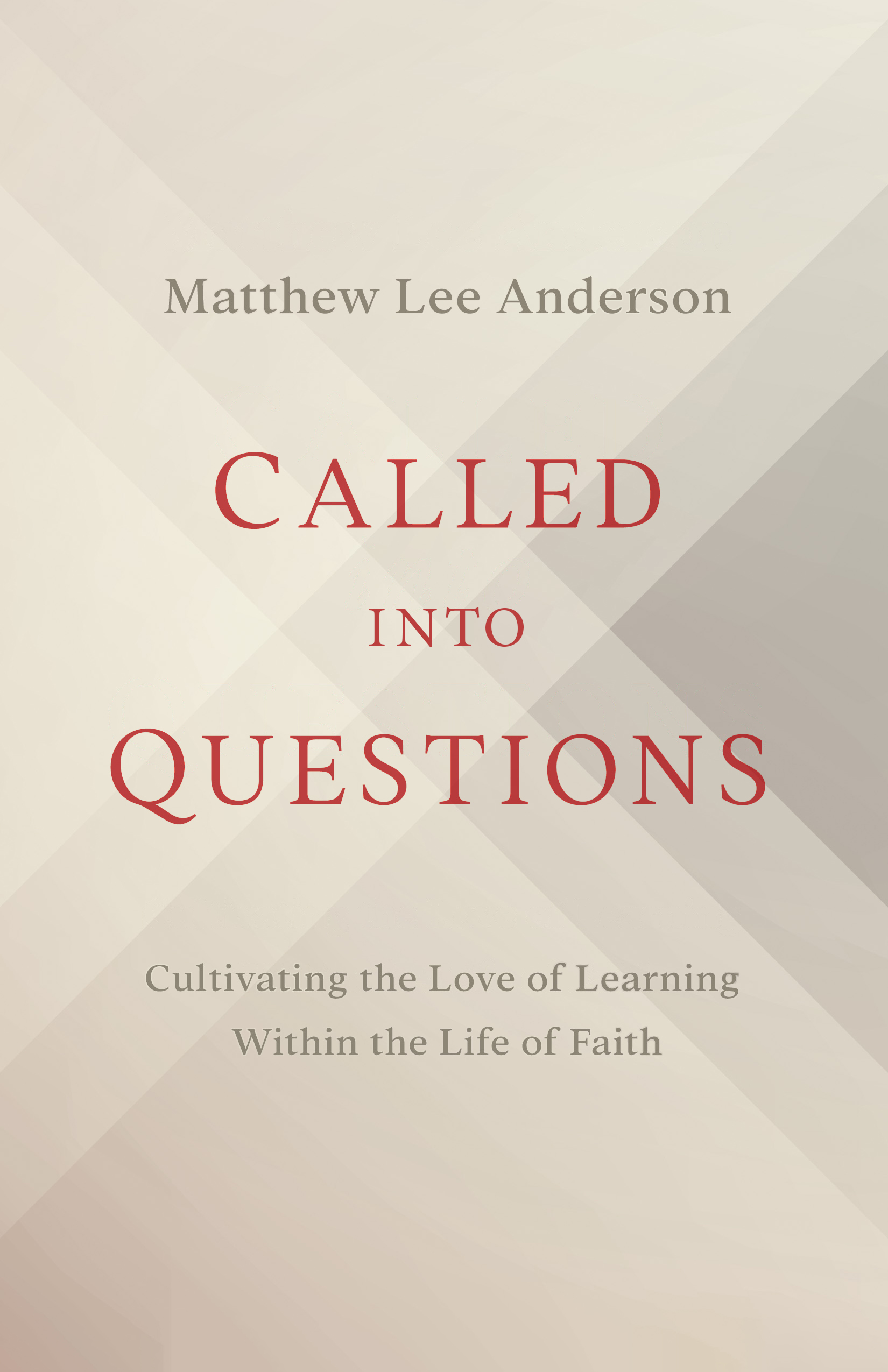
Called into Questions: Cultivating the Love of Learning Within the Life of Faith
Do we know what it means to question well?
We need not fear questions. By the grace of God, we have the safety and security to rush headlong into them and find ourselves better for it on the other side.
Faith is not the sort of thing that endures so long as our eyes are closed. The opposite is the Faith helps us see, and that means not shrinking from the ambiguities and the difficulties that provoke our most profound questions.
In our embrace of questioning, we must learn to question well. In our uncertainty, we must not give up the task of walking worthy of the calling that Christ has placed upon us.
We are living in the age of deconstruction. We are constantly bombarded online, in schools, and sometimes even in our homes by attitudes and arguments aimed at deconstructing our faith. Called into Questions is written to aid us in faithfully questioning our foundations. Professor Matthew Lee Anderson shows us, and the ones we love, how to grapple with doubt in a redemptive way—in a way that brings us closer and leaves us more secure in Jesus Christ.
We need not fear questions. By the grace of God, we have the safety and security to rush headlong into them and find ourselves better for it on the other side.
Faith is not the sort of thing that endures so long as our eyes are closed. The opposite is the Faith helps us see, and that means not shrinking from the ambiguities and the difficulties that provoke our most profound questions.
In our embrace of questioning, we must learn to question well. In our uncertainty, we must not give up the task of walking worthy of the calling that Christ has placed upon us.
We are living in the age of deconstruction. We are constantly bombarded online, in schools, and sometimes even in our homes by attitudes and arguments aimed at deconstructing our faith. Called into Questions is written to aid us in faithfully questioning our foundations. Professor Matthew Lee Anderson shows us, and the ones we love, how to grapple with doubt in a redemptive way—in a way that brings us closer and leaves us more secure in Jesus Christ.
201 pages, Kindle Edition
First published October 3, 2023
Ratings & Reviews
Friends & Following
Create a free account to discover what your friends think of this book!
Community Reviews
Displaying 1 - 14 of 14 reviews

May 3, 2024
Read for a recent forum where we hosted the author at our church. It was very enjoyable. I appreciated all the references to classical literature and thought. It would be good for educators and those who work a lot with high school or college aged students. Explores the need and place for questions without divulging into amorphous generalizing. Distinguishes between good and bad questions, even touches on the questioning of Jesus and the role of lament as questions of good faith.

June 5, 2024
This book was beautiful and refreshing, and came at a really good time for me. I especially appreciated the chapters "From Doubt to Lament," "Friendship, Disagreement, and our Fundamental Commitments," "The End of our Exploring," and the afterword, "To the Deconstructing." I wrote on every page of this book, often bracketing entire paragraphs. It's written with such thoughtfulness and care, and expressed (better than I could) a number of the thoughts that have been swirling around my brain lately. Really refreshing, really solid.

March 16, 2025
“For now, though, there is the plodding, the questioning and the prayer, the serving and the sacrifice. Certainty is a trick, doubt a deceiver. The steadfast confidence of faith kneels — neither triumphant nor defeated, but resolute: ‘Thy kingdom come, thy will be done.’”
This book richly taught how to question while remaining faithful to Christ. I felt blessed reading it. Highly recommend!
This book richly taught how to question while remaining faithful to Christ. I felt blessed reading it. Highly recommend!

February 24, 2024
Jam-packed with wisdom and fine, fine writing. And a postscript that is gold in these deconstructing times. There, I think I've whetted your appetite.

Read
February 7, 2025“I could only think that the resurrection of Jesus had better be true, that God must be worth all the heartache and sorrow of this world. That I would be angry with Him if He was not. That the only two real options are that this is a terrible universe or that God is terribly good.”
April 29, 2024
I purchased this book for an upcoming Seminary class on Spiritual Formation. The first chapter asserts that "God has called us into the questioning life" and that "questioning well... can make us more more awake -- more alive and discerning -- in the spheres to which God has called us."
In subsequent chapters, we are drawn into how God calls us into a questioning life and how we might consider when and how to ask questions. There is no prescriptive formula provided as there are many nuances to a given circumstance. Instead, several examples are shared for consideration, drawing on Scripture to express good and bad questions.
Matt Anderson also comments that we live in an age when doubt "has become the currency of the highly educated." He talks at length about healthy questioning in faith contrasted to doubt, which is "a double-mindedness, an indecisiveness and instability in our desires and practical judgments."
This book does not provide an easy self-help solution to asking better questions, but it does encourage the reader to biblically understand the power of questions. We learn through both Scriptural and modern examples of how questions impact others and how we might demonstrate better discernment in our questions.
This is a book that would be most beneficial in supplementing discussion with other believers. And a book that one should use to examine their own questioning life rather than just reading quickly through and setting on a bookshelf. I found myself underlining several passages, which I have already turned back to reflect on. Considering how crucial questioning is -- not just in gaining knowledge and understanding -- but also in building relationships, I think this is a book well-worth reading and reflecting on.
In subsequent chapters, we are drawn into how God calls us into a questioning life and how we might consider when and how to ask questions. There is no prescriptive formula provided as there are many nuances to a given circumstance. Instead, several examples are shared for consideration, drawing on Scripture to express good and bad questions.
Matt Anderson also comments that we live in an age when doubt "has become the currency of the highly educated." He talks at length about healthy questioning in faith contrasted to doubt, which is "a double-mindedness, an indecisiveness and instability in our desires and practical judgments."
This book does not provide an easy self-help solution to asking better questions, but it does encourage the reader to biblically understand the power of questions. We learn through both Scriptural and modern examples of how questions impact others and how we might demonstrate better discernment in our questions.
This is a book that would be most beneficial in supplementing discussion with other believers. And a book that one should use to examine their own questioning life rather than just reading quickly through and setting on a bookshelf. I found myself underlining several passages, which I have already turned back to reflect on. Considering how crucial questioning is -- not just in gaining knowledge and understanding -- but also in building relationships, I think this is a book well-worth reading and reflecting on.

October 27, 2023
This is a good book with wisdom to offer those wondering how to ask questions well. For Anderson, questioning well may be best summed up by the phrase ‘faith seeking understanding’:
“God has called each of us into the questioning life. As we leave behind the childhood of our youth, Christians enter into the childhood of faith… Unless we become like little children, Jesus says in Matthew 18, we shall have no place in the kingdom of heaven. Children are both familiar with their ignorance and eager to overcome it; they are shameless in asking questions because they have not yet learned to fear the unknown. Questioning is the form our love takes in its intellectual mode; it is an expression of our life in Christ, in which we turn with interest toward others, the world, and God. As creatures, we constantly confront the limits of our knowledge and are moved to learn more. Praise and thanksgiving are the crown of our humanity, but they are preceded by our questions and generate new ones.” (15-16)
We seek understanding with the confidence of faith, which hopes for the goodness of God and the return of Christ as we face the unknown and confront our own double-mindedness (doubt). This, of course, can feel extremely difficult to realize in our own lives. How do we know what questions are worth asking? When should we be satisfied with the answers we find? When should we accept that certain questions may never be answered? Helpfully, Anderson emphasizes that this “intellectual mode” of learning and questioning should not be separate from but moved along by our love for God displayed in prayer, Scripture reading, and involvement in the life of the church. The cultivation of wisdom and virtue in the life of the questioner is always relevant due to the discernment required to ask good questions at the right time, he says.
Doubt can deceive us and curiosity (in an older sense of the word) can be a vice, but difficult questions can help us. Certainty can be illusory and self-deception is nearly ubiquitous, but faith, hope, and love amount to a confident and right trust in God. The best thing about this book is that Anderson presents a thorough interaction with the topic of questions throughout Scripture. The chapter on doubt is very good and it makes a compelling case that God has given us the language of lament in the Psalms so that we can voice our doubts to him. I loved this point as this is something that has been significant in my own life.
One of the surprising things about Scripture is that it explicitly names the pain, doubt, and difficult questions human beings have- and expects that naming such things does not catapult the asker into doubt, but is compatible with seeking God in prayer: “When I remember God, I moan; when I meditate, my spirit faints… Will the Lord spurn forever, and never again be favorable? Has his steadfast love forever ceased? Are his promises at an end for all time? Has God forgotten to be gracious?” By God’s grace, such questions can give way to others: “Lord, to whom shall we go? You have the words of eternal life, and we have believed, and have come to know, that you are the Holy One of God."
“God has called each of us into the questioning life. As we leave behind the childhood of our youth, Christians enter into the childhood of faith… Unless we become like little children, Jesus says in Matthew 18, we shall have no place in the kingdom of heaven. Children are both familiar with their ignorance and eager to overcome it; they are shameless in asking questions because they have not yet learned to fear the unknown. Questioning is the form our love takes in its intellectual mode; it is an expression of our life in Christ, in which we turn with interest toward others, the world, and God. As creatures, we constantly confront the limits of our knowledge and are moved to learn more. Praise and thanksgiving are the crown of our humanity, but they are preceded by our questions and generate new ones.” (15-16)
We seek understanding with the confidence of faith, which hopes for the goodness of God and the return of Christ as we face the unknown and confront our own double-mindedness (doubt). This, of course, can feel extremely difficult to realize in our own lives. How do we know what questions are worth asking? When should we be satisfied with the answers we find? When should we accept that certain questions may never be answered? Helpfully, Anderson emphasizes that this “intellectual mode” of learning and questioning should not be separate from but moved along by our love for God displayed in prayer, Scripture reading, and involvement in the life of the church. The cultivation of wisdom and virtue in the life of the questioner is always relevant due to the discernment required to ask good questions at the right time, he says.
Doubt can deceive us and curiosity (in an older sense of the word) can be a vice, but difficult questions can help us. Certainty can be illusory and self-deception is nearly ubiquitous, but faith, hope, and love amount to a confident and right trust in God. The best thing about this book is that Anderson presents a thorough interaction with the topic of questions throughout Scripture. The chapter on doubt is very good and it makes a compelling case that God has given us the language of lament in the Psalms so that we can voice our doubts to him. I loved this point as this is something that has been significant in my own life.
One of the surprising things about Scripture is that it explicitly names the pain, doubt, and difficult questions human beings have- and expects that naming such things does not catapult the asker into doubt, but is compatible with seeking God in prayer: “When I remember God, I moan; when I meditate, my spirit faints… Will the Lord spurn forever, and never again be favorable? Has his steadfast love forever ceased? Are his promises at an end for all time? Has God forgotten to be gracious?” By God’s grace, such questions can give way to others: “Lord, to whom shall we go? You have the words of eternal life, and we have believed, and have come to know, that you are the Holy One of God."

July 15, 2025
This is a book that explores the place and value of questions in the life of the Christian. The author argues that questioning "...is an expression of our life in Christ, in which we turn with interest toward others, the world, and God" (16). He also aims to explore "what a sincere and faithful question sounds like" (19). This book intrigued me because I love asking questions myself and have always been drawn to people who are thoughtful questioners—in church, in conversation, in the classroom, even here on Goodreads!
I appreciate this author's curiosity and enthusiasm for life. He seems like a genuinely lovely person and I have no doubt that he is able to get great conversations going both in his classroom and on his podcast. Ultimately, though, I found the thinking in this book to be a little muddled, underdeveloped, and even at times contradictory. I could easily see what this author was trying to say at the individual sentence level but, with the exception of the first couple of chapters, I really struggled to understand how all the ideas fit together to form a convincing whole. My impression is that he argues in a circular, rather than a linear, fashion. Some might find this deep and refreshing; I just found it frustrating. Upon reaching the end of the book with a very haggard brain, my sense is that this author is much more adept at asking good questions than answering them. He would probably say that's the point, but then what's going on in these 200 pages? Not much that I could wrap my head around.
I appreciate this author's curiosity and enthusiasm for life. He seems like a genuinely lovely person and I have no doubt that he is able to get great conversations going both in his classroom and on his podcast. Ultimately, though, I found the thinking in this book to be a little muddled, underdeveloped, and even at times contradictory. I could easily see what this author was trying to say at the individual sentence level but, with the exception of the first couple of chapters, I really struggled to understand how all the ideas fit together to form a convincing whole. My impression is that he argues in a circular, rather than a linear, fashion. Some might find this deep and refreshing; I just found it frustrating. Upon reaching the end of the book with a very haggard brain, my sense is that this author is much more adept at asking good questions than answering them. He would probably say that's the point, but then what's going on in these 200 pages? Not much that I could wrap my head around.
October 23, 2023
This book is very thoughtful, as is everything else Matt Anderson writes. I will be recommending it to everyone I know.

September 28, 2024
I took almost a year to finish this, and I'm so glad I did because I could take my time and digest it. During college, surrounded by an environment of questioning, many of my peers either questioned their way to a deeper relationship with God or lost their faith. In "Called Into Questions," Matthew Lee Anderson offers poignant and exhorting points.
Each chapter presents an aspect of questioning, like motivations for questions, safe environments to ask questions, and how to ask the right questions and with whom. Anderson backs up his points with theological champions (GK Chesterton, CS Lewis, etc.), literature references, and more. After reading each chapter, I felt the need to talk about it with anyone I could- family, friends, coworkers (even non-Christians) because I wanted others to learn what I was learning too. My faith practice of questioning will be forever changed because of this one!
If you pick this up, be prepared to question your own way of thinking and I highly reccomend annotating!
*Mahalo to Moody Publishers for a copy of the book. All opinions are my own.
Each chapter presents an aspect of questioning, like motivations for questions, safe environments to ask questions, and how to ask the right questions and with whom. Anderson backs up his points with theological champions (GK Chesterton, CS Lewis, etc.), literature references, and more. After reading each chapter, I felt the need to talk about it with anyone I could- family, friends, coworkers (even non-Christians) because I wanted others to learn what I was learning too. My faith practice of questioning will be forever changed because of this one!
If you pick this up, be prepared to question your own way of thinking and I highly reccomend annotating!
*Mahalo to Moody Publishers for a copy of the book. All opinions are my own.

June 11, 2024
Such a beautiful book!!

October 29, 2023
I’m still thinking about this book. It came to me at just the right time as I had been thinking extensively about doubt and the place of questions in the Christian faith. Some elements I really enjoyed were Anderson’s footnotes, and his letter to one deconstructing at the end. I think I’ll need to reread it to fully grasp how best to employ it, but rereading “Called Into Questions” will hardly be considered a chore.

Read
July 21, 2024“The questioning life is responsive and responsible to God. In questioning, we direct our attention outward, away from ourselves toward another who can give us an answer….Questions invite the other person to speak—an invitation we should also be willing to receive.”, p. 24

May 8, 2024
A heart felt journey about how to deepen your relationship with God through questioning. One read will not be enough!!!!
Displaying 1 - 14 of 14 reviews