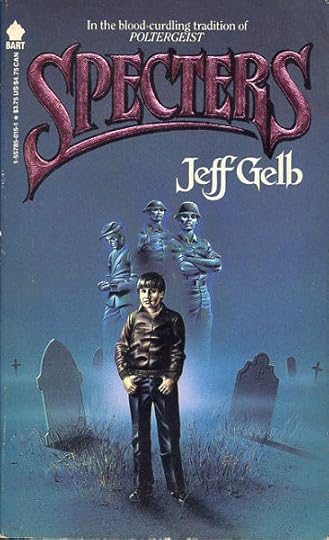
An unexplained drowning. A brutal murder at a dinner party. A kid’s Halloween prank gone wrong. Paul and Johnny have been best friends since they were kids--hell, they’ve been best friends since their parents were kids--but now events seem to be tearing them apart.
When the boys are involved in a tragic car accident, it seems likely that their friendship will be broken forever. Even Paul can see that Johnny’s new friend Vic is a troublemaker, and Johnny’s fascination with the axe murderer who’s rampaging through town is creeping Paul out. At the same time, Paul’s having dreams and visions of dead people. With Johnny distracted, Paul turns to the neighborhood witch for answers--but sometimes, you don’t get the answer you were looking for...
Jeff Gelb is a former disc jockey and music columnist who created the SHOCK ROCK series of music-based horror fiction. He has also written a number of short stories, including Graveyard Shift, The Last Victim and The Portrait. In 2001, he collaborated with Max Allan Collins to create the anthology series FLESH AND BLOOD, tales of erotic noir from some of the finest writers in crime fiction. Mr. Gelb is now in his fifth decade producing the comic book fanzine MEN OF MYSTERY.
Here's the cover of the 1988 Bart Books mass-market I have. There's not much out there in internetland on this book, so I have no idea if it's any good. I do know I really enjoyed what I've read of the Jeff Gelb-edited Hot Blood: Tales of Erotic Horror series of paperback anthos from the late 80s/early 90s, as well as the few short stories of his I've read over the years. ------------------------------------------ Ugh. I would have thought that the co-editor of one of the better and more original antho series of the late horror boom era would have come up with something a little more unique. It wasn't offensively bad, just totally unnecessary, as this sort of tale had been done to death by '88. I don't mind authors using classic horror tropes -- I mean, they're classic for a reason -- but I'd like to see something original, or at least some 3-dimensional characters to draw me in.
This had neither. It's basically about a kid named Paul who has some newfound psychic abilities, and can see how someone died just by touching something of theirs. No one, not even his parents, believe him. In fact they think he needs psychiatric help when he insists he knows what a neighborhood girl was thinking and doing moments before she was fatally struck by a car. Meanwhile, there's a serial killer on the loose, and he, with the help of an older lady psychic friend, must use his newly unlocked superpowers to figure out who it is.
Okay, I could get down with that, if I cared at all about Paul or any of the other characters. But I didn't, because they didn't feel like real people to me. I didn't feel anything during the dramatic moments, because I didn't care. Mostly my eyes just glazed over, especially during some of the ridiculous dialogue. My tolerance may have been higher for this sort of thing back in the day, but after having read so much top-shelf horror fiction in recent years, I don't really want to waste time with derivative stuff like this. Your mileage may vary.
If "Halloween" and "Friday the 13th" shaped the content of horror films in the 80s, there is no question that Stephen King's "It" was responsible for horror literature of that decade and beyond. For better or worse.
Many of us horror fans do enjoy that small-town-evil brand of coming-of-age tales featuring battles between the innocence of children and the corruption of adulthood. Unfortunately, through multiple knock-offs and clones, the theme was overdone. There were just too many writers of roughly the same generation as Stephen King reliving their childhood through young literary characters growing up in suburban America, and too many publishing companies wanting to pretend that buying their newest book would lead to the discovery of the next Stephen King. But you can't be the next King by mimicry.
As much as I understand the reasons for these kid-centric horror stories, I do get tired of all the shenanigans from the likes of Johnny and Jimbo and Squirt and Sport and Mugsy and Pugsy and Spanky and Wanky. Now, Jeff Gelb has made a name for himself as editor and contributor to erotic horror and music-based horror anthologies, but for what appears to be his only full-length novel, he chose to follow in the footsteps of "It," stumbling all the way.
First of all, the kids act and speak in ways that aren't very different from the adults, which fails to make the younger characters believable. And most of the grown-ups are not nice people. We have page after page of kids getting smacked upside the head from raging dads, neglected by self-absorbed moms and babysitters, or forced into therapy by neurotic parents. All of the cast is a reflection of a cynical approach to life by the author. One of the adults is an obligatory "Bob," of course, but he prefers to be called "Robert," and he had been having a sleazy affair with one of the victims of the opening axe murder and likes to abuse his son. And we have the obligatory psychiatrist who is more mentally ill than pretty much anyone on the planet. The kids are almost all psychopaths, torturing frogs, running over toddlers playing in the street, grave robbing, threatening people with switch blades, and on and on. Stephen King had set the location for "It" in the town of Derry, which had been infected by an ancient evil, and readers generally accepted this as an explanation for why most of the population were jackasses. I didn't. Here, the explanation is equally unsatisfactory. Authors can put whatever spin they want on how their novel ends up with so many unlikeable characters, but it doesn't hide the digital storytelling. Readers don't need everyone except the protagonists to be so damn nasty in order to recognize the heroes.
This novel sets a high bar for brutality by starting off with a bang. In the prologue and the very first chapter, we get three gnarly deaths. Then it fizzles out, taking forever to make any kind of significant link between the rest of the book and its intense opening. The convoluted plot lines do start to come together by the halfway point, but in the most contrived and convenient ways. We then get an abrupt climax of sorts, which normally would have been the end of the story. But no, it continues on for Parts II and III. By then, the book had already worn out its welcome for me, but the story starts to redeem itself with higher stakes and characters with an actual arc. Unfortunately, there just isn't enough improvement to elevate my overall opinion of this novel. We are ultimately left with two flimsy murder mysteries that the reader can solve almost the moment certain characters are introduced. And the finale clearly tries to copy the final battle of "It," though written in a way that reminds me of a turn-based RPG where the boss monster just sits there while the protagonist powers up and manipulates his inventory. It's pretty silly.
I just could not connect with this one. The characters all lacked sufficient charm to be anything but annoying, if not despicable. The plot was too derivative. Narrative momentum was too dependent on coincidence. There was a fair amount of carnage candy and disturbing material, but somehow failed to create adequate suspense or scares.
If you are a one of the few who collect paperbacks from hell to actually READ them, and not just for the covers, I'd probably skip this unless you are a completist. If you like coming-of-age horrors, make sure you check out Brian Keene's "Ghoul," Thomas Tessier's "Phantom," and Robert McCammon's "Boy's Life."
I'm not sure how deep I want to get into this novel. OK, I'll start with the bad. The last 1/4 of the book just isn't very good. It isn't bad if you enjoy boredom, but there's a lot of plot and character build up in the first half of the novel which Gelb than resolves and replaces with a really boring end game that just wasn't necessary.
So, I will give the novel 3 Stars for the 1st 3rd of the novel which I thought was pretty damned good.
The story in a nutshell. Paul is a young kid who discovers he can communicate with the dead. His best bud, John, is a troubled youth who likes horror movies and murder. Unlike another John and Paul, they don't start a rock band, but go visit the town witch (either Abagail or Hazel depending on who was editing this book that day), and the games begin.
Did I mention the novel begins with a decapitation? The novel begins with a decapitation.
Straddling the lines between horror and dark fantasy, Gelb, gives us a lot of crisp, clear writing, characters that are believable, and just enough cheese to keep the novel tasty.
I just wish he had developed the main story presented at the beginning of the novel and allowed that to carry the whole book.
Oh well, the last half of Huck Finn sucked too, but its still worth reading.