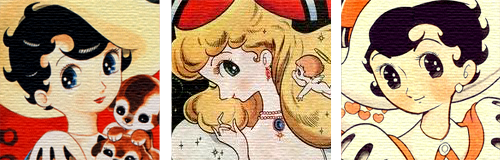
I can't think of a higher compliment I can make that I'm going to be absorbing and processing this marvellous little piece for some time and so any initial thoughts I have right now feel somewhat trite and ill-considered. This is a deceptively simple manga (and a highly influential one), ostensibly written for children, about a girl accidentally born with a girl and a boy's heart who ultimately has to hide her feminine self so that she may be heir to a kingdom which will only allow men as rulers.
There's simultaneously a whole lot of stuff going on here but it's all presented in such a frivolous manner that one can't ever confidently tell what Tezuka is trying to say, and I think perhaps that's the point. It almost feels as if Tezuka is throwing down the gauntlet here insomuch as challenging "you want to talk about women, you want to talk about gender roles? Well ... here you go!" and the work will deftly flit from pronouncing that Princess Sapphire when she's fully a girl (minus boy-heart) is weak and can't lift a sword, to presenting another female character who as an entirely capable expert swordswoman. In fact, everytime gender roleing is mentioned it's almost always with a wink and a nod and for comic effect - did he really just say that? It seems so but somehow the characters all charge onwards defying expectations regardless. For example, One plotline - perhaps my favourite, sees Madame Hell (literally the devil's wife) trying to steal Sapphire's girl-heart to give to her daughter Hecate, who is simply not feminine enough for her. Once she's done this she'll be able to marry her off to the Prince Franz, or so she thinks. Hecate simply doesn't want the heart because she doesn't want to be feminine and tricks her mother into thinking she has it by acting feminine. Tezuka's assumptions seem pretty clear here: One can - and maybe should - be a woman but not wish to be beholden to the gender assumptions behind womanhood.
For me, therefore, this is a really slippery text and deliberately so. The whole thing seems to be - at least metaphorically - a story of Princess Sapphire being in something of a gender identity crises, her constant switching between how she chooses to present herself as a boy or girl is muddied by society's constant expectations of how she should be i.e she must have a girl heart or a boy heart and only one. It's interesting to note that her female sex-type is only brought up once, at the very end, as proof that she is actually a woman when she shows her breasts to another woman. Elsewhere in the story friends and enemies alike are happy to make assumptions based on her gender-type without seeking biological proof.
It's not much of a spoiler to say that she does eventually wind up with a girl heart only but by this point in the story her external constraints (as represented by (the duke, Madame Hell and Venus respectively) have mostly ebbed away all and I'm not entirely sure what this means for her future. Will she be able to live as a ruler of Silverland and a girl now? I'm not arguing that princess Knight is a fully-progressive piece by the standards of 2023, but I do think it is aware of its own assumptions and the feminist conversation.
(NB: If this is the end of the story, however there is a short follow up series entitled The Twin Knights which I guess I'll have to read)
Tezuka certainly keeps these kinds of tensions at the forefront of the narrative but on another level, what's remarkable here is that this is still a children's story. It initially seems quite Disney-esque but the influences are also clearly from MGM style swashbucklers too. It's never less than straightforward fun and the wacky narratives can be enjoyed perfectly well without thinking about them too deeply. Tezuka certainly keeps the pace going and there are more than enough ideas here to warrant the 27 chapters worth of length.
(it's just a shame that the original anime series hasn't been subbed - the dub is un-watchably bad and I gave up on it pretty quickly)