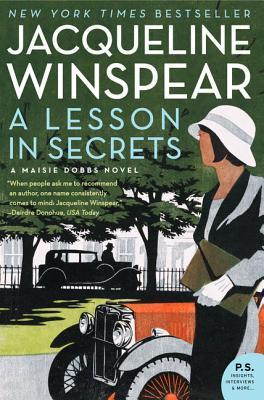
I’m not sure how or when I first discovered the Maise Dobbs series. I think I happened upon the first book, Maisie Dobbs, at the library. Intrigued by the setting – England between the wars – I picked it up and immediately liked the character. It was an interesting mystery novel in that a large portion of it was a flashback to the character’s past. I can’t even remember her first case, truth be told. It was Maisie and her personal story that kept me interested. Since then, I have waited anxiously for the release of each book. Fans of the series are blessed that Winspear seems consistently capable of publishing a book per year. Each year, I read the book immediately and am always a bit let down at the end because I know that there is another year to wait for the next chapter in Maisie’s story.
Maisie’s story…that is what keeps me coming back. While I enjoy the mysteries and am especially pleased that each mystery reveals a bit of British history as it relates to World War I – most often events in the War that show the Crown and people in power in a less than favorable light – I do feel this aspect of the era is tapped out. At this point in the series it is fall 1932, 14 years since the Armistice, and that people are still holding on to the grudges and ills of the past seems more of storytelling crutch than a necessity. Maisie says, at least once a book, that she was a nurse in the war. Her friend, Priscilla, always gets teary eyed and worried when looking at her three sons, named after her three brothers lost in the war. Maisie’s loyal sidekick’s, Billy Beale, skills running communication wire during the war always comes in handy in some way. I understand, on one level, the need to give some historical character details for those new to the series, but there comes a point in real life where constant reference to “back in the day” becomes annoying. Unfortunately, that time has come for the Maisie Dobbs series.
Maybe Winspear has realized this. In A Lesson in Secrets, Maisie goes undercover for the Secret Police (a job she has fallen into because of her late mentor’s spy past and her body of work as a respected private inquiry agent) to a small college in Cambridge. The goal of this college, St Francis, is to foster peace by bringing in students from across the world together in the hopes that they will return to their homeland and become advocates for peaceful solutions to the world’s problems. Of course, the British government thinks something shady is going on. It is Maisie’s job to find out just what. While she is there as a lecturer in Philosophy, the college’s founder is murdered. The story, from that point, has it’s feet in two different eras – the war of the past, which relates to the college founder’s murder, and the war of the future as Maisie uncovers what is a universal truth, no matter the era – young people are especially gullible to bombastic political rhetoric. In this case, during this time, the rhetoric is fascism.
Because the Maisie Dobbs series is so character driven, each mystery has somehow enabled Maisie to grow, to let go bit by bit the scars that World War I left on her (as a nurse in the war, natch). As I said earlier, it is the character that keeps me coming back to these books. Watching her grow, while learning a bit about hidden British history, has been a treat. However, the mystery in A Lesson in Secrets seems to be there because that’s the formula Winspear has created. It doesn’t, in any way, move Maisie as a character forward. In fact, an aspect of it (mutiny and desertion on the front lines) was covered fully, and much more deftly, in a previous book. In short, it is the least engaging portion of the novel. Which is a major problem because Maisie spends most of her time trying to solve that murder instead of focusing on her secret agent job of uncovering the nefarious doings of easily manipulated young people.
Though I’m sure the British would like to wipe this stain from their history, it is a fact that many, many British were sympathetic to Hitler’s ideas when he first came on the scene. The Prince of Wales, the future King Edward, was a supporter of Hitler. If he had not abdicated the throne for the American divorcee Mrs. Wallis Simpson, we would have a very different world today. Hitler and his brand of fascism was not seen as a threat to the Crown, some thought of it as a solution to their problems. The Crown was more worried with the Red Menace in Russia and were willing to hand wave the less palatable aspects of Hitler’ ideology. So, when Maisie goes to her Secret Service boss and tells him that there is evidence of fascism at St. Francis and not communism, he dismisses her concerns.
I’m sure it is very difficult for a 21st century author to write about that time – the rise of fascism – with the ignorance required to make it believable. The problem is we know their future. We know that England will change its tune when Hitler marches across Europe. We know that Hitler will kill millions of Jews in concentration camps. We know that those children in 1932 will be going off to war in 1939. It is difficult to write believable ignorant characters when such knowledge is almost part of our DNA. For a few books now, Maisie and her mentor, Maurice, have dropped little hints of concerns about people like Oswald Mosely and “what’s happening in Europe.” Their opinions, about almost everything, seem a bit too on the nose.
Which brings me to a concern I have harbored for Maisie for a few books now. She is turning into a Mary Sue. For those of you unfamiliar with the term, a definition:
A Mary Sue (sometimes just Sue), in literary criticism and particularly in fan fiction, is a fictional character with overly idealized and hackneyed mannerisms, lacking noteworthy flaws, and primarily functioning as a wish-fulfillment fantasy for the author or reader.
In fan fiction, Mary Sues are usually author inserts – a character that is a thinly veiled avatar for the writer. While I don’t think that is the case with Maisie and Winspear, I do think that Maisie suffers from “idealized and hackneyed mannerisms and is lacking in noteworthy flaws.” Maisie always solves the case, knows the right thing to say and when, gets people to open up to her with little to no effort, investigates rings around the police, helps out her friends when they’re in need, is always compassionate to those that deserve it and holds negative opinions about no one in particular, except maybe men that avoided serving in the war, the government for not doing all they can for veterans and now has a wary eye on fascists. But, those people deserve to be disliked, don’t they? Her biggest flaw, as far as I can tell, is that she is emotionally closed off and is slow to open herself up to other people. She hides behind an overly professional, proper demeanor. She did make some progress in this book, however. She called men that she has known and worked with for years by their Christian names instead of their tongue twisting titles. It’s only taken seven books.
I’m sure it sounds as if I didn’t like the book and I have grown tired of the character of Maisie. On the contrary, I did like the book (but didn’t love it) and I like Maisie immensely. But, I think it’s time for Winspear to deviate from her formula. When her mysteries stop directly affecting Maisie, they can no longer hold the book up. I spent the majority of A Lesson in Secrets skimming the mystery for more information about Maisie’s personal life. That is a major problem for a mystery novel, especially when the tidbits about her personal life are fleeting and rather shallow. But, more on that later.
I would like to see Winspear deviate completely for a book and maybe do an homage to Agatha Christie with a murder at a grand estate. Now that Maisie is in a relationship with a Viscount, it would be easy to put her in that situation. Make it even more interesting by setting it at her friend, Priscilla’s, house in France and have a Hercule Poirot type character that Maisie is competing with to solve the manor murder. Better still – have Maisie lose out on the unacknowledged competition and not solve the murder first.
Maisie Dobbs is the only mystery series that I follow because I’ve always believed that long, drawn-out series sacrifice character growth for the formula. The story should serve the character, not the character serving the story. I had never felt that about Maisie, until this book. I felt a germ of dissatisfaction with the last book, The Mapping of Love and Death, with the sudden romance between Maisie and a thinly drawn character that has, however, been around from the beginning, James Compton. He spent the majority (read: all) of the first six books in Canada, with a one line mention here and there. He appears in book seven and, after a few chance encounters with Maisie, they start dating. In A Lesson in Secrets, they’re involved in a full on affair. But, Winspear spends too little time on the relationship and it feels shallow and rushed as a result. Compton as a character and the relationship as a sub-plot are so underdeveloped that it is difficult to feel or even understand Maisie’s happiness. This book would have been a perfect opportunity for Winspear to develop Maisie’s personal life. Instead, she has Compton in Canada for 3/4 of the book and Maisie worried, for a few paragraphs sprinkled over a couple hundred pages, if James is really in Canada or in London without telling her. Honestly, why would we care one way or the other? Winspear hasn’t taken the time to show the two together. We think Maisie is happy because she should be happy, not because we’ve been shown her happiness in any detail.
I will confess that part of my dissatisfaction with Maisie and Compton stems from the fact that there is another character that has been around for quite a while, has been more fully developed (but, honestly, only slightly) and seems much more suited to Maisie. Winspear has dropped enough hints about the two throughout the series that I believe Richard Stratton is the man Maisie will eventually fall in love with. But, here’s the thing: I don’t think I have the patience to wait. It has taken Winspear eight books to cover three years of Maisie’s life. At that rate, and with Winspear publishing a book a year, it will take 16 years to get to Germany invading Poland, and 17 or 18 to the Battle of Britain. If Compton breaks her heart, or (my prediction) she dumps him because he will want her to quit her career and dedicate her life fully to being the wife of a Viscount and future Lord , it might take Maisie three or four years to get the courage to even go out on a date. That is 8-10 publishing years, right there. Then there’s the fact that, at the end of A Lesson in Secrets, Stratton resigns from Scotland Yard as a detective and is off to Essex as a math/physics teacher in a boarding school. Seriously? Really? I’m sorry. I’m just not that patient.
I can hear my detractors now: “If you’re just in it for the relationship then you don’t truly appreciate the series. It is a mystery first and foremost.” To that I disagree. Agatha Christie’s Miss Marple and Hercule Poirot novels were first and foremost mystery series. There is no character development in her investigators at all, and very little background given. Maisie Dobbs is primarily a character study. Maisie, in fact, stands in for all of England and the changes in society that were wrought by the Great War – the entrance of women into the workforce in professional capacity (Maisie as a successful woman in a man’s profession), the breakdown of the class system (Maisie having a relationship with a man that is well above her in class) and the loosening of rigid Victorian/Edwardian morals (as evidenced by the sexual nature of her affair with Compton. I do give Winspear full credit for giving Maisie a sex life and not making her a spinster, another reality of post-war Britain.). But, this has all been a long time coming. As a faithful reader and one that recommends these books to others, I have a right to be somewhat dissatisfied with the snail’s pace of character growth that Winspear has created.
Am I looking forward to the next book? Yes. Will I buy it and read it immediately on release? Most likely. Do I have high hopes that Winspear will deviate from her formula? Yes. Do I think she will? No. I respect that Maisie is Winspear’s character and she has the right to do with her as she likes. I also have the right to stop reading if I lose interest and, unfortunately, I’m perilously close.