Jump to ratings and reviews
Rate this book

A győztes nem nyer semmit

Rate this book
Hemingway harmadik, egyben utolsó novellagyűjteménye, benne olyan gyöngyszemekkel, mint A világ fénye, Egy tiszta, jól megvilágított hely vagy az Apák és fiúk. Tizennégy eltérő hosszúságú, változatos helyszíneken játszódó történet. A megjelenő alakok, témák, helyszínek egészen különbözőek: öreg, spanyol koldus, egy kórház baleseti osztálya az Egyesült Államokban, beszélgetések egy svájci restiben.

Ernest Hemingway novellákkal indult, és pályája során végig ebben a műfajban tudta legjobban megmutatni briliáns erényeit.

A 21. Század Kiadó – Magyarországon először – az eredeti kötetek megjelenési sorrendjében, azok tartalmát követve, három kötetben adja közre Hemingway novellisztikáját.

Hardcover

First published October 27, 1933

197 people are currently reading
2827 people want to read

About the author

Ernest Hemingway

2,180 books32.2k followers
Ernest Miller Hemingway was an American novelist, short-story writer and journalist. Best known for an economical, understated style that significantly influenced later 20th-century writers, he is often romanticized for his adventurous lifestyle, and outspoken and blunt public image. Most of Hemingway's works were published between the mid-1920s and mid-1950s, including seven novels, six short-story collections and two non-fiction works. His writings have become classics of American literature; he was awarded the 1954 Nobel Prize in Literature, while three of his novels, four short-story collections and three nonfiction works were published posthumously.
Hemingway was raised in Oak Park, Illinois. After high school, he spent six months as a cub reporter for The Kansas City Star before enlisting in the Red Cross. He served as an ambulance driver on the Italian Front in World War I and was seriously wounded in 1918. His wartime experiences formed the basis for his 1929 novel A Farewell to Arms. He married Hadley Richardson in 1921, the first of four wives. They moved to Paris where he worked as a foreign correspondent for the Toronto Star and fell under the influence of the modernist writers and artists of the 1920s' "Lost Generation" expatriate community. His debut novel The Sun Also Rises was published in 1926.
He divorced Richardson in 1927 and married Pauline Pfeiffer. They divorced after he returned from the Spanish Civil War, where he had worked as a journalist and which formed the basis for his 1940 novel For Whom the Bell Tolls. Martha Gellhorn became his third wife in 1940. He and Gellhorn separated after he met Mary Welsh Hemingway in London during World War II. Hemingway was present with Allied troops as a journalist at the Normandy landings and the liberation of Paris. He maintained permanent residences in Key West, Florida, in the 1930s and in Cuba in the 1940s and 1950s. On a 1954 trip to Africa, he was seriously injured in two plane accidents on successive days, leaving him in pain and ill health for much of the rest of his life. In 1959, he bought a house in Ketchum, Idaho, where, on July 2, 1961 (a couple weeks before his 62nd birthday), he killed himself using one of his shotguns.

Ratings & Reviews

What do you think?
Rate this book

Friends & Following

Create a free account to discover what your friends think of this book!

Community Reviews

5 stars
576 (20%)
4 stars
1,104 (38%)
3 stars
924 (32%)
2 stars
222 (7%)
1 star
43 (1%)
Displaying 1 - 30 of 263 reviews
Profile Image for Dave Schaafsma.
Author 6 books32.1k followers
December 22, 2019
I’ve read all of these stories multiple times, in various Hemingway collections and best stories ever collections, but I saw that this audio version was read by Stacy Keach and so I jumped at it. Keach has played in many dramatic adaptations of Hemingway novels and stories, and I looked forward to hearing his voice reading Hemingway’s work. Last summer (2019) I saw Keach play in a one-man play based on Hemingway in late career, Pamplona, here in Chicago.

https://www.youtube.com/watch?v=6yqhH...

Hemingway's third and final collection of stories, Winner Take Nothing was published four years after A Farewell to Arms (1929), many of them published in magazines. There are some Nick Adams stories, and some very short work inspired in some ways by Chekhov, more about character and dialogue than classic short story form.

The real gems here include “A Clean, Well-Lighted Place” about a deaf older man who comes to a bar every night to drink himself to sleep. Recently he has tried to commit suicide, which was something which Hemingway and his family were very, very familiar with, of course.

“I wouldn't want to be that old. An old man is a nasty thing”—younger waiter

“Our nada who art in nada, nada be thy name, thy kingdom nada, thy will be nada”—older waiter, who hopes his own struggle with fears about the meaninglessness of life may just be a medical condition, insomnia.

Read it here:

https://www.wlps.org/view/2546.pdf

Another gem, much reprinted, is “Fathers and Sons,” somewhat inspired by Ivan Turgenev’s novel of the same name, which involves Nick Adams’s own son, his father, and grandfather.

Hemingway is flat out one of the best short story writers ever. Period. If you wanted to read a collection of his best work I would read some of the many great ones in his Collected Stories, Men Without Women, or In Our Time, instead of this one, but I loved Keach writing these stories, and once again experiencing Hemingway’s lean “iceberg” approach to meaning.
Profile Image for Shane.
Author 12 books297 followers
June 29, 2009
I picked up a Hemingway book after nearly 30 years. And yet he was a formative influence on me as a writer. The book reinforced to me that "dialogue is everything", nobody wins, but everyone changes, punctuation needs to be used for rhythm, actions are harder to describe indirectly but are more powerful when done that way, word repetitions are okay if they create effect, passive voice for scene setting is okay, and sentences that run along like this one are great - all taboos with today's writing schools and editors. To his credit, Hemingway may have pleased the pundits with his technique, which is 99% show rather than tell.

Many of the scenes in this collection centre around a bar or restaurant with plenty of alcohol to oil the wheels. The time shift in a scene set in a Swiss restaurant, a scene that seems to repeat itself over and over again, is only indicated by the changing of the room's decor. Normal people are contrasted with conflicted ones,the horrors of war are described in indirect but dramatic detail (the dead always have out-turned pockets and papers scattered abouth them, in addition to flies), teenagers have sex in the woods and the reader discovers this only in the dialogue occuring around the event. Hemingway is audacious by having the characters in a story set in Wyoming run through most of their dialogue in French - however the structure and content was such that this anglophone got it!

He frequently uses a panoramic viewpoint, focussing on an entire scene before zooming down to a character's POV within it - very cinematic. And his characters sometimes do not have names, nor are we clear of their sex - all part of his minimalistic technique. But he is still able to create memorable atmoshere out of the most original situations: the shell-shocked soldier roaming the battlefront, the couple breaking-up in a Paris restaurant, the boy and his father hunting in the woods, the scavenging sailor seeking his pot of gold in a wreck just out of reach, the three whores in a railway station, the self-absorbed bullfighter, the gambler suffering from gangerene with a bullet in his belly, and the nun praying to God that her favourite baseball team wins.

I felt liberated reading this book and wanted to raise a glass with Papa Hem (if he was still alive) saying, "Damn those who try to teach us to write. Writing comes from within, let no writing instructor, editor or publisher put us under."
Profile Image for Alan.
718 reviews288 followers
June 12, 2023
This collection includes a few of the tried and true friends - I have already made a note of them, so I will talk about the new ones that I encountered.

There weren’t any that I outright disliked. That’s pretty good. I’m happy that a lot of Hemingway’s ideas about writing are fresh in my mind from having read A Moveable Feast. I know that he won’t necessarily tell you everything he is thinking about in the story. At times, he won’t even allude to the most important events and emotions in a story. What this means is that I need to be in a mood to resonate with the emotional wave that he is on, and sometimes I am not there. For instance, with After the Storm and The Light of the World, I thought, huh. Fair. That was a fair story. But then you have stories like The Sea Change and The Mother of a Queen, or perhaps even the extremely short One Reader Writes, all of which packed a punch. Again, I found myself amazed by Hemingway’s use of specific character idiosyncrasies to get me to feel for them. Something like the man’s outpouring of shame and poorly directed anger in The Sea Change, or the spelling mistakes in One Reader Writes. There was a moment in Wine of Wyoming where I felt tears coming on, and I had to dig to find why. Can you guess? Yep. The depiction of aging and death. Something about the image of hitting the road while the old, friendly couple stand there. Regret is in the air. The future isn’t certain.

Perhaps the most pleasant surprise in this collection was A Natural History of the Dead, because it… just wasn’t really Hemingway? Until the last couple of pages anyway. Long sentences akin to what you would find in the Victorian era. Overdone but perfect descriptions. I really want a full novel of just that, but I don’t believe it exists.
Profile Image for Iva.
418 reviews47 followers
March 6, 2019
Не варто було ковтати її так швидко, цю збірку.

Виновий колір обкладинки якнайліпше пасує вмісту: короткі стильові історії, що скоріше замальовки, аніж сюжети, із терпким смаком та фірмовим рваним ритмом, де дійство може описатися у одну телеграфну фразу та й по всьому.

Трохи військового, трохи морського, трохи буденно-п’яницького. Гем як він є.
Profile Image for trestitia ⵊⵊⵊ deamorski.
1,539 reviews448 followers
November 21, 2016

güncelleme:
Kilimanjaro'nun Karları ile 5 ortak hikayesi var. bu kitaptaki sevdiğim bir kaç öykü orada da bulunuyor. tabi bu kitabı da çok sevdim ama Klimanjaro'daki geri kalan öyküleri buradakilere nazaran daha beğendim için onu tercih edebilirsiniz bence.


niye süründürdüm ben bu kitabın yorumunu: çünkü hakkında okuyordum. öykü okumak zor zanaat. ki ben hiçbir zaman konu edebi eser okumaya gelince iddialı biri değilimdir, sayı olarak da, kavrama olarak da vesaire. o yüzden öykülerini adlarıyla aratarak internette bulduklarımı okudum, sonuçta iyi bir okuyucu değilim bence. (hayır tabi ki, vaktim yoktu, SİZ ÖYLE YAPIN DİYE YAZDIM. araştırıp okudum elbette ama günlerimi literatür taraması falanla geçirmedim yanlış anlaşılmasın :D)


nazım okumak ne kadar zorsa, nesir okumakta o kadar zor. ama bence, nesir türlerinde okuması en zor türlerinden biri öykü diyebilirim. ki bence, şahsım adına söylemiyorum, öykü okumak da her babayiğidin harcı değil.
ve okumayı sadece anlamak olarak söylemiyorum, tabi ki yazının sahip olduğu akım, dil, üslup çok daha önemli, ama öykü okumak, film izlerken sinematografisini, planlarını, sekanslarını anlamak gibi bir çaba gerektiriyor. çünkü konuyu yakalamak isterken tüm bunları kaçırıyorsunuz. ve eğer benim gibi sanatın her türünde sembolist, sürrealist kaygılar güdüyorsanız daha da fena.
bunu şunun için söylüyorum; hemingway'in öykülerini ne siz keşfedin diye süslü, kapalı yaratıyor ne de sonunda şaşırma nidaları atacağınız şekilde yazıyor. öykülerine "ee?" dememek için adamı, hayatını ve bahsi geçen dönemlerin en azından kulağınıza çalınmış olması lazım bence. (thank god bu bende çok fazla nette dolanmak ve ansiklopedi okumaktan, var.)


tabi benim gibi illa "altında bişi var bulucam ne demek istemiş dur bi dk şunda acaba şeyi mi kastediyo ya da işaret ediyo" diyen bi manyaksanız (ki gizem kitapları okumam) hemingway'de bir şey bulamama imkanınız yok, ÇÜNKÜ: Profesör Utonium, hemingway'i yaratırken adamın muhteşem gözlem, keskinlik, katılık, doğrudanlık ilkelerine yanlışlıkla şahane yalın betimleme de karıştırmış ve ortaya powerpuff ernest çıkmış. :D

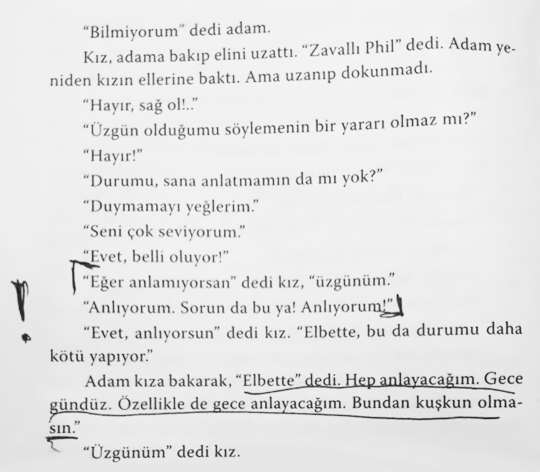
mesela şu:


yani demek istediğim illa öykülerinde size verecek bi mesajı falan yok, o dönemi size eğip büküp işleyip burma bilezik gibi de sunmuyor ama minnacık da olsa bir şey yakalamamak elde değil, tema olarak da, işleyiş olarak da vesaire.

kitabın 'eski' arka kapak yazısı bence öyküleri daha güzel açıklıyor. "... Bütün bu insanların başından geçenler sanki sıradan, önemsiz şeylermiş gibi görünür ilk bakışta. Ancak, bir süre sonra hepsi, Hemingway'in olağanüstü gözlemleri ve yaklaşımlarıyla, okuyucunun gözünde simgesel birer varlık olur çıkar."
aynen bu. biriciğim benim diyor ki, 'bir karakterim var, bir zamanım veya bir mekanım, bir meselem, bir olayım; izninizle ki umrumda değil, başlıyorum...' deyip anlatmaya başlıyor. derdi bu yani. başı, kıçı, içi değil. ki ben bu yalınlığa rağmen bazı hikayelerinde 'ee?' deyip internette hakkında okuyunca 'haaaa.' dedim.

son bir şey: bence bu adamı okuyorsanız, kitabın sonunda hikayeye ulaşılacağını sanmaktansa, okurken, ilk kelimeden yakalayın, yan yana yürüyün hemingway'le. o zaman daha rahat anlarsınız. hikaye bitti ve 'vay be' değil, hikaye sırasında 'ah tanrım' tarzında gibi yani anla beni.


üf kayıp kuşak (lost generation) okumak yeterince zor değilmiş gibi...

şu öyküler müthişti: derin değişim, isviçre'ye selam (3 bölümden oluşuyor), bir günlük bekleyiş, ölümün doğal tarihi, kumarbaz, rahibe ve radyo, babalar ve oğullar

hemingway'e fiziksel olarak da aşığım.
xoxo
iko


not: nick karakteri bir iki kez geçiyor, bilgi yayınevi oluşturmamış böyle bir dizi ama nick'in hikayeleri diye bir olayı var yazarın, mercek altına aldım.
Profile Image for Jay.
259 reviews61 followers
May 8, 2016
Winner Take Nothing was Hemingway’s third major collection of short stories, published in 1933 between his two non-fiction works, Death in the Afternoon and The Green Hills of Africa. By the 1930s, Hemingway had lost much of his luster with the literary critics. With the publication of this third collection, many of the more prestigious of the critics began to characterize some of his writing as tedious, repetitious and uninteresting. Hemingway, now universally recognized as the master of the short story, may have included in this volume several not so memorable pieces but overall the stories continue to challenge and inform.

Death and/or aging are major themes: “A Clean, Well-Lighted Place”; “God Rest You Merry Gentlemen”; “A Natural History of the Dead” reprinted from Death in the Afternoon; “A Day’s Wait”; “Fathers and Sons”. Three deal with Nick Adams: “The Light of the World” places Nick in Michigan as a curious teenager; “A Way You’ll Never Be” sees Nick in Italy after he has been wounded; “Fathers and Sons” encounters Nick as an adult remembering his Father. Love or rather marginalized love runs through several: “The Sea Change”; “The Mother of the Queen”; “One Reader Writes”. Nor does Hemingway ignore the have-nots, the unfortunate, the lonely: “After the Storm”; “Homage to Switzerland”; Wines of Wyoming”; “The Gambler, the Nun, and the Radio”.

As is so typical of his earlier work, the writing is sparse and suggestive, showing an amazing facility with dialogue. And there are always within the stories links to his own life—to the people, places and incidents that forged his own private and public worlds. Although the stories stand alone, knowing something of Hemingway’s biography adds other dimensions to his fiction.
Profile Image for Andy Miller.
976 reviews70 followers
March 30, 2014
This collection of short stories was first published in 1933, 4 years after he wrote Farewell to Arms. It includes one of my all time favorite stories, "A Clean Well Lighted Place" That story's dialogue between two waiters who are waiting for their last customer, a lonely, deaf old man, to leave is simple, straightforward, and short but says more about loneliness, compassion, estrangement, and empathy than any novel fifty times as long

"The Light of the World" is another story that is almost dialogue, most taking place at a train station between Hemingway's alter ego character, Nick Adams, his friend, and others waiting for a train including five prostitutes. I've read this story many times and have never figured out which prostitute, if either, was telling the truth about a relationship with a famed prizefighter(Jack Johnson is discussed in the story a jarring reminder that this story was written in a different time and certainly without any racial enlightenment)

"A Way You'll Never Be" is another Nick Adams story ,a war story that is another example that the real Hemingway stories about war are so much different than the Hemingway reputation for macho stories glorifying war. As with most of his war stories, this does not write of actual battles but of the aftermath of battles already fought and the foreboding of battles to come

"A Day's Wait" is only 3 pages long but says so much about fatherhood and has such a nice humorous ending

"Fathers and Sons" is another favorite story of mine. Nick Adams is driving with his young son with Hemingway describing the landscape as they talk of hunting and Nick's dad, sparking Nick's nostalgic memories of growing up in Michigan, all tied up in a way only Hemingway could do

Profile Image for Olha Brailiak.
97 reviews4 followers
August 22, 2020
Мабуть, не найкраще з Хемінгуея, але все одно дуже добре.
Збірка оповідань, не кожне з яких вражаюче, але в кожному, якщо захотіти, можна побачити щось цінне для себе.
Для перечитування
Profile Image for Brad.
Author 2 books1,917 followers
March 28, 2009
The Sea Change -- This story represents much that Hemingway is great at, distilled to its most fundamental.

He makes us feel his characters in a heart beat. The Sea Change is three and a half pages, yet we know almost everything we need to know about Phil and the Girl instantly, and Hemingway makes us care.

He also expresses setting so perfectly and sparingly that we feel we're in this tiny bar in Paris, yet the description of the bar is implied, mirrored in his descriptions of the couple and James the bartender. Who they are, how they look, how they behave, gives us most of the goods on the bar, and the two additional clients, with their brief interruption of proceedings, give us all the rest we need. The bar is airy and small and private. James is close to his clientele, a trusted barkeep in the traditional mode. There is rich wood throughout and a zinc bar with mirrors behind. Phil stares into those mirrors and sees the change that is in him.

Which is the other thing Hemingway does so well: he expresses the change in people, and the moments that change them, better than any other.

As Phil's Love asks his blessing to conduct an affair with the woman she loves, Phil feels himself responding as society prescribes. He is angry. He threatens violence. He is wounded and tries to wound her with guilt and recrimination. But he loves her too much, and the prescription is overthrown. He is accepting, quickly accepting, and therein lies The Sea Change. He is not the prescribed male he thought he was. His comfort is rocked, not by his Lover's infidelity (for what can that really mean in a world where love cannot be controlled?), but by his realization that he is not the man he tried to be. He looks in the mirror and his true self is revealed beneath the unchanged image that stares back.

It's a pretty powerful message in three and a half pages. I wish I could do that.
Profile Image for Nazarii Zanoz.
568 reviews47 followers
June 28, 2020
В юні роки в мене не склалося з Гемінґвеєм, проте вирішив зробити поправку на вік (не певен, що таку літературу варто читати в шкільні роки) і спробувати ще раз, але тепер коротку прозу. Не скажу, що я в захопленні, більшість історій в цій книжці виявилися або дуже мимо, або я не зрозумів, про що вони взагалі. Але дві історії підкупили: про антропологію війни і про підстріленого мексиканця. В першій реалізм, з котрим Гемінґвей описує все, попри свою страхітливість, якраз тут виявився дуже доцільним. В другій ж помітна майстерність автора в створенні діалогів. Так незвичайно й архетипово водночас, що не можеш не вірити.
Profile Image for Sladjana Kovacevic.
841 reviews20 followers
December 24, 2023
WINNER TAKES NOTHING-ERNEST HEMINGWAY
✒️"His father was with him, suddenly, in deserted orchards and in new-ploughed fields, in thickets, on small hills, or when going through dead grass, whenever splitting wood or hauling water, by grist mills, cider mills and dams and always with open fires. The towns he lived in were not towns his father knew. After he was fifteen he had shared nothing with him. His father had frost in his beard in cold weather."
✒️"You might not like them,' Nick said to the boy. 'But I think you would.'
'And my grandfather lived with them too when he was a boy, didn't he?'
Yes. When I asked him what they were like he said that he had many friends among them."
FATHERS AND SONS
👨Poslednja priča u zbirci je o generacijama jedne porodi ce,o surovom životu i bliskosti koja pruža nadu i u najtežim situacijama,o onima koji odlaze i onima koji ih smenjuju i o stvarima koje ostavljaju trag u sećanju.
👨Na neki način i cela zbirka je o životima ljudi koji se bore sa životnim okolnostima i nastoje da sačuvaju tračak humanosti i kad je najteže.
👨Izuzetna zbirka pripovedaka,od kojih su neke baš ostavile jak utisak.
2,827 reviews73 followers
October 19, 2024
2.5 Stars!

Ah Hemingway that masculine or masculine writers, or so he would have everyone believe, but unfortunately like most hyper-masculine types they usually end up wanting to destroy the world or destroy themselves, and Hemingway opted for the latter.

I’ve only read a couple of Hemingway books and that was over twenty years ago (“A Moveable Feast” and “For Whom The Bell Tolls”). The former was more interesting as you got an insight into the dynamics between the author and the Fitzgeralds as they moved through France. But neither made a lasting impression on me and I found his writing a bit too spare and cold for my tastes.

So anyway I suppose these stories are OK and have some interesting scenes and moments scattered throughout them, and there's certainly moments of quality and imagination, but there's nothing in here which was particularly memorable or that would make me recommend this to anyone in particular.
June 10, 2025
Гемінґвей навряд чи стане моїм улюбленим автором 😅
Короткі замальовки… ніби клаптики… уривки життя)))
Історії про війну особливо зрезонували… деякі були дивними… деякі сюрреалістичними…
Як на мене, діалоги французькою варто було перекласти 😅
Profile Image for Tom Stamper.
657 reviews39 followers
December 24, 2019
I tend to agree with those who say Hemingway’s short stories are superior to his novels after I read Men without Women compared to The Sun Also Rises. I don’t think Winner Take Nothing is as good as the previous story collection, but it still has some interesting tales.

I had read a few of these stories back in college most memorably The Clean Well-Lighted Place, a story that our professor, Dr. Momberger, cherished. He told us that this was Hemingway’s most successful James Joyce homage. Hemingway would frequent the same cafes as Joyce in Paris just to look at him without ever speaking to him. In some ways this story’s old man is Joyce and the bartenders are two halves of Hemingway. The older bartender represents the Hemingway that wants the old man to drink in peace and the younger bartender represents the hell raising Hemingway that want to get on with things. Taken that way it’s an interesting story. On the surface I never would have gotten there without Philip Momberger leading the way.

The story that leads this collection After the Storm is strong. A storm sinks a ship and our protagonist wants to loot the ship before anyone else.

A Natural History of the dead reads mostly like nonfiction up until the conflict between a Lieutenant and an Army doctor at the end.

The Sea Change seems to be a reworking of Hills Like White Elephants. The man and the woman are having a discussion where the subject is only hinted at. Although the subject is different the outcome of both stories makes one wonder as to whether the relationship can withstand the unspoken conflict.

The Gambler, The Nun, and the Radio is reminiscent of The Killers in the stoicism of the man that is going to die as a result of his earlier transgressions. It goes further than that outcome and ends like many of the Hemingway homages of Joyce with no classic resolution. A little philosophy and finished.

The Wine of Wyoming is a charming tale of a French bootlegging couple out west, but the mix of French and English requires language skills. He could have named the main character Nick Adams I suppose.

And speaking of Adams we get The Light of the World early on and the collection ends with Fathers and Sons, my favorite story of the collection. Fathers and Sons begins with Nick Adams driving with his son asleep beside him. The quiet makes Nick think of his own father and his adventures as a youth. Near the end the son wakes up and asks about the Grandfather and the cycle continues.

The collection starts strong, lags a little in the middle and then finishes well.
Profile Image for John.
850 reviews186 followers
December 21, 2019
There was a time that I loved reading Hemingway, but successive readings of his work later in my own life have made me wonder why I liked him so much. This collection of short stories just doesn't seem to have much purpose.

Most of the stories in this collection are "nothing". There simply is no value in the end. There are a few of them that have a sparse beauty to them, but mostly they're just stories of very flawed and selfish people acting out flawed and selfish lives.
Profile Image for Czarny Pies.
2,828 reviews1 follower
December 1, 2020
In "Winner Take Nothing" his third and final collection of stories, Hemingway throws caution to the wind, abandons his standard formula and lays plenty of eggs. His biographers have loved this work, where he reveals far too much about himself. A normal reader will find it embarrassing.
Despite the many low moments, this collection has many rewards for Hemingway's fans. Even when he is not at top form, Hemingway always manages to add depth and nuances to his overall corpus.
Profile Image for Illiterate.
2,774 reviews56 followers
August 8, 2023
Hemingway’s tough characters and sparse prose are most effective when they encourage readers to fill their silences with vulnerability and sentimentality.
Profile Image for Kostiantyn.
502 reviews3 followers
May 16, 2025
It’s a good read overall. The book can create an atmosphere. But each story on its own is not particularly remarkable. Very short, sometimes unpleasant, and in the majority of cases are focused on subjects that make me question why someone would consider writing about that.

“A Clean, Well-Lighted Place” and “A Day’s Wait” are the two exceptions to the above. Both capture human feelings very well. One (feeling) per story. The first should make the discerning reader prepare a glass of brandy, and after the second, hug their child.

“After the Storm” – what a pity! The premise of diving to a sunken luxury liner… Total crap. But what a pity! It had so much potential.

“The Sea Change” and “The Light of the World” were not bad, but not pleasant to read. Same for “God Rest You Merry, Gentlemen” and “One Reader Writes”. Those were even interesting, but still not pleasant to read.

“A Natural History of the Dead” and “A Way You’ll Never Be” – war… these stories here seem meant to give the reader a full range of things that Hemingway wrote about. So it’s dark, horrible, and pointless, just like war.

“The Mother of a Queen” – a very strange story. Not bad, but very strange. As the author asks at the end, “What kind of blood is it that makes a man like that?”, it makes me question what kind of ink was used to write down a story like that.

“Homage to Switzerland” – a funny collection of stories combined under one title. I’m not sure what the intention was, but collecting several stories under one name was not a particularly successful approach, in my opinion. It felt like reading through several drafts.

“Wine of Wyoming” and “Fathers and Sons” didn’t really resonate with me, despite being interesting stories.

“The Gambler, the Nun, and the Radio” – fun and nice, but with some weird dialogues and monologues. In other words, it probably can be the best of the book if not Sister Cecilia. The thin one knows it:
“I distrust all priests, monks, and sisters,” said the thin one... “Now I believe in nothing. Neither do I go to mass.”
“Why? Does it mount to your head?”
“No,” said the thin one. “It is alcohol that mounts to my head. Religion is the opium of the poor.”
Profile Image for John.
1,680 reviews131 followers
December 23, 2025
Seventeen short stories first published in 1933. The stories are set in Africa, Spain, Florida, Wyoming and one in Switzerland. Sad, poignant, observational and during the Spanish Civil War.

Hemingway captures the everyday tragedies in daily life. The idiocy of war and the efforts people make to survive and acceptance of fate.

The Short Happy Life of Francis Macomber stood out for me. A wealthy man on a safari panics and is seen as a coward by his wife hunting a lion. She sleeps with the guide but the next day Francis finds his courage and his wife knows he will leave her so she accidentally shoots him dead while he courageously confronts a buffalo. The guide knows she murdered him but covers it up.

After the Storm based on a true shipwreck off the Florida Keys. A salvager cannot get into the ship as he doesn’t have the right equipment and when he returns others have stripped it bare.

Homage to Switzerland is a story in three parts with each part telling the story of a different man in the same Swiss train station.
This entire review has been hidden because of spoilers.
Profile Image for Marysya.
362 reviews41 followers
August 17, 2019
Дуже Гемівська атмосфера - вечір пізнього літа, забута Богом кав*ярня чи бар, вино і розмови, багато розмов, які мали б мати терапевтичний ефект на героїв, яких давить розчарування, сум, втрата. Але їх важко зцілити - самотність огортає та приглушує. Дуже коротенькі ескізи до історій, хотіло б ся продовження, бо не впевнена, що встигла за ці пару сторінок вловити суть деяких з них.
Profile Image for Sean Taylor.
69 reviews17 followers
Read
September 21, 2023
Reading Hemingway's short stories has been revolutionary for me. Truly a masterclass in subtext and, more importantly, pure joy.

(As well as Joyce--I see he wears the Dubliners influence on his sleeve.) Of course I loved the Montana connections too.
Profile Image for Caden.
2 reviews
June 26, 2024
Wine of Wyoming may be the best short story I have ever read.
Profile Image for Pat Rolston.
388 reviews21 followers
January 21, 2021
I experienced this book in audio mode with Stacy Keach delivering a perfectly matched reading to the sparse staccato dialogue. I am sure Hemingway would be smiling at Keach’s interpretation of the dark and compact short stories. The stories strike me as akin to the non sci-fi 1950s versions of Black Mirror. They often end with sudden finality and some far more dramatic than others. This is a book I highly recommend in this audio format, but I don’t find the stories compelling enough to go back and read again as the printed word.
Profile Image for Tessa van Nes.
18 reviews
November 21, 2023
Boy, oh, boy, am I glad I finished this book. Oh my Lord. At times I could see why he's considered a good/interesting writer, but even placed in context, I found this a rough read. There is so much about it that I didn't like, I could write an essay about it. But I'd rather not.
Profile Image for Evalyn.
Author 14 books33 followers
June 23, 2018
A collection of short stories by one of my favorite authors. These are not necessarily my favorites but Hemingway's minimalistic, terse style give the stories a forthright impact that is unmistakable.
Profile Image for Romaissa.
96 reviews46 followers
July 8, 2019
This book is my introduction to Hemingway's works. I didn't enjoy most of the stories, but i must say that he is a really good writer. I haven't read a book before with such writing style; it is unique. The stories share themes of loss, loneliness, alcoholism, the aftermath of war and other subjects related to the dark side of reality. The stories varied in length; some were long and others were more like a one scene description. My favorite is The Sea Change which was about a break up of a couple in Paris. What i liked most about the stories, if not only, is the style of the author. His descriptions of the setting made me feel like i was right there in the scene although i wasn't enjoying the story that much, but his writing has the ability to affect this way. I also found his narration similarly cinematic and very clever. I would like to read another of his works, but certainly a novel next time.
Profile Image for Naleendra Weerapitiya.
309 reviews32 followers
May 29, 2022
Hemingway published three Short story Collections, and this is the third one. In previous years I've read the first two ( In our Time, and Men Without Women), and my aim is to read "The Complete short Stories of Ernest Hemingway", which is a collection of 70 stories. This book has two sections - the first forty nine stories ( which has his 3 short story collections, plus a six more), plus those published in books and magazines subsequent to this 49, along with seven unpublished ones.

After the Storm: In a way, our narrator, the looter of wrecked cruise ships is a winner, since he's the first to discover the wreck, and he guesses that many are the treasures for the taking, if only he can get into the ship, which has been sunk and stuck in the quick sand. He risks his life a couple of times to gain access, but fails. When he returns, better equipped, he finds that someone after him has taken all there is to take. He may have been a winner in discovering the recent wreck, but he gets nothing for his troubles and risks. Life is that way, the author seems to suggest.

A Clean Well-Lighted Place is just that, in how it paints a picture in the reader's mind. A waiter, who understands that for some, there is no better place, than a well lighted clean place to slowly drink away the night; while those who do not wish it have someone waiting at home for them. A classical Hemingway story, where the bare feel of the environment, a lonely old man who says just a few words, but who's better represented across the dialogue between the two waiters, creates a sense of compassion for those who needs a clean well-lighted place, away from the darkness, for whom it is synonymous with loneliness.

The Light of the World : This story is considered a Nick Adams story, with the narrator thought of as Nick. Nick is with his friend Tommy, and they while away their time, first at a bar, and then at a station. While they are not welcome at the bar, a person who is hinted as being with a certain sexual tendency shows some interest in the young boys. The station also finds some prostitutes who speak of a now dead boxer - with two of them arguing as to who actually knew him, among the two of them. The overall tone of the story is one of recalling better times ( the prostitutes - they are clearly obese now), or trying to win a favour ( the gay cook), while the two boys while away their time in an aimless way.

God Rest You Merry, Gentlemen: Here, two doctors discuss a strange case, and the bungling of at least one of them, in the company of our narrator, Horace. The doctors dialogue is an interesting one, as it touches incompetence, subtle antisemitism, as well as misgivings of a youth burdened with the idea of sin. Although Hemingway's iceberg theory is practiced here as elsewhere in this book, the dialogues shed more light than in other instances.

The Sea Change: Adopting his "iceberg" stance in his little tales, we find Hemingway telling us a little story about a breakup, with the girl having been unfaithful with another girl. The boy, so close to forgiving her and making up, talks to himself, instills a stance of a discipline artificially, and lets the girl go.

A Way You'll Never Be: In this Nick Adams, shell-shocked and traumatized, visits his friend, the Italian Captain Paravicini's encampment. Nick is troubled by certain images, and has a tendency to rant, and talk at length on unrelated subjects. While his friend Paravicini is both sympathetic and concerned about what his walking about could trigger, we the readers feel for Nick, the free spirited boy whom we first met as a teenager (if that), two collections ago. By now the war has made a mess of him!

The Mother of a Queen: One thing that needs to be noted when reading fiction which is almost 90 years old ( some of these stories must be over a 100), is how people then looked at "the other" who is different to you. In this story, the queen is a gay bullfighter, who doesn't keep his end of the bargain with money. The narrator who appears to be his manager concludes the story disparagingly.

"There's a queen for you. You can't touch them. Nothing, nothing can touch them. They spend money on themselves or for vanity, but they never pay.... What kind of blood is it that makes a man like that ?

One Reader Writes is a letter to a doctor, seeking advice on whether it'll be safe for her to return to her husband, who is undergoing medication for a STD upon returning from war. The woman clearly is lost between her father's pressure to leave him, and her love for her husband. The woman is hinted as being marginally ignorant, and the letter carries a genuine concerned tone, and hence its attraction.

Homage to Switzerland is a fantastic story in three episodes, all taking place inside a station cafe. Its attraction lies in the warmth of the cafe which comes across the pages, as well as the attitudes of three guests, two of whom try who try lead on the waitress, while one is going through a painful separation himself. The third character discovers a life long fan of the National Geographical magazine, and a cozy conversation takes place. As the title suggest, the three scenes suggest the cosy comfort of the station cafe, the hospitality, the cold outside contrasted. While the story doesn't ever attempt to say it, it is clear with the use of his tip of the iceberg way of writing, that it is a lovely place to be, and he cherishes his memories there.

A Day's Wait, is a story of innocence as a young boy works himself to a state thinking that his death is imminent, all through mixing up of two scales used for measuring temperature.

A Natural History of the Dead: This short story begins by presenting the view points of the Scottish traveler Mungo Park, as well of Bishop Stanley that no branch of Natural history could be studied without an increasing of faith, hope, and love. Well, Hemingway mockingly, but maintaining a stoic like stance, detail us some war related deaths which leave us with some heavy dents on whatever faith we had, and quite hopeless of this world being anything wonderful.

Wine of Wyoming attempts to do a comparison of life as seen by a traditional French couple, now in Wyoming, and the American way of life. The very Catholic French couple are abundant in hospitality and they find it hard embrace the more liberal ways of the Americans, the whiskey consuming, the drinking by the girls etc. A large part of the dialogue take place in French, and the fact that I was using the kindle helped me look up the translations.

The Gambler, the nun, and the Radio is story based in a hospital, in which a Mexican is being treated for a shooting accident, and Frazer ( a writer), convalesces. The nun in question is so excitable, that it is clear that she does her utmost to conceal her womanliness in prayer. The radio is all that the convalescing writer has to resort to. The story which stretches on at the pace of slow days in a hospital takes on a philosophical bent, when the gambler raises that the point that the opium can be different things for different people.

Revolution, Mr. Frazer thought, is no opium. Revolution is a catharsis; an ecstasy which can only be prolonged by tyranny. The opiums are for before and for after. He was thinking well, a little too well.

Nick Adams is now 38 years old. I was glad to note that he's made a good recovery from the time we found him in "A Way you'll never be". Nick drives with his son by his side, reminisces about what he loved about his dad, and what he didn't. He recalls the times he spent with his native Indian friends, the hunting and fishing days. It is easily one of the best stories in this collection, as it illuminates a great deal about the relationships between Fathers and Sons.

All in all this collection too carries the short story characteristics of Hemingway, its little said - much implied tone, plenty of war time/ war related stories, and the charm that it brings to the reader. Not to be missed by a lover of short stories, for sure.

Rating: ****1/2


Profile Image for Δημήτριος Καραγιάννης.
Author 3 books5 followers
August 18, 2021
This was my first real contact with Hemingway. I had read some of his stories here and there during the long years of uni, but never something quite concrete. I can now come to a first understanding of him as an author in the sense that we have now been introduced.
1. Hemingway feels like the Tarantino of the modernist era in 20th American literature. His dialogue is incredibly witty, fast and is one of the most realistic ones i have ever encountered in a literary text. He bombards the reader with dialogue, description, action, and it feels like i am watching an action film with the characters being actors that keep on babbling and murmuring while shooting and driving and moving around.
2.I did not quite grasp the modernist feeling of depression, nihilism and death, despite the fact that several of the stories were about hunting, killing and deaths. Instead, i gathered that Hemingway had a very narrow view of life, highly centered on the insecurities of the modern males of his time, with little regard towards philosophy, possessed with gaps that he violently seeks to fill with recreational activities. When those activities are nine times out of ten hunting or harassing female waiters, you can see where the problem with Hemingway lies.
3.It can be argued that he is merely honest or sought to depict how the male person of his time viewed life and its joys and woes, but I simply cannot see it like that. The pattern is way too predictable and repetitive to be ignored.
4.His stories are quite entertaining, but i found them rather shallow in content and depth, like i mentioned earlier. Instead of philosophical and psychological pondering, it constantly feels as if his characters merely want to make a statement or indulge in cheap-quality escapism.
5. For the record though, reading Hemingway made me feel like I was reading a contemporary author despite the fact that he wasn't my cup of tea. He was, undoubtedly, way ahead of his time.
Profile Image for Bruno.
302 reviews17 followers
December 18, 2020
Another interesting collection of short stories.Some of them involve Ernest Hemingway in a role of a traveler, Nick Adams (mentioned in In Our Times). Of course, it's not his only role,as he witnessed many of the events his stories are based,adapted or inspired by. I've found many stories quite engaging (among them After the Storm, A Clean,Well-Lighted Place, The Mother of a Queen, Wine of Wyoming and The Gambler, the Nun and the Radio), while the others were left in obscurity, due to not paying too much of an attention because of how short they are. The same reason is for the other two collections (In Our Times and Men Without Women), but I wanted to go through all forty nine stories (I will review the remaining stories next), so I can express my personal opinion. Winner Take Nothing discusses themes of life, hope, futility, hospitality, resentment or joy of foreign intervention, personal struggles and inner conflicts, but gives us more investment, since it has more stories with 15-20 plus pages than the other two. However you choose to read them, it doesn't matter,because you won't be disappointed. If you are a fan of short stories,you can spend an entire month and enjoy it (reading 2-3 stories per day). Have a nice day
Displaying 1 - 30 of 263 reviews

Can't find what you're looking for?

Get help and learn more about the design.