Jump to ratings and reviews
Rate this book

Некрофил

Rate this book
Книги Витткоп поражают смертельным великолепием стиля. «Некрофил» ослепительная повесть о невозможной любви нисколько не утратил своей взрывной силы.

204 pages, Paperback

First published January 1, 1972

82 people are currently reading
7598 people want to read

About the author

Gabrielle Wittkop

19 books128 followers
Gabrielle Wittkop (née Menardeau) (1920-2002) was a French writer. She was born in Nantes. She married Justus Wittkop, a Nazi deserter, in Paris and moved with him to Germany in 1946 after the end of the Second World War.

Her first book, on the German writer E.T.A. Hoffmann was published in German in 1966. Her first novel Le Necrophile (The Necrophiliac, 1972) was published in 1972 by Régine Desforges. She wrote several highly regarded novels and travelogues. She also contributed to the art pages of the Frankfurter Allgemeine Zeitung.

After her partner committed suicide, she wrote an account of it in Hemlock (1988). She herself committed suicide in 2002, after she was diagnosed with lung cancer. Although popular in France and Germany, Wittkop's works are not widely available in English. The Necrophiliac was translated in a Canadian edition by Don Bapst in 2011.

(from Wikipedia)

Ratings & Reviews

What do you think?
Rate this book

Friends & Following

Create a free account to discover what your friends think of this book!

Community Reviews

5 stars
906 (26%)
4 stars
1,323 (38%)
3 stars
800 (23%)
2 stars
255 (7%)
1 star
115 (3%)
Displaying 1 - 30 of 631 reviews
Profile Image for [P].
145 reviews610 followers
February 11, 2016
Last Christmas I decided I was going to buy my mother some books. She has always been a reader, but I had never really taken any notice of what exactly she read. So as the end of December approached I steered one of our conversations towards literature, and was surprised to discover that she likes ‘the nastiest’ thrillers, featuring ‘gruesome, stomach-churning murders.’ I suggested a couple of titles, ones that I own, which, as I don’t enjoy nastiness myself, are admittedly PG13 in terms of content, and was told that they were ‘not horrible enough.’ As a result of this conversation, I, being a dutiful son, went away and did some research and tried to put together an appropriate selection of books. Indeed, I was put in an absurd, and uncomfortable, situation whereby I found myself having to weigh up whether, for example, a bunch of women being tied to radiators and repeatedly raped was more or less nasty than the slaughter and dismemberment of children. Where, I asked myself, do these acts sit on the unpleasantness scale? And the thing is, I could have spared myself all that, for I actually already had a book in my possession, one that I had completely forgotten about, but which, I’m sad to say, would likely give my dear old mother quite a thrill. It is The Necrophiliac by Gabrielle Wittkop.

Before I move onto discussing just how unpleasant large parts of this little book are, I want to return to something that I wrote in the previous paragraph, something that might strike you as odd or inconsistent. I wrote that I don’t enjoy nastiness myself – and that wasn’t a lie, being someone who refuses to watch The Human Centipede, for example – and so you might justifiably ask why I would therefore even contemplate reading a book called The Necrophiliac, which is, I’m afraid, appropriately titled. Well, part of the reason is that I have lately found myself running short on books to read, and have, as a result, turned to more genre fiction, the kind of thing that I have until now not fully explored. The Necrophiliac is, then, the final stop on my short foray into outré gothic literature, which has also seen me take on Maldoror and The Manuscript Found in Saragossa. Secondly, and more significantly, I was interested in Gabrielle Wittkop herself. I have written previously that I don’t care about authors and their biography, that I actively avoid all that stuff, but in this case I think it is relevant, and certainly goes some way to explaining the allure of her work [for me, at least]. Wittkop was a French writer, who married a deserting Nazi, one assumes in order to legitimise and protect him, but also to provide a front for his homosexuality. Moreover, Wittkop committed suicide in 2002, after having contracted lung cancer [which my mother also has]. This was, quite clearly, a ballsy lady, someone who really didn’t give a fuck what people thought of her, someone who was opposed to any kind of “social consciousness,” and was intent on living her life, and dying, as she saw fit. And I find that attractive, and it made me more sympathetic to her book, it made me see it in light of her desire to not only piss off conventional society, but also exercise her freedom.

“She’s not one of the dead from whom I have any grief in separating myself, the way one deplores having to leave a friend. She certainly had a mean character, I would swear to it. From time to time, she emits a deep gurgling that makes me suspicious.”

So, how unpleasant is the The Necrophiliac? Very, is the short answer. I must admit that I was close to abandoning it after only two or three pages. The book begins, one suspects intentionally, by giving you the impression that ‘the little girl’ being described is actually still alive – Lucien, the narrator, notes her ‘sly, ironic smile’ – and yet it soon becomes clear that she is not, as he declares that he cannot enter the ‘very beautiful dead girl’ right away, that he must wait a few hours until the body has softened. I was, without exaggeration, holding on by my nails at this point, but what follows will probably stay with me for the rest of my life. It is truly disgusting, truly vile. And it doesn’t stand alone. The scene in question isn’t simply a case of a book starting ‘with a bang’ and then settling down or becoming more approachable. There are numerous disturbing, and quite graphic, descriptions of sex with dead people, more than one of whom are children [including a baby]. Confronted with all that, this was the first time in my reading life that I had to make a concerted effort, a conscious decision, almost as though it was a test of endurance, to continue with a novel, when it would have been easier for me to have thrown it away from myself. Perhaps you have a stronger stomach than I do, but I make no apologies for what I have revealed [nor for my squeamishness]. Certainly no review of The Necrophiliac ought to play down its contents.

description
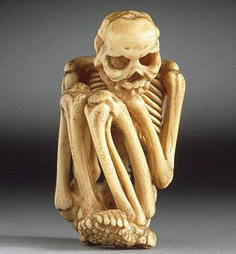
[Skeleton netsuke, a miniature Japanese sculpture referenced in the novel]

I imagine that the book’s most ardent defenders [and they do exist, and I may be one myself, once I have had more time to digest it] will refer to Wittkop’s prose. There is an intentional discrepancy, a kind of disconnect, between the consistently appalling content and the sophisticated style. Wittkop, via Lucien, writes in impressively fluid, elegant sentences, that are reminiscent of Vladimir Nabokov or the great Italian author Giuseppe Tomasi de Lampesdusa. Lucien is, in fact, almost charming, but certainly intelligent and persuasive company, such that you at times forget that he does, and truly enjoys, unspeakable things. Indeed, he often writes with genuine tenderness about his love for the dead people he desecrates [going so far as to claim that he doesn’t want to hurt the corpse of a little boy], and, as noted earlier, he treats them, speaks about them, as though they are alive, as though he has a legitimate relationship with them; he remembers them, he refers to them by name [which shows that they are not just a body to him], he eulogises them and the pleasure they gave or give him. I have actually seen the book referred to as a romance novel, and while that seems something of a stretch it could be said to be a love letter to necrophilia, to the special joys of union with a corpse. I must also point out that it is Lucian’s dry, straight-faced, very serious narration, that accounts for how the book is at points surprisingly funny. I’m not sure I have it in me to convince you of that, but there is definite humour in episodes such as when he calls little Lucian [which isn’t a euphemism for his penis, but rather himself as a child] a young romantic for eyeing some acquaintance and wishing that she were dead.

“Their fine powerful odor is that of the bombyx. It seems to come from the heart of the earth, from the empire where the musky larvae trudge between the roots, where blades of mica gleam like frozen silver, there where the blood of future chrysanthemums wells up, among the dusty peat, the sulphureous mire. The smell of the dead is that of the return to the cosmos, that of the sublime alchemy.”


If you have read Lolita much of what I have just been discussing will be familiar to you. The Necrophiliac is, without question, heavily influenced by Nabokov’s most famous, and best, work. That claim may serve to inspire more people to pick up and read Wittkop’s novel, but, for me, it is also something of a criticism, for it did, in places, veer almost into the realm of pastiche. There is, for example, a passage that is very similar to Lolita‘s ‘fire of my loins’ opening sentences [“Suzanne, my beautiful Lily the joy of my soul and of my flesh…”]. I guess the level of one’s admiration for the Russian, and one’s opinions about literary theft or influence, will determine how much this sort of thing bothers you. Another possible problem with The Necrophiliac is that it is just too short, clocking in at under one hundred pages, in a book that is less than standard dimensions. It may, for some, be a blessing that we don’t get to spend significant time with Lucien, but I would have preferred there to be more of a plot, so that the unpleasantness didn’t stack up, one after the other; I would have liked to be allowed to breathe a bit more, to enjoy the prose and some of the nice turns of phrase and interesting observations. On this, it is also worth pointing out that Wittkop, as you would expect, only half-heartedly attempts to justify, or give an explanation for, her repugnant creation and how he came to be what he is. Lucien reveals that his younger self was masturbating [quite innocently, it seems] when he found out that his mother had died, and therefore one could see this as forming in his mind some kind of connection between sex and death. There are also some hints that, as with someone like Jeffry Dahmer, he prefers the dead because they are, unlike the living, ‘silent’ and ‘agreeable.’

As I come to conclude, I am drawn back to my initial reaction to The Necrophiliac, which was to ask myself ‘Do I want to take this book to work?’ I think it was the first time I had ever contemplated this question. Do I want to be seen with this? Do I want other people to know that this is what I am reading? Do I, more specifically, want to field questions about it? I had visions of being in the staffroom and someone, as they invariably do, asking me ‘what are you reading?’ Ah, well, um…a book. ‘What’s it about?’ Er, oh…a man…who fucks dead people. ‘How interesting…are you enjoying it?’ Am I enjoying it? Did I enjoy it? Yes, yes I did. With one or two reservations.
134 reviews97 followers
December 9, 2023
And me, soon, I will fall into death like Narcissus into his own image.

The heart wants what the heart wants. In the case of Lucien's heart, it's dead people.

This is his diary.
In excruciating detail, he describes his lovers as they vomit black liquid, turn from pale to purple, and—once their rotten bodies disintegrate under his touch—eventually end up in the Seine.

As acquired as Lucien's taste may be, one can't help but feel for this man whose life is shaped by constantly having to let go of the ones he loves.

The Seine had welcomed her body, which had been saturated by my sweat and engorged by my semen for two weeks. My life, my death, mixed in Suzanne. In her, I entered into Hades; with her, I travelled all the way into the oceanic silt, tangled myself in the seaweed, petrified myself into the limestone, circulated into the veins of coral...


Despite the unappetizing imagery, the beauty of Wittkop's prose creates distance between the reader and Lucien's doings, so I wasn't too bothered by the detailed descriptions of all the ways he has fun with people past their expiration date.

A great read for those who enjoy reading about vile things described with pretty words—or for those who get all hot and bothered at open casket funerals.


Big fat TW for necrophilia (duh), including dead children.
Profile Image for Carlos De Eguiluz.
226 reviews196 followers
July 20, 2017
Advertencia: Este libro es súmamente oscuro; hasta me atrevería a decir que es el más perverso que he leído en toda mi vida. No recomendable para menores de dieciocho años, personas de estómago sensible y/o suceptibles a la muerte.

Cuatro estrellas a una terrible atrocidad, a la prosa de una mujer atormentada, a la peligrosa lectura de la maldad y la depravación encarnada.

Hay una razón por la que tardé más de tres días en leer este simple y pequeño libro, y esa es su temática —vaya, hasta sigo sintiendo escalofríos—. Y claro, sabía en lo que me estaba metiendo desde que leí el titulo; sin embargo, con lo que me encontré páginas después fue mucho peor. Me encontré a mi mismo tratando de asimilar situaciónes atroces, maldades innombrables y buscando humanidad en lo inhumano.

A resaltar: La introducción a la necrofilia a nuesto personaje principal. Cómo los necrófilos se reconocen. La pedofilia inducida en el taumatismo. Los delirios y esperanza por la muerte de las personas que deseaba. Los gemelos.

No sé si sea buena idea comentarles a fondo lo que aquí sucede, pues, ni yo mismo me siento cómodo exponiendolo. Recomendaría que le echaran un vistazo, pero no, mejor no lo hagan.

"Mi sastre —un sastre que ha conservado los untuosos modales de los viejos tiempos y me habla en tercera persona— no ha conseguido a la postre dejar de sugerirme un vestuario menos sombrío. «Pues, por elegante que sea, el negro resulta triste.» Es, por tanto, el color que me conviene, ya que yo también estoy triste. Triste por tener que separarme siempre de los que quiero."

"No puedo ver a una mujer bonita o a un hombre agradable sin desear inmediatamente que estén muertos. Antes, en los días de mi adolescencia, lo deseaba incluso con pasión, con furia. Se trataba de una vecina, tres o cuatro años mayor que yo, una muchacha alta y morena, con los ojos verdes, a la que veía todos los días. Aunque la deseaba, nunca se me ocurrió ni siquiera tocarle la mano. Esperaba, ansiaba su muerte, y esa muerte se convertía para mí en la máxima aspiración en torno a la cual gravitaban todos mis pensamientos."

Me gustaba figurármela en su lecho de muerte, imaginar con toda exactitud las circunstancias del entorno, las flores, los cirios, el olor fúnebre, la boca pálida y los párpados mal cerrados sobre unos ojos en blanco. Una vez, al encontrármela por casualidad en la escalera, observé que mi vecina tenía un pliegue doloroso en la comisura izquierda de los labios. Yo era joven, estaba enamorado y era romántico, lo que me hizo deducir inmediatamente que ella tenía una secreta tendencia al suicidio."

"Durante catorce días, he sido inefablemente feliz. Inefablemente pero no del todo pues, para mí, la alegría siempre va acompañada de la pena de saberla efímera, la felicidad lleva siempre, ostensiblemente, el germen de su propio final. Sólo la muerte —la mía— me liberará de la derrota, de la herida que nos inflige el tiempo."

"El Sena había acogido su cuerpo, saturado a lo largo de dos semanas de mi sudor y repleto de mi semen, mi vida, mi muerte, mezclados en Suzanne. En ella entré en el Hades, con ella rodé hasta los légamos oceánicos, me ensortijé en las algas, me petrifiqué en las rocas calizas, circulé por las venas de los corales..."

"A decir verdad, pienso más bien que la ocasión hace al ladrón."

"Hay en mis amores un instante inefable, aquel en que descubro por primera vez el rostro del acompañante con que me gratifica la suerte, cuando me inclino con avidez sobre él y descubro las facciones que no tardarán en resultarme familiares."

"La muerte me atrae desde muy lejos, a través de unos laberintos desconocidos."

"Me sentí como avergonzado de gozar de él allí mismo, expuesto a la hostilidad de un mundo abierto, a los peligros de los imponderables. Pues la clandestinidad exige unas murallas que protejan del aliento de la tierra y unas cortinas que detengan la mirada de los astros."

"Sólo hay una cosa asquerosa: ocasionar dolor."

"Me gustaría vivir y me gustaría morir, pero no puedo vivir ni morir."

"Extraños al mundo de los vivos, habían sido creados para morir y la Muerte les había señalado apasionadamente desde el principio."
Profile Image for Meike.
Author 1 book4,950 followers
September 1, 2022
Gabrielle Wittkop masterfully trolls us with lyrical romantic language, Gothic motifs, and an abundance of literary references from Edgar Allan Poe and Vladimir Nabokov to the Marquis de Sade: In her slender epistolary debut novel, a highly cultivated antiquarian from Paris celebrates the melancholic beauty of our constant decay by, you know, robbing graves and having sex with corpses. It's disgusting and hilarious, and it's also perfectly crafted. In his diary, Lucien, the title-giving necrophiliac, plays with tons of literary tropes, but turns them into the grotesque, the macabre, and the bizarre, and it's all way more amusing than it should be.

You can learn more about necrophilia from my favorite mortician Caitlin Doughty who tallked about it on YouTube, and in case you wonder why in the world I picked up this book, check out the video on the rediscovery of author Gabrielle Wittkop by a man of wonderful literary tastes, Cliff Sargent, here.
Profile Image for Sam Quixote.
4,801 reviews13.4k followers
October 10, 2014
Lucien is an antique dealer, a French gentleman, and a necrophiliac. The book is told from the first person perspective in diary form as we follow Lucien’s dark adventures robbing graves and taking back the recently interred back to his home where his actions with them are described in unflinching detail.

There isn’t much else to the story – the types of dead people changes such as going from a young woman, to an older woman, to a man, to a child, and to a mother and her baby. Each encounter is described tenderly in the style of a romance novel except that one of the (unwilling) participants is dead.

Gabrielle Wittkop does try to explain her protagonist’s behaviour but I found her explanation to be a bit pat. Lucien masturbates for the first time shortly before his grandmother tells him his mother has died and that he must say goodbye. As he kisses the corpse of his mother he forever links the two things together – sexuality and death; a bit too convenient, no? I think the reality of the mind of a necrophiliac would be less logical than that to the point that their behaviour and their choices would be unexplainable and utterly confounding to the ordinary person.

Lucien is a fascinating person though. At times he appears strangely normal as he goes about his ordinary daytime life. At horrifying moments, like when he’s with a dead infant, he clearly sets down what he believes to be the distinctions between himself and an infamous French medieval nobleman called Gilles de Rais who raped and murdered children.

I think the shortness of the book (83 pages on smaller than average pages) helps the book as I don’t think I could have finished it at even twice the length. The repeated trysts that Lucien describes with the various corpses are both distasteful and dreary to read by the end of the book and the lack of a plot means the reader is left with descriptions of putrefying bodies and Lucien’s methods of maintaining the bodies for days on end.

Wittkop has created an original character in Lucien while gifting him with an eloquent voice that never fails to disturb. Her writing is truly high quality and the book is easy to read for that reason, while being difficult to read because of the subject matter. The Necrophiliac is a morbidly engrossing read that anyone interested in horror or gothic literature might want to check out. There certainly aren’t many books like this out there!
Profile Image for Vicki Herbert - Vacation until Jan 2.
727 reviews170 followers
November 1, 2023
You Can Put Lipstick On a Pig, But...

THE NECROPHILIAC by Gabrielle Wittkop

No spoilers. 4 stars. If you purchased this book to learn more about what makes a necrophiliac tick, this story gives you all the variations and positions, etc...

However...

I removed 1 star for trying to sell this book as beautiful poetry. You can put lipstick on a pig, but it's still a pig...

The book is written in diary form and tells the story of Lucien, an antique store owner who robs graves, takes the dead back to his apartment, and has sex with them...

Until they become so putrid...

... that they stink up his apartment and himself, then dumps them into the Seine. Sounds a little like a serial killer to me except that they are already dead...

He is not picky...

He has no preference (man, woman, child, perfect, deformed) they need only be dead...

This book was sensational in a sleazy way, trying to pass itself as poetry. If you're just curious about the hows of necrophilia this book covers it all. If you're looking for poetry, look elsewhere.
Profile Image for Nate D.
1,653 reviews1,250 followers
August 6, 2016
The journals of an erudite and cultured connoisseur of the pleasures dead flesh. A well-spoken monster, perhaps. The real feat here, in this singular entry into the canon of the transgressive French novel, is Gabrielle Wittkop's ability to entirely withhold judgement. There's no reckoning here, no moral, no strong narrative, not even any real attempt to psychoanalyze, compartmentalize, or explain away what is taking place: just the uneasily not-even-really-always-that-repulsive musings of a man who steals the bodies of the dead and sleeps with them. The sheer frankness (coupled with the beautifully-formed prose throughout) makes this somehow disturbingly not all that disturbing. It lulls you into accepting its world. Or is this horrific and there's something wrong with me for accepting it so easily? But despite the ghoulishness of his preoccupations, Lucian's not really harming anyone (besides the bereaved, of course, but we hear nothing about whether or not they even learn that their former loved ones have gone missing), so he can begin to sound, as his voice insinuates, really not all so insane as we might desire that he must be.
Profile Image for To-The-Point Reviews.
113 reviews103 followers
January 7, 2025
Can I interest you in a beautifully written book about a fella who fucks dead people (including children)?

Well, can I?
Profile Image for Bogdan.
134 reviews82 followers
March 21, 2025
Cadavre exquis, le nom d'un célèbre procédé poétique surréaliste, est illustré dans ce livre d’une manière bien plus littérale qu'on ne le croirait ou ne le souhaiterait avant la lecture…

Il s’agit véritablement d’un nécrophile qui, dans son journal, décrit sa passion avec un luxe de détails hallucinants. Et si ce ne sont pas les cadavres eux-mêmes, alors c'est bien la prose qui les embaume qui est exquise…

Il y a une sensualité macabre – cette coïncidence entre Éros et Thanatos – mais aussi un humour noir ensorcelant! Je dois avouer que j'ai eu quelques crampes de rire et que j’ai lu la plupart du livre avec un sourire indescriptible…

Si l'on veut lire quelque chose d’interdit en dehors de l’imagination et de la littérature, mais qui se retrouve ici écrit avec le plus beau style et aussi avec le plus fin goût possible, alors lisez Le nécrophile.

Ce contraste radical entre le style exquis et le contenu grotesque m’a rivé les yeux aux pages et m’a fait me sentir un peu comme la humaine, trop humaine bête, le criminel de M de Fritz Lang qui, accaparé par une foule dans le sous-sol d’un bâtiment, crie à ses implacables juges, en se justifiant comme un être psychologiquement scindé:

Ich will nicht, ich muss!


Moi aussi, en lisant ce livre, je lançais parfois des cris muets vers l’instance morale qui se trouve (peut-être) quelque part dans mon âme:
— Je peux pas le lire!
— Il faut! résonnait l’écho esthétique.
— Non! Je peux pas!
— Il faut!
— Je ne peux pas!...
— Il faut!...

P.-S. : Je blague, évidemment. J'ai lu ce livre avec le plus véritable plaisir du texte, la jouissance dont parle Barthes. Il n'y a pas d’art morbide – tout vrai art est vital.
Profile Image for xelsoi.
Author 3 books1,073 followers
July 5, 2024
Reseña de julio, 2024
Dos años más tarde, me gustó tanto como la primera vez.

Reseña de julio, 2022
Esta nouvelle - me dio con ese concepto, sepan perdonar - es el diario de un anticuario quien, por las noches, asalta los cementerios franceses para exhumar cadáveres recién enterrados y violarlos hasta que la putrefacción ya no se lo permita.
Las imágenes son increíblemente morbosas. La descripción del sexo es gráfica y minuciosa. La selección de víctimas - si es que puede llamársele así a un muerto - es tan variada como perturbadora: desde mujeres que encarnan los valores del bien y la belleza para el siglo XX, hasta niños precozmente desahuciados. Este relato setentero no conoce el pudor ni la moral.
La prosa, por su parte, es preciosa. Cada frase parece articulada con su cuidado y delicadeza. Esta densidad alarga las cuarenta páginas sobre las que Wittkop escribe El necrófilo, para bien, a mi parecer. Su brevedad no merma ni su belleza ni su encanto.
Profile Image for nastya .
388 reviews521 followers
January 26, 2023
My second foray into the classics of transgressive fiction after The Story of the Eye. Testing my limits. The title says it all.

I thought Wittkop was a beautiful writer, she's French (why is it always French, anyone knows?). She must be great, because unlike Bataille, this book got under my skin and made me nauseous with all the sumptuous descriptions of rotting human flesh and liquids coming out from the decomposing body. Also there's a very macabre sense of humor in here.

Unfortunately I skipped a little by the end, I just wanted it to end to be honest, even though the book is tiny. So I am impressed... and disgusted. Don't eat anything before reading it.
Profile Image for Katherine.
512 reviews3 followers
April 14, 2024
"Me gustaría mucho sus ojos en blanco, sus labios mudos, su sexo glacial, ojalá estuviera usted muerto. Por desgracia, tiene el mal gusto de estar vivo"

Narrado en forma de diario, nos sumergiremos en las andanzas de un solitario anticuario que está rodeado de cierto misterio para los demás, pero la realidad es que esconde una fascinación y gusto de lo más extremo. Tiene un deseo sexual de lo más retorcido y oscuro, un gusto por lo frío y lo cetrino, como el mismo lo dice, por lo muerto.

Realmente el título me decía mucho y nada a la vez. Por más rechazo que me provocaba lo leído, más interesada estaba en seguir avanzando y saber hasta donde llegaba, y vaya que tiene momentos retorcidos y extremos, pero manejados de una manera impecable.

La pluma de la autora es una maravilla, manejó muy bien el contexto y el nivel de información que entregaba, hubo momentos en los que realmente me hacía sentir muy incómoda, asqueada, por lo íntimo del relato que nos expone, aunque muy interesada en seguir el recorrido por la visión y mente del protagonista. La prosa poética de la autora expone y transmite todo.

Es muy interesante cómo la autora nos sumerge en la mente del protagonista, su deseo por lo inerte, transmitiéndonos los detalles, las sensaciones, el deseo que tiene a flor de piel, como lo hace sentir, y su desinterés por lo vivo.

Es una lectura muy íntima, que nos adentra en uno de los rincones más retorcidos y oscuros de la mente y deseo humano, en esos que nos da la sensación que no tendríamos que estar conociendo.
Profile Image for Anita Dalton.
Author 2 books172 followers
October 3, 2014
The Necrophiliac covers new ground for me. Though there are details in this book that lend themselves well to readers looking for a nasty wallow, this is, at its core, a romantic book about doomed love. Lucien, the narrator and diarist, is less interested in decay but it does not deter him. He is a romantic necrophile, genuinely drawn to specific dead people. He has no sexual or age preference, rather concentrating on specific people who are compelling to him. His relationships are, by the nature of his paraphilia, short term, and he mourns the loss of each romantic partner as their decay takes them away from him. He experiences a complete breakdown during his last affair and it feels very much like Lucien planned it that way, tiring of a life wherein those he loves will always be taken from him within days or weeks of discovering them.

In his diary, Lucien, who is a wealthy antiques dealer, describes in detail his love affairs with dead people. He has just enough charm and self-control to be able to move about in society without revealing his true nature, but he also seems to be creepy enough that his cleaning ladies remarked that he smelled like a vampire. Lucien is very expressive, and it was especially interesting how, for him, the dead had vastly different personalities. That sentence seemed odd to me as I typed it because my first impulse is to think that the dead have personalities. But they don’t, do they? We just imbue the corpse with the traits we knew it possessed when it was alive. A cadaver has no more personality than a chair. Lucien didn’t know most of the dead people he decides to have sex with. He doesn’t know what their living traits were. His specific sexual desire permits him to attribute what he believes are the individual motivations of the dead.

You don’t get an easy introduction to the ideas in this book, either. Right from the first words you are smacked with the foul reality and the interesting interpretations Lucien shares. The first page shows Lucien describing a little girl whose body he is inspecting (and how he obtained this body is not made clear but we will eventually learn the many ways Lucien courts the dead).

You can read my entire discussion here.
Profile Image for Doug.
2,549 reviews914 followers
June 15, 2023
4.5, rounded down.

"Wittkop spins tales with her trademark macabre elegance and chilling humor, maneuvering in an uncertain space between dark Romanticism, Gothic Expressionism and Sadean cruelty. "Death is life's most important moment," Wittkop claimed." [...from the back jacket of her collection of novellas].

That is an apt description of this shocking little novella, which I primarily read to fulfill a 'Read Harder' Challenge - and because a GR friend (shoutout to Meike!) highly recommended it! Wittkop herself is a fascinating character, - she married a homosexual Nazi deserter, twenty-two years her senior, during the Occupation, who she assisted in committing suicide when he developed Parkinson's, and then later committed suicide herself after being diagnosed with lung cancer.

Although this was her first novel, written back in 1972, when she was 52, this wasn't translated and published in English till 2011 - but it was definitely worth the wait. It wouldn't be to everyone's taste - in fact, I wrack my brain to think of ANYONE I would recommend it to - but the elegance of her language and the dark sensuality she invokes mitigates the oft-times disgusting nature of her narrative.

The book takes the form of a diary by the titular Lucien, a middle-aged antiques dealer who, upon discovering the joys of self-pleasure for the very first time, is interrupted by his grandmother to go and kiss his just deceased mother goodbye - thus conflating the joys of sex with that of death. (I know, right?!). The diary covers several years and highlights his nocturnal forays into cemeteries, where he digs up the freshly buried corpses of both men and women to take back to his flat for his strange enjoyment.

Two other volumes of Wittkop's novellas are available in English, and on the strength of this, I intend to read them both soon.

Two interesting articles on Wittkop and the book (and hey, if The Guardian says it's a masterpiece, who am I to argue?!):

https://www.theguardian.com/books/201...
https://www.independent.co.uk/news/ob...

And a brief YT vid on Wittkop:

https://www.youtube.com/watch?v=gTlv7...
Profile Image for Hux.
395 reviews118 followers
October 30, 2024
Hmm, where to start with this one. I suppose with the basics. The book is the diary of a man named Lucien who owns an antique shop and, in his spare time, digs up dead bodies and takes them home so he can have sex with them. Good. All clear? Then we shall continue...

It should be noted from the outset that Wittkop is not squeamish about giving us details so if you're not comfortable with the subject matter or the visuals they will undoubtedly stimulate (he has a dead baby on his naked lap at one point) then you should probably just skip it. That being said, however, I thought Wittkop's writing was rather wonderful, occasionally even quite beautiful. She took the premise and really went for it, sparing little, exploring everything, and almost justifying the sexual acts as their own unique form of human relations. At one point Lucien even points out that while the young will happily stand in solidarity for all manner of grotesque or outlier sexualities, this one might be a step too far for them (despite the inanimate, non-sentient nature of the abused). The diary format works well as there's no real story, only individual encounters with a variety of victims, poetic insights on the nature of his desires and compulsions (and the word bombyx at regular intervals). He is aroused by all dead bodies, men women, and yes, children. But the content of the book, no matter how depraved, is always elevated by the wonderful prose (plus it's gloriously short).

"My excitation had put me into a sort of delirium, and I'd hardly started passionately licking the point of encounter where these beautiful dead creatures united my desire, when I thought I would die myself and inundated myself, moaning."

It's difficult to surmise what Wittkop is exploring as a theme here, perhaps loneliness, the outsider, or just those with a perversion so dark that it cannot be discussed openly. I must admit, the fact that she is a woman also gives the book a unique feel. Maybe it shouldn't but it did. There's always an added salaciousness when such sexual deviancy is in the hands of a woman and, for all I know, that may have been the point she was ultimately making. Hard to say. But the book was very readable and occasionally even reached heights of sincere beauty. An odd little novella.

Very good but approach with (some) caution.

EDIT: also the amount of people giving bad reviews. What did you think a book called The Necrophiliac was gonna be about? Cheese enthusiasts?
Profile Image for Jean Ra.
415 reviews1 follower
December 9, 2025
El título ya es lo suficiente gráfico, así que el contenido no es engañoso. Es la literatura que asalta la última orilla, en la que se aborda lo indecible y, para mucha gente, lo inimaginable.

Lo que quizás más impacta es que esta historia, la del anticuario Lucien, a la cual accedemos a través de las entradas de su diario personal, donde describe actos muy sórdidos, éstos son expresados con evidente elegancia, con un lenguaje elevado y sofisticado pero no pomposo, a veces aportando algunas pinceladas gráficas, expresadas de forma imaginativa, de modo que el contraste de la elevación del estilo fricciona con la bajeza de los actos siniestros que se describe, con tal destreza que tal equilibrio precario se sostiene durante toda la lectura, alejándose del sensacionalismo y la pornografía emocional, haciendo por lo tanto de su empresa una exploración profana de las esquinas más oscuras del mundo.

Según me ha parecido durante la lectura, Wittkop emplea la necrofilia como vehículo de expresión de una soledad radical. Lucien, el narrador, en su tienda de antigüedades, trata con clientes, en el mundo exterior parece que, de vez en cuando, entabla contacto con otras personas, pero es alguien para quien la sociedad es una nube de odio e ignorancia, él la describe como el mundo hostil, los policías, la estupidez, el odio. Se comenta que es una persona tímida, también expresa su odio hacia Gilles de Rais, por lo tanto Wittkop no quiere caracterizarlo como una figura omnipotente, de maldad y poder por encima del mundo, sino como una figura romántica y ensimismada, una sombra temblorosa que busca saciar su particular y perturbador gusto cuando nadie mira, en la tranquilidad y el recogimiento de su habitación, necesitado de amantes radicalmente pasivos porque con los vivos, comprobamos en un par de momentos, a Lucien le resulta imposible. Es un marginal y está demasiado alejado del mundo.

El texto en su práctica totalidad es abyecto, aunque se expresa con gracia, por formas sorprendentes, incluso floridas. Quien haya leído al marqués de Sade, de quien Wittkop es evidente heredera, conoce expresiones como por ejemplo "las delicias de Sodoma", son gestos que en ocasiones me arrancaron risas, no te esperas que se emplee términos tan corteses para expresar cosas tan sórdidas. Tales elecciones de vocabulario no son una simple provocación. Comprendemos que, dado que todo está escrito en primera persona, es la visión del personaje, se expresa tal y cómo él lo siente. No posee intenciones magníficas, tan sólo está fascinado por esos amantes pasivos, a los que venera y son el objetivo último de su existencia, en ocasiones su admiración es muy estética, la riqueza con la que se expresan sus encantos es sumamente variada y Wittkop tiene el talento de hacerlo verosímil. Cuando Lucien toma uno de estos cuerpos lo que expresa es afecto y ternura, se muestra hospitalario, él ofrece su dormitorio a sus amigos fúnebres y los acoge para este profano y último homenaje, antes que acaben buceando en el fondo del Sena.

Para que lo anterior funcione y tenga sentido resulta crucial que el personaje esté caracterizado de forma convincente y que la voz narradora posea soltura y elocuencia, exigencias que Wittkop resuelve con sobresaliente solvencia. Lucien se siente a resguardo en el territorio privado de su diario personal y por lo tanto ahí se expresa sin tapujos y sin remordimientos, si no cae en la grosería es porque ha recibido una educación esmerada, cuida la forma en la que expresa sus gustos abyectos, con imaginación y humor, la amenaza reside afuera, en la calle, no en el diario donde se expresa. Aparte, para que el personaje transmita que su gusto es poco convencional y muy refinado, también se le hace conocedor de pintura y arte incunable, como ahora Koshi Muramoto, creador del siglo XVIII de los artísticos broches de kimonos, que esculpía con imágenes obscenas, muy queridas por Lucien. Cabe preguntarse, ¿cuánta gente sería capaz de dotar de gustos tan recónditos a un personaje?

Una vez lo anterior queda bien atado sabemos que la base de la narración es sólida, pero queda el meollo, ¿cómo imaginar las actividades de alguien semejante? También ahí Wittkop demuestra una enorme capacidad, que puede fabular no sólo acerca del imaginario del personaje, también en sus rutinas, los riesgos que corre, sus temores y la clase de personajes que a veces se topa. Buena parte de su tiempo Lucien lo invierte en enterarse de decesos recientes (sin discriminar demasiado en las consecuencias de la muerte), y luego, en las horas nocturnas, ir a dónde se ha enterrado al muerto, profanar su tumba y luego trasladarlo a escondidas en su Chevrlolet hasta su apartamento, dónde admira su belleza y se encierra en su dormitorio con estos "amigos fúnebres" hasta que su estado de descomposición se hace insalvable e intolerable incluso para él, ocultándose y disimulando al máximo todos estos manejos para permanecer alejado de la mirada ajena de esa sociedad, que lo aplastaría con fervor si se supiera de sus aficiones. Por lo tanto, de una forma algo retorcida, hallamos el clásico conflicto de la literatura romántica, el del individuo contra la sociedad.

Wittkop busca, hasta cierto punto, un naturalismo psicológico, tal y como se comprueba en el capítulo fundacional ubicado en la infancia de Lucien, en el día del fallecimiento de su madre, capítulo también lleno de eufemismos, lo que no resta potencia, tal es la capacidad poética de la autora. Desde ahí, cuando seguimos su día a día, se hace intermitente hincapié en la posibilidad de estos actos, de sus peligros reales como ahora ser descubierto, de sus efectos en la mente, sin duda quiere que al lector, hasta cierto grado, pueda encuadrarlos dentro de este mundo a pesar de su excentricidad. Pero claramente sus intenciones no son moralizantes ni tampoco busca sostenerse sobre una crítica social o política, más bien su exploración es estética, observa las fibras más raras del deseo, testea los límites de la lectura, comprueba cómo se puede expresar lo inerrable y cuanto puede aguantar el lector, quebrando tabús sin caer en el sensacionalismo. Porque su objetivo es atacar esa moralidad dominante, desautorizarla, atreverse a mirar más allá, dónde no es aconsejable acercarse, porque para eso también está y sirve la literatura.

Acabo la lectura francamente impresionado. Conocí la existencia de El necrófilo hace unos años, cuando estaba publicado en la colección La sonrisa vertical de Tusquets, dedicada a la literatura libertina y erótica. Durante estos años he manejado la idea de leerlo, pero a veces porque se interponían otras lecturas y otras porque temía no estar lo bastante perceptivo como para alcanzar la verdadera sustancia y no quedarme en la superficie, lo he ido postergando, decisión de la que hoy me alegro porque merece la pena llegar a esta lectura en las mejores condiciones. En mi caso particular esta reserva no se debía al miedo de resultar trastornado o abrumado, si te dices que vas a leer una novela titulada El necrófilo has de saber de sobras a lo que te atienes, pero está claro que el riesgo existe y que no es para todos los paladares. Ahora, si te interesan obras transgresoras que rompan barreras o bien que combinen de forma diestra, paroxística y paradójica lo espantoso con lo bello, el deseo y la muerte, sin duda El necrófilo es una gran oportunidad para adentrarse en lo prohibido y la literatura fuera de lo común.
Profile Image for sologdin.
1,855 reviews875 followers
September 13, 2021
It's not obvious to me that the world needs this book to have been written--so let's approach its composition as an act of pure supererogation. It is also an impossible narrative, because necrophilies "have definitely chosen incommunicability, and their loves transcend into the inexpressible."

In spite of this impossibility, text expresses contempt for the "old and aberrant confusion between two beings so fundamentally opposed as the vampire and the necrophiliac, between the dead that feed off the living and the living who love the dead." Why love them? Because the "dead always have surprises to share." And yet despite the surprises, the necrophile's life is a solitude, for there's "No counterpart for the necrophiliac in love, the gift that he gives of himself awakens no enthusiasm." I suppose the dead are the last word on insensitive, selfish lovers, then.

Despite the kenomatic surprises, despite the lengthy recitation on the inexpressible, the love of the dead is not shameless, and does not proceed "in the hostility of the open world, with the danger of chance, for the clandestine need walls to protect against terrestrial murmurings, curtains to stop the watchfulness of the stars." I suppose necrophilia is sufficiently subversive that exhibitionism doesn't hot it up any.

These academic ruminations aside, it has lots of descriptions of corpse-fucking.
Profile Image for L.S. Popovich.
Author 2 books460 followers
February 11, 2022
An enchanting and disturbing novella. Not as haunting as Story of the Eye but nearly as daring. The title says it all. We are afforded the detailed and poetic perspective of a dastardly protagonist with a taboo kink. What elevates this unique premise are the rich and profound meditations on death, mingling grotesque descriptions with sensual linguistic flair. I can't imagine such a premise ever being executed better. Parts read like Baudelaire, and the absence of other meaningful characters allow the strange obsession with bombyx and the delights of the senses to take hold of the reader as they do the protagonist. The repetition and metaphors ring true. How else could the author imagine such scenes except through her own strangely morbid sensibilities? Whether she carefully researched a state of mind or exercised her rarified imagination, the result is an aesthetically breathtaking plummet into the abyss of perversion. Each encounter with varied and quirky corpses is guaranteed to leave a memorable taste in your mouth.
Profile Image for Álvaro.
329 reviews134 followers
February 14, 2022
Que cosa más tremenda este libro.
Advertir que no es para estómagos sensibles es quedarse corto (necrofilia, claro, pero muy "extrema", con niños, dentro de la propia tumba, con monjas en catafalcos...)
Y aun así...
Y aun así un tono crepuscular, romántico y poético que hace que te lo leas de un tirón.
El libro más death metal que he leído en mi vida (A quien le guste el metal extremo, sabe de lo que hablo).
La traducción, por el lirismo que desprende el texto, me parece un acierto, y la edición, con los collage de la autora, una delicia, pero cobrar 17 € , dada la extensión, me parece un poco un excesivo.

¿Lo recomiendo? Yo lo leí en un par de horas, fascinado y repugnado a partes iguales, pero ha ido a mi estantería de favoritos. No presupongas que sabes a lo que te vas a exponer, por que es MUY extremo.
Leer con cautela.
Profile Image for Gohnar23.
1,071 reviews37 followers
September 10, 2025
#️⃣4️⃣4️⃣4️⃣ Read & Reviewed in 2025 💔🩸
Date : 🚀 Saturday, September 6, 2025 🚫🔻❌
Word Count📃: 17k Words 🧨🔪🎈

⋆⭒𓆟⋆。˚𖦹𓆜✩⋆ >-;;⁠;⁠;€ᐷ °‧ 𓆝 𓆟 𓆞 ·。

( ˶°ㅁ°) !! My 18th read in "READING AS MANY BOOKS AS I CANNN 😢 cuz smth....happened.....irl.........😥" September ⚡

5️⃣🌟, hmmmmm it seems that i've already read something like this especially with the entire thing just being random events that happen over the course of a necrophiliac's life and all the thoughts that he may have on his condition and his responses to societal judgement..
——————————————————————
➕➖0️⃣1️⃣2️⃣3️⃣4️⃣5️⃣6️⃣7️⃣8️⃣9️⃣🔟✖️➗

OH WAITTT, YEAHHHHH I DIDD......ITS CALLED DEAD INSIDE BY CHANDLER MORRISON.

But this time instead of still being a sane person, still having a consciousness and empathy for LIVING BEINGS, instead of giving logical and valid arguments that technically speaking 'no one gets hurt' because like the person is already dead and is generally a character that is just trubled but still subject for justice. THIS GUY IS JUST STRAIGHT OF KIDNAP LITTLE CHILDREN AND THEN KILLING THEM AND THEN UHH OK YOU GET IT 😁😁😁😁. Lucien is ANOTHER TYPE OF UNHINGENESS & unmoral thoughts and actions......

WHICH IS GREAT TO BE A SUBJECT MATTER IN A CLASSIC BOOK 🌟🌟🌟🌟🌟🌟🌟 (still technically splatterpunk but not necessarily splatterpunk because it's not intended to be written as a splatterpunk book)
Profile Image for Maika.
291 reviews92 followers
March 31, 2025
Tremendamente perturbador. Una lectura nada fácil, que te deja mal cuerpo mientras la lees.
Piénsatelo mucho antes de elegir esta lectura, porque con cada paso de página te vas quedando pequeño ante tanta enormidad de detalles truculentos y desagradables con respecto a las relaciones íntimas de un anticuario y sus víctimas en forma de cadáveres; sin importar sexo, edad y/o condición. Todo vale.

Está muy bien escrito, de forma poética. Pero no es para mí. Llegué a un punto en que quería que acabara porque está todo contado de forma tan explícita que es imposible no sentirse abrumado.
Profile Image for arsen hakobian..
256 reviews
January 7, 2021
Թեման էնքան նուրբ էր, էնքա՜ն նուրբ, էդքան լարի վրա գտնվողի զգուշավորությամբ գրել. էդ փառահեղ բան ա։

Էդ նուրբ թեման էդքան նուրբ տեղ հասցնելը ու դրա միջոցով ճանաչելի դարձնել լիքը բաներ, որոնք մեր աշխարհի հակառակ կողմում են կամ մենք էդպես, միանգամից վանում ենք, դա հանճարեղ բան է։

Ոչ մի ավել բառ, ոչ մի ավել հնչյուն չկար, էս սահմանի վրա գրած էր, որովհետև զգում ես, որ եթե մի բառ ավել գրեր կդառնար արդեն լպիրշություն կամ ինչ-որ անկապ, տհաճ բան։ Չնայած էդ ամենին հեղինակը սահմանը չի անցնում։
Profile Image for Israel Montoya Baquero.
280 reviews3 followers
February 8, 2019
¿Cual es el limite entre lo macabro y la belleza? ¿Entre el amor y lo desagradable? Si quereis averiguarlo o, simplemente, leer un libro bello, bellísimo...no lo dudeis y perdeos en esta pequeña novelita.
Profile Image for Antonio Heras.
Author 8 books157 followers
May 25, 2022
Muy bueno. Seguiré con otros libros de la autora.
Profile Image for Alfredo Pagoto.
82 reviews15 followers
September 14, 2025
El tictac de los relojes y el crujido de la madera adquirían una dimensión especial como cada vez que estaba presente la Muerte. Ella es la gran matemática que otorga a las variables del problema su valor exacto.
Profile Image for Gafas y Ojeras.
340 reviews392 followers
May 29, 2024
En estos tiempos de lo políticamente correcto el terror siempre emerge para revolverte las tripas. Sus historias se empeñan en llevarte a tus límites mientras se vanaglorian de haber derrotado a aquellos que alardean de innecesarios linajes dentro horror. Esas narraciones incomodan, sacuden tus entrañas, molestan, llenan tus sueños de malestar y tus vigilias de desazón, no están aquí para divertirte aunque te inviten a subirte a sus railes. Son historias de terror que buscan llenarte de la cabeza de la pura perversidad a la que puedas enfrentarte.
El necrófilo entra dentro de ese grupo de libros que supone una experiencia para el lector. Directo y honesto desde su título, nos pone en la piel de un Lucien, un anticuario que disfruta amando a la muerte en todo su esplendor. La novela de Gabrielle Wittkop te invita a leer el diario de este personaje y a perderte entre sus experiencias con todo tipo de difuntos para tratar de entender una mente disfuncional. Escrita en primera persona, el amor que se desliza por cada una de las experiencias que narra la escritora incomoda y pervierte, transformando cada página que avanzas en un tormento de empatía problemática. De ahí que cada párrafo de la novela suponga un obstáculo más hacia el cierre de una historia que no quiere contar sino cantar la atroz historia de este peculiar anticuario.
De ahí que sobresalga la excelente narrativa de Wittkop y su delicadeza a la hora de mostrar lo que debiera estar oculto. Sus palabras empujan las insinuaciones de los relatos de Poe recordándole que vivimos nuevos tiempos en donde lo inenarrable se puede poetizar. Es una delicia leer las atrocidades que se cuentan en esta historia y sentir ese pequeño placer literario que negarás ante los demás haber experimentado. Por alguna razón el entusiasmo bordea el recuerdo de aquellos que se adentran en la narrativa de Gabrielle Wittkop.
La que cuenta es terrible pero ¿quién no se ha enamorado alguna vez de palabras terribles?
Profile Image for The Bookclectic.
51 reviews31 followers
August 16, 2020
This book was beautiful, morbid, poetic, gross, and definitely not for the faint of heart. I went in completely blind. Because the synopsis compared this book to Poe and Baudelaire, I expected murder and a slow and subtly disturbing ambiance. I also assumed the title was a metaphor. I was mistaken. By the end of the second paragraph I was thoroughly shocked, and I paused to consider whether or not I wanted to continue reading. I did.

This author is kind of brilliant in my opinion. She imagines the life of a man who is a romantic, a bit of a poet, a perfectionist, refined (or at least considers himself to be), and is completely obsessed and sexually aroused by death. I have not read many books that have successfully woven together horrific acts with beauty, but this was by the far the best. If you can tolerate a highly descriptive dive into this subject, you should definitely read this book!
Displaying 1 - 30 of 631 reviews

Can't find what you're looking for?

Get help and learn more about the design.