

What do you think?

Walking to Canterbury: A Modern Journey Through Chaucer's Medieval England
More than six hundred years ago, the Archbishop of Canterbury was murdered by King Henry II’s knights. Before the Archbishop’s blood dried on the Cathedral floor, the miracles began. The number of pilgrims visiting his shrine in the Middle Ages was so massive that the stone floor wore thin where they knelt to pray. They came seeking healing, penance, or a sign from God. Chaucer’s The Canterbury Tales , one of the greatest, most enduring works of English literature, is a bigger-than-life drama based on the experience of the medieval pilgrim. Power, politics, friendship, betrayal, martyrdom, miracles, and stories all had a place on the sixty mile path from London to Canterbury, known as the Pilgrim’s Way.
Walking to Canterbury is Jerry Ellis’s moving and fascinating account of his own modern pilgrimage along that famous path. Filled with incredible details about medieval life, Ellis’s tale strikingly juxtaposes the contemporary world he passes through on his long hike with the history that peeks out from behind an ancient stone wall or a church. Carrying everything he needs on his back, Ellis stops at pubs and taverns for food and shelter and trades tales with the truly captivating people he meets along the way, just as the pilgrims from the twelfth century would have done. Embarking on a journey that is spiritual and historical, Ellis reveals the wonders of an ancient trek through modern England toward the ultimate enlightenment.
Walking to Canterbury is Jerry Ellis’s moving and fascinating account of his own modern pilgrimage along that famous path. Filled with incredible details about medieval life, Ellis’s tale strikingly juxtaposes the contemporary world he passes through on his long hike with the history that peeks out from behind an ancient stone wall or a church. Carrying everything he needs on his back, Ellis stops at pubs and taverns for food and shelter and trades tales with the truly captivating people he meets along the way, just as the pilgrims from the twelfth century would have done. Embarking on a journey that is spiritual and historical, Ellis reveals the wonders of an ancient trek through modern England toward the ultimate enlightenment.
320 pages, Paperback
First published March 4, 2003
About the author
Jerry Ellis
28 books25 followersJerry Ellis, Cherokee and Scottish, graduated from the University of Alabama. He was the first person in the modern world to walk the 900 mile route of the Cherokee Trail of Tears, where 4,000 of his ancestors died in 1838: Seven thousand armed US Soldiers marched them from their homes in the SE to present day Oklahoma in the heart of winter. Many of the Cherokee had no shoes. They were buried in shallow unmarked graves. Ellis' book about his trek, WALKING THE TRAIL, ONE MAN'S JOURNEY ALONG THE CHEROKEE TRAIL OF TEARS, was published by Random House and nominated by the publisher for a Pulitzer Prize and a National Book Award. The book was endorsed by Dee Brown, author of BURY MY HEART AT WOUNDED KNEE. WALKING THE TRAIL was included in two anthologies, one by Norton, and it was quoted in Reader's Digest. Last year it went on display in the National Teachers Hall of Fame. Ellis has lectured about his trek, the book and the Cherokee in Asia, Africa, Europe and USA. He has had four non-fiction history/adventure books published by Random House and has written for the New York Times. He has had five plays produced. His fifth book, CIAO FROM ROMA! SPRING IN THE ETERNAL CITY OF LOVE, is on Kindle at Amazon. His sixth and new book, THE BOY WITH GIANT HANDS, is also on Kindle. Ellis lives in both Fort Payne, Alabama and in Rome, Italy. He has traveled to six continents and speaks Spanish and Italian.
Ratings & Reviews
Friends & Following
Create a free account to discover what your friends think of this book!
Community Reviews
Displaying 1 - 30 of 32 reviews

October 16, 2021
Making a pilgrimage, whether to Canterbury in England, Santiago de Compostela in Spain or to Kumano Kodô, the ancient pilgrimage trail in Japan is an age-old tradition that carries with it a very modern relevance. In the words of Guy Stagg:

In this tale of a 100 mile trek from London to Canterbury, traveling with a cumbersome backpack & encountering some rather memorable characters en route, the author explores his English ancestry, just as he earlier had used a much longer journey to come to terms with his Cherokee heritage.
Ellis is especially keen on tracing the details of the murder of Thomas Becket in the Canterbury Cathedral in 1170, after a friendship with King Henry II clashes with the ethical/religious quest of Thomas to follow the dictates of Rome & his own spiritual realm. (Thomas had acted as King Henry's chancellor but his later priesthood gradually began to hold sway over his previous & more temporal role.)
Enmeshed with the day-to-day pilgrimage details of encounters with uncomprehending local people, entering pubs with duffel on his back in search of food, finding shelter each night & dealing with the logistics of finding his way without GPS or adequate maps, Ellis does a fair amount of soul-searching about his life and recounts details of medieval British history involving frequent plagues, changes in royal leadership & the perils of defenseless pilgrims who were preyed upon by rogues & highwaymen who sought their purse & not infrequently took their lives. If successful in reaching Canterbury, the pilgrims' quest was said to cleanse them of all sins, thus offering a new beginning.
That said, it was felt that there was a connection between relics & miracles and the point of a pilgrimage to Canterbury was in part that the place where the murder of Thomas Becket occurred could sanctify anyone who made it to that site within the Canterbury Cathedral. The insertion of comments on the life of Hildegarde von Bingen and Heloise & Abelard, as well as comments about the historic monastic community at Aylesford, The Friars, where Ellis spends some time during his journey seemed more well-placed.
The reader also encounters Geoffrey Chaucer's characters & some of his prose as well, inserting an interesting 14th century pilgrimage element to counter that of Jerry Ellis's much more sedate & rather more secular modern pilgrimage.

What made this tale of interest to me, other than that I read much of it while walking a somewhat similar pilgrimage route between Winchester & Canterbury, is the interplay that Jerry Ellis devotes to the medieval world & its pilgrims, as compared with his own quest for meaning. He balances the role of Christ within Medieval Europe with that of Sequoia among the Cherokee, the sacred with the erotic/profane and often attempts to comprehend the role of his mixed heritage within the context of his own life.
In fact, his walking staff includes carvings by Ellis of both Christ & Sequoia. Uncovering what appears to be a scallop shell, a symbol for pilgrims even today, unearthed by a dog but apparently belonging to a medieval pilgrim seems to bind the author to the past, especially since the figure of Crow Dog is an important image for Cherokee people.
It seems unfortunate that Walking to Canterbury has so few readers at Goodreads & most likely elsewhere as well, especially given endorsements by Tony Hillerman & Dee Brown. In spite of some ambiguities & inconsistencies, the author provides an interesting account of his pilgrimage to Canterbury, encapsulating a kind of liberation at the cathedral, as well as a merger or unification of his English & his Cherokee natures. There is also a splendid, uplifting ending, as he conveys that "travel, much like a pilgrimage becomes one with the process of learning".
At the start of the journey, I thought I was walking into the wreckage of Christianity. My impression now was of how much remained, holding tight to its decayed inheritance. Despite the decline of religion in Europe, it was still possible to cross the continent like a medieval pilgrim: traveling on foot, stopping at shrines, and supported by charity. Still possible to find comfort in pilgrim rites, even if the belief was gone. So maybe decline was also evidence of endurance, and loss the price we pay for surviving.Walking to Canterbury: A Modern Journey Through Chaucer's Medieval England is the tale of a 1999 pilgrimage to the great cathedral by Jerry Ellis, someone who earlier in his life walked 700 miles to honor his Native-American heritage & to remember the tragedy of 1838 when 7,000 U.S. soldiers marched 18,000 of America's indigenous people 900 miles in the midst of winter to "Indian Territory" in Oklahoma, forcing them to leave behind their Appalachian home in Alabama, with many of them perishing en route in what became known as the "trail of tears."
In this tale of a 100 mile trek from London to Canterbury, traveling with a cumbersome backpack & encountering some rather memorable characters en route, the author explores his English ancestry, just as he earlier had used a much longer journey to come to terms with his Cherokee heritage.
Ellis is especially keen on tracing the details of the murder of Thomas Becket in the Canterbury Cathedral in 1170, after a friendship with King Henry II clashes with the ethical/religious quest of Thomas to follow the dictates of Rome & his own spiritual realm. (Thomas had acted as King Henry's chancellor but his later priesthood gradually began to hold sway over his previous & more temporal role.)
Enmeshed with the day-to-day pilgrimage details of encounters with uncomprehending local people, entering pubs with duffel on his back in search of food, finding shelter each night & dealing with the logistics of finding his way without GPS or adequate maps, Ellis does a fair amount of soul-searching about his life and recounts details of medieval British history involving frequent plagues, changes in royal leadership & the perils of defenseless pilgrims who were preyed upon by rogues & highwaymen who sought their purse & not infrequently took their lives. If successful in reaching Canterbury, the pilgrims' quest was said to cleanse them of all sins, thus offering a new beginning.
Fear of sudden death from the plague & burning eternally in hell inspired masses of pilgrims to make pilgrimages & it also enhanced the economy of places like Canterbury. But some were simply unable to pay imposed fines to feudal lords, with a pilgrimage their only option.A few pilgrims walked barefoot or in leg-irons or chains to demonstrate their resolve to reform their lives. Many believed that the periodic plagues & other disease was the result of sin. However, some of the author's narrative is rather scattershot, as for example an extended commentary on the place of various kinds of religious relics in the medieval world, including one church that boasted it had the foreskin & another the umbilical cord of Christ, details that seemed unnecessary.
A pilgrim asked for forgiveness of those he had wronged or owed money to, got permission from his wife & the feudal lord, made a will, gained a blessing from his parish priest or monk, was handed a staff in a ritual that originated with knights departing on the first Crusade & commenced walking. For pilgrims traveling in groups was common, but a solo pilgrim won the most respect because it gave him a greater opportunity to know God.
That said, it was felt that there was a connection between relics & miracles and the point of a pilgrimage to Canterbury was in part that the place where the murder of Thomas Becket occurred could sanctify anyone who made it to that site within the Canterbury Cathedral. The insertion of comments on the life of Hildegarde von Bingen and Heloise & Abelard, as well as comments about the historic monastic community at Aylesford, The Friars, where Ellis spends some time during his journey seemed more well-placed.
The reader also encounters Geoffrey Chaucer's characters & some of his prose as well, inserting an interesting 14th century pilgrimage element to counter that of Jerry Ellis's much more sedate & rather more secular modern pilgrimage.
What made this tale of interest to me, other than that I read much of it while walking a somewhat similar pilgrimage route between Winchester & Canterbury, is the interplay that Jerry Ellis devotes to the medieval world & its pilgrims, as compared with his own quest for meaning. He balances the role of Christ within Medieval Europe with that of Sequoia among the Cherokee, the sacred with the erotic/profane and often attempts to comprehend the role of his mixed heritage within the context of his own life.
In fact, his walking staff includes carvings by Ellis of both Christ & Sequoia. Uncovering what appears to be a scallop shell, a symbol for pilgrims even today, unearthed by a dog but apparently belonging to a medieval pilgrim seems to bind the author to the past, especially since the figure of Crow Dog is an important image for Cherokee people.
It seems unfortunate that Walking to Canterbury has so few readers at Goodreads & most likely elsewhere as well, especially given endorsements by Tony Hillerman & Dee Brown. In spite of some ambiguities & inconsistencies, the author provides an interesting account of his pilgrimage to Canterbury, encapsulating a kind of liberation at the cathedral, as well as a merger or unification of his English & his Cherokee natures. There is also a splendid, uplifting ending, as he conveys that "travel, much like a pilgrimage becomes one with the process of learning".
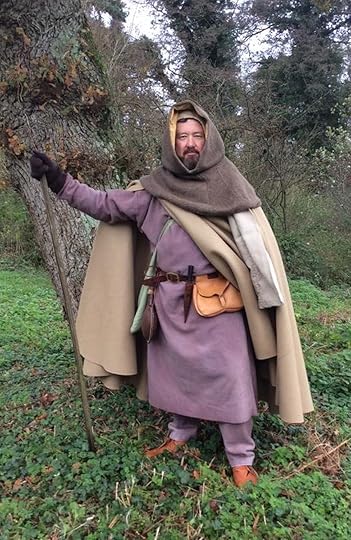
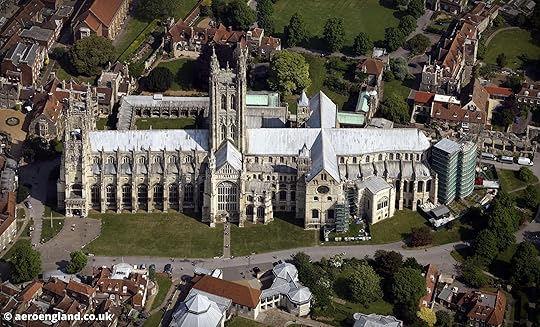
And, all roads do not lead to Rome, the empire that built the "Pilgrims' Way"; rather the paths lead to the human condition where souls & spirits await our daily judgement to acknowledge them, or turn our heads, pretending that we don't see.*Among the images within my review are: the author, Jerry Ellis; a recreated medieval pilgrim; Chaucer's "Wife of Bath"; the cathedral at Canterbury.

June 15, 2008
This book is really rather hard to classify as it blends travel writing with a generous touch of spiritual reflection as well has loads of historical and literary explanation. The delightful thing is that it does each in just the right amounts that you never feel bogged down or preached at; in fact, it is something of a breath of fresh air and truly uplifting. A reading of Chaucer's Canterbury Tales is recommended though not by any means required.

March 2, 2014
I was so happy to find this book (in a wagon outside a second-hand store in Key West). I have a deep love for Geoffrey Chaucer, and lately I've been reading pilgrimage-themed books, so this seemed perfect.
And it was, for a while. But the third theme of the book, besides the pilgrims of The Canterbury Tales and details about mediaeval life in England, is the spiritual journey of the author. After a while, it was too much to take.
An example of how overbearing he became: when he reaches the Cathedral, he's disappointed to find out that he wouldn't be allowed to bring his staff, pack or hat inside. "Without these symbols of pilgrimage, I was but another passerby."
So of course, once inside, he approaches the shrine on his knees, just so everyone there will know how special he is.
I would have like a little more Wife of Bath and the Prioress and a little less 21th century ego tripping.
And it was, for a while. But the third theme of the book, besides the pilgrims of The Canterbury Tales and details about mediaeval life in England, is the spiritual journey of the author. After a while, it was too much to take.
An example of how overbearing he became: when he reaches the Cathedral, he's disappointed to find out that he wouldn't be allowed to bring his staff, pack or hat inside. "Without these symbols of pilgrimage, I was but another passerby."
So of course, once inside, he approaches the shrine on his knees, just so everyone there will know how special he is.
I would have like a little more Wife of Bath and the Prioress and a little less 21th century ego tripping.
November 23, 2016
Author Jerry Ellis is well known for taking very long walks and then writing beautifully about them. He explains in "Walking to Canterbury" that he has ancestral roots in the British Isles and also some Cherokee blood. Ellis had previously undertaken a journey across the Trail of Tears, that had been the route of the forced Cherokee exodus from their homeland at the direction of our government in the 1830s. He had written about this extensive hike in his celebrated book entitled "Walking the Trail" (which is now on my reading list). Ellis felt behooved to embark upon a pilgrimage in the UK that would in some ways mirror his expedition in honor of the Cherokee.
Ellis recounts his experiences as he walked along the medieval Pilgrim's Way to Canterbury, which he began not far outside London and concluded about a week later at Canterbury Cathedral, the site of the brutal murder/martyrdom of Thomas Becket. He alternates his physical and spiritual adventures along the trail with fascinating studies, both of life in medieval England and the troubled pilgrims described in Chaucer's Canterbury Tales. Ellis finds himself sympathizing and sometimes identifying with the medieval pilgrims, and he describes his strong, reliant affection for the colorful characters with whom he interacts during his week in 1999 England.
In the book's Epilogue, Ellis offers some of the perspective to be gained from a look back at medieval Britain: "While the medieval church may have controlled the ignorant masses, the modern American world is also a bit brainwashed. But instead of the church doing it on the great scale it once celebrated, it has been replaced with advertisements on TV: every other ad caters to people's fear of death, just as profound now as it was in the Middle Ages. But instead of taking pilgrimages for our spiritual and physical health, we have turned to 'miracles' in the form of every pill imaginable. Don't forget to buy that new car, the latest fashion, and diet food--guaranteed to give heaven on earth."
Author Jerry Ellis is well known for taking very long walks and then writing beautifully about them.
"Walking to Canterbury" is an engrossing book for anyone who enjoys purposeful, explorational walks that immerse the sojourner in nature, history, and culture as well as provide encounters with interesting people. Ellis' approach to his own genealogical background has provided inspiration for my own efforts at compiling family history, and I believe others who have ancestral roots in Britain will find this book valuable. Ellis has likely motivated many of his readers to undertake at least small sections of the walks about which he has written, particularly this one in England because the UK government marks and preserves the trail.
The modern official British National Trail name for the Pilgrim's Way described by Chaucer is the North Downs Way. Sections of the original trail are no longer accessible, but North Downs retraces as much of the medieval route as possible, and locals still call it Pilgrim's Way.
Ellis recounts his experiences as he walked along the medieval Pilgrim's Way to Canterbury, which he began not far outside London and concluded about a week later at Canterbury Cathedral, the site of the brutal murder/martyrdom of Thomas Becket. He alternates his physical and spiritual adventures along the trail with fascinating studies, both of life in medieval England and the troubled pilgrims described in Chaucer's Canterbury Tales. Ellis finds himself sympathizing and sometimes identifying with the medieval pilgrims, and he describes his strong, reliant affection for the colorful characters with whom he interacts during his week in 1999 England.
In the book's Epilogue, Ellis offers some of the perspective to be gained from a look back at medieval Britain: "While the medieval church may have controlled the ignorant masses, the modern American world is also a bit brainwashed. But instead of the church doing it on the great scale it once celebrated, it has been replaced with advertisements on TV: every other ad caters to people's fear of death, just as profound now as it was in the Middle Ages. But instead of taking pilgrimages for our spiritual and physical health, we have turned to 'miracles' in the form of every pill imaginable. Don't forget to buy that new car, the latest fashion, and diet food--guaranteed to give heaven on earth."
Author Jerry Ellis is well known for taking very long walks and then writing beautifully about them.
"Walking to Canterbury" is an engrossing book for anyone who enjoys purposeful, explorational walks that immerse the sojourner in nature, history, and culture as well as provide encounters with interesting people. Ellis' approach to his own genealogical background has provided inspiration for my own efforts at compiling family history, and I believe others who have ancestral roots in Britain will find this book valuable. Ellis has likely motivated many of his readers to undertake at least small sections of the walks about which he has written, particularly this one in England because the UK government marks and preserves the trail.
The modern official British National Trail name for the Pilgrim's Way described by Chaucer is the North Downs Way. Sections of the original trail are no longer accessible, but North Downs retraces as much of the medieval route as possible, and locals still call it Pilgrim's Way.

October 30, 2018
More than eight hundred years ago, Thomas Becket, the Archbishop of Canterbury, was murdered by King Henry II's knights. Soon, miracles began to take place in the cathedral where he was murdered and people began to make pilgrimages to the shrine. Walking to Canterbury is Jerry Ellis's account of his own modern pilgrimage along the same path those pilgrims took long ago."
This book wasn't at all what I thought it was going to be, but it wasn't bad. While I don't care much for the flowery and melodramatic writing style of the author, his research and knowledge are outstanding. The book is packed with historical anecdotes and more information than one can really process the first time through. I loved how he wove medieval history with what he was doing each day. He really is a brilliant writer, even if I don't prefer his style.
I wasn't keen on his weird spiritual weirdnesses. He's very New Agey---citing strange thoughts on God or god or whomever he chooses to recognize in whatever situation. That particular element only got worse as the book progressed.
All in all, I thought the material was fabulous. I'm glad I read this and think it would be quite the eye-opening experience to make the pilgrimage myself someday.
This book wasn't at all what I thought it was going to be, but it wasn't bad. While I don't care much for the flowery and melodramatic writing style of the author, his research and knowledge are outstanding. The book is packed with historical anecdotes and more information than one can really process the first time through. I loved how he wove medieval history with what he was doing each day. He really is a brilliant writer, even if I don't prefer his style.
I wasn't keen on his weird spiritual weirdnesses. He's very New Agey---citing strange thoughts on God or god or whomever he chooses to recognize in whatever situation. That particular element only got worse as the book progressed.
All in all, I thought the material was fabulous. I'm glad I read this and think it would be quite the eye-opening experience to make the pilgrimage myself someday.

June 23, 2014
I read this book from the library several years ago. It reminds me a little of Bill Bryson's later works - more information and fewer yucks. It traces the author's walk along the Canterbury trail in about 2000, with reflections on the modern & historic landmarks along the way as well as people with whom he chats as he goes along from pub to flophouse to campground. It wasn't great writing, but it was memorable, and included maps and drawings, which I always appreciate in this type of book.

July 8, 2008
In Walking to Canterbury, the author, Jerry Ellis, undertakes a modern pilgrimage from London to Canterbury.
There are three major aspects to this book, the first of which is the author's journey. Like Chaucer's pilgrims, Ellis makes the journey on foot, in 7 days, walking during the day and looking for lodging when he reaches a town at the end of the day. Sections of the book focused on the journey read like a travel book with lush and rich descriptions of the landscape and towns.
Throughout these recollections, Ellis makes comparisons to the England of Chaucer's day (and before) by drawing on historical records from the medieval period. Ellis provides much detail about the everyday life of people in the Middle Ages (from peasants to priests to kings). Each chapter has a set of footnotes at the end of the text--clearly Ellis knows his stuff. And while Chaucer is a focus in some of these historical sections--and Ellis quotes from The Canterbury Tales from time to time--the focus also extends beyond Chaucer alone.
Thirdly--and most enjoyably to me--Ellis relates the stories of people that he encounters along the way. Some of the stories are lighthearted, like the time he spends with two young men nicknamed Big Head and Red Top; some are emotional, like his fast friendship with two fellow travelers; and some are spiritual, such as his brief conversation with a lone boy riding a bike.
Sometimes the relation of the stories (for me) hover on the brink of the melodramatic, but perhaps the depth of emotion expressed matches the spiritual quest that the author undertakes.
The back cover of my edition has a quotation from the LA Times that "Jerry Ellis is an ideal companion for a long ramble," and I would agree. I am glad I got to walk along for the journey.
There are three major aspects to this book, the first of which is the author's journey. Like Chaucer's pilgrims, Ellis makes the journey on foot, in 7 days, walking during the day and looking for lodging when he reaches a town at the end of the day. Sections of the book focused on the journey read like a travel book with lush and rich descriptions of the landscape and towns.
Throughout these recollections, Ellis makes comparisons to the England of Chaucer's day (and before) by drawing on historical records from the medieval period. Ellis provides much detail about the everyday life of people in the Middle Ages (from peasants to priests to kings). Each chapter has a set of footnotes at the end of the text--clearly Ellis knows his stuff. And while Chaucer is a focus in some of these historical sections--and Ellis quotes from The Canterbury Tales from time to time--the focus also extends beyond Chaucer alone.
Thirdly--and most enjoyably to me--Ellis relates the stories of people that he encounters along the way. Some of the stories are lighthearted, like the time he spends with two young men nicknamed Big Head and Red Top; some are emotional, like his fast friendship with two fellow travelers; and some are spiritual, such as his brief conversation with a lone boy riding a bike.
Sometimes the relation of the stories (for me) hover on the brink of the melodramatic, but perhaps the depth of emotion expressed matches the spiritual quest that the author undertakes.
The back cover of my edition has a quotation from the LA Times that "Jerry Ellis is an ideal companion for a long ramble," and I would agree. I am glad I got to walk along for the journey.

August 4, 2014
When I started this book, I wasn't sure what I would think. Just as Mr.Ellis walked "The Trail of Tears", which became a Pulitzer-Prize Award nominee.....he also takes a pilgrimage down a 60 mile path for this book. The story takes place with an event that occurred 600 years ago when the Archbishop of Canterbury was murdered. Unexplain miracles began to happen. People came from all over for healing...some sign from God. Along his journey, the author stopped at spoke with many people. Again this book is as inspiration, in my opinion, as "The Trail of Tears.
June 12, 2013
After several years of in-depth medieval histories, this was a pleasant surprise: spiritual time-travel with snippets of life from the 16th and 21st centuries shapepshifting back and forth. Ellis brings his Cherokee heritage and its spiritual practice of deeply experiencing the land and people as a tool to reconcile with his English heritage as well. And it works. Made me want to hop a plane and hit the trail.

April 5, 2011
I loved this book so much. I read it in a day and just fell in love with the idea of walking the Pilgrim's Way. I do wonder how truthful the author's encounters were with people mentioned, cuz it seems a bit too perfect for the story. I've been to England and didn't meet people like he met- people who seemed conveniently well versed in Chaucer. But a good read nonetheless and inspiring!!
April 18, 2011
I picked this up because I like to walk, and I wasn't disappointed. Ellis walks for all the right reasons, is open to spontaneous happenings and people along the way, and slips in enough medieval tales that you feel you've learned something without any effort. "Travel and meeting people are how you learn about yourself, the quality of your life, and how you might improve it." Walk on!

March 11, 2016
Finally, I made it to Canterbury with Jerry Ellis. I would give this a 3.5 rating. Author's descriptions are well-done, and he incorporates medieval history and literature into the story of a 21st century pilgrimage on foot from London to Canterbury, England. I love British history and literature but the book does not move quickly. So I kept putting it down for long periods of time.

November 18, 2010
One of my new favourite books. He weaves little passages of the Canterbury Tales, parallels his pilgrimage with history, and makes you so want to take that pilgrimage yourself.

April 18, 2015
I enjoyed learning how a half-English/half-Native American man made sense of his walk to Canterbury. Delightful way of encountering the older Christian tradition.

July 24, 2017
This book was really wonderful. It reminded me of the travel books I used to read when I was young-before today's great age of the memoir. Nowadays, books like this are much more focused on the author's inner psychology and issues; with a much tighter packaged premise. In contrast, Ellis' book meanders from Chaucer's pilgrims to the landscape to his own interests and life. Even his reasons for going on the pilgrimage were all over the place. Basically, he is part British and he likes to walk. It was kooky and very unpackaged.
For all these reasons, I found this book delightful. But absolutely the best part about his writing was how the people he met on the road became the main focus of the book. From kids to troubled teenagers to very lonely housewives and the elderly, he treated every person he encountered with such respect and kindness. And the ending when he went on his knees at Becket's shrine was really almost breathtaking--since he didn't have a connection to the murdered bishop that was immediately understandable to the reader. You just kind of fall in love with this kind soul Jerry Ellis. The book was written in 2000, but it felt much more old fashioned. It was charming and really a great read even if you aren't en route to Canterbury yourself!
For all these reasons, I found this book delightful. But absolutely the best part about his writing was how the people he met on the road became the main focus of the book. From kids to troubled teenagers to very lonely housewives and the elderly, he treated every person he encountered with such respect and kindness. And the ending when he went on his knees at Becket's shrine was really almost breathtaking--since he didn't have a connection to the murdered bishop that was immediately understandable to the reader. You just kind of fall in love with this kind soul Jerry Ellis. The book was written in 2000, but it felt much more old fashioned. It was charming and really a great read even if you aren't en route to Canterbury yourself!

June 18, 2019
I loved this book, it was not at all what I was expecting, (which was more in the way of a travel guide) but by half way through the book I was enchanted. This book is about the authors perceptions of his pilgrimage mixed with historical facts & parts of Chaucer's "The Canterbury Tales" with small black & white pictures from the medieval Luttrell Psalter. There is no concrete "this is the route" type of writing. The author has a tenderness of heart and an eye for the mystical which captured my imagination. I am sad to know that the world & Britain particularly, has changed so much since Mr. Ellis took his pilgrimage but I thoroughly enjoyed traveling with him via the magic of words.
August 7, 2026
This is the story of a pilgrimage from London to Canterbury with all its' collected stories, characters, and experiences. While it occurs in the present-times, tidbits of history take us back to what it would have been like in medieval times when the practice was common. The combination of historical placement, relation to Chaucer, and the changes wrought by modern times make this an oddly compelling read.
I was surprised by how much this book pulled me into it. The author has a unique talent for enveloping the reader into his world, making even the most mundane things take on whimsical qualities. His combined heritage also adds a special perspective and singular outlook that is quite engrossing. He focuses most on connecting and then lets everything else just 'happen'.
I was surprised by how much this book pulled me into it. The author has a unique talent for enveloping the reader into his world, making even the most mundane things take on whimsical qualities. His combined heritage also adds a special perspective and singular outlook that is quite engrossing. He focuses most on connecting and then lets everything else just 'happen'.

January 14, 2019
Reading through the reviews now after I finished it, I wonder if any have read The Canterbury Tales. I have, many years ago and I truly enjoyed this book along with travel tidbits and references to historical pieces of information. I also didn't think the writer was "new age" or had "flowery or melodramatic prose." As a lover of British lit. This book caught my interest and held it.
April 29, 2025
As a guide to the journey from London to Canterbury it is very poor. On occasions I am suspecting that his memory is poor and he gives a poor description of many of the highlights of the route.
As a guide to medieval pilgrimages from London to Canterbury the book is good. He knows his 'Canterbury Tales' and references a number of other sources.
As a guide to medieval pilgrimages from London to Canterbury the book is good. He knows his 'Canterbury Tales' and references a number of other sources.

August 11, 2017
This book seemed promising, but failed to hold my attention after the first chapter or two. A good editor would have been helpful.
November 29, 2023
The author's modern walk from London to Canterbury evokes the history and spirit of the medieval pilgrims. Nice reminder of how important it is to slow down and connect to the earth.

October 26, 2025
I’ve always been a medieval nerd, so I enjoyed this memoir. The author decides to take a pilgrimage on foot to Canterbury, just like the peasants of older days did. Filled with history, this is an educational memoir with healthy dollops of Chaucer thrown in. Folks who enjoy Renn fairs will enjoy this book.

August 17, 2016
An absolutely lovely book -- a combination of travelogue, history lesson, and memoir. This is a mixture that risks either being very boring, or very confusing. Luckily, "Walking to Canterbury" is neither. It is a calm, informative, contemplative journey that travels literally through time and space, and does so with gentle ease and not a drop of judgement against a single character the author meets along the journey. If nothing else, reading this makes me ache to return to England, which is my own personal spiritual home. If you're in the mood for both a physical and spiritual pilgrimage that never becomes tiresome or pious, this is the book for you.
August 24, 2013
On his journey one of the characters Ellis met:
Anders ....was a college professor, teaching philosophy and economics.
"Some people don't understand how the two subjects are fins on the same fish," he said. "They think economics is graphs and numbers. But I try to teach my students to see how they can live life to its fullest, to do all they can with what little they have....Travel and meeting people are how you learn about yourself, the quality of your life, and how you might improve it."
Read
July 30, 2011I can't seem to leave England. After a visually gorgeous drive through villages around Canterbury and a special evening of song in the cathedral cloisters (all arranged by Kay), and with a life-long (well, nearly) passion for the Thomas Becket story, this book was custom made for me. A great read. Inspiring in several ways.

August 19, 2013
A light, yet interesting read about an American of British and Cherokee heritage who re-enacts the medieval pilgrimage of walking from London to Canterbury. He has a beautiful way of interweaving sections of Chaucer's "Canterbury Tales" with his observations of the towns, countryside, and the characters he meets along the way.
May 12, 2010
Honestly, I think this is the worst book I have ever read, it was an assignment for an English class in high school. I will never get the 4-5 hours of my life that it took to read this hunk of crap back. I would rather mainline Drano than read it again!

January 12, 2009
Interesting book. I was never a fan of the canterbury tales but this was a whole different experience. Got a bit new-agey at times but he is native american so....

January 31, 2009
The author walks to Canterbury, discussing Chaucer as he goes. Fun read.

September 6, 2011
Interesting story, although at times it became a bit metaphysical, as well as bogged down in history; however, I admit that I'm not particularly interested in Canterbury Tales-era England.
Displaying 1 - 30 of 32 reviews