Jump to ratings and reviews
Rate this book

Varna, Jati, Caste: A Primer on Indian Social Structures

Rate this book
Caste is being used as a major weapon to shame Hindus. This crisp and easy primer presents a powerful counter to Western Universalism's harsh attacks on caste. It is a long over-due toolkit to help all open-minded people gain an understanding of the subtleties of Hinduism's complex social order. This social structure has, after all, produced a civilization with unparalleled diversity. The Vedic world view along with the historical journey of Varna and Jati demolishes the prevailing myths about caste. Myths that are demolished in this book.

192 pages, Kindle Edition

Published March 19, 2023

123 people are currently reading
197 people want to read

About the author

Rajiv Malhotra

23 books453 followers
Rajiv Malhotra is the founder and president of Infinity Foundation. An Indian-American entrepreneur, philanthropist and community leader, he has devoted himself, for the last ten years, to clarifying the many misperceptions about Indic traditions in America and amongst Indians.

He is an active writer, columnist, and speaker on a variety of topics, including the traditions and cultures of India, the Indian Diaspora, globalization, and East-West relations. Rajiv has been appointed to the Asian-American Commission for the State of New Jersey, where he serves as the Chairman for the Education Committee, which was created to start an Asian Studies program in schools. He also serves on the Advisory Board of the New Jersey Chapter of the American Red Cross and has volunteered in local hospice and AIDS counseling.

Ratings & Reviews

What do you think?
Rate this book

Friends & Following

Create a free account to discover what your friends think of this book!

Community Reviews

5 stars
80 (58%)
4 stars
35 (25%)
3 stars
18 (13%)
2 stars
3 (2%)
1 star
1 (<1%)
Displaying 1 - 29 of 29 reviews
Profile Image for Preetam Chatterjee.
7,187 reviews387 followers
September 13, 2025
#Binge Reviewing my previous Reads # Hindutva, Indic

Rajiv Malhotra has spent decades positioning himself as both a cultural warrior and a civilisational interpreter, someone who seeks to wrest the narrative of India away from Western scholars and their interpretive grids and return it to what he sees as the sources of its own authenticity.

Each of his major works, from Breaking India to Sanskrit Non-Translatables and The Battle for Sanskrit, has a recognizable rhythm: first an outline of the Western or secularist distortion, then a sharp critique of its assumptions and hidden agendas, and finally a counter-vision that asserts India’s agency.

His book Varna, Jati, Caste: A Primer on Indian Social Structures fits squarely into this trajectory, but its stakes are higher and more charged, because caste is the nerve-centre of almost every debate about Indian society, politics, and culture. If Sanskrit was the contested ground for intellectual sovereignty, caste is the battlefield of India’s social soul. And Malhotra, predictably, does not retreat from the fire; he marches straight into it.

At first glance, the word “primer” in the subtitle might mislead readers into thinking this is an elementary or introductory treatment. However, the book is anything but simplistic. What Malhotra does here is attempt a reframing exercise: to disentangle the categories of varna, jati, and caste, to recover their precolonial meanings, and to show how the fusion of these concepts under the single, loaded label of “caste” is itself a product of colonial misrepresentation and missionary propaganda.

For Malhotra, “caste” is not a neutral descriptor but a weaponized term, carrying within it centuries of Orientalist stereotypes, Christian moralism, and postcolonial social theory. The insistence on using “caste” as the umbrella term, he argues, has distorted both scholarship and public discourse, making it impossible to see India’s social structures in their original terms. His goal is not to deny social hierarchy or discrimination but to challenge the very framework through which such realities are interpreted.

The book thus begins by carefully distinguishing varna from jati. Varna, for Malhotra, is an idealised four-fold classification, linked to functions and dispositions, not rigid birth categories. Jati, by contrast, is the lived, dynamic, community-based social organization that proliferated into thousands of groups, with their own occupational specialisations, rituals, and kinship rules.

When British administrators, Orientalist scholars, and missionaries collapsed these into a single rigid “caste system,” they created what Malhotra sees as a caricature: a frozen hierarchy imposed on India’s past and then projected back as an eternal essence of Hindu society. By exposing this conflation, Malhotra believes he is not whitewashing oppression but rather recovering a more complex and pluralistic social reality that colonialism misrepresented for its own ends.

What gives the book its force is the way it situates this argument within a longer genealogy of Western thought about India.

Malhotra’s adversaries are not only the East India Company census-makers but also the modern critical theorists who, in his view, recycle the same distortions under the guise of progressive scholarship. He draws connections between colonial ethnography, missionary tracts, Marxist historiography, and contemporary NGOs, suggesting that all of them feed on the same foundational misreading: the idea of India as a civilisation hopelessly trapped in caste oppression. In this sense, the book continues the “Breaking India” theme, identifying external interventions that destabilise Indian society by weaponizing its faultlines. But here the battleground is not secessionism or evangelical funding but the very categories through which Indians understand themselves.

Reading Malhotra’s prose, one senses the urgency of his mission. He is not simply clarifying distinctions for the sake of academic precision; he is trying to unshackle Indian identity from what he sees as an imported epistemology. The word “caste,” in his account, is like a Trojan horse: it appears as a mere label, but inside it lurks an entire worldview of hierarchy, oppression, and shame, designed to make Hindus internalise a sense of civilisational guilt.

By substituting the terms varna and jati, Malhotra seeks to restore a vocabulary in which Indians can speak about their own social structures without conceding to Western moral frameworks. This is consistent with his earlier insistence on Sanskrit non-translatables: just as words like dharma and atman cannot be flattened into “religion” and “soul,” so too varna and jati cannot be flattened into “caste.” Translation, for Malhotra, is never innocent; it is the site where power is exercised and agency lost.

But if the project is ambitious and provocative, it is also deeply contentious. Critics will say, and with some justification, that Malhotra downplays the realities of hierarchy, exclusion, and violence that have been recorded throughout Indian history. His attempt to rescue varna as an ideal scheme and jati as a pluralistic community network risks sounding like apologetics, even if he insists otherwise.

The danger of his approach is that in his zeal to expose colonial distortions, he sometimes makes precolonial inequities seem like benign differences rather than entrenched systems of privilege and oppression. This is where his writing is at once compelling and frustrating: it sparks a necessary rethinking of categories but often glosses over the material realities that made “caste” a lived burden for millions. The polemical edge that makes his prose sharp also makes it one-sided.

Yet to dismiss the book as mere whitewashing would be to miss its larger intellectual intervention. What Malhotra is really challenging is the monopoly of interpretation. He is saying, in effect, that caste studies have been dominated by lenses external to Indian civilisation, whether colonial, Marxist, or postmodern, and that Indians must reclaim the right to theorise their own social structures.

This is not a call to deny injustice but to refuse the framing of injustice in categories that strip away civilisational nuance. And in that sense, the book echoes larger global debates about decolonisation. Just as African scholars question the use of “tribe” as a colonial label that homogenised diverse communities, Malhotra is questioning the use of “caste” as a label that collapses varna and jati into a monolith of oppression. Whether one agrees with him or not, the intellectual move is part of a broader struggle over knowledge and power.

The reflective reader will also notice how the book speaks to Malhotra’s long-standing preoccupations. His fight against Sheldon Pollock in The Battle for Sanskrit was about who gets to interpret Sanskrit texts. His argument in Sanskrit Non-Translatables was about who controls the meanings of key concepts. His warnings in Breaking India and Snakes in the Ganga were about who funds and drives narratives about Indian society.

Varna, Jati, Caste is of a piece with this, focusing on one of the most loaded and globally recognised aspects of Indian identity. It is as if Malhotra has gradually been circling around the core, and here he finally engages with the issue most associated with India’s image in the world. The battle for Sanskrit was important, but the battle over caste is existential, because it shapes not just intellectual discourse but social and political life itself.

In comparing this book with others in the genre, one sees both its strengths and its limits. A.G. Noorani’s The RSS: A Menace to India is polemical in the opposite direction, using caste as evidence of Hinduism’s oppressive essence. Swapan Dasgupta’s Awakening Bharat Mata collects ideological writings that navigate caste with a conservative nationalist lens. Manu Pillai’s Gods, Guns and Missionaries tells a more historical story of how modern Hindu identity was shaped, including its entanglements with caste.

Against these, Malhotra’s book stands out not for offering historical narrative or political analysis but for its conceptual clarity: it wants to pull apart the very categories others take for granted. That makes it less useful as social history but more provocative as civilisational theory. It is not a chronicle of caste but a battle over the word “caste” itself.

The reflective essayist must acknowledge how this book complicates our reading of both Indian and Western narratives. On the one hand, it warns us against accepting colonial categories uncritically. On the other, it warns us against romanticising the past by dissolving all hierarchy into benign diversity. The truth lies, as always, somewhere in between.

The colonial state did distort, freeze, and weaponize India’s social structures, but precolonial India was not an egalitarian utopia. Malhotra’s book is strongest when it exposes the colonial gaze, weakest when it refuses to confront the internal dynamics of exclusion with equal seriousness. Yet perhaps its value lies precisely in its imbalance: it pushes the pendulum back hard enough to make space for new, more nuanced engagements that neither demonise nor sanitise.

Stylistically, the book is classic Malhotra. He writes with urgency, with a sense of mission, often with rhetorical flourishes that make his work more manifesto than monograph. For academic readers, this is frustrating, as they expect nuance and balance. For lay readers, it is invigorating, because it feels like someone is finally standing up to the chorus of caste-as-India’s-essence. His admirers will read it as a decolonising intervention, his critics as ideological obfuscation. Either way, it refuses to be ignored. And in that refusal, it does what all of Malhotra’s books do: force the debate into the public square.

Ultimately, Varna, Jati, Caste is less a conclusion than an opening salvo. It is not the last word on caste—indeed, it cannot be—but it is a provocation that unsettles received wisdom and demands a response. In reading it, one may disagree with Malhotra’s minimisation of hierarchy, one may find his polemics exhausting, but one cannot leave untouched by the questions he raises:

Who defines India’s social categories, in what language, and to what end?

Those questions linger long after the polemics fade, and they ensure that this book, like his others, will continue to haunt both scholarship and public discourse.

In the end, to review this book is to acknowledge the paradox of Malhotra’s project. He is at once illuminating and obscuring, liberating and constraining. He gives Indian readers tools to resist external misrepresentations, but he also risks arming them with oversimplifications that ignore internal complexities. His insistence on varna and jati as alternatives to caste is a valuable corrective, but it must be supplemented with honest reckonings of how those structures also produced suffering.

If one reads him not as the final word but as a passionate interlocutor, then his work becomes less threatening and more generative. It becomes a catalyst for deeper, more balanced conversations that neither capitulate to colonial categories nor retreat into nostalgia.

At nearly every point, the reflective reader is caught between admiration for the courage of his intervention and discomfort with its blind spots. That tension is precisely why the book matters. In a world where “caste” has become the shorthand for India in the global imagination, to challenge the term itself is to challenge a narrative centuries in the making. Whether one agrees with Malhotra or not, his refusal to accept that shorthand forces us to reconsider how much of our self-understanding is mediated by alien categories.

That is no small achievement. And it is why, for all its flaws, Varna, Jati, Caste: A Primer on Indian Social Structures deserves to be read, debated, contested, and remembered as one of Malhotra’s most important interventions.
Profile Image for mahesh.
271 reviews26 followers
March 9, 2024
Probably one of the best books about Varna or Jati, Where more research is stored in small compartments for the end-to-end understanding of the Varna ashrama system, its evolution, and its exploitation. As usual, Rajiv Malhotra has done great scholarly work in this book for young and flexible minds to question the negative social engineering done from the era of the Mughal/British to the current democracy.
I have read several works of Vedic, social, or spiritual topics that come under Santan dharma, But I haven't found much importance of Jati(So-called Caste) in any of those scriptures. So it surprised me in the beginning since from childhood our education system, engineers our brain stating opportunistic caste system was an integral part of Santana dharma rather than it being just a social system that turned redundant with political and economic changes. For the last few years, I had to go through multiple books to unclutter and clean my brain from the junks of social engineering, It took me lots of time.
if you don't have that much time If you want to be free from an indoctrinated brain with facts and logic rather than a BJP-led emotional blabber. Please do read this book, He has summed up all research in one book so you get a better understanding of the Varna ashram system, Its pros and cons, and its distortion.

Rajiv Malhotra is probably the only intellectual Kshatriya who dares to offer constructive criticism of the views and opinions of B.R. Ambedkar. I am very sure Ambedkar would have enjoyed the company of Malhotra if he was alive. In one of the chapters in this book, Keeping Jati in Context Malhotra did a great job of summarizing the views of all 4 books written by Ambedkar.
Profile Image for Vaibhav Tripathi.
103 reviews2 followers
July 7, 2024

Three glaring points of contention for which I removed 3 stars:


1. Idealistic View of Varna and Jati:

In chapter 1, the author provides an idealistic view of the caste system, which he differentiates as Varnashram Dharma based on Varna and Jati, claiming it is different from caste. However, the author doesn't provide any citations to support where he found this idealistic view—whether in any scriptures or sociological analysis. It seems this system is entirely based on the beliefs or fundamental dogmas of Hinduism that the author subscribes to. The theory of reincarnation and karma judgment based on past life deeds justifies the caste system or Varnashram Dharma without addressing the moral problems it creates. The author simply packages it in a new box with the assumption that everything was as he describes. Essentially, he is masquerading inequality as diversity.


2. Unsubstantiated Historical Claims:

Based on this dogma, the author nonchalantly puts forward the theory that endogamy and caste rigidity started due to Mughal rule, again without any citation. This contradicts genetic evidence, such as that found in the book Early Indians, which shows endogamy started 1,900 years ago. Such unverified claims weaken the credibility of his arguments.


3. Controversial Theories on British Influence:

The most bizarre and controversial theory appears in the section on British rule, where the author theorizes that the census data collected by the British are responsible for caste identity and rigidity, and even untouchability, again without any citations from reputable sources. What the British actually did was systematically study the already existing systems in India and publish them in English. Therefore, in English, untouchability only appears after the census data. The author ironically thinks that the reservation or positive discrimination system by the Indian government is responsible for the caste system, reflecting the views of a privileged NRI Brahmin living in America.


Hindu religions in India are often based more on orthopraxy (practice and rituals) than orthodoxy (fixed doctrines). This makes it important to study how Hindu society has been in the present and over the last few hundred years, for which we have written records and data since the Portuguese arrived, rather than speculating on how this system came to be. Rajiv takes the opposite approach, speculating on an ideal philosophy of Hindu society based on Brahmanical notions and extrapolating it throughout history without citations and studies. Overemphasis on scriptures is also pointless as Indian society follows orthopraxy, not orthodoxy. The author is so progressive that he wants to erase not just untouchability but the history of untouchability as well.


The redeeming aspect of the book is that it reveals how the privileged mind works, hence two stars. For someone who has not read about the topic, this book might seem really good. The problem with amateur writers like Rajiv, compared to professional and so-called Marxist historians like Romila Thapar, is that Rajiv doesn't have any fear of reputation or a peer review system. He can publish anything he likes. Meanwhile, government historians might be influenced by the government in power and may self-censor to avoid clashing with the ruling government, but they have strong incentives to avoid factual inaccuracies out of fear for their reputation and legacy, unlike ideologically inspired writers like Arun Shourie and Rajiv.


Dominant castes have always had problems with census and the study of Indian society. Their new theories are extensions of these old problems, as seen in Ambedkar's brilliant essay "From Millions to Fractions" in the book Essentials of B.R. Ambedkar, edited by Valerian Rodrigues.
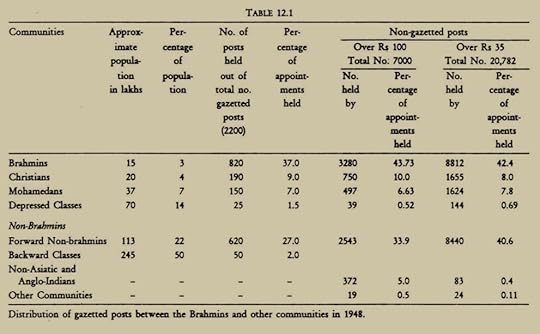


Author masquerades inequality as diversity. See the table below taken from 'Essentials of BR Ambedkar writings' book;

Table
122 reviews1 follower
December 5, 2023
Whilst I went into this with my nose turned up, expecting a poorly researched, mystical-nonsense fuelled bit of propaganda, against which I would rail for its vast internal inconsistencies and for taking the side of the upper caste/class, I was glad and surprised to be proven wrong.

If the mission of Marxist historians like Romila Thapar, simply put, is to tell the narrative from the perspective of the downtrodden - i.e the labour class (whether it be agricultural, mercantile or whatever else) OR in the specifically Indic context, the so-called lower castes - then projects such as Varna, Jati, Caste jointly authored by Rajiv Malhotra and Vijaya Viswanathan, leaders of the Infinity Foundation (a slightly suspect organisation intellectually, in my opinion) simply aim to narrate from a different perspective.

Is it the perspective of the Brahmin? The Upper class? According to Thapar and the Marxists, yes, irrefutably so. But Malhotra’s basic claim is that the Marxist outlook, splitting society into two strict groups according to their relationship to the means of production, is fundamentally inaccurate in understanding Caste and Indian Society.

Though this may be a contentious claim, it’s not necessarily a wrong one. After all, isn’t it the case that there is no historical truth, only historical perspective? And if so, what’s the harm in the addition of a new perspective? If anything, the harm is in ignoring the perspective.

It’s not academically rigorous by any means - chapter 2 has 6 citations only and all from the same source! - and there are many points made which seem to have no sound historical source: was Vedic Varna ever practiced like he says it was? is there any evidence for this?

Yet, I wholeheartedly welcome such a digression from the norm. There is far more to Malhotra’s book than meets the eye - I hope those anti-caste activists such as Yendge and the like, the Marxists such as Thapar etc, do engage with this on some level: whether they viciously dismantle it or not, at least Malhotra’s perspective (which he unjustly terms the Indic perspective) will be acknowledged for what it is - another valid perspective of Indian history.
10 reviews
Read
June 30, 2023
a well-researched and foundational text i can see being an important writing in developing future movements around indic consciousness/national identity

it has many strengths:
- argues that varna/caste can only be understood in the context of hinduism’s broader goals and spiritual framework; provides a good primer on these goals.
- is another strong text in favor of “diversity does not have to mean divisiveness” and provides a well-researched critique of western universalism.
- provides excellent examples of britain’s efforts to solidify the caste system, that these efforts were challenging precisely because the varna/jati system that existed in india prior was fluid and diverse; and the many ills that have been perpetuated through these efforts.
- has a fantastic chapter on ambedkar’s work, including paragraphs that critique hinduism, and reconciles his critique with the broader argument of the book, which adds balance to the narrative;
- is short and comprehensible with clear arguments- can be read in a day.

i felt that the book also had weak points:
- certain aspects of history felt underexplored. i was hoping to have a better understanding of the roots of untouchability and how its practices developed over time. instead the book describes how some parts of untouchability have persisted in christianity and islam and defends its practice in hinduism. ambedkar’s chapter added some balance but the narrative still felt incomplete.
- i wanted to learn more about the origins and primary thinkers of the dalit movement. there were mentions but no organized history/narrative. even if the author does not agree with the tenets of the movement, how can a primer on varna/jati/caste be complete without a section exploring the arguments of these thinkers?
- the book excels when it describes india’s rich history, but falls victim to the very reductionism it seems to critique when it discusses concepts beyond india (e.g. critical race theory). the author never defines CRT or its merits before claiming that it is all “identity politics”. it would be sufficient to say that one should be careful in applying the tenets of CRT to vedic social structures since india’s history and american/european history are very different. this does not mean that CRT as a whole has no merit.
- this critique is also hypocritical because while the author praises hinduism’s ability to celebrate diversity within india, he seems to take issue with efforts to celebrate diversity in areas beyond the topics discussed in the book (e.g. with gender and sexual identities). this is a complex discussion and omission may have been a better approach than reductionism.
- i understand that western tenets of equity have been applied inappropriately to india without sufficient understanding of its social structures, and so it is understandable to have a knee-jerk response against these tenets, but it overall harms the credibility and accessibility of a book to dismiss “wokeism” without sufficient exploration. this is a longer discussion, but modern social advocacy in the west actually does not need to conflict with extricating india’s history from the colonialist narrative. i felt like western advocacy/india’s national identity were pitted against each other for no particular reason, which unfortunately narrowed the audience for a book that otherwise has many important pearls.

every strong argument has its pros and cons, but overall a very informative read!
16 reviews
June 24, 2023
Excellent primer that is written in simple language and provides a great framework for a counter argument. I read this in full to be prepared for the misinformation that is taught in middle school. It also provides a good structure to educate our children on this misinformation.
Profile Image for Parth Agrawal.
129 reviews19 followers
October 12, 2025
Hello everyone, I hope all of you are doing well. Today, I am here with a book on an issue which has made me question a lot of beliefs and ideas of people living in our society. A lot of these ideas became apparent to me as I interacted with them on this subject directly and even when they unintentionally exhibited their beliefs while expressing their opinion on something which is often influenced by the title of this book

I am a huge Rajiv Malhotra fan because he uses logic and historical facts to dismantle the narrative which is often peddled by people with vested interests and secondly, he links these age old issues with contemporary happenings and presents a picture of how the wheels are in motion to continue this menace both within and outside India.

It would be interesting to know that the word caste comes from a Portuguese word "Casta" which loosely translated to clan/tribe. Portuguese came to India in 16th century and they saw that people are loosely divided into groups which were based on occupations. I want to repeat that the operative word in this statement is "loosely". Scriptural basis of this division can be found in Varnashrama dharmas which advocated 4 varnas i.e. Brahmin, Rajanya (which later turned into Kshtriya), Vaishya and Shudras. Now what we need to understand is that these occupation based identities were never as ossified as they are made to be. People used to transfer from one occupation to another based on their inclination. However, 800 years of Islamic subjugation and 350 years of British subjugation drained India's decentralized system. In Shah Jahan's reign, 655 individuals used to get 62% of the empire's revenue. It was worse in Akbar's reign when 25 people used to get 30% of the empire's revenue

Our dharmashastras, from which the Britishers have liberally borrowed their viewpoint regarding Hinduism, talks about apad-dharma (Dharma in times of distress) which prescribes that difficult times may warrant to introduce fluidity/ossification into occupation based varna/jati system and that's what happened in all these years of subjugation. However, the permanent institutionalization of this ossified reality/interpretation was a European deed, but more on that later

There are multiple scriptural sources which refutes the argument that varna system has always been the oppressive birth-based system. The 4 varnas were shown as 4 body parts of the cosmic being while the cosmic being is lying horizontally. So, the argument that categorization of shudras as the feet of the cosmic being puts them at the lowest hierarchy is incorrect for multiple reasons. First, the cosmic being is merely a personification of society at large, not a religious fatwa to be believed in. Second, the cosmic being has been described to be lying horizontally so the derivation of importance or value on the basis of vertical hierarchy is not applicable. Third, the attempt to divide the society into the body parts of the cosmic being was done to demonstrate the interdependency that these parts of society had on each other. Fourth, if shudras were so weak and downtrodden section of the society, then how come there were so many shudra based empires with a shudra king like Shivaji Maharaja, Chandragupta Maurya and many great rulers from the Gupta dynasty, Pallava dynasty etc. Fifth, even the great sages and poets that are celebrated in Hinduism are all Shudras be it Valmiki, Vyas, Kalidas etc. Scriptures have enough references to show that this system was based on aptitude and not on birth for example vajrasuchika upanishad, even in verse 4.13 of Gita, Krishna says that 4 varnas were created by me on the basis of individual character. Krishna himself demonstrated this ideology through his life by being raised by Vaishya cowherds, by ruling Dwarka as a Kshatriya, by playing the character of Arjun's charioteer as Shudra and by reciting Gita as a Brahmin. Sixth, Manusmriti is often quoted to demonstrate the oppressiveness of these divisions however, verse 4:176 is conveniently ignored which clearly says that every rule of conduct can be renounced if it brings unhappiness or arouses righteous indignation. I believe it is safe to say that the caste system as we know it today, was not something which was promoted by Hinduism and whosoever thinks that Hinduism as a concept is nothing more than a agglomeration of oppressive rules and regulations are either delusional or they have an agenda to malign its reputation

Now, the question arises if Hinduism didn't promote any of this, then where did the modern caste system came into existence? Britishers brought it. Let us see how. Britishers came to India in 1600 and the first census of presidencies in India was conducted in 1871. That is 271 years of British presence in Indian society and yet, there are various census commissioners such as W.R Cornish, the one responsible for Madras Presidency, then there is C F Magrath, the one responsible for Bihar presidency, who have gone on record to say that it is difficult to believe that there ever existed a period in which the society was clearly demarcated into 4 varnas and that it has no relevance in today's world and must be set aside. When they conducted the census for the first time and tried to categorize the population on some basis, they failed to come up with any category which was concrete enough to do so. Since they belonged to a society which had a top down hierarchical classification, they couldn't make sense of decentralized Indian society. Indian society didn't work the way British wanted to deal with it. So, India's diversity was forcibly fit into English worldview with each subsequent Census and the man who is responsible for the most heinous social engineering experiments which is still causing mayhem is Sir Herbert Risley (Census Commissioner 1901). The caste system as a social system started taking shape after this because real life benefits and entitlements were linked and associated with this. Even the untouchables as 5th varna was a creation of Sir Herbert Risley because time and again, multiple travelers came and admitted this with astonishment that India never had any system of untouchability or slavery such as Megasthenes and Hieun Tsang. Furthermore, this problem got its more concrete manifestation due to complicity of Indian nationalists. Gopal Krishna Gokhale passed a resolution on "Depressed classes" in 1903 which gave rise to Depressed classes mission society of India in 1906. However, by this time, various newspapers, with Bombay gazetteer being one of them, started using "Depressed castes" interchangeably with "Depressed classes". These actions legitimized the creation of an imaginary group and now, they needed someone to blame their misery on. Unfortunately, "Hindus" were showcased as the villain who perpetrated all these excesses against them and by this logic, this section turned itself into non-Hindus from outcaste Hindus. Later on, Gandhiji gave them the term "Harijan" in 1931 while Ambedkar carried forward the argument that untouchables are not even Hindus. Finally, in Government of India Act, 1935, "Depressed classes" was introduced as "scheduled castes" and it has been carried forward ever since. Furthermore, this idea was projected back in the history by amalgamating it with varna and jati to justify that it was always a part of Vedic society

Lastly, any discussion on caste is incomplete without discussing the ideas of Dr. B R Ambedkar. There are few clarifications which are needed at the time which were categorically endorsed by Mr. Ambedkar. He said that caste is not an racial issue but a social issue of people of same race. So, the current intelligentsia which is trying to agglomerate caste with race is basically using caste to fulfill their own vested interests which must be fulfilling their vested interests. Furthermore, Dr. Ambedkar wanted to model the Indian society on the ideals of liberty, equality and fraternity which echoes in the French revolution of 1789. he emphasized that the relationship must exist between each citizen individually and state with no group identity serving as the intermediary between the individual and the state. However, his idea of achieving this ideal was through destruction of Hinduism which is something I don't agree with it is too reductive in its approach. He also dispelled this myth that western social structures have found the answers for today's problems as they are based on class and it is largely defined by material wealth. There is tremendous pressure to move up the class hierarchy which results in mental health challenges as well as social tensions and violence

It is an amazing book and it will help you to dispel a lot of doubts that you might have on the subject and it will help you to arm yourself against any untenable criticism hurled at Hindu community
Profile Image for Bharath.
953 reviews636 followers
January 28, 2024
As the author Rajiv Malhotra points out in the blurb, caste has become a weapon to beat Hindus with and make them feel small. This issue is real and very visible today, with authors like Audrey Truschke regularly making hateful remarks. Rajiv Malhotra for long stood alone, bravely countering this hate. Audrey Truschke avoids debating with him, declaring haughtily that she is a scholar and he is not.

In my reading of Hinduism’s most respected texts, I found no basis for discrimination and cruelty based on caste. In fact, Adi Shankara in his commentaries repeats umpteen times that all of us, life forms and the universe are one - tightly bound and are manifestations of the divine ‘Brahman’ (the source). Yet, it is true that in the last two centuries it was a major issue in Indian society – with widespread stories of segregation & discrimination. While modern India has contained discrimination, caste is still a strong source of identity. This book provides an excellent view of how we reached here and, in my view, offers sensible suggestions for the way forward. One of the reasons which Rajiv points out is the politics to garner votes by segregating people and reaffirming their caste & religious identity. Neither is the politics of voter segregation & fear mongering unique to India.

The book starts with the conceptual basis of Hindusim – Vyavaharika (the world of sensory experiences & relative reality) and Paramarthika (spiritual and dharmic traditions, the path to absolute reality). The concepts of Dharma, Moksha, Karma underpin many of the practices calling for balance in conduct, yajna (reaching to a higher cause & sacrifice) and ahimsa (avoid causing hurt/pain/harm). The varna system was provided to look at governance based on professions. Hinduism never had a practice of resolving conflict by destroying a contrary viewpoint – rather you were expected to find your way with debate and learning. Hindus have had unparalleled freedom in prayers, rituals & beliefs since long. Texts such as Dharmashastras & Manu Smrithi, which are the most cited for caste based conduct, are hardly ever read by Hindus – and Mahatma Gandhi has himself pointed out that they went through edits across several centuries. Most Indian historians agree that caste discrimination is a more recent phenomenon, well after the vedic period. Shudras are mentioned as running many industries in Vedic times. The oldest Veda, the Rig Veda affirms equality & one-ness. The Vajrasuchika Upanishad very explicitly disallows birth-based discrimination. The Gita also says that varna is not birth based. Greek authors have mentioned that all people in India were free, something rare during that period. Invasions of the country brought about a sense of desperation in a nation which was among the richest till then. There is no evidence of clean separation of people & discrimination in early Hinduism. The reverse is more true – with lots of examples of influential people from all castes.

I found this to be an excellent primer on the fundamentals of Hindu thought and evolution of Indian society. It provides an excellent vocabulary to know the metaphorical essence of Hinduism’s most important concepts. This is not an in-depth commentary on any of Hinduism’s revered scriptures such as the Bhagavad Gita, the Vedas or the Upanishads, though all are referred.
Profile Image for Harsh Agrawal.
242 reviews17 followers
Read
April 11, 2023
Varna, Jati and Caste : A Primer on Indian Social Structures
Authors; Shri Rajiv Malhotra Ji & Shrimati Vijaya Vishwananthan Ji
Occam Books: An Imprint of BluOne Ink
168 Pages
MRP: Rs.250/-

Thank you Infinity Foundation and BluOne Ink for providing a review copy of the book.

"Varna, Jati and Caste: A Primer on Indian Social Structures" by Shri Rajiv Malhotra and Shrimati Vijaya Vishwananthan is a powerful and much-needed tool for anyone seeking to understand the complexities of Hinduism's social order. The book provides a strong counter to the Western Universalism's harsh attacks on caste, which are being used to shame Hindus. The authors argue that the caste system was created by the British colonialists, and that the Hindu social structure is much more nuanced than what is commonly portrayed.
The book is a quick read and is presented in a crisp and easy-to-understand manner. The authors present the Vedic world view and the historical journey of Varna and Jati to demolish the prevailing myths about caste. They argue that the Hindu social structure has produced a civilization with unparalleled diversity, the Indo-Sarasvati Civilization, and that it is important to understand and appreciate the subtleties of this complex system.
The book provides a strong counter-attack on the Eurocentric approach and offers a fresh perspective on the caste system. The authors argue that the myths about the caste system need to be debunked, and that all open-minded people should gain an understanding of the subtleties of Hinduism's complex social order. The book is an eye-opener, and every Hindu should read it.
The authors argue that the caste system was created by the British, and that we continue with the colonial albatross by stigmatizing one or the other segment of our citizens, creating deep divisions, and hard-baking these divisions through law. The book provides a much-needed perspective on the caste system and offers a powerful argument for its abolition while providing social and economic protection to the vulnerable.
Overall, "Varna, Jati and Caste: A Primer on Indian Social Structures" is an important and much-needed book for anyone seeking to understand the complexities of Hinduism's social order. The book is well-researched and provides a fresh perspective on the caste system. It is a must-read for every Hindu and for anyone interested in understanding the nuances of India's social structure.


10 reviews
August 19, 2024
The "Varna, Jati and Caste" is a must read for everyone who is interested in knowing about the social structures in India and how they evolved over time. For a long time, Indains have been fed the narrative of different castes in India being different races and the caste system existed from pre-historic or vedic times. For someone like me who has been brought up on these theories first propounded by British and then now being carried forward by woke liberals, this book is a refreshing read
One should read the book to understand that Varna, Jati and Caste are not the same and how one evolved into another over the seven historical phases of India and how it has degenerated into the current system during the last few centuries. It is also interesting to know that the social hierarchies haven't remained static and have seen many upheavals over the last several millenniums and the current hierarchy that we see probably isn't more than a few centuries old. It's relieving to that it will continue to evolve in the present and the future
While the authors talk about most of the ancient texts of India, the chapter on Dharmasastras is very important. It details the restrictions that are placed on different jatis and why they aren’t imposing a hierarchy or upper and lower castes as being interpreted by some people.
The chapter on Ambedkar is a true eye-opener: The current mainstream political and social movements using his name have suppressed most of his ideas and just promote some selected portions of his ideas for their own gains. His views on Hinduism, Islam, Buddhism and Communism are a must read, whether you agree with them or not.
(And, for anyone who is sceptical, the author doesn't support or condone the current hierarchy of upper and lower castes as we know it)
Profile Image for Shantanu Patnaik.
45 reviews1 follower
January 1, 2025
While book helped me understand at a broader level the context of Varna, Jati, Caste, Untouchability, the agenda single-handedly seemed to prove that Varna and Jati are primarly positive things while few cons. I expected more a critique of the issues and opportunities to possibly rectify them. Few other issues I found with this:

1. Focusing on Islam's and Christianity's Caste system, even though they are not talked about enough, dilutes the focus on issues in Hinduism's Caste System. This book was not supposed to be about Caste System in all religions.

2. Book asserts that Hinduism's caste system was created by British in 19th century and within a sort span of time (100-150 years), they seeped into the Hindu Society and gained more acceptance than Millennium old concepts like Varna and Jati. Why this happened and why was post-independence India so consumed is not answered clearly? Pointing fingers only at Vote Bank Politics don't seem to answer the question fully

3. Examples of Mahabharat ring hollow as Karna himself was ridiculed multiple times by Draupadi and Pandavas for being a Charioteer's son.

4. Author says that "the jati system reduced competition for natural resources and avoided over-exploitation. The internal specialization of a given jati ensured the efficient inter-generational flow of competence in specialized skills." He overlooks the fact that since its driven down on basis of birth and not skills, many were ostracized in their communities for wanting to do something outside their jati. A cobbler couldn't become a farmer if he wanted to. So how does this "specialization" ensure equality of opportunities?
65 reviews2 followers
July 9, 2023
I have been always been baffled by the term caste being an alien word & it becomes the framework applied to study Indian society & its structures.

This book really does well to delve deep into the origins of Jati & its relation to Varna.

The journey from Varna to Caste over the various time periods is one the key USP.

Caste in its current form being one of the most notable British Social Engineering project.

No discussion about caste is incomplete without Ambedkar. I was really fascinated on the counter provided to Ambedkar’s understanding of the Varna & Jati. His misunderstanding of Sanatana Dharma is very similar to that of Gandhi’s understanding of the Islamic ideology.

Nonetheless, Ambedkar’s understanding on the Islamic ideology is bang-on. In today’s parlance, he would be labelled as a Islamophobe. For once, I saw something good about Gandhi wrt his desire to retain Varna’s & fix the issues without doing structure changes.

The conclusion is well designed as a myth buster.

This is one books that really is a must read to understand these key concepts & its articulation is very commendable.
31 reviews
September 10, 2024
Must read for everyone. Simple, short and crisp. This book does what it is meant to do. Be a starting point for people to think about the evolution of social structures in Bharat from ancient times to the current period. It is not extremely detailed does not each and everything that might have happened but provides a big picture analysis of events that have shaped our "caste" structure of today. This book provides a basis for social discrimination as not being engraved in Sanatana Dharma, but rather as events which have taken place because the people have been made to go more and more away form our original ways of living to the colonial way of living be it the Mughal way or the British way. This book does not endorse discrimination obviously, and makes a clear argument that hierarchies are natural outcome of individual diversity which manifests as social diversity. This ofcourse makes a fertile ground for discrimination till the social system and each of its components are linked to each other such that discrimination against individuals or a group will come back and bite the perpetrator in the proverbial a**.
5 reviews27 followers
November 16, 2025
Unlike the Breaking India book, one is left wondering at times where a supporting reference for a claim is. So, sometimes the reader might think that the author is just expressing an opinion (without that supporting reference). At other times of course, the supporting references are really useful.

But aside that, the book is a great primer for the uninitiated. For someone well-versed with the subject, there are still some good things to pick. The least of all being how Ambedkar's treatises throw light on what he thinks of Hinduism, Buddhism and Islam. The author breaks down and critiques Ambedkar's views and lays bare the problems with his understanding of Hinduism and his own interpretation of Buddhism in the form of Navayana Buddhism. This book is not for the Bhim Army. They can't handle it. :-D
This entire review has been hidden because of spoilers.
November 29, 2023
A small book for a big subject and i appreciate the authors for keeping it short. The book is precise and concise which highlights the evolution of caste with Context which is important here. It maybe easy to pass judgements now but it is important that we understand the context and the environment prevailed in that timeline .
I enjoyed the author's interpretation of BR Ambedkar's works on caste which felt me wanting to read more on his views
This book is a must read for anyone who wants to understand jati / caste without any prejudice and there is more than enough reference in the book to research further
Profile Image for Soul Searching.
24 reviews
August 26, 2025
I started with this book to understand more about varna system, how it all started. Good thing is it is really short and easy to understand, but I am not convinced that jati and caste based differentiation started more with Mughal and British rule. I completely agree that early vedic period did not have jati and also varnas were interchangeable, however many smriti texts openly talk about jati and differentiation based on that. We can always say they are subject to interpretation however, we do historically have records on jati discrimination even before Mughals. i feel research is short here.
Profile Image for Pravar.
29 reviews
August 26, 2023
Whilst offering a valuable alternative mainstream perspective on caste, and the concepts of varna and jati with which it is often conflated, this short book suffers from several issues. Principally, it lacks detailed engagement with the historical or theoretical background for the claims it makes, whilst also being too quick to attribute the dominant narrative about caste to a poorly articulated ‘woke’ movement. The absence of citations of other leading works in the field and lack of attempts to refute or engage with them in detail no doubt contributes to this.
Profile Image for Jay Mehta.
83 reviews1 follower
December 19, 2023
A must read, especially for those who are new to this topic. The book provides a very good background of how "caste" came about in Bharat and morphed over the years, last by the British colonial policies. It also provides the understanding of Varna-Jati dynamics in Bharat and the nuances around it. Very good primer, especially for the NRIs and 2nd/3rd Gen Hindus abroad who are suddenly seeing this "caste" train running amok and find themselves at the receiving end of all these questions from non-Hindus, many times from the view of contempt or mockery.
Definitely recommended!
Profile Image for Robin Rana.
11 reviews4 followers
March 31, 2023
A crisp fact based introduction to Indian Social System and its evolution through the vedic to contemporary times.

Highly recommend this to have informed opinion and facts to generate a constructive debate on the topic before it gets hijacked by the western "intellectuals"
1 review
November 1, 2024
informative

I never really understood the “caste” system until I read this book. It tends to be one sided but the we have exposed to the other false and malicious Western denigration.
Profile Image for Sumant Charlu.
34 reviews1 follower
September 26, 2025
A book of monumental proportions. The way this book navigates the intricate social structure of our nation is a shocking eyeopener. Highly recommended for anyone interested in finding out how the social structure evolved over time and got to where it is right now.
1 review
January 27, 2024
Fantastic book for theological and historical facts or a collection of understanding
Profile Image for Gary W. Price.
29 reviews
June 20, 2024
Calls out DEI

Loved it. Didn't pull any punches over the caste system and colonialism. Plus DEI was mentioned, especially at the end, worthwhile for social science majors.
Profile Image for anaghsa.
18 reviews1 follower
April 6, 2024
A fantastic book outlining what varna, jati and caste actually are, while debunking myths with citation, and bringing to light all aspects and viewpoints of Dr. BR Ambedkar with regard to the dalit movement. everyone who wants to truly learn and be educated on this topic before talking about the “caste system”, must read this book. it’s a light and easy read. overall, a solid 5/5 stars.
Displaying 1 - 29 of 29 reviews

Can't find what you're looking for?

Get help and learn more about the design.