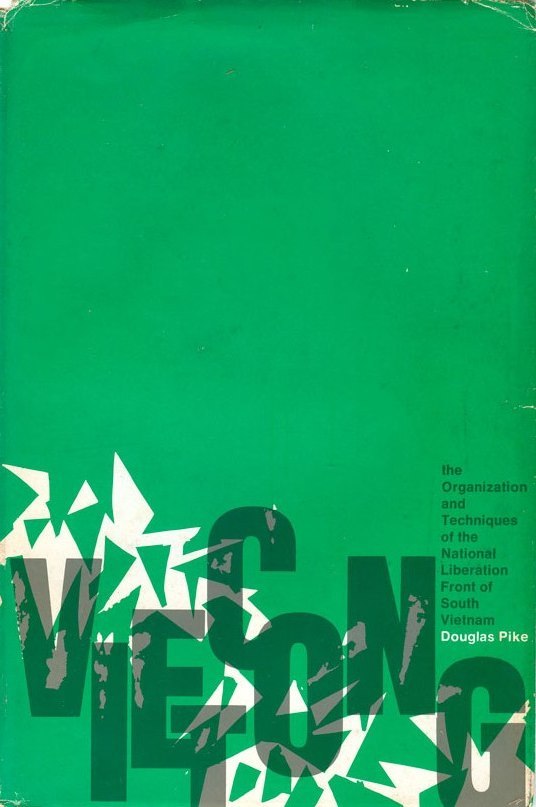
Douglas Pike served as a foreign service officer with the US Information Agency in Vietnam since October 1960. He began his book as a private endeavor to record only certain events in Vietnam, but gradually broadened its focus to include everything about Viet Cong insurgency, making it a highly important and useful guide.
Interestingly, Pike begins by rejecting the widely held conviction that between 1960 and 1964 South Vietnam was a place of terror and sudden death. On the contrary, he insists that the average Vietnamese could grow his rice unaffected by the on-going war, and the chance that his village would find itself under guerrilla attack or become the scene of a clash between the ARVN and the Viet Cong was "not much greater than the odds of being hit by lightning."
He characterizes the National Liberation Front very well. The main goal of the NLF was to control the population and, through this control, to organize the people as a weapon against the government. But according to Pike, there was more to it. The NLF's ultimate objective taken together with other activities was to create a new pattern of socialization. It manipulated economic activities, which were the base for all village activities, in such a way as to increase communalism, or collectivization, and thus to disrupt and alter the village means of production. It also manipulated educational and other intellectual activities within the village, and allowed the Viet Cong men to more easily control the villagers hostile to the NLF. Consistent with Ho's ideas of a Vietnamized Communism, it attempted to substitute traditional Marxism-Leninism for one disguised by religious beliefs to work within the familiar village life and at the same time imbue it with new values.
In those areas of the country where it had continuous and firm social control, the NLF was, in the author's words, a society within a society, with its own social structure, ideals, and coercive methods. The NLF men made a conscious and massive effort to extend political participation on the local level so that the South Vietnamese people would form a self-contained, self-supported opposition to the government. It is a mistake to think that the majority of the Vietnamese joined the NLF because they were believers. In fact, almost the opposite was the case. The Vietnamese youth was first surrounded by the Viet Cing social organization, which had infiltrated his village and which he had no hand in creating – but to which he was considered to somehow belong. Through a process of insinuation, he or she came to realize that he was part of the NLF, never sure of how this happened and never having a choice. In other words, conversion followed subversion instead of the other way round. Therefore, not motives but circumstances must be explored to understand the recruitment pattern of the NLF.
Another misconception Pike addresses is the American officials' assumption that the NLF members were fanatics. Because they performed well in combat, it was reasoned, they were highly motivated, which apparently meant that they were dedicated to an ideological cause. Thus, American analysts wasted time searching for the essence of that belief and for its source. However, this dedication to an ideological cause simply did not exist, especially among the NLF's best units. The Viet Cong's best military units – the Main Force units – were so effective because they consisted of professionals. "These were not green young Vietnamese farmers, only recently introduced to the rifle, but experienced guerrillas who had been fighting most of their adult lives," writes the author. What motivated them was not so much ideology as professional competence. They could have been compared to the US Marines. They were very good, with superb discipline, and much more versed in guerrilla warfare than the Americans and the ARVN. They knew how to use camouflage, which was essential for their survival, and were skilled in small-unit tactics, especially the ambush. They trained hard, rehearsed, and practiced attacks until perfect, and then they fought with all they were worth. This is why they proved to be such formidable opponents for the American-South Vietnamese alliance.
Interestingly, Pike also does not threat the NLF as Communists in the common sense of the word. According to his observations, the Viet Cong were not Communists by ideology at all. To be a Communist means mastering Marxism-Leninism, which NLF Vietnamese found notoriously difficult to understand, though, because it was strikingly un-Vietnamese. For instance, it must have been a truly monumental achievement for a cadre to convince a Vietnamese villager that "matter", not God or Spirit, is the reality and that nothing is inherently unknowable. Thus, the NLF was not a Communist because it had embraced the Marxist-Leninist ideology, but rather because it allied itself with states that did. This distinction was a weakness because, explains the author, the convictions that held the Communists and their movements together during dark days elsewhere were mostly absent in Vietnam.
VIET CONG is a great book for anyone who wants to achieve in-depth understanding of the peculiar brand of Vietnamese Communism and the nature of the Viet Cong revolutionary struggle. This book is well-researched and based on Douglas Pike's personal experience in Vietnam. I highly recommend it.
This book documents the intricate organization and purpose of the Viet Cong. It reveals how they were able to stand up to the mighty U.S. (until defeated soundly at Tet and eventually replaced by North Vietnamese regulars.) It is the most authoritative work on the structure and activity of the Viet Cong. This is an important work by Douglas Pike who spent many years in Asia and six in Vietnam specifically as an official of the United States Information Agency. If you are a student of the Vietnam Conflict this book is essential to have or read.
Douglas Pike stunned the American nation, and landed on the cover of TIME MAGAZINE, by documenting how the Vietcong actually enjoyed popular support in South Vietnam and had succeeded in creating a parallel government to the corrupt US-backed regime in Saigon. Gasp! How did Pike come across such information? Simple he read VC newspapers, pamphlets, and listened to their radio broadcasts. If "the best and the brightest" in Washington, DC and the media had bothered to listen to him instead of just praising his research skills the US might have cut its losses and abandoned Ky and Thieu by 1967, saving lives on both sides, and America's global reputation too.
This is an excellent account of our adversary in South Vietnam. Meticulously researched and organized it should be required reading for anybody doing research on the war.