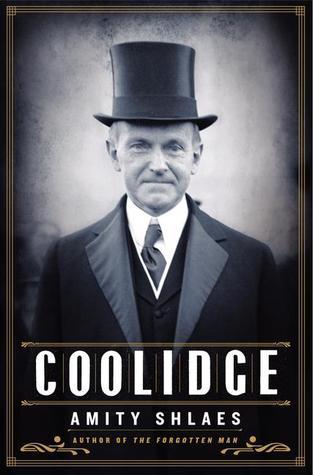
I think most people have a natural tendency to give a biography higher marks if they share political or ideological positions with the subject and lower marks if the subject resides on the opposite end of the spectrum. So I feel compelled to preface this review by clarifying that, as both conservative and a proponent of fiscal discipline, my low mark for this bio stems from other reasons:
First off, Coolidge is just not that exciting a subject to begin with. His personal life prior to politics has none of the drama or excitement of someone like Teddy, Ike, or Grant. And his political life and presidential administration, with a few exceptions, was focused almost entirely on fiscal responsibility and paying down debt (and let’s be honest, that doesn’t exactly make for riveting reading material). Second, Shlaes’ approach to this book seems to double down on the least exciting aspects of the man and his time. Rather than offer some color and context of life in the “roaring 20s”, we see the Coolidge economic boom almost entirely through the eyes of an accountant with no social life, constantly counting the tax revenue. Third, I found Shlaes’ writing style plodding and occasionally difficult to follow. I felt she had a tendency to either burry important points in long paragraphs or switch subjects with no notice mid-paragraph. I found myself having to re-read pages to make sure I didn’t miss anything. Fourth, the author was clearly enthusiastic about Coolidge’s pro-growth policies and that agenda is clearly reflected in her writing. Nothing wrong with having a strong opinion, but I prefer bios that at least make an attempt at objectivity by presenting opposing viewpoints. Finally, I felt there was no serious analysis of Coolidge’s culpability or lack thereof for the Great Depression. There are compelling arguments to be made on both sides of that debate but she blows through these competing views in just a few short paragraphs.
Silent Cal is hard man to make exciting. Even after reading this book, I still have an incomplete appreciation for why he was so wildly popular (especially in his early political career before he could take credit for a booming economy). The book is not without merit. Indeed some sections (like the death of his teenage son) were covered quite movingly. But by and large, the book felt a little too much like its subject, focused on economic policy to the exclusion of other issues and lacking in personality.
What follows are my notes on the book.
His family farmed the rocky Vermont land (timber, sugar, sheep), while most of his relations moved out west. They succeeded because they lived economically, writing down all expenses in little notebooks. Family lore was full of stories about the consequences of not living within your means (17). In 1872, John Calvin Coolidge was born (he later dropped John from his name). He grew quiet and reserved after the death of his mother. He was sent off to Black River Academy in Ludlow, giving him his first exposure to the larger world (railroads, factories, banks, etc).
Democrat President Grover Cleveland’s decision to remove tariffs advantaged Australia and decimated Vermont sheep farmers (28). In his final year at Ludlow, his sister Abbie died. He traveled to Amherst College to take the entrance exam, leaving Vermont like so many before him (30). Introverted and quiet, he wasn’t invited to join a fraternity. He kept rigorous financial books yet was perpetually short of funds. He was powerfully influenced by Professor Charles Garman and his emphasis on the individual (as opposed to the European focus on classes or groups) (52).
Politics continued to fascinate him. His father support Benjamin Harrison, who had signed the Sherman Silver Purchase Act and endorsed tariffs that protected Vermont wool (39). His Amherst professors supported Cleveland, free trade, and the Gold Standard (40). His political awakening took place at a time when the US was first waking up to new questions of itself. In the farming age, people might be underemployed but rarely unemployed. With industrialization and factory closings many people could be suddenly without a job. The income tax became law in 1894 (46).
Unable to afford law school, he began “reading” the law (i.e. apprenticeship under a lawyer for 3 years)(61). The terseness of the silent clerk appealed to clients (who were billed by the hour). He qualified for the law a year earlier than expected and opened his own law office, working common fare of small towns (writs, deeds, rent collection). In 1898, as the US was readying for war with Spain, he won a seat on the city council (71).
Grace Anna Goodhue was everything Coolidge wasn’t: outgoing, athletic, handy, and from a family of Democrats (79). Opposites attracted and they were married in 1905. Independent, he attended church with Grace but never joined, was hesitant to join any civic clubs, and rented a house not liking to be beholden to bankers (91).
Roosevelt dominated the political scene. Coolidge approved of TR’s style of progressivism: sound budgeting, rigorous civil service, school reform, accepting of immigrants. He also approved of TR’s “splendid character” (89). He won a seat in the lower house of the Massachusetts state legislature. His formative legislative experience was during TR’s trust busting. Ironically, it was Morgan and the big banks that stepped in to rescue the monetary system in the Panic of 1907. He decided not to run again in 08 in order to shore up his finances. Lawyering didn’t compensate him for the fun of the political chase and he decided to run for mayor of Northampton in 1909.
Reelected in 1910, he began campaigning for state senate. Both parties were vying for the progressive label and TR was tempted to get back in the fray. Coolidge bridled at TR’s break with tradition and aligned with others to deny him the GOP nomination (113). Coolidge considered himself progressive: he voted for women’s suffrage, state income tax, a minimum wage for female workers, and salary increases for teachers (114). After negotiating a wool manufacturers strike, he soured on progressives, increasingly viewing them as socialists and anarchists. His thinking aligned more with Taft, himself tiring of the progressive onslaught (116). Wilson won when TR split the ticket.
In 1913, he won the Senate presidency. He had expected to pilot, but not in waters of war. The war in Europe was bound to disrupt a port town like Boston. He set aside his concerns about progressives and worked to pull all GOP factions together, always seeking agreement and middle ground (128). Though he deplored spending, he took the lead to make sure MA was doing its part and vowed to support Wilson (128). He drafted his party’s platform that year and included every progressive item they could think of to build a big tent.
European gold began pouring into the US safe haven and the stock market surged on war contracts (133). The surge of war contracts put his colleagues in a spending mood. Amherst alumni, looking to elevate some of their own to positions of greater power, pushed him for Lt Governor. Thanks to new automobiles, campaigning across the state proved easy and he won by a whopping 50K votes. A clear sign he was on a path to be governor in the future (138).
Out of control war spending convinced him the system was broken. The income tax raised money but there was no budget plan overseen by the executive. Legislatures appropriated and spent at will with no discipline or long range plans. He won reelection with an even larger margin, right before the US declared war. Spending tripled and the country borrowed money on a scale unimagined (143). In 1918, he ran for governor. His victory coincided with the WWI armistice (146).
The state legislature voted to consolidate the departments of the commonwealth government from 100 down to 20 but left the execution to the governor. This meant laying off friends and offending political constituencies crucial to future campaigns (his was only a 12 month term). The post-war economy was a mess. Food costs had doubled since 1913. Workers had suffered low wages to “do their part” for the war effort. The war over, they now sought pay raises. Horror stories from Russia put many in a mood to negotiate with organized labor (148). Conciliation seemed the only course for a governor of a big industrial state in 1919. Employers and labor looked to Washington for leadership but Wilson was busy fighting for the League of Nations.
When Boston police went on strike, rioters rampaged unchecked. Coolidge called the state Guard. Fearing other cities would face similar strikes, all appetite for concessions evaporated (159). Bostonians, initially sympathetic with the police, turned on them as the city descended into lawlessness. Wilson discovered reporters were not interested in his League but wanted to talk about labor (163). Coolidge kept the Guard in place and told the police they could never return to their jobs. Arguing this was desertion not a strike, and there could be no compromise (167).
His handling of the strike made him a national figure. He had also upstaged a sitting president. Wilson was still vacillating and refused to get involved in the next big strike (steel). Because of the mandated government cuts, his odds of reelections seemed bleak. Then the coal and steel strikers overplayed their hands. Voters, unable to warms their homes, turned against the unions (181). Coolidge won reelection in a landslide (183). He took advantage of the cover of his victory to announce his controversial “Big List” of slimmed down government (184).
After the war, the country expected a revival but instead faced a worsening economy. War debt was $21B (10x the pre-war debt). The income tax top rate had shot up to 70%. Money fled to tax free municipal bonds, hindering job creation. Railroads were released from national control only to be dumped into a recession (193).
His name appeared among prospected GOP presidential candidates. The front runners included General Leonard Wood (a Roosevelt protégé), Herbert Hoover, and IL Governor Lowden. Coolidge and Ohio Senator and newspaper publisher Warren Harding hoped to emerge a dark horse in a deadlocked convention (189). Among all GOP candidates, Harding best captured the national mood by appealing to common sense and a return to “normalcy”. The sentiment struck a chord with the public reeling from so much upheaval. The savvy and outgoing Harding proved every faction’s 2nd choice and he won on the 10th ballot (200). In an unpredictable stampede, and without any apparent leadership intervention, the delegates enthusiastically selected him as the VP candidate (201).
The GOP won with 60% of the vote and 404-127 in the Electoral College. The GOP also held 70% of the House (9/10 seats not in the South). No longer the progressive party, it was the party of low taxes, tariffs, less government, and stability (209). Harding was naming respected powerhouses to advise him (Hoover to Commerce, Hughes to State, Mellon to Treasury). Silent Cal, almost the exact opposite of the outgoing Harding, experienced culture shock in the DC social scene and he was difficult for many to understand. In addition to his style of dress, quiet demeanor, and breaches of etiquette, he was also shunned by DC high society because he was a threat to the activist, Roosevelt wing of the Republican Party (247). The Harding White House featured the general atmosphere of a convivial gambling saloon (all in the era of Prohibition). Harding’s crowd was much wilder than his own temperament and always seemed to find itself in little scandals (232).
Growth is not automatic, steps had to be taken to bring it about. At the top of the list, Harding and Mellon set about to return income taxes to their pre-war rates. Other Cabinet posts looked for ways to cut. Albert Fall moved to sell the navy’s oil reserves to raise revenue and improve their efficiency (222). Harding called an extra session of Congress to pass his budget law giving the executive branch oversite (225). New Budget Bureau chief Charles Dawes looked for ways to reduce the budget. One was to divest of government surplus left over from the war. Harding called for the Washington Naval Conference to reduce the number of capital ships among the great powers (227).
Of all Harding’s men, Coolidge found himself drawn to Mellon, a kindred spirit struggling to promulgate quality policy and simplify taxes (239). The great legacy of the war (beyond the debt) was the size and waste of government. But lawmakers began querying the way Harding went about commercializing Teapot Dome (Wyoming oil reserves). Fall appeared to accept bribes when he leased it without putting it out for bids and progressives went on the attack (240). Harding vetoed a popular veteran bonus bill, dimming GOP prospects for the mid-terms (242).
He found out about Harding’s death while in Vermont. He was sworn in as president by his father (the local notary). He intended to finish what Harding started, to prove the war was but an interlude and bring the country back to a time of smaller government (253). Coolidge met with his budget director Lord every Friday, before Cabinet meetings. Together they cut, then cut some more trying to reduce the budget from $3.2 to $3B and begin paying down the $20B debt (255). Harding never had the temperament to tell people no. Coolidge almost always said no (263). He and Mellon began promoting “scientific taxation,” the proposition that lower taxes would spur growth and increase tax revenues. Additionally, lower taxes would redirect money away from municipal bonds and put it back into the economy (266). Addressing a joint session of Congress, he pitched Mellon’s tax bill. Coolidge wasn’t loud, but he did speak clearly which worked well over the new medium of radio (273).
The opposition attacked Mellon in an effort to stall the legislation, while they moved to pass a veteran’s bonus/pension bill. He vetoed the bill as too costly and contrary to his efforts to reduce the debt (286). Believing that the only way to win passage of his tax bill was to make concessions, he signed an immigration bill that contained restrictions on the Japanese (285). He signed a token tax reform bill but not the “scientific” bill he and Mellon wanted. He believed he would need to run again to get it passed.
His son Calvin got a blister playing tennis which became infected with streptococcus. The chaotic DNC convention paused to announce the death of the president’s son (300). Coolidge wasn’t the same afterwards. In his darker thoughts, he believed his son would be alive if he had never come to Washington. Politics interested him less.
Even with only the token tax bill, tax revenue was $150M higher than last year (301). If small rate cuts produced greater revenue, then Mellon’s full plan seemed likely to bring in even more. He needed to justify his son’s death with something great and this seemed to be it (302).
While his opponents were more boisterous campaigners, their oratory seemed overwrought on radio. Coolidge won a 3-way race with 54% of the vote (319). Elected in his own right, free to appoint his own cabinet, and with gains in the House and Senate he had more leverage to push his agenda than before. In Feb 1926, Coolidge prevailed signing Mellon’s tax bill into law (339). Many Democrats wanted to use the extra revenue not for debt reduction but large new programs (344). Commerce Secretary Herbert Hoover demanded infrastructure projects (like the future Hoover Dam). Despite his refusal to appropriate, Coolidge remained enormously popular and talk of another term was rampant (347). The next fiscal year the Treasury surplus reached $218M. The debt was down to $19B (349).
Coolidge was an enthusiastic supporter of aviation (good for commerce and cheaper than battleships) (350). The Army and Navy viewed their drastically cut budgets as a threat to national defense. He developed a friendship with Lindbergh following his famous flight to Paris.
He set up the summer White House in the Black Hills of South Dakota. Hoover seemed omnipresent during this period, annoying him so much that he went out of his way to put him in his place by telling reporters he’d never be Secretary of State (357). The Mississippi flood of 1927 was the greatest national emergency since WWI. Firmly committed to federalism, he refused to intrude in state affairs. Eventually, he sent Hoover (without gov funds) to chair a relief commission. Hoover amazed all and the whole scenario seemed to prove Hoover’s case for federal management of waterways (359). Hoover had upstaged Coolidge, just as he had upstaged Wilson. Annual surpluses continued to rise: $599M that year, up from $378M the year before (363).
To secure federal funds to sculpt Mt. Rushmore, Borglum asked Coolidge to write the text for the monument. While in SD, he surprised reporters with his announcement that he would not run for reelection (381). He had seen Wilson and Harding fade in office. He had also believed that presidents were surrounded by yes men and it was wise to step down rather than come to believe in your own greatness.
Coolidge expected a severe correction to an artificially high stock market. Yet he believed it wrong to interfere in the market and so did nothing to reign it in (397). He accurately predicted the election of “that superman Hoover” who would increase spending in response to an economic downturn, and that the Democrats that followed him would then spend money like water (398). When Vermont was devastated by terrible flooding that November, he again refusing to intervene, leaving the relief effort to Hoover and the Red Cross (400). He stuck to his principles, even though it meant the ruin of his home state.
At the 1928 Pan-American Conference in Cuba, he proposed a multi-national peace compact (France wanted a bilateral treaty). Coolidge was determined to succeed where Wilson had failed. On August 27th, the Kellogg-Briand Pact was signed, renouncing war as a policy tool for resolving disputes. The Senate ratified the treaty 85-1. In hindsight, the treaty clearly failed but it set a precedent that would be copied in the UN charter.
After Hoover’s election, Coolidge’s mood darkened. He vehemently believed Hoover’s policies in response to the predicted recession would make a bad situation worse, undermining the growth and stability he had worked so hard to build (424). The market continued to climb; he knew the higher it rose, the greater the coming crash.
He felt lucky to survive the presidency and relished leaving public life. He turned down jobs on Wall Street and his relationship with Grace dramatically improved. When the crash came, he thought Hoover’s actions perpetuated panic where he had displayed steady, calming leadership (438). He concluded the reason for the prolonged Depression was uncertainty: “Business can stand anything better than uncertainty” (442). Now writing columns for a publishing house, he lamented that Hoover’s spending exceeded his wildest imagination. Even during the recession, he and his columns remained wildly popular (446). Finally free of the constraints of the office, he felt free to open up about the loss of his son. Still on the Gold Standard and unwilling to run multi-year deficits, Hoover raised taxes to balance the budget. This erosion of his legacy dismayed him (448).
Speaking at Madison Square Garden for Hoover’s reelection campaign, he argued that the GOP would lose if they made this a spending contest. Hoover had spent money like a Democrat but it still wasn’t enough to secure his reelection. It disturbed him that the national mood had slid from normalcy to experimentation so quickly, leaving him feeling he “no longer fit in with these times” (453). He died suddenly on January 5th, 1933.