Jump to ratings and reviews
Rate this book

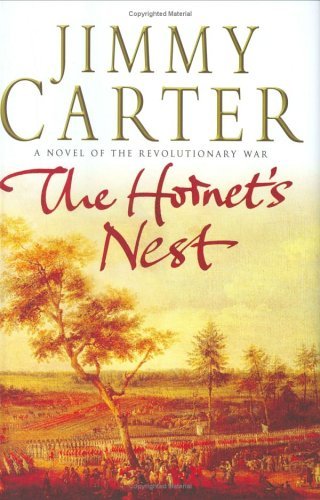
The Hornet's Nest

Rate this book
The Barnes & Noble Review
Former president and Nobel Peace Prize winner Jimmy Carter presents a novel of the Revolutionary War that emphasizes the role of the South in the battle for America's independence. With a multitude of previous nonfiction works, ranging in topics from the Middle East conflict (The Blood of Abraham) to the workings of democracy (A Government as Good as Its People), Carter uses his political understanding to bring this well-researched tale to fascinating life.


When newlyweds Ethan and Epsey Pratt move from Philadelphia to a settlement in Georgia, they find themselves drawn into the war despite all their best efforts. Side by side with their Quaker neighbors Kindred and Mavis Morris, the Pratts are forced to take up arms against the British, as the world around them is bitterly changed forever.


With a discerning eye and a commitment to historical accuracy, Carter provides a unique view of the American Revolution by presenting lesser-known aspects of the conflict -- including the shameful way everyone involved tried to manipulate and control the Indian tribes. Despite a huge cast of characters and an extremely detailed and complex narrative, Carter keeps the story rooted in the personalities of common folks faced with extraordinary difficulties. The Hornet's Nest is a vivid, compelling, and original fiction debut from one of our most noted history makers. Tom Piccirilli

480 pages, Paperback

First published January 1, 2003

149 people are currently reading
1100 people want to read

About the author

Jimmy Carter

276 books640 followers
Librarian’s note: There is more than one author in the Goodreads database with this name.

James Earl Carter, Junior, known as Jimmy, the thirty-ninth president of the United States from 1977 to 1981, creditably established energy-conservation measures, concluded the treaties of Panama Canal in 1978, negotiated the accords of Camp David between Egypt and Israel in 1979, and won the Nobel Prize of 2002 for peace.

Ronald Wilson Reagan defeated Jimmy Carter, the incumbent, in the presidential election of 1980.

He served and received. Carter served two terms in the senate of Georgia and as the 76th governor from 1971 to 1975.

Carter created new Cabinet-level Department of education. A national policy included price decontrol and new technology. From 1977, people reduced foreign oil imports one-half to 1982. In foreign affairs, Carter pursued the second round of strategic arms limitation talks (SALT). Carter sought to put a stronger emphasis on human rights in 1979. People saw his return of the zone as a major concession of influence in Latin America, and Carter came under heavy criticism.

Iranian students in 1979 took over the American embassy and held hostages, and an attempt to rescue them failed; several additional major crises, including serious fuel shortages and the Soviet invasion of Afghanistan, marked the final year of his tenure. Edward Moore Kennedy challenged significantly higher disapproval ratings of Carter for nomination of the Democratic Party before the election of 1980. Carter defeated Kennedy for the nomination lost the election to Ronald Wilson Reagan, a Republican.

Carter left office and with Rosalynn Smith Carter, his wife, afterward founded the nongovernmental center and organization that works to advance human rights. He traveled extensively to conduct, to observe elections, and to advance disease prevention and eradication in developing nations. He, a key, also figured in the project of habitat for humanity. Carter particularly vocalized on the Palestinian conflict.

http://us.macmillan.com/author/jimmyc...

Ratings & Reviews

What do you think?
Rate this book

Friends & Following

Create a free account to discover what your friends think of this book!

Community Reviews

5 stars
184 (14%)
4 stars
342 (27%)
3 stars
445 (35%)
2 stars
216 (17%)
1 star
73 (5%)
Displaying 1 - 30 of 217 reviews
529 reviews38 followers
January 17, 2021
This felt more like a group of rather random biographies edited together than a novel. It was quite educational—we don't often hear about what happened during the revolutionary war in the south — but it was so dryly written that it was almost impossible to maintain interest. One interesting theme is the way the revolutionary war set up issues that wouldn't be resolved, or even begin to be resolved, until the Civil War.
Profile Image for Aaron Million.
550 reviews524 followers
December 14, 2022
Jimmy Carter has written many books, but only one of them has been fiction. And that is this one. Even with this ostensibly being fiction, it is clear that Carter did a lot of research in preparation of writing his story, as many of the events depicted here did actually occur. In addition, many but not all of the characters were real people. Carter employed a mix of completely fictional characters, people who were real but who history barely mentioned and thus left open to interpretation (or invention) most of their actions, and accurate depictions of historical individuals.

The main characters are mostly fictional. The nominal main character, Ethan Pratt, is absent for long stretches of the book. Even though Carter both starts and finishes the book with him, he didn't feel like the hub of the story. Carter had so many angles going (frontiersmen, British officials, Indians, Quakers) at the same time that Pratt seemed relegated to the background for about half of the book. I did not get too invested in him and that is probably why, although I also found him to be an unlikeable person. Carter does show how he transforms from someone who just wants to be left alone into a militant militiamen bent on revenge; someone who cheats on his wife and who also left a friend to die.

Then again, Ethan was not the only rough character here. Pretty much everyone is. Carter is really good at showing just how violent and crude most people were back then. Most of these people had little money; they were basically just getting by. Many of them were uneducated and intolerant. The few wealthy people (such as Joseph Maddock, the head of the Quaker settlement) were depicted as always looking to make a profit, whether it be out of the war or from someone in a weak position. The Americans do not come across well here, but then again the British were just as bad. Quite frankly, that mirrors my own view of the two sides during this time period - each were guilty of numerous atrocities against the other.

One of the major characters who was real but history had little about was Thomas Brown, who became the leader of the Florida Rangers on the British side. He was brutal, but he was also brutalized. Like Pratt, he became obsessed with vengeance and violence. Carter was able to bring both he and Pratt together to face each other towards the end, in effect wrapping up two storylines simultaneously.

There were a few areas where I thought that Carter fell short. One is with the Indians. Carter starts off by having one of his fictionalized characters, Newota, seem to be an important player. But Newota soon got relegated to the sidelines, and then all but disappears until close to the end, and even then he is only mentioned briefly. This mirrors what happened with the Indian storyline in general: Carter seems to forget about it. The Creeks and Cherokees (and a few other tribes) are frequently mentioned, but the scene never shifts to them. I would have liked to have seen either Newota have a bigger role, or for the Indian tribes to play a more prominent part in the events.

Similarly, the Quaker settlement storyline sort of peters out. The Quakers are a big part of the early chapters, with Ethan's wife Epsey being a Quaker, and the Pratts moving from North Carolina to Georgia with the Quakers, then setting up a homestead with their settlement. After that though there are only occasional brief scenes there the rest of the way. In a Q&A session at the end of the book, Carter says that he portrayed the Quaker settlement accurately - and I have no reason to doubt that - but I wish he would have explored their motives further.

Slavery is also touched on, with a chapter about Quash Dolly, a slave woman who helps the British. I wish Carter would have carried her story further. The chapter he does have on her is brutal - depicting the disgusting and degrading treatment doled out by whites against blacks. It is still difficult to believe that there was a time when people looked upon those of a different skin color as property. Humans possess an endless capacity to be cruel and inhumane towards other humans.

Carter does something that I think is rather bold: he kills off two major characters early in the book. Both Henry and Sophronia Pratt die, not at the same time nor of the same cause. Of course, being that this occurs early on, I have to somewhat question if they can really be classified as principal characters. When close to 400 pages remain, and those two have already died, how can they be considered as principal characters? Henry's death does have meaning and it contributes to later actions by Ethan, but Sophronia dies of smallpox. Still, it's a bold choice for a novelist.

What Carter excels at is painting the overall bleak picture of how daily life was like during the war. Food was scarce, disease was rampant, violence lurked in every corner, and communication was delayed. This was a time period where, unless you were wealthy, just day-to-day life was grueling. It is not a world that I would want to inhabit. Reading Carter's story is close enough. Carter has not written a sequel to this book, and given his advanced age now I would not expect one. Which is too bad, because he did a good - though not great - job with a difficult subject.

Grade: B
Profile Image for Dale.
1,948 reviews66 followers
July 18, 2012
Fact-filled, but not well told

Regardless of your views on Jimmy Carter the politician, he is also Jimmy Carter the author. A good reviewer should separate his opinions, be they pro or con, about the politician from a politician's works of fiction. I will endeavor to do so here.

Carter's interest in his native state of Georgia has led him to write, The Hornet's Nest: A Novel of the Revolutionary War , a historical novel about the Revolutionary War in Georgia, the Carolinas and Florida. Admittedly, this is an area that is often ignored in favor of Boston, Valley Forge and Philadelphia so there is room for quality fiction in this area.

The problem with Carter's work is not a lack of attention to historical detail - it is too much attention to historical detail to the detriment of an actual story about fictional characters. Carter's storyline shifts from being a piece of historical fiction to being a rather dry local history throughout the work.

Carter's passion for historical detail often drowns out the narrative. The reader is treated to dry facts about the intricacies of the British command in Florida ad nauseum. We are repeatedly told some of the some details over and over again - sometimes multiple times on the same page! ...

Read more at: http://dwdsreviews.blogspot.com/2011/...
Profile Image for Michelle Stimpson.
455 reviews9 followers
July 1, 2011
I really wanted to like this book more than I did. The fictionalized characters were interesting and I was wrapped up in their story, then Carter digresses to true historical accounts that took away from the story. Too many names, dates, and historical facts for a novel. I didn't quite get the end. I'm not sure if I, as the reader, am supposed to draw my own conclusion or if there is a clue to the ending that I am somehow missing.

On a happy note, I learned a lot about the Revolutionary War and it gave me a better understanding of how some of the problems we continue to face in America stem from that time. Maybe the things I learned are better than just an "ok" rating, but as a novel, it was just "ok."
1 review
March 25, 2008
Pres. Carter's book treats in depth the Revolutionary War and its preceding altercations in Georgia, South Carolina and the British territory of Florida. I was glad to learn more about the most southern colonies' involvement since it hasn't received the historical attention that the mid-south and northern alliance has been given. Almost all of the characters were actual people. Carter has been critized by reviewers of novels because the interactions and conversations among participants seem stilted and unemotional. I personally found that this added to the realism since I believe people who led exceptionally hard lives, particularly if they were of Scotish/English extraction, were not given to much emotionalism.. except possibly anger. This is a novel because a few of the characters are fictional, but the events are not. And so it reads more like a history text...which is not a bad thing.
163 reviews10 followers
August 2, 2008
I am tempted to give this five stars, just because i am impressed Carter could write so well, but it isn't THAT good.

A well researched and brought to life history of the Revolutionary war in the South. While no expert on the Revolution, I am farily familiar with the history and there is a ton of stuff I did not know. I don;t know how accurate it is, but his characters are so realistic and human, and thr conflict is laid out without prejudice. Some supporting the British and some British themselves where at least honorable. I had no idea that the Quakers were semi loyalist. And I had no idea that some of the independence activists were pieces of shit. The connection with the native Americans and their role is fascinating. And the love story and down to earth style of writing make this a hard to put down book

Profile Image for Walter.
339 reviews29 followers
August 20, 2016
"The Hornet's Nest" is the first novel by President Jimmy Carter, and that fact alone makes this book a compelling read. It is a historical novel set in Georgia during the years leading up to and during the American Revolution. If this were a history rather than a historical novel, I would probably give this book a rating of four or even five, unfortunately this book lacks many of the elements that are indispensable to a great novel. A historical novel should be a great story placed in a historical setting. But this novel, like many novels written by historians, is essentially a history with a few fictional characters and events thrown in.

The first third of the book deals with a Quaker family who move to Georgia in the 1760s, and have to deal with the slavery, the relations with Native Americans and the hostility of the locals to the British colonial rulers that they found there. However, once the war begins, the novel drops the pretense of being a novel and simply sticks to relating the historical events that took place in the war. The Quaker family is lost from this point until almost the end of the narrative. Several other fictional characters are introduced, but there is no character development, the characters are simply used to narrate the events of the war. There really is no story here either. It's a shame because the writing is quite good, and I learned a lot about the events of the Revolutionary War in Georgia by reading this book. But it's not a novel per se. The reader should be aware of that.

Overall I would recommend this book to people with an interest in the colonial history of the American South, as well as fans of Jimmy Carter.
Profile Image for Dan.
101 reviews2 followers
May 1, 2014
I was a bit hesitant taking on this book, knowing it was the first novel by former U.S. President Jimmy Carter - widely known as one of the least successful U.S. Presidents. But, hey, it turns out that he makes for a pretty good author of historical fiction.

The writing is a bit weird in places, for example, Carter loves to start sentences with "The next day..." "The next week..." "The next month...". Also, I laughed out loud at the beginning of each chapter because of the chapter titles which basically give away/summarize what should have been the key "reveal" of each chapter. "Jimmy goes to war..." "Billy Gets Shot..." etc.

Having said this, once you get past some of the awkwardness, this is actually a really good book. Carter paints an extremely intriguing multi-decade picture of the events leading up to the Revolutionary War from the point of view of people in the Carolina's and especially Georgia. It's a part of the picture that most of us never hear about in school.

He also explains the relationship between the Native American tribes, the British, the colonists and even slaves in a very fascinating way.

Overall, great book!
Profile Image for Kristina.
106 reviews8 followers
May 18, 2016
I'm really glad I read this book. I've read my fair share (and then some) of books about the Revolutionary War but it is most definitely true that there are only a few specifically about or from the perspective of the South. Carter does an excellent job of laying out the competing loyalties and the various tensions that existed for citizens of South Carolina and Georgia. It's amazing how little impact the war in the north and mid-Atlantic had on those two states; they were far more preoccupied with the Indians and the British incursions from Florida. In that regard, it was a fantastic and fascinating book.

I will say, however, that I found the book a little bit choppy and at times slow to read. Particularly in the beginning, when Carter is establishing the characters, I felt that it dragged. It seemed like Carter was trying to write in a style similar to that of Edward Cline, meaning great detail and information in a seemingly dense book but with character of the characters to move the story along and engage the reader. Unfortunately, until the last third of the book, there wasn't very much engagement for me and I found the characters to be slightly flat.
Profile Image for Megan.
700 reviews89 followers
September 30, 2010
I first heard of this book when Carter himself mentioned it when he was being interviewed by Jon Stewart on The Daily Show. It sounded interesting, because I kind of specialize in early American history, and c'mon this is a novel written by an ex President. But to my disappointment, this book sucked. There's way too many main characters that Carter focuses on. And if there has to be a main character, which would be Ethan Pratt, he's absent for good part of the book. The characters all seem to have the exact same personalities as well and are mostly two dimensional. But each character brings a new conflict, a new side to the Revolution. Like Kindred shows the struggles of Indians, Quash shows the struggles of slavery and Brown shows the struggles of being a loyalist. But with a couple of these characters, they seem to be only token characters in order to show us this side of the story. Because once Carter is done showing us this side of the conflict, we never hear of them again. This book focuses on the American Revolution in the southern colonies like North and South Carolina and Georgia. But again, the main character, Pratt, doesn't even get into the war until long after the Congress declares us a Nation. It probably would have been better if the character would have been involved in the war sooner rather than later. This really could have been written better. Like other reviewers says, it really does read like a text book and sounds like non fiction. Apparently, Carter's actual non-fiction books are good so I don't want to give up on President Carter just yet. But this book was not a good first impression.
This entire review has been hidden because of spoilers.
Profile Image for Donna.
491 reviews11 followers
July 4, 2009
A timely finish--4th of July! ;-)

Tho a "dry" read for me, I did find HORNET'S NEST very informative. I enjoyed learning about the Revolutionary War via a novel. President Carter's story helped me recall the things I learned back in high school and college classes, giving greater emphasis to the war in the south. Jersey Girl that I am, my focus was always, Washington crossing the Delaware on Christmas--Trenton, Princeton, Morristown (the places I viisted as a child) and north to Boston.

I appreciated learning more about the politics of the war--Whigs and Tories, French and British political tensions, treatment of Cherokee and Creeks (just saw a great program on this in DC at the Native American Museum), their lifestyles and what led to the Trail of Tears. Also, was interesting to read about Slave involvment (Quash Dolly), and the Negro Regiments during this war (I'd thought they had not be involved in military fighting until Civil Wat under Robert Shaw as seen in the movie GLORY).

Overall a good read. Can I give it a 2 1/2?

I will go down a different path for my next read, but still wish to get my hands on WIDOW's WAR, and possibly (time permitting) read Mike's 1776, by Mccullough
Profile Image for Gary Beene.
Author 4 books5 followers
August 13, 2013
I very much enjoyed this book not so much because it was great writing, but rather because it was an interesting story line and provided a tremendous amount of history about the revolutionary war in the southern colonies - primarily Georgia and South Carolina. Inasmuch as I was not that familiar with that piece of our nation's history it was fascinating. I did listen to the audio book on a long drive and it was very well performed by the reader, so I suppose that it may have been a bit more dry if I had just read it. Nevertheless, it is a good book and will surprise the reader regarding the good guys, bad guys and American Indians.
Profile Image for Scotty.
163 reviews12 followers
January 13, 2024
Barely one star, Carter's book of fiction is a textbook with some dialogue thrown in. The characters are poorly developed and flat as plywood. It appeared as though it started as a good fictional story of the Revolutionary War but . . . after the first five chapters, it appeared as one of two things happened: the writing aspect became to tedious or the publisher pressured for a faster finish. Either way, the book takes a dramatic turn and begins to string large amounts of history together without plot and little to zero creative writing.
Another aspect that seemed to be a constant in the book was the very obvious fact that Carter thoroughly enjoyed writing about how magnificent the British were and how a bunch of hillbilly Georgia morans stumbled over a victory or two. Even the victory at Yorktown was snubbed, and reinforced in the book that it really wasn't that big of a victory. I continued to read, thinking that Carter, being a former President of the United States, would round something out or show a clear path of both sides. That did not happen. Even when surrendering American soldiers were butchered by Banastre Tarleton, it was mentioned briefly and dismissively; when on the same occurence with American soldiers doing the killing, they were "animals." It was at this point I almost put the book down, but I pressed on to give a qualified review of having read the entire book.
I just finished the book. I am still a little bewildered. I bet the Brits loved the book. Of course, when a former POTUS claimed to have written a book, the whole publishing industry will fist fight over the chance to be the publisher. Although it does not appear as though Schuster consulted their editorial staff.
14 reviews1 follower
March 8, 2010
I wanted to read something about the revolutionary war, and was trying to choose between The Hornet's Nest and 1776 for which to read first. As 1776 is a history, and The Hornet's Nest is fiction, I figured 1776 would be the dryer of the two, so should go first. As it turns out, I was wrong. Carter's book, while having a story and characters, is very dry in places. This is particularly true when he has his characters recite lists of historical facts. Throughout the book the characters' dialogue is dull and stilted, and in many cases repetitive. For instance, the book might tell us that the militia is poorly equipped, and describe details of this, and then a page later a character will tell someone that the militia is poorly equipped, and will describe those exact same details. It seems like Carter wanted to make sure to get across those historical facts, but didn't have an editor willing to cut out the repetitive parts.

It was slow going through the first 3/4 of the book because I wasn't motivated to read it. Near the end, though, things pick up. And whereas the beginning of the book was too much of a history lesson, the last bits present some very interesting history...interspersed with annoyingly boring fictional parts.

Overall, the book isn't that good. I think one would be better off with a simple history. The book could have been great, had there been better editing and perhaps someone to help Carter with the dialogue.
Profile Image for AngieA Allen.
443 reviews12 followers
September 26, 2015
This story of the American Revolution written by former President Jimmy Carter was excellent as history; not so good as fiction. I learned a substantial amount about the War of Independence in the Southern states; but the characters were not as well developed as those in a novel should be. The love story was particularly thin and the relationship between Ethan Pratt, our hero, and his wife, Epsey is two dimensional and, even as a marriage of convenience, lacking any real feeling. I must assume, though it was never stated, that these folks are based on members of the author's family from that era. As for the historical part, I was completely ignorant of the War in the deep south and found that writing particularly interesting and that is what compelled me to complete the book. The writing style was generally easy going and the voice was pleasant; all history should be written this way (minus the fiction) to attract those who may not be experienced with reading history. It is, after all, a story.
Profile Image for Phair.
2,120 reviews34 followers
March 5, 2011
As a novelist, Carter made a good president. This had no real plot, just action. It was basically the history of the entire Revolutionary War in the South, blow by blow, with a few fictional characters thrown into the mix here and there.

Little character development or conflict other than the purely historical. Too much covered, too many places, too many people, and not enough focus or personal drama.

In the end I read the first 200pp and skimmed the rest. Felt it was very didactic- almost read like a high school history text.

This was suggested for a f2f book group read by one of our few gents- he didn't stay with the group very long. I think we spent most of the session discussing how little most of us knew about this southern theatre of the Revolutionary War and Nathanael Greene who was an important figure here even though he was originally from good old Rhode Island.

Profile Image for Anup Sinha.
Author 3 books6 followers
July 31, 2016
I love Jimmy Carter and his intelligence is obvious, even in his 80s. I found this book a difficult read, however, and partly because he is so much smarter than me.

The first 100 pages were intriguing and I also read the ending thoroughly, but most of the middle I had to skim through. It reads like a historical log, like a documentary, more than a story, with lots of names, lots of details, and seemingly only one voice for all the characters. He had a really good idea, just didn't narrate it well in my opinion. His main character, Ethan Pratt, is interesting but he goes hundreds of pages that have nothing to do with him, trying to tell the story of the revolutionary war. I did get a historical lesson out of it and his research and knowledge of that era in the south is really incredible. I just didn't find the narration itself fluid and readable.
Profile Image for Peebee.
1,668 reviews32 followers
May 22, 2012
I read this for the Seasonal Reading Challenge, and it was one of my last books to read. I knew the average ratings weren't high, but figured I could get through it anyway. Let me tell you, it was painful. Jimmy Carter should stick to peacekeeping and solving international health issues, because a fiction writer, he isn't. He may have lust in his heart, but there was none in this book...even the sexual passages felt all wrong and as dry as sawdust. There has to be a better Revolutionary War book out there...I just wish I'd found it in time to finish the challenge without having to slog through this clunker.
Profile Image for Sheu Quen.
175 reviews
July 22, 2016
There's only one word to describe this book after I painstakingly tried to finish reading it, and it's boring. Well, maybe not to the history buffs and those who are interested in the American Revolution. But to me, after the first few chapters, it began to dawn on me the endless truckload of historical facts and figures, the overwhelming amount of battle jargon, strategies, and tactics. Oogh, it was really hard to 'keep calm and carry on'. Eventually, I decided to stop torturing myself and end my suffering. I'll be reading a new one today!
Profile Image for JK.
280 reviews
September 25, 2023
I am only 25 pages in and am doubtful I am going to finish this book... I feel as if I am in a history lesson for people that don't know a lot about American history. Some of the facts thus far, have been interesting (like spelling out the differences between the Whigs and Tories), but it doesn't take away from the feeling of being lectured to... and probably enhances it. I am disappointed, because I would have liked to read about the Revolutionary War in places that didn't involve New England. Maybe someday, I'll finish it, but I'm not holding out great hope.
7 reviews
Read
May 21, 2014
This is a great novel which I just finished reading for the second time. What I most like about it is the fact that it is about the Revolutionary War from a southern perspective. It talks about the battles and events that occurred in Georgia and South Carolina during the war and to a lesser extent Florida.

I would recommend it to anyone who loves history - it is historical fiction - some characters are historical and some are fiction - some actions are made up and some are actual.
Profile Image for Bonnye Reed.
4,696 reviews110 followers
May 1, 2017
I thoroughly enjoyed this book, probably for the same reason some of the reviews have been negative. The intricate detail of lives in the time period, this crisis in our history, made this book an extraordinary look into a part of American History we were not even aware of from a public school education. Thank you, Jimmy Carter, for sharing with us your love and knowledge of southern history.
Profile Image for Steven Ford.
20 reviews2 followers
June 30, 2009
Great book about the American Revolution. With real historical characters spiced up with fictional characters, this book takes you to the Southern colonies of Colonial America, where important events greatly effected the outcome of the war.

While it can be viewed as a history lesson, it is told as a story, and succeeds in being educational and very entertaining.
38 reviews
May 24, 2009
I tried really hard given my love for Jimmy, but fiction is just not his strongest suit.
436 reviews1 follower
November 15, 2009
I read this because of my deep admiration for Jimmy. To be honest, it took me awhile to get through this book. Had to switch from hardcover to audio to finish it. It was educational.
Profile Image for Corinne.
101 reviews
February 27, 2010
sorry Mr President, I admire your work but not your fiction writing
Profile Image for Stacy.
1,003 reviews90 followers
July 10, 2016
Very well researched
95 reviews4 followers
April 5, 2025
This book felt more like a history textbook than a novel and to be honest, it probably would have worked better as one.

There's no question that this book was superbly and meticulously researched and the most interesting thing about this book, by far, is the historical side of it. I don't know all that much about the American Revolution (it was more or less skirted over when I was in school, beyond a few oblique references to tax evasion) and I know even less about what was happening in the southern states at the time.

As a novel, however, you'll need some form of hydration to read it because it's VERY dry. In fact, it was an absolute slog to read and eye-wateringly dull for the most part.

It's a very lifeless, emotionless novel written in a very didactic, almost clinical, style.

Important scenes that should have emotional payoffs are written in a few sentences, very matter-of-factly, leaving it impossible to gain any kind of connection to any of the characters or really to care about the story. There's a lot of telling and not showing and it almost feels as if the book is embarrassed to describe humans acting like humans and instead describes everything in a very detached way.

But it's not really a story. It's a bunch of facts and figures and meticulous, often excruciating, historical detail. It's less a novel and more of a history book with a few dramatic re-enactments thrown in - which, again, would make this a very interesting textbook, but leave us with an incredibly dull novel.

Normally I'd give a book like this only one star, but I will give it an extra star because of how well researched it is and how much I learned from reading it. Plus, I can't bring myself to give a one star review to the guy who wiped out Guinea Worm and negotiated the Camp David Peace Accords.
Profile Image for Sally Lindsay-briggs.
824 reviews54 followers
September 18, 2020
My husband found this discarded book for me. I understand why they didn’t want it. Much of the writing contained run-on sentences that had to be reread because they were confusing. It also jumped back and forth between British leaders and Americans, to the point where you didn’t know who was who. There was much to learn about the Revolutionary war that I never gleaned as a History major in college. It is astounding that we really did win.
Displaying 1 - 30 of 217 reviews

Can't find what you're looking for?

Get help and learn more about the design.