This is a MINOR LEAGUE book in my baseball library. (class AAA, maybe) Availability. OOP - many available Type. ERA/SPECIAL Use. BROWSE _explanation_
This review is a combined review of two minor baseball books …. this one and Smart Baseball
This book is of rather limited interest. You could want a copy if …
1 – you have an interest in baseball (still) 2 – you were collecting baseball cards in the 1960s (Unfortunately, I was about done collecting by the year I went to college - 1962.)
It’s not a reading book. There are two pages of text for each of ten years. The rest of the book is pictures of baseball cards.
Positives: (1) The pages are semi-glossy, resulting in pretty decent depictions of the cards. (2) Beneath each card is the number of the card in the set (3) Perhaps best, there’s an index. Each player pictured on any card in the sets is listed in the index, together with the year(s)/card number(s). This allows a pretty easy look-up of cards for specific players, despite the book’s pages having no page numbers.
Negatives: (1) The two page text introducing each year’s set can be confusing. The events listed in the text occurred in the year of the set. So for the 1960 set, the text mentions Ted Williams’ last at bat, which occurred in 1960. HOWEVER the reader must always remain aware that the CARD pictured for a player in this set has reference to the PREVIOUS season. So 1960 cards refer to the 1959 season; the introductory text refers to the 1960 season. (2) Not a problem with the book, but TOPPS had odd criteria which determined who they made cards for, criteria which seems to have changed often. Ted Williams last played in 1960. But, not only did they not make a card for him in the 1961 set (showing his stats for his last year), they didn’t even make a card for him in the 1960 set (showing his stats for 1959). Apparently, once he announced his retirement, they were finished with him. (3) The pictures of the cards are nowhere near the size shown in the book’s cover (which are probably close to life size). All cards but the 1960 set had portraits and cards to be viewed vertically. Those vertical cards have images that are 1 7/8” x 1 3/8”. So on a single large page there are images of 36 cards. (4) To me, the greatest negative was that only the front of the cards are shown. The back, if you will recall, had statistical info for several seasons for the player, biographical info, and other stuff that varied from year to year.
I remember opening these cards when I was collecting them, glancing briefly at the front portrait, then (if I had any interest beyond opening the next card) I would flip the card over to look at all the goodies on the back. If the back stuff was of great interest to you, this book would not be.
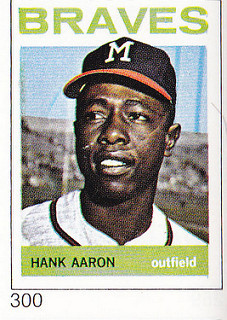
Hank Aaron's card, from the 1964 set
You can see here that a bit of enlargement from a scan of the book doesn't look all that good.
If you're interested, the stats on the back of this card, for the 1963 season, would have included info like...
Probably Aaron's best season in the 1960s - though he was remarkably consistent from year to year.
And I want to know ... what are the chances that a Hall of Fame player like Aaron, when aligned alphabetically with all other players who have played the game, would be right at the head of the line?
Well ........ see comment #4 below. Aaron is no longer at the front of the alphabetical line. Thus passes into history an amazing coincidence.