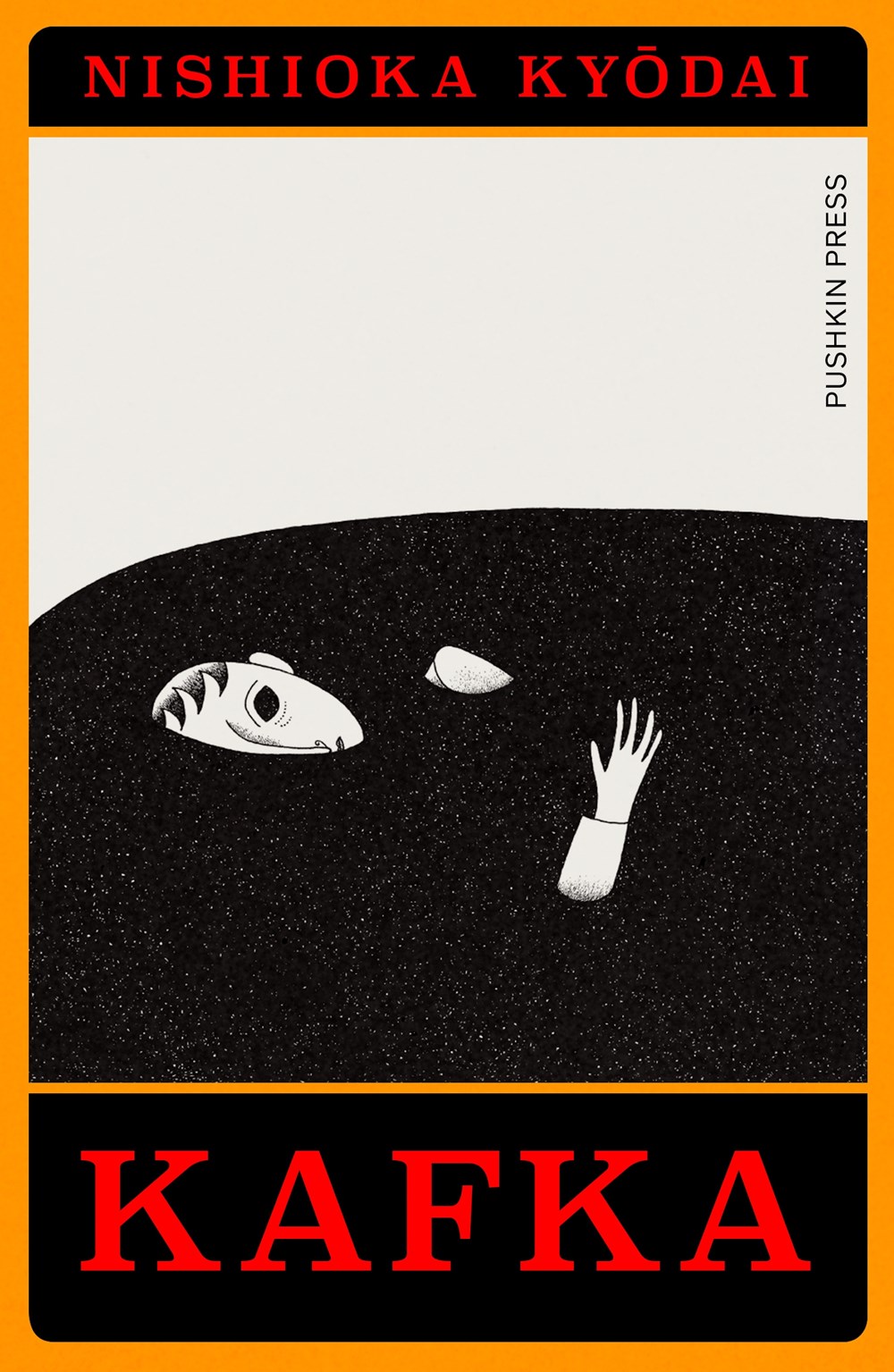
I was first drawn to this book by its description and eye-catching cover (whoever says that you can't judge a book by its cover doesn't understand its importance as a marketing tool).
I've read a number of Kafka's short stories many years ago, and the prospect of seeing them given life in a graphic adaptation piqued my interest, especially when Junji Ito, whose adaptations and art style I appreciate, got a personal shout-out. I wouldn't say he's the first illustrator I thought of, reading this book; rather, it has an art style and claustrophobic aesthetic that reminded me of Coraline.
Now, on to the book: I don't think I can say much about the actual stories and the text, since not only it's adapted and abridged from the original German, but it is also translated two times - once from German to Japanese and then from Japanese to English. The translator notes in the afterword that his difficulty was three-fold, because not only he had to work within the abridged material while trying to decide which version of the story he should stay loyal to and which to consider the original version to translate, but he also had to work with the illustration and panels on the pictorial front. I was impressed by David Yang's efforts to mantain a balance between these realities and adapting them to a Western audience.
One thing that I didn't appreciate was how the text frames, built for Japanese text, which sometimes can be written vertically, inhibited Yang's translations so much that he took the stylistic choice of writing "vertically" as well, turning the text 90° - meaning the reader has to turn the book or the device sideways to be able to read. I'm sure I can't fault this only on him, since the book wasn't written for Western consumption as its first goal, but I can't help but compare it to other manga translations where this problem doesn't seem to exist, or is dealt with in different ways.
The short story i was most curious to see adapted was, of course, The Metamorphosis, and I was not disappointed: in accordance to Kafka's wishes, the creature is never shown, thus only "seen" through the eyes of Samsa's family and the lodgers, making his presence (and his existence) known only in relation to the objects he interacts with, like the bed and bedsheet, the picture on the wall, and the food in increasing states of decay.
I really liked Nishioka Satoshi's interpretation of the source material: he sees Kafka's stories as tales about hunger and power, with the obvious A Hunger Artist as a pioneer of this view, but it can be seen as well in The Bucket Rider and The Vulture. In THe Metamonphosis food is without a doubt the way Grete uses to exert power over her brother.
Other short-stories shine for their graphics; the style in the illustration of people remains the same all throughout the collection, but the difference can be seen in the panels for each one, and in their constant change they give further meaning to the original text.
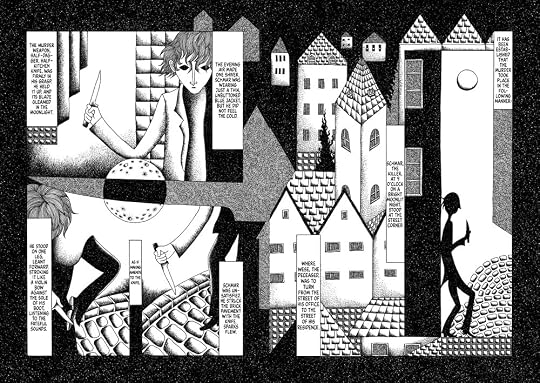
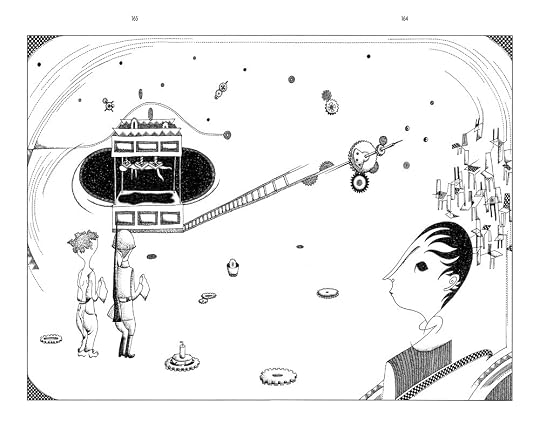
I particularly appreciated the contrast in the sequencing of certain stories: Jackals and Arabs is characterised by sinuous and surreal images, a reminder of the mirages of the desert, where by the end all the jackals seem to morph into one as the lines between each one is blurred; after that we're hit by the cobblestoned panels of a town in A Fraticide, where the pages themselves seem to fill the page in an architectural quality, the horror vacui of full illustrations giving a claustrophobic ambience to a murder scene. The latter is furter contrasted by the empty spaces of The Vulture, featurless except for the three characters, where everything seems suspended in a dream.
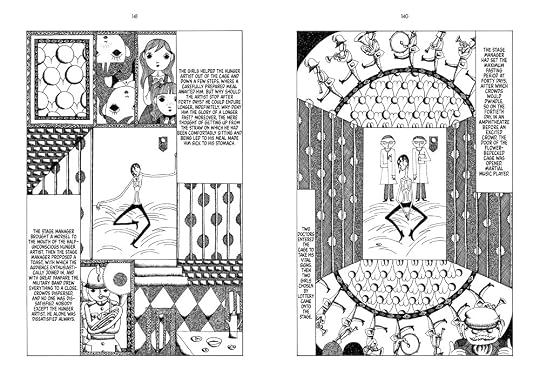
Another graphic device I appreciated is the central box used in A Hunger Artist, always framed by the illustration of the outside world as it physically and metaphorically keeps the artist in his cage.
The book is a quick read and packs a powerful punch, I would definitely recommend it to fans of Kafka and of surreal and cosmic horror, it's a 3.5 rating for me!
Access to the ARC acquired thanks to NetGalley in exchange for an honest review.