In 1899 Jeremy, a young engineer, leaves a small town in Maine to oversee the construction of a railroad across British East Africa. In charge of hundreds of Indian laborers, he becomes the reluctant hunter of two lions that are killing his men in nightly attacks on their camp. Plagued by fear, wracked with malaria, and alienated by a secret he can tell no one, he takes increasing solace in the company of an African man who scouts for him.
In 2000 Max, an American ethnobotonist, travels to Rwanda in search of an obscure vine that could become a lifesaving pharmaceutical. Stationed in the mountains, she shadows a family of gorillas—the last of their group to survive the merciless assault of local poachers. Max bears a striking gift for communicating with the apes. But soon the precarious freedom of both is threatened as a violent rebel group from the nearby Congo draws close.
Told in alternating perspectives that interweave the two characters and their fates, Audrey Schulman’s newest novel deftly confronts the struggle between progress and preservation, idiosyncrasy and acceptance. Evoking both Barbara Kingsolver and Andrea Barrett, this enthralling fiction, wise and generous, explores some of the crucial social and cultural challenges that, over the years, have come to shape our world.
The engaging story and memorable characters make this fine novel an ideal book club selection.
Audrey Schulman is the author of three previous novels: Swimming With Jonah, The Cage, and A House Named Brazil. Her work has been translated into eleven languages. Born in Montreal, Schulman now lives in Cambridge, Massachusetts.
Uno di quei libri dove la trama è un valore aggiunto. Io ne incontro di rado, perché di rado li cerco, non è tanto cosa si racconta che mi interessa, ma come. Qui, però, ho fatto volentieri un’eccezione.
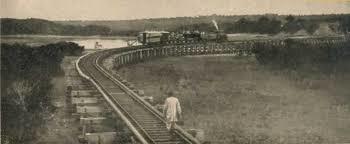
La ferrovia sul fiume Tsavo.
Due personaggi protagonisti, separati da un secolo, e legati saldamente da qualcosa che si rivela alla fine: ma è abbastanza prevedibile, e non aggiunge nulla alla bellezza dei due racconti che procedono a montaggio alternato. Due americani, del Maine, che per ragioni diverse finiscono in Africa, l’uno nel 1899 a costruire un ponte della ferrovia sul fiume Tsavo (odierno Kenia), l’altra nel 2000 per cercare una rara pianta medicinale sui monti Virunga (al confine tra Rwanda e Congo). Le ragioni che li conducono in Africa non sono così diverse come sembrerebbe a primo acchito, perché i personaggi si somigliano, e i “diversi” sono proprio loro. Sono outsiders, come si direbbe a casa loro: lui in quanto omosessuale – lei in quanto affetta da sindrome di Asperger.
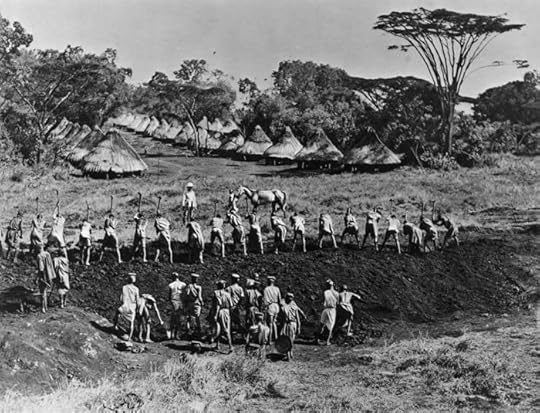
I lavori per la costruzione della ferrovia.
Lui, Jeremy, si sente capito e accettato solo tra gli indigeni, più di quanto avesse mai creduto di potere essere, considerato che a casa sua è scrutato e guardato come un animale strano. Lei, Max, una vita intera passata a imitare i normali, evita gli sguardi e ha bisogno che tra sé e gli altri ci sia una distanza di sicurezza. Entrambi, cominciano a sentirsi realizzati, accettati e finalmente ‘a casa’ una volta arrivati in Africa. Entrambi in posizioni professionali di rilievo, capiscono tuttavia che il loro lavoro accelererà il processo di distruzione di quell’habitat che stanno imparando ad amare. Sono due storie basate sulle sensazioni, sulla percezione e l’osservazione, sui segnali che mandiamo e che ci arrivano dal mondo circostante.
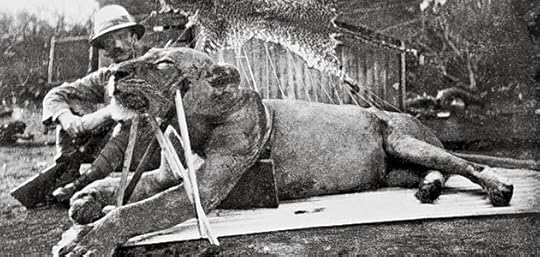
Il colonnello Patterson con uno dei due leoni.
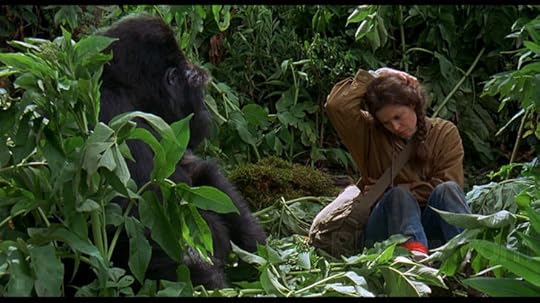
È una storia di diverse velocità d’esistenza. È la storia di due esseri umani che cercano il loro posto nel mondo, e cominciano a trovarlo solo arrivando in Africa. Entrambi avendo a che fare con gli animali del posto, lei con i gorilla di montagna, gli stessi di Dian Fossey, come allora minacciati di estinzione da bracconieri e presunti guerriglieri.
Sigourney Weaver - Dian Fossey e uno dei gorilla di montagna, questa volta senza la nebbia.
Per Jeremy, invece, si tratta di due leoni cacciatori cannibali, per di più maschi (tra i leoni, le femmine sono i cacciatori), che uccisero circa 140 persone prima che Jeremy ne riuscisse ad ammazzare uno, spingendo l’altro ad allontanarsi e sparire.
Schulman sviluppa le sue due storie con sapienza, eleganza e ritmo. Purtroppo non evita le solite banalità sulla sindrome di Asperger (le persone che ne sono affette svilupperebbero talenti unici fino al punto della genialità, vedi Picasso, Einstein, Madame Curie…).
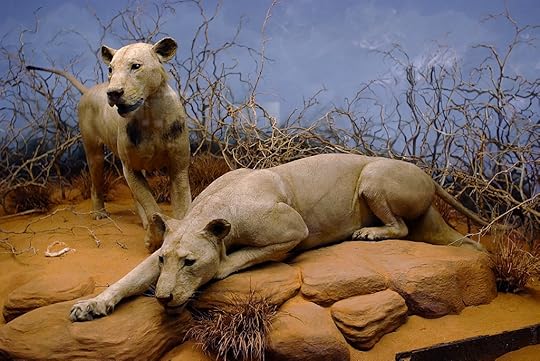
I due leoni imbalsamati nel museo di Chicago.
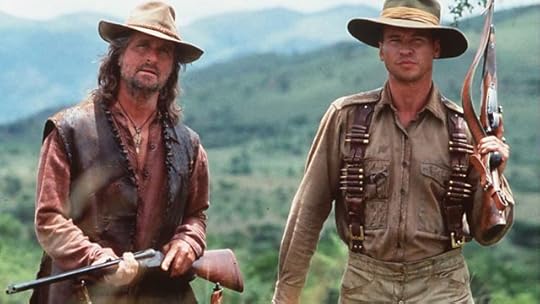
E, credo che avrebbe potuto essere più esplicita e pagare meglio i suoi debiti di ispirazione: “The Man-Eaters of Tsavo”, opera del colonnello Patterson, non gli è servito solo per saperne di più sulla botanica, ma è spunto e base della storia di Jeremy, ricalcata su quella dello stesso colonnello Patterson, a sua volta ingegnere, a sua volta spedito a costruire il ponte della ferrovia sul fiume Tsavo, che si trovò a fronteggiare la stessa minaccia (i Man-Eaters del titolo sono proprio i leoni cannibali), due leoni maschi senza criniera che per mesi seminarono terrore e morte. L’opera di Patterson ha ispirato ben tre film, incluso il più recente “Spiriti nelle tenebre”, dove Val Kilmer impersona proprio il colonnello Patterson.
Michael Douglas e Val Kilmer-Col. John Henry Patterson protagonisti insieme ai due leoni del film “The Ghost and the Darkness - Spiriti nelle tenebre” di Stephen Hopkins, 1996.
When one of the key protagonists of a book is a biracial American ethnobotonist who is surmounting the challenges of Aspergers, you know instantly that you’re in the hands of an author who is unafraid of taking literary risks.
And so it is with Audrey Schulman’s inspired, imaginative, and downright haunting new book, Three Weeks in December. Told in alternating perspectives, the book chronicles a three week period in two lives that are separated by a millennium: Jeremy, a young engineer who is charged with overseeing the construction of a railroad in East Africa in 1899, and Max, the female ethnobotonist, who travels to Rwanda’s gorilla country searching for a potentially life-saving vine that can be used in the development of a pharmaceutical.
Both are self-defined misfits. Jeremy is “different” in a way that eventually becomes apparent; Max leverages the unique qualities of her Aspergers become an expert in plants. “Most people didn’t understand; they consider plants as static as a bureau or a shoe,” she thought. “When she looked at a tree, she saw not a stationary object, but a photo of a dancer in mid-motion, the gesture of its branches describing the battle for food or love.”
Gradually, the arcs of the two distinct stories come together. As in Campbell’s The Hero’s Journey, both Jeremy and Max will need to surmount their inner challenges and their worst fears. For Jeremy, he must confront two killer lions who, starved and desperate, are mounting increasingly bold attacks on the camp. Max must confront equally desperate Kutus – a fictional group made up from the details of child soldiers, who are drug-addicted and ruthless in their need to survive. In each case, Jeremy and Max must glean how and why they are connected to the larger world they live in, where humans are not the only force on the planet.
Audrey Schulman, in her afterword, states that she has not only visited Africa but read over 70 books to write this novel. It shows. There is plenty to learn from this book: why coltan (the material that cell phones need in order to work) is becoming the downfall of the Congo…why mosquitoes, not lions, are the most feared…why so-called “progress” is gradually destroying the dwindling habitat of the gorillas who are unlikely to survive in the wild. “The gorillas aren’t meant to live this far up the mountains,” Max is told. “At this altitude, there are fewer of the plants they eat and the temps are colder. They’re at their limit.”
I read the last 100 pages on an adrenalin high, as the arcs were woven tighter and tighter and the themes began to take center stage. Audrey Schulman does an outstanding job in integrating high-wire suspense with self-discovery. Read this book. Savor it.
Audrey Schulman writes about genuinely interesting stuff. Her fascination with apes and botany, and natural world in general, is as noticeable here as it was in her arguably better work Theory of Bastards, and I am all in on it. I didn't expect to be so taken by a story about hunting two human-eating lions in 1899 and a search for a medicinal herb in 2000.
However, Three Weeks in December was first published in 2010, and is totally a product of its time. Like, let's say, movies Blood Diamond and The Last King of Scotland, this novel is about Africa, but the narrative is uncomfortably West-centric. Even though it takes a firmly anti-colonialism stance, it spectacularly fails at giving a non-Western perspective, which I guess I shouldn't be surprised by. There is an acknowledgment in the end where the author talks about almost a hundred books she read to do a research for this novel, and not one of these books appeared to have been written by an African author.
I enjoyed this novel in some ways, but I wouldn't recommend it.
This interesting book alternates chapters between two people a century apart, a botanist on the hunt in Rwanda for a vine with promising medical properties for stroke victims (December 2000), and an engineer in charge of building a railway and bridge for the British imperialists into the Congo (December 1899). They both struggle with social "handicaps" that they overcome to a great extent in their weeks in Africa, leading them to personal successes they might not otherwise have been able to achieve. Beautifully done and satisfying too, we learn the connection between the two in the end.
When I read Audrey Schulman's Three Weeks in December, I was transported back to the time when I read literary novels by the dozen. In college and graduate school, especially, I loved fiction that took me to other countries, or even to other worlds. I lived for sentences so beautiful that they could bring me to my knees. Never mind where those sentences might take me. I just wanted to bask in the crystalline light of words and images perfectly crafted.
Among my favorite novels were books by Henry James, Virginia Woolf, Paul Bowles, D.H. Lawrence, James Joyce, E.M. Forster, Evelyn Waugh, and Doris Lessing. Now there is Audrey Schulman, who has reminded me of how much I love to read.
Many reviewers here have already summarized the plot, so I won't go in that direction with this review. You already know that this book involves two parallel stories, one set in 1899 and one set in 2000, and that the two stories are connected—a fact that doesn't become clear until the end of the book. What you need to know is that this is a “must read” book, whether you're 22 or 82 years old. The social and political issues in both story lines—whether you agree that they should be connected or not by the book's end—will leave you thinking deeply, not just about Africa and its troubled history, but about the British railway system, Asperger's Syndrome, the great apes, and the strange medicinal properties of certain plants.
Even better, as you read, you will be immersed in gorgeous passages like these: “When she woke, the sun had appeared from behind the clouds. The last two weeks on these mountains, she'd been surprised by how much the light could change along the jungle floor. At times it was as gloomy as a basement, at other points it gleamed otherworldly with mist. Sometimes it dazzled the eyes, as brazen as a spotlight. “Right now, a thick beam of dusty light poured down through a hole in the canopy. In the brightness of this luminance, everything shown as though lit from within, the stained-glass of the flickering leaves, the brilliant red of a parrot flying by, the hewed columns of the giant trucks. The cathedral of the trees. This must be where humans came up with the architecture of churches—the vaulted spaces and filtered light imprinted in the genes as the original holy place.”
As I said before: you must read this book. You will be forever changed by it.
It's clear that Audrey Schulman loves research. In the afterword, she mentions that she read 70+ books to write this novel and provides a reading list, by topic, of the ones she recommends. (She provided a similar list at the end of Theory of Bastards.) Three Weeks in December benefits from her extensive research; it is rich with details that ring true. But at the same time, the story sometimes lacks focus.
Three Weeks is broken into dual narratives. The first is set in 1899 and follows an American engineer, Jeremy, overseeing the building of a railroad in Kenya. The project is imperiled by the hunting of two man-eating lions that terrorize the camp (and the nearby villages). Jeremy must contend with nature, with his own preconceptions about the people of Africa and the Indian workers he manages, and with his own ambivalence about his homosexuality. The second narrative is set in 2000 an follows Max, an ethnobotanist with Asperger's (when the term was still in use), who is recruited by a pharmaceutical company and sent to Rwanda to find a plant with potential medicinal properties. She must study the gorillas in the region, in the hopes they will lead her to the plant she seeks, while in the background the Kutu (a group of child soldiers led by a warlord) are terrorizing the region and moving ever closer to the research station.
There are a lot of moving parts to this book: colonization, racism, war, botany, zoology, sexuality, neurodiversity. There is breathless adventure; there is quiet contemplation; there are beautiful descriptions of the landscape. The narratives share some themes, and the echoes of what is happening in 1899 can be seen in 2000.
I like the way Schulman writes (although this book needed a better editing process) and the characters she creates (they feel dimensional), and I love the scientific detail she adds (there's a lot about the interaction and eating habits of gorillas and lions that was totally fascinating). However, I think this book was overloaded and the ending left me vaguely dissatisfied. She tied certain threads together in a way I thought was unnecessary and left others dangling in a way that left me disappointed. Still, it's well worth reading and I'm glad I did.
This is the best book I have read all year. As I said before, I never would have read it if it hadn't been given to me by the marvelous Kat Warren. Wonderful writing, gripping story(ies). Unusual, fascinating characters: a female biracial enthnobotanist with Asperger's in the year 2000, and a tortured gay railroad developer in 1899. Both in Africa to do a job. Don't miss it.
Audrey Schulman has written a very literary page-turner with her new novel, Three Weeks in December. From page one I was drawn in and smitten. The pages flew by and I couldn't wait to get back to the book each time I put it down.
The book is written in two narratives, each one about one hundred years apart and taking place during the month of December. One narrative takes place in 1899 and the other in 2000. Both protagonists hail from Maine and end up in Africa.
The first protagonist is Jeremy who takes a job as an engineer for a railroad company in British East Africa, now known as Kenya. He is responsible for supervising several hundred men, mostly from India. They are building a railroad and as the book opens they are responsible for building a bridge that crosses the Tsavo River. Jeremy is an engineer with a good safety record who is more than happy to leave Maine and some personal `secrets' behind. These secrets become obvious as the book progresses. There are only two Caucasians on the project, Jeremy and Alan, the physician.
During Jeremy's tenure in Kenya, a lion is killing off his workers, along with their dying from malaria and other tropical diseases. During the first year in Africa, 30% of the people die from malaria. Jeremy wants to get the lion who is also responsible for deaths in villages. It seems that there are two lions working in tandem and they have developed a taste for human flesh. Jeremy is inspired by Otambe, a tribesman who is a great hunter and who speaks English. Jeremy seeks him out for advice and comraderie. Together they hunt the lions.
Max's narrative forms the other half of the book. An ethnobotanist with Asperger's syndrome (a mild form of Autism), she is hired by a pharmaceutical company to search for a vine that has curative properties for heart disease. She is placed in Rwanda, 35 miles from the Congo border in the heart of the Mountain Gorillas' terrain. As she works with the group of scientists who study the gorillas, she searches for the vine. Her Asperger's serves her well with the gorillas and she feels at home with them, `flash-glancing' and not making eye contact with them which is natural for her. "In her life he'd come upon many situations she didn't know how to deal with - social difficulties or matters of etiquette. In these circumstances she'd learned to locate the neurotypical she assumed had the most appropriate experience and ask that person for information and advice." Max is entranced with the gorillas and feels like she has found an acceptance that she does not get from `neurotypicals'.
There is trouble in the Congo and it is moving towards Rwanda in the form of a childrens' army called the Kutu, named for its founder. It is a fictional army but it's based on the actual child soldiers in Africa. "The Kutu keep charging forward anyway, chewing their qat, shooting their Kalashnikovs, crazy skinny little kids." Max and the scientists worry about the Kutu as they do their research. They worry about their own lives and those of the gorillas who have already been pushed to a high point on the mountain that is beyond their optimum habitat.
Both Max and Jeremy come to terms with their deepest sense of self in Africa, learning to love this continent which at first was frightening, different, and culturally foreign to them. Max learns that having Asperger's is a perfect mix as an ethnobotanist studying gorillas. Her sense of smell and her natural way of being fits together perfectly with the animals she is surrounded by. Jeremy learns to appreciate who he is and what he is running from becomes less frightening to him. It is not until the last few pages of the book that the connection between Max and Jeremy becomes apparent. Ms. Schulman leads the reader into this in an evocative and necessary manner. This is a book to appreciate and mull over with its beautiful descriptions of Africa and the wonderful characterizations of the two main characters.
BASICALLY: this book is a disgrace, dehumanizes the native African characters, and perpetuates negative stereotypes of the continent. Also it's poorly written - so many mistakes, was there no editing process?
Okay let's dive in. For most of this book I gave it the benefit of the doubt. Told people I liked it so far but was reserving judgement to see if/what the characters learned. Once I got to the final (20) pages or so it was clear that not only were the characters not going to learn, but the author would continue inflicting harmful messages upon her reader so that even the readers cannot take away the right message from the adventures of the protagonists.
I'll start off with the thing that first struck me as problematic with this book: the continual reference to "Africa." Jeremy in 1899 and Max in 2000 BOTH refer to "Africa" as if it were a country, or even a town/village. (E.g. pg 147-148 Max awakens "in the darkness of her African cabin"... Why not her Rwandan cabin? Or even her mountain or jungle cabin? The continent of Africa has a huge diversity of architectural traditions... What about this cabin is "African"? What does that even mean?) It's slightly more understandable for Jeremy who finds himself in a British East Africa territory before the nation of Kenya existed. But still. Give me a break. This book does nothing but reinforce harmful stereotypes of "Africa" where the main characteristics are the wild animals, harsh climate, and dangerous rebel armies of child soldiers. We learn nothing else about "Africa" except these things. It's no wonder there's a common view in the U.S. that Africa is nothing but "sh*thole countries" when this is the kind of crap literature people get away with publishing! And all the other reviews in Goodreads are praising this book as so eye-opening! You've got to be kidding me.
Of course, it's no wonder this book has such a narrow and colonial view of Africa (even while *supposedly* Jeremy is *struggling* with the harm of colonization) (I'm not convinced; more on him in a sec). The author's note says that Audrey Schulman has "been to Africa" and read over 70 books, some of which she recommends to her readers. Um, excuse me, what do you mean by "I've been to Africa"?! Like... You went on a weeklong safari once? You lived there for several years? Where in "Africa" did you live/visit? Also by the way, I can't help but notice that ALL the reference books she listed in the back were written by Europeans/white North Americans.
~~~BIG SPOILERS START HERE~~~
Max's portion of the book is quite interesting, I admit. I have fewer problems with this part compared to Jeremy but still, allow me to air my few but strong grievances. I've said this already but please, why must we have the "life in 'Africa' means living rugged and in fear of dangerous armed rebel groups" trope?!?! (Oh and the witch doctor, what was that about? We never found out.) A big issue in this section is that we get so many hints about Mutara's traumatic past but learn zip, silch, nada about him or any of his backstory. Huh, Westerners, maybe you should ask the local dude about his experience once in a while? Nope. The scientists just entirely instrumentalize Mutara, paying almost no heed whatsoever to his opinions or needs. Max's character was cool though and I appreciated the moral grey areas presented by her quest for the medicinal vine that could save humans but would doom the mountain gorillas...
Jeremy on the other hand. LOTS of problems... And zero redemption.
Okay so just a small thing first: Patsy. Entitled selfish schmuck Jeremy decides that he "is unable to imagine a future" without his horse Patsy, so he pays an exorbitant amount of money to bring her on the ship with him from Maine to (present-day Kenya). All this despite the clear and explicit warning he'd received "not to bring any animals with him from America," because they don't respond well to the climate and are susceptible to "the diseases of the tropics." But no, health of his horse be damned, Jeremy must have his trusty Patsy! After all, "if Jeremy had one symbol of his adulthood, it was Patsy." Soooo I'm hoping it was a surprise to no one whatsoever that, after having been there, oh I don't know, three weeks maybe?, Patsy gets sick and dies. Jeremy is sad for a couple pages and forces the Indian railroad workers to dig her a grave in the pouring rain, while he himself raises not a finger. Aaaand then we don't hear about Patsy for the rest of the book.
As I f*cking cannot believe anyone else in the reviews is talking about, the absolute most disgraceful and repugnant part of this entire book is Jeremy's dehumanizing, objectifying, and clearly abusive relationship with the unnamed (THAT'S RIGHT, UNNAMED, fight me) WaKikiyu woman. (WaKikiyu = one of the local villages where, by the way, there are major malnutrition problems; presumably this woman had little choice in getting this gig...) For a couple chapters she's refered to as "the WaKikiyu cook" but then Jeremy decides he should call her something. He asks her name. "'Excuse me, what is your name?' he inquired. "Her expression assessed him, warily. She responded with a phrase that had several t's in it. "'Can you say again?' he asked and she repeated the phrase. "Her name, he wondered, or was she announcing she could not understand him?.... "He said, 'How about the name Sarah then?' "She nodded, perhaps understanding or maybe simply wanting an end to the exchange." (Pg 244-245) And then for the rest of the book, f*cking Jeremy proceeds to CALL HER SARAH.
The end of the book is kind of confusing in many ways but here are some things we do know: Jeremy is in love with Otombe who is no longer around (due to their lion hunt being complete and railroad construction progressing). Jeremy has malaria. In malaria-induced not-quite-delirium, Jeremy has sex with the WaKikiyu woman, trying to tell himself it's actually Otombe. He seems to have lots of sex with this woman, actually, in kind of an obsessive way, all the while *never exchanging words nor meaningful communication of any kind with her*. He manages to get her pregnant, then imagines (not clear if this happens in real life or just his imagination) he brings her and the baby to America and, rather than *actually figure out her real name* he keeps calling her Sarah and *makes up a last name for her* which then becomes the last name of the baby. This is so messed up on so many levels guys. Why couldn't Jeremy have just had a nice if unrequited loving friendship with Otombe? Why bring this poor woman into the equation?! Of course the stupid tie-it-all-up-at-the-end is that the child they make together becomes Max's ancestor but ugh it feels so contrived and gross.
One reviewer suggested the book was trying to imply Max was dealing with the legacy of her ancestor's colonial forays in Africa, but she doesn't know anything about Jeremy or do any reckoning with colonialism at all. There's certainly no "reckoning with my ancestors' legacy" going on here. Nice try, Schulman. No cigar.
Four and a half stars, really. Very interesting book told in alternating chapters set 100 years apart. One narrator is an American engineer in 1899 who goes to Kenya (or British East Africa) to work on a railway project. The other one is an American botanist in 2000 who goes to Rwanda to search for a vine with amazing medical properties on a gorilla preserve. Both are social misfits, ostracized in their home communities: the engineer is gay, the ethnobotanist has Aspergrer's. Both stories are fascinating: the earlier one involves a hunt for man-eating lions, the later ones all kinds of gorilla interactions and menace caused by KONY-like child army. The most fascinating parts are not the ones which are plot driven though, but the descriptions of daily life and thought processes of someone with Asperger's. Absolutely amazing, especially as told in the 1st person. I could go on and on, but the key difference between this narration and the Curious Incident of the Dog in the Night is that Max is very self-aware, articulate and educated. I was also reminded of State of Wonder, due to shared idea of going to the remote jungle to seek medical cure material. I was completely blown over by the discovery in the last few pages of the book that there is a connection between the two protagonists! I completely missed it! The reason for the 4 1/2 and not 5 stars is that I'd like to have this connection made more explicit and I didn't like the ambiguous ending. But maybe I am kidding myself that it was ambiguous, maybe it was all too obvious, and the author wanted to spare us. Also I liked the fact that Jeremy changed in some fundamental, though perhaps regretable ways, but Max did not change that much. She adapted, but I think that it is maybe not possible for a person with Asperger's to change. Sorry to be so verbose, but go read this book!!! I'd love to talk to you about it!
When I first moved to Pittsburgh, my brother and I lived on the North Side, walking distance to the Carnegie Science Museum and Omnimax theater. On more than one occasion I walked to the theater to see Jane Goodall's Wild Chimpanzees, a film about the creatures that Goodall has spent years living with and understanding. My love for Goodall goes back further than I can remember exactly, and sitting there in the Omnimax theater watching Goodall on such a large scale, surrounded by her beloved animals, touched me in a way I can't really describe.
I was reminded of those viewings while I read this book.
There are two storylines in this book, and neither of them have to do with Jane Goodall or chimpanzees. One story takes place in 1899, following Jeremy, an engineer overseeing the building of a railroad across a portion of Africa. The other story takes place in 2000, following the life of Max, an ethnobotanist with Asperger's who is chosen to visit Rwanda in order to find a vine that could be used in pharmaceuticals. More Dian Fossey than Jane Goodall, Max is able to communicate with the gorillas in ways that no other humans can.
I actually was distracted by the alternating storylines because I'm a little fuzzy in the head right now and was mostly fascinated with Max's story, wanting to hear more about her. In my head she was the sort of woman that I am naturally fascinated by, a Dian Fossey/Jane Goodall/Temple Grandin combination, and I think a full story could have revolved around her. The alternate 1899 story wasn't bad, it built up to important points, but it wasn't what I wanted out of the story.
An interesting book, all told. I wish I had been able to enjoy it more than I did, but blame the head fuzziness and not Schulman's writing. I fully anticipate to read more by her.
I love lions. Big, beautiful killing machines that they are. I wouldn’t want to meet one in dark alley. And I wouldn’t want to be in Africa, building a railroad, when the lions decide to eat people. This book is based, in part, on a true story about the lions that hunted the railroad builders in the 1880s. The Tsvao lions, you can go to the Chicago Field Museum and see the stuffed bodies. Schulman’s book tells two stories that at first seem to have little in common. One is about an American man who is hired by the rail company. The second is about a young botanist with Asperser’s who travels to Africa to find a mysterious plant, and in doing so she joins a group studying Mountain Gorillas. The book is rather gripping and the narratives aren’t as dissimilar as they first would appear. The characters are believably drawn and Schulman takes the time to allow the realness of the characters to be the connection to the reader as opposed to going overboard in making her characters likable. This is important because it isn’t likability that keeps the reader reading, but the need to know what happens.
I waver between 3 and 4 stars. Four because I really enjoy her writing. As with her Theory of Bastards, she masters building up a slow tension that keeps you needing to know what happens next. I like that she’s unconventional, takes up some unusual topics and approach them in her own way. I *like* feeling the writer behind the words, and her interests shine through very clearly.
Three because.. it’s an odd book. The two stories that take place 100 years apart, did not really go together, imo, as interesting as they were in their own right. I’m not sure what each novel wanted to tell me, though, or even what the goal was with this novel at all. So I left it feeling slightly puzzled, I guess.
I really wanted to love this book but I didn't. I picked it up because it takes place in Africa in both Kenya and Rwanda (Gorilla Mountain) and as I had just been there last year I really wanted to revisit it again even if only in a book. I did enjoy how she depicted the gorillas-that felt very true to my short dealings with them. I did enjoy how she wrote about the beauty of Kenya. I can`t say I became attached to either main character , although I liked Max better. I did also like the tie in to the two stories at the end-it was very subtle and you could almost miss it. All in all it is still a good read if you want to read anything to do with Africa and gorillas.
This is a book that I could really get into. The two stories, 1oo years apart, should have been told separately and developed into stand-alone books, The interleafing is artificial and the topics don't belong together in my estimation. Interesting in parts for the depiction of the African setting and, in particular the interaction with a group of gorillas, the novel did not, for me, move very convincingly beyond the adventure story where two unprepared Americans are confronting Africa in order to come to terms with their own personal challenges.
Audrey Schulman captures Africa through the senses of two of the main characters who visit Africa with two very different missions, one in the year 1899, and one in the year 2000. Through these two main characters, the reader learns about the African landscapes of Kenya and Rwanda, in addition to its changing landscapes. The reader also learns about the innermost feelings and challenges of the two main characters the audience comes to understand and accept.
Max is an ethnobotanist who has been commissioned by a pharmaceutical company in the year 2000 to find the Rwandan "medicinal" vine that the mountain gorillas eat, to save thousands of people from heart disease. Max has Asperger's Syndrome. She does not want to work on fragrances, but instead, desires to make a difference in her life. Max has a flat expression, speaks in monotone, rocks, flaps her arms, and does not like any closeness of human contact. Over the years, Max has developed coping mechanisms to appear normal - breathing deep and focusing on pleasant experiences in her life. Along with the challenges of Asperger's Syndrome, Max does have the focus to become intimately aware of every plant she encounters, its texture and smell. She can become so focused, that falling, bleeding, and breaking her arm does not prevent her from straying from finding the medicinal cure she has sought out to find. In her quest, Max becomes one with the gorillas, whose very behavior is similar to hers. With the gorillas, she is not alone any more. The tension mounts as the danger of the Civil War in the Congo is only 3.5 miles from where Max works in the mountains. (The Kutu are child soldiers who are trained to attack white people).
Jeremy is an American engineer who wants to leave his homosexual humiliations behind him as he ventures out with many Indians to build a railroad and a bridge near the River Tsavo, in the country now called Kenya, in an effort to expand the European scramble for African territory. Jeremy falls in love with Africa, the red earth, the smells, and the numerous animals that are a part of the landscape. "All around them now, gazelles spronged upward out of the grass, living popcorn, legs ramrod straight beneath, their tails swishing behind their tight white buttocks...the gazelles bounded away in the direction the men had come from, their bodies arcing over the top of the grass like dophins over the sea."
Jeremy's challenges are Malaria, dead Indian bodies with hot coals in their mouths to represent Hindu cremation, Yellow Fever, and two large lions mauling Indian workers. Jeremy is expected by his crew to exterminate the large animals. This is not only Jeremy's challenge. He falls in love with an African guide and fights to hide his feelings from his workers, the doctor on site, and the man he loves.
There is so much to learn in this story. I read each chapter, one chapter about Jeremy, the next about Max, with great emotion and understanding. Audrey Schulman is one special author!
I read this based on the title and cover picture alone. I thought it was going to be a nonfiction book about the Tsavo lions and colonial Kenya. Shows I should pay more attention. It is also the reason I listened to it, even though I almost never listen to fiction on audio - I thought it would be nonfiction.
Anyway, so on to it. This one is really hard because I honestly really liked the story telling here. The characters were unique and compelling. The stories came to life and I wanted more and more. I wish both stories in this book were their own books with more detail. I really, really liked the story telling.
The downsides were that the two stories didn't fit together. I kept waiting for some reveal to link the stories, but it didn't happen. They just ended. No link, other than both stories being about people who go to Africa to search for something 100 years apart. Not even the same part of Africa - Kenya and Rwanda. And it was obvious the author did do a fair amount of research for the book, but there were details that really annoyed me and made me doubt accuracy of things I'm not as familiar with. For example, Virunga park is not in Rwanda. So why was it set there? While khat is used in Rwanda it's not a big part of drug culture, so why was that the drug that the rebel groups were supposed to be on? Plus various other things. So those took me out of the story, as compelling as it was.
In the end though, the story telling was good enough that it kept me wanting more, and that's a win.
Audrey Schulman wrote a book that knocked my socks off. That’s pretty much the easiest way to sum it up. I gasped, I sniffled, I accidentally missed dinner while on vacation – that’s how engrossing Three Weeks in December actually is. The characters, particularly Max, a brilliant scientist with Asperger’s syndrome, are vivid and arresting and their story lines quickly take over your imagination. I was at a ski lodge while reading the majority of the book, and despite the glinting snow around me, I could hear lions roaring, mosquitoes buzzing, and gorillas huffling.
The seemingly disparate tales of British railway construction and modern guerrilla (and gorilla) warfare are surprisingly parallel, and from the readers’ vantage point it’s easy to realize how the virtue of “progress” can cloak any potential downside of a given innovation.
Schulman’s writing is lyrical and captivating, her dialogue is strong, and her storytelling skills are superb. I’ve added the rest of her books to my to-read list and I recommend this one heartily.
I enjoyed reading this book. I found the 2 American characters compelling, one a young gay man and engineer by trade in December 1899, and the other a mixed race woman with Asperger's and ethnobotanist by trade in December 2000. Both greatly studied in how they are "supposed to" act and deeply aware of their difference from those expectations. I liked the comparison of how 2 people with "other" status are contrasted by how accepted they were in their time. Different than Jeremy's experience, Max's mother studied, accepted, accommodated and appreciated her, as did her colleagues. Being hunted by lions in the former story and child soldiers in the latter, the pacing was fast and felt like a well-researched thriller with rich nature imagery and detail, powered by characters who do not often get to be the heroes in action adventures.
I think my 2012 self (when this was written) would have liked it even more, but I'm challenging myself to look deeper into where a writer spends their time in a book and the representation of different people and peoples in it:
In that vein, the American/Euro-centricity of this book is pretty astounding. All of the African and Indian characters are in service to the American main characters. Otombe is objectified. "Sarah" doesn't even get her own name and treated as if it was ok for her to be a means to an end. Mutara, who grew up in Rwanda and probably knows most about everything is never treated like the expert he would've been. The Indians building the British East Africa railroad are portrayed as "savages" and regularly referred to casually in the language of the time "coolies," but given no humanity. And the Congo's Kutu are ghastly and tragic, but not really emotionally explored how colonization and the exploitation of African natural resources led to their circumstances.
Both main characters were aware that the logical culmination of their work and skillsets that brought them to Africa was actually going to bring harm to the wildlife and people there. Max explored this conundrum related to her gorillas (which was fine and interesting), but I don't feel like the author truly wrestled with the impact of exploitation of African countries and people in a meaningful way. Colonization is acknowledged but seems let off the hook and instead feeds into the "Africa is so exotic but really just comprised of s#thole countries" narrative.
This book blew me away. The research effort must have been enormous. There is so much insight and information included: about Aspergers, about animal and plant life, about the behavior of Silverback gorillas, about the building of the railroad and the workers who came to help construct the rails, about the difficulties associated with sexual orientation, about scientific research and the workings of pharmaceutical companies, about survival and survival instincts, about courage in the face of extreme danger, about the history of Africa and some of its tribal customs. Although there were two parallel stories, alternating chapters, one hundred years apart historically, it worked amazingly well and held my attention. I was never bored.
The author managed to write two completely different tales and then connect them in subtle ways, over a brief period in December, in 1899, and in December of 2000. However, there were times when the story faltered, lacked believability. Could Max have accomplished all she did physically with a dislocated shoulder? Would Jeremy have really been able to hunt the lions when he was so sick with malaria? Would the pharmaceutical company have abandoned its researchers? Also, although the ending took me totally by surprise, I thought it was the least effective part of the book, and a bit of a disappointment. It required a total suspension of disbelief. Perhaps it was the only way the book could credibly end for the way the tale was told, but I had hoped for more. For the most part, though, the story was riveting.
The book introduced many controversial topics which the reader will have to explore and digest. The characters are wonderfully developed and real. You can envision them as flesh and blood as you read.
The first tale begins in December of 1899, and except for brief paragraphs relating to Jeremy’s past, growing up in Maine, it takes place largely, in the country now called Kenya, the place of birth of President Obama's family. It is interesting to learn about the life some of his ancestors may have led and the hardships they faced, so different from those in America.
Jeremy is an engineer, a man who builds functional, utilitarian bridges, but he is a man who does not fit in with his brethren. He is different and he is lonely. He needs a change, an opportunity. When offered, he takes a job in British East Africa to escape his past and to build a railroad. He hopes to be successful and then to purchase a plot of land and follow in the footsteps of his ‘grandpapi’, creating something from nothing, with hard work and dedication. He prides himself on his work ethic and his attention to detail and to the safety of the men who work for him.
The second tale begins in Maine, in 2000. Two pharmaceutical executives come to see Dr. Max Tombay, an ethnobotonist, to offer her a job in Africa, to try and find a plant that might have the power to cure heart disease; she happily accepts. Her future had been looming as one in which she would be researching fragrances, and that held no interest for her. She, too, needs a change, an opportunity. She is different and she is lonely. She does not fit in with her contemporaries. Plants are easier to interact with than people.
In some ways, the story of Max is more complete than the story of Jeremy, but in the end, it all blends and meshes seamlessly. Even though the chapters alternate with each story, they could each have stood alone. Putting them together allows the reader to compare and contrast the similarities and differences between the two individuals who are both in Africa for similar, yet widely diverse reasons. Both, however, wish to escape the pain of their personality and their past. Reading the chapters alternately, illustrates how their lives collide with each other, connect and intersect, although separated by 100 years. Both characters arrive in Africa totally unprepared for what awaits them, but both are eager to begin their work.
Both characters are resented by their fellow workers in Africa. He is resented by the tribes who do not want their way of life destroyed by the construction of the railroad; she is resented by the other researchers who do not want her interfering or threatening and disturbing the safety and way of life for the gorillas. Still, they are both more comfortable in Africa. Both characters are able to control their emotions and maintain their outlook through their thoughts and memories. Although Jeremy is the only white man, his difference in other ways goes unnoticed. Max is the only one with autism, but her difference enables her to do her research thoroughly. She earns the respect of the others. Jeremy feels safer in Africa with the natives because they don’t stare; Max feels safer with the gorillas because they exhibit signs of Aspergers and they don’t stare. Their unreal expectations for the real world they have entered and the results of their actions, are thoroughly examined by the author with clarity, and there is an ever present tension and excitement which keeps you turning pages.
When finished, you may ask yourself why either of them went to Africa, when it was dangerous, even in 2000? Max went because she wanted to do useful research, find a cure for heart disease, to earn respect and perhaps be accepted and embraced as respectable. Jeremy went to get away from the inevitability of staring eyes. Both were trying to escape their differences and both left without concern for their own safety, so desperate were they for change and a chance to start anew. Both main characters wanted to make the world a better place. He wanted to build a better bridge, in a safer way for the workers; she wanted to save lives and find a cure for heart disease. Both preferred solitude and pursued thorough investigation to accomplish their goals.
You may further ask yourself, has there been any real progress in Africa? Has the country been tamed, civilized? Has the effort of other countries injured or aided its development, its natives? Did the railroad help build Africa into a thriving nation? Have the natives stopped attacking each other, cannibalizing each other, selling each other? Can Africa ever be thoroughly explored?
Although the stories are separated by 100 years, they both have surprisingly similar concerns to face: natives, wild animals, survival. This is a great book for a book club discussion.
A goodreads acquaintance said this is one of the best books she's read this year. Because it's set in East Africa in the 1890s (and central Africa now), I borrowed it immediately. I like it so far and so was dismayed to come across a fragment on page 36. Unlike the risible but wrong misplaced modifiers in the book I just shunted into the Donate pile, this fragment is obvious to any lay reader, let alone a copy editor: "One was that the cause in the brain at all, but in the gut." Verbs useful. The verb the one word a sentence a sentence.
That was fun!
In the same paragraph is another fragment, this one less egregious because purposeful: "The person's nerves jangling with a morphine-induced intensity."
Mm, I want to like this, so I should step away until I'm in a more forgiving frame of mind: "The plane left tomorrow, the lab equipment was already packed" (39).
The next day: Incidences instead of incidents? Really? (42)
Eh, drat. I had a long rant about how the spelling errors, wrong punctuation, and bad grammar ruined the experience of what could have been a great novel, but through my own stupidity I lost it. So. Instead of recompiling all the page numbers, I'll spare you. Great characters and plots, interesting parallels between the two threads, but technical errors ripped me out of the story with almost physical pain.
I will look up the page of one great simile: "After a day in the jungle, Yoko's hair was standing straight up, a little like a cockatiel's feathers" (221). It is only the crest feathers on a cockatiel that can stand erect and the rest of its feathers have no more erectile power than those of any other bird, but the cockatiel is so neglected in literature that I'll allow the broader statement.
This novel is absolutely stunning. I couldn't put it down. The writing itself is lovely, the protagonists are compelling, the Rwandan setting is exotic and beautiful, and the story...oh, the story.
The novel tells the story of two Americans who go to Rwanda at two different times, for different reasons: Jeremy Turnkey travels to Rwanda in December 1899 to oversee the construction of a railroad, and Max Tombay, an ethnobotanist with Asperger's syndrome, goes to Rwanda in December 2000 to find a plant that has been shown to prevent heart disease in gorillas. While Max's story was compelling to me from the outset, Schulman drew me to Jeremy's story more and more, especially when his encounters with the native wildlife begin: the crew that Jeremy oversees is hunted by a pair of giant lions (this is based on real-life occurrences).
I don't want to say anymore, lest I give away any of the surprises that occur in this novel, but I haven't enjoyed a book this much since I read The Elegance of the Hedgehog, also published by Europa Editions. This book struck me just as much with its beauty in composition and insight into characters: Max's "Aspie" tendencies give an idea of what it is like to be someone with Asperger's, especially to someone who doesn't know too much about the condition. You will become tangled up in the story, with both characters, on an incredible journey with each. I highly recommend this novel; it's one of my favorites of the year.
This is the first book by Audrey Schulman that I've read, but it won't be the last. What a wonderful writer she is. In this book, she takes two parallel stories of people who, in the society of their time, are regarded as not "normal".
One, a young engineer who is more or less shunned in his American hometown for being "gay" in 1899. He takes a job with the British railroad in British East Africa (now Kenya and Uganda) to build a bridge for the company. It's a beautiful tale of how, in adapting to the new land, he learns to accommodate himself to his "abnormality" and live his life. Part of his change is brought about through encounters with high mountain lions.
The second story is of an African American PhD ethnobotanist who is hired in 2000 by a pharmaceutical company to locate a plant in an obscure jungle in Rwanda, Africa which is home to mountain gorillas. Though brilliant, this young woman has aspberger's syndrome, and has had to work her whole life to subdue natural instincts to appear more "normal". She is thrown in with a group of fellow scientists, and discovers her ability to communicate with these gorillas in this most challenging tale.
These stories take place a century apart but are beautifully entertained in ways small and large through Schulman's amazing parallelism. She gives you a genuine page turner of adventure, terror and self-discorver in language that is compelling.
Received an ARC from BookBrowse.com and posted a review there. Disliked this book intensely as it appeared to be written for book group discussion. It is the story of three weeks in December in the Congo during 1899 and 2000 involving 2 different family members who both journey from Maine. One is a scientist and one is an engineer and their professional stories alone would have made an interesting book. Instead, the author gave them complicated personal lives which really gave the book a soap opera feel and took away from the previuos good writing. There are lots of discussion points for a book club, but taken as a whole, I was disappointed.
This book was so good! Every time I picked it up, I was immediately sucked into the world that Schulman created. It would have never been a book I would have picked up based on the description. It was given to me by a friend and I am very grateful!! The two story lines in the book seem so different, but have some common themes. Then, you find a connection at the end. It was a powerful story and it was written so beautifully. I especially enjoyed the insight of what it would feel like to try to function in the world and have Asperger's. It was fascinating to read about Max connecting with the gorillas using "aspie" forms of communication. Overall, just a great read.
Fascinating, but flawed. I read this book after running across the story of the Tsavo maneaters, the navel's underlying source text. In particular (and completely independant of the Tsavo incident, I'm aware that the stories ARE different). My problem is not so much with the 2000 plot line, but in the 1899 plot line the reader is encouraged to sympathize with the plight of the hunter. I feel like this should have focused more on the consequences of colonialism and the price of attaining personal glory at the expense of colonists than the marginalization of homosexuals in Victorian society. Maybe I'll write that book though.
Wow, this is one of the best books I have read this year. There are two storylines both set in December in Africa...one modern day, one in 1899. Both were equally compelling. She was able to use the stories to inform the reader about Aspergers, homosexuality as well as gorilla and lion behavior and botony and the development of pharmaceuticals.