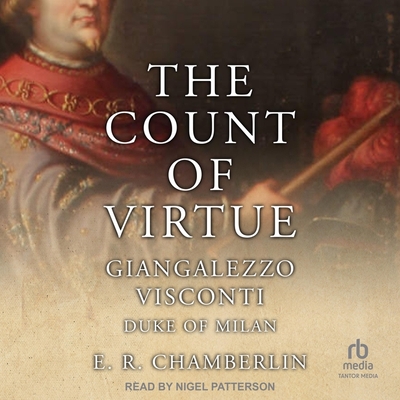
MP3 CD Format Fourteenth century Italy was mercenaries swarmed across the land as competing city states attempted to vie with each other for power, while pestilence and famine decimated populations.
Into this cauldron was born Giangalezzo Visconti, a man who perfectly exemplified all the contradictions of his age. Viscous, covetous, and with loose morals, he has been portrayed as one of the most criminal men in history, yet he was also a man of remarkable gifts as a brilliant administrator, a shrewd ruler who was able to command the loyalty of his men, and a patron of beautiful art and architecture at the dawn of the Renaissance.
Visconti as a young boy had been taught by Petrarch, yet he was just as influenced by his family of deft schemers and killers as he carved his pathway to power. Playing the parochial jealousies of the city-states against one another he was able to weaken his rivals and strike them in quick succession.
E. R. Chamberlin's The Count of Virtue is a remarkable study of the life and times of Giangaleazzo Visconti that provides fascinating insight into the political, social and cultural world of fourteenth century Italy.
Historian and author. Chamberlin was the author of numerous popular history books ranging from ancient Rome to twentieth-century Britain. Although he was born in Jamaica, he returned to England with his father during the Great Depression. Chamberlin dropped out of school when he was fourteen and became an apprentice leather dresser.
When he was old enough, he eagerly left this work behind to enlist in the Royal Navy in 1944. He served in the military until 1947 and then found work at the Norwich Public Library. It was here that his real education began, and Chamberlin took advantage of his vocation by reading history texts avidly. He later also worked at the Holborn Public Library and then for the book division at Readers’ Digest.
His first book, The Count of Virtue: Giangaleazzo Visconti, Duke of Milan, was released in 1965. This would be followed by thirty more books over the next three decades. Among these are The Bad Popes (1969), The Sack of Rome (1979), The Nineteenth Century (1983), The Emperor, Charlemagne (1986), and The Tower of London: An Illustrated History (1989). Also active in historical preservation projects, Chamberlin helped rescue the Guildford Institute building from destruction in 1982 and had a monument to Admiral Horatio Nelson constructed on Mt. Etna in Italy.
For the former endeavor, Chamberlin was recognized with an honorary degree from the University of Surrey in 1982.
Gian Galeazzo Visconti is likely not a name you have come across: perhaps only Machiavelli, the Medici, and the Borgias remain relevant 500 years after the Renaissance, as the city-states of Italy have long since passed into the nation-state of Italy. E.R. Chamberlin provides a wonderful overview of the greatest of the Visconti clan to rule over Milan. Gian Galeazzo may well have been better known if he had lived a bit longer: at the time of his death, he was on the cusp of conquering Florence, eliminating a potent southern rival and perhaps locking in his hold on most of Italy north of Rome. The rise and fall of the Visconti is a powerful lesson in how to preserve strength through diplomacy, and how quickly strength can ebb into demise, as the Visconti family fell less than 50 years after the death of Gian Galeazzo.