

What do you think?

Lori & Joe
Lori and Joe have lived in the Lake District for many years, in a quiet valley where one day is much like another. Bringing Joe his regular cup of coffee one morning, Lori finds him dead. She could call an ambulance, but what difference would it make? Instead, she heads out for a walk over the fells. As she makes her way through the November fog, Lori’s thoughts slip between past and present, revealing a marriage marked by isolation, childlessness and a terrible secret she’s never disclosed.
Arnold’s musical prose merges form and content to express what cannot be communicated through language alone. Taking place over the course of a single day, yet revealing the secrets of a marriage of many decades, Lori & Joe is a sparse, intimate and deeply moving story of entrapment and isolation, and of a life in which desire is continually overcome by nothing changes and nothing is ever (re)solved.
Arnold’s musical prose merges form and content to express what cannot be communicated through language alone. Taking place over the course of a single day, yet revealing the secrets of a marriage of many decades, Lori & Joe is a sparse, intimate and deeply moving story of entrapment and isolation, and of a life in which desire is continually overcome by nothing changes and nothing is ever (re)solved.
146 pages, Kindle Edition
Published April 4, 2023
Ratings & Reviews
Friends & Following
Create a free account to discover what your friends think of this book!
Community Reviews
Displaying 1 - 30 of 42 reviews
November 1, 2023
I’ve read Arnold’s first novel Slip of a Fish. And i knew i wanted to read anything she writes next. But that was before I’ve read Septology. Now, when Lori&Joe came out, it has found me in my post-Fossian reading period. (Or whatever adjective they'd attach to Fosse as they'd need one soon). Anyway, this sequence of events has definitely affected my reading experience of this novel. For the first half of the book, i felt really conflicted about the text. I felt Arnold’s style of writing was too close to the one i remembered from “Septology”:
She’s got time, she thinks, before the sun comes up over the fell, yes, she’s got a bit of time, although she can feel it, the earth, slowly turning eastwards and well, no, she won’t go back inside just yet, she’ll stay here in the yard and watch the sun come up from behind the fell, yes, this is what she really wants to do, she thinks, and she lifts her arms, she spreads her arms and she sees that her arms hold so much more than this one fell, that, yes, she’s cradling the whole line of fells, from south to north, as far as Thorn-thwaite Crag, and further, she thinks, and she stretches and stretches and she sees that the darkness has almost left, she sees the fell fall inside another light and she understands how restless it is, yes, this feeling, something tightening then slackening, a huge thing, Lori thinks.
Those tidal waves of repeating and modifying words, incantational rhyme so pertinent to Fosse’s prose and even the “verbal ticks” like “yes” and “she thinks” are all present here. "The infamous tyranny of influence", I thought. (Who has actually come up with this term? Harold Bloom? I will have to look it up later). However, the apparent metaphysical dimension and Fosse's game of mirrors with identities or something that would replace those elements were lacking in this book. So i often found myself distracted from what was actually here by such comparisons.
However, when i’ve actually settled and have started to follow Arnold’s character, the text has come out on its own: uniquely throbbing and trembling.
Unexpectedly, it reminded me of a protagonist in The Outsider by Albert Camus when the lack of his visible emotional reaction during his mother’s funeral and the related disapproval by the public arguably cost him life. Like Camus’s story, this novel made me think how unique is each experience of grief. How free it should be from a gaze by anyone else, especially the judgement of any group.
This novel also made me think how much of a devastating drama is hidden in each quiet life...
And she thinks, not tears now and she feels them pushing inside her head and she thinks, all day they’ve been threatening, ever since she stopped on the bridleway and looked up at the sky. White from end to end, yes, that’s how it was this morning, Lori thinks, and it’s been nothing but rain all month, one rain after another rain, there’s hardly been time to breathe between them and she looks across the rough ground and she feels the tears pushing inside and she thinks, there can’t be another landscape that takes the rains like this one, that absorbs violence after violence and in summer gives flowers that wear veins in their petals. Bog pimpernel, Lori thinks, skylarks, cottongrass.
Throbbing, powerful stuff...
She’s got time, she thinks, before the sun comes up over the fell, yes, she’s got a bit of time, although she can feel it, the earth, slowly turning eastwards and well, no, she won’t go back inside just yet, she’ll stay here in the yard and watch the sun come up from behind the fell, yes, this is what she really wants to do, she thinks, and she lifts her arms, she spreads her arms and she sees that her arms hold so much more than this one fell, that, yes, she’s cradling the whole line of fells, from south to north, as far as Thorn-thwaite Crag, and further, she thinks, and she stretches and stretches and she sees that the darkness has almost left, she sees the fell fall inside another light and she understands how restless it is, yes, this feeling, something tightening then slackening, a huge thing, Lori thinks.
Those tidal waves of repeating and modifying words, incantational rhyme so pertinent to Fosse’s prose and even the “verbal ticks” like “yes” and “she thinks” are all present here. "The infamous tyranny of influence", I thought. (Who has actually come up with this term? Harold Bloom? I will have to look it up later). However, the apparent metaphysical dimension and Fosse's game of mirrors with identities or something that would replace those elements were lacking in this book. So i often found myself distracted from what was actually here by such comparisons.
However, when i’ve actually settled and have started to follow Arnold’s character, the text has come out on its own: uniquely throbbing and trembling.
Unexpectedly, it reminded me of a protagonist in The Outsider by Albert Camus when the lack of his visible emotional reaction during his mother’s funeral and the related disapproval by the public arguably cost him life. Like Camus’s story, this novel made me think how unique is each experience of grief. How free it should be from a gaze by anyone else, especially the judgement of any group.
This novel also made me think how much of a devastating drama is hidden in each quiet life...
And she thinks, not tears now and she feels them pushing inside her head and she thinks, all day they’ve been threatening, ever since she stopped on the bridleway and looked up at the sky. White from end to end, yes, that’s how it was this morning, Lori thinks, and it’s been nothing but rain all month, one rain after another rain, there’s hardly been time to breathe between them and she looks across the rough ground and she feels the tears pushing inside and she thinks, there can’t be another landscape that takes the rains like this one, that absorbs violence after violence and in summer gives flowers that wear veins in their petals. Bog pimpernel, Lori thinks, skylarks, cottongrass.
Throbbing, powerful stuff...

October 17, 2023
Shortlisted for the 2023 Goldsmiths Prize
Shortlisted for the 2024 James Tait Black Prize for Fiction
Joseph has to be asked, she thinks, and if they just got the back roof sorted then there wouldn't be all this friction between them every time it rains. Yes, get the back roof done, Lori thinks, all it needs is a sheet of polycarbonate, that's what she's been told, it's an afternoon's work, a day at the most, yes, she could ignore the problem with the main roof if they got someone in to do the back one. Joseph knows people, she thinks. She's been saying the same things for years, she sends herself round and round in circles and the rain will hold off today, for a few hours at least. She won't be out long. Up the fell and back down, that's all she'll do today, and if a few drops of rain get in it's hardly a big deal, no, the bucket only needs to be out when the rain's really hammering and well, she can see it isn't going to end up like that today, no, it's far from a bad day for the time of year, Lori thinks.
And that's four dead bodies she's seen now.
Lori and Joe is Amy Arnold's 2nd novel and, as with the first in 2019, has been shortlisted for the Goldsmiths Prize, "awarded to a book that is deemed genuinely novel and which embodies the spirit of invention that characterizes the genre at its best".
It is published by the small independent press Prototype whose ethos is perfect for the Goldsmiths Prize and who also published the exceptional Vehicle by Jen Calleja which would would also have been a worthy shortlistee, were Calleja herself not ineligible having studied at Goldsmiths:
The judges' citation for the Prize reads:
The novel opens in South Lakeland in 2009, with Lori, married for 25 years to Joe, most of which have been spent in the same house, walking up the stairs to bring him his morning coffee, and to challenge him on his offensive bicycle.
Coffee, she says. And she promised herself last night she’d say something to Joe about the bike. Yes, get the Chambéry out of the kitchen once and for all, she thinks, and she goes on up a few steps and she thinks, not Chambéry, no, not with the r sitting there in the front of the mouth.
Like this, love. As if you’re about to gargle, she thinks, and well, she’s never been any good at gargling either. That’s another thing she can’t do, she thinks, and when it comes to doing anything like that, when it comes to any sort of performance, she means, she hasn’t got a cat in hell’s chance of getting it right and she thinks, forget it, forget Chambéry, yes, she’ll say LeMond, she can bluff the d if she needs to, yes, easier to bluff the d than risk Chambéry, and Lori walks on up the stairs.
Coffee, she says, and she’ll give the eye a good rub when she’s put the coffee down. Hold on with the eye for now, she thinks, and after they’ve had coffee she’ll go walking up on the fell, and it must be the third morning they’ve woken to fog, if not the fourth, she thinks, yes, she’d struggle to remember another time like it, and Lori walks on up the stairs with the coffee and she imagines herself walking down the bridleway to the church, she imagines herself crossing the little bridge over the beck, and here she is again, here she is on the stairs with two mugs of coffee. One for Joseph and one for her, and she pushes open the bedroom door with her foot.
Coffee, she says, and she thinks, put the coffee down then rub the eyes. Both of them, because there isn’t any use in pretending it’s only the left, and it’s still so early. It still isn’t quite light and Lori stands inside the bedroom door and looks across the room and out into the valley and well, look at that, she thinks, the tups are out with the ewes at last, and she’ll put the coffee down and rub her eyes, God, yes, that’s one thing that really can’t wait, she thinks, and Lori says, coffee, and she looks over at the bed and she thinks, something isn’t right over there, no, something isn’t quite as it usually is, and she stands inside the bedroom door with the two mugs of coffee and she thinks, look again, yes, look more carefully, and she takes a little step towards the bed.
Joseph’s dead, she thinks.
But having found Joe dead, rather than call for an ambulance, doctor or undertaker, she goes for a long walk in the feels, and the novel narrates, in the style in dialogue with the brilliant prose of our new Nobel Laureate Jon Fosse, her thoughts looking back on their marriage.
Much of the novel's narrative detail emerges subtly between the lines of her thoughts - for example the passage that opens my review and the four deaths (Jo, her parents and who?) or this about Fergus, the youngest of seven children who once lived next door:
Fergus was a doll that day. She'd thought she heard his eyes click-clack, les yeux, l'oeil, and how on earth do you go about pronouncing oe, she thinks. Not oh, ee. No, not that, and she thinks, shut up, will you? because even if she gets the oe she'll never get the i next to the L, and she thinks, give up with French, we never go further south than Morecambe anyway.
Even her not phoning immediately for help on Joe's death proves resonant.
The bike at the heart of the novel, the 1997 LeMond Chambéry from Trek (RRP £1,999.99 from Scotby Cycles in Carlisle) symbolises much of the story, the bike itself named after one of the saddest days in world sport:
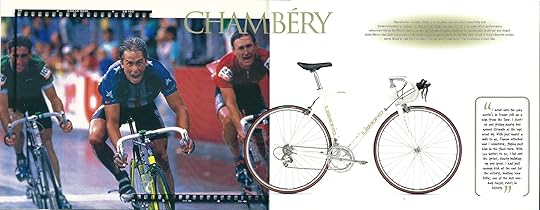
Lori's lack of confidence in pronouncing the name Chambéry reminds her of how the pretentious pillock Joe (reminiscent of 'Le Professeur', Laurent Fignon) is always correcting her pronunciation of the classical music composers he insists she listens to, while the consistent, loyal and taciturn Lori can be best compared to the King of the Classics himself, the one and only Sean Kelly. And Greg LeMond himself reminds her of Joe's stuttering, which is triggered by 'n's and 'd's, her one power over him. Kelly's own missing out on the Worlds, the 1989 race a particularly painful case, represents Lori's regret at the lack of any children, which lies at the heart of her tortuous thoughts, with silver-medallist Dmitri Konychev as the cuckolded Paul from the novel.
An impressive choice by the judges and one of several books I'd be happy to see win the prize.
Shortlisted for the 2024 James Tait Black Prize for Fiction
Joseph has to be asked, she thinks, and if they just got the back roof sorted then there wouldn't be all this friction between them every time it rains. Yes, get the back roof done, Lori thinks, all it needs is a sheet of polycarbonate, that's what she's been told, it's an afternoon's work, a day at the most, yes, she could ignore the problem with the main roof if they got someone in to do the back one. Joseph knows people, she thinks. She's been saying the same things for years, she sends herself round and round in circles and the rain will hold off today, for a few hours at least. She won't be out long. Up the fell and back down, that's all she'll do today, and if a few drops of rain get in it's hardly a big deal, no, the bucket only needs to be out when the rain's really hammering and well, she can see it isn't going to end up like that today, no, it's far from a bad day for the time of year, Lori thinks.
And that's four dead bodies she's seen now.
Lori and Joe is Amy Arnold's 2nd novel and, as with the first in 2019, has been shortlisted for the Goldsmiths Prize, "awarded to a book that is deemed genuinely novel and which embodies the spirit of invention that characterizes the genre at its best".
It is published by the small independent press Prototype whose ethos is perfect for the Goldsmiths Prize and who also published the exceptional Vehicle by Jen Calleja which would would also have been a worthy shortlistee, were Calleja herself not ineligible having studied at Goldsmiths:
Through the discovery of high quality work across genres, Prototype strives to increase audiences for experimental writing, as the home for writers and artists whose work requires a creative vision not offered by mainstream literary publishers.
The judges' citation for the Prize reads:
Written in prose of astonishing musicality and resonance, Lori & Joe captures precisely the ebb and flow of a woman’s thoughts as she walks the Cumbrian fells following her husband’s sudden death. At first a seemingly quiet and meditative novel, the story that unfolds is anything but quiet – an unforgettable and devastating portrait of regret, secrets and harm amid a landscape of haunting beauty
The novel opens in South Lakeland in 2009, with Lori, married for 25 years to Joe, most of which have been spent in the same house, walking up the stairs to bring him his morning coffee, and to challenge him on his offensive bicycle.
Coffee, she says. And she promised herself last night she’d say something to Joe about the bike. Yes, get the Chambéry out of the kitchen once and for all, she thinks, and she goes on up a few steps and she thinks, not Chambéry, no, not with the r sitting there in the front of the mouth.
Like this, love. As if you’re about to gargle, she thinks, and well, she’s never been any good at gargling either. That’s another thing she can’t do, she thinks, and when it comes to doing anything like that, when it comes to any sort of performance, she means, she hasn’t got a cat in hell’s chance of getting it right and she thinks, forget it, forget Chambéry, yes, she’ll say LeMond, she can bluff the d if she needs to, yes, easier to bluff the d than risk Chambéry, and Lori walks on up the stairs.
Coffee, she says, and she’ll give the eye a good rub when she’s put the coffee down. Hold on with the eye for now, she thinks, and after they’ve had coffee she’ll go walking up on the fell, and it must be the third morning they’ve woken to fog, if not the fourth, she thinks, yes, she’d struggle to remember another time like it, and Lori walks on up the stairs with the coffee and she imagines herself walking down the bridleway to the church, she imagines herself crossing the little bridge over the beck, and here she is again, here she is on the stairs with two mugs of coffee. One for Joseph and one for her, and she pushes open the bedroom door with her foot.
Coffee, she says, and she thinks, put the coffee down then rub the eyes. Both of them, because there isn’t any use in pretending it’s only the left, and it’s still so early. It still isn’t quite light and Lori stands inside the bedroom door and looks across the room and out into the valley and well, look at that, she thinks, the tups are out with the ewes at last, and she’ll put the coffee down and rub her eyes, God, yes, that’s one thing that really can’t wait, she thinks, and Lori says, coffee, and she looks over at the bed and she thinks, something isn’t right over there, no, something isn’t quite as it usually is, and she stands inside the bedroom door with the two mugs of coffee and she thinks, look again, yes, look more carefully, and she takes a little step towards the bed.
Joseph’s dead, she thinks.
But having found Joe dead, rather than call for an ambulance, doctor or undertaker, she goes for a long walk in the feels, and the novel narrates, in the style in dialogue with the brilliant prose of our new Nobel Laureate Jon Fosse, her thoughts looking back on their marriage.
Much of the novel's narrative detail emerges subtly between the lines of her thoughts - for example the passage that opens my review and the four deaths (Jo, her parents and who?) or this about Fergus, the youngest of seven children who once lived next door:
Fergus was a doll that day. She'd thought she heard his eyes click-clack, les yeux, l'oeil, and how on earth do you go about pronouncing oe, she thinks. Not oh, ee. No, not that, and she thinks, shut up, will you? because even if she gets the oe she'll never get the i next to the L, and she thinks, give up with French, we never go further south than Morecambe anyway.
Even her not phoning immediately for help on Joe's death proves resonant.
The bike at the heart of the novel, the 1997 LeMond Chambéry from Trek (RRP £1,999.99 from Scotby Cycles in Carlisle) symbolises much of the story, the bike itself named after one of the saddest days in world sport:
Lori's lack of confidence in pronouncing the name Chambéry reminds her of how the pretentious pillock Joe (reminiscent of 'Le Professeur', Laurent Fignon) is always correcting her pronunciation of the classical music composers he insists she listens to, while the consistent, loyal and taciturn Lori can be best compared to the King of the Classics himself, the one and only Sean Kelly. And Greg LeMond himself reminds her of Joe's stuttering, which is triggered by 'n's and 'd's, her one power over him. Kelly's own missing out on the Worlds, the 1989 race a particularly painful case, represents Lori's regret at the lack of any children, which lies at the heart of her tortuous thoughts, with silver-medallist Dmitri Konychev as the cuckolded Paul from the novel.
An impressive choice by the judges and one of several books I'd be happy to see win the prize.

May 7, 2024
This is vindication for my system of adding books to my tbr list, then (partly intentional - partly due to my memory) totally forgetting about them. Had I realised the subject matter here, I would most likely avoided it.
Lori Fitzgerald and her husband Joe are an elderly couple living near Troutbeck, just over the hill from where I lived for the last decade. Lori is up as usual one morning, making the coffee, preparing for a fell walk, but when she takes Joe his coffee she realises he is dead.
She is quite calm, and decides to take on her fell walk as usual, with the rest of the short novel following her thoughts fleeting between mulling scones, bike rides and classical music, to more weighty matters.
Like Lori’s rain-sodden hike across the fell, the book’s arduous qualities are part of its reward.
There are few places as appropriate as the fell to set one’s thoughts straight, and Arnold’s writing champions that.
Lori Fitzgerald and her husband Joe are an elderly couple living near Troutbeck, just over the hill from where I lived for the last decade. Lori is up as usual one morning, making the coffee, preparing for a fell walk, but when she takes Joe his coffee she realises he is dead.
She is quite calm, and decides to take on her fell walk as usual, with the rest of the short novel following her thoughts fleeting between mulling scones, bike rides and classical music, to more weighty matters.
Like Lori’s rain-sodden hike across the fell, the book’s arduous qualities are part of its reward.
There are few places as appropriate as the fell to set one’s thoughts straight, and Arnold’s writing champions that.


April 1, 2024
3.5
this book is so intense, the sentences are long and rambling and the prose lulls you into a sense of security and then often shocks the reader with new details about the characters
the discussions about motherhood and marriage were really interesting, i just wanted to know a bit more i think? especially about Silas near the end but i really enjoyed the story, very unique style
this book is so intense, the sentences are long and rambling and the prose lulls you into a sense of security and then often shocks the reader with new details about the characters
the discussions about motherhood and marriage were really interesting, i just wanted to know a bit more i think? especially about Silas near the end but i really enjoyed the story, very unique style

January 15, 2024
Amy Arnold’s second novel, Lori & Joe follows a lot of the themes found in her debut Slip of a Fish but like all good second efforts, some of the wrinkles in the previous book are ironed out. Lori… is a more taut novel with a clearer plot.
Lori lives on a farm, one day she goes up the stairs and finds joe dead. This leads to an exploration of her relationship and some episodes of the past.
Like Slip… jumping back in time is a way of revealing previous secrets that were buried. Once again there is that circular writing style, which Arnold uses to get the most out of Lori’s state of mind.
Unfortunately, as with her previous novel, I did not get on too well with Lori & Joe. I’m not a fan of the way Amy Arnold writes, once again a book to admire, rather than embrace.
Lori lives on a farm, one day she goes up the stairs and finds joe dead. This leads to an exploration of her relationship and some episodes of the past.
Like Slip… jumping back in time is a way of revealing previous secrets that were buried. Once again there is that circular writing style, which Arnold uses to get the most out of Lori’s state of mind.
Unfortunately, as with her previous novel, I did not get on too well with Lori & Joe. I’m not a fan of the way Amy Arnold writes, once again a book to admire, rather than embrace.


October 27, 2023
I read this because it is on the Goldsmith's 2023 prize shortlist. This prize is known for selecting books that are innovative in some way, either in structure, plot, characterization. It used to be described as "experimental" but that adjective has gone out of use for various reasons.
The whole of this book is told by Lori, the female character, and made up completely by the silent conversation she has in her mind. Since it happens in the first chapter it is no spoiler to say that she finds her husband dead and spends the rest of the book going on a long walk and thinking of their long life together through many event and characters. This was very well done and quite mesmerizing to read but I can't see it as a winner of the prize.
The whole of this book is told by Lori, the female character, and made up completely by the silent conversation she has in her mind. Since it happens in the first chapter it is no spoiler to say that she finds her husband dead and spends the rest of the book going on a long walk and thinking of their long life together through many event and characters. This was very well done and quite mesmerizing to read but I can't see it as a winner of the prize.

November 23, 2023
my thought processes are not dissimilar to what the reader experiences when reading Lori & Joe; the very adhd-ness of it all. and because i am not the fastest reader and the luxury of time to read is not something i have, this kind of reading experience, the recursive-accretive storytelling, is not my favorite. there is no narrative, but the remembrances and thoughts of the narrator unspool and unspool and yes, you told us that part already, several times, and towards the end a few nuggets tumble out in the unspooling. it's a style of storytelling. it's ambient but not immersive. maybe André 3000 will write a soundtrack for this book. maybe he already has.

June 12, 2023
A woman's interior monologue over the course of a day as she walks the Fells, her relationship, being childless, landscape and music, the large family next door. An artful and convincing portrayal of a mind, looping, repetitive and obsessive, then quietly devastating.
November 8, 2023
lori gives herself a few hours of solitude to collect her thoughts after finding her husband in
bed, dead. beautifully melodic writing, the repetitiveness and lack of finishing thoughts, the jumping from one thought to the next - it all makes you feel like you’re in lori‘s, in lo‘s, head. and because of that glimpse into how she thinks, how her brain works, you start to understand why she‘s done what she‘s done, why she thinks what she thinks.
the life she‘s lived, the one she reminisces about, is not very eventful, questions are left open (which is a bit frustrating), but that‘s what makes it all the more real.
“and joe says you have to give up on one thing and in its place, and he kisses her on the cheek and she feels that both the lips and the cheek need to be wet to get a feeling like that.“
bed, dead. beautifully melodic writing, the repetitiveness and lack of finishing thoughts, the jumping from one thought to the next - it all makes you feel like you’re in lori‘s, in lo‘s, head. and because of that glimpse into how she thinks, how her brain works, you start to understand why she‘s done what she‘s done, why she thinks what she thinks.
the life she‘s lived, the one she reminisces about, is not very eventful, questions are left open (which is a bit frustrating), but that‘s what makes it all the more real.
“and joe says you have to give up on one thing and in its place, and he kisses her on the cheek and she feels that both the lips and the cheek need to be wet to get a feeling like that.“

May 28, 2024
3 / 5 stars
Very unique and accomplished for what it was and what it intended to be. I appreciate the experimentation of the book and the sense of confusion and urgency the writing suggests, however the stream of consciousness was a bit grating sometimes and felt a little bit too artificial at times and too pretentious to charm me.
An interesting enough story that deserved much more fleshing out at times.
Very unique and accomplished for what it was and what it intended to be. I appreciate the experimentation of the book and the sense of confusion and urgency the writing suggests, however the stream of consciousness was a bit grating sometimes and felt a little bit too artificial at times and too pretentious to charm me.
An interesting enough story that deserved much more fleshing out at times.
May 11, 2024
Not as good as I thought it would be

January 7, 2026
(3.75)

Read
January 29, 20253/20
Not entirely sure about my feelings towards this, it has its moments for me. Some great images. Though I think I’ve read too much of that extended sentence, train of thought style lately. Read a few Fosse comparisons here and there and I felt that rang true.
Not entirely sure about my feelings towards this, it has its moments for me. Some great images. Though I think I’ve read too much of that extended sentence, train of thought style lately. Read a few Fosse comparisons here and there and I felt that rang true.

Read
October 14, 2023Review to follow
April 3, 2025
3 1/2 stars
Intense and devastating in a quiet way.
Intense and devastating in a quiet way.

October 7, 2023
Shortlisted for the 2024 James Tait Black Memorial Prize to go with its shortlisting for the 2023 Goldsmith Prize.
This is the author’s second novel – her first “Slip of a Fish” won the inaugural (2018) Northern Book Prize (for unpublished books) run by the small press And Other Stories, and on subsequent publication was also shortlisted for the Goldsmith Prize (in 2019). I felt it was an ambitious and very promising debut: one which dealt sensitively and empathetically with difficult topics of generational abuse and trauma, and which inventively disassembled language to capture its very themes and ideas. I also felt it drew on the author’s Neuropsychology training in crafting the character of Ash, the first-person narrator at the centre of the novel – one I described as a vulnerable adult, who is not prepared to make herself vulnerable – struggling to open up to those around her, her interior life being much richer than her exterior one. Ash’s voice was a distinctively neurodiverse one due to her internal refuge in language – loving to consider the sounds of words, playing with homonyms, while at the same time struggling with the way words are used by others, in ways she finds slippery and sometimes untrustworthy. A central idea in her narrative was the confluence of linearity and circularity in the way she revisited key incidents, but while also avoiding a clear examination of them – and this did lead to an ambiguity in the novel. The author said of it: It was never intended to be challenging. Being challenging for the sake of it strikes me as pointless. The truth is that I never really imagined anyone would read it so I just did my best to find the form that allowed the story to be told. However, I did make a conscious decision not to answer questions, tie up loose ends, or explain. This probably does make for a challenging read.
Many of these same ideas: a troubled first party narrator, a struggle with language used by others, the confluence of linearity and circularity, the revisiting of past incidents, a deliberate ambiguity – remain here.
At the time of that novel’s publication the author also said “I moved up to the Lakes a couple of years ago and was so busy exploring the fells that I hardly wrote a word for months. I have a pretty decent view of the Coniston Fells from my bedroom window. Sometimes the pull to be out there is so strong I have to shut my curtains to keep myself at my desk. I know a lot of local writers draw inspiration from this landscape. It takes time, years, to know a place. Until then I don’t think I’ll be writing about the Lakes.”
It seems that the author has now got to know the Lakes – as this novel is set “somewhere in South Lakeland, late November 1999” and indeed is very much around the “pull to be out there”; exploring the landscape and the fells, while also exploring a life.
It is published by another UK small press – the Hackney based Prototype Publishing which has “an emphasis on producing unique and beautiful books, we are committed to championing the work of new voices in free-form contemporary literature …. … Prototype strives to increase audiences for experimental writing, as the home for writers and artists whose work requires a creative vision not offered by mainstream literary publishers.”
The first party narrator here is Lori: 25 and a half years ago (mid 1974) when she was 28, she and her relatively newly acquired partner Joe (a trained pianist) move up from down South to a small cottage in the fellside town of Troutbeck. Their neighbours are Paul and Annie: Paul away with work for long periods (and effectively absent from the novel) and Annie already the mother of two young boy twins (around three and a half). The sight of the twins on her first day stirs in Lori a desire for her own children and domesticity, but Joe is not interested preferring their own coupledom and his love of listening to and singing classical music – and instead it is Annie’s family which grows steadily over time to Lori’s disquiet.
The novel takes place over a single day – the cataract-affected Lori, as it her morning habit, goes downstairs on waking to over-brew her and Joe’s morning coffee, surprised that Joe is not half-jestingly banging the floor with the stick he now needs to walk in his increasing ill-health, Returning upstairs she finds Joe has died in his sleep and instead of calling for a Doctor decides to take a long walk up into the foggy fell over their cottage.
The book places us in her stream of thoughts as she walks over that day– her thoughts as circular as her journey as she thinks back on some seminal moments in the life of the two neighbouring cottages – each retelling of the story adding to our accumulated understanding of both the incident and of Lori: Annie visiting to announce her latest pregnancy; a day one of the twins shoots a crow and his sensitive younger brother goes to retrieve it; a secret visit she paid to the house to observe the new born youngest child; a later traumatic event involving that child (Joe being the fourth dead body Lori has seen after the death of both her parents).
Woven within this are a number of recurring themes reflecting Joe and Lori’s domestic life and the (grudging as well as willing) accommodations, compromises as well as silent resentments which have built up within it and between them over time: Joe’s shuffling slipper-wearing walk; their Nine O’Clock News watching ritual; Lori’s obsession with the births and deaths in the local paper; the cat (the only pet Joe will agree to)’s habit of beheading animals; Joe’s late acquired bike a Lemond Chambéry (“what’s Chambéry anyway? what is that?”: reviewer aside: the answer unknown to Lori is the most traumatic sporting defeat of all time, as my brother has said up at the Roger Osborne/Trevor Brooking level); Joe’s thick and fumbling fingers; Lori’s difficulty and Joe’s fluency with foreign words; his angelic but somehow disturbing singing; and so on.
Lori is also very aware of present day physical aspects: the climate and countryside (“Lori looks up at the white sky and she thinks, two kinds of white, one Machiavellian”); the flora (“Bog pimpernel, Lori thinks, skylarks, cottongrass”); the fauna (“the tups are out with the ewes”); her clothing (“she looks down at her boots and she sees a little crack in the leather, she sees it running across the big toe. Like a river delta”); and above all her body (“she pats herself down there, she gives herself a few small pats around and she can’t tell, no, she’s never been able to, and well, no, it’s really, she thinks, yes, broken waters”).
The author made it clear both in the text of Slip of A Fish and interviews around it that Jon Fosse is a key inspiration – and the stylistic influence is I think even clearer in this book, which seems appropriate given that Fosse won the Nobel the day after this was Goldsmith longlisted.
As an aside – what is the equivalent of Sapphic, Dickensian, Kafkaesque …….. the only one I can think of is Fossilised.
And I think that captures much of the spirit of this book – past incidents which have calcified in Lori’s mind and body, embedded in the very sediment of her memories - but which are now being subject to discovery and present day examination with Joe’s passing.
Overall, this is a worthy addition to the Goldsmith shortlist – one I re-read immediately after completion.
He’s dead. He’s dead up there on our bed, Lori thinks, and she waits to see if she feels anything, something, and well, she doesn’t. You can’t go forcing a thing if it won’t come on its own, she thinks, and Lori looks down at her boots. She’s too late with the leather, she thinks, and she thinks of those photos you get, the ones of huge river deltas and she thinks of the boy who put his finger in the dike and she thinks, what’s that got to do with anything? And she’ll hunt out the neatsfoot anyway and she thinks, Moor Head, yes, then she’ll decide, and she feels the cold around her middle, or perhaps around her heart, although she’s never been able to pinpoint where the heart is exactly, and she thinks of all those diagrams you get, the ones of lungs and kidneys and intestines and she thinks, slippery yellows and pinks and browns and reds, and she’s supposed to feel something, if all those obituaries she reads are true, if the time she spends in the back pages of The Gazette is worth anything at all, and Lori thinks, Joseph and Lori Fitzgerald are delighted to announce, no, Joe and Lori proudly announce, and she thinks, the safe arrival of their much awaited, and she thinks, daughter or son? and she looks down at her boots and she thinks, not this, Lori, we’re past all this, and she sees her boots moving over the rough ground, grasses and sedges, swollen mosses and it’s with great sadness that we announce the passing.
This is the author’s second novel – her first “Slip of a Fish” won the inaugural (2018) Northern Book Prize (for unpublished books) run by the small press And Other Stories, and on subsequent publication was also shortlisted for the Goldsmith Prize (in 2019). I felt it was an ambitious and very promising debut: one which dealt sensitively and empathetically with difficult topics of generational abuse and trauma, and which inventively disassembled language to capture its very themes and ideas. I also felt it drew on the author’s Neuropsychology training in crafting the character of Ash, the first-person narrator at the centre of the novel – one I described as a vulnerable adult, who is not prepared to make herself vulnerable – struggling to open up to those around her, her interior life being much richer than her exterior one. Ash’s voice was a distinctively neurodiverse one due to her internal refuge in language – loving to consider the sounds of words, playing with homonyms, while at the same time struggling with the way words are used by others, in ways she finds slippery and sometimes untrustworthy. A central idea in her narrative was the confluence of linearity and circularity in the way she revisited key incidents, but while also avoiding a clear examination of them – and this did lead to an ambiguity in the novel. The author said of it: It was never intended to be challenging. Being challenging for the sake of it strikes me as pointless. The truth is that I never really imagined anyone would read it so I just did my best to find the form that allowed the story to be told. However, I did make a conscious decision not to answer questions, tie up loose ends, or explain. This probably does make for a challenging read.
Many of these same ideas: a troubled first party narrator, a struggle with language used by others, the confluence of linearity and circularity, the revisiting of past incidents, a deliberate ambiguity – remain here.
At the time of that novel’s publication the author also said “I moved up to the Lakes a couple of years ago and was so busy exploring the fells that I hardly wrote a word for months. I have a pretty decent view of the Coniston Fells from my bedroom window. Sometimes the pull to be out there is so strong I have to shut my curtains to keep myself at my desk. I know a lot of local writers draw inspiration from this landscape. It takes time, years, to know a place. Until then I don’t think I’ll be writing about the Lakes.”
It seems that the author has now got to know the Lakes – as this novel is set “somewhere in South Lakeland, late November 1999” and indeed is very much around the “pull to be out there”; exploring the landscape and the fells, while also exploring a life.
It is published by another UK small press – the Hackney based Prototype Publishing which has “an emphasis on producing unique and beautiful books, we are committed to championing the work of new voices in free-form contemporary literature …. … Prototype strives to increase audiences for experimental writing, as the home for writers and artists whose work requires a creative vision not offered by mainstream literary publishers.”
The first party narrator here is Lori: 25 and a half years ago (mid 1974) when she was 28, she and her relatively newly acquired partner Joe (a trained pianist) move up from down South to a small cottage in the fellside town of Troutbeck. Their neighbours are Paul and Annie: Paul away with work for long periods (and effectively absent from the novel) and Annie already the mother of two young boy twins (around three and a half). The sight of the twins on her first day stirs in Lori a desire for her own children and domesticity, but Joe is not interested preferring their own coupledom and his love of listening to and singing classical music – and instead it is Annie’s family which grows steadily over time to Lori’s disquiet.
That was it, Lori thinks, over. And she says, Felix, Emile, Ross, Charlotte, Louise, Silas and she hears the smallest turn of wind at the grasses. Silas, Silas, Lori says. He’ll almost be a man now, he’ll be just about the same age Emile was the day he shot the crow down from the sky, a bit older maybe, and she thinks, go on up now, yes, push on up.
The novel takes place over a single day – the cataract-affected Lori, as it her morning habit, goes downstairs on waking to over-brew her and Joe’s morning coffee, surprised that Joe is not half-jestingly banging the floor with the stick he now needs to walk in his increasing ill-health, Returning upstairs she finds Joe has died in his sleep and instead of calling for a Doctor decides to take a long walk up into the foggy fell over their cottage.
The book places us in her stream of thoughts as she walks over that day– her thoughts as circular as her journey as she thinks back on some seminal moments in the life of the two neighbouring cottages – each retelling of the story adding to our accumulated understanding of both the incident and of Lori: Annie visiting to announce her latest pregnancy; a day one of the twins shoots a crow and his sensitive younger brother goes to retrieve it; a secret visit she paid to the house to observe the new born youngest child; a later traumatic event involving that child (Joe being the fourth dead body Lori has seen after the death of both her parents).
Woven within this are a number of recurring themes reflecting Joe and Lori’s domestic life and the (grudging as well as willing) accommodations, compromises as well as silent resentments which have built up within it and between them over time: Joe’s shuffling slipper-wearing walk; their Nine O’Clock News watching ritual; Lori’s obsession with the births and deaths in the local paper; the cat (the only pet Joe will agree to)’s habit of beheading animals; Joe’s late acquired bike a Lemond Chambéry (“what’s Chambéry anyway? what is that?”: reviewer aside: the answer unknown to Lori is the most traumatic sporting defeat of all time, as my brother has said up at the Roger Osborne/Trevor Brooking level); Joe’s thick and fumbling fingers; Lori’s difficulty and Joe’s fluency with foreign words; his angelic but somehow disturbing singing; and so on.
Lori is also very aware of present day physical aspects: the climate and countryside (“Lori looks up at the white sky and she thinks, two kinds of white, one Machiavellian”); the flora (“Bog pimpernel, Lori thinks, skylarks, cottongrass”); the fauna (“the tups are out with the ewes”); her clothing (“she looks down at her boots and she sees a little crack in the leather, she sees it running across the big toe. Like a river delta”); and above all her body (“she pats herself down there, she gives herself a few small pats around and she can’t tell, no, she’s never been able to, and well, no, it’s really, she thinks, yes, broken waters”).
The author made it clear both in the text of Slip of A Fish and interviews around it that Jon Fosse is a key inspiration – and the stylistic influence is I think even clearer in this book, which seems appropriate given that Fosse won the Nobel the day after this was Goldsmith longlisted.
As an aside – what is the equivalent of Sapphic, Dickensian, Kafkaesque …….. the only one I can think of is Fossilised.
And I think that captures much of the spirit of this book – past incidents which have calcified in Lori’s mind and body, embedded in the very sediment of her memories - but which are now being subject to discovery and present day examination with Joe’s passing.
Overall, this is a worthy addition to the Goldsmith shortlist – one I re-read immediately after completion.
And she thinks, not tears now and she feels them pushing inside her head and she thinks, all day they’ve been threatening, ever since she stopped on the bridleway and looked up at the sky. White from end to end, yes, that’s how it was this morning, Lori thinks, and it’s been nothing but rain all month, one rain after another rain, there’s hardly been time to breathe between them and she looks across the rough ground and she feels the tears pushing inside and she thinks, there can’t be another landscape that takes the rains like this one, that absorbs violence after violence and in summer gives flowers that wear veins in their petals.

October 10, 2023
It’s on a day like any other – or maybe like none at all – that Lori finds her partner Joe dead in their Lake District home. She doesn’t see the point in calling for an ambulance, and goes out for a walk instead. Over the course of that day, Lori thinks back on her life with Joe, and we see how out of place she felt when she moved to the Lake District, and how much she would dwell on their neighbours’ large family.
Arnold portrays Lori’s thoughts as constantly shifting and looping back on themselves. This creates a restlessness that animates the novel, and also allows Lori to deflect thoughts that she may prefer not to have. It’s striking that, when she registers that Joe is dead, her attention turns swiftly to the coffee she’s carrying and the state of the carpet.
For a taste of Arnold’s approach in action, here is Lori when emotion catches up with her:
What I like about this is the way Lori tries to push her feelings into the external environment: when tears come, she focuses on rain. In turn, this gives an extra dimension to the comment about landscapes absorbing “violence after violence”, as one starts to wonder what Lori might really mean. There ae quiet revelations here, quiet because Lori would rather not voice them out loud.
Arnold portrays Lori’s thoughts as constantly shifting and looping back on themselves. This creates a restlessness that animates the novel, and also allows Lori to deflect thoughts that she may prefer not to have. It’s striking that, when she registers that Joe is dead, her attention turns swiftly to the coffee she’s carrying and the state of the carpet.
For a taste of Arnold’s approach in action, here is Lori when emotion catches up with her:
And she thinks, not tears now and she feels them pushing inside her head and she thinks, all day they’ve been threatening, ever since she stopped on the bridleway and looked up at the sky. White from end to end, yes, that’s how it was this morning, Lori thinks, and it’s been nothing but rain all month, one rain after another rain, there’s hardly been time to breathe between them and she looks across the rough ground and she feels the tears pushing inside and she thinks, there can’t be another landscape that takes the rains like this one, that absorbs violence after violence and in summer gives flowers that wear veins in their petals. Bog pimpernel, Lori thinks, skylarks, cottongrass.
What I like about this is the way Lori tries to push her feelings into the external environment: when tears come, she focuses on rain. In turn, this gives an extra dimension to the comment about landscapes absorbing “violence after violence”, as one starts to wonder what Lori might really mean. There ae quiet revelations here, quiet because Lori would rather not voice them out loud.
Read
January 10, 2025Cumbrian novel- small house with large family next door - walking and thinking - years of resentment
Accidental choice. Tiarnán bought it for me.
I wish I understood more on first read about the symbolism of the landscape. Some fleeting understanding of some tools Arnold used to create meaning, like the sore eyes with grit that can’t be removed, some other imagery - like the music motif, and the fog.
I thought Arnold captured consciousness through prose. The blend was far more on style than narrative but I thought it was pitched perfectly. The way we think around things rather than directly at them. How we had a glimpse at a knowledge she refused to remember 99% of the time. I liked how Lori fixated/inadvertently returned over and over again to specific memories. I do this too. It was incredible to see this in prose. Goodreads reviewers describe the balance between linearity and circularity. She revisits key incidents without examining them. Deflecting thoughts she’d rather not have.Also many very good examples of how contradictiory or multiple things can be true at the same time, such as Joe’s singing being beautiful but disturbing to Lori.
I really enjoyed reading it and found myself very focused on it (most of the time). This reminds me not to force reading but appreciate when I’m in the right mind-state for it, because it’s glorious to read when you feel so focused and attentive to the writer. It’s probably not a coincidence I was reflecting on this on a book about consciousness. I also wonder whether that facet of the writing was more pronounced because I’ve been thinking about that so much recently.
Arnold doesn’t give much about the characters. I quite like that, I see why - because why should we have answers? - but there’s a lot we never know, about Annie, even Lori. But I attribute that to the fundamental inability to control our thoughts. We cannot direct attention to truly reveal ourselves in the way so much fiction does. So in this way it reflects consciousness?
Quietly devesrating. The unfelt pain of regret and not having the family she desired. The large family next door.
It’s funny I put down the waves and picked up this, which is so similar. Apparently Ducks Newburyport is similar. And Jon Fosse?
Someone wrote on Goodreads, a book to admire, rather than embrace. Which I feel sums it up perfectly. I was impressed, inspired sometimes, but I didn’t love it.
Accidental choice. Tiarnán bought it for me.
I wish I understood more on first read about the symbolism of the landscape. Some fleeting understanding of some tools Arnold used to create meaning, like the sore eyes with grit that can’t be removed, some other imagery - like the music motif, and the fog.
I thought Arnold captured consciousness through prose. The blend was far more on style than narrative but I thought it was pitched perfectly. The way we think around things rather than directly at them. How we had a glimpse at a knowledge she refused to remember 99% of the time. I liked how Lori fixated/inadvertently returned over and over again to specific memories. I do this too. It was incredible to see this in prose. Goodreads reviewers describe the balance between linearity and circularity. She revisits key incidents without examining them. Deflecting thoughts she’d rather not have.Also many very good examples of how contradictiory or multiple things can be true at the same time, such as Joe’s singing being beautiful but disturbing to Lori.
I really enjoyed reading it and found myself very focused on it (most of the time). This reminds me not to force reading but appreciate when I’m in the right mind-state for it, because it’s glorious to read when you feel so focused and attentive to the writer. It’s probably not a coincidence I was reflecting on this on a book about consciousness. I also wonder whether that facet of the writing was more pronounced because I’ve been thinking about that so much recently.
Arnold doesn’t give much about the characters. I quite like that, I see why - because why should we have answers? - but there’s a lot we never know, about Annie, even Lori. But I attribute that to the fundamental inability to control our thoughts. We cannot direct attention to truly reveal ourselves in the way so much fiction does. So in this way it reflects consciousness?
Quietly devesrating. The unfelt pain of regret and not having the family she desired. The large family next door.
It’s funny I put down the waves and picked up this, which is so similar. Apparently Ducks Newburyport is similar. And Jon Fosse?
Someone wrote on Goodreads, a book to admire, rather than embrace. Which I feel sums it up perfectly. I was impressed, inspired sometimes, but I didn’t love it.

January 4, 2024
▪️
Lori & Joe
Amy Arnold
This book takes place over the course of one day and I compulsively read it over the course of one day too, and though I like this parallel, I’d also like to read it again with a deeper focus on the wonderful descriptions of both the landscape and human behaviours.
I feel that on the fells there should be so much empty space and freedom for the mind and spirit to roam and find fulfilment, and yet here, there is more a sense of closed-in claustrophobic confinement in the emotions of our protagonist, Lori.
This short novel opens when she brings her husband his morning coffee. On finding him deceased, curiously and intriguingly, she goes for a long hike in the fog instead of calling for help or for an ambulance. As she wanders up and over the mountain trails she reveals her life to us, meandering and interweaving her past and her present as she advances in and out of the fog on the fell and the fog of her mind, obsessively and repetitively not unlike my own internal monologues that I wish I could just pause now and again.
It’s intense, uneasy and intimate.
I liked it.
▪️▪️▪️

November 8, 2023
This ran Never Was close as the most stylishly written book on the shortlist for the Goldsmiths Prize for innovative fiction 2023, the strongest shortlist we've looked at this year to date. https://auraist.substack.com/p/goldsm...
Auraist selects the best-written books from prize shortlists and major reviews, and interviews the prose experts who wrote them. ‘I like very much what you are doing. I’ve been giving out about the same problem for years.’ - Paul Lynch, Booker-shortlisted 2023 for Prophet Song.
Auraist selects the best-written books from prize shortlists and major reviews, and interviews the prose experts who wrote them. ‘I like very much what you are doing. I’ve been giving out about the same problem for years.’ - Paul Lynch, Booker-shortlisted 2023 for Prophet Song.

January 8, 2024
I read this because it was on the 2023 Goldsmith shortlist. I had previously read and enjoyed the author's previous book (also a Goldsmith nominee) from 2019 Slip of a Fish. This book concerns an older woman who finds her husband dead when she takes him his morning coffee. Rather than call anyone, she puts on her almost worn out boots and goes for a walk -- a long walk across the fells. The reader accompanies Lori on this walk and eavesdrops on her conversation with herself, as she remembers her long life living with Joe and how she always wanted a child. There's a secret too and eventually Lori faces it.

April 29, 2024
An extraordinary book. It was only when I got to the end I realised the publishers specialise in poetry and fiction that is not mainstream. Reading it is not dissimilar to listening to a badly tuned radio pre-digital. Snatches of information come in, mixed up with other information and multitude of repeated phrases. The author clips the end off sentences just as unfinished thoughts in your head. Lori has stress related mental problems and one can imagine the thought processes.
That makes it sound awful, it isn't. It's not straightforward to absorb but the lead character (Lori) gets under your skin as the lines between reality and imagination get blurred. It is poetic in a sense. Much is left to the reader's imagination and when the dots are joined up, they do so with a jolt.
That makes it sound awful, it isn't. It's not straightforward to absorb but the lead character (Lori) gets under your skin as the lines between reality and imagination get blurred. It is poetic in a sense. Much is left to the reader's imagination and when the dots are joined up, they do so with a jolt.
September 18, 2024
This is a stream of consciousness narrative that captures a few hours in the mind of Lori, a woman on a long walk following the sudden death of her husband.
The qualities that make it compelling are also what works against it. That the first-person, real-time narration is so convincing and immersive means it's also frequently boring and repetitive as Lori returns to the same memories and worries over and over again. It's a slim novel, taking about the same amount of time to read as Lori's walk, but it's still a bit of a slog at points.
The qualities that make it compelling are also what works against it. That the first-person, real-time narration is so convincing and immersive means it's also frequently boring and repetitive as Lori returns to the same memories and worries over and over again. It's a slim novel, taking about the same amount of time to read as Lori's walk, but it's still a bit of a slog at points.
October 19, 2023
So great to discover an excellent book this late in the year, something you want to shout about.
This unassuming yet emotionally vigorous novel puts me in mind of this year's nobel winner Jon Fosse. It's hypnotic and reflective with stretches of what I can only describe as 'silence'. Amongst the 'silence' however there are unexpected claps of powerful revelation that will make you gasp in a breath you did not know you were holding.
A very, very good novel that demands a second read.
This unassuming yet emotionally vigorous novel puts me in mind of this year's nobel winner Jon Fosse. It's hypnotic and reflective with stretches of what I can only describe as 'silence'. Amongst the 'silence' however there are unexpected claps of powerful revelation that will make you gasp in a breath you did not know you were holding.
A very, very good novel that demands a second read.
March 23, 2024
A fairly weird little story. A rather sad reflection on the co-dependence of an aging couple. Lori waits for Joe to tap on the floor above to indicate he is ready for his morning coffee. Eventually she takes it up and discovers him dead in bed. Rather than panic, Lori decides to take her morning walk as usual, pushing herself on and reflecting on the past.
January 11, 2025
Arnold's writing style reminds me of Fosse, especially his short work "The Shining". She is easier to read than Fosse but no less bleak. There is beauty in this book and some deep comments about life, aging, relationships and the different way our lives could have gone. Its ruminative and intimate, which lent it a power that moved me. I read this slowly because I needed to take breaks.
September 7, 2026
3.5.
the circular prose was an apt way to explore Lori's mind and general ideas about womanhood, motherhood, and marriage. My interest was sustained by peppering these long ramblings with little moments of revelation – like someone letting a secret slip mid-story.
Great bones but I was left wanting more.
the circular prose was an apt way to explore Lori's mind and general ideas about womanhood, motherhood, and marriage. My interest was sustained by peppering these long ramblings with little moments of revelation – like someone letting a secret slip mid-story.
Great bones but I was left wanting more.


April 27, 2024
Preferred the last half over the first. Am usually a big Prototype fan but I think other novels they’ve published have stuck with me more. Experimental but often repeats the same sentence structure which makes it a bit tedious. Hilarious and sad. The bar for men truly is so low.
Displaying 1 - 30 of 42 reviews