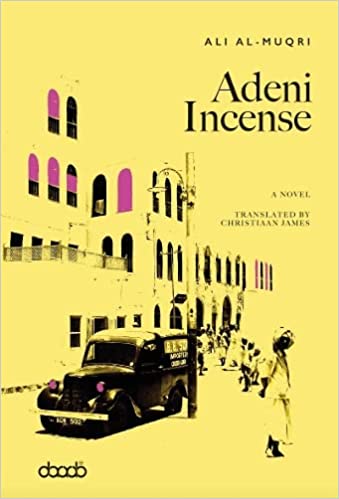
Adeni Incense interrogates concepts of belonging, identity, and who is entitled to speak for the whole. While set within a unique time period in Yemen's history, the novel is timely today as the centrifugal forces of national chauvinism and parochialism seek to further entrench psychological borders between peoples. With its richly developed scenes and moving depiction of a society teetering on a precipice, Adeni Incense is a masterwork of storytelling, leaving the reader with indelible memories of beloved characters and uncertainty over the viability of pluralism and diversity.
Teeming with Indians, Arabs, Somalis, Europeans, and others, Aden is no like no other city in the world. A transcendent city. A city for all no matter Muslim, Jewish, Hindu, or animist. And when "Michel," a young Frenchman washes ashore, fleeing his past in search of a new future, he's immediately drawn into this intoxicating cocktail of dreamers, revolutionaries, artists, and politicians who have all found a place within the city's vibrant atmosphere. Yet not all is as it seems. Monumental changes and forces are bearing down on Aden, threatening to erupt and refashion its identity, and redefine who can lay claim to the city that has always welcomed misfits.
You're ok with the unknown? Confusion won't kill you? Let this book test your capacities...
Another book club read, this time we wanted to dive into Yemeni historical fiction. It was a difficult book to get through but did that make it bad? I don't think so.
At first, I was confused by the choice of protagonist: we're given two French brothers with different values and convictions about WW2 (fiercely nationalist, and not), and our guy could be either of the two! It's unclear which he is, and I'm pretty sure we never find out! I was questioning the choice because his perspective felt very orientalist and self-centred: why introduce Aden through such a pompous lens? I wrote in the margin "Is this guy terrible?"
But it's a story of transformation. Michel (or whatever his name is, who really knows?) becomes less and less of a character and more of a narrator as time goes on. His perspective becomes more knowledgable, refined, empathetic and unphased the longer that he lives in Aden, until finally he is no longer questioning his identity as a Frenchman but as an Adeni.
What I enjoyed most about this book was how creatively the author infuses this theme of smells into the novel. We have copious descriptions of scents around the city, ritualistic scenes in which clothing gets perfumed, plot points involving smells, like a legal dispute involving stolen scent creators(!), Israeli nostalgia in exile (we'll get there), arguments over which perfume to gift to the queen, kiss prints on letters made with a naughty pair of lips, ETC! It's not easy to transfer the impact of such a murky concept into words, but the entire novel felt more like an act of smelling rather than reading.
The other thing that the novel does well is showcasing the ethnic and religious diversity of Aden during British colonial days. It reminded me a bit of London while reading about it. We have Northern and Parsi Indians, Zoroastrians, Baha'is, Somalis, Arabs, Muslims, Europeans, Christians and of course Jews. Everyone is apparently extremely tolerant, multilingual and united in Adeni identity. Is this somewhat romanticised? It's hard to tell.
There is a large Jewish community that lives peacefully among others in the city, until the occupation of Palestine causes a sharp turn in Arab sentiment towards Jews. Jewish people suffer a kind of proxy retribution for the establishment of Israel and eventually decide to flee to that same Israel. It felt expansive and enriching to read a range of perspectives that are uncommon to hear these days.
What I enjoyed least was the way in which the author would unnecessarily give our protagonist all these really unbelievable moments of being lusted over by the most popular women and girls of the entire city. It made no sense, and really detracted from the beauty of the story.
Overall, this was a difficult book to read because it insists on confusing the reader by being vague and indefinite about almost everything, in a similar way to how life might be if we only relied on our sense of smell. By the end I found myself respecting the stylistic choice and caring about the city of Aden, and wondering more about the history of Jewish flight to Israel as a direct response to Arab nationalist movements: how common was it? What can it teach us about polarisation?
I'd recommend this book to patient readers of historical fiction and anyone who wants to explore the history of Aden through fiction. I would probably not recommend it to readers that need clear and compelling storytelling.