How a Michigan farm boy became the richest man in America is a classic, almost mythic tale, but never before has Henry Ford’s outsized genius been brought to life so vividly as it is in this engaging and superbly researched biography.
The real Henry Ford was a tangle of contradictions. He set off the consumer revolution by producing a car affordable to the masses, all the while lamenting the moral toll exacted by consumerism. He believed in giving his workers a living wage, though he was entirely opposed to union labor. He had a warm and loving relationship with his wife, but sired a son with another woman. A rabid anti-Semite, he nonetheless embraced African American workers in the era of Jim Crow.
Uncovering the man behind the myth, situating his achievements and their attendant controversies firmly within the context of early twentieth-century America, Watts has given us a comprehensive, illuminating, and fascinating biography of one of America’s first mass-culture celebrities.
A specialist in the cultural and intellectual history of the United States, Steven Watts is Professor Emeritus in History at the University of Missouri.
If you are looking for a book that focuses on the history of the Ford Company, the company from a business point of view detailing yearly turnovers, profitability statistics, capital structure and such, this is not the book for you. This book instead focuses on the man who brought the company into being, Henry Ford (1863 – 1947). Of course we do learn about the company, but we learn so much more about his life, his family, his friends, his quirks, his goals and principles as well as what he sought to achieve through producing a car that an ordinary man could afford. He became a folk hero! He is judged to be the person to have made the largest impact on American life in the 20th Century! I didn’t know this before I picked up the book. In making cars accessible to the common man he brought about our consumer society, vertical integration of production, urbanization, roadways that cover the land, new buildings (gas stations and garages) and changes in our credit system (installment plans). He even changed how we court the opposite sex; think of all the smooching that goes on in cars!
This book looks at Henry Ford over his entire life span. We are given his attributes as well as his faults. It is extremely interesting to view consumerism, a concept we today look at with distaste, through the eyes of those who saw it as a promise of good life and a leveling between the classes. What was being offered was a life style that before had been limited to the rich and the elite. Did Ford come to understand the negative consequences of the society he had helped to create? Yes, he did, and we see how he wanted to counteract the negative attributes in the consumer society that arose.
We learn about the significance of Ford’s 5$ /day wage promise, as well as the subsequent Sociological Department and the requirements attached to the promise. We learn of his initial interest in car racing. I absolutely adored reading about the race starring Barney Oldfield driving the 999! Not only here but in all that we are told the author grabs your interest. He pulls you in and makes you care to find out what happens as events unfold. We learn of all the early car models, particularly the models of importance to Henry. We also learn of his refusal to make changes. Less attention is focused on the models initiated by others in the company. We learn of how the assembly line came into being and of the different Ford plants – Piquette Avenue, Highland Park, River Rouge and Willow Run. We learn of Henry Ford’s pacifism as well as the company’s participation in both wars. Both Henry’s hatred of FDR and Ida Tarbell’s appreciation of Henry. We learn of labor conflicts and the horrible, horrible Harry Bennett, the early partner Alexander Y. Malcomson and the principal Charles Sorensen during the company’s first four decades. Ford’s contributions to schooling, his anti-semitism, his help to Native Americans in Georgia, his Oscar II Peace Ship, the Chicago Tribune libel trial and the Dodge brothers libel trial of 1919. The book is long, but it remains interesting. It has to be long because there are just so many important things to tell!
Family relationships are thoroughly covered. The bond between father and son and how it plays out over the years is heartbreaking to observe. We come to understand his wife. We learn of his mistress, his children and grandchildren. We follow how the relationships alter over time.
Henry Ford kept no diaries. He expressed his thoughts and beliefs through ghostwriters. He was extensively interviewed and written up in papers. His deeds speak volumes. Much is written about those he worked with; here there is no lack of documentation. I very much appreciated the multitude of quotes. We are not simply t-o-l-d what others thought, but we hear what they said and the exact words they used to express themselves. I came to fully understand individuals’ motivations, personal psychology, how they felt and why they did what they did.
There is a bit of repetition, but I didn’t mind this at all. Repetition makes facts stick into my head.
The audiobook narration by John H. Mayer was absolutely perfect. It is read clearly and distinctly with a pinch of dramatization. Just a pinch! For example when you listen to the exciting Manufacturers’ Cup Race in 1902 with good old Barney Oldfield you grip your seat. This is how I want all non-fiction audiobooks to be read. NO! This is how I want all audiobooks to be read. The speed is perfect, it sounds natural. You who want books read quickly can increase the speed.
I definitely recommend this book. It is not dry. This book is less about the “head of a corporation” than about a fascinating person that shaped the world we live in today. This book is in fact much better than I ever thought it would be!
Henry Ford (1863-1947) is best remembered as the founder of Ford Motor Co. – the automaker which still bears his name. But in his own time he was renowned for his mass-produced Model T cars and for instituting a “living wage” for his employees at a time when that concept wasn’t even embryonic.
Those facts alone would suggest Ford as a superb biographical subject. But other qualities (and captivating contradictions) also make him compelling: he was a relentless self-promoter (but a very hard worker), a notoriously bad day-to-day business manager (but an unmatched visionary) and aggressively promoted Victorian-era moral standards (while conducting a three-decade affair with a much younger employee).
Watts expertly reviews Ford’s successes as well as his personal and professional failures in this engrossing 536-page narrative. Ruthlessly objective, this biography never lets Ford off the hook…but is also careful to highlight the qualities which made him so successful.
Although the author’s writing style is not as vibrant or colorful as I would have liked, Watts is more analytical and penetrating than most biographers. Ford is an interesting subject, but a complicated study in contrasts…and Watts carefully dissects and distills this perplexing dichotomy.
There are countless interesting moments in this biography. Some of the more fascinating include tales of Ford camping with Thomas Edison, his dreadful testimony in a libel lawsuit and his views regarding reincarnation. Other memorable moments include Ford’s long-term affair with his personal assistant, his virulent anti-Semitism and his shabby treatment of his son.
The book proceeds chronologically until Ford launches his car company. At that point the chapters are organized thematically (describing various personality traits Ford exhibited). Although some readers have found this odd or difficult to follow, I found it surprisingly logical and easy to follow.
Disappointing, however, is that Watts fails to focus more on Ford’s personal life. The biography is half-finished before his wife is thoroughly introduced. And despite his son’s impact on his life (for better and worse), Edsel isn’t a subject of focus until even later in the biography. Finally, for all the merit of this fabulous biography, the reader never quite feels as though he or she is seeing the world through Ford’s eyes; instead, this is clearly an astute study of Ford as discerned from afar.
Overall, Steven Watts’s “The People’s Tycoon: Henry Ford and the American Century” is a balanced, thoughtful, revealing and occasionally captivating biography of a fascinating twentieth-century industrialist. Readers seeking a thrilling narrative may come away enlightened but not fully satisfied. Nearly everyone, however, will feel as though they’ve read the most perceptive account of Ford which may ever be written.
The book is organized by chapters describing a character trait. Which means you may go through a decade learning about him and his relationships as they pertain to that trait. Then in the next chapter, jump back and learn about the relationships as they pertain to another trait. In some ways this felt repetitive although technically it wasn't. Overall it paints the picture of a remarkable, complex and flawed man. A very thorough account of his life.
I readily admit I read this book primarily due to my interest in the time period, particularly concerning the nascent American automotive industry and especially the development of the Model T.
The strength of this book is that in many places it is as much a Social History of turn-of-the-last-century America as it is a chronicle of Henry Ford. This is explained by the fact that American social history is the author's area of expertise. I also enjoyed the early chapters describing Ford's early life and development, and the development of his automotive inventions.
The book misses 4 stars because this biography needed far more detail of Ford Motor Co. history woven into it. Once the Model T is under production, the automotive industry is almost completely set aside except as an afterthought, or something going on in the background. For instance, there is no real mention of Lincoln or Mercury, and no more than a passing mention of Ford's forays into aviation w/ the "Flivver" plane or the Ford tri-motor. I also felt like there was a big gap in Ford's activities in Latin American w/ no mention of his rubber plantation (Fordlandia)! While important, the author just spends too much time on Ford's pacifistic activities and his terrible anti-semitism.
The bottom line is that neither myself nor anyone else would be reading about Henry Ford at all were it not for the Model T and the Ford Motor Company. More industrial history absolutely needed. 3 stars.
Henry Ford was in many ways typical of the 19th century American male. He was suspicious of book learning, fascinated with things mechanical, restless and curious about the material world, convinced he could improve on things by tinkering with them, at home on a farm and always open to the guy across the fence.
He was also typical of those who rise to fame and fortune through obsession. He had a goal in mind that drove him to dedicate his time without any doubt that his efforts would prove out. The thought that one will be successful through stick-to-it-tiveness regardless of the opinions of others can do wonders and in Henry Ford it led a nation into a new way of life.
Ford had an uncanny vision of what he was bringing about: the world of the consumer able to afford things and the time to enjoy leisure activities with them, an introduction to the common citizen of what had only been available to the rich.
In this delightful read, Steven Watts takes aspects of Henry Ford as his chapter titles. One reads of the inventor, the bigot, the folk hero, the politician, and so many more. Just looking over these titles would lure anyone into reading this fascinating account. For those used to a sequential history, it takes a little getting used to the repeated return to earlier times in order to look at yet another aspect of the man, but it perfectly fits Ford's multidimensional individualism.
Ford did not accept the word no. There was always a way to accomplish anything, even when reality said otherwise. His signal achievement was the creation of the car for everyone, the Model T, though it came into being while many others were pursuing car production. His first two companies failed but the third, the Ford Motor Company, did the trick.
The key to low cost production was the assembly line which in retrospect seems obvious. Teams of men had been moving from chassis to chassis to complete assembly when it dawned that moving the cars along while keeping the people in place made more sense. This made possible a great jump in efficient production while at the same time creating that bane of industrialism, the assembly line worker doing one small thing repetitively all day long.
The captivating part of Henry Ford was his quirkiness. He knew a lot on many technical subjects but he did not accept that there were areas in which he knew nothing. He was more than willing to speak out on all subjects (through intermediaries...he hated public speaking). Though a proponent of education, he never felt his own lack of education should inhibit his holding forth on anything that caught his attention.
We all have personality traits that conflict, but because of the great power that Ford attained, his wishes had epic consequences. His inability to accept that he might be wrong, the disease of the rich and powerful, made working under him difficult, particularly for his only son, Edsel, who, though he was made president of the Ford Motor Company, was continually and deliberately undermined by his father to the dismay of company management that could do nothing about it.
Though the bringer of the automobile to the masses, Henry had his conservative side. He didn't like FDR or the New Deal, favored Prohibition, did not drink, smoke or indulge in food. His lean physique was maintained to the end of his life and even in his seventies he would challenge and beat younger men in a foot race. In spite of the industrialism his Model T heralded, he hankered after farm life, recommended it, and loved objects from 19th century America.
He had a great sense of humor, loved children and was never happier than when talking one-on-one with some stranger. He unilaterally doubled the pay of his factory workers but could not bear the idea of a union because it would challenge his absolute rule over his company.
And there is so much more! The reader's interest is maintained in so many ways, not the least of which is the portrayal of the people Ford worked with and their methods of dealing with his absolute power combined with a lack of interest in reasoning about any subject. To Henry Ford, things were black and white, so you didn't waste his time trying to make a case for anything unless you could demonstrate physically that what you had in mind was superior. In the 1930's while other car companies were coming out with new models frequently, killing the sales of the 15 year old Model T that Henry wanted only to improve, it almost took an act of God to replace it with the Model A.
He was an anti-Semite. He hated Wall Street and disregarded the knowledge of experts. He started an elementary school from scratch for poor Southern blacks and created working men's schools. He introduced soybeans to America and developed chemicals from plants. He hired a ship to take a group of anti-war activists with him to Europe to stop WW1. He sponsored an hour long radio program of classical music that was the 5th most popular program in the late 30's.
Steve Watts writes: "...he somehow managed to become a living symbol both of progress and of respect for older values. Ford was a half-hearted revolutionary whose misgivings, by mirroring those of his fellow citizens, created a bond of endearment."
Pick up a copy of this wonderful story of a major character in American history, Henry Ford a human firework.
Henry Ford was such an interesting man. He looked after the poor and middle class people. As a youngster he would disassemble other kid’s watches and put them back together. Later he was a chief engineer for Thomas Edison. Edison remained Henry’s hero throughout his life. Henry got very interested in the motor less carriages.
He developed the cheapest car a person could buy. The model T automobile became the most popular car of the 1920’s. It cost $500. Which was a lot for that time but as low as he could produce a car. Two things made him produce cars more cheaply. One was the discovery of Valadalium. If you add this steel it makes the car lighter and stronger. The other was the use of an assembly line for production. Moving the parts to the worker who did the same function everyday then passed it along increased production so more cars were available.
Ford also offered his workers a $5 dollar a day work day. This was astronomical increase in wages for his workers. However part of the $5 dollar day included a visit from a Ford staff member who would visit the employees houses and teach the employee about the use of money and give health advice. More than half of Ford employees were immigrants so it was hard for Ford staff to communicate with them. So Henry Ford set up a school to teach his employees English.
As the years passed the public became fascinated with Henry Ford. He along with John Burroughs, Thomas Edison and Harvey Firestone would go on camping trips and write about them. They made the newspapers and were named the Four Vagabonds.
Ford believed in reincarnation, exercise and that all disease was caused by the food we eat. The author, doesn’t neglect to tell the bad side of Henry Ford either. The workers on the assembly job got monotonous to the worker so Ford faced absenteeism.
In addition, when the congress passed authorization for unionization. Ford fought against and would not sign the contract that was proposed to him. However he finally backed down and gave Ford workers their union. He was also an anti-Semite. He had produced a pamphlet that was critical of the Jews. He disliked Banks and Wall Street which he believed was the creation by Jews. He later repented and apologized to the Jewish people.
This book details a man who was beloved and hated at times by the American people. It was a great read about one great interesting man.
This is a well-written and fair biography of Henry Ford. Ford was an American folk hero who Watts demythologizes. Nevertheless, Ford understood consumerism, mass culture, and the populism. He was concerned about producing a car that ordinary folk could afford, the Model T. Ford stressed hard work, humility, integrity, temperance and piety throughout his life. After the success of the Model T, he introduced the $5 work day but with a catch as Ford was as much about making cars as men. He developed a “sociology department” which demanded the same values for his workers as he grew up with, even sending agents into homes to check on their personal lives. This is a tale of two Fords, one the inventor/businessman/politician and the other the moralist/racist. Ford caused trouble for himself in the cross-over, from successful businessman into area he was ignorant of. Ford believed in reincarnation, was a spiritualist, sponsored and led the “Peace Ship” fiasco to end WWI, fought against labor unions, and exposed himself as a bigot and racist with his anti-Semitism rantings in his newspaper. He even had his own enforcers (thugs) at the River Rouge plant mainly to keep union talk out. His moral and ideological character would ever after be in question. Along with the automobile, Ford’s other legacy is Greenfield Village and the Ford Museum. Ford believed that real history wasn’t taught in school but realized in museums where people could put their hands on artifacts and antiques of a bygone era. He believed that the greatness of the country was not found in politicians, generals, business executives but rather in the lives of ordinary people. He experimented with all types of uses for soybeans. Later in life Ford was senile, a crackpot when it came to medical issues, and dabbled in small projects. Later in life he was only a figurehead when it came to Ford Motor Co. To paraphrase Will Rogers, he once said of Ford, “I don’t know if he helped us or hurt us, but one thing is for sure, we will never be the same.” A good read.
Henry Ford was at once one of the most powerful and influential person of the twentieth century and a significant negative force in America. While he had great success in introducing the Model T to the USA and deciding on a whim to double salaries to $5 a day and cut the working day from nine hours to eight, he did not have the ability that see beyond the Model T while other companies where introducing new, better cars. He was a rabid anti-Semite, an international isolationist, and anti union. His early success deprived him of the ability to listen to other opinions, including that of his son, Edsel, as his company was collapsing around him.
Wow! An extensive and well researched biography of one of the founders and developers of the modern consumer industrial society that has existed since Henry ford pioneered it. Very even handed, the book focuses on Ford’s great qualities and many accomplishments, along with his virtues that shaped his business and personal life. But it also does not pull any punches, detailing his deep faults, bigotry, and obsession with control.
If looking at this book alongside other Ford biographies, it's arrangement by topic (vs chronological) is perhaps a unique selling point. It worked well for highlighting particular issues or values central to his life, but I found myself wishing for more chronological clarification around exactly when and how certain specific events proceeded or influenced each other. This could have illuminated motivations, moods, and other such context to better assist the reader in building their own conclusions about his character. As it is, there are a handful of repetitions—almost word for word references to things already presented, but these seemed largely dysfunctional.
I appreciated that the book was, for the most part, balanced in recognizing the positive and negative aspects of Ford and his life. I don't want to use the term "sugar coated" here as that would not be accurate, but the book did read to me as having an undercurrent of "boys will be boys" shoulder shrugging over the darker corners of the Henry Ford story. Personally, I found the documentary on Ford from PBS' American Experience to be more to the point in wrestling with this complex legacy in a forthright and productive manner.
This biography of one of America's most fascinating individuals, was very enlightening. I never knew he had a rocky relationship with his son, Edsel, or his anti-Semantic views. I never knew he had espoused social causes, even developing a sociology department within his company in the early years. I was interested to learn his close relationship with Thomas Edison and was surprised about his friendship with George Washington Carver.
I enjoy an occasional biography. I wish the author had spent less time on Ford's social causes and more time on the development of the automobile. I was disappointed the book didn't cover more about the Edsel brand but later learned the car did not make it's debut until the 1950's.
The CD was 29 hours and 34 minutes long and read by John H. Mayer. It would receive an endorsement but not a ringing one. Read it (or listen to it) if you want, but there must be more interesting biographies of Ford out there.
I really enjoyed this book. Being a "Detroiter" and having known of Henry Ford in general terms only slightly prepared me for this marvelous, well researched and thought provoking book. Often bibliographers become so enamoured with their subject that the "story" reeks of revisionist nonsense. Mr. Watts tells the Ford story "warts and all." It is an utterly fascinating tale about a somewhat overlooked subject.
Very well written. He pulls no punches with Ford and openly discusses all of his faults. Perhaps a bit biased "against" Ford. The edition was small print and rather tedious to get through, but worth a read, even though I really do not care for Henry Ford any more.
Henry Ford was not a genius. That reality makes his achievements all the more impressive. Though later in life he went through a despicable Anti-Semitic phase, this came in my opinion from his status as a simpleton in all matters unrelated to the design and manufacture of automobiles. He did not have much formal schooling and was not an excellent reader. He did not build his cars, other than the first one, the Quadricycle. He directed others to do so. He found and surrounded himself with some excellent designers. The real fruit of his career was the Model T, which was produced from 1908-1927. Not many people realize what happened with the Model T. It first sold for $850 in 1909. After it started selling well, Henry Ford did not sit back and count his shekels. Instead, he looked for ways to make the production of the car and its assembly faster and cheaper for his company to produce, without compromising on the quality of the materials and assembly. The creation of Model Ts rose almost exponentially as he has his factory moved from having small teams work on cars one at a time until done to having the assembly line where every worker contributed one part to the whole and what once took a whole day changed to building a Model T in 90 minutes. So, most importantly, as this flood of profit came in, how did Henry Ford react? Did he keep the $850-per-car gravy train coming in? No! He lowered the price to $280 per car! He still got rich, but he enabled an entire class of Americans who were poor to exchange their horse and buggy for a Model T. After 19 years of refining the Model T, its production process and lowering the price, Ford stopped making the Model T in 1927. The 15 million in total Model Ts that were created made it so, in the 1920's, 40% of all cars on the road in the world were Ford Model T cars.
Ford built them with a special chromium-containing vanadium steel that was especially strong and light and that did not rust. Ford had first heard about the steel when he was at a race and he walked over to inspect a crashed Italian racer. The steel was amazingly lightweight and strong. The Model T was vanadium steel throughout and thus they are to this day especially resistant to rusting.
I guess I should explain my obvious curiosity about the Model T.
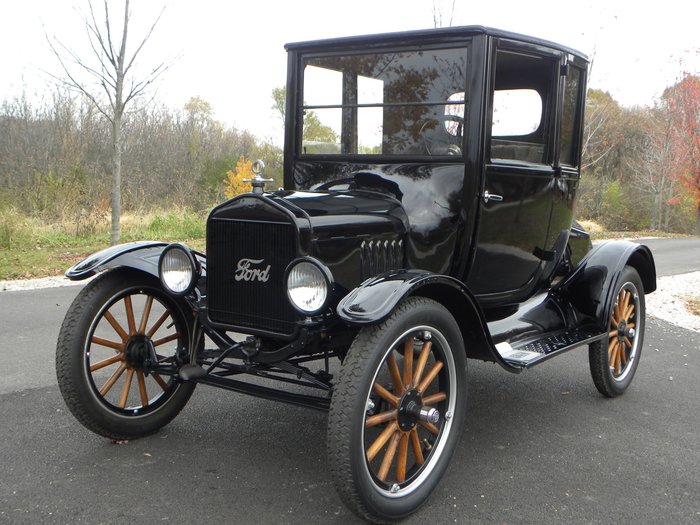
A year ago I needed to buy a used car and wanted a pickup, because I live on an acreage. Though I had never been a car guy and have until two years ago not even known how to change the brake pads in a car, decided that I needed to learn and now I have been able to do lots of maintenance on my mother's Honda Accord, which I inherited, and on my Peace Sports VIP Super Chill, which is an 80cc Vespa-type scooter that I keep as backup transportation. So, foolish me, I bought a '93 Ford Ranger, in the delusion that I would be able to do the maintenance myself. Even back then, it was much more complicated than I had time or inclination to face. Fortunately, the Ranger did me a favor last Summer by throwing its serpentine belt and then crapping out a ton of oil. I had it towed to a Ford dealership here and they held their noses, refused to touch it and counseled me to buy one of their new cars. I had it towed home and there it sat in my driveway until a week ago when I converted the $2,250 that I originally paid for it into a nice tidy $150, when it was towed away for scrap. So, I hope you see where I'm going here. Four days ago, I bought for $15K a 1923 Ford Model T Dr's Coupe. I also bought a brand-new facsimile book called "Ford Service: Practical Methods for Repairing and Servicing Ford Cars". The book is full of pictures and arrows explaining exactly what do do, written for 1920's technicians who were not that great of readers. Every paragraph numbered.
I am giving this book five stars, because it introduced me to Henry Ford, showing me his plusses and minuses, and induced me to make the step of buying the Ford Model T Dr's Coupe, that you see in the two photos.
The book did become repetitive with the theme of Henry moving forward with industrial development while keeping an eye on the rural past. That said, the book gave a good biography of the man's life with its highs and lows. Henry was a great engineer/machinist and he surrounded himself with a team of exceptional men who could take on responsibilities he wasn't good at such as the business side, the operations side, and the sales and advertising side; they created a behemoth of a company. Reading about the assembly line and the workers was awe-inspiring, how they all came together to build cars (and weapons during World War 2) at a tremendous rate and significantly changed the fabric of the country and later the world.
As an individual, Henry knew of the importance of publicity and always used the spotlight to emphasize his company and his personal beliefs on life. He even used the terms "social justice" and "America first" in regards to uplifting workers with better wages and keeping America out of World War 2 respectively and I thought those terms came out only recently. He tried to instill moral principles upon his workers and thought they could be directed according to scientific self-management just like the cars built on the assembly line. He also helped out black people and developed a friendship with George Washington Carver.
Unfortunately, Henry fell victim to an affliction that's happened to countless successful people: he reached his peak and didn't know when to bow out and give up responsibility to the next generation. His lust for power and the limelight caused him to mistreat his son to the point the latter died early. The way he ruled the company reminded me of the book "The Dictator's Handbook"; since he had the sole power in the company and didn't have advisors, he gave orders like a king resulting in misery among his workers and deteriorating conditions within the company. He also couldn't change with the times; he started consumer culture but it outgrew him and he couldn't adjust, refusing to build a new car model or offer credit until after long fights with his subordinates.
Tragically, he suffered greatly in old age. It was humbling reading about this man who was a titan in his prime succumbing to strokes and senility. He tried to continue running his company but his suspicions and reliance on the opportunistic Harry Bennett caused a lot of great leaders to be ousted; it reminded me of King Theoden and Wormtongue in "The Lord of the Rings". Finally, he needed to be forced to resign.
So what I have written in the following paragraphs - under the line - were written while I was in the midst of reading this book - however it is really a worthy read - I have put it in my mind as a book to give to folks if appropriate.
Initially in my mind was Henry Ford - the developer of the assembly line - the $5/day innovator - the anti- semite, the Hitler admirer - the FDR opponent- maker of B-24s during WWII - but he was really a dynamic person in many ways.
He not only made the assembly line first he developed a notably better car - second he saw it as a peoples car, the Model T, and he kept lowering the price - he was not well educated but mechanically a genius it seems and tenacious - working to perfect his goals - he raced cars in the beginning too - I had looked for a long time for a biography of Ford and really found not many at all - mostly his ghost written ones - and finally somehow I came across this - I. have read other industrialist biographies - Carnegie, Rockefeller but none were so noticeable outside their industrial field while Ford was active in many areas - may have hated Jews but seems to have interacted well with African Americans, with immigrants - he had severe parental failures - he had other shortcoming - more than a few - but was generous and modest if arrogant in his thinking.
I would read it for more than Ford but also the pulse of America in the first half of the last century - well I have read it so I suggest you consider reading it.
----------------------------------------------------- First let me note that I have looked for a while for a Ford biography - not having found one - notable that it is not in the New York City library system - I had to get it from a Connecticut library - I now see that it is available on Kindle but I couldn't find it before to be able to read a samp.e So I am about 40% thru this book -up to mid 1920s - so far Ford is not very objectionable - he does try to impose lifestyle changes upon his workers following his virtually doubling their pay to $5/day. He encourages no alcohol, stable home life, paying bills - buying nothing on time except homes and CARS. But he did support peace efforts for WWI before the US entered at least. He was somewhat generous to charities - or if he wasn't his wife had the power to do such. Along the way to getting to his car empire he was a car race driver, a builder, a mechanic etc. very industrious. He was drawn to his mechanic aptitude but seems, so far, to have always held farming as the best profession. He would have fit right in with Thomas Jefferson's yeoman farmer attitudes, I think, if he was a reader of history. - more to come I am sure
So now at 57% through the book, up to generally 1927, comes the first indication of Ford's anti-semitism - dating back to 1920 when, sing the Dearborn Independent - a newspaper he had purchased in 1918, he began his weekly attach on Jews called the "The International Jew : The world's problem".
Intentionally or not Mr. Watts, the author has delayed introducing this until the story is up to 1927,. Maybe to not interfere with the presentation of the industrial progress, and problems and relationship with others problems - maybe not the least of which with his son Edsel. -
I finished The People’s Tycoon: Henry Ford and the American Century by Steven Watts.
Henry Ford is a dichotomy of a man who brought forth a new American Industrial Revolution while at the same time embracing a more old fashioned outlook on life. A man who often showed disdain for “book learning “ while at the same time embracing the need for education. A man who created a new system of consumerism and made commonplace the idea that every family should and would have an automobile, he perfected the assembly line for the manufacture of his beloved Model T while at the same time being wedded to an America centered on the farm.
Filled with anachronisms he loved technology but embraced a more traditional America. A progressive who wanted to raise the standard of living of his employees so the could take part in the new wave of consumerism while fighting the acceptance of unionization. A pacifist who ultimately allowed his company to be part of the World War II war effort. A man who did all he could to educate African Americans and help them participate and share in the American dream but also virulently Anti-Semitic and early on somewhat sympathetic to the Nazi movement and Hitler’s Germany.
He put more faith in others than his own son Edsel Ford in the running of the Ford Motor Company and as he grew older grew more autocratic and surrounded by sycophantic yes men.
A great American and 20th century industrialist filled with a multitude of weaknesses. A more complicated yet simple man will be hard to find. A fascinating book on a fascinating man which I would encourage those interested in Henry Ford to read.
This book brought Ford and Henry Ford to life more then Greenfield Village ever could.
What my 👂 heard below 👇
She hung on my utterances It transcends logic I have a restless curiosity about it Large expressive blue eyes We talked with drawings instead of words We part ways on some key points Your money will never do better than your mindset will allow Growing car profits eventually took me to real estate investments would eventually took me into stock investments His need for myth making twisted the facts Hopefully as years go by animosities mellow If this logic continues and worry about deeper income inequality You're fascinating in your ambiguity I own my property earned my way and I'm beholdnt to nobody There's a larger dimension to this maneuver It's a dangerous proposition Big ideas and stubborn Independence I refused politely You don't sell goods usually you sell ideas about goods The ache is in my heart the place where I hunger Take my instinctive hunch and reduce it to a working formula mit I'm never happier than when I'm working at top notch Modest simple honesty He has a prophetic eye I occasionally grew testy A great heart beats in Henry Ford You appear like a king on a throne telling me what to do She demonstrated a warm sure touch Most men are entirely too confident in their ability to fail I appreciate our loyal friendship I was able to accumulate considerable power Your sense of your own might has grown grotesque Why are you acting with such calculated in sensitivity That dirty rotten puke He has a cold tablet matter His output was prolific This warped dynamic has reached a climax
Henry Ford feels familiar in 2026, even when much of what he is best known for happened over 100 years ago. Like contemporary business figures, Ford knew one industry very well, as he practically invented the modern automobile manufacturer. But he also had a deeply misplaced confidence in his thoughts on many other aspects of public life, some of which were benign (affection for rural life and classic forms of dancing) and some that were anything but (open anti-semitism and healthcare quackery). Every day in 2026, there seems to be a news article about someone who knows something about business but presumes to know far more, and seems exclusively to be disastrous.
This book’s format is unique, with each chapter bearing a title like ‘Celebrity’, ‘Legend’, ‘Father’, ‘Bigot’, with each title acting as the focus for the book. This works well as a way of showing Ford’s ascent in popularity and renown, though another reader might be frustrated by chapters that seem to go back and explain, “Oh, by the way, he was also doling out ridiculous medical advice while doing all that.” I found it effective, though.
Ford was a complicated figure, but he was mostly a guy who knew one thing quite well (the proverbial hedgehog, not a fox) and didn’t think that deeply about many other things. He certainly had some opinions that he held deeply (including hateful ones), but others were less thought-through, and he broadcasted both equally.
This is an outstanding biography of a fascinating and inspiring, yet flawed, individual. The author manages to delve deeply into Ford's personal and professional life, his mind, and the effects of what he did and what he tried to do, yet portraying a balanced perspective on both the good and the bad. The book carefully describes Ford's image, both self-cultivated and at times unintended, as well as the reality of what occurred in his life. The one criticism I would make of the book was the lack of attention paid to his family - the insight about his wife, children and other family members were only included in ways that related to Ford's professional life, with some small exceptions to provide color and a sense of Ford as a person. While the focus of the book remained true to the title - the People's Tycoon - it would have been interesting to read more about Ford the person, although that might have taken away from the intent and also made a book that was already more than 500 pages a bit unwieldy.
I should pay more attention to the titles. I was expecting a different book but I was very well satisfied with a narrative that went in a completely unexpected trajectory. I will want to read further about the more technical developments of the Ford company but this focused on his life and beliefs. And there were some odd beliefs. He sounds fascinating but I'm glad I wasn't there to suffer the contradictions. There was a darkness and even cruelty. I'm sure they were offset by the good he did. And he did change the entire direction of civilization though whether that was intentional or if he was carried along in the stream of inevitability is another matter. It was a good story with some narrative quirks and story telling devices that blemished it slightly but it's a nice solid four stars. And a good tough narrator with maybe two mispronounced words. I love mispronounced words. It makes me feel so superior.
I love reading the history of early car entrepreneurs that had the vision to make something that had never been made before. Steven Watts did an amazing job of finding all the interviews with all the people who worked with or somehow knew Henry Ford, then taking those conversations, news and magazine articles, biographies, and put them into an amazing story. Mr Watts and a lot of people could not understand why Henry so opposed labor unions when he gave his workers the highest pay (5 dollar work day), short hours and many benefits. But Ford throughout his life insisted on being in total control of the Ford Motor Company, he wouldn't even allow his son. Edsel, to make decisions. This book is rather long and contains many side stories that either go back in time to project ahead which might be confusing. A must read for any car guy.
A fairly comprehensive look at Henry Ford, highlighting both the positive and negative aspects of the man with a fair point of view. Though it does drag in the middle it was an easy read if not the most engrossing. The author had a bad habit in the second half of ending a chapter with a foreboding sentence to then not discuss the alluded to topic at all in the next part. The ruthlessness of some of Ford's dealings combined with his desire to make the world better was an interesting dynamic.
Watts does a good job showing the juxtaposition of Ford changing the American culture while also weary of the changes he helped bring forth. The parallels between today's main popular car tycoon and Ford made for good reading.
Good, a solid three stars. Watts has clearly done his research and is a competent writer. I wasn’t wild about the format – chronological up to the point at which Ford has created the Ford company and develops the Model T; after that he covers various spheres of Ford’s activities down through the decades in chapters with the appropriate title, such as “Reformer”, “Politician”, “Bigot”, “Father” and so on. That gives a handy compendium if, say, you just wanted to know about Ford’s antisemitism but does make for a certain amount of repetition and really gives no feeling as to what all Ford was up to at any particular time.
I wanted to like this book. Unfortunately, I found myself putting it aside to do something else. I had hoped to learn about Henry's feelings and business dealings during the depression, but they were barely referenced. It was the same situation with the relationship between Henry and his son, Edsel. Most of what was provided was done so in the section talking about the impact of Edsel's death on Henry. Personally, I'm left wanting to know more about that. The writing itself is perfect. I didn't have to have a dictionary next to me to be able to understand the content. Very exhaustive research on many of the important things. Overall, to me it was just ok.
He certainly is one of the Giants of the 20th century. Made automobiles affordable for the “common” man. He was antisemetic,populist,pacifist,control freak,hated banks and finance,hated government intervention.was a great promoter of education and supported some colleges and primary schools.He was a terrible father to his only son.he was for cheaper products and higher wages but hated unions.For all he did for industrialization and capitalism he remained a guy who grew up on a farm and longed for a simpler and stricter life.
Excellent biography that not only strives to unwrap Ford's actual history but examines his impact on consumerism. Watts did an excellent job in trying to show all facets of Ford--his genius, his ignorance, his love, infidelity, etc. I especially found the discussions on the changing American landscape pertaining to saving/consumerism to be especially helpful.
A very interestng read - and man. Henry Ford was such an amazing man. His ideas for industry and manufacturing were totally new - unheard of. Not even imagined. With those he definitely changed the world world. He also had lots of lousy ideas that also changed the world. A long, slow, read but worth it.
I can't imagine a better biography of Ford, even though this is the only one I've read/listened to. What a dick this guy was at times - toward Jews and his only son. But also had that spark familiar to Churchill, Teddy Roosevelt, and like great men. Great read for broad-minded businessmen, as well as those generally curious about how the world got to be where it is today.