Jump to ratings and reviews
Rate this book

Save the Pearls #1

Revealing Eden

Rate this book
Eden Newman must mate before her 18th birthday in six months or she'll be left outside to die in a burning world. But who will pick up her mate-option when she's cursed with white skin and a tragically low mate-rate of 15%? In a post-apocalyptic, totalitarian, underground world where class and beauty are defined by resistance to an overheated environment, Eden's coloring brands her as a member of the lowest class, a weak and ugly Pearl. If only she can mate with a dark-skinned Coal from the ruling class, she'll be safe. Just maybe one Coal sees the Real Eden and will be her salvation her co-worker Jamal has begun secretly dating her. But when Eden unwittingly compromises her father's secret biological experiment, she finds herself in the eye of a storm and thrown into the last area of rainforest, a strange and dangerous land. Eden must fight to save her father, who may be humanity's last hope, while standing up to a powerful beast-man she believes is her enemy, despite her overwhelming attraction. Eden must change to survive but only if she can redefine her ideas of beauty and of love, along with a little help from her "adopted aunt" Emily Dickinson.

307 pages, Hardcover

First published October 1, 2011

14 people are currently reading
4149 people want to read

About the author

Victoria Foyt

8 books69 followers
Victoria Foyt's debut novel, The Virtual Life of Lexie Diamond, a young adult fantasy
mystery thriller (HarperCollins) was Recommended by The Center for Children's Books, and received a five-star, must read rating from Teens Read Too: “Foyt has created a compelling character and an electrifying story that will hold readers until the last page.”

Victoria co-wrote and starred in several acclaimed feature films, including "Going Shopping" with Rob Morrow, "Déjà Vu" with Vanessa Redgrave, "Last Summer in the Hamptons" with Melissa Leo, and "Babyfever" with Eric Roberts.

Victoria has appeared on news outlets such as Good Morning America, Entertainment Tonight, E! Entertainment, HBO, CNN-TV, Showbiz Today, ABC Radio, Turner TV Entertainment Report, TNT Rough Cuts, and Westwood One Radio, and has received extensive coverage on Siskel & Ebert.

She also has been featured in Vogue Magazine, O at Home, Elle Magazine, Movieline, Venice Magazine, Avenue Magazine, Night Magazine, Moviemaker Magazine, The Los Angeles Times, The San Francisco Chronicle, La Opinion, Miami New Times, Dramalogue, and Backstage West, among others.

Born and raised in Coral Gables, Florida, Victoria attended the University of Miami, where she received her Bachelor of Arts in French and Spanish and German. She currently resides in Santa Monica, California. She loves reading--at least two or three books a month--movies, tennis, swimming, hiking, and lots of dark chocolate.

Ratings & Reviews

What do you think?
Rate this book

Friends & Following

Create a free account to discover what your friends think of this book!

Community Reviews

5 stars
129 (12%)
4 stars
78 (7%)
3 stars
76 (7%)
2 stars
85 (8%)
1 star
629 (63%)
Displaying 1 - 30 of 369 reviews
Profile Image for Steph Sinclair.
461 reviews11.3k followers
December 4, 2013

"I believe that anyone who reads the novel will understand its strong stance against racism."
-Victoria Fyot (Judging A Book By Its Cover Gives Birth To Racism)

Well, I hate to be the bearer of bad news, but you failed. Badly. To say Revealing Eden is offensive is such a massive understatement. I couldn't even stomach more that a few pages at a time. It was like taking a spork to your eye, but then it breaks leaving you with only the handle to carry out your dark deed. Even with the obvious racism aside, the Revealing Eden is simply not good. From the dialogue to the characters to the plot, it was very badly written. A tragic mess.

There are a few things you should know before reading this review:

1. I am an African-American.
2. I went into this book knowing I would probably dislike it. Why?
-Because I'm obviously masochistic.
-Because I'm taking one for the team. You're welcome.
-Because Foyt made a statement that not many African-Americans had read her book. Here I am and yes, we still exist.
3. I will most likely address a few statements made by Foyt about her novel as it pertains to Revealing Eden.
4. Oh, and this review is kinda long. Sorry about that. LOADS to cover. >.<

Apparently, according to Victoria Foyt the population of white people have plummeted due to an increase in sun radiation, leaving black people in charge. My first issue was with the lack of science in that premise. (And no. Throwing out random scientific names of insects, animals and plants does not signify that you've done your homework.) If the sun's radiation was *that* bad, being black won't do you that much good. What's even more odd is that for majority of the novel, Eden is hanging out outside in the sun without her coating (more on that later). I kept waiting for her to complain about how hot it was or that her skin felt burnt, but it never happened. Her father is working in a lab attempting to genetically alter people so that they have animal traits and no one has created a better sunblock or, I don't know, CURED CANCER?! Where is the logic in that?

Whites in this novel are considered a burden to society since they have such a low rate of survival. If one does not have a mate by age 18, they are to be sentenced to death. There seems to be an obvious solution to this hypothetical problem: breed out the weaker genetics. But instead white people are oppressed just for the sake of oppression. And even though Eden knows she has had two mating offers, she refuses to accept either one, choosing to wait for her "Dark Prince" in hopes that he will pick up her mating option. Her reasoning?
"Because I don't want my child to be all Pearl. I'd rather be dead than mate with one of my kind."

*sigh* I can't believe I have to break this down, but if a black person and a white person have a baby, that doesn't automatically guarantee a dark-skinned baby. In fact, some may have very fair complexion. Funny thing the way genetics works. But what did I expect? Almost all the dark-skinned people in Revealing Eden were black as night. The one person who is mentioned with brown skin is assumed to be mixed. *Shaking my head* It was then I should have realized that logic was not going to be Revealing Eden's strong point.

In order for Eden to fit in, she walks around with a coating of "Midnight Luster" on her skin and hair. She talks about dying her hair black and I couldn't figure out why she was doing that. Doesn't Foyt know that black peoples' hair is not actually black? Is that a common misconception even today? It's weird because it's something I've never thought of before. Sure, there are some whose hair is black, but it's not very common at all. It was the little things like that were I noticed a trend beginning: Foyt did absolutely no research on African-Americans or any other race for that matter. It is very evident by her constant reliance on black stereotypes applied even to white characters.

*Warning: Many quote-inducing headdesking ahead.

Applying black stereotypes to a white female to generate sympathy for the main character:
"White people were lazy good-for-nothings with weak genetics."

A black woman's figure categorizing her status in society:
"Voluptuous, with raisin-colored skin, everything about Ashina screamed ruling class."

*facepalm*:
"On the main stage a band of Coals performed in whiteface."

Oh and I can't forget about the constant theme running rampant that black people are out to get the white people. As if black people, that are now in charge, have nothing else better to do with their time than antagonize others. White women everywhere are doing the "White Woman's Workout." >_>

Every black person in the world is out to get white people:
"She suspected that each and every Coal passerby wanted to hurt her..."


It's always black people:
"All of a sudden, she heard two men behind her. Coals, she figured by their careless, drunken laughter."

Songs about black men raping a white girl:
Little Pearly whirly,
lost inside the mines;
tossed from Coal to Coal, in fear, she whines,
"I'm sorry, Mother,
he said he only wanted to see my white skin shine."

they raping everyboy out here Antoine Dodson / Bed Intruder

Even more rape comparisons:
She felt more violated than if she'd been raped.
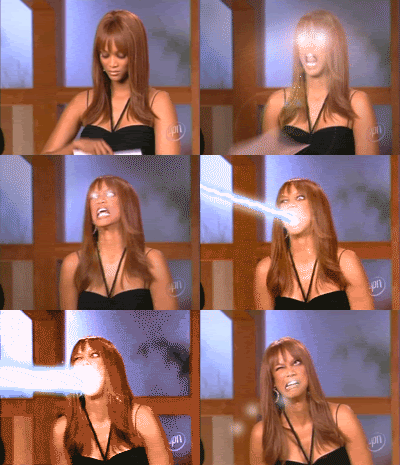
Go on and scream. Let it out.


And on and on it goes. But then it gets worse when because there doesn't seem to be any indication that slavery or the Civil Rights Movement ever happened. How was she being oppressed? Well as far as I can tell, white people were well-fed, had their own places, had jobs etc. The biggest thing against them was the mating age, having to wear their "coating" (I'm not sure if that was a law or anything) and getting rude remarks from black people. On a few occasions Eden even wishes the world could go back to a time where white people were free to go outside with their white skin without being persecuted. She frequently says that a black person couldn't possibly understand what it was like to be in her shoes. *slow blink*
"Someday, when you're locked up in a cage, Bramford, maybe you'll understand what it feels like to be an outcast."

If only Bramford knew what it was like to be an outcast.

Maybe now he would know how it felt to be judged by your appearance.

What did Bramford know about disappointment?

Yeah, that's not offensive at all. Not one bit. #sarcasm

And then there is the issue of the FFP A.K.A. the Federation of Free People, "a militant organization of Coals that vowed to rid the planet of Pearls." Pause. *deep breaths* How am I supposed to take that? The Federation of FREE People? Get me off this planet. I'm just going to leave that alone before I start seeing blood-red. Too late, I just saw red. Excuse me.


Okay, sorry about that. That was a tad awkward.

I also want to address the titles given to the races.

White- Pearls

Asian- Ambers

Latino- Tiger Eyes

Black- Coals

Albino- Cottons

Are you kidding me? Coals? As in black as coals? Pearls? As in precious pieces of jewelry? Cotton? As in what my ancestors were forced to pick in the fields? Do I even need to explain how offensive that is? And Foyt's response to the backlash of these titles?
"Why are whites called Pearls, while blacks are called Coals? Imagine a gritty, post-apocalyptic world where all that matters is survival. What good will a pearl do you when luxury items have no use? Coal has energy, fire, and real value. It is durable and strong, not easily crushed like a pearl. Pearl is a pejorative term here. Coals are admired. Coals oppress Pearls because they fear that those with light skin will add to a population unable to survive “The Heat,” and drain meager resources."
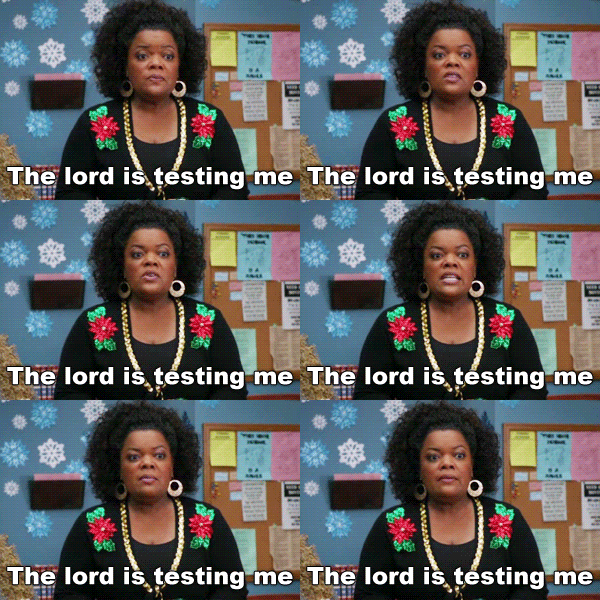


No, no, no, no. NO! You do not give a title that has been used as a racial slur to a people who have been oppressed. You do not do that. And if you think any of that is okay, something is deeply wrong with you. By no stretch of the imagination can "Pearl" be considered a racial slur. Unless, along with common sense, this society has happened to lose every dictionary in existance. In which case, I shall provide the definition.

pearl1    [purl] 
noun
1. a smooth, rounded bead formed within the shells of certain mollusks and composed of the mineral aragonite or calcite in a matrix, deposited in concentric layers as a protective coating around an irritating foreign object: valued as a gem when lustrous and finely colored. Compare cultured pearl.
2. something resembling this, as various synthetic substances for use in costume jewelry.
3. something similar in form, luster, etc., as a dewdrop or a capsule of medicine.
4. something precious or choice; the finest example of anything: pearls of wisdom.
5. a very pale gray approaching white but commonly with a bluish tinge.

Yup, that is just the title I would give to a group that is being oppressed. Tell them they're worthless while giving them a name that literally means precious. Moreover, if "Coal" supposed to be a positive title, highlighting their strengths, then why is "Cotton" considered derogatory? By definition cotton is a very useful resource. It's strong, durable, able to withstand cold and hot temperatures. So what's the deal here?

Only Cottons, the derogatory word for albinos, were lower, and they were extinct.

I don't think for a second Fyot didn't know what she was doing when she wrote that because in the beginning of the novel she calls "Coal" a racial slur herself.
Before she knew it, she blurted out an incendiary racial slur. "Gets your hands off of me, you damn Coal!"

First of all, I'm surprised she was still alive after saying that to someone of the elite class. Surely if Pearls are so worthless and oppressed, there would be severe consequences for an action like that? Second, Foyt is again baking her cake and trying to stuff her face with it too. Which one is it? It's either a positive term or a racial slur. It cannot be both. I'll tell you what I think. I think Foyt was just trying to smooth things over with her choice of words. And failed, I might add, because my bullshit meter is about to explode.

In the second half of the novel I had no idea what was going on half the time. The scenes were very jumbled with no clear direction of where the plot was headed. World building left way too many holes in the story. Because surely there are more races on Earth that just the ones listed in Revealing Eden. Character interactions were much of the same confusion. But I think that it mostly had to do with the fact that Eden was a fucking idiot. Her stupidity burned. For real.


From this day forward I can never say Bella Swan was the worst. Eden is the worst protagonist I have ever read. Not only does she completely miss the point over and over again, regardless of how many times it is spelled out, but she is extremely selfish and all around unlikable. There is a scene in the novel where Eden happens across an anaconda and I felt myself rooting for the snake. Sadly, he didn't win. *weeps*

One thing that was clear was how Eden suddenly became attracted to Bramford after he became half beast. One minute she is talking about how sexy he is and the next she is calling him names, even after he saves her life several times. (Bold is mine.)
That dumb beast had been gone since yesterday afternoon.

And why had she thought the dress would please such an insensitive brute?

"Is this where you lock up your victims? You're an animal, Bramford."

The selfish beast simply dropped the subject and ignored her.

Also she likes to ride him like an animal:
She sunk her fingers into his long silky hair, like reins on a horse. As if she controlled the beast. Eden knew it wasn't true, but she enjoyed the illusion just the same.

What. The. Hell. A black man is turned into an animal and you have your white protagonist daydreaming about riding him like a frickin' pony? I just... can't.

When I finally finished reading Revealing Eden I had to ask myself what kind of person would think any of this would be remotely okay? Foyt says:
"So yes, this book is meant to provoke the white community that has never experienced racism or been oppressed because they have been in the majority in this country."

I take issue with the white community only able to be provoked by featuring a white girl who is oppressed by black people using the very same stereotypes we fight against everyday. So, yes. I taking extreme offense to that. If Foyt is indeed "color blind" as she claims then making readers connect with a black character shouldn't be a problem for her. But instead she chose to "turn racism on its head" and say, "Black folk, I know you guys have dealt with some really rough shit in the past, but what if it happened to white people?" No, just no. The African-American community exists *because* of the oppression. It is our history, our roots. It is the one thing that must be left alone. You can't just take that away from us and apply it yourselves and make us look like the bad guys in your novel! This is one of the few times where I had to sit back and wonder who could possibly enjoy this book.
"And if you ask if all these reviewers are white then consider that you have a racist point of view."

Oh, really? Racist point of view?  Racism isn't dead. It's something that many of us has to face everyday. As a people, it is ingrained in our society that our features are less desirable than that of whites. There are somethings some people will never understand. They have never had to walk in the shoes of another race and therefore they have limited understanding on what it means to be a Person of Color. When you get followed around in a clothing store because of your skin color, when you can't go into the 7-11 with your hoodie on, when a job tells you your natural hair is "unprofessional," when your 4-year-old daughter asks you why her hair doesn't "go down like a princess" as if hers could never be considered as such, when you see celebrities of your race white washed in ad campaigns, when your male relatives are arrested for looking suspicious, when you see your grandparents cry after Obama was elected because they thought they would never live to see the day where a black man held office, when you know there are some parts of the country where you are just not welcome because of your skin color, or when you walk down the aisle of your local book store and all you see on the book covers are white people, with a small section devoted to African-Americans, you realize you are living in a white world. Racist point of view? Wherever would one have gotten that?

I think this goes without saying: NO STARS FOR YOU!

*SARCASM ALERT*

You didn't think I'd just leave it on that unhappy note did you? Pfft, as if!

Ay yo, if black people truly ruled da world we damn sure wouldn't be toting 'round some whack name like "Coals." Naw, we'd go for something MUCH more gangsta like, Chocolate Thundas. Then we'd go n' elect Snoop Dogg as our president and Dave Chappelle as our VP, ya feel meh? We'd give women back control of their bodies. We'd legalize MJ and the national anthem would be "Young, Wild and Free."  We'd move the capital to the ATL, where we like to "throw dem bones." Grillz would be covered by dental insurance. Free health care to all citizens. Oppress white people? Naw, we ain't got time fo' dat shit, man! We'd be too busy spending our reparation money from da Gov'ment, giving back to the economy.

Chicken spots n' drive through liquor stores would be on every corner. You welcome!  (So what, we get drunk...). 12pm would be a mandatory nation wide nap time, which no one would pay any attention to. Fuck the system! (So what, we don't sleep...). Though dey should 'cause "The Itis" is a very serious condition affecting 1 out of 2 black folk e'rywhere. And finally, random flash mob dances would be to songs like "Lean Wit It, Rock Wit It" and "We Fly High" (We just havin' fun and we don't care who sees...).


We stay fly. No lie. You know dis...


Book was provided by publisher/author via NetGalley for an honest review.

More reviews and other fantastical things at Cuddlebuggery Book Blog.
Profile Image for John Egbert.
189 reviews163 followers
July 31, 2012
Edit 8/4/2012:

"Conceivably, if the book had not reached the African-American community of readers, if such a category still exists, perhaps there might be some backlash."
-Victoria Foyt

She did not just go there.

she did not just go there

description
-some guy on Victoria Foyt (no not really) (but still)

When I get depressed, I don't want to be around other people. I usually sit in an empty room. Sometimes I'll use art therapy and draw something glittery and happy to make me feel better. Other people? They like hugs. Me, I hate even being near people when I'm feeling down.

So now you understand why I spent a lot of time alone after reading the first ten pages of Save the Pearls.

Art therapy? This is what I drew while fuming and angsting over Save the Pearls:

description

I was not a happy camper. There are a multitude of reasons why.

I mean, even if I were to overlook the blatantly racist premise and plotline, Revealing Eden still sucks.

The author can't write her way out of a fucking box. First of all, Eden is hardly a character. I've seen potted plants with more personality. I would have rather the book be written from the perspective of a potted plant, in all honesty.

Revealing Cedar... Save the Trees #1. Would have been more interesting and thought provoking than this.

But I'm getting away from point. Secondly, if Eden had a personality you would be sure Foyt would tell you exactly what it is. Because she makes sure to tell every fucking other thing. Does this woman even know the meaning of the word "show"?!

She couldn't have been less subtle if she taped her book to a club and proceeded to whack me over the head.

The world in which she tries to place us in is so obviously fake. It doesn't feel sci-fi or post apocalyptic. While with good post-apocalyptic books (Angelfall, for instance) I was able to get into the setting almost immediately, every mention of the oh so horrible society Eden was living in had me groaning in agony and clawing at my eyes and face.

description

"Pearls, which was the derogatory term for whites..."

OH YEAH I'M SURE

IT CERTAINLY SOUNDS LIKE ONE

I mentioned in an update how slurs have reasons as to why they are slurs.

The most infamous n word, as I mentioned, could be translated to mean "black object". So, yeah, you can take a wild guess as to why it's offensive. (For the purpose of now we're going to disregard the hundreds of years of baggage piled on top of that, which is another reason why pearls is shit and doesn't work.)

A pearl is a precious gem! HOW IS THAT OFFENSIVE? And, okay, even disregarding the fact that it is a precious gem I could say "well maybe they're calling them useless clam spit". But even then, to call another group you're trying to oppress a pearl and then turn around and call yourself a coal? What the motherfuckery...

I guess the Coals are just that shitty at oppressing people.

description

The more of the book I read, the more I felt like asking Foyt what the frex she was thinking when she wrote this. And I only got to page ten, mind you.

And even then, at the time I was speechless. Other than the underlying instinctive reaction to deliver a good kick to the crotch of whoever was responsible for this, I think looked pretty much like,

description

Because, how, how can you write this.

And not know.

How offensive it is.

Maybe if Foyt was a teenager, a twelve year old at that, I would have understood. Like how five year olds do the supposedly native american mouth call thing without knowing it's racist because nobody ever told them? Maybe? But Foyt is a grown woman. She should know better. And that only made it worse.

Of course, then there's the obvious. That she does know. And she just doesn't care. Which is what I'm going to assume.

So, in conclusion, Foyt:

description

DISHONOR ON YOU.

DISHONOR.

Because, you know what? You are dishonorable. You are dishonorable for writing this book. You are dishonorable for thinking you're doing anyone a favor by publishing this. You are dishonorable. You have no honor. None. You say you're 'turning the tables on racism'. Oh please. The only thing you're doing is contributing to racism. Yes. It's true. Believe it or not the premise of "white people being oppressed by evil and savage black people" isn't a new thing. You are not original. You are not helping by perpetrating this. You are not helping. Stop.

description

If you really want to help, you know what you can do?

description

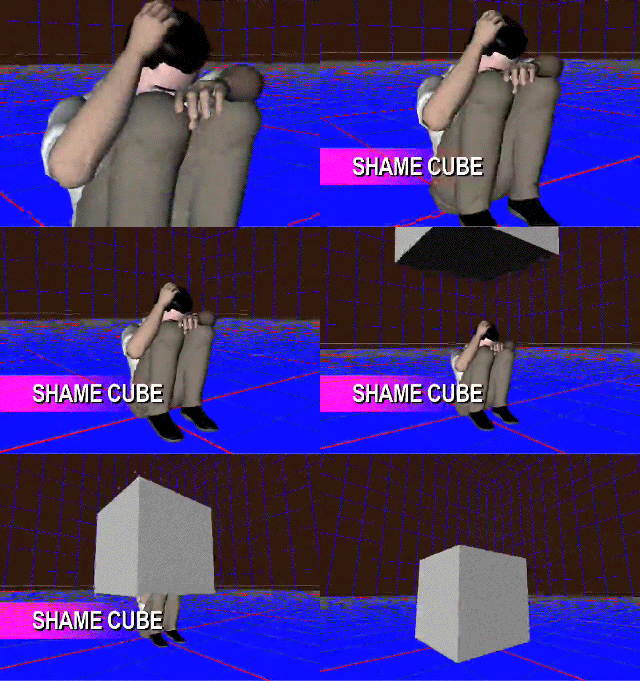
Yes, that is about the only thing you can do to help. Sit in the fucking shame cube and show your remorse for this disgusting "book". Go on, now.

Everyone who isn't Foyt... I would recommend staying away from this so called novel. Sure, I know that you may be curious, but believe me, it won't cause you anything but pain. And if you're really lucky, it will make you hate humans and feel like shit after you read it.

Like me.

description

Now if you'll excuse me I'm going to consume so much chocolate my very being will become a mix of cacao, sugar and milk. Have a nice day.
Profile Image for Amanda.
1 review
July 27, 2012
This is a racist piece of shit excuse for a book. I'm sorry, but I can't take a book that "turns the tables on racism" by--once again--victimizing poor, young, fragile caucasian girls and vilifying POC seriously. There is no excuse for blatant racism. The cover of this book uses blackface. One of the core concepts of this book is using blackface.

Pretty blond-haired blue-eyed white girls using blackface is NOT turning the tables on racism. Stop pretending like it is, and stop adding fuel to the fire.

The terms for POC are offensive and ill-issued. Black individuals are referred to as Coals (the image draws to mind dirty, undesirable, disposable); Asian individuals are referred to as Ambers; Latino and Hispanic individuals are referred to as Tiger's-Eyes; meanwhile, caucasians are referred to as Pearls (precious, rare, etc.). THIS IS RACISM. It's not even masked racism; it's in your face, on the page. On page nine, it shines through clear as day--our protagonist refers to a POC as "them." (Italicized, by the way.)

Take me back to the time when teenagers read books of solid merit and upstanding moral meaning; perhaps this is the time when dystopian actually meant something in the literary world, where Bradbury and Orwell and Huxley and Atwood and Heinlein and their contemporaries reigned. I'm getting quite tired with the authors who have the strongest influence over today's youth exacerbating a problem rather than attempting to navigate the terrain constructively and without a whiny, self-pitying protagonist floundering in the way.

I am ashamed that this book is being taken seriously. I am ashamed that it's winning awards. I am ashamed that people not that much younger than me are the target market and are being exposed to this bullshit. I'm ashamed that a grown-ass woman would think that it's okay for her to write about something that she's never had any kind of experience with. I shouldn't feel the need to apologize for every white writer out there, and it shouldn't be my job. Get this shit off the market and don't let your kids read it.
Profile Image for Tenth.
5 reviews3 followers
July 28, 2012
I only read the first chapter of this book, and I barely even made it that far, because this book is so painfully racist.

Supposedly by making white people an oppressed group and black people the dominant group this book 'turns the tables on racism' with the intent of showing readers that racism is bad. But in practise it seems to just be an excuse to frame black people and dangerous and threatening and white people as poor little victims, reenforcing racist stereotypes. Even the title of the series "Save the Pearls" (which translates from this book's jargon to "Save the Whites") sounds like the type of thing you come across on racist extremist websites that fearmonger about white people 'dying out' because other races are apparently such a threat. Not to mention that in the society Foyt dreams up white people apparently spend all their time in blackface, a device she uses without seeming to display any sort of knowledge of, or concern about, how it has been historically (and contemporarily, sadly) used as a tool to mock and spread stereotypes about black people.

If you want to read YA fiction which genuinely uses the tool of switching around who is the oppressor and oppressed in order to give the reader a different perspective on racism, try Noughts and Crosses by Malorie Blackman. A much less offensive, much more nuanced, and all around better written YA book that explores issues of race.
Profile Image for Isa.
619 reviews312 followers
July 27, 2012
Originally posted at Paperback Wonderland.

This book was one of the most racist things I have ever read.
The bare bones of the plot: a world where black people are the oppressing majority and white people are the oppressed minority. Obviously, the concept isn't new. It was done - and well done, at that - by Malorie Blackman in her Noughts and Crosses series. If you're interested in the premise, but you dislike blatant racist propaganda, give that one a try.

You could assume this reversal would serve to de-construct issues surrounding racism (as happened in Blackman's books). You'd be wrong. The way this goes about reads more like, "how can we make everyone care about the racism POC have to endure? I know! Let's get a pretty, blond, white girl to go through that!" It's a mockery, a dystopian what-if, with all its horrors, of what is a reality to POC to this very day.

Foyt doesn't just reverse social roles, as Blackman did, she comes up with a dystopian, post-apocalyptic future in which solar radiation ("The Great Meltdown") killed almost everyone - except most black people.
Even though UV radiation's effects on the immune system and eyes are independent of race, and it's never clearly explained how humanity managed to survive in a world where flora and fauna have been decimated - the ever present holograms, as far as I know, won't fill your belly or keep you from getting rickets. But moving on.

This book is so messed up that I honestly need to give examples so people don't accuse me of making it up. So...

"Had Peach forgotten that Eden’s skin only had a dark coating? Maybe she was passing, after all. Wouldn’t that be nice?"

The book starts off with black face and I'm not even going to touch that one, because it's too obvious to anyone with a functional brain. In this book, the author goes so far as to have "a band of Coals" known as "The Lost Caucasians" performing in whiteface. I'm also not going to go off on how problematic the whole issue of passing is. Anyone with the bare minimum knowledge of history already knows it. The author addresses it only as problematic insofar as it is just another way the protagonist fails to see how beautiful she really is. I mean... I mean, really. I don't even know anymore.

"She was a lowly Pearl, worth nothing in a world ruled by dark-skinned Coals."

I'm sure that, if asked, Foyt would have a very witty justification for "Coals" - the way she chose to term the black majority in the book. Exposure to solar radiation will make you perish of "The Heat", and those who survive it are the "Coals" - hahaha, get it?
Too bad that when in context - in this case, comparing it to what other races are called - "Coals" is still insulting. Get this, the extinct albinos are "Cottons" (I swear I'm not making this up to better showcase how absurdly racist this is, Foyt really seems to have gone out of her way to be insulting), white people are "Pearls" - of course there are black pearls but let's ignore that and focus on the fact that pearls are precious gems and coals are... coals. So what happened is that, in a dystopia where black people are the ruling class, they chose a derogatory term for themselves? Am I getting this right? Because don't let yourself be fooled, the ruling majority is the one who decides who is who and what is what. So black people decided they would be Coals and white people would be Pearls? Was it a racist naming decision by the author or was it a racist implication that black people are so ignorant they don't even understand the value dissonance of their choice? It's really a choose your flavour of racism issue here.

Don't let this whole naming thing distract you, even though Pearls are the lowest of the low, the protagonist still finds time in her busy schedule of being oppressed to be racist:
"Ashina jumped up and grabbed Eden’s lab coat. “Are you calling me a liar?”
Eden flinched. One of them was touching her. White-hot light exploded in her head. Before she knew it, she blurted out an incendiary racial slur.
“Get your hands off of me, you damn Coal!”
"
Can you imagine how this would work out in the real world - I don't even need to add, "back when...", I mean now.

"Because of [Eden's father] high intelligence scores, they had overlooked his race and given him the position of lead scientist at Resources for Environmental Adaptation, or REA. He even had secured Eden a plum researcher’s job at the lab. They were the only Pearls allowed to work there."

Never mind that brilliant POC find their paths barred when they try to make it in Academia today, not even worth mentioning how POC scientists were treated in the real world social period corresponding to this novel. The fact that her father is a "Pearl" but still the lead scientist is, by itself, unbelievable, not only that but he managed to get his 17 year old daughter a position in a top scientific facility. But let us set aside the absurd to explore the ever popular "white man saves the day" aspect of it, shall we? I mean, really, even in a world where they are at the bottom of the social ladder, and all but extinct, the white protagonists still manage to save the "ignorant" POC. Well done. And it gets worse:

"Eden might be powerless, but she smiled at the secret knowledge that she was one of only three people who understood how he was about to change the world, and possibly, even save it."
Not only do white people save the day, but the POC don't just lack the ability to save themselves, they lack the very capacity to even understand how it happens at all.

"If Eden wasn't mated in six months when she turned eighteen—the deadline for girls—she'd be cut off from Basic Resources, and left outside to die."

Why? Why provide this incentive for the reproduction of a race deemed inferior? Let's take a look at how that worked out in the real world. African slaves who their owners thought were no better than animals, were bred as such, to make strong slaves, thus serving a purpose to their exploiting oppressors. However, in this world, "Pearls" don't seem to fare too well. Their position would be even less regarded than Native populations back in the day, I mean, at least the Natives didn't just up and die if left on their own as Pearls do - and what happened to Natives under the colonizers? Genocide, that's what. They scattered them, took away their lands and resources, took the children away from their parents to effectively destroy their culture and, to this day they are extremely oppressed. There are no incentives given to rebuild their great nations, be it in the US, be it in Canada, be it in Australia, Native populations are always amongst the poorest.
But I guess the "Pearls" would have to "get mated" because how can you have a YA book without the heroine discovering that her reason to go on is finding and keeping a man? Unthinkable.

Bramford, her boss and potential romantic interest has skin "the color of storm clouds" so I don't know if Foyt was being poetic and saying he was dark, or being insulting and saying he was ashy to the nth degree, like, "That dude really needs some lotion, his skin... storms a brewing. You see that man and he only makes sense in a production of The Tempest, hovering overhead".

Jamal (of course, he'd be named Jamal, of course) "My Dark Prince" (Eden's words, not mine), her other love interest "Unlike most of his kind, he was colorblind" - I don't know how, in this day and age, an author - therefore a person who knows how to read - has not yet grasped the concept that being "colorblind" regarding race is, in fact, racist. You have to be in a position of privilege to have the option to ignore race, if you check your privilege you will not say ignorant things like, "I don't see race." Really, it's not a complicated concept.

Eden, as a character, is horrible. Whiny, racist, full of self hatred and always expecting her problems will be solved by her "Dark Prince" who always calls her "Little Bunny" and "pet" and despite this she can't wait to be mated to him and have his babies. I thought it unlikely he'd be interested in her, considering her personality alone all issues of race aside

And if all this mess wasn't bad enough there was some bestiality sprinkled on top of the whole thing.

By the way, I think Foyt forgot something in her list of "thank yous":
Profile Image for Rose.
2,016 reviews1,095 followers
August 6, 2012
Initial reaction:Before I start this review, I want to clarify a few things. First, I've read the whole of this novel. I'm not judging it on the cover (though I think in the measure of this review, I'd like to talk about that separately), and I'm not judging it on just the premise alone - I read the entire book. Technically I read this book twice if I count the hour long read that I zipped through to see what would happen with it (this was in a copy loaned to me at first, but then when NetGalley approved me, I returned the copy and went by the NG's e-copy to make my notes and highlights), and then another time for clarity of details. I've taken notes, I've highlighted my e-copy to include excerpts and statements in the following review. So I've been through the whole of this with a patient eye. Probably too patient, and probably moreso than many of my peers would probably be if they knew what was in this book.

Second, I'm a woman of color, and an avid reader. I'm not one to skirt talking about racial issues and the harsh realities that people of color face each day. I think being able to recognize multiculturalism in our society is an important thing, and talking about racial/cultural differences and hardships and being able to come to terms with them comprise much more than talking about the differences in our skin tones.

So, Victoria Foyt writes a YA novel that promises to "turn the tables" on racism. To make a young adult audience understand that there's more to a person than just their race. She aims to create a novel that approaches racial attitudes with sensitivity and fresh insight.

Well, I'm here to say for the record that Ms. Foyt failed miserably on all those counts.

Is there a coming of terms for Eden finding acceptance for who she is? Ultimately yes, but goodness it was a rocky road of ill description to get there, and it manages to insult multiple minority groups in the process (Thank you for thoroughly insulting African-Americans, Latinos, Asians, the Huaorani people, Aztec culture, among other groups). I would not recommend this for a YA audience, to be honest, and I'm going to outline just how badly it comes across. The characters are flat, the worldbuilding is lazy, the research and science is haphazardly drawn, the handling of racial issues I can't even begin to say how mediocre they came across, and the premise/execution is not only incendiary, but also misogynistic and culturally inaccurate, with many elements thrown together without much rhyme or reason. Much of the narrative is naive, completely skewed, and I was not only offended, but horrified at the level of ignorance.

This by no means a reflection of reality or even a plausible future. It's drivel.

In due perspective, if this book is any reflection upon the author's ideas on racial relations, cultural expansion and love in today's culture, I think Ms. Foyt has a long path of learning to do.

Full review:

I'm going to be personal for a quick before diving headfirst into this review. This is the hardest review I've ever had to write, and as such it's difficult to know where to begin with Foyt's work. I don't get into the habit of telling people what or how to write, but it comes with the territory that if you write on a subject of any tonality - especially if you're dealing with tough issues like racism, prejudice, and establishing cultural histories in a constructive manner - you have to be knowledgeable and sensitive to your subject(s).

I believe that Victoria Foyt lacks understanding of any of the cultural histories that she expounds upon in this book. Her point on using the book as a way to illustrate how racism hurts and how to come terms with loving one's own identity is mostly lost with how disconnected it is with its subject matter. It's as if she looked on Wikipedia and said "Ooh, here's an indigenous tribe (Huaorani), and I'll pick from these groups (i.e. Aztec), and I think I'll put this cultural historical backdrop with this other one, mix it up and see what happens. Ta-da! I'm 'cultural'!"

That's clearly no way to go about it. It's never a good idea to approach dealing with racial/cultural acceptance by perpetuating fears, clichés and practicing tunnel vision when it comes to the crude perception, description and depiction of ANY group. Foyt, unfortunately, violates all of those respective dimensions. I struggle between thinking whether she was aware of this, or if she really approached it without knowing just how incendiary it would come across. It's difficult to say she was completely unaware of them because the elements are so infuriating and blatant.

If you take the book by it's barest bones, taking out the racist/misogynistic/non-sensical language - it progresses as a very formulaic YA dystopian romance. Girl resides in post-apocalyptic society ravaged by a natural disaster that decimates the population. Girl is among the minority living under the rule of an oppressive majority, even among some who seek to eliminate her kind. Girl seeks to escape with her father - who's working towards a way to live in the society against the dictations of the oppressive majority rule and societal limitations. Girl meets member of the majority that she absolutely hates and doesn't understand, but then she comes to *love* him by some turns of events. And Girl must join forces with that Majority member to overcome obstacles to their plight and their *love*. By the end, Girl comes to accept her role in the world, comes to find happiness with those she's aligned with, and moves forward to the next plight of her journey. The end.

Sounds harmless if you think about it that way, right? I almost wish it had become another story entirely, because those bare bones aren't a bad format, but the details of the story are ultimately what will matter in terms of how the story comes across.

Let's consider the other elements, starting with the cover and how it ties in with the story. Horrid Photoshop attempt aside (and I would not have picked up this on the cover alone - it's just not flattering), there's a lot about this cover that does tie in with the story. I can't hide the fact I'm offended by it, both with the premise and collective story behind me. I said this once in another review I wrote (via "League of Strays" by Schulman), but I think it bears repeating here: "...the one thing that should be clear is that a person of any age should never feel afraid enough to hide who they are - no matter what the dimension entails - gender, age, race, orientation, religion - what have you."

In this case, the storyline deals with race and how a girl has to hide herself to be a part of another race in order to blend and abide by the terms of her society. I'll leave you to think on that while I move to the other elements of the cover. The eyes above the half-white, half-"disguised" girl are those belonging to a jaguar, which is the partial identity of one of the "majority" members that the main character comes into company with during the story. And finally - the leaves represent the jungle/forest that the story eventually transitions to.

I'm going to take extra care in saying this next bit. Let me explain this because the author may not have intended to do it and may defend it in every argument she makes to kingdom come, but the implications are that on the cover and IN the collective story - it uses Blackface and mocks the experiences of people of color. This whole book is a mockery of the experiences of people of color - of multiple groups of people of color.

You might be thinking, "Rose, why would you say these things when it's obvious that the author says she's speaking against racism in this book?" Well, let's get into the specifics of the story, out from the bare bones.

17- year old Eden Newman is the protagonist of this book - the girl showcased on the cover. There's no subtlety in her naming - it draws upon Creationist allusions in Christianity, which means somewhere down the road, the creation of a new race is probably going to have something to do with Eden. This is further asserted with Eden's appointed role in this dystopian society - she has to find someone to mate with before her 18th birthday or else be cut off from the limited resources in the environment desolated by solar overheating. The problem, in Eden's view and with her role in the respective society, is that she's a "Pearl", the pejorative for Caucasians in this story. There are other specific pejoratives in the story as well - "Coal" for Black, "Amber" for Asians, "Tiger Eye" for Latinos. "Cotton" even for Albinos. *rolls eyes*

I have a problem with the use of slurs in this book, not just for the naming but for their respective, and I would say inaccurate, function in this work. For one, slurs are intended to dehumanize and degrade the person or group they're oriented toward. They are supposed to harm/hurt. "Cotton" and "Coal" - in the real world, have been used as pejoratives before, with various combinations. If the author had bothered to do her research (even taking as much as 2 minutes to search on Google) on the etymology of slurs and where some of them are derived, maybe - just maybe, she would know how they function. Precious stones are NOT slurs. And I don't buy the explanation Foyt gave in the aftermath of criticisms of this. Quoted from the author's post:

"Why are whites called Pearls, while blacks are called Coals? Imagine a gritty, post-apocalyptic world where all that matters is survival. What good will a pearl do you when luxury items have no use? Coal has energy, fire, and real value. It is durable and strong, not easily crushed like a pearl. Pearl is a pejorative term here. Coals are admired. Coals oppress Pearls because they fear that those with light skin will add to a population unable to survive "The Heat," and drain meager resources. "

Three counterarguments to this: first, this isn't just a black/white issue - Why were the other races given their respective naming in measure of precious stones? That was never explained in the book - not for function nor offending context (much like neither Coal or Pearl were explained - if your book doesn't explain these things, it's a bad sign.). Second, isn't it contradictory for a slur against a respective group to have such a championing meaning? If the term "Coal" is a pejorative AGAINST the race it's intended for, and Eden uses it AGAINST the group she hates, why is it that the meaning is actually COMPLIMENTING their role in the society? Sense this does not make. (Even still, the argument Foyt makes with coals vs. pearls is inaccurate with respect to their physical properties.)

Third: if these identifications are meant to be slurs - why are they championed as identification for these groups than what they're actual names are concerned? Does everyone in this society identify by the slurs used against them, or is Eden just that racist? If it's an actual "slur" as it's intended, then maybe she would realize how wrong it was once she ended up with the man she supposedly loved, because she would know its use would be offensive, just as much as Pearl was when used against her.

Even with these considerations, I was far more offended by the frequent uses of "bitch" towards women in this book and the italicized use of "them" in this book than some of the so-called slurs that are used. Eden's the target of one of those uses of "bitch", but the others are used by Eden to describe her "Coal" female superiors among others. For example:

"That bitch Ashina was fifteen minutes late, and Eden wanted her break." (Chapter 1, not really characteristic of someone who's in fear for her life and has dwindling self worth in the presence of the majority rule, is it?)

"Was the bitch trying to set her up?" (Chapter 7, Eden referring to Ashina yet again…)

"Jamal and that bitch were in cahoots?" (Chapter 7, Eden reflecting on Jamal's - a "Coal" she admired and trusted at one point in the story - betrayal and referring to Ashina, AGAIN.)

"Damn Bramford for picking the lock on her heart. Damn the hunger the kiss had awoken in her. And damn that conniving selfish bitch, Rebecca." (Chapter 31 - Eden falling in love with her "Coal" counterpart, Bramford - who's actually helping Eden out of the oppressive society alongside Eden's father. Rebecca is Bramford's former DECEASED lover, who Eden is jealous of, though it should be noted that Rebecca betrayed Bramford. Eden actually acts for a time in the guise of Rebecca as to fool Bramford and "make him suffer". I'm not even going there. I just can't.)

Then there are the uses of the italicized them, which are patronizing enough towards "Coals". They're supposed to be the oppressive majority in this book, but I couldn't help but think how insufferable Eden was with her use of these terms. It was hard to feel sympathy because Eden sounds like a spoiled brat instead of someone who's suffering under oppressive rule. Examples:

"And yet if Eden were one of them, she would be safe." (Chapter 1, Eden claims she wants to be a part of the majority because she thinks they're more "beautiful" and "safe", but this comes across as patronizing.)

"Eden flinched. One of them was touching her." (Chapter 1. Sure, Ms. Foyt. You're writing about racial relations and understanding prejudice, and yet you have one of them touching the character and and inciting fear and disgust at the gesture from Eden's viewpoint. Seriously, this isn't right.)

"She suspected that every Coal passerby wanted to hurt her, though the statistical odds against that were high. And her sensors, which automatically translated the babel of foreign languages into English, the official language, told her it wasn't true. Still she could never shake the fear of being around so many of them." (Chapter 3)

The last one I'm quoting as stand alone because it was the one that shook me the most, though there are a total of about 9 instances in the text where them used, probably in the first five or six chapters. It presumes the assimilation of languages in this supposed distant future, plus establishes a fear factor against another race than hers in this supposed future. How is this not an example of Eden being prejudiced herself? How the heck is this turning the tables on racism?

It should be noted that Foyt had many chances to show why the different divisions between these groups were, and to delve into the complexity of the hatred and dissention among them. She didn't do that.

I'm getting a little ahead of myself because I haven't expounded on the direction which the story takes from it's initial grounds, but rather trying to outline its constructional problems. So now I'm going to take a bit to talk about the characters and progressive plot.

We've met Eden and know her aim in the society is to mate and survive in her respective society according to the "rules" established, but there are other people around her who are also in her inner circles. There's her father, who just so happens to be a genius "Pearl" scientist who's trying to find ways of surviving the "Heat" so they can emerge from their underground society and live among the realm without being under the rule of the "Coal" majority. There's also Bramford, a high ranking member of the majority class of "Coals", who secretly helps Eden and her father both by subjecting himself to experiments that mess with this DNA and are supposed to be adaptations that will help them live on the surface.

The scientific explanations in this book are bogus, if even in just the premise alone. I don't know if Foyt knew about the existence of "melanin theory" and how it's been knocked down many times as unscientific and culturally incendiary (especially in how it contributes to racism within and outside of their respective populations), but this book plays into that non-theory very heavily. While it is true that melanin does act to counter effects of UV rays from the sun, it's not an absolute shield. The effects of global warming as being a "cautionary warning" in this book are noted, but it's not a heavy theme. It's just a plot device. Not to mention the book completely skirts the issue of how adaptation comes into play when residing in a specific environment, and how melanocytes adjust melanin production depending on the climate one lives, and that CAN shift with generational adaptations. Still, high melanin count doesn't mean an absolute protector for people of color. If the elements are enough to where a large population dies from the affects, and it kills life on the surface, then it's going to be a factor in killing people regardless of their skin tone.

I'm not sure what Foyt was thinking with a lot of the leaps taken in this work. It doesn't feel realistic even considering the sci-fi/fantasy tag. Trying to also legitimize the science in this by throwing in scientific names for species didn't help matters much either, I saw right through it and found the alternating names distracting and far too heavily loaded into the work.

In any case, Bramford, Eden, and Eden's father are working under secrecy, even as there are external forces at work in the society that threaten them. Eden's actions get them into trouble when she spills secret information to someone she thought was an ally (Jamal, a "Coal" she thought was a potential mate). Adding to the complication are a group called the FFA, who champion eliminating all "Pearls" from existence *rolls eyes*. There's really not much about the FFA to really note their respective role in the story.

Eventually, the plot shifts to where they have to escape the lab, and Bramford, as a result of the experiments becomes a half man/half jaguar adapting to the environment. I guess Foyt was right on one note about this being a "Beauty and the Beast" love story, but it's so farfetched and plays right into so many racial stereotypes. It's not even subtle. I never knew the point where Eden really shifted into loving Bramford. It was more like a light switch that suddenly came on in the progression of the story. Eventually Eden finds herself in the company of the rainforest and the Huaorani (which…I don't understand how a rainforest would be able to survive some of the disaster elements this book gave from the beginning? Another point of contradiction.)

Misrepresenting the Huaorani culture and Aztec histories, as well as trying to blend Christian elements within it or whatever else the author was trying to do with it threw my patience out the window. I read on to the end, but didn't have any investment in the characters to care. even when it eventually reaches it's noted resolution and "lesson".

I'm going to stop here, because there are far too many problems in this work to be able to write about in the mishandling of racial issues and cultural expansion. It's incredibly patronizing to people of color on multiple standpoints, for someone supposedly writing to be against racist principles and establish cultural understanding, it doesn't help Foyt's case. This needed a far more able, sensitive, and knowledgeable voice to carry the respective story.

I would not recommend this book for anyone, let alone a YA audience.

Overall score: 0.5/5

Note: I received this as an ARC from NetGalley, from Sand Dollar Press/Bookmasters.
Profile Image for Gabriela.
1 review2 followers
July 27, 2012
racist. racist. racist. This person puts everything into perspective much more eloquently so I leave her open letter to the author here:

Dear Victoria Foyt,
I had never thought I’d have to write a letter like this. I’d thought that perhaps people knew some things were off limits, and that such things were off limits because they still cause hurt to very real and very subjugated people, but I was wrong.

Mrs. Foyt, I’d like you to know that I’m only nineteen, a young Black person budding in a world where I am (whether consciously or otherwise) considered less than because of my race. Even as a light-skinned Black person, I face fetishistic catcalls from white males, propositions for sexual conduct and marriage and discrimination in the job market.

I’m sure you’re not interested in reading about my life, and that’s perfectly fine. I’m sending you this email, not to inquire, but to share my feelings on your (latest?) book “Save the Pearls”.

You see Mrs. Foyt, I was under the impression that you were indeed “turning the tables on racism”. The phrase itself acknowledges that in today’s current world situation, white people cannot and do not face racism on institutional and global levels like counterparts of color. My interest was piqued to see just how your book would manage to flip the script.

I would like to say that I was surprised at how dreadful the concept of your book is, but I wasn’t. People of color are always let down in various forms of media and entertainment; we receive mere morsels compared to our white counterparts in terms of representation, acting roles, and complex character writing in novels.

Mrs. Foyt your book isn’t turning the tables on anything. In fact, you are helping to mold young minds such as mine to further ignore the plight of people of color and disrespect the historical pain they’ve been through. Your book, your youtube channel — it encourages blackface, a practice used to dehumanize black people. I’m sure you’re aware of the racist minstrel shows performed in the U.S. and if not, I implore you to use Google’s search engine to read about it as well as view film evidence that portrays black people in a less than favorable light (to say the least). The mentalities and stereotypes blackface created have not dissipated over the years Mrs. Foyt. People of color, black people specifically (I speak of them because I am black myself), still suffer from the detrimental acts committed by racist white people in the past. Hell, we still suffer due to detrimental acts committed by racist white people NOW.

My point concerning blackface is that, regardless of your intentions, blackface is hurtful and painful to black people. The historical pain and agony of being dehumanized, subjugated, murdered, lynched, raped (all in masse) cannot be separated from blackface for the sake of a novel written by a white woman. It CANNOT. I am writing this email to essentially express how I and many other black people feel; we are appalled by your racism, and yes, you are indeed being racist.

Your novel is no “neo-racist” treasure. It fails to address the issues people of color face today, something that could be done even if your novel focuses on “subjugated” white people. The terminology used in your novel reveals your racist subconscious (a subconscious white people as well as people of color possess): white people are referred to as ‘pearls’ I believe? And Asians are referred to as ‘ambers’? I also understand that Latin people are called ‘tiger-eyes’? These are all precious or semi-precious gems, of value on the market today. Do you see what I’m getting at? The black people in your novel are called coals, a term that actually has a historical background. Many dark skinned black people (I’m not particularly sure if you know any) have had themselves negatively likened to coal at some point in their lives, and if not, they’re among the lucky ones. It is evident that your novel doesn’t truly “turn the tables on racism” as you suggest, but rather, offers a common and wrong perspective on social dynamics through fantasy and post-apocalyptic science fiction.

The wide bracket you’ve place people of color under fails to take several things into account, things I hope (but doubt) you’ve addressed in your novel: what of pale-skinned black people? Are they pearls? East Asians, whose skin color is sometimes more fair than that of white people, and more prone to damage — are they considered pearls or do they remain ambers simply because of their race? Dark skinned southeast Asians, does their status improve to that of coals? There are pale skinned Latin@s, indigenous Latin@s, afro-Latin@s… have you taken them into account as well? It seems as though your book doesn’t acknowledge the racial complexities of our current world, nor does it take into account the future race-mixing that would occur before your apocalypse.

But in all honesty, your narrow-minded perspective on racial features pales (no pun intended) in comparison to the blackface which you encourage on your youtube channel. As I’ve stated before, blackface carries with it the weight and agony of widespread dehumanization and genocide; I often have an extremely difficult time explaining the severity of this to my counterparts in school as well as to adults who haven’t taken the time to learn about societal issues. I do not think you understand the gravity of encouraging impressionable people to commit blackface — regardless of its intention or purpose. You are fostering more ignorance through your young adult novel, and contributing to the silent killer that is covert white supremacy. Mrs. Foyt, you may think you’re showing appreciation for people of color, for dark skin (as I’ve noticed through your descriptions of dark skin) but there is a fetishistic tone that disturbs me, especially as someone (who is just one voice of millions) who is often harassed because of the hypersexualized nature associated with my race/skin color.

Your book has been published already and I doubt you’ll do any changes to anything you’ve already written because of a solitary letter sent by a lightskinned negro, but I hope you’ve taken the time to read this opinion, an opinion that actually matters much more than usually credited for; a person of color’s views on race and racism are always of the utmost importance, considering the discrimination and subjugation we face. This letter might have saddened you, might have angered you, but I hope that if you have indeed felt these emotions while reading this, you’ve considered the emotions of the people of color who were so deeply offended after having read the premise of your book and also after having read your book. I hope you considered the black people who were (once again) emotionally wounded, after viewing how you’ve encouraged blackface and used it as a mere plot device for a novel. I hope you considered my anger and my hurt, the emotions I have to stifle on a day to day basis in order to function in a world that will never care about me as much as it will care about you.

Thank you for your time.
I am not expecting a reply.

- CC

http://damnlayoffthebleach.tumblr.com/
Profile Image for Kerry.
52 reviews12 followers
July 27, 2012
-Blackface is not edgy or progressive.
-Naming a race of people "Coal" is not a compliment.
-Telling us that "Pearl" is a slur does not make it so.
-Claiming that the world's hierarchy is dependent on skin tone does not mean that you can separate people based on race while ignoring their actual skin color.
-Calling your heroine's love interest a "beast" does not imply his supposed beauty and high status.
-Questioning the existence of an African-American community of readers will make me side-eye you damn hard.
- Telling us that this "terrifying" dystopian future is "all too easy to imagine" is ignoring the prevalence of racism and white privilege that currently exists in our society.

We get it - You believe that special white snowflakes always deserve to be the heroine because their lives are oh so hard. Why not just come out and admit to all the racist imagery and insulting propaganda you're publishing? This book is disgusting.

There is never a reason to make racism about white people. Repeat that as many times as you have to before it finally sinks in.
3 reviews30 followers
July 28, 2012
This is a terrible idea for a book. As a woman of color, I find it extremely offensive to see a woman in blackface on the promotion, a comparison to Beauty and the Beast, where a black man is considered 'beastly', and the names of the two races themselves - 'pearl' for white and 'coal' for black - what is this author trying to convey here? I'm sure anyone with a brain can guess. As a young adult, my intelligence is insulted - how could this be considered good literature when it blatantly trivializes the trials and tribulations of actual slavery? It can't - this book is absolute trash.
Profile Image for Mel (who is deeply in love with herself).
73 reviews146 followers
Want to read
July 30, 2012
I saved my review yesterday without even finishing it. Here's the full thing.


Sometimes, people are convinced that they have the lower hand in life. They think the world's against them, that they are at the bottom of society's rungs. And sometimes, that is simply not the case. Victoria Hoyt has envisioned a world in which black people (or Coals) are at the top of society's social hierarchy because of their dark skin colour. White people (or "Pearls") are at the bottom of the hierarchy because of their pale skin colour.

I refuse to read a book which has such blatant racist undertones.


I mean, come on. Pearls and Coals?

Let's see what Pearls comes up with, shall we, when I Google it?


M'kay.

And now the Coals.


And here's a bonus picture, less than half the page down!


And we're expected to believe the Pearls need saving? It's the fricking Coals that need saving, from such an ignorant author!

And don't even get me started on the protagonist's name. Eden? Eden? Go and Google Image "Eden" and see what comes up. Seriously, do it.


Yeah. For somebody who seems intent on spitting in the face of racism, Ms Hoyt sure seems to be doing the exact opposite. Even when Caucasians are in the minority, they are, essentially, the "upper" class.

And the synopsis? Apparently, Eden's father is the only one on the planet who can save humanity. Guess what? He's white, too. It seems the beast-like Coals can't do nothing without the help of The White Man. You know how, in Avatar, the native tribespeople (or N'avi) were doomed to die until Jake Sully came along? It's like that.

It seems Victoria Hoyt can't get over the fact that white people are now at the bottom of the ladder. Which is absurd, considering she's the one who's created this class system in the first place. Maybe she's too reluctant to let go of her privileged life as a Caucasian living in an American town, in which the only non-Caucasians she saw was her housekeeper and a few Cubans in her private high school. Maybe she can't let go of The Good Life a Caucasian usually has. She just can't resist giving them the upper hand. There's "Eden" with the Paradisiacal name. Her father, the man with the power to save the world!, and the general name given to Caucasians: Pearls.

Combatting racism, my ass.


**edit**

A friend drew attention to this article the author's written. Just when you think it can't get any worse....it does.
Profile Image for Nepeta Leijon.
68 reviews8 followers
August 5, 2012
EDIT #2

"Conceivably, if the book had not reached the African-American community of readers, if such a category still exists, perhaps there might be some backlash."- Victoria Foyt

And here is my response to this:

"The problem with Victoria Foyt is that she is ignorant. Is she really implying that African Americans do not read? How ignorant can someone be? Well, Victoria Foyt has obviously proved me wrong. There are still people as shallow and racist as her.
Not all African Americans are idiots, you know, Mrs. Foyt. Thank you very much.

Sincerely,
Nepeta Leijon, a concerned citizen against discrimination and idiotic authors."
-

Roxie Rex on Victoria Foyt


EDIT

http://www.huffingtonpost.com/victori...

Read this. Just go and read it. Wow, Foyt, just when I couldn't think that you were more ignorant, I was proven completely wrong.

Oh, how terrible, they thought you were African American. BOO HOO. People think I'm white (And I'm an Italian-Hispanic) all the time.

DEAL WITH IT.

Also, maybe you should listen to the Sufferer's Last Sermon. Sure, it's fictional, but it has a good message for racist pricks like you.


Let's talk about racism and this book.
This book is not about racism. This book is pretty much shaming black people and putting white people on a high pedestal.

So, they're called pearls. What's the world called? Oyster?

So, Asians are Ambers, Hispanics are Tiger's Eyes, and blacks are COALS? Wait, why the fuck not obsidian? Also, is the author an idiot? I'm part Spanish and I have green eyes that are pretty fucking large. And I'm light skinned.

CONGRATULATIONS ON STEREOTYPING AND CATEGORIZING, FOYT. YOU GET NOTHING!

I have seen the videos of this book and I have gagged and choked while watching them. Really, black facing? Go fuck yourself. Yeah, go do it. People like you, Foyt, disgust me.

Is this your measly attempt to make a book on 'reverse racism'? Because, let's face it, there is no such thing as reverse racism. If you are a Hispanic person disrespecting a white person because of their skin color, you are racist. Same applies if the situation is vice versa.

There is absolutely no reason this book should have ever been written.

Yes, I will admit, as a light skinned person, I haven't had to experience much racism, but when I see my best friend crying her eyes out because someone called her the 'n' word and I end up reading a book like this were black people are called COALS, it makes me want to punch someone.

Let's stop the racism. It's pointless, stupid, and hurtful. We are all people.

And Foyt, do not keep on writing such a racist series. It gives a bad example to young adults.
Profile Image for ♡ hbp ♡.
46 reviews
July 28, 2012
i actually read this a long long time ago, and it invoked me to such anger, i can't believe i haven't put up a review for it.

well, since it was a very long time ago, i've forgotten much of what happened in the book. one thing that did happen [and quite consistently throughout the book] that i will never forget, though, was racism.

so.

1) Pearls. Ambers. Tigers-eyes. And then, Coals. That is blatant racism right there, smacking you in the face. Do you want me to believe that the term "Pearl" is supposed to, in any way, belittle or insult or put shame to the white class?

2) Man/animal hybrid loving? if that didn't just put up the squick factor, i'm not sure what did.

3)
"(...) this is about an interracial relationship in a post-apocalyptic world. Or more narrowly, if you take out the question of race, a Beauty and the Beast story (...)"

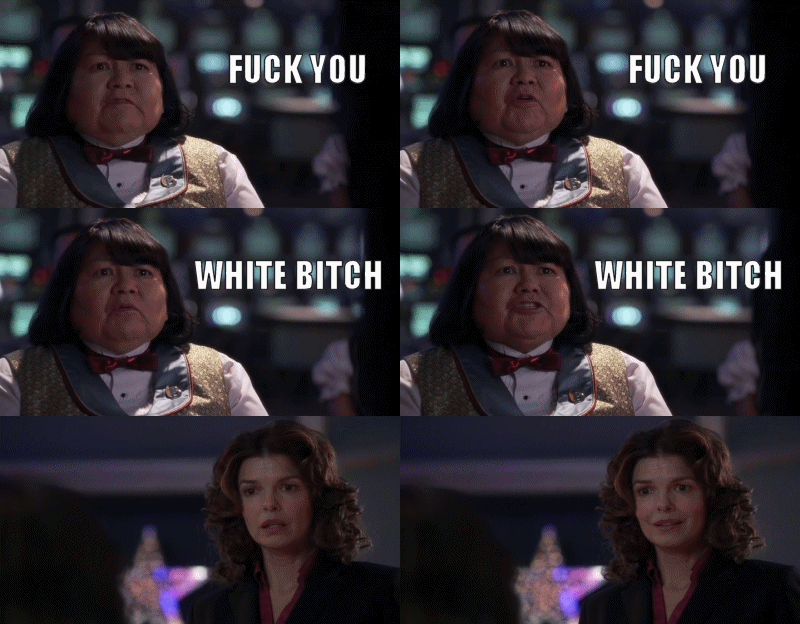
I'm sorry, but you cannot take out the "question of race" in a book that is in fact about race. And since Eden our PEARL is in a pseudo-relationship with Bramford the COAL, that makes our poor, subjugated, woe-is-me White Girl the Beauty; while ugly, oppressive, monstrous Bramford the Black Guy is the Beast.

4) This coming from a woman who's not sure African-Americans even read any more. I shouldn't be surprised by the author's frame of mind, though, growing up as a privileged white girl sometimes does that to a person. I'd like to think - or hope, at least - that i managed to steer clear of that route.

I'm too harsh on her, of course. Being "slandered with an ugly epithet" at a young age must have been traumatizing for her. Oh, it's not like she didn't have any friends at school and everyone avoided her because she was a POC; it's not like she couldn't get a job, or had to face sexual harassment at every street corner because of her skin colour; but she was insulted with a term normally used for an African-American, and that is bad enough. So she knows what it feels like, you see? She understands what it's like to be on the brunt end of racism. So she speaks for us all when she wrote this book of reverse-racism.
Profile Image for Amber.
71 reviews12 followers
July 28, 2012
This is how I imagine the idea for this story was born.

One stormy evening, Victoria Foyt was browsing her Tumblr blog, uploading pictures of herself and her best friend from last night's party. An hour later, much to her horror, Victoria's image had been reposted by a social justice blogger, calling her out for racism. Racism! She thought angrily, well I never! After sending a few angry anonymous threats to the Tumblr user, Victoria got off anon and said that she could use racist slurs as a joke whenever she wants, as this is Amurrcah, and she has the freedom of speech.

After telling her best friend Stephanie, who is also a racist, of her Tumblr encounter, Stephanie got serious. "Well, she said you can't know what it's like to be a minority, right?" Victoria nodded. "Well then, let's show her. Write a book where white girls are considered so ugly that they have to dress up as black people just to get sex. My little sister has some makeup leftover from when she did her Pocahontas photoshoot, we can use that for the cover of the book. I am aware of blackface but this is totally different."

Now, four years later, Victoria sits in her plush recliner with her Macbook Air, scrolling through social justice blogs. Now everyone knows that she can be a person of color, too.
Profile Image for Whitley Birks.
294 reviews362 followers
December 4, 2013
Dear sweet baby Jesus, that’s how long it took me to crawl through this book. I…I almost don’t even know what happened, because so much of it was just bullshit. Just…pages and pages of words, words that sort of came together to make sentences, but the sentences didn’t come together to make a scene. It was like reading stream-of-consciousness fanfiction written by someone going through pon farr. Nothing can beat the racism in this book for sheer disgust, but the rampant sexualization sure gives it the old college try.

The plot of the book is relatively simple. Eden is a research assistant, working for her dad, who is about to do some big experiment to make man/beast hybrids. She’s worried about getting married, because stupid. (A lot of things are “because stupid” and I’ll cover them later.) She’s got a boyfriend that she hopes will propose, and he asks her to some dance thingy, so that gets her excited. Once there, she gets harassed by some creeps, her boss rescues her, and then they go back to the lab where the human test subjects have gone missing. So her boss, Bramford, volunteers himself, instead. Halfway through, some militia group that Eden’s boyfriend belongs to shows up, and they fuck shit up. Eden decides that the best course of action is SET THE PLACE ON FIRE because…stupid. Bramford turns a little more animal than planned, but he and Eden and Eden’s father all escape in a plane. They fly off to the Amazon and hide in the jungle with a tribe called the Huaorani.

And then there’s literally 200 pages of bullshit where Eden just flails around like a moron, gets lost in the jungle, pouts, and goes on at length about how she’s now sexually attracted to Bramford. Also, there’s a mild mystery about some woman named Rebecca, and after far too long we find out that she was Bramford’s first wife, and she betrayed him to the militia once and then also died. Also, they have a son who’s an albino, which is a big deal because of stupid.

Seriously. 200 pages. In the last 50 pages, Eden tries to contact someone back in civilization to come get her, but it turns out to be her old fake-boyfriend and the militia instead, and they try to shoot everyone up, but some Aztecs (???) come out of nowhere and blowdart them to death. Then Eden and the albino kid get set to become half-beast like Bramford and go off living in the jungle. Because if you do an experiment on yourself to become immune to the #1 thing that kills everyone in your society…that makes you an outcast and you have to go live in the jungle?

Good god, where do I even begin? I guess the racism is a pretty good spot. The author claims to have tried to “turn racism on its head” and flip the roles around. First of all, the very concept is insulting. Want to portray racism? WRITE ABOUT A POC CHARACTER. This is basically saying that white people won’t care about injustice unless it’s applied to other white people. Which, yeah, that’s a big problem in our society. It won’t be solved by perpetuating it with more “poor whitey” stories. Second, this book fails pretty hard at what it set out to do. This isn’t racism “turned on its head,” it’s just regular racism. Eden hates the black people and characterizes them extremely poorly. It only gets worse when Bramford turns into a “beast” and they run into the “primitive” Huaorani. In short, this is our own, modern, white-superiority racism, just with the “unnatural” turn of having blacks be in charge of shit. It really does read as if the pure and good whites suddenly got “taken over” by the nasty, mean, bitchy black people, and oh, woe, isn’t that so terrible!!! Gasp, what a frightening turn of events! It’s wrong because it goes against nature and all that. *gag* I think part of this impression is because the book can’t help but give in to stereotypes about its black characters, and in part because it doesn’t realize what actually goes into institutionalized racism. It hits all the high points, but none of the subtleties.

And that’s not even getting into the few lines that make it completely obvious that Eden still thinks of herself as superior, regardless of what the book tries to tell us. Like:

Eden flinched. One of them was touching her. White-hot light exploded in her head. Before she knew it, she blurted out an incendiary racial slur.
“Get your hands off me, you damn Coal!”

Yup. Really. Eden thinks it’s an insult to be touched by a black person. She even flinches at it. Because black people are apparently just that nasty.

And of course, then there’s all the science fails. Supposedly this world comes about when “the Great Meltdown” happened, but we have no idea what that is. Now light-skinned people keep dying from “the Heat,” but we don’t know what that is, either. Heatstroke? Radiation from the sun is mentioned several times, but the few examples we have of “the Heat” make it seem like the victims are actually overheating, not dying from cancer or something. And if that’s the case (heck, even if “cancer” is the case) then it’s utterly ridiculous to say that darker people survive it better. Skin tone is not a body heat regulator. In fact, we’re not entirely sure why people developed different skin tones, but we do know it doesn’t have to do with temperature. There’s a few theories bouncing around; I like this one but there’s others as well. If the author had done even a modicum of research, even just to confirm what she thought she knew about ‘radiation’ and skin color, she would have found this out pretty quick.

Plus, everyone lives underground. Really. Underground, in a completely climate-controlled environment, with air-conditioning, never exposed to direct sunlight. And yet somehow white people get heatstroke but black people don’t, all because of this radiation that absolutely no one is exposed to.

And then there’s this whole “mating” bullshit. Girls have to have sex by the time they hit 18 or they get cut off from…um, free stuff? We later see one of these non-mated white women being forced into prostitution to make ends-meat, so is it that no one will hire her? Is everyone in the society living off government handouts? But…Eden has a job, so…is she banned from working if she doesn’t mate?

Eden’s “mate-rate” is 15%, but we have NO FUCKING CLUE what that means. Really, none. A lot of drama is places on this number 15, but we don’t know what that number represents or how it was decided upon. There’s some hint that high or low ratings are an indication of your genetic fitness, but…later in the book Jamal goes on about how his rate went down because he was burned in a fire. Burns which do not affect his genetics at all. It affects his job performance and general fitness, I guess, since he had a very physical profession as a security worker before the fire. Is that what a “mate-rate” is? Your ability to be self-sufficient? Or… fuck, why am I still thinking about this?

Bigger problem with the mating issue: it makes no sense. Supposedly this is some ultra-unemotional society, where extreme reactions are dulled with a drug called “oxy” (we’re told this, never shown it) and resources are scarce. Yeah: resources are scarce. But if you don’t mate and make kids, you don’t get resources. Basically, if you don’t pop out children which will put even more of a drain on the limited resources, then you’ll be punished for it because resources are limited and can’t be wasted on your sorry, useless ass. What?

Note, by the way, that it’s only women who have a time limit. And that limit is 18. As soon as you become an adult, girls, your only job is to make babies. Men can do things like stay single and run corporations, but all your good for is making babies. If you don’t make babies, you either die or become a whore.

Once we get out of the underground part, 2/3rds of the book takes place in the jungle, around a race of real-life indigenous people. The book parallels real life in an almost creepy manner: the book says that they somehow survived in spite of “the Heat” and were only recently discovered to be still living on the surface; in reality, the Huaorani were “discovered” in the 1940s, along with the rich oil reserves on their land. In the book, the size of the Huaorani settlement isn’t made clear. We only see two families, and no indication is made of whether that’s all there is or if Eden just didn’t care about/notice anyone else. The main Huaorani character we interact with is Maria, who literally does nothing in the book except take care of her two small children and wait on Eden and her father. She’s servile and unassuming and, to all appearances, perfectly happy to play maid to these white visitors. She and her sister-in-law live in huts and keep small gardens and believe in fables and… Basically, it’s what a white person would imagine when thinking about a “simple, native” existence through fake-nostalgia-colored glasses. There’s not a hint of the Huaorani’s culture outside of a few nods to mythology, there’s no history for these two families or how their village came to be, there’s no sense that they are part of a larger nation made up of intelligent and independent people.

The Huaorani, by the way, are pretty god damn smart and have set up their own rights/activist group, fought for the right to live on their own land, been in legal battles with oil companies, and they’ve had a recent history fraught with conflict and controversy. They’re also made up of multiple tribes, and they aren’t a homogenous society of people who all agree, because you get varying levels of cooperation with both each other and outsiders. They are a complex nation of intelligent people with a rich culture and history, and with some extremely delicate issues that are currently still being fought over, but this author sweeps all of that aside and turns them into bland, grinning servants.

Read more here and here
1 review
July 27, 2012
A weakly-written white person's revenge-anxiety fantasy with a ridiculous premise, Revealing Eden reveals Victoria Foyt as a person no one should ever want to know. The assumption many white Americans have is that black people are just positively itching to oppress white people, and this book explores that, rather than the idea that maybe POC are better than that. Whatever you do, don't tell Foyt that whites have been the global minority since we began keeping track of the numbers; there's no telling how she would feel about this news.

The only thing more ridiculously over-the-top racist than "Pearls" and "Coals" as a way to refer to white people and black people is the trailer featuring a white woman in blackface. Skip this one, preferably across the waters of a particularly deep lake.
Profile Image for Kala.
247 reviews57 followers
August 2, 2012
Okay, I made it to about 60% and I've skimmed the last 30% because it's so damn boring. I usually always try to finish a book, but it's just not going to happen. This book is one of the worst books I've ever read in my entire life.

Bizarre quotes/facts from the first part of this book:
* we've had black people referred to as "they" multiple times (her italics, not mine)
* the main character has a daydream about being able to hang out on a beach with only white people
* "How many times had Eden heard it? White people were lazy good-for-nothings with weak genetics."
* "One of them was touching her. White-hot light exploded in her head. Before she knew it, she blurted out an incendiary racial slur. "Get your hands off me, you damn Coal!""
* The government supplies everyone with "Oxy" which is a "happy drug" that everyone is addicted to (and I mean everyone).
* Eden's father calls her "daught" which is short for "daughter" ... what kind of nickname is that??
* "I don't want my child to be all Pearl. I'd rather be dead than mate with one of my own kind."
* Her mother had red hair and as such was called a "Pink Pearl"
* "Cottons" (aka albinos) are apparently so disgusting that Pearls and Coals work together to tie an 8-year-old Cotton to a funeral pyre and killing him on TV


The basic plot is that Eden is the beautiful oppressed white girl (a "Pearl") who lives where black people ("Coals") are beastly, evil, and treat Pearls like garbage. The evil black people are the majority because almost all the white people got skin cancer and died. In order to "fit in" and be "attractive" Eden wears blackface (oh wait, it's called "Midnight Luster" - that makes it better!). Eden spends the majority of this book concerned about being beautiful. There is an actual paragraph where she is having an inner monologue about how she wishes things could be better for Pearls so that she could be considered beautiful. Can she get any more superficial?

Eden's father is a Pearl scientist who is going to save the world by turning everyone into cat people - aka we are all going to look like this in order to survive:
description

Eden's father's boss, Bramford, decides to be the first test subject and is turned into a black jaguar man. Eden is attracted to him for some reason. There is a huge explosion or something in the lab and Eden, jaguar man, and her dad all escape to the jungle where a bunch of Spanish speaking Indians live. There are a bunch of chapters about Bramford carrying Eden around, roaring, killing monkeys for the tribe to eat, etc.


After about 50 pages of this, I lost interest and I just can't continue. I just can't finish. While Eden is still whining about wishing she were black so she could be beautiful, they aren't around any evil "Coals" anymore so the racist comments have been toned down.

There is a lot of controversy around this book and to be honest, I think most of it is founded. I believe this author thinks she is trying to do something good and make white people understand what it's like to be faced with racism, but she completely failed. All this book does is reinforce the bullshit racist stereotypes about black people being beastly, cruel, and stupid.

Even so, the plot denigrates into something so boring that I'd be surprised if many people finish it.

Eden is so superficial and selfish. All she cares about is herself and being beautiful. The love story so far is non-existant, outside of Eden swooning over catman every five seconds because he's so buff and manly. Those leathery claw hands really turn her on.

Please don't read this book. If you must, borrow it from someone. Do not pay money for this book - you will regret it.
Profile Image for DARK ROMANCE .
168 reviews46 followers
August 14, 2012
Ugg...who allowed this SHIT to be published? And I'm not even sorry either, this book is blatantly racist and offensive on SO MANY levels. And BLACKFACE!?? Really!??
Profile Image for Amanda.
1 review
August 3, 2012
This book and the author are incredibly and overtly racist and sexist, whether she is conscious of it or not. I'm saddened that this amount of ignorance still exists in the world today. How could the author possibly defend what she has written? How on earth was this allowed to be published in this day and age? Why, in the name of all things holy, did she think promoting the book while using Black Face was an acceptable marketing plan? She calls the evil black overlords "Coals", the now-extinct albinos "Cottons" and the white characters paint themselves in a substance called "Midnight Luster" in order to "pass" as black, and yet she claims she fails to see any racist connotations in her work. On top of that, one of the black male leads, Jamal (seriously) is described as beastly and exotic evoking the "Mandingo" stereotype while the "one nice Coal" is named Peach and might as well have a big ol' sign on her saying "Mammy". Girls are expected to "mate" by the time they are 18 and it is their sole function in this world despite the fact that this dystopia is overpopulated and food is scarce. What makes it even more horrifying is that it's aimed at young readers.

There is nothing original or thought-provoking at all in this novel and the plot, character development and supposed science behind her world are flimsy at best. It's a poorly-veiled excuse to feed into old prejudices and fears and it's being promoted as kid literature. I wouldn't recommend this book to anyone and I think it should be removed from store shelves for its incredibly offensive nature.

This is an honest review of the book and not cyber bullying as Ms. Foyt claims on her Stop the Good Reads Bullies webpage. Thanks for making me first comment though. It proves to me that you're reading every single response on every single web page and are still refusing to apologize to P.O.C. for your hurtful words. I am white and I have never nor will ever experience racism because of that. I was raised and still live in a wealthy town in Canada and my words mean very little except to prove that people of all races find this book misguided at best and disgusting at worst. The author needs to be listening especially to P.O.C. because it is their voices that matter most on this issue, instead of deleting and ignoring their comments.
Profile Image for Katie(babs).
1,867 reviews530 followers
Read
July 30, 2012
I really tried to keep an open mind while I read this because of all the reviews and controversy surrounding this book, but I had to DNF by page 30 before I lost my marbles.

The reverse discrimination set in a Dystopian future was too intense and uncomfortable for me to read because it started right away and doesn't let up.

Also making the heroine have "black face" and explain why her people, the Pearls aka the whites were considered less than second class citizens by the Coals aka the blacks just rubbed me the wrong way. Also the fact that the heroine had to mate before she turned 18 or would die or get killed was too misogynistic for me. A young girl doesn't mate with a man deserves to die? So not my thing.

Better to stop reading because my inner Hulk wants to smash something.
Profile Image for Nicky.
4,138 reviews1,112 followers
August 5, 2012
I heard a lot about this book, and I couldn't quite believe that anyone would actually take this premise and run with it. So I downloaded a three chapter preview. To be fair to the book, I didn't find it in itself terribly written: predictable, and nothing that stands out from the crowd, but there is some world-building there and despite my horror at the premise, I could have read more without wanting to stab my eyes out.

I didn't want to, however, because the whole idea is so breathtakingly offensive. It's supposed to 'turn racism on its head', by making people of colour the ones with privilege and white people the underprivileged, forced to wear blackface. It's so appropriative of the experiences of real victims of racism, and so obviously written by someone who has held privilege all their life. It's heavy-handed and clunky, and just... I can only assume from reading it that the author is one of those people who talks a lot about reverse racism and denies the real amount of privilege they have.

It doesn't come across as the kind of book that could shed any new light on the issue of racism, or exorcise any demons. The people of colour are stereotyped and unsubtle, most of them barely even two dimensional. They're just evil, and you're meant to swallow that.

I don't really have words for how problematic I find this book. It could seem as if the author is saying, stop talking about the bad things white people did in the past, because if you were allowed to rule us, you'd be as bad or worse, and this is why we can't let you have power over us.

Obviously, I haven't read the whole book, but when the very concept is so troubling to me, I'm not going to pay for the full book and read it.

ETA: Realised I didn't say anything about the concept of white people being "Pearls" and black people being "Coals". I hear that there is actually some reason behind that in the author's mind (pearls are not valuable in this society; coal is) but that doesn't make it feel any less problematic when reading the book, especially as that is never articulated.
Profile Image for #ReadAllTheBooks.
1,219 reviews93 followers
August 3, 2012
I think I know what you're wondering. Is this book as racist as people are making it out to be? In a word, yes. Yes it is. But do I think that Foyt set out to make her book this offensive? No. No, after having finished the book I think I can say that this is more an example of why authors should do their research and listen to their audience when covering real life problems (such as racism) that you yourself have never experienced. Despite Foyt's claims that she's been called a bad word during childhood, she has no true first hand experience of the type of racism she describes in this book. This doesn't mean that she couldn't potentially have written an apt description of racism, but it does mean that she should've done better research and spoken to people who have experienced it. Unfortunately that's not the only type of research she apparently didn't do, but more on that later.

First off, I have to say that this did have some entertainment value, although it definitely wasn't in the way that Foyt intended it. I kept reading this because it had this train wreck sense of fun to it, like how so many of us continuously look to see what Octomom or Snooki is doing now. Not because we particularly like them, but because we're so horrified by their actions that we can't help but keep watching. That's the biggest appeal of this book and if you're the type of person who likes that sort of book (this audience does exist- I'm one of them) then this is exactly up your alley.

But as far as the book itself goes? It's awful. There's so much unintended racism in this book that it fails to tell much of a message at all. It does have some educational value as a way of showing authors the value of research and what not to do, as well as warning people that stating that you don't see races (aka "colorblind") might just mean that you're only steps away from penning something like this and alienating a whole score of readers. (Seriously, did Foyt even put any thought into any of the things she has said so far?) One of the biggest signs that Foyt did no research into racism is that she really only focuses on the idea that someone has to be openly hostile and violent against someone to show racism. Yes, that's part of racism but that's barely the tip of the iceberg. Racism is also where people refuse to acknowledge you, move to the other side of the street because they think you're going to do something, avoiding talking to you, talking down to you... there's so many different forms of racism that aren't readily hostile. Sometimes you get racism in situations where people think they're being nice. Foyt never seems to grasp that concept here. I'm not going to list all of the various things in here that came across as racist since there's so many of them and they've been listed fairly well on various websites. All I will say is that Foyt does some serious stereotyping here without ever really thinking about it.

The lack of scientific research is fairly obvious in this book, as the amount of melanin in someone's skin won't matter much if you've got a solar ray blast that kills off almost all of the world's vegetation and leaves enough radiation/sunray gunk to where it'd practically melt an albino. Science doesn't work that way.

Where the book gets even more ludicrous is where Foyt begins to break and then outright ignore her own universe rules. We have the area around the cave system where everyone lives be a barren and scorched earth, yet there's abundant rainforest life elsewhere. At least I think it's supposed to be a rainforest. Since the Huaorani tribe is supposed to be in Ecuador for the most part, the rainforest in the book is most likely along the equator, which would be one of the places most hard hit by the solar blast. Rainforests are so insanely fragile that even the slightest change in sun, heat, or any number of factors would demolish it. Yet we have butterflies floating around. Again, science doesn't work that way just because you want to have your characters run through the rainforest. Another rule in the book that is broken quickly is the idea that Eden would quickly die in the sunlight. She doesn't and shows little to no signs of the Heat (aka really bad sunburn) for most of the book. Even an albino revealed later in the book gets exposed to the sun with no terrible repercussions. Now this might be a plot point but even if it is, this should've been mentioned at some point.

Another thing that sort of irked me with the book is that Foyt never seemed to know exactly which audience she was writing to. The interactions between Foyt and Bramford are devoid of chemistry, so we have lots of mentioning of lust and "tingly feelings" to make up for that. (I am still confused as to why Bramford was attracted to Eden at all, as she was completely unlikable and a jerk for most/all of the book.) The descriptions in the book aren't graphic, but at one point we have Eden grinding against Bramford's neck while she's riding on his shoulders. Granted, part of this was to urge him to run faster, but when you make mentions of the line "like sweet, dripping honey" from a Dickinson poem, you're going to get sexual connotations out of it. This might be tame in comparison to some of the other stuff out there in the romance section, but this is a teen book and you have to be careful about how you phrase things. Not all parents want stuff like this in their teens' novels, not because they want to teach kids that their bodies are dirty, but because they just feel like they should have books that don't include this. I've read more graphic stuff and I've read YA books where there's been sexual themes, but this just felt like it was stuff that was written more for adult readers than teens, if that makes any sense.

Overall I feel that one of the worst things about this book was that it had the potential to be more. Foyt isn't a great writer, but she's not a newbie making spelling and grammar errors left and right. She's clearly written before, which is what makes the research errors and plot holes all that much more glaring. It's also what makes so much of this book seem so racist: she's not really writing things she's fully aware of and it shows. If an 80 year old cloistered nun were to try to write a sex manual, I think it'd come across just as clueless as Foyt's writing does, which is the best comparison I can really make to this.

But should you read it? Well, there's some value to reading this for the reasons stated above. I just think that if the author was smart, she'd forego any further books in the series for right now and work on re-writing this one. (Although I admit that I'd probably check out the next book for the lulz.) All talk of racism aside, this book has some serious plot and character problems that need to be addressed. I've read worse, but that's no excuse for the universe inconsistencies and unlikable characters. I'm giving this a 1.5 for entertainment value, but it's just a mess.


Update
I'm updating this because Foyt has recently published another blog where she tries to explain why she named black people "Coals". Her justification was that pearls are useless in this society (since you can't produce energy with them) while coal can be used for energy. She also stated other things about the book in an attempt to explain them, such as saying that there are limited resources and the Pearls are seen as a drain on resources, which is why they're so readily killed off and discriminated against. My reason for this annendum is to state that nowhere in the book does she explain any of the things in her book. Any of these could have helped to explain many things as well as defuse some of the more... "interesting" aspects of the book, but at no point is any of this mentioned. While I'm not trying to bully the author, this is a huge failing as an author in that you omit aspects like this. An explanation of these could've deepened the novel greatly if they'd actually been included. The problem is, now I've already read the book and no amount of further explanation will help fix the plot holes, mistakes, inconsistencies, and other flaws of the novel (NOT talking about the stuff that could be seen as unintentionally racist). This is why I stand by my thought that the book should probably be re-written and better developed. Explanations like this should be in the novel. You generally shouldn't have to explain the more basic concepts like this.

1.5 out of 5 stars

(ARC provided by Netgalley)
Profile Image for Toks.
283 reviews21 followers
July 29, 2012
Hailing from the nonexistent category of African-American readers, I'm here today to say this book exceeded expectations.

It is even more awful than anyone told me or I could've imagined. I question why Goodreads won't let me just give this zero stars as an exception. In point form:

- Your world-building is bad and you should feel bad.
Now, I know everyone is jumping on the YA Lit dystopia bandwagon to become the next Hunger Games, but in the very least, you need internally consistent logic. Melanin is not a radiation filter.

- Eden makes Edmund Pevensie look sweet and even-tempered and Bella Swan merely misguided.

- You cannot have a race name double as a racial slur, and judging by everyone's reaction to Eden's outburst, Coal is not complimentary.

- On that note, really? Pearl is the closest you can get to derogatory but coal (a dirty pollutant) in an environmental dystopia is supposed to be good?

- With an issue like race in a position of privilege you have to be very delicate with how you choose to explore that theme. Foyt uses a sledgehammer.

- How many times can you describe your black male characters as overtly sexual and violent without feeling like you're NOT AT ALL subverting stereotypes?

- Also Eden can keep calling her black female boss doing her job, a bitch. Even when the men are cruel they're ~sexy~ but Ashina? That haughty bitch. That's really turning stereotypes on their heads you guys.

- If there is an imperative to mate and they need more children why would they limit everyone to a child each? That's not even replacing the parents.

- The father speaks like a bad Sherlock fanfiction. Stop calling your own daughter, Daught.

- The sentence structure is god awful.

- Bramford has a name even if he is part leopard. Eden knows him. Why would she start calling him El Tigre? Not to mention, in case I forgot, he is called beastly every third sentence.

- I'm going to let someone else handle the portrayal of the Native people in this book. “Residue from oil mining,” her father said, indicating the murky water. “My hypothesis is the tribe sold their oil rights long ago, probably for worthless cash. I suspect no one ever explained the consequences.”...nope.

- If anyone has special snowflake disease it's Eden. She's not an animal, she exclaims! She won't eat the Native people's food. It's like vomit, and she spits it out. She wishes she had meal pills! Wahhhh where is her Life-Band? Whine. Whine. Whine.

- "Eden yearned to caress his savage face but feared he might hit her." pg 97. This is not romantic. What is with modern YA Lit and romanticizing creepy situations?

- I have nothing to say about that mess of an ending or the preachiness of colourblindness. From a person of colour, who racism affects in the real world, this is a piss poor examination what racism is like. Also colourblindness is exclusively a white privilege because you can't be ignorant of something that systematically affects you. What on earth is wrong with acknowledging race and discrimination and its effects on others' experiences and actively being sensitive to such?

Edit:
- How could I forget the blackface? Which is both because Coals don't like looking at pearls and it's illegal or some such nonsense. She describes putting on red lipstick in a way to make her lips look bigger. Get it? Big lips. Because black people have them -_-"
Profile Image for Mel.
84 reviews250 followers
August 19, 2012
Just when you thought it couldn't get much worse when desperately single women who tired of the bondage slave they imprisoned for 20 years began publishing their Fifty shades of Grey fanfiction, this shit is published. It seems as time passes that the quality and integrity of literature, like aging scrotums and breasts, is going doooooooown towards the grouuuund.

-Review after having read part one-

Well first of all the synopsis is ridiculous. It just jumps from one ridiculous plot point to another. Boo-hoo, ugly girl, here comes the Hunger Games referen-FATHERDOINGSOMEKINDOFSCIENYTHINGYTHATFUCKSEVERYTHINGUPPPP-beast mannnnn, he's a hot guy tooooo-ADOPTED AUNT SOMEWHERE IN THERE, BECAUSE REASONS.

Wut.


Something I find interesting about this book and the author, though mind you not in a kind fashion of the word 'interesting', is that she tries ever so hard to pass this book off as 'combating racism', even though the tactics she uses are about as useful to combating racism as Playboy magazines are for dead people. Not very.

One does not simply combat racism by using ridiculous premises which basically end up being racist themselves. I mean seriously, blackface? Coals? Black people being seen as monsters? White being the minority? Give me a break.

Since when is being a white supremacist apologist combating racism? The author, on her blog, pretty much stands up on her white shining pedestal and weeps 'Oh woe is me, I am white, and soon the world will be overrun by darker skinned people. Woe is me, I am white and in the minority'. Right. So all those many, many, MANY years of whites being assholes to people of other skin colours were just mumblings of your history teacher whose lessons you slept through. Racism has a history of progress (at least in some societies thus far). Turning the tables by switching the situations can't be done with coherent sense.

If you want to combat racism correctly, watch the movie AMERICAN HISTORY X. You might have heard of it. It stars Edward Norton, whom I'm sure more than one of you have masturbated to at some point. Yeah, he's awesome, isn't he? He sure is. A brilliant and dedicated actor. One of a fucking kind. Go and watch that movie he was in called American History X, and that's how you combat racism. The movie basically did it in a way that no class is shown as better than the other, but basically points out the flaws of the hatred both sides have for each other and ends up binding them together through this hatred, but not as people of different classes, rather as human beings. This book is just a silly attempt to be bold and anti-racist. But it's... so silly.

I kinda wish the book ends where the first part ends. Eden gets killed. The end. All is well.

Mrs. Foyt, I think you should take a nice long nap. Just... consider that before you write the second book of the series... and consider it again each time. Thanks.
Profile Image for Lydia Presley.
1,387 reviews113 followers
February 5, 2012
Original review posted here

I don’t do pure negative reviews very often – usually there’s some sort of saving grace in a book, a storyline I like, a character I admired, something I can pull from the book, but I can’t do it here.

Let’s look at the list of things that got to me:

1. Reverse racism. Foyt tried an experiment and, in my opinion, failed. Something that is a basic cornerstone of good writing is show, don’t tell. Don’t include a word and then reference it as being a “racist” term, in those exact words! There’s no need to turn history around to prove a point either. White-face bands? Reverse slavery/abuse? The whole idea just rubbed me the wrong way – especially since the idea for her earth was actually a good one, and so much could have been done with it that was fresh and new.

2. Beastiality. Have we gotten to the point that we’re angel/demon/vampire/werewolf/witch/mermaid/fairy -’d out? Do we really need to turn to beastial creatures to get that hot, romance-y, steam fix? I cannot tell you how much times “tail” was mentioned that seemed to get Eden all hot and bothered, and oh my goodness, it gave me the heebie-jeebies.

3. Plot. I couldn’t really find one. I mean, I could find a spoiled brat of a girl, but .. was the plot her intention to actually get away? or was it that she protests too much? or was it that.. you know, I don’t know. If you read this book, and like it, please tell me what the plot was? 75% in, I was talking about this book to a friend, and she asked what the plot was and it blew me away that I couldn’t articulate it.

I love dystopia books, I love science fiction, I love a good story with racial tension in it, it gets my mind working (Go read Tankborn by Karen Sandler). But, other than a spark of what could have been, I just didn’t find much of anything to like in this story.
Profile Image for Dawn Vanniman.
194 reviews9 followers
May 14, 2012
So this story is set in a future where the heat and sun have gotten ridiculous and the darker your skin is, the safer you are. Caucasians are now the minority due to their fragile skin and are called 'Pearls'. African-Americans are the majority and everyone wants to be a 'Coal'. So much so that Pearls cover their hair and skin with a makeup of sorts in order to be more 'average' and pretty. Also, in this world you must be marked to mate by age 18 or lose all resources on which to live.

Eden is a Pearl - she's whiny, self-centered and I kept hoping someone would off her...the sooner the better. She's 17 years old, but most of the time came off as maybe 12 years old and then I was icked out by the sexual stuff. Eden only seems to be concerned with mating and having children, yet she's described as being really smart. Not that you can't be smart and married with children - look at me! ;)

Then there's the men:

1 - her boyfriend Jamal - he's a Coal, but no one can know about their relationship. He seemed obnoxious right from the start.

2 - her boss Bramford - he's a Coal and acts distant with her, but at the same time he acts very sexual toward her.

No matter what, she seems to be fine with the domineering ways of the men toward her.

Spoilers:


Bramford is eventually genetically altered to be a jaguar/human hybrid. Suddenly, whenever he's near, Eden is hot for him. When he's not around, she seems to think he's a rotten person. Frankly, I'm weirded out by her being so hot over a part animal/part human...also by her letting men lead her around and not thinking.

The premise is a good one, but the characters were lackluster, the writing was stilted and the plot mechanics were awkward.
Profile Image for James Tullos.
424 reviews1,862 followers
April 16, 2022
I won't go over the racism, since other reviews already have. What few mention is how much this fails as a book.

There's no plot until the last 50 pages, Eden is an obnoxious protagonist, there are typos, and everyone is always high on oxycodone.

I felt gaslit by Eden's moodswings about Bramford, she goes from loving him to thinking about he's always been a monster to being horny in a single chapter, and her changes in mood are never acknowledged.


-25 stars
Profile Image for Mikki Kendall.
Author 13 books1,527 followers
July 29, 2012
Read Revealing Eden yesterday & it is actually worse than I expected. Aside from everything else Foyt is a terrible writer. Her racism shines through on every page, but that’s about all that’s clear. Otherwise the plot is a mess, she peppers the book with scientific terms, but clearly doesn’t know basic biology, much less anything about DNA or genetic therapies. Add in the one dimensional characters rooted in stereotypes, the plot twist straight out of a soap opera, & the complete failure to build a believable mythos for her world & you can tell that any awards listed for this claptrap are purchased or simply made up. The offensive plot devices are all that make this train wreck remotely interesting & they’re not deployed with any skill. It’s poorly written, poorly plotted, & after a while it even fails at being offensive simply because it’s so boring.
4 reviews
April 14, 2012
Revealing Eden is brilliantly paced--it's such a page turner and is extremely difficult to put down. I just kept thinking "One more chapter--one more chapter."

What I love about dystopian novels is their ability to make us look at ourselves and what the world can become if we're not willing to change--and author Victoria Foyt gets the reader to do exactly that. The premise of a post-apocalyptic world where, after a "Great Meltdown," humans with lighter skin, aka Pearls, are at the bottom of the caste/class system due to a lack of melanin to protect them from the radiation given off by the overheated sun. Pearls are considered the lowest of the low and ugly, which makes it hard for them to survive, since due to limited resources and a government mandate, women must mate by their 18th birthday and men by their 24th or 25th.

The main character, Eden Newman, is on the verge of her 18th and desperate to find a mate so she can survive. Since she's in a secret relationship with a highly desirable man of a dark skinned race, aka the Coals, Eden hopes that she may have a chance, until a betrayal and misunderstanding throws her entire world into chaos.

I related to Eden very well and loved figuring things out at the same she did during the book. She grows immensely throughout, learning to accept herself and realize that she is actually beautiful. And in a world where true love seems to be a myth, she discovers that it may actually exist. The plot is well-crafted and extremely unique, and all the characters are believable.

The descriptions in the book are amazing and thorough, yet enjoyable to read and don't overload you. The elements of tension are incredible, which is what I think makes it such a page turner. It was hard not to think about how horrifying society could easily become--a world of extreme racism and danger caused by a deteriorated environment.

Foyt is now one of my favorite new authors! I can't wait for the second installment of Save the Pearls and look forward to what else she has in store.
Comment Comment | Permalink
Profile Image for Jennifer (Bad Bird Reads).
710 reviews200 followers
October 26, 2012
Note: I decided to repost my review of this book. I originally took it down for the many cyber attacks I received for my opinion of this book. I understand many people view this book differently and are upset by how they interpreted the content. If I reread this book today, would my opinion have changed? Probably. But this review below was how I felt about the book a long time ago. I can't change that. I just ask that you please not bully or attack me anymore for my opinion. I respect how you feel about this book, please respect me back. Thank you.


The Good
Eden lives in a dystopian world where the darker your skin, the more desirable you are because those with dark skin can more easily stand the excessively hot environment that the earth now nurtures. Eden is a Pearl, a white person, which pretty much categorizes her as the dregs of society. Eden can only hope that a desirable Coal, a black person, will pick up her mate-option. But the story really begins when Eden and her father are swept away by Ronson Bramford, one of the most desirable and wealthiest Coals, and taken to a secluded part of the rainforest. This is after Eden compromises her father's vital experiments and Bramford is turned into something between beast and man. But Bramford's new transformation might be the key to helping society gain a semblance of what it once was, with everyone on more equal footing and with a better adaption to the environment.

To tell you the truth, I was scared out of my mind while reading this book. I always put myself in the position of the protagonist and to live in the world Eden lives would be like a death sentence without a defined date. To be so disposable and surrounded by people who hate your kind is just terrifying. But despite my fear, I devoured this book in one night. I don't often read dystopian type novels, but I have to admit this was a great introduction to the premise.

Eden was an interesting character that I couldn't help but feel sorry for. She tries to do the right thing but seems to always make things worse. Even though she has learned to be subservient and fear her superiors, she still has this inner strength that I think comes from her father's determination, her mother's love for life, and her "aunt" Emily's beautiful words. Oh, I can't forget to mention that. I think Foyt's concept of making Emily Dickinson Eden's "aunt" was wonderful. Her integration of Dickinson's poetry was quite fascinating. It brought a sense of realness to an otherwise fantastical world.

Bramford was a mystery most of the book. We can see that he views Eden not as a Pearl but as a woman, even when her childish actions say otherwise. But his past haunts him and his future is very much uncertain. He envisions a better world, just like Eden's father, but it has cost him some of his humanity. Though Foyt doesn't provide a very detailed description of what Bramford looks like after his transformation, I can't help but think of him as hot. It's the way Eden sees him that helps me visualize his undeniable masculinity and inhuman strength.

Watching Eden and Bramford fall in love was quite endearing. They couldn't be more opposite but they find something special in each other. It's as if they see the real person inside, the one each had to hide from the rest of society.

I think Foyt did a great job of writing a story that speaks to the many issues we face each day. How our culture defines what beauty is and what such beauty gets you. The issues of racism and the ever-increasing destruction of our environment and earth. The plot was intriguing, the characters were eye-catching, the action was amazing, and the concept was unique. Oh, and the mystery. Most of my question's didn't get answered till the very end, but I liked that. To keep guessing till the last turn of the page made it so much more exciting.

The Bad
It's hard to pinpoint exactly what I didn't like about the book. One thing that was a little annoying was that from the summary and blurbs about the book I was expecting a different story. With the emphasis of the Coal/Pearl relationship and dystopian type world, Revealing Eden didn't focus too much on this aspect. The majority of the book was set in the rainforest away from the oppressive society I assumed was going to be the focus of the book.

The other thing that bothered me, though this is probably just me, the relationship between Eden and her father was depressing and how it was "resolved" was very unsatisfactory. And I know Eden can be a pain in the butt but you can't fault her for the decisions she makes when no one would tell her the whole story or truth.

The Snuggly
We get some kissing and a little touching. This is a young adult book all the way, though we do get a little cussing.

Overall
Though young adult is not my primary source of reading material, I have to say this book surprised me. It caught my attention from the get-go and never let up. Though the story took a turn I wasn't expecting, I still enjoyed myself till the end. I can't wait for part two. And I wanted to thank Foyt for signing my copy. Revealing Eden was the first hard-copy ARC I ever received, and your message only made it that much more special. Highly recommended for all ages.
Displaying 1 - 30 of 369 reviews

Can't find what you're looking for?

Get help and learn more about the design.