

What do you think?

Our History Has Always Been Contraband: In Defense of Black Studies
"The centuries-long attack on Black history represents a strike against our very worth, brilliance, and value. We’re ready to fight back. And when we fight, we win." —Colin Kaepernick
Since its founding as a discipline, Black Studies has been under relentless attack by social and political forces seeking to discredit and neutralize it. Our History Has Always Been Contraband was born out of an urgent need to respond to the latest efforts to remove content from an AP African American Studies course being piloted in high schools across the United States. Edited by Colin Kaepernick, Robin D. G. Kelley, and Keeanga-Yamahtta Taylor, Our History Has Always Been Contraband brings together canonical texts and authors in Black Studies, including those excised from or not included in the AP curriculum.
Featuring writings David Walker, Frederick Douglass, Anna Julia Cooper, Zora Neale Hurston, W. E. B. Du Bois, C. L. R. James, James Baldwin, June Jordan, Angela Y. Davis, Robert Allen, Barbara Smith, Toni Cade Bambara, bell hooks, Barbara Christian, Patricia Hill Collins, Cathy J. Cohen, Kimberlé Crenshaw, Saidiya Hartman, Khalil Gibran Muhammad, and many others.
Our History Has Always Been Contraband excerpts readings that cut across and between literature, political theory, law, psychology, sociology, gender and sexuality studies, queer and feminist theory, and history. This volume also includes original essays by editors Kaepernick, Kelley, and Taylor, elucidating how we got here, and pieces by Brea Baker, Marlon Williams-Clark, and Roderick A. Ferguson detailing how we can fight back.
To read Our History Has Always Been Contraband is to be an outlaw for liberation. These writings illuminate the ways we can collectively work toward freedom for all—through abolition, feminism, racial justice, economic empowerment, self-determination, desegregation, decolonization, reparations, queer liberation, cultural and artistic expression, and beyond.
Since its founding as a discipline, Black Studies has been under relentless attack by social and political forces seeking to discredit and neutralize it. Our History Has Always Been Contraband was born out of an urgent need to respond to the latest efforts to remove content from an AP African American Studies course being piloted in high schools across the United States. Edited by Colin Kaepernick, Robin D. G. Kelley, and Keeanga-Yamahtta Taylor, Our History Has Always Been Contraband brings together canonical texts and authors in Black Studies, including those excised from or not included in the AP curriculum.
Featuring writings David Walker, Frederick Douglass, Anna Julia Cooper, Zora Neale Hurston, W. E. B. Du Bois, C. L. R. James, James Baldwin, June Jordan, Angela Y. Davis, Robert Allen, Barbara Smith, Toni Cade Bambara, bell hooks, Barbara Christian, Patricia Hill Collins, Cathy J. Cohen, Kimberlé Crenshaw, Saidiya Hartman, Khalil Gibran Muhammad, and many others.
Our History Has Always Been Contraband excerpts readings that cut across and between literature, political theory, law, psychology, sociology, gender and sexuality studies, queer and feminist theory, and history. This volume also includes original essays by editors Kaepernick, Kelley, and Taylor, elucidating how we got here, and pieces by Brea Baker, Marlon Williams-Clark, and Roderick A. Ferguson detailing how we can fight back.
To read Our History Has Always Been Contraband is to be an outlaw for liberation. These writings illuminate the ways we can collectively work toward freedom for all—through abolition, feminism, racial justice, economic empowerment, self-determination, desegregation, decolonization, reparations, queer liberation, cultural and artistic expression, and beyond.
191 pages, Paperback
Published July 4, 2023
Ratings & Reviews
Friends & Following
Create a free account to discover what your friends think of this book!
Community Reviews
Displaying 1 - 30 of 44 reviews

December 9, 2023
White supremacy is a problem for all of us, not just Black people. But Black people are best positioned to critique it—and to defend the need for academic responses to it. As Florida and other US states decry “critical race theory” i schools, Our History Has Always Been Contraband: In Defense of Black Studies is just that. Colin Kaepernick, Robin D.G. Kelley, and Keeanga-Yamahtta Taylor have selected a treasure trove of historic essays that explicate the need for strong academic programs that focus on studying Black literature, Black histories, Black cultures—both within the African American context and beyond. I received a copy of this book for free in exchange for a review.
As I often do with these kinds of books, I like to start off with a positionality disclaimer: I am, of course, a white woman. This book will hit differently for me than it will for Black readers. The book also acknowledges that it is very focused on the United States, and therefore on anti-Black racism through the lens of African American enslavement and oppression. The editors have done this on purpose to make sure the volume is slim and accessible. I understand that desire, and it was probably the right call—yet my biggest takeaway, having now read all these essays, is that I need more. I’m Canadian, so my familiarity with and relationship to the history of slavery and other, often ongoing anti-Black racism will be different from American readers. That being said, Canada desperately needs more Black studies here, at every level of the education system. So much of this book still applies north of the border!
Another strength of this book is how it focuses on historic writings over contemporary. The first two parts, the bulk, are taken up by these essays—or more often than not, excerpts from what are much longer pieces. At first I was annoyed by this strategy, but now I see the value in it: if I was moved enough by one of the excerpts, it is easy enough for me to locate the full-length version elsewhere. This way, Kaepernick and the others expose readers to a wider cross-section of discourse from Black thinkers and writers. I like it.
Some of the authors are famous names you have (hopefully) heard of, such as Frederick Douglass, Zora Neale Hurston, James Baldwin, etc. Others might be more niche but no less talented, no less important. I particularly want to highlight “Toward a Black Feminist Criticism” by Barbara Smith from 1977. Smith, cofounder of the Combahee River Collective, argues that Black women have too long been invisible in their contributions to literature and art. Black women writers and artists need spaces to share their experiences without being erased by white feminists or by Black men. Smith especially highlights the plight of Black lesbian writers, who face three axes of oppression. In this way I hear a lot of echoes of critiques from Audre Lorde or bell hooks. Indeed, the writing of Black women is so important to elevate and amplify for exactly the reasons that Smith gives in this short excerpt. A feminism built exclusively on the complaints and experiences of white, straight women will never liberate all women.
This collection goes hard, by the way—I hope that was obvious from what I said above. These essays don’t pull their punches; if you were looking for something to coddle white fragility, don’t expect anything here. This book makes it very clear that Black people in the US are fighting for survival, still, and that Black studies programs and Black literature are vital to that survival.
Part 3 caps the book with three essays written for the collection. They emphasize the need for resistance against the unjust laws and censorship occurring within the academy and the wider education system in the US. Again, as specific as this book is to that context, these ideas are taking root in other places around the world, so these essays are still relevant.
This book is an excellent collection of thoughts, arguments, and purposeful expressions of resistance and struggle. It epitomizes why racists are so terrified of allowing critical thinking and history to be taught in schools, of why they are working so hard to ban these books and ideas from classrooms and lecture theatres. Black scholars, Black writers, Black thinkers have always been at the forefront of anti-oppressive thought and action. Now they need our help. Our History Has Always Been Contraband reminds readers that it’s the same dance, just a different tune: the struggle has existed for centuries, and it’s time to fight again.
Originally posted on Kara.Reviews, where you can easily browse all my reviews and subscribe to my newsletter.

As I often do with these kinds of books, I like to start off with a positionality disclaimer: I am, of course, a white woman. This book will hit differently for me than it will for Black readers. The book also acknowledges that it is very focused on the United States, and therefore on anti-Black racism through the lens of African American enslavement and oppression. The editors have done this on purpose to make sure the volume is slim and accessible. I understand that desire, and it was probably the right call—yet my biggest takeaway, having now read all these essays, is that I need more. I’m Canadian, so my familiarity with and relationship to the history of slavery and other, often ongoing anti-Black racism will be different from American readers. That being said, Canada desperately needs more Black studies here, at every level of the education system. So much of this book still applies north of the border!
Another strength of this book is how it focuses on historic writings over contemporary. The first two parts, the bulk, are taken up by these essays—or more often than not, excerpts from what are much longer pieces. At first I was annoyed by this strategy, but now I see the value in it: if I was moved enough by one of the excerpts, it is easy enough for me to locate the full-length version elsewhere. This way, Kaepernick and the others expose readers to a wider cross-section of discourse from Black thinkers and writers. I like it.
Some of the authors are famous names you have (hopefully) heard of, such as Frederick Douglass, Zora Neale Hurston, James Baldwin, etc. Others might be more niche but no less talented, no less important. I particularly want to highlight “Toward a Black Feminist Criticism” by Barbara Smith from 1977. Smith, cofounder of the Combahee River Collective, argues that Black women have too long been invisible in their contributions to literature and art. Black women writers and artists need spaces to share their experiences without being erased by white feminists or by Black men. Smith especially highlights the plight of Black lesbian writers, who face three axes of oppression. In this way I hear a lot of echoes of critiques from Audre Lorde or bell hooks. Indeed, the writing of Black women is so important to elevate and amplify for exactly the reasons that Smith gives in this short excerpt. A feminism built exclusively on the complaints and experiences of white, straight women will never liberate all women.
This collection goes hard, by the way—I hope that was obvious from what I said above. These essays don’t pull their punches; if you were looking for something to coddle white fragility, don’t expect anything here. This book makes it very clear that Black people in the US are fighting for survival, still, and that Black studies programs and Black literature are vital to that survival.
Part 3 caps the book with three essays written for the collection. They emphasize the need for resistance against the unjust laws and censorship occurring within the academy and the wider education system in the US. Again, as specific as this book is to that context, these ideas are taking root in other places around the world, so these essays are still relevant.
This book is an excellent collection of thoughts, arguments, and purposeful expressions of resistance and struggle. It epitomizes why racists are so terrified of allowing critical thinking and history to be taught in schools, of why they are working so hard to ban these books and ideas from classrooms and lecture theatres. Black scholars, Black writers, Black thinkers have always been at the forefront of anti-oppressive thought and action. Now they need our help. Our History Has Always Been Contraband reminds readers that it’s the same dance, just a different tune: the struggle has existed for centuries, and it’s time to fight again.
Originally posted on Kara.Reviews, where you can easily browse all my reviews and subscribe to my newsletter.
July 26, 2023
Excellent collection of important texts and authors, highly recommended! Intended to make the texts banned in Florida (and elsewhere) available to teachers and students, this is also worth reading for anyone curious to know what's going on in this particular battle in the cultural war, and also to enjoy a sampling of vital texts in the field, of both historical and contemporary interest.
As Colin Kaepernick notes in the preface, the book has three sections: How We Got Here (the history of the present); The History They Don't Want You to Know (essential readings), and How We Fight Back ("...reflections on and practical steps for ensuring that our histories and the histories of white supremacy in the United States are included in any curriculum worthy of true educational value"). Definitely worth checking out, especially if you are fighting back against the attempt to impose absurd propaganda in place of real history in our educational institutions.
I loved revisiting the many familiar names among the contributors, but also appreciated the chance to encounter new authors I'd not read before.
As Colin Kaepernick notes in the preface, the book has three sections: How We Got Here (the history of the present); The History They Don't Want You to Know (essential readings), and How We Fight Back ("...reflections on and practical steps for ensuring that our histories and the histories of white supremacy in the United States are included in any curriculum worthy of true educational value"). Definitely worth checking out, especially if you are fighting back against the attempt to impose absurd propaganda in place of real history in our educational institutions.
I loved revisiting the many familiar names among the contributors, but also appreciated the chance to encounter new authors I'd not read before.

February 20, 2024
Check out my book blogs at:
https://abookblog4you.blogspot.com/
https://www.tumblr.com/bookowldevours...
5/5 stars
*Spoiler alert!*
Our History Has Always Been Contraband is an interdisciplinary collection of contemporary and historical essays, edited by Colin Kaepernick, Robin D.G. Kelley, and Keeanga-Yamahtta Taylor. Its aim is to defend the importance of studying and including the Black experience in curricula all over the United States and world, in response to a series of book and curricula bans that brand Black studies as radical and racist (looking at you Florida though it’s not alone in this by any means).
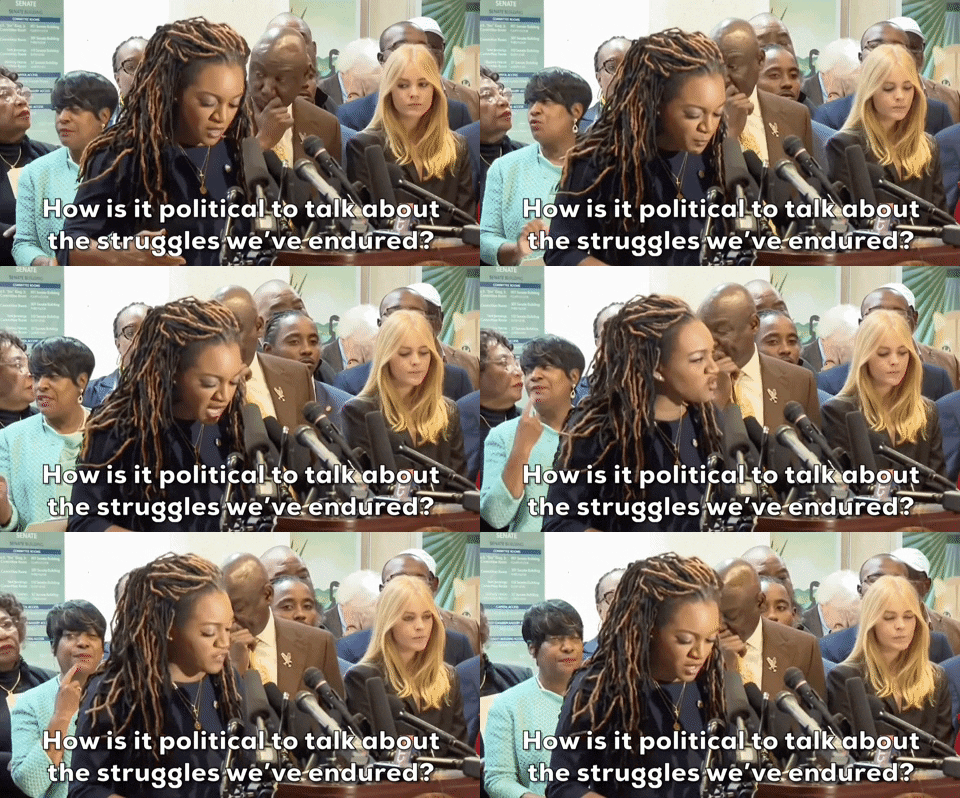
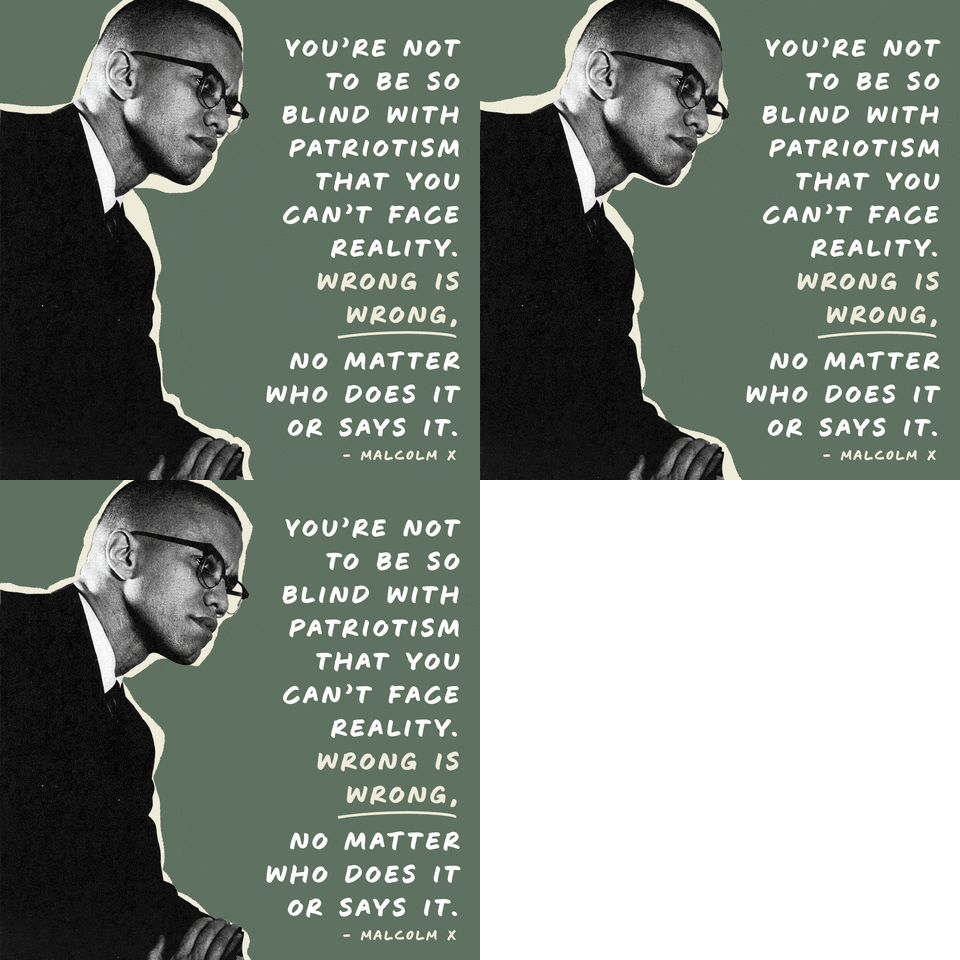
Frankly, I roll my eyes whenever these attacks on Black studies as radical and racist come out. It is out of a sense of patriotism that people who care about the United States and want to see the country be better air these frank assessments of the cruel and sordid origins of our republic. We cannot ignore our history—which seems to be the purpose of all these book bans and the pinning of everything evil on terms like critical race theory (CRT)—and expect our democracy to be healthy or withstand the stresses coming to a culmination in this year’s presidential election.
Clearly, the people suppressing this stuff don’t understand that there is an enhanced allure to the forbidden. People are going to find these books, bans or no bans. And what is so controversial about people who have been historically (and presently) oppressed, wanting to take part freely in their democracy? What is wrong with wanting to see better for our society?
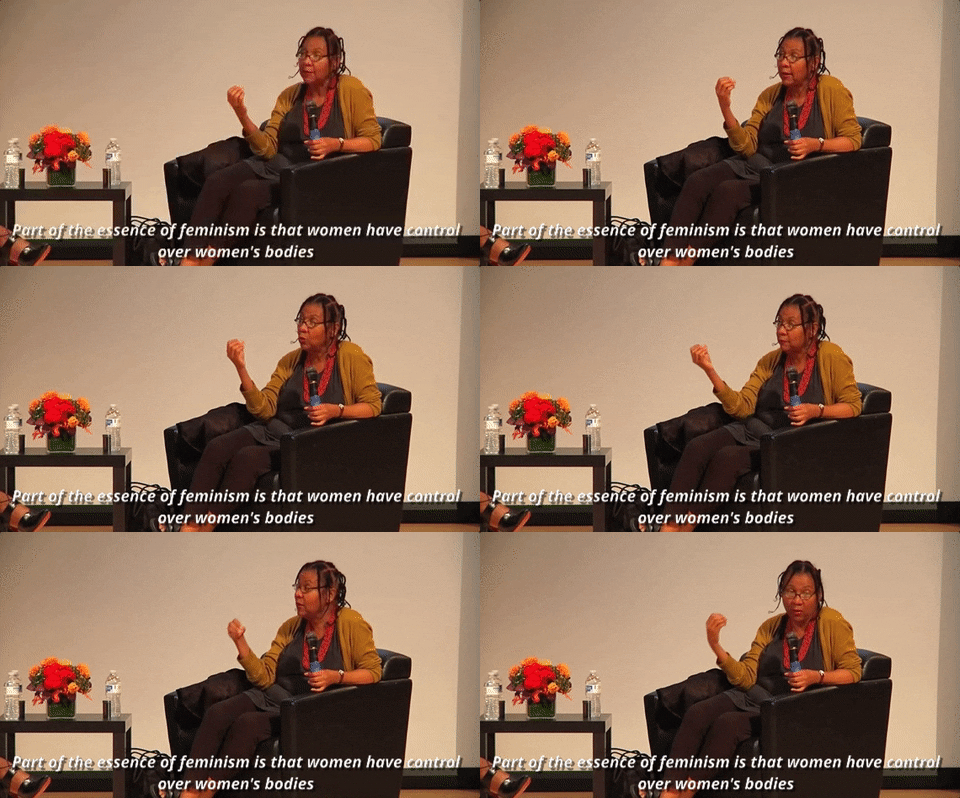
Personally, one of the essays that stood out to me was by bell hooks, who talks plainly and with searing honesty about the intersections and power dynamics involved with both gender and race. (I quote a passage here below.)
I’ve encountered bell hooks in other books I’ve read over the years to fill in the gaps of what I learned in school and admired her brutal honesty about the systems at work today. I’ve always felt that there was a bunch being hidden from us, and only as a privileged, white adult woman have begun to understand the magnitude of it, because this was not my experience growing up.
I have a lot more to learn and even more to act upon, but Our History Has Always Been Contraband is a good place to start.
Happy reading!
--BookOwl
https://abookblog4you.blogspot.com/
https://www.tumblr.com/bookowldevours...
5/5 stars
*Spoiler alert!*
Our History Has Always Been Contraband is an interdisciplinary collection of contemporary and historical essays, edited by Colin Kaepernick, Robin D.G. Kelley, and Keeanga-Yamahtta Taylor. Its aim is to defend the importance of studying and including the Black experience in curricula all over the United States and world, in response to a series of book and curricula bans that brand Black studies as radical and racist (looking at you Florida though it’s not alone in this by any means).
“To talk about the importance of teaching Black History… we must be honest about ourselves and talk about values; values shape what one thinks is important to preserve. The history of Black people throughout the African diaspora has been riddled with stereotypes, myths, and miseducation… Marcus Garvey … who rallied for Black people to move back to Africa, had a mindset that Black Americans were going back to the Motherland to civilize it… White supremacy can produce internalized racism where people belonging to an oppressed group take on the mindset and teachings of the oppressor about themselves… ‘radical’ has been used to describe perspectives that challenge the power structures of society and the history that comes with it. Some misinterpret that criticism as hate for America, but it is the opposite. Having different perspectives and viewpoints of history allows us to learn how to be better people; and critiquing one’s country based on lived experiences is not hate but a love so strong that one dares to criticize this country to make it better, a more perfect union…”
Frankly, I roll my eyes whenever these attacks on Black studies as radical and racist come out. It is out of a sense of patriotism that people who care about the United States and want to see the country be better air these frank assessments of the cruel and sordid origins of our republic. We cannot ignore our history—which seems to be the purpose of all these book bans and the pinning of everything evil on terms like critical race theory (CRT)—and expect our democracy to be healthy or withstand the stresses coming to a culmination in this year’s presidential election.
Clearly, the people suppressing this stuff don’t understand that there is an enhanced allure to the forbidden. People are going to find these books, bans or no bans. And what is so controversial about people who have been historically (and presently) oppressed, wanting to take part freely in their democracy? What is wrong with wanting to see better for our society?
Personally, one of the essays that stood out to me was by bell hooks, who talks plainly and with searing honesty about the intersections and power dynamics involved with both gender and race. (I quote a passage here below.)
“White women and black men have it both ways. They can act as oppressor or be oppressed. Black men may be victimized by racism, but sexism allows them to act as … oppressors of women. White women may be victimized by sexism, but racism allows them to act as exploiters and oppressors of black people… Black male sexism has undermined struggles to eradicate racism just as white female racism undermines feminist struggle. As long as these two groups, or any group, defines liberation as gaining social equality with ruling-class white men, they have a vested interest in the continued exploitation and oppression of others.”
I’ve encountered bell hooks in other books I’ve read over the years to fill in the gaps of what I learned in school and admired her brutal honesty about the systems at work today. I’ve always felt that there was a bunch being hidden from us, and only as a privileged, white adult woman have begun to understand the magnitude of it, because this was not my experience growing up.
I have a lot more to learn and even more to act upon, but Our History Has Always Been Contraband is a good place to start.
Happy reading!
--BookOwl

August 22, 2023
I deliberately took my time with this Black history reader. One shouldn't just fly through or skim over more than 100 years of writings by people who lived the history, and stood up to challenge it.
With essays by authors ranging from Frederick Douglass and W.E.B. DuBois to Angela Davis, this book looks at the historical struggles that BIPOC people have experienced in this country with an insider's view. The reading is at times heavy and at times hopeful, but at all times important.
I cannot recommend highly enough that those interested in the history of this country, as well as the politics behind how critical race theory has been coopted to mean something it is not, read this volume with a thoughtful eye.
With essays by authors ranging from Frederick Douglass and W.E.B. DuBois to Angela Davis, this book looks at the historical struggles that BIPOC people have experienced in this country with an insider's view. The reading is at times heavy and at times hopeful, but at all times important.
I cannot recommend highly enough that those interested in the history of this country, as well as the politics behind how critical race theory has been coopted to mean something it is not, read this volume with a thoughtful eye.

February 11, 2024
4 stars This is a solid collection. It was mostly older essays and excerpts, which were great but I’ve read most of them before. I think the anthology would be strengthened with more new essays.

March 15, 2025
An excellent introduction to some of the key voices and ideas in Black studies.

December 9, 2023
Short, dense, and powerful collection of writings put together in response to Ron DeSantis’ attempts to ban AP African American studies in public high schools. My one main critique is probably that some essays can run a bit short and I get the impression that they were cut down to maintain brevity within the format of the book. It leaves me wanting more, so it’s not ultimately bad, but it can feel a bit sparse when I think that the authors/editors were instead aiming for accessibility through this decision. A great intro (from my notably nonblack pov) of Black and Ethnic Studies in America. There are some really life changing essays in here that I will continue to think about for a long time. Having this historical context as an Asian American is also a very helpful reminder that our liberation is inextricably connected and that Asian American liberation movements have directly benefitted from Black American struggle.
Some that left a big impression on me:
“A Talk to Teachers” by James Baldwin
“A Race for Theory” by Barbara Christian
“African-American Women’s History and the Metalanguage of Race” by Evelyn Brooks Higginbotham
“Race: The Floating Signifier” by Stuart Hall
“Venus in Two Acts” by Saidiya Hartman
“Black Panther Party ‘Ten-Point Program’” by Huey Newton and Bobby Seale
Some that left a big impression on me:
“A Talk to Teachers” by James Baldwin
“A Race for Theory” by Barbara Christian
“African-American Women’s History and the Metalanguage of Race” by Evelyn Brooks Higginbotham
“Race: The Floating Signifier” by Stuart Hall
“Venus in Two Acts” by Saidiya Hartman
“Black Panther Party ‘Ten-Point Program’” by Huey Newton and Bobby Seale
February 11, 2024
I shouldn’t have taken so long to finish this book but I literally wanted to pour over and ponder every word. There were so many people that wrote essays in the book that made me want to learn about them more and new people that I need to do more research on. This book was written because Black Studies has always been here and will always be be needed.
I really enjoyed reading excerpts by bell hooks, James Baldwin and Zora Neale Hurston. This is a must read for anyone, especially me people that want and need to know that our history is US history!
I really enjoyed reading excerpts by bell hooks, James Baldwin and Zora Neale Hurston. This is a must read for anyone, especially me people that want and need to know that our history is US history!

November 14, 2023
The major upside of this book is its relevancy, as it was just published this year. The writers are speaking directly and indirectly, to the cancellation and erasure of Black history, culture, and studies in this country. A few of the essays are pretty theoretical, but everyone included here - from Du Bois to Robin D.G. Kelley are the real deal. A great primer for folks who aren't familiar with the subject - or want to teach it to others!

July 16, 2023
A really phenomenal selection of essays here, from experts in their fields. I learned a tremendous amount and read this whole volume in a flash. Tremendously educational, and does a fantastic job of dispelling myths and educating people on things they have likely heard in the news, but only a propagandized form.
July 6, 2023
A COMPELLING COLLECTION OF OLD/NEW ESSAYS DEFENDING TRUE HISTORY
The ‘Acknowledgements’ section of this 2023 book explains, “This book originated in response to the attacks on the teaching of Advanced Placement African American Studies in Florida and the broader efforts to ban books, whitewash history, and roll back civil and human rights.” (Pg. 169)
Colin Kaepernick wrote in his Preface, “Alongside powerful work being led by organizations like the African American Policy Forum, Dream Defenders, and cohort upon cohorts of student organizers from around the country, I hope this collection of historical and contemporary essays---some of which are original---can be used as a resource to deepen our collective understanding of Black history through the discipline of Black Studies---a dynamic field of study whose twentieth-century origins were birthed in resistance to the very foundations of Western thought and the US university system… My hope is that what’s contained within these pages will help us to draw connections between past the present struggles and to find inspiration in our histories of community resistance. Yes---Black history in a society that refuses to shed its white supremacy IS contraband. Yet, self-preservation is nonnegotiable. We must defend our stories, our community, our humanity, and our future no matter what the cost.”
Coeditor Robin D.G. Kelley explains, “We put together [this book] in response to the latest war on Black Studies, provoked in part by efforts to introduce an advanced placement course in African American Studies into our nation’s high schools. We felt an urgent need to respond not only to right-wing lies and the whitewashing of US history but also to an ill-informed mainstream discourse over the meaning, purpose, and scholarly value of Black Studies… Black Studies courses are not designed to serve Black students alone but all students… The essays and collected readings gathered here should make it indisputably clear that Black Studies is a legitimate intellectual endeavor---one that does not sit at the margins of social inquiry but at the very center. [This book] is intended for students, educators, and policy makers, as well as general readers interested in the subject and seeking to understand the politics behind the current attack on critical education… We deliberately selected texts and authors who had been excluded from the AP African American Studies curriculum, as well as a few canonical texts in African American Studies appropriate for high school students… the latest version of the curriculum places a heavy emphasis on history centered on the US and precolonial Africa.” (Pg. 4)
She adds, “The short-lived 1776 Commission issued its first and only report less than two weeks after the January 6, 2021, insurrection… Perhaps their most egregious fabrication was turning Dr. Martin Luther King Jr., into a colorblind libertarian. The report managed to recast the civil rights movement as a proponent of individual liberty, equal opportunity, and colorblindness that, with the death of King, lost its way when it embraced ‘group rights,’ ‘preferential treatment’ for minorities, and ‘identity politics.’ This is the same Dr. King whose book ‘Why We Can’t Wait’ supported ‘compensatory or preferential treatment for the Negro’… who called on the federal government to divest from the war in Vietnam, invest in the war on poverty, recognize racism as a source of inequality, and acknowledge ‘the debt that they owe a people who were kept in slavery two hundred and forty-four years.’” (Pg. 13)
Co-Editor Keeanga-Yamahtta Taylor observes, “the argument that Black Studies is politics masquerading as academic inquiry is a smoke screen. Indeed, the problem is not one of politics mixing with education---the issue is WHICH politics will be mixed with education. Were the state-sanctioned 1776 Commission to write history lessons highlighting the eternal goodness of all things American, that would be lauded.” (Pg. 22)
Frederick Douglass stated, “What, to the American slave, is your 4th of July? I answer: a day that reveals to him… the gross injustice and cruelty to which he is the constant victim. To him, your celebration is a sham; your boasted liberty, an unholy license; … your shouts of liberty and equality, hollow mockery; your prayers and hymns… with all your religious parade and solemnity, are, to Him, mere bombast, fraud, deception, impiety, and hypocrisy---a thin veil to cover up crimes which would disgrace a nation of savages. There is not a nation on the earth guilty of practices more shocking and bloody than are the people of the United States, at this very hour.” (Pg. 31-32)
Gloria T. Hull and Barbara Smith observe, “The early women’s movement gained inspiration from the Black movement… Black women were a part of that early women’s movement… However, for many reasons… the women’s movement became largely and apparently white. The effect that this had upon the nascent field of women’s studies was predictably disastrous. Women’s studies courses… focused almost exclusively upon the lives of white women. Black studies, which was much too often male-dominated, also ignored Black women… Because of white women’s racism and Black men’s sexism, there was no room in either for a serious consideration of the lives of Black women… Only a Black AND feminist analysis can sufficiently comprehend the material of Black women’s studies, and only a creative Black feminist perspective will enable the field to expand.” (Pg. 89)
bell hooks notes, “White women and black men have it both ways. They can act as oppressor or be oppressed. Black men may be victimized by racism, but sexism allows them to act as … oppressors of women. White women may be victimized by sexism, but racism allows them to act as exploiters and oppressors of black people… Black male sexism has undermined struggles to eradicate racism just as white female racism undermines feminist struggle. As long as these two groups, or any group, defines liberation as gaining social equality with ruling-class white men, they have a vested interest in the continued exploitation and oppression of others.” (Pg. 95)
Cathy J. Cohen acknowledges, “in recognizing the distinct history of oppression that lesbian, gay, bisexual, and transgendered people have confronted and challenged, I am not willing to embrace every queer as my marginalized political ally. In the same way, I do not assume that shared racial, gender, and/or class position or identity guarantees or produces similar political commitments…” (Pg. 114)
Kimberlé Crenshaw states, “the doctrine of color blindness… not only works to legitimize material deprivations, but it also produces a particular ideological regime. That regime forces African Americans into articulating legitimate demands within the discourse of victimhood… Consequently, when blacks are told that they should not be deploying the use of victimology as a way of articulating demands, they are essentially being forced into a catch-22. The only way one can achieve political power through this structure is to articulate ourselves as victims, yet the very articulation… is a justification for rejecting our claim.” (Pg. 121)
Khalil Gibran Muhammad points out, “there are options in how we choose to use and interpret crime statistics… the numbers do not speak for themselves. They never have. They have always been interpreted … in a broader political, economic, and social context in which race mattered. The falsity of past claims of race neutral crime statistics and color-blind justice should caution us against the ubiquitous referencing of statistics about black criminality today, especially given the relative silence about white criminality…. The choice about which narratives we attach to the data in the future, however, is ours to make…” (Pg. 129)
Keeanga-Yamahtta Taylor asserts, “President Obama turned out to be very different from candidate Obama… Obama distinguished himself from establishment candidate Hillary Clinton … He spoke of economic inequality and connected with young people… In March 2008 Obama finally gave a comprehensive speech on race, in which he pulled off the feat of addressing the concerns of African Americans while calming the fears of white voters… No one running for president… had ever spoken so directly about the history of racism in government and society at large… In that sense Obama broke the mold, but he also established the terms upon which he would engage race matters---with dubious evenhandedness, even in response to events that required decisive action on behalf of the racially aggrieved… Early in his administration… with the full effects of the recession still pulsing in Black communities, conflict between the Black president and his base could be detected… As Black unemployment was climbing … civil rights leaders asked Obama if he would craft policies to address Black joblessness. He responded, ‘I have a special responsibility to look out for the interests of every American…’ It was a disappointing response… Obama had not shown nearly the same reticence when publicly chastising African-Americans for a range of behaviors that read like a handbook on anti-Black stereotypes, from parenting skills … to sexual mores and television-watching habits…” (Pg. 142-144)
Marlon Williams-Clark suggests, “To talk about the importance of teaching Black History… we must be honest about ourselves and talk about values; values shape what one thinks is important to preserve. The history of Black people throughout the African diaspora has been riddled with stereotypes, myths, and miseducation… Marcus Garvey … who rallied for Black people to move back to Africa, had a mindset that Black Americans were going back to the Motherland to civilize it… White supremacy can produce internalized racism where people belonging to an oppressed group take on the mindset and teachings of the oppressor about themselves… ‘radical’ has been used to describe perspectives that challenge the power structures of society and the history that comes with it. Some misinterpret that criticism as hate for America, but it is the opposite. Having different perspectives and viewpoints of history allows us to learn how to be better people; and critiquing one’s country based on lived experiences is not hate but a love so strong that one dares to criticize this country to make it better, a more perfect union…” (Pg. 161-162)
This is an excellent selection of essays (both current, and historical), that will be “must reading” for anyone interested in the current debates about Black Studies, Critical Race Theory, and related topics.
The ‘Acknowledgements’ section of this 2023 book explains, “This book originated in response to the attacks on the teaching of Advanced Placement African American Studies in Florida and the broader efforts to ban books, whitewash history, and roll back civil and human rights.” (Pg. 169)
Colin Kaepernick wrote in his Preface, “Alongside powerful work being led by organizations like the African American Policy Forum, Dream Defenders, and cohort upon cohorts of student organizers from around the country, I hope this collection of historical and contemporary essays---some of which are original---can be used as a resource to deepen our collective understanding of Black history through the discipline of Black Studies---a dynamic field of study whose twentieth-century origins were birthed in resistance to the very foundations of Western thought and the US university system… My hope is that what’s contained within these pages will help us to draw connections between past the present struggles and to find inspiration in our histories of community resistance. Yes---Black history in a society that refuses to shed its white supremacy IS contraband. Yet, self-preservation is nonnegotiable. We must defend our stories, our community, our humanity, and our future no matter what the cost.”
Coeditor Robin D.G. Kelley explains, “We put together [this book] in response to the latest war on Black Studies, provoked in part by efforts to introduce an advanced placement course in African American Studies into our nation’s high schools. We felt an urgent need to respond not only to right-wing lies and the whitewashing of US history but also to an ill-informed mainstream discourse over the meaning, purpose, and scholarly value of Black Studies… Black Studies courses are not designed to serve Black students alone but all students… The essays and collected readings gathered here should make it indisputably clear that Black Studies is a legitimate intellectual endeavor---one that does not sit at the margins of social inquiry but at the very center. [This book] is intended for students, educators, and policy makers, as well as general readers interested in the subject and seeking to understand the politics behind the current attack on critical education… We deliberately selected texts and authors who had been excluded from the AP African American Studies curriculum, as well as a few canonical texts in African American Studies appropriate for high school students… the latest version of the curriculum places a heavy emphasis on history centered on the US and precolonial Africa.” (Pg. 4)
She adds, “The short-lived 1776 Commission issued its first and only report less than two weeks after the January 6, 2021, insurrection… Perhaps their most egregious fabrication was turning Dr. Martin Luther King Jr., into a colorblind libertarian. The report managed to recast the civil rights movement as a proponent of individual liberty, equal opportunity, and colorblindness that, with the death of King, lost its way when it embraced ‘group rights,’ ‘preferential treatment’ for minorities, and ‘identity politics.’ This is the same Dr. King whose book ‘Why We Can’t Wait’ supported ‘compensatory or preferential treatment for the Negro’… who called on the federal government to divest from the war in Vietnam, invest in the war on poverty, recognize racism as a source of inequality, and acknowledge ‘the debt that they owe a people who were kept in slavery two hundred and forty-four years.’” (Pg. 13)
Co-Editor Keeanga-Yamahtta Taylor observes, “the argument that Black Studies is politics masquerading as academic inquiry is a smoke screen. Indeed, the problem is not one of politics mixing with education---the issue is WHICH politics will be mixed with education. Were the state-sanctioned 1776 Commission to write history lessons highlighting the eternal goodness of all things American, that would be lauded.” (Pg. 22)
Frederick Douglass stated, “What, to the American slave, is your 4th of July? I answer: a day that reveals to him… the gross injustice and cruelty to which he is the constant victim. To him, your celebration is a sham; your boasted liberty, an unholy license; … your shouts of liberty and equality, hollow mockery; your prayers and hymns… with all your religious parade and solemnity, are, to Him, mere bombast, fraud, deception, impiety, and hypocrisy---a thin veil to cover up crimes which would disgrace a nation of savages. There is not a nation on the earth guilty of practices more shocking and bloody than are the people of the United States, at this very hour.” (Pg. 31-32)
Gloria T. Hull and Barbara Smith observe, “The early women’s movement gained inspiration from the Black movement… Black women were a part of that early women’s movement… However, for many reasons… the women’s movement became largely and apparently white. The effect that this had upon the nascent field of women’s studies was predictably disastrous. Women’s studies courses… focused almost exclusively upon the lives of white women. Black studies, which was much too often male-dominated, also ignored Black women… Because of white women’s racism and Black men’s sexism, there was no room in either for a serious consideration of the lives of Black women… Only a Black AND feminist analysis can sufficiently comprehend the material of Black women’s studies, and only a creative Black feminist perspective will enable the field to expand.” (Pg. 89)
bell hooks notes, “White women and black men have it both ways. They can act as oppressor or be oppressed. Black men may be victimized by racism, but sexism allows them to act as … oppressors of women. White women may be victimized by sexism, but racism allows them to act as exploiters and oppressors of black people… Black male sexism has undermined struggles to eradicate racism just as white female racism undermines feminist struggle. As long as these two groups, or any group, defines liberation as gaining social equality with ruling-class white men, they have a vested interest in the continued exploitation and oppression of others.” (Pg. 95)
Cathy J. Cohen acknowledges, “in recognizing the distinct history of oppression that lesbian, gay, bisexual, and transgendered people have confronted and challenged, I am not willing to embrace every queer as my marginalized political ally. In the same way, I do not assume that shared racial, gender, and/or class position or identity guarantees or produces similar political commitments…” (Pg. 114)
Kimberlé Crenshaw states, “the doctrine of color blindness… not only works to legitimize material deprivations, but it also produces a particular ideological regime. That regime forces African Americans into articulating legitimate demands within the discourse of victimhood… Consequently, when blacks are told that they should not be deploying the use of victimology as a way of articulating demands, they are essentially being forced into a catch-22. The only way one can achieve political power through this structure is to articulate ourselves as victims, yet the very articulation… is a justification for rejecting our claim.” (Pg. 121)
Khalil Gibran Muhammad points out, “there are options in how we choose to use and interpret crime statistics… the numbers do not speak for themselves. They never have. They have always been interpreted … in a broader political, economic, and social context in which race mattered. The falsity of past claims of race neutral crime statistics and color-blind justice should caution us against the ubiquitous referencing of statistics about black criminality today, especially given the relative silence about white criminality…. The choice about which narratives we attach to the data in the future, however, is ours to make…” (Pg. 129)
Keeanga-Yamahtta Taylor asserts, “President Obama turned out to be very different from candidate Obama… Obama distinguished himself from establishment candidate Hillary Clinton … He spoke of economic inequality and connected with young people… In March 2008 Obama finally gave a comprehensive speech on race, in which he pulled off the feat of addressing the concerns of African Americans while calming the fears of white voters… No one running for president… had ever spoken so directly about the history of racism in government and society at large… In that sense Obama broke the mold, but he also established the terms upon which he would engage race matters---with dubious evenhandedness, even in response to events that required decisive action on behalf of the racially aggrieved… Early in his administration… with the full effects of the recession still pulsing in Black communities, conflict between the Black president and his base could be detected… As Black unemployment was climbing … civil rights leaders asked Obama if he would craft policies to address Black joblessness. He responded, ‘I have a special responsibility to look out for the interests of every American…’ It was a disappointing response… Obama had not shown nearly the same reticence when publicly chastising African-Americans for a range of behaviors that read like a handbook on anti-Black stereotypes, from parenting skills … to sexual mores and television-watching habits…” (Pg. 142-144)
Marlon Williams-Clark suggests, “To talk about the importance of teaching Black History… we must be honest about ourselves and talk about values; values shape what one thinks is important to preserve. The history of Black people throughout the African diaspora has been riddled with stereotypes, myths, and miseducation… Marcus Garvey … who rallied for Black people to move back to Africa, had a mindset that Black Americans were going back to the Motherland to civilize it… White supremacy can produce internalized racism where people belonging to an oppressed group take on the mindset and teachings of the oppressor about themselves… ‘radical’ has been used to describe perspectives that challenge the power structures of society and the history that comes with it. Some misinterpret that criticism as hate for America, but it is the opposite. Having different perspectives and viewpoints of history allows us to learn how to be better people; and critiquing one’s country based on lived experiences is not hate but a love so strong that one dares to criticize this country to make it better, a more perfect union…” (Pg. 161-162)
This is an excellent selection of essays (both current, and historical), that will be “must reading” for anyone interested in the current debates about Black Studies, Critical Race Theory, and related topics.

Read
December 5, 2025Kaepernick is nothing short of a hero for his activism and Keanga is fantastic as well but this collection falls somewhat flat, especially with the conflation of today’s Black, counter-hegemonic writing with that of the past

October 29, 2023
In the United States’ present moment of book or curricular challenges, Our History Has Always Been Contraband: In Defense of Black Studies clearly and concisely makes the case for Black studies as a needed and necessary counter to the traditional white focused national narrative.
This collection, co edited by Colin Kaepernick, Robin D.G. Kelley and Keeanga-Yamahtta Taylor is arranged in three parts. The volume opens with a preface and two essays from the editors that explain ‘How We Got Here”, the origins and impetus for this book, specially the DeSantis led legislation to outlaw the teaching of ‘Critical Race Theory’ and cancelation of the Advanced Placement African American studies course.
Part two, “The History They Don’t Want You to Know” is the bulk of the book. Excerpting portions of groundbreaking or foundational works of Black Studies from the 1820s through 2022. Familiar names such as Frederick Douglass, James Baldwin, W.E.B. Du Bois, bell hooks, Zora Neale Hurston and Angela Davis appear alongside contemporary scholars such as Ta-Nehisi Coates, Michelle Alexander and many others It is broad in its focus, an interdisciplinary compilation that touches on feminism, queer theory, education, history, representation, literature and many other topics.
Section three, “How We Fight Back,” offers reflections and next steps. Be informed, be involved, ask questions. Laws and society can and have changed, but not without struggle.
Our History… is not comprehensive, but it is not intended to be, it is an anthology of Black Studies that offers the reader a curriculum for deeper study. It is a work that illuminates a history denied and in opposition to the idealized quest for freedom we’re taught in school.
Recommended reading for Americans and those looking to more fully understand American society.
I received a free print version of this book thanks to the Coriolis Company.
This collection, co edited by Colin Kaepernick, Robin D.G. Kelley and Keeanga-Yamahtta Taylor is arranged in three parts. The volume opens with a preface and two essays from the editors that explain ‘How We Got Here”, the origins and impetus for this book, specially the DeSantis led legislation to outlaw the teaching of ‘Critical Race Theory’ and cancelation of the Advanced Placement African American studies course.
Part two, “The History They Don’t Want You to Know” is the bulk of the book. Excerpting portions of groundbreaking or foundational works of Black Studies from the 1820s through 2022. Familiar names such as Frederick Douglass, James Baldwin, W.E.B. Du Bois, bell hooks, Zora Neale Hurston and Angela Davis appear alongside contemporary scholars such as Ta-Nehisi Coates, Michelle Alexander and many others It is broad in its focus, an interdisciplinary compilation that touches on feminism, queer theory, education, history, representation, literature and many other topics.
Section three, “How We Fight Back,” offers reflections and next steps. Be informed, be involved, ask questions. Laws and society can and have changed, but not without struggle.
Our History… is not comprehensive, but it is not intended to be, it is an anthology of Black Studies that offers the reader a curriculum for deeper study. It is a work that illuminates a history denied and in opposition to the idealized quest for freedom we’re taught in school.
Recommended reading for Americans and those looking to more fully understand American society.
I received a free print version of this book thanks to the Coriolis Company.

December 27, 2023
This collection of essays, some new for this volume, were gathered to deepen the understanding of “Black history through the discipline of Black studies” - a field developed to offer an alternative to the foundations of Western education and the American university system. This book is divided into three discrete sections. The first section “How We Got Here” features essays by Robin D.G. Kelley and Keeanga-Yamahtta Taylor. In the two opening essays the history of Black studies and its relation to Critical Race Theory (CRT) and also radical Black political thought and action. Part two features historical essays from well-known African-American writers, such as Frederick Douglass’ “The Meaning of July Fourth for the Negro,” and Zora Neale Huston’s recounting of the story of one of the last living ex-slaves from the last slave ship to come to the United States. Part Two is by far the longest section of the book and includes other contemporary writers tackling issues related to mass incarceration, police brutality, and how healthcare and access is racialized and its disproportionate negative effects on Black Americans. Part Three discusses what people can do with the information presented in the other sections of the book. These suggestions aren’t for Black people or other racial minorities only, but they are for all Americans interested in the truth. We must read and read widely, especially banned books. We must teach Black history as American history, not as an afterthought or as a distinct module.
The selections in this collection provide a good entry point to Black studies. The selections allow one to easily seek the larger writing the selection is from or to find additional readings to explore the various topics further.
The selections in this collection provide a good entry point to Black studies. The selections allow one to easily seek the larger writing the selection is from or to find additional readings to explore the various topics further.

December 18, 2023
OUR HISTORY HAS ALWAYS BEEN CONTRABAND - edited by Coin Kaepernick, Robin D. G. Kelly, Keeanga-Yamahtta Taylor. Narrated by Jamie Lincoln Smith is a collection of short readings by a wide variety of black authors selected from the past centuries of United States history. These authors comment on racism, politics, slavery, social status, psychology, sociology, education, gender, and more to give the reader a look at what needs to be included in history studies.
Since I was listening to this book, I often forgot who had written a particular passage as the table of contents did not include the author's name. A second issue came with readings that presented a woman's viewpoint. With a male narrator, it just didn't sit right. Generally gender does not matter in narration, but some of the readings really needed a female voice.
I found the section on critical race theory, a widely misunderstood class of study, very interesting. The problems resulting from the "War on Drugs" was thought provoking. It was interesting to realize that the fight for women's rights, which has a long history, was largely driven by white women, often even excluding women of color.
I would have been better served with a good book on Black history. I recommend this as an introduction to further study.
Since I was listening to this book, I often forgot who had written a particular passage as the table of contents did not include the author's name. A second issue came with readings that presented a woman's viewpoint. With a male narrator, it just didn't sit right. Generally gender does not matter in narration, but some of the readings really needed a female voice.
I found the section on critical race theory, a widely misunderstood class of study, very interesting. The problems resulting from the "War on Drugs" was thought provoking. It was interesting to realize that the fight for women's rights, which has a long history, was largely driven by white women, often even excluding women of color.
I would have been better served with a good book on Black history. I recommend this as an introduction to further study.

January 16, 2024
Full disclosure: I was given a copy of this book from Coriolis Company in exchange for an honest review.
Ever since I read "White Fragility: Why It’s So Hard for White People to Talk About Racism" by Robin DiAngelo, I have been seeking out resources and stories regarding racism and the marginalized experience. I’ve always been interested in history, especially in areas that aren’t as well known. Black history in the United States is a great example because of the controversy surrounding the teaching of it in schools. One year ago this week, the State of Florida banned them from instructing students in a newly created advanced placement course in African American Studies. Colin Kaepernick, Robin D. G. Kelley, and Keeanga-Yamahtta Taylor address this particular issue in today’s book "Our History Has Always Been Contraband: In Defense of Black Studies" with powerful readings and essays that effectively tie in past and present struggles with educating people on this subject.
To read more of this review, click on this link: https://chick-who-reads-everything.co...
Ever since I read "White Fragility: Why It’s So Hard for White People to Talk About Racism" by Robin DiAngelo, I have been seeking out resources and stories regarding racism and the marginalized experience. I’ve always been interested in history, especially in areas that aren’t as well known. Black history in the United States is a great example because of the controversy surrounding the teaching of it in schools. One year ago this week, the State of Florida banned them from instructing students in a newly created advanced placement course in African American Studies. Colin Kaepernick, Robin D. G. Kelley, and Keeanga-Yamahtta Taylor address this particular issue in today’s book "Our History Has Always Been Contraband: In Defense of Black Studies" with powerful readings and essays that effectively tie in past and present struggles with educating people on this subject.
To read more of this review, click on this link: https://chick-who-reads-everything.co...

Read
August 13, 2024i was supposed to read this for a class i took last semester but didnt end up doing it because my professor assigned it the week during finals for some reason. i decided to try and get through it now because i really liked the introduction and the premise + some of the authors mentioned in the book i have read in other classes ive taken/have a working knowledge of and even though i like their work, i found this collection to be pretty lackluster. there were only a few entries that i felt were very raw and hard hitting for me and those excerpts were weirdly cut off at parts to the point where it was difficult to get invested and to grasp the totality of the ideas. again, ive read a ton of the authors mentioned and didnt feel this way while reading their work. there was one excerpt from a journal that i have literally read all the way through but i didnt really like the part mentioned in the book. i felt that kaepernick could have chosen better excerpts from the pieces he pulled from to improve clarity + interest

July 24, 2023
I was given a copy of this book for review by someone unknown. I can't find the e-mail among my saved messages. It's a bit of a mystery to me. It could have been an employee of the publisher, an agent or a publicist.
This book is a collection of essays and excerpts. My review includes what I learned from this book that I considered most significant.
In "On Racial Justice, Black History, Critical Race Theory and Other Felonious Ideas" by Robin D. G. Kelley, I found out about Freedom Libraries for the first time. Freedom Libraries were established in the South because African Americans had to sue for access to public libraries in most Southern states.
I also found out about Black disability issues, how diabetes and asthma are related to pollution and a secret school for slaves in Natchez, Mississippi.
For my complete review see https://shomeretmasked.blogspot.com/2...
This book is a collection of essays and excerpts. My review includes what I learned from this book that I considered most significant.
In "On Racial Justice, Black History, Critical Race Theory and Other Felonious Ideas" by Robin D. G. Kelley, I found out about Freedom Libraries for the first time. Freedom Libraries were established in the South because African Americans had to sue for access to public libraries in most Southern states.
I also found out about Black disability issues, how diabetes and asthma are related to pollution and a secret school for slaves in Natchez, Mississippi.
For my complete review see https://shomeretmasked.blogspot.com/2...

July 27, 2023
this is the one! a collection of absolute bangers that illuminates a few things:
(1) what race is and how it has been constructed, laying out plainly how racism operates & permeates today
(2) what Black Studies as a field is--not everything by nor about Black people is Black studies (cc: my admin who wanted me to uplift Colin Powell in my teaching)
(3) the responsibility of Black Studies to propel us to a more just world
the authors/essays in the collection weren't new to me (and probably won't be to others who have studied previously), but the selection and compilation of them is truly necessary in this moment. this book is also an indelible teaching resource for me as i plan for high school African American History this year. excited to read and study these essays with students <3
(1) what race is and how it has been constructed, laying out plainly how racism operates & permeates today
(2) what Black Studies as a field is--not everything by nor about Black people is Black studies (cc: my admin who wanted me to uplift Colin Powell in my teaching)
(3) the responsibility of Black Studies to propel us to a more just world
the authors/essays in the collection weren't new to me (and probably won't be to others who have studied previously), but the selection and compilation of them is truly necessary in this moment. this book is also an indelible teaching resource for me as i plan for high school African American History this year. excited to read and study these essays with students <3

August 18, 2023
In a time when history is under assault. It's books like these that keeps the conversation around real history and black history going. Due to Ron Desantis, Mom's For Liberty (An Orwellion 1984 group), and conservatives in Florida banning AP African-American classes, which also resulted in local efforts to ban books that talk about black history, as well as other different views and experiences from school library shelves as well as public libraries. The assault on real history of nothing new, but the assault on history now is really scary. But thanks to books like this, really history can be taught no matter how many books Desantis and history cronies ban. This book proves that, "Black people have been here, aren't going anywhere, and have pushed this country to embody the values and rights it proclaims for all Americans." Read this, and resist the assault on real history.
September 30, 2023
I actually got a free ebook copy of this book from Haymarket Books a while ago, but I forgot to actually read it. So when I saw it at my local library's new book section, I knew I had to read it.
And I'm really glad I did. This book is a much needed primer and introduction to 250+ years of Black Radical thought across America, and is a necessary injunction into our collective consciousness as the far right increasing attacks teaching Black history. While I've read most of the pieces within this collection, I still found the story told through all of these selected works useful, and the essays from the editors to be timely and compelling. An incredibly accessible and valuable piece of work for our moment. Highly recommend especially for the high school /undergrad crowd the fascists are trying to hide this history from.
And I'm really glad I did. This book is a much needed primer and introduction to 250+ years of Black Radical thought across America, and is a necessary injunction into our collective consciousness as the far right increasing attacks teaching Black history. While I've read most of the pieces within this collection, I still found the story told through all of these selected works useful, and the essays from the editors to be timely and compelling. An incredibly accessible and valuable piece of work for our moment. Highly recommend especially for the high school /undergrad crowd the fascists are trying to hide this history from.

August 16, 2023
Who is afraid of Black Studies??
Black History has always been controversial and contraband. Let’s be honest. Are you surprised that some of these bans are happening? As an educator and book lover, I have become curious about history and what I missed in grade school. I want to teach others too! I am planting seeds of Hope!
Our History Has Always Been Contraband illustrates a study on the move. Inam looking for books that can help me plant those seeds!
The book is in three parts:
1. How We Got Here
2. The History They Don’t Want You To Know
3. How We Fight Back
Thanks, @coriolisco for the digital copy
Black History has always been controversial and contraband. Let’s be honest. Are you surprised that some of these bans are happening? As an educator and book lover, I have become curious about history and what I missed in grade school. I want to teach others too! I am planting seeds of Hope!
Our History Has Always Been Contraband illustrates a study on the move. Inam looking for books that can help me plant those seeds!
The book is in three parts:
1. How We Got Here
2. The History They Don’t Want You To Know
3. How We Fight Back
Thanks, @coriolisco for the digital copy
February 29, 2024
A revolutionary text that allows anyone who can read to educate themselves on Black history--no classroom needed. As a response to the suppression of Black studies by the resurgence of white supremacy, editors Colin Kaepernick, Robin D. G. Kelley, and Keeanga-Yamahtta Taylor have gathered canonical texts and fresh, inspiring new essays and published an equivalent textbook for that famous (and now often forbidden) Black Studies AP course for high school students, including materials that were cut from the course to try to woo consent from the state of Florida.
What a gift. What a godsend. Read it, share it, give it to a curious or furious kid. Be your own Freedom School.
What a gift. What a godsend. Read it, share it, give it to a curious or furious kid. Be your own Freedom School.

March 16, 2024
What an important book for what is happening in Florida right now - I learned so much! I love the second section presented as a sampling of different reading materials that one might get introduced to in a black history course. I was able to note some that I’d like to look into reading and learning from more. This book could serve as a reference book for organizing groups, education or book clubs for people who want to deepen their knowledge in black history. Highly recommend!

October 12, 2025
Our History Has Always Been Contraband is a powerful and important collection of essays that makes a compelling case for the value and necessity of Black Studies. While I found many of the ideas deeply resonant as a Black woman, they also felt somewhat redundant. I don’t believe I am the book’s primary audience. Additionally, because the audiobook features a wide range of authors with varying styles and perspectives, it was occasionally difficult to follow.
February 18, 2024
Extremely thought provoking essays written by Black scholars, essayists, from the time of enslavement to the present on the the need for Black History to be molded into everyday consciousness. A call to action needed more than ever with the unrelenting assault and undermining from so many threatened by truth of this country's founding who continue to whitewash American history. A must read.
February 3, 2025
This anthology serves as a vigorous defense of the field of American American Studies—and an effective proof of concept—assembling a brisk but wide-ranging primer of seminal texts & authors in the field. The essays were informative, compelling, and well-edited to maintain the quality of each text & voice, while establishing a distinctive character across the collection.
September 19, 2026
Very good primer for those new to Black American theory. I would have certainly taught this in my Black American Lit class if I were still in the classroom. I could have seen adding a few more contemporary essays...there's certainly room...pushing to 300 pages would have been perfectly fine, but hopefully, through the success of this volume, we'll see a second or a revised edition!
January 4, 2024
Great collection of essays and excerpts. I had read almost all of the full versions, most of them in college in my Black Studies classes. This was more of an comprehensive review for me, but its nice to have all these writings accessible in one collection.

February 12, 2024
Our history is being changed in front of our very eyes. These collections of essays from notable activists, writers, and scholars remind us that the fight for liberation of our people and all oppressed people requires us to be bold and disciplined.
Displaying 1 - 30 of 44 reviews