

What do you think?
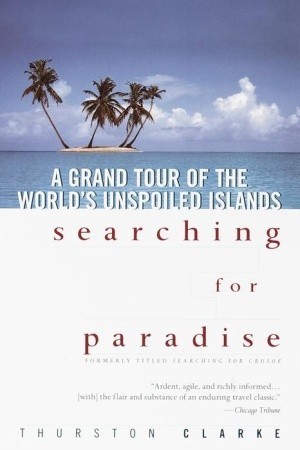
Searching for Paradise: A Grand Tour of the World's Unspoiled Islands
“DELIGHTFUL . . . INQUISITIVE AND INTELLIGENT, THIS BOOK WILL TAKE YOU FAR AND OPEN YOUR EYES.”
–The Seattle Times
In a penetrating, brilliantly written book that weaves sociology, history, politics, personality, and ancient and popular culture into one compelling narrative, Thurston Clarke island-hops around the oceans of the world, searching for an explanation for the most enduring geographic love affair of all time–between humankind and islands. Along the way Clarke visits the remote and silent Mas À Tierra, the island off the coast of Chile that inspired Defoe to write Robinson Crusoe; sleepy, simple Campobello, the Canadian island where Franklin D. Roosevelt spent his boyhood summers; Jura in the Hebrides, where George Orwell wrote 1984. A stunning work of wit, adventure, and incisive exploration, Searching for Paradise brings a unique passion to dazzling life.
“This enchanting hymn to our ceaseless fascination for islands and insularity is brilliant, quite without equal. Thurston Clarke’s wisdom and sensitivity radiate from every he fills us with an inexplicable longing for the land and the people glimpsed above the cliff top, and through the grasses beyond the beach.”
–SIMON WINCHESTER
Author of The Professor and the Madman
“An intelligent, passionate, absorbing book that manages to pull together the threads of history, myth, travelogue, personal reflection, and social commentary into a delightful narrative.”
–Toronto Globe and Mail
–The Seattle Times
In a penetrating, brilliantly written book that weaves sociology, history, politics, personality, and ancient and popular culture into one compelling narrative, Thurston Clarke island-hops around the oceans of the world, searching for an explanation for the most enduring geographic love affair of all time–between humankind and islands. Along the way Clarke visits the remote and silent Mas À Tierra, the island off the coast of Chile that inspired Defoe to write Robinson Crusoe; sleepy, simple Campobello, the Canadian island where Franklin D. Roosevelt spent his boyhood summers; Jura in the Hebrides, where George Orwell wrote 1984. A stunning work of wit, adventure, and incisive exploration, Searching for Paradise brings a unique passion to dazzling life.
“This enchanting hymn to our ceaseless fascination for islands and insularity is brilliant, quite without equal. Thurston Clarke’s wisdom and sensitivity radiate from every he fills us with an inexplicable longing for the land and the people glimpsed above the cliff top, and through the grasses beyond the beach.”
–SIMON WINCHESTER
Author of The Professor and the Madman
“An intelligent, passionate, absorbing book that manages to pull together the threads of history, myth, travelogue, personal reflection, and social commentary into a delightful narrative.”
–Toronto Globe and Mail
- GenresTravelNonfictionHistory
352 pages, Paperback
First published February 1, 2001
About the author
Thurston Clarke
17 books66 followersThurston Clarke has written eleven widely acclaimed works of fiction and nonfiction, including three New York Times Notable Books. His 'Pearl Harbor Ghosts' was the basis for a CBS documentary, and his bestselling 'Lost Hero', a biography of Raoul Wallenberg, was made into an award-winning NBC miniseries.
Clarke's articles have appeared in Vanity Fair, The New York Times, The Washington Post, and many other publications. The recipient of a Guggenheim Fellowship and other awards, he lives with his wife and three daughters in upstate New York.
Clarke's articles have appeared in Vanity Fair, The New York Times, The Washington Post, and many other publications. The recipient of a Guggenheim Fellowship and other awards, he lives with his wife and three daughters in upstate New York.
Ratings & Reviews
Friends & Following
Create a free account to discover what your friends think of this book!
Community Reviews
Displaying 1 - 12 of 12 reviews

August 31, 2012
_Searching for Paradise_ by Thurston Clarke was a wonderful, well-written, witty book touring many of the world's islands, from the arctic island of Svalbard to sunny South Pacific islands like Abemama and a number of islands in between. I found the book a good mixture of history and travelogue and loved the author's descriptions of the sites, architecture, and in many cases fauna and flora of the places he visited as well as interviews with those who lived there.
Daniel Defoe's _Robinson Crusoe_ is one of the greatest stories of Western literature, so much a part of Western culture that its story haunts the very concept of an island, so much so that each person landing on an island brings Crusoe with them. Crusoe he writes "persuades us that islands are more liberating than confining, more contemplative than lonely," a place where one can meet God more easily because one is isolated from the wickedness of the world.
Clarke set out to find the reason for the most passionate and "enduring geographic love affair of all time," that between humans and islands, to identify what creates "islomania" (a gripping love for islands) and "islomanes" (island lovers). His intellectual journey took him not only to _Robinson Crusoe_, but also _Lord of the Flies_, _Peter Pan_, _Treasure Island_, _Swiss Family Robinson_, _The Odyssey_, _The Tempest_, _South Pacific_, and even James Bond and _Gilligan's Island_ (that latter which he detests by the way). It also of course took him to over a dozen islands and islets in oceans throughout the world.
Does Clarke find the answers to his question? He doesn't find a definitive answer, but does find many theories. Some islands may be appealing because they are so close to many images of the Garden of Eden; the Bandas of eastern Indonesia are the "archetypal island paradise," with palm trees, gorgeous beaches, reefs teeming with fish, dense forests, and verdant mountains. This very attraction has doomed many islands to rampant overdevelopment, pollution, and an eradication of indigenous fauna, flora, and culture, something that Clarke recounted again and again in the book. Nowhere was this more obvious than in the Caribbean, where too many islands had become what he called "mooring blocks" for cruise liners, lands where the locals had been encouraged to sell their precious property, spent the money, and in the end became maids, cleaning buildings they couldn't afford on land that their ancestors used to own. Parrot-haunted jungles, crumbling colonial forts, and small fishing villages were razed to make way for condominiums, exclusive resort hotels, and fast food restaurants.
Some like the near timeless, open-air museum quality of some islands, islands which became natural attics, holding all manner of relics. Islanders in Vanuatu walk daily among the ruins of World War II equipment, hoping for the Americans to return. The South Pacific island of Kosrae's Christians - nearly the entirely island - faithfully preserve nearly identical services to those brought to them by 19th century New England missionaries. The private island of Niihau in the Hawaiian Islands preserves some of the last native Hawaiian Polynesian culture and many otherwise extinct Hawaiian plants.
Others were attracted to islands because a small number of people or even one man or woman could make a huge difference there, their actions remembered for years, decades, or centuries later. Des Alwi, an entrepreneur and preservationist, is adored on the island of Banda Neira and will likely be remembered by islanders for many decades to come for his numerous great deeds on behalf of the islanders. On Espiritu Santo (part of Vanuatu in the South Pacific) Clarke met the local man Tommy Wells, a person who had worked with the Americans when they had a bustling military base during World War II, who not only pined for the Americans to return but remembered with great affection two individual American serviceman, one of whom Wells found out died on Guadalcanal and still caused him sadness. Clarke wondered if anywhere in the world were memories of this man, Captain Burke, fresh enough in anyone else's mind to evoke tears. Wells told his children and grandchildren about Burke, so it is possible that a century from now he will still be remembered.
Other islands were attractive because of the sense of community and belonging that they offered. Though he sneered a little at pensioners who moved to islands, thinking that they suddenly belong to a community because they exchanged pleasantries with store employees, many islands, often very isolated and underdeveloped ones, like Utila near the coast of Honduras and Eigg off the coast of Scotland, were places where everyone knows everyone else, children are safe to run around and play without worries, towns and communities so small that one can recognize who was coming by their familiar silhouette in the dark or the sound of the engine of their particular car.
Still other islands are not quite resort islands but comfortable vacation islands, ones that offer many of the attractions of islands I just mentioned, if only for a few weeks or months each summer, back in the days when families took long vacations together, mingling with the locals who lived there year round and becoming friends with them. These islands - like Fishers Island near Long Island and Campobello Island (a Canadian island just north of Maine) - also offered shared experiences for families who returned year after year and became fixed in the memory of their children and their children, associated with happy times, good food, and summer romances.
Others come to islands for a marvelous sense of isolation. The Roosevelt loved Campobello because of its relative lack of telephones and electricity. Many flee to Crusoe's (or rather Alexander Selkirk's that is, the inspiration for Crusoe) island of Mas a Tierra for its profound sense of isolation, located as it is four hundred miles off the coast of Chile, perhaps to escape financial or romantic problems at home.
A well-written book with nice maps and a great bibliography.
Daniel Defoe's _Robinson Crusoe_ is one of the greatest stories of Western literature, so much a part of Western culture that its story haunts the very concept of an island, so much so that each person landing on an island brings Crusoe with them. Crusoe he writes "persuades us that islands are more liberating than confining, more contemplative than lonely," a place where one can meet God more easily because one is isolated from the wickedness of the world.
Clarke set out to find the reason for the most passionate and "enduring geographic love affair of all time," that between humans and islands, to identify what creates "islomania" (a gripping love for islands) and "islomanes" (island lovers). His intellectual journey took him not only to _Robinson Crusoe_, but also _Lord of the Flies_, _Peter Pan_, _Treasure Island_, _Swiss Family Robinson_, _The Odyssey_, _The Tempest_, _South Pacific_, and even James Bond and _Gilligan's Island_ (that latter which he detests by the way). It also of course took him to over a dozen islands and islets in oceans throughout the world.
Does Clarke find the answers to his question? He doesn't find a definitive answer, but does find many theories. Some islands may be appealing because they are so close to many images of the Garden of Eden; the Bandas of eastern Indonesia are the "archetypal island paradise," with palm trees, gorgeous beaches, reefs teeming with fish, dense forests, and verdant mountains. This very attraction has doomed many islands to rampant overdevelopment, pollution, and an eradication of indigenous fauna, flora, and culture, something that Clarke recounted again and again in the book. Nowhere was this more obvious than in the Caribbean, where too many islands had become what he called "mooring blocks" for cruise liners, lands where the locals had been encouraged to sell their precious property, spent the money, and in the end became maids, cleaning buildings they couldn't afford on land that their ancestors used to own. Parrot-haunted jungles, crumbling colonial forts, and small fishing villages were razed to make way for condominiums, exclusive resort hotels, and fast food restaurants.
Some like the near timeless, open-air museum quality of some islands, islands which became natural attics, holding all manner of relics. Islanders in Vanuatu walk daily among the ruins of World War II equipment, hoping for the Americans to return. The South Pacific island of Kosrae's Christians - nearly the entirely island - faithfully preserve nearly identical services to those brought to them by 19th century New England missionaries. The private island of Niihau in the Hawaiian Islands preserves some of the last native Hawaiian Polynesian culture and many otherwise extinct Hawaiian plants.
Others were attracted to islands because a small number of people or even one man or woman could make a huge difference there, their actions remembered for years, decades, or centuries later. Des Alwi, an entrepreneur and preservationist, is adored on the island of Banda Neira and will likely be remembered by islanders for many decades to come for his numerous great deeds on behalf of the islanders. On Espiritu Santo (part of Vanuatu in the South Pacific) Clarke met the local man Tommy Wells, a person who had worked with the Americans when they had a bustling military base during World War II, who not only pined for the Americans to return but remembered with great affection two individual American serviceman, one of whom Wells found out died on Guadalcanal and still caused him sadness. Clarke wondered if anywhere in the world were memories of this man, Captain Burke, fresh enough in anyone else's mind to evoke tears. Wells told his children and grandchildren about Burke, so it is possible that a century from now he will still be remembered.
Other islands were attractive because of the sense of community and belonging that they offered. Though he sneered a little at pensioners who moved to islands, thinking that they suddenly belong to a community because they exchanged pleasantries with store employees, many islands, often very isolated and underdeveloped ones, like Utila near the coast of Honduras and Eigg off the coast of Scotland, were places where everyone knows everyone else, children are safe to run around and play without worries, towns and communities so small that one can recognize who was coming by their familiar silhouette in the dark or the sound of the engine of their particular car.
Still other islands are not quite resort islands but comfortable vacation islands, ones that offer many of the attractions of islands I just mentioned, if only for a few weeks or months each summer, back in the days when families took long vacations together, mingling with the locals who lived there year round and becoming friends with them. These islands - like Fishers Island near Long Island and Campobello Island (a Canadian island just north of Maine) - also offered shared experiences for families who returned year after year and became fixed in the memory of their children and their children, associated with happy times, good food, and summer romances.
Others come to islands for a marvelous sense of isolation. The Roosevelt loved Campobello because of its relative lack of telephones and electricity. Many flee to Crusoe's (or rather Alexander Selkirk's that is, the inspiration for Crusoe) island of Mas a Tierra for its profound sense of isolation, located as it is four hundred miles off the coast of Chile, perhaps to escape financial or romantic problems at home.
A well-written book with nice maps and a great bibliography.

July 18, 2018
I love islands and so does Clarke. This is a great piece of creative nonfiction. Clarke does a lovely job of weaving a common theme throughout, but also of discussing the things that make each island unique. Honestly, he hasn't made me want to visit most of these islands. Islands are in trouble due to global climate change. He does a very nice job of talking about the Catch-22 of attracting tourists and trying to be environmentally aware. Love his writing style.
March 15, 2020
This book is clearly for those fans of islands, and I am certainly one of those. Clarke helped me understand my own islomania and infatuation with islands. I did not realize there was such a thing, but as I have become more savvy, I get my enthusiasm, and this book helped me define, understand and embrace it.
Searching out islands and exploring them is a valid endeavor.
Searching out islands and exploring them is a valid endeavor.

April 11, 2021
Another brilliant and delicious travel log from Thurston Clark that expanded my geographical knowledge and brought more amazement and appreciation of this incredible planet we are part of.

November 29, 2012
Life on an island has a special quality, a mix of independence and isolation which often creates unusual society. Thurston Clarke describes visits to perhaps 20 islands, scattered around the globe. They are carefully selected--not too big (e.g. Jamaica, Mauritius, Malta), nor too small. Like Tolstoy's unhappy families, each island is different. In most of them, isolation has driven people to greater togetherness--but not always.
The book starts with "Mas a Tierra" off the coast of Chile, now renamed "Isla Robinson Crusoe" because that was where a Scottish seaman named Alexander Selkirk was marooned for more than four years, providing the foundation to Defoe's "Robinson Crusoe." The facts about Selkirk are well known, but on the last island in the book, Utila off the coast of Honduras, Clarke finds people who claim no, it was THEIR island.
In between you find Banda Neira in the Spice Islands, whose welfare became the old-age hobby of a famous native son (though, as the epilogue tells, even he could not prevent religious riots). You visit Espiritu Santo, the locale of "South Pacific," and the Maldive archipelago, whose average elevation above sea level is just 1 meter. Its natives fearfully watch global warming raise the sea level, and yet they add to it in their own way. There is Niihau, the Hawaiian island whose owners struggle to keep it pristine, and Jura and Eigg off Scotland, offering refuge from urban Britain. And others...
You will enjoy this travelogue. Buy it, ration yourself to one chapter per evening, and you will have two weeks of eye-opening reading, about wonderful and strange places. You may well never set foot on any of them, but Clarke's narrative is the next best thing.
Note: This book was originally published under the name "Searching for Crusoe"
The book starts with "Mas a Tierra" off the coast of Chile, now renamed "Isla Robinson Crusoe" because that was where a Scottish seaman named Alexander Selkirk was marooned for more than four years, providing the foundation to Defoe's "Robinson Crusoe." The facts about Selkirk are well known, but on the last island in the book, Utila off the coast of Honduras, Clarke finds people who claim no, it was THEIR island.
In between you find Banda Neira in the Spice Islands, whose welfare became the old-age hobby of a famous native son (though, as the epilogue tells, even he could not prevent religious riots). You visit Espiritu Santo, the locale of "South Pacific," and the Maldive archipelago, whose average elevation above sea level is just 1 meter. Its natives fearfully watch global warming raise the sea level, and yet they add to it in their own way. There is Niihau, the Hawaiian island whose owners struggle to keep it pristine, and Jura and Eigg off Scotland, offering refuge from urban Britain. And others...
You will enjoy this travelogue. Buy it, ration yourself to one chapter per evening, and you will have two weeks of eye-opening reading, about wonderful and strange places. You may well never set foot on any of them, but Clarke's narrative is the next best thing.
Note: This book was originally published under the name "Searching for Crusoe"
November 30, 2016
I have never heard of Thurston Clarke but picked this book up second hand at a book fair because it looked interesting. And indeed it was. A little dated (2001) but he writes so well that even ordinary details become interesting and I found myself reading just one more chapter before bed and then another one and then another one... Over the intervening years the idyllic islands are probably no longer quite so idyllic and the ugly ones probably uglier still but that doesn't make the stories in this book any less interesting.

August 18, 2013
My major complaint with this book is that the author limited himself so much in the examples of islands which he picked to explore/discuss after creating his own categorization of different kinds of islands. Not sure I agree with his taxonomy but it is a way to begin the discussion. There is way more to say on the topic. This title only scratches the surface of the Paradise Island thing some of us have.

February 26, 2010
Low 3. Unfortunately, Clarke fails to transmit fully his passion for islands to this reader. The book cannot maintain the early promise of the opening chapter on Mas a Tierra in the Pacific, the island where the inspiration for Robinson Crusoe was castaway. The only chapter which came close to reigniting avid interest was that on the sinking islands of the Maldives. Sporadically an engaging read.
July 25, 2011
2010- Like most people, I am interested in most anything island-related. This book was a good mixture of both ""discovered"" (and hence overpopulated, polluted, etc) islands and ""undiscovered"" islands. Overall a quick and interesting history/travelogue.

May 25, 2014
Surprisingly good ! Picked this up as a free book somewhere for a "car book" as something to read while waiting . After living on Gabriola Island I can relate to his stories and loved his insights into some of the remote and wonderful places he visited.

October 4, 2007
Author does a good job portraying life on several remote islands.

September 29, 2015
fair, not well written, choppy
Displaying 1 - 12 of 12 reviews