

What do you think?

Convergence Saga #2
We Are the Crisis
In We Are the Crisis—the second book in the Convergence Saga from award-winning author Cadwell Turnbull—humans and monsters come into conflict in a magical and dangerous world as civil rights collide with preternatural forces.
In this highly anticipated sequel, set a few years after No Gods, No Monsters, humanity continues to grapple with the revelation that supernatural beings exist. A werewolf pack investigates the strange disappearances of former members and ends up unraveling a greater conspiracy, while back on St. Thomas, a hurricane approaches and a political debate over monster’s rights ignites tensions in the local community.
Meanwhile, New Era—a pro-monster activist group—works to build a network between monsters and humans, but their mission is threatened by hate crimes perpetrated by a human-supremacist group known as the Black Hand. And beneath it all two ancient orders escalate their conflict, revealing dangerous secrets about the gods and the very origins of magic in the universe.
Told backward and forward in time as events escalate and unravel, We Are the Crisis is a brilliant contemporary fantasy that takes readers on an immersive and thrilling journey.
In this highly anticipated sequel, set a few years after No Gods, No Monsters, humanity continues to grapple with the revelation that supernatural beings exist. A werewolf pack investigates the strange disappearances of former members and ends up unraveling a greater conspiracy, while back on St. Thomas, a hurricane approaches and a political debate over monster’s rights ignites tensions in the local community.
Meanwhile, New Era—a pro-monster activist group—works to build a network between monsters and humans, but their mission is threatened by hate crimes perpetrated by a human-supremacist group known as the Black Hand. And beneath it all two ancient orders escalate their conflict, revealing dangerous secrets about the gods and the very origins of magic in the universe.
Told backward and forward in time as events escalate and unravel, We Are the Crisis is a brilliant contemporary fantasy that takes readers on an immersive and thrilling journey.
338 pages, Hardcover
First published November 7, 2023
About the author
Cadwell Turnbull
29 books905 followersHello, I'm Cadwell Turnbull, author of the science fiction novel The Lesson and the Convergence Saga.
My short fiction has appeared in The Verge, Lightspeed, Nightmare, Asimov’s Science Fiction and a number of anthologies, including Jordan Peele's Out There Screaming. My short story “Loneliness is in Your Blood” was selected for The Best American Science Fiction and Fantasy 2018. My short story "Jump" was selected for the Year's Best Science Fiction and Fantasy 2019.
The Lesson was the recipient of the 2020 Neukom Institute Literary Award. My novel No Gods, No Monsters was the winner of a Lambda and a finalist for the Shirley Jackson Award. We Are the Crisis was a finalist for the Manly Wade Wellman Award and an Ignyte Award.
My short fiction has appeared in The Verge, Lightspeed, Nightmare, Asimov’s Science Fiction and a number of anthologies, including Jordan Peele's Out There Screaming. My short story “Loneliness is in Your Blood” was selected for The Best American Science Fiction and Fantasy 2018. My short story "Jump" was selected for the Year's Best Science Fiction and Fantasy 2019.
The Lesson was the recipient of the 2020 Neukom Institute Literary Award. My novel No Gods, No Monsters was the winner of a Lambda and a finalist for the Shirley Jackson Award. We Are the Crisis was a finalist for the Manly Wade Wellman Award and an Ignyte Award.
Ratings & Reviews
Friends & Following
Create a free account to discover what your friends think of this book!
Community Reviews
Displaying 1 - 30 of 201 reviews

March 20, 2024
A great follow up to the first book in this series. Monsters are out now—for the world to see. What this means for the rest of humanity is uncertain, with some who welcome the revelation and those who hate and fear it. The larger world of the monsters themselves, and their many factions, grows far more complex and wider. Told through differing perspectives—and realities—this story confronts the best and worst of who we are. Can’t wait for the next installment.

November 1, 2023
Five stars. This series is going to be the death of me.
Have you read No Gods, No Monsters? Did you find it dark and mesmerizing and deliciously original? Were you fascinated by the complex characters, strange brain-breaking scenes, and thorough world-building?
Then let me introduce you to a sequel that doesn't disappoint. We Are the Crisis doesn't surpass the original, but then again what does these days?
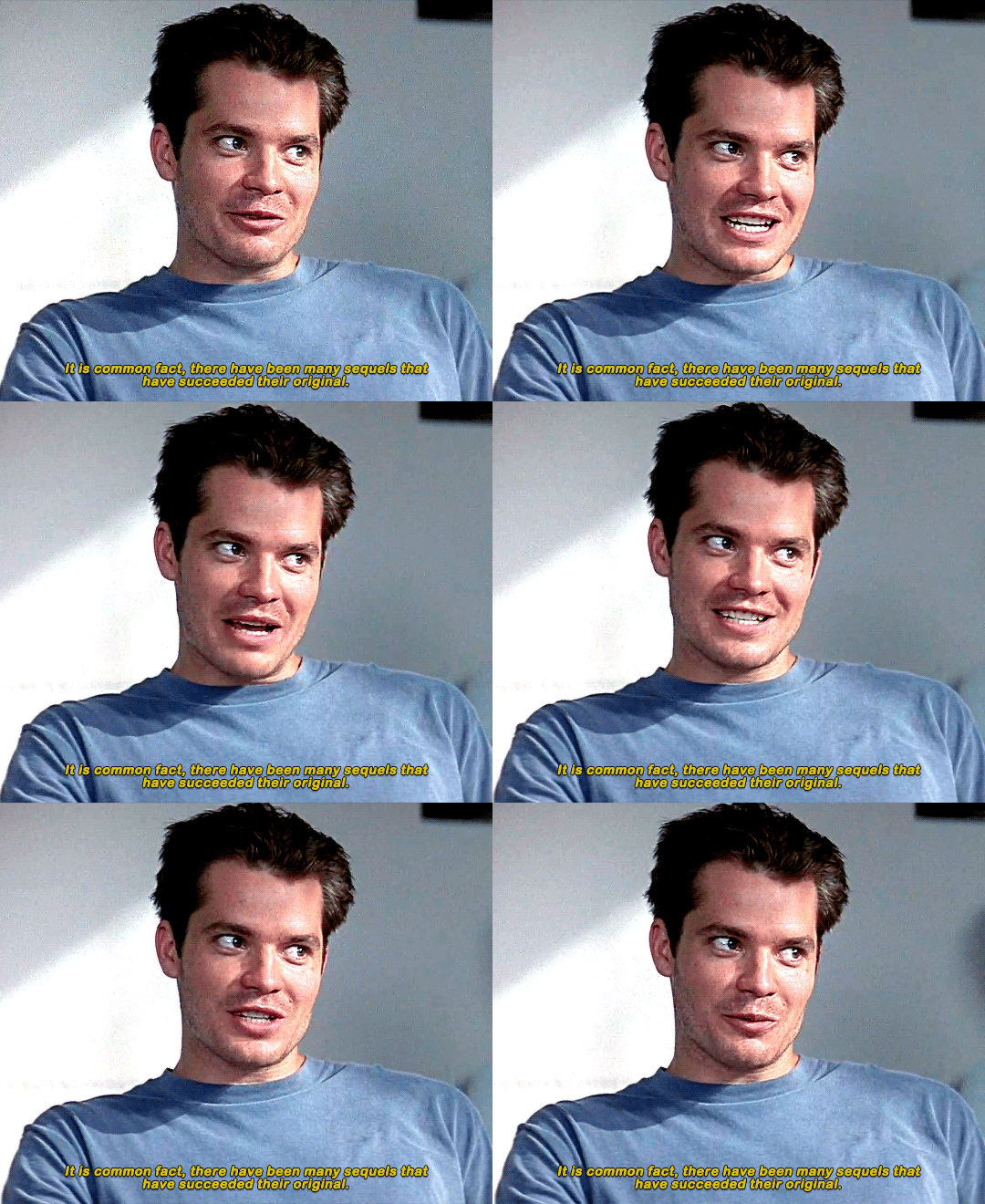
It's neither better nor worse, but exactly what a sequel should be - a perfectly balanced companion to the original, an expansion of our story that feels as natural as an inhale. The same blend of lush weirdness that made the first novel such a delightful fever dream to read is ever-present here. I loved being back in this world, back in its weird celestial spaces, dark rituals, and diverse characters.
This is, to put it simply, enjoyable. This is top tier horror fantasy.
Thanks to Edelweiss and Blackstone Publishing for the drc!
Have you read No Gods, No Monsters? Did you find it dark and mesmerizing and deliciously original? Were you fascinated by the complex characters, strange brain-breaking scenes, and thorough world-building?
Then let me introduce you to a sequel that doesn't disappoint. We Are the Crisis doesn't surpass the original, but then again what does these days?
It's neither better nor worse, but exactly what a sequel should be - a perfectly balanced companion to the original, an expansion of our story that feels as natural as an inhale. The same blend of lush weirdness that made the first novel such a delightful fever dream to read is ever-present here. I loved being back in this world, back in its weird celestial spaces, dark rituals, and diverse characters.
This is, to put it simply, enjoyable. This is top tier horror fantasy.
Thanks to Edelweiss and Blackstone Publishing for the drc!

November 2, 2023
Now Available!
The title of book two of The Convergence Saga trilogy tells you exactly where the narrative is headed. Book one: No Gods, No Monsters (which I encourage you to read or re-read first) introduced us to a world underneath our own, of battling supernatural forces, and allegorical references to otherness. It's absolutely a social commentary about power and marginalization, and left us asking ourselves who in our society are the real monsters? Turnbull further complicates the monster metaphor by introducing members of marginalized communities who are capable of transformation. Does this change our sense of the definition of monster? Who are we othering, and why?
From the first book in the series, we know how Turnbull cares for his characters. Instances of harm and injustice are keenly felt, but also surrounded by, and infused with, a complicated kind of love. With deft, precise, prose about the lives of individuals, the author communicates larger concepts about our greater society.
The author also perfectly encapsulates the kind of grief and pain which no amount of screaming can scare away. There is no doubt that this is horror, on several different levels. Sometimes the world beneath our own comes through for us, and at other times, it compounds our fears. Turnbull answers the question "If there are cracks in the Universe, what gets let in?" Ordinarily, anything one can imagine actually does exist, but not where we can get to it. We get ghostly iterations, but nothing concrete. Usually, that is. But, what if the rule regarding the veil between worlds is broken, for nefarious reasons? The story reminds us that we have monsters among us, who don't follow the rules, who have horrifying aims, and who are too chicken to do their own dirty work.
The contrast between those who want to perpetrate evil horrors for their own satisfaction, and those who want to cooperate for group benefit, could not be more stark.
I like that the author presents family relationships as they actually are in life: messy, frustrating, sometimes strained. Those who have had tragedy associated with family, often develop a keen sense of readiness for any outcome, any danger, and at the same time, a deep-level insecurity and vulnerability (which of course, drives their state of constant alertness). The idyllic family is either a façade, or a unicorn. I also like that the dialogue is natural. If a character spouts some cheesy line, another character is quick to parrot the line back to them, just to emphasize its preposterousness.
In terms of the specific plot, the second book opens with Laina, Rebecca, and Ridley on the road. Two years have gone by since the protest, and they are no closer to figuring out how to stay safe, or how to find allies. They sense danger that is always infuriatingly vague. Until it isn't. In this case, danger finds them. There is an unexpected lesson from this early confrontation, about our responsibilities to each other, and how often we neglect to do right by each other, out of fear. The experience seems to bond the trio even stronger, and make them even more determined to figure out what is happening. Turnbull makes good use of one of the oldest tropes around: how warning folks against investigating events they cannot possibly understand, is actually an invitation to do just that.
They are not sure what supernatural group they are up against, but they do know of a radical extremist human group which wishes them harm. It appears that monster hunters have morphed into a kind of monster themselves. Transformation has reached a full circle of meaning. The secret societies in this story, are the most hidden, yet have the most impact, which mirrors our society exactly. We already know that the ultrawealthy and the ultrapowerful direct everything from behind the scenes. Most people are manipulated and don't even know it. This is especially evident in the attempt by those in power behind the scenes to get two different groups to go to war against each other. Each group will think it's their own idea, that they weren't moved by an unseen hand.
It took me a while, deep into the second book to realize the beauty of Turnbull's choice of magic as metaphor. After all, what is magic, but a power greater than our own, which we don't have access to?
There are a bazillion insights to glean in this Convergence Saga, and subsequent readings reveal more of them each time. In this reading, it strikes me that the author has created parallels inside parallels. The multiverse, which the dictionary defines as "an infinite realm of being or potential being" has its conceptual counterpart in the way we bring infinite iterations of ourselves to every interaction. It's poetic and mind-expanding. It gives new meaning to the phrase "You contain Universes," because occasionally, someone does, or at the very least can traverse them.
Some of the author's concepts are more straightforward, like the attempt by the government to force monsters to carry identity cards, out of stated "concerns for the safety of the people." Every marginalized group knows the slippery slope this represents.
One of the most amazing sequences in the book, comes at the end: disaster befalling the characters at the same time, from different sources, in different places. By rotating through their points of view, the author is creating symmetry, tying the chaos together into a pattern. The source of danger could be a terrorist organization (supported clandestinely by the police), an approaching hurricane, even a supernatural cult. Or, ya know . . . all of the above.
The things to love about this book are legion. It's a perfect sequel to NO GODS, NO MONSTERS.
Thank you to NetGalley and to Blackstone Publishing, for providing an e-proof of this novel for review. And please, do not make me wait forever for the final book in the trilogy, even though you know I will.
The title of book two of The Convergence Saga trilogy tells you exactly where the narrative is headed. Book one: No Gods, No Monsters (which I encourage you to read or re-read first) introduced us to a world underneath our own, of battling supernatural forces, and allegorical references to otherness. It's absolutely a social commentary about power and marginalization, and left us asking ourselves who in our society are the real monsters? Turnbull further complicates the monster metaphor by introducing members of marginalized communities who are capable of transformation. Does this change our sense of the definition of monster? Who are we othering, and why?
From the first book in the series, we know how Turnbull cares for his characters. Instances of harm and injustice are keenly felt, but also surrounded by, and infused with, a complicated kind of love. With deft, precise, prose about the lives of individuals, the author communicates larger concepts about our greater society.
The author also perfectly encapsulates the kind of grief and pain which no amount of screaming can scare away. There is no doubt that this is horror, on several different levels. Sometimes the world beneath our own comes through for us, and at other times, it compounds our fears. Turnbull answers the question "If there are cracks in the Universe, what gets let in?" Ordinarily, anything one can imagine actually does exist, but not where we can get to it. We get ghostly iterations, but nothing concrete. Usually, that is. But, what if the rule regarding the veil between worlds is broken, for nefarious reasons? The story reminds us that we have monsters among us, who don't follow the rules, who have horrifying aims, and who are too chicken to do their own dirty work.
The contrast between those who want to perpetrate evil horrors for their own satisfaction, and those who want to cooperate for group benefit, could not be more stark.
I like that the author presents family relationships as they actually are in life: messy, frustrating, sometimes strained. Those who have had tragedy associated with family, often develop a keen sense of readiness for any outcome, any danger, and at the same time, a deep-level insecurity and vulnerability (which of course, drives their state of constant alertness). The idyllic family is either a façade, or a unicorn. I also like that the dialogue is natural. If a character spouts some cheesy line, another character is quick to parrot the line back to them, just to emphasize its preposterousness.
In terms of the specific plot, the second book opens with Laina, Rebecca, and Ridley on the road. Two years have gone by since the protest, and they are no closer to figuring out how to stay safe, or how to find allies. They sense danger that is always infuriatingly vague. Until it isn't. In this case, danger finds them. There is an unexpected lesson from this early confrontation, about our responsibilities to each other, and how often we neglect to do right by each other, out of fear. The experience seems to bond the trio even stronger, and make them even more determined to figure out what is happening. Turnbull makes good use of one of the oldest tropes around: how warning folks against investigating events they cannot possibly understand, is actually an invitation to do just that.
They are not sure what supernatural group they are up against, but they do know of a radical extremist human group which wishes them harm. It appears that monster hunters have morphed into a kind of monster themselves. Transformation has reached a full circle of meaning. The secret societies in this story, are the most hidden, yet have the most impact, which mirrors our society exactly. We already know that the ultrawealthy and the ultrapowerful direct everything from behind the scenes. Most people are manipulated and don't even know it. This is especially evident in the attempt by those in power behind the scenes to get two different groups to go to war against each other. Each group will think it's their own idea, that they weren't moved by an unseen hand.
It took me a while, deep into the second book to realize the beauty of Turnbull's choice of magic as metaphor. After all, what is magic, but a power greater than our own, which we don't have access to?
There are a bazillion insights to glean in this Convergence Saga, and subsequent readings reveal more of them each time. In this reading, it strikes me that the author has created parallels inside parallels. The multiverse, which the dictionary defines as "an infinite realm of being or potential being" has its conceptual counterpart in the way we bring infinite iterations of ourselves to every interaction. It's poetic and mind-expanding. It gives new meaning to the phrase "You contain Universes," because occasionally, someone does, or at the very least can traverse them.
Some of the author's concepts are more straightforward, like the attempt by the government to force monsters to carry identity cards, out of stated "concerns for the safety of the people." Every marginalized group knows the slippery slope this represents.
One of the most amazing sequences in the book, comes at the end: disaster befalling the characters at the same time, from different sources, in different places. By rotating through their points of view, the author is creating symmetry, tying the chaos together into a pattern. The source of danger could be a terrorist organization (supported clandestinely by the police), an approaching hurricane, even a supernatural cult. Or, ya know . . . all of the above.
The things to love about this book are legion. It's a perfect sequel to NO GODS, NO MONSTERS.
Thank you to NetGalley and to Blackstone Publishing, for providing an e-proof of this novel for review. And please, do not make me wait forever for the final book in the trilogy, even though you know I will.

December 3, 2023
We Are the Crisis is the second book in the Convergence Saga by Cadwell Turnbull and takes place three years after No Gods No Monsters. The existence of monsters is no longer a secret and, although there are many humans who are allies and are willing to fight along with them for equal rights, there are also many who see them as a threat which much be at the very least contained or even obliterated. One of these groups is the Black Hand, a violent pro-human group that may be responsible for the disappearance of many monsters.
First, what I didn’t like. I will say right off that it would be very hard to jump into this book without having read the first book in the series. Even having read it, albeit a couple of years ago, I found it a bit hard to catch up. Add to that, there are some problems that seem inherent to a middle book in a series. It does not always seem as cohesive as the first as there are many storylines, the purpose of which are not always clear, so that much of the book seems just a set up for the next book, making the story occasionally confusing and a bit draggy in places.
What I did like. It is well-written and, even when I wasn’t sure of what was going on, it still kept me immersed in the story throughout. There are a lot of moving parts packed into the story that made it hard for me to put it down. I loved how Turnbull allowed his characters to grow and change as their circumstances changed and how he blends issues like race and class into the story. Overall, I wouldn’t say I liked this as much as the first book but that’s a pretty high bar to compare it to and it did what a really good second book should do ie. I can’t wait to read the third book to see how this all works out in the end.
I read the book while listening along with the audiobook version and I gotta say Dion Graham does an absolutely spot-on job as narrator. But whether you choose to read or listen or both, if you’ve read No Goods. No Monsters, you need this book. If you haven’t, what are you waiting for?
I received an arc and audiobook from Netgalley and Blackstone Publishing in exchange for an honest review
First, what I didn’t like. I will say right off that it would be very hard to jump into this book without having read the first book in the series. Even having read it, albeit a couple of years ago, I found it a bit hard to catch up. Add to that, there are some problems that seem inherent to a middle book in a series. It does not always seem as cohesive as the first as there are many storylines, the purpose of which are not always clear, so that much of the book seems just a set up for the next book, making the story occasionally confusing and a bit draggy in places.
What I did like. It is well-written and, even when I wasn’t sure of what was going on, it still kept me immersed in the story throughout. There are a lot of moving parts packed into the story that made it hard for me to put it down. I loved how Turnbull allowed his characters to grow and change as their circumstances changed and how he blends issues like race and class into the story. Overall, I wouldn’t say I liked this as much as the first book but that’s a pretty high bar to compare it to and it did what a really good second book should do ie. I can’t wait to read the third book to see how this all works out in the end.
I read the book while listening along with the audiobook version and I gotta say Dion Graham does an absolutely spot-on job as narrator. But whether you choose to read or listen or both, if you’ve read No Goods. No Monsters, you need this book. If you haven’t, what are you waiting for?
I received an arc and audiobook from Netgalley and Blackstone Publishing in exchange for an honest review

October 5, 2023
I enjoyed this sequel more than the first book. There are still a lot of concepts, storylines, and timelines addressed in one book, and it is overall a lot.

May 30, 2024
My apologies to Netgalley, the author, and the publishers for being late on my honest review of this book. Truthfully, I sat on the read of this book as I did not feel as if I was ready to get back into such an intense, personal, and awe-inspiring work. I loved the first book in the Convergence series and didn't want this one to let down. I also didn't want to struggle with any lack of recollection of names or events.
Thank the dimensional gods that this was not so. This second book in the series opened up as if there were no break from the first, despite the five year gap in time line. Additionally, I felt as if I had never been away from this world. And quite honestly, when the book finished, I wanted to reach out to the author, Cadwell Turnbull, and demand that he keep writing.
How messed up is that?
As much as I want to be that reader: I hate to be that reader, but when can we have the next book in the series? I respect the author and the pace needed to produce such an awesome world. I await eagerly for the next installment; I have faith in the dimensional gods.
What an awesome read!
Thank the dimensional gods that this was not so. This second book in the series opened up as if there were no break from the first, despite the five year gap in time line. Additionally, I felt as if I had never been away from this world. And quite honestly, when the book finished, I wanted to reach out to the author, Cadwell Turnbull, and demand that he keep writing.
How messed up is that?
As much as I want to be that reader: I hate to be that reader, but when can we have the next book in the series? I respect the author and the pace needed to produce such an awesome world. I await eagerly for the next installment; I have faith in the dimensional gods.
What an awesome read!
August 21, 2023
Stepping back into this series a while after reading the first book felt like reuniting with a group of beloved old friends. I miss all the characters already!
This is a story of conspiracy, cults, and communities, set in a magical world as realistic as our own.
This is a story of conspiracy, cults, and communities, set in a magical world as realistic as our own.

December 20, 2023
3.5 stars.
This story picks up after the horrific ending in "No Gods, No Monsters", and continues with the darkness, love, desperation, violence and almost hopelessness described in book one. For anyone who has not read book one, do not start here.
This book is well written, and author Cadwell Turnbull dives deeper into some of his characters, expanding their experiences and responses to the existential crisis they're faced with as shapeshifters in a world that in some cases hates them enough to kill them, and in others, is debating how to integrate the shifters into society.
Some of the shifters are working to build their safety through activism, even while the monster haters, some organized into a pro-human group called the Black Hand, face off repeatedly. This action is cover for two ancient orders who have different aims and secrets and information about the gods and magic that have overtaken life.
Where I enjoyed book one unreservedly, I had a tough time getting through this book. I'm not entirely sure what did not work for me this time, as Turnbull writes wonderfully, and does interesting things with his characters. I particularly liked his exploration of characters, and how they are coping with the upending of their world, whether because of their new powers, or because of their fear over the changes to those they knew, or their assumptions about their world. The book is wonderfully dark with big stakes, and I just wish I had enjoyed it more than I did.
Thank you to Netgalley and to Blackstone Publishing for this ARC in exchange for my review.
This story picks up after the horrific ending in "No Gods, No Monsters", and continues with the darkness, love, desperation, violence and almost hopelessness described in book one. For anyone who has not read book one, do not start here.
This book is well written, and author Cadwell Turnbull dives deeper into some of his characters, expanding their experiences and responses to the existential crisis they're faced with as shapeshifters in a world that in some cases hates them enough to kill them, and in others, is debating how to integrate the shifters into society.
Some of the shifters are working to build their safety through activism, even while the monster haters, some organized into a pro-human group called the Black Hand, face off repeatedly. This action is cover for two ancient orders who have different aims and secrets and information about the gods and magic that have overtaken life.
Where I enjoyed book one unreservedly, I had a tough time getting through this book. I'm not entirely sure what did not work for me this time, as Turnbull writes wonderfully, and does interesting things with his characters. I particularly liked his exploration of characters, and how they are coping with the upending of their world, whether because of their new powers, or because of their fear over the changes to those they knew, or their assumptions about their world. The book is wonderfully dark with big stakes, and I just wish I had enjoyed it more than I did.
Thank you to Netgalley and to Blackstone Publishing for this ARC in exchange for my review.

May 2, 2024
I adored the first book and there was plenty I really liked about this sequel. But sadly, I was also very confused. That was not my experience with the first book where I trusted the process and the author to catch me up at some point. This time, I think the confusion was due to my inability to keep any names in my head whatsoever. I was very lost. Nevertheless, I love what Turnbull is doing with the perspectives and the characters and the absolute impeccable world building - but I will have to reread the first two books in preparation for the third one for sure. Maybe take some notes.

January 17, 2024
The first book in this series No Gods, No Monsters was by first book by Cadwell Turnbull. It is an Anarchist werewolf novel with lots of cosmic horror. It is a book that has a major character who is a member of a collective book shop that is a bi-racial, asexual trans anarchist who grew up reading Leguin and Bakunin alike. In many ways, this novel’s pitch-black fantasy and moments of cosmic horror combined with monsters we can root for feels like Clive Barker’s Cabal if he grew up listening to anarcho-punk and being an activist. If I read the book without a bio and author photo I might have stereotyped the author as a green-haired crust punk, but Turnbull is a black author who grew up in the U.S. Virgin Islands.
I had him on the podcast see it here:
https://www.youtube.com/watch?v=WwT1C...
Now in the interview, he admits at the time he had not yet read Barker, the comparisons were not intentional. This series referred to as the Convergence Saga takes place mostly around Boston after ‘the fracture effect’ an event that outs the existence of monsters to the world. The first novel that centered around an anarchist bookstore and activism was something I related to and had locked me in for this series.
Set three years after the first book, members of the wolf pack are starting to disappear and the suspects are a radical ant-monster group called Black Hand. This group seems to mirror the rise of MAGA and anti-LBGTQ organizing that we have seen rise as society has become more accepting. On the surface, it would be easy to paint this series as a civil rights allegory. It is that but also touches on cosmic horror elements and magic itself.
As much as I loved the first book I had to re-read my review to stoke my memory, that said as soon as I started to read the story came back to me. Again the activism at the heart of the story worked better for me than the action.
Like the first book, the first scene to stand out to me was a meeting of New Era a pro-monster group. Turnbull is interested in how these communities organize, and you do that through meetings. “Ridley, for those who don’t know me, I co-own the bookstore in Union Square, in Sommerville. I don’t mean to speak out of turn, but when you say ‘protect each other,’ how far are you willing to go?”
No one has an easy answer to that question. The scene where a woman becomes a wolf in the meeting is one of the most powerful of the series.
“You can look at her,” Ridley is saying. “That’s the whole point. See that she is not dangerous.”
In the modern world, the right is organized around and by othering, and creating fear of immigrants, Trans people, and liberals themselves who they mock as Lib-tards. The chief allegory of this series could seem on the nose if it was so accurate in scenes like this. This could come off as silly, and it requires the reader to step off the cliff with their imagination a bit.
Civil rights and the debate over them appear to be the theme of this book and the cosmic forces directing the pro and anti-monster in a war or conflict is where we are heading. We Are the Crisis feels like it says sides, corners, and ideas I can’t come close to understanding all of. I think that is one of the best things about it. The level of thought and care in the storytelling is clear. If you were dispassionately describing the concept it might sound goofy. It is not, it is powerful storytelling that speaks to the struggles of otherness in our culture.
I had him on the podcast see it here:
https://www.youtube.com/watch?v=WwT1C...
Now in the interview, he admits at the time he had not yet read Barker, the comparisons were not intentional. This series referred to as the Convergence Saga takes place mostly around Boston after ‘the fracture effect’ an event that outs the existence of monsters to the world. The first novel that centered around an anarchist bookstore and activism was something I related to and had locked me in for this series.
Set three years after the first book, members of the wolf pack are starting to disappear and the suspects are a radical ant-monster group called Black Hand. This group seems to mirror the rise of MAGA and anti-LBGTQ organizing that we have seen rise as society has become more accepting. On the surface, it would be easy to paint this series as a civil rights allegory. It is that but also touches on cosmic horror elements and magic itself.
As much as I loved the first book I had to re-read my review to stoke my memory, that said as soon as I started to read the story came back to me. Again the activism at the heart of the story worked better for me than the action.
Like the first book, the first scene to stand out to me was a meeting of New Era a pro-monster group. Turnbull is interested in how these communities organize, and you do that through meetings. “Ridley, for those who don’t know me, I co-own the bookstore in Union Square, in Sommerville. I don’t mean to speak out of turn, but when you say ‘protect each other,’ how far are you willing to go?”
No one has an easy answer to that question. The scene where a woman becomes a wolf in the meeting is one of the most powerful of the series.
“You can look at her,” Ridley is saying. “That’s the whole point. See that she is not dangerous.”
In the modern world, the right is organized around and by othering, and creating fear of immigrants, Trans people, and liberals themselves who they mock as Lib-tards. The chief allegory of this series could seem on the nose if it was so accurate in scenes like this. This could come off as silly, and it requires the reader to step off the cliff with their imagination a bit.
Civil rights and the debate over them appear to be the theme of this book and the cosmic forces directing the pro and anti-monster in a war or conflict is where we are heading. We Are the Crisis feels like it says sides, corners, and ideas I can’t come close to understanding all of. I think that is one of the best things about it. The level of thought and care in the storytelling is clear. If you were dispassionately describing the concept it might sound goofy. It is not, it is powerful storytelling that speaks to the struggles of otherness in our culture.
May 31, 2024
I listened to this book while I also read the physical copy that I received from the public library. Dion Graham did a great job of narrating the text. The inflection and differing volume in the voices let you know when someone different was speaking and the pace was good. I was able to easily follow along (at certain points I just listened to it in the car without the text in front of me and was able to go back to the book without a problem).
What can I say about this book? Turnbull knows how to pack a lot into a few hundred pages! I’ve read books that don’t have nearly as much character development or plot as these two Turnbull books have. Honestly, if these books were chunked and separated, you could probably get material for 6-7 separate tomes, but somehow Turnbull packs it all into two books.
I enjoyed this book. I think it is a fitting sequel to No Gods, No Monsters. In this book we learn about what has happened to our familiar characters while meeting a few new ones. The story has moved past the events in the first book and war is definitely forecast for the third book. All of the groups are engaging their members at this point and preparing for the inevitable showdown!
What I want to know is how are all of the multiverses going to come together? Will the monsters move to another universe? Is that possible? Waiting on book 3…
What can I say about this book? Turnbull knows how to pack a lot into a few hundred pages! I’ve read books that don’t have nearly as much character development or plot as these two Turnbull books have. Honestly, if these books were chunked and separated, you could probably get material for 6-7 separate tomes, but somehow Turnbull packs it all into two books.
I enjoyed this book. I think it is a fitting sequel to No Gods, No Monsters. In this book we learn about what has happened to our familiar characters while meeting a few new ones. The story has moved past the events in the first book and war is definitely forecast for the third book. All of the groups are engaging their members at this point and preparing for the inevitable showdown!
What I want to know is how are all of the multiverses going to come together? Will the monsters move to another universe? Is that possible? Waiting on book 3…
This entire review has been hidden because of spoilers.

December 12, 2022
How do you review a second book in a series that feels more like a straight continuation yet just as mysterious and unknowable as its first book?
I stand by my early assessment of this series that 1. it's best read as a group discussion and 2. I think the series is larger than its parts.
While I can't lie that I felt at times this reading experience was frustrating at times, I am still wholeheartedly in love with these characters and these worlds. We are getting deeper into the minutae of the magical aspects, Cal is still being sneaky, and connecting the dots feels like you at the top of a rollercoaster.
It's one hell of a ride!
I think I will probally try for a more coherent review once I've reread this cause that seems to be the pattern with me and Turnbull.
I received an advanced reading copy from Blackstone Publishing through NetGalley in exchange for an honest review.
original comment:
"No Gods, No Monsters is the reckoning. We Are the Crisis is the backlash once the world generally makes up its mind about what is happening. The focus is the social change, told through the characters. But many of the characters will also be invested in finding answers to better understand the monster world. They’ll find some of what they’re looking for, and some of what they’re not. It's several years into the future."
And the cover looks brilliant!
I stand by my early assessment of this series that 1. it's best read as a group discussion and 2. I think the series is larger than its parts.
While I can't lie that I felt at times this reading experience was frustrating at times, I am still wholeheartedly in love with these characters and these worlds. We are getting deeper into the minutae of the magical aspects, Cal is still being sneaky, and connecting the dots feels like you at the top of a rollercoaster.
It's one hell of a ride!
I think I will probally try for a more coherent review once I've reread this cause that seems to be the pattern with me and Turnbull.
I received an advanced reading copy from Blackstone Publishing through NetGalley in exchange for an honest review.
original comment:
"No Gods, No Monsters is the reckoning. We Are the Crisis is the backlash once the world generally makes up its mind about what is happening. The focus is the social change, told through the characters. But many of the characters will also be invested in finding answers to better understand the monster world. They’ll find some of what they’re looking for, and some of what they’re not. It's several years into the future."
And the cover looks brilliant!
November 5, 2023
Parts of the prose feel a little disjointed in this one - something that typically reads better as audio than print - but I still loved the monsters, the multiverse, the collective politics, and the reflective tone. I probably should have reread No Gods No Monsters first, but I'll read them back to back again as a reread some day. There's a lot of layers here in this book, and it has the feel of a building storm (as Sondra so eerily thinks as a hurricane comes through VI). But this book is deeply Boston - set in Somerville, JP, Medford, Watertown, downtown, it's an easy-to-imagine underbelly of the streets I know so well.
Genre: speculative fiction, horror
Boston, MA, 2025
Three years after the Boston Massacre, when Monsters first came into the public eye, there is a calm before another storm. Prejudice against monsters is strong, but there’s support building, too. Activist groups have sprung up, in support of and against monsters. Even those with ties to the wolves, vampires, and creatures from other cultures aren’t sure how public they should go, knowing their lives are at risk. From Somerville to the Virgin Islands, there’s also a call for the rise in cooperatives, which fits with the Pack Magic mentality of the werewolves and other monsters, knowing that they’re stronger together than apart.
There is nothing scarier than a near-future speculative fiction/horror book that takes place on the streets of your own city, especially when there are components that feel so real. We are the Crisis is deeply Boston - set in Somerville, JP, Medford, Watertown, as well as downtown - and Turnbull writes an easy-to-imagine underbelly of the streets I know so well.
There are a lot of layers to this book, and I look forward to diving deeper into them on a future reread. I didn’t reread No Gods No Monsters first, so I spent more time that I’d like to admit reorienting myself to the characters and their perils. That’s not to say Turnbull doesn’t do a good job of re-introducing those characters, because he does! The first half of the book sets the stage like the building storm, positioning characters before the crisis itself.
We are the Crisis was an excellent followup to No Gods No Monsters, from queer normativity and collective politics to a monstrous multiverse and interdimensional gods. I can’t recommend this series enough.
Genre: speculative fiction, horror
Boston, MA, 2025
Three years after the Boston Massacre, when Monsters first came into the public eye, there is a calm before another storm. Prejudice against monsters is strong, but there’s support building, too. Activist groups have sprung up, in support of and against monsters. Even those with ties to the wolves, vampires, and creatures from other cultures aren’t sure how public they should go, knowing their lives are at risk. From Somerville to the Virgin Islands, there’s also a call for the rise in cooperatives, which fits with the Pack Magic mentality of the werewolves and other monsters, knowing that they’re stronger together than apart.
There is nothing scarier than a near-future speculative fiction/horror book that takes place on the streets of your own city, especially when there are components that feel so real. We are the Crisis is deeply Boston - set in Somerville, JP, Medford, Watertown, as well as downtown - and Turnbull writes an easy-to-imagine underbelly of the streets I know so well.
There are a lot of layers to this book, and I look forward to diving deeper into them on a future reread. I didn’t reread No Gods No Monsters first, so I spent more time that I’d like to admit reorienting myself to the characters and their perils. That’s not to say Turnbull doesn’t do a good job of re-introducing those characters, because he does! The first half of the book sets the stage like the building storm, positioning characters before the crisis itself.
We are the Crisis was an excellent followup to No Gods No Monsters, from queer normativity and collective politics to a monstrous multiverse and interdimensional gods. I can’t recommend this series enough.

August 3, 2023
Cadwell Turnbull’s latest book will release in November of this year. It starts three years after the events in No Gods No Monsters, the first book of an expected trilogy. You can find my review of that first book here.
I had the opportunity to grab an advanced copy of the new book from Netgalley recently. I had such great fun with the first book (I gave it 5 stars) that I immediately dropped my other reading - I’m in the middle of four other books right now - and dove into We Are the Crisis .
Many of my comments on the first book also apply here. The new book is also a well written page turner with multiple story lines and multiple monsters and multiple universes. It can be overwhelming, especially as you try to remember back to the events of the first book. It’s true that We Are the Crisis can be a frustrating read. It’s also true that it’s a fascinating mishmash of a book. I am still not entirely sure where this series is going, but I am enjoying the ride.
I will try to give you a bit of a synopsis of the book with the caveat that no summary can do these books justice - there is just too much going on. But here goes:
In Book 1, in a world almost exactly like ours, monsters are suddenly revealed to be real. It all starts in Boston with Liana whose brother had been shot and killed by Boston police. She learns that videotape of his death is available and reveals that in fact her brother was a werewolf. Monsters are real and the world must begin to cope with that fact. Turns out that doesn’t go too well at all, culminating in the “Monster Massacre”.
Book 2 starts three years after the massacre. Monsters have gone undercover. A militant group called the Black Hand is stalking monsters. A number of plotlines reveal themselves in Book 2, some with characters we’ve met before, others introducing new characters. This all culminates in… well, maybe I shouldn’t give too much away.
Suffice it to say that enough is revealed - and not revealed - to leave me wanting more. I’ll just have to wait patiently for Book 3.
I will caution that these books are not for everyone - it takes some patience and persistence to read them, as Turnbull slowly, slowly reveals the wheels within wheels that tie these stories together. One thing that made that easier in Book 1 was the excellent writing. I didn’t find the writing in We Are the Crisis to be as consistently excellent. And the plotlines here seem, if anything, denser than No Gods, No Monsters. Regardless, I devoured this book.
RATING: Five Stars ⭐⭐⭐⭐⭐
NOTE: I read an advanced review copy of the book courtesy of NetGalley and Blackstone Publishing. The book will be available on November 7, 2023.
I had the opportunity to grab an advanced copy of the new book from Netgalley recently. I had such great fun with the first book (I gave it 5 stars) that I immediately dropped my other reading - I’m in the middle of four other books right now - and dove into We Are the Crisis .
Many of my comments on the first book also apply here. The new book is also a well written page turner with multiple story lines and multiple monsters and multiple universes. It can be overwhelming, especially as you try to remember back to the events of the first book. It’s true that We Are the Crisis can be a frustrating read. It’s also true that it’s a fascinating mishmash of a book. I am still not entirely sure where this series is going, but I am enjoying the ride.
I will try to give you a bit of a synopsis of the book with the caveat that no summary can do these books justice - there is just too much going on. But here goes:
In Book 1, in a world almost exactly like ours, monsters are suddenly revealed to be real. It all starts in Boston with Liana whose brother had been shot and killed by Boston police. She learns that videotape of his death is available and reveals that in fact her brother was a werewolf. Monsters are real and the world must begin to cope with that fact. Turns out that doesn’t go too well at all, culminating in the “Monster Massacre”.
Book 2 starts three years after the massacre. Monsters have gone undercover. A militant group called the Black Hand is stalking monsters. A number of plotlines reveal themselves in Book 2, some with characters we’ve met before, others introducing new characters. This all culminates in… well, maybe I shouldn’t give too much away.
Suffice it to say that enough is revealed - and not revealed - to leave me wanting more. I’ll just have to wait patiently for Book 3.
I will caution that these books are not for everyone - it takes some patience and persistence to read them, as Turnbull slowly, slowly reveals the wheels within wheels that tie these stories together. One thing that made that easier in Book 1 was the excellent writing. I didn’t find the writing in We Are the Crisis to be as consistently excellent. And the plotlines here seem, if anything, denser than No Gods, No Monsters. Regardless, I devoured this book.
RATING: Five Stars ⭐⭐⭐⭐⭐
NOTE: I read an advanced review copy of the book courtesy of NetGalley and Blackstone Publishing. The book will be available on November 7, 2023.
Want to Read
September 1, 2023got the arc!!!!!!!!!!!! (i'm gonna need a recap of the first book lol)
April 17, 2026
4.5 stars rounded up to 5
Did I gave an extra 0.25 stars for Yeats alone? Of course I have!
Turnbull is an author to watch out for. He is still breaking my mind, but the characters and events are finally coming together.
I loved the many dimensional characters, their lore, their gains and losses and how real they've felt. I am already sad that I only have one book and this adventure will be over for me.
"Like it or not, the monsters in our community come from the same places we do, with the same histories. They are from the stories we carried over the sea with us."
Did I gave an extra 0.25 stars for Yeats alone? Of course I have!
Turnbull is an author to watch out for. He is still breaking my mind, but the characters and events are finally coming together.
I loved the many dimensional characters, their lore, their gains and losses and how real they've felt. I am already sad that I only have one book and this adventure will be over for me.
"Like it or not, the monsters in our community come from the same places we do, with the same histories. They are from the stories we carried over the sea with us."
April 5, 2025
Je n'ai pas réussi à rentrer dans le livre. L'idée est intéressante, mais ... Voilà.

November 17, 2023
I love love love love love this series! I also cannot recommend stronger that you read it by listening to the audiobooks. The narrator is perfection… The most handsome deep voice it's simply butter! I absolutely love this series and I got to say I don't remember if I gave the first book five stars… I probably did… But I really liked the second book even more. I think what was so interesting about the first book is you're not exactly sure what is going on and when you figure it out you're like… Well hell that was quite the twist! But then the second book explains so much more about this world which I think was even more enjoyable even though I really love a good twist! Really if you like social commentary sci-fi/fantasy you gotta read this book… Well I mean listen to this book because like I said butter people! I actually really hope they turned it into a series because damn Cauldwell Trumbull is a phenomenal writer… And storyteller!

October 8, 2023
3.75. The second of three in the Convergence Saga and sequel to No Gods, No Monsters, We Are The Crisis is set a few years after the first book. In the first, the world comes to know that monsters exist. In this installment, the world is processing what that means, and the reactions vary from extrajudicial violence to solidarity movements to debates on legislating equal protections; Turnbull weaves in conversations about monsters and their place in society happening on the streets, in governance, and in families. Like it’s predecessor, We Are The Crisis has a large ensemble cast of characters and multiple plot lines (some of which eventually intersect), together constructing a large-scale narrative of a world reckoning with a new reality; some of the characters are familiar from book one, while others are new. This will not be a book for everyone — it in some ways reads more like literary fiction than anything, and it is entirely non-linear; at times it reads more like a series of vignettes than a single novel. As someone who enjoys novels like this (and television like this, really — the kind of narratives where the setting is akin to a character whose struggles are revealed through those of disparate characters) I really love this series. The only reason I’d rate this lower than the first book is because it does feel very ‘middle book’ — some threads come together but it doesn’t end in a conclusive way, so it has left me eagerly awaiting book three.
Content warnings: violence, murder, blood, hate crime
Thank you to NetGalley and Blackstone Publishing for providing an ARC in exchange for this review.
Content warnings: violence, murder, blood, hate crime
Thank you to NetGalley and Blackstone Publishing for providing an ARC in exchange for this review.

August 8, 2023
"How is it even possible to change a person by telling them a story?" One of the many protagonists in the book asks, before the story's climax. The answer is hidden in plain sight throughout the book. Part of it lies in our power of creation, in building our world with what we believe.
WE ARE THE CRISIS opens with conflict and never lets you forget what is at stake for the monsters, despite how they get on with life, and adjust to the new normal, from being barely tolerated to being hunted.
Yes, it's a book about monsters. And about inclusion, class, and negotiating power. It's urgent and furious, but does not simplify the obstacles and probable solutions, which do not rest on one chosen hero but in the collective effort of many.
I enjoyed THE LESSON, and NO GODS NO MONSTERS, and this book certainly delivers! Highly recommend.
WE ARE THE CRISIS opens with conflict and never lets you forget what is at stake for the monsters, despite how they get on with life, and adjust to the new normal, from being barely tolerated to being hunted.
Yes, it's a book about monsters. And about inclusion, class, and negotiating power. It's urgent and furious, but does not simplify the obstacles and probable solutions, which do not rest on one chosen hero but in the collective effort of many.
I enjoyed THE LESSON, and NO GODS NO MONSTERS, and this book certainly delivers! Highly recommend.
February 16, 2025
Initially intended on reading this like the first, but got so behind on ARCs that I decided to audiobook it lest my goldfish brain forget what happened. I don't know if that's why I didn't like this one as much. I think I looked the first because of the balance of real life anarchist and other community and the fantasy elements, whereas this one felt heavier on the fantasy which isn't usually what I go for. I'll stop definitely read further entries in the series and there's still plenty of cool things in this one.

August 12, 2023
I loved No Gods, No Monsters and was thrilled to be given the opportunity to read this book.
It has so much going on, I cannot wait for the conclusion in the the next book!
read if you are a fan of; chosen families, betrayal, supernatural, complicated stories
I just reviewed We Are the Crisis by Cadwell Turnbull. #WeAretheCrisis #NetGalley
It has so much going on, I cannot wait for the conclusion in the the next book!
read if you are a fan of; chosen families, betrayal, supernatural, complicated stories
I just reviewed We Are the Crisis by Cadwell Turnbull. #WeAretheCrisis #NetGalley

May 2, 2024
Cadwell Turnbull takes us on a wild ride (AGAIN). I am so thankful I had a character chart (from a book friend) to help trace who was who. We are the Crisis a tumulous and spacey ride. It keeps you hooked and guessing. It chilled my blood. It made me laugh. It made me wonder. Turnbull does not suffer from second-book syndrome with this one.

Want to Read
July 26, 2023i'm so excited i'm going to scream continuously until november
October 31, 2023
I was so, so excited to get my grubby little hands on an eARC of We Are the Crisis this month because of how much I loved No Gods No Monsters. I’ve spent the past two years trying to get everyone I know who is even vaguely interested in fantasy to pick up No Gods No Monsters, which I keep unsuccessfully pitching as “Succubus Blues by way of Riot Baby” and Amal el-Mohtar once described as “like listening to a symphony that’s trying to eat you.”
No Gods No Monsters has a queer werewolf poly triad running a bookstore, a deeply dysfunctional mutual aid co-op, secret societies, dark conspiracies, incredibly awkward dinner parties, and monsters just trying to get on with things. It’s told from the perspective of a deeply involved narrator whose motives are opaque, who head-hops with wild abandon and stops the whole story to have conversations with dead academics. It’s weird, and wild, and wonderful, and I can’t recommend it enough.
I really wish I could tell you that We Are the Crisis is just as good, but it left me feeling a little flat. I still had a great time, but it didn’t do anything new. All of the elements that made me fall in love with No Gods remained present, but the number of plot threads was a little overwhelming, and the overarching narrative showed these threads crossing each other but never quite tying together, which I found frustrating.
We Are the Crisis is, structurally speaking, just plain weird. We flip through characters of interest with very little pattern, with flashbacks woven in to the present throughout. Critical plot points are relayed third- or even fourth-hand, the narrator’s level of involvement varies wildly from section to section, and the prose is sparse and distant. I loved this style in No Gods and continued to really enjoy it here, and if anything I would appreciated Turnbull leaning even harder into that weirdness.
I think We Are the Crisis is ultimately suffering a little bit from middle-book syndrome, leaving the reader with too little new information and too few conclusions to feel satisfied. No Gods No Monsters was always going to be a hard act to follow, so even though I was a little disappointed I’m still very much looking forward to the next one.
No Gods No Monsters has a queer werewolf poly triad running a bookstore, a deeply dysfunctional mutual aid co-op, secret societies, dark conspiracies, incredibly awkward dinner parties, and monsters just trying to get on with things. It’s told from the perspective of a deeply involved narrator whose motives are opaque, who head-hops with wild abandon and stops the whole story to have conversations with dead academics. It’s weird, and wild, and wonderful, and I can’t recommend it enough.
I really wish I could tell you that We Are the Crisis is just as good, but it left me feeling a little flat. I still had a great time, but it didn’t do anything new. All of the elements that made me fall in love with No Gods remained present, but the number of plot threads was a little overwhelming, and the overarching narrative showed these threads crossing each other but never quite tying together, which I found frustrating.
We Are the Crisis is, structurally speaking, just plain weird. We flip through characters of interest with very little pattern, with flashbacks woven in to the present throughout. Critical plot points are relayed third- or even fourth-hand, the narrator’s level of involvement varies wildly from section to section, and the prose is sparse and distant. I loved this style in No Gods and continued to really enjoy it here, and if anything I would appreciated Turnbull leaning even harder into that weirdness.
I think We Are the Crisis is ultimately suffering a little bit from middle-book syndrome, leaving the reader with too little new information and too few conclusions to feel satisfied. No Gods No Monsters was always going to be a hard act to follow, so even though I was a little disappointed I’m still very much looking forward to the next one.

November 24, 2023
I was provided an ARC of this book via Netgalley, however I listened to the audiobook as I did with book 1. As with all of my reviews, all opinions are my own.
This picks up a few years after No Gods, No Monsters with the world still reeling after the revelation that the supernatural monsters from myth do exist in the real world. Activist groups form for and against monsters living within society and the politics parallel what we see today regarding various minority groups. The author does a great job using the supernatural and horror elements in this series as allegory to discuss very real social commentary issues. The world building is very well done.
This is told in a non-linear fashion as the story unfolds and isn't always told in the same dimension as the author uses the concept of the multiverse to tell the story. I'm not sure if there is another book, I hope there is because I have alot of unanswered questions. You absolutely need to read the first book before diving into this book, as the world and way the story is told is complex. There is also a large cast of characters to keep track of so wouldn't start in the middle. I had a harder time keeping track of what was going on in this second installment as I did in the first book. The storyline keeps getting more and more complex. The ending is a bit open ended for my tastes, but I do believe this is a trilogy so I will patiently wait to find out how things play out. Turnbull is a masterful writer who uses fantasy and horror in a unique away to tell a powerful story.
This picks up a few years after No Gods, No Monsters with the world still reeling after the revelation that the supernatural monsters from myth do exist in the real world. Activist groups form for and against monsters living within society and the politics parallel what we see today regarding various minority groups. The author does a great job using the supernatural and horror elements in this series as allegory to discuss very real social commentary issues. The world building is very well done.
This is told in a non-linear fashion as the story unfolds and isn't always told in the same dimension as the author uses the concept of the multiverse to tell the story. I'm not sure if there is another book, I hope there is because I have alot of unanswered questions. You absolutely need to read the first book before diving into this book, as the world and way the story is told is complex. There is also a large cast of characters to keep track of so wouldn't start in the middle. I had a harder time keeping track of what was going on in this second installment as I did in the first book. The storyline keeps getting more and more complex. The ending is a bit open ended for my tastes, but I do believe this is a trilogy so I will patiently wait to find out how things play out. Turnbull is a masterful writer who uses fantasy and horror in a unique away to tell a powerful story.
August 14, 2025
The monsters are "out" and society isn't sure how they fit into the fabric of society. The first book in this series *No Gods No Monsters* was a delicious and sweetly ambiguous story that was clearly a metaphor for civil rights and belonging. It was one of my favorite books of the last few years, and though it was VERY twisty and confusing at times, I was very satisfied with the brutal conclusion.
*Crisis* behaves in many of the same ways. You as a reader aren't meant to know what's going on and are usually led by the author down dark hallways full of strange noises without a flashlight. This book does fall into the "middle book" problem of trying to get all of the chess pieces into the right places. But in this rare case I didn't find that a problem. I enjoyed Crisis quite a bit, and Turnbull's wonderful writing kept me hanging on with this unusual story gently promising that they payoff (the third book) will be worthy of patience. While not as brutal or wildly bizarre as *No Gods*, it's still at home in the universe we know.
This series is honestly one of my favorites, especially in the weird fiction realm. However I will warn that for those whose patience wanders a bit, or you read before bed and let a book lull you to sleep... it's not going to be an easy experience. A LOT going on, and Turnbull plays with the veil of reality often. Read the books together, re-read them if needed for best results.
I'm just glad I won't have to wait long for part three...
*Crisis* behaves in many of the same ways. You as a reader aren't meant to know what's going on and are usually led by the author down dark hallways full of strange noises without a flashlight. This book does fall into the "middle book" problem of trying to get all of the chess pieces into the right places. But in this rare case I didn't find that a problem. I enjoyed Crisis quite a bit, and Turnbull's wonderful writing kept me hanging on with this unusual story gently promising that they payoff (the third book) will be worthy of patience. While not as brutal or wildly bizarre as *No Gods*, it's still at home in the universe we know.
This series is honestly one of my favorites, especially in the weird fiction realm. However I will warn that for those whose patience wanders a bit, or you read before bed and let a book lull you to sleep... it's not going to be an easy experience. A LOT going on, and Turnbull plays with the veil of reality often. Read the books together, re-read them if needed for best results.
I'm just glad I won't have to wait long for part three...

October 31, 2024
Le roman reprend quelques temps après les évènements du tome 1 et nous replonge rapidement dans l'action. J'avoue que j'ai eu un peu de mal à retrouver qui est qui (il y a vraiment beaucoup de personnages dans cette saga) mais ça n'a pas non plus été trop gênant. Ceci étant dit, si vous avez la possibilité de relire le tome 1 avant de vous lancer dans cette suite, c'est probablement une bonne idée.
⠀
Je me souviens m'être un peu senti perdu dans la première partie du tome 1 mais ça n'a pas été le cas ici. Bien sûr, l'intrigue reste assez dense et il y a toujours des moments où on voit bien qu'on ne comprend pas tout, mais j'ai trouvé que c'était vraiment bien dosé et que ça ne suscitait pas de frustration. Pas chez moi en tout cas.
⠀
Petit à petit, on commence à en apprendre plus sur cet univers, à mieux comprendre les dynamiques des différents groupes, et surtout à mieux appréhender toutes les bizarreries du roman. Pour autant, je sais qu'une fois le tome 3 paru (et lu), il sera vraiment intéressant de relire les 3 tomes à la suite en connaissant tous les tenants et les aboutissants de la série pour pouvoir vraiment tout comprendre.
⠀
Cette série est extrêmement particulière mais je m'y suis vraiment attaché tellement je trouve que l'auteur a fait du bon boulot. J'ai vraiment hâte d'avoir le fin mot de l'histoire pour comprendre les choix de l'auteur et découvrir pourquoi certains évènements réels ont été intégrés à l'histoire (et modifiés). Nul doute que l'explication finale sera surprenante et terriblement efficace.
⠀
Je me souviens m'être un peu senti perdu dans la première partie du tome 1 mais ça n'a pas été le cas ici. Bien sûr, l'intrigue reste assez dense et il y a toujours des moments où on voit bien qu'on ne comprend pas tout, mais j'ai trouvé que c'était vraiment bien dosé et que ça ne suscitait pas de frustration. Pas chez moi en tout cas.
⠀
Petit à petit, on commence à en apprendre plus sur cet univers, à mieux comprendre les dynamiques des différents groupes, et surtout à mieux appréhender toutes les bizarreries du roman. Pour autant, je sais qu'une fois le tome 3 paru (et lu), il sera vraiment intéressant de relire les 3 tomes à la suite en connaissant tous les tenants et les aboutissants de la série pour pouvoir vraiment tout comprendre.
⠀
Cette série est extrêmement particulière mais je m'y suis vraiment attaché tellement je trouve que l'auteur a fait du bon boulot. J'ai vraiment hâte d'avoir le fin mot de l'histoire pour comprendre les choix de l'auteur et découvrir pourquoi certains évènements réels ont été intégrés à l'histoire (et modifiés). Nul doute que l'explication finale sera surprenante et terriblement efficace.

November 8, 2023
WARNING: SPOILER ALERT
OTHER WARNING: DO NOT READ THIS BOOK UNLESS YOU HAVE READ ITS PREDECESSOR, NO GODS, NO MONSTERS
I REALLY liked the first book in what is now a series (at least a trilogy), No Gods, No Monsters. I honestly didn't realize there would be a second book, but I was excited to read it. I don't want to say I was disappointed, but it was a lot slower and more politically centered than I usually can get my teeth into (no pun intended). There are a few great scenes and the last few chapters are amazing, but a good portion of the book was easily skimmable.
Having said this, I look forward to the 3rd book and hope i get the chance to review it as well. Cadwell Turnbull is a fantastic, imaginative author.
Thanks to Netgalley, Black Stone Publishing and of course, Cadwell Turnbull for the opportunity to read and review this ARC. All opinions are my own.
OTHER WARNING: DO NOT READ THIS BOOK UNLESS YOU HAVE READ ITS PREDECESSOR, NO GODS, NO MONSTERS
I REALLY liked the first book in what is now a series (at least a trilogy), No Gods, No Monsters. I honestly didn't realize there would be a second book, but I was excited to read it. I don't want to say I was disappointed, but it was a lot slower and more politically centered than I usually can get my teeth into (no pun intended). There are a few great scenes and the last few chapters are amazing, but a good portion of the book was easily skimmable.
Having said this, I look forward to the 3rd book and hope i get the chance to review it as well. Cadwell Turnbull is a fantastic, imaginative author.
Thanks to Netgalley, Black Stone Publishing and of course, Cadwell Turnbull for the opportunity to read and review this ARC. All opinions are my own.
October 30, 2023
Disjointed scenes. Kept wondering how they were all going to fit together. That doesn’t happen until the end, and I mean the very end. Middle book of a trilogy and I feel it’s definitely one of those where it is best to read the first volume before cracking this one open. Interesting characters although to me they were mostly one dimensional. Some graphic violence. Unusual plot set in the near future in a world of multi-verses. Wonder if the story’s theme of humans vs monsters is allegorical of the world’s cultural and political divisions. I sure see the similarities. I know a lot of people love this series of books, but for me it was just okay. 3.75 stars
Displaying 1 - 30 of 201 reviews