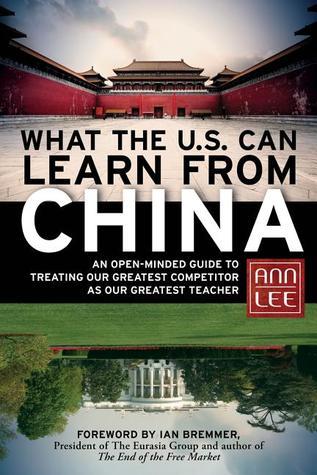
I read this book with great anticipation, as it is the first to turn the mirror on American economic policy and planning, from a comparative perspective involving China, and it does so insightfully and compellingly. Lee clearly speaks as the insider she is on financial matters, and as one who has long straddled two cultures. The prudent pragmatism of China's leadership has helped it to avoid the fallout from the collapse of the Soviet Union, though it has not been able to take the Japanese path to international economic power, instead having to settle for a tremendous amount of direct foreign investment. That said, the Chinese have shown a remarkable willingess to adapt and learn from the West, both good and bad, how to conduct economic policy. The book makes abundantly evident that despite the advantage of being able to make policy decisions arbitrarily, the Chinese leadership has been stewards of a cautious course of economic development that has mostly served the country well, though the rapid economic rise has inevitably led to a large wealth gap, exacerbated by rampant corruption. Of course, industrial espionage and until recently wholesale copyright violation has not hurt their cause any, nor has the ability to control the banking system, and regulate the currency by refusing to make it readily convertible. All this aside, China has made planning decisions relatively free from political interference, and not only because of one-party rule.
Where I find fault in this book--and where I think the author is on shaky ground--is in her analysis of American foreign policy. On this topic she overextends herself well beyond her area of expertise, which I found off-putting. Her perception that China has used its soft power shrewdly is mistaken: its policies appeal to mutual economic benefit without regard for their moral and ethnical ramifications. Never mind that China looks the other way while conducting trade with Iran, North Korea, and the Sudan, among other rogue regimes, or that it enforces colonial rule on Tibet and Xinjiang, and attempts to lay claim hundreds of kilometers of coastal waters. In an interview recently with CCTV News in Beijing, Lee insinuated that American propaganda (which is how she characterizes our campaign for human rights and democracy) paves the way for the military industrial complex. She also described our use of soft power as hypocritical, making the speciously narrow claim that the treatment of Black men in our prison system excludes us from being able to condemn human rights violations abroad. In this regard, she is either naive or disingenuous, but in either case playing the role of the useful idiot.