

What do you think?

Attack! #3
Yurei Attack!: The Japanese Ghost Survival Guide
Yurei Attack! is a nightmare-inducing one-stop guide to Japan's traditional ghosts and spirits.
Surviving encounters with angry ghosts and sexy specters. Haunted places. Dangerous games and how to play them. And more importantly, a guided tour of what awaits in the world of the dead.
Yurei is the Japanese word for "ghost." It's as simple as that. They are the souls of dead people, unable--or unwilling--to shuffle off this mortal coil. Yurei are many things, but "friendly" isn't the first word that comes to mind. Not every yurei is dangerous, but they are all driven by emotions so uncontrollably powerful that they have taken on a life of their rage, sadness, devotion, a desire for revenge, or even the firm belief that they are still alive.
This book, the third in the authors' bestselling Attack! series, after Yokai Attack! and Ninja Attack! gives detailed information on 39 of the creepiest yurei stalking Japan, along with detailed histories and defensive tactics should you have the misfortune to encounter one.
Japanese ghosts
Book 3 of 3 in the Yokai Attack! series. Others include Ninja Attack! and Yokai Attack!.
Surviving encounters with angry ghosts and sexy specters. Haunted places. Dangerous games and how to play them. And more importantly, a guided tour of what awaits in the world of the dead.
Yurei is the Japanese word for "ghost." It's as simple as that. They are the souls of dead people, unable--or unwilling--to shuffle off this mortal coil. Yurei are many things, but "friendly" isn't the first word that comes to mind. Not every yurei is dangerous, but they are all driven by emotions so uncontrollably powerful that they have taken on a life of their rage, sadness, devotion, a desire for revenge, or even the firm belief that they are still alive.
This book, the third in the authors' bestselling Attack! series, after Yokai Attack! and Ninja Attack! gives detailed information on 39 of the creepiest yurei stalking Japan, along with detailed histories and defensive tactics should you have the misfortune to encounter one.
Japanese ghosts
Book 3 of 3 in the Yokai Attack! series. Others include Ninja Attack! and Yokai Attack!.
192 pages, Paperback
First published January 1, 2012
Ratings & Reviews
Friends & Following
Create a free account to discover what your friends think of this book!
Community Reviews
Displaying 1 - 30 of 55 reviews

July 3, 2019
Read as research for the sequel to Tanuki Tango Overdrive.

June 5, 2015
The most common, fatal mistake with a sequel is just throwing more of the same into the mix. Yoda & Alt thankfully avoid this with Yurei Attack!, sequel to Yokai Attack!. While fans of the first book will enjoy this, it's got a feel and subject matter all its own.
This time, there will be blood.
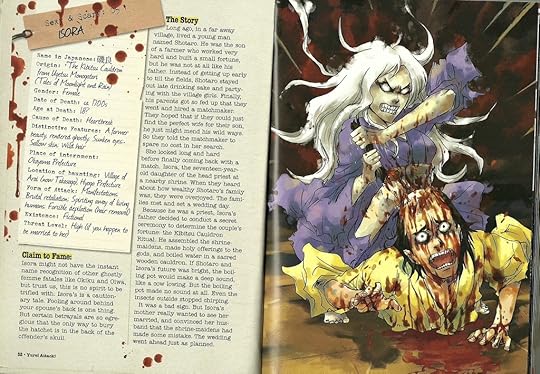
Oh, yes, there will be blood.
Yokai Attack was an irreverent guide to the monsters of Japanese superstition, but the authors wisely realized that even their already tightly-controlled humor wouldn't fit this subject. Yurei are Japanese ghosts, and their stories are often dark tragedies. Thus, instead of getting jokes about the shoe size of a giant foot, we get a humor that borders like the sardonic narrator from a Tales from the Crypt story. Mad Magazine humor wouldn;t have fit amongst all the betrayal, adultery (tastefully described, parents, you can let your kiddies read this), and accidental death. The book avoids being mean, and I appreciate that. Creepy and tragic at times, but not mean.
Another wise move is the varying of the contents. We get a chapter on scorned women that segue into a chapter on extremely homicidal ghosts. They're all amazingly cool, but continuing like that would have eventually got a bit same-y by the end. Instead, we get chapters on tragic and sympathetic ghosts, famous haunted places, and (one of my favorites) traditional Japanese ways to contact the spirit world.
So you get your romantic tragedy, but without any Whoopi Goldberg.
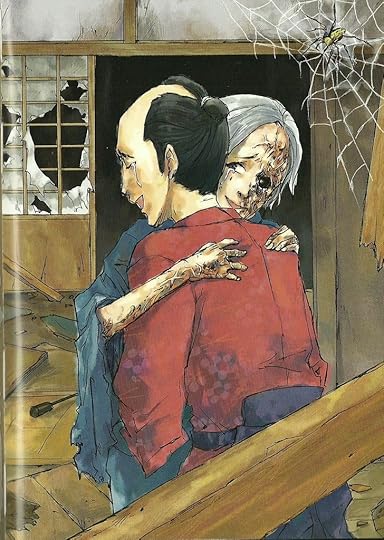
Then there's the chapter on Buddhist Hell.

'Nuff said.
All in all, an incredible book, with all of the cultural insights, beautiful photos and woodcuts, and rell-researched references I got from Yokai Attack! I really want some of the yurei toys they show at the end. I also appreciated how they'd drop little notes on how the yurei stories interact but yokai legends, but keep them very brief and concise in case the reader started with this volume.
You should buy this. Me, I'm going to go watch Ju-on 1 & 2 back-to-back.
This time, there will be blood.

Oh, yes, there will be blood.
Yokai Attack was an irreverent guide to the monsters of Japanese superstition, but the authors wisely realized that even their already tightly-controlled humor wouldn't fit this subject. Yurei are Japanese ghosts, and their stories are often dark tragedies. Thus, instead of getting jokes about the shoe size of a giant foot, we get a humor that borders like the sardonic narrator from a Tales from the Crypt story. Mad Magazine humor wouldn;t have fit amongst all the betrayal, adultery (tastefully described, parents, you can let your kiddies read this), and accidental death. The book avoids being mean, and I appreciate that. Creepy and tragic at times, but not mean.
Another wise move is the varying of the contents. We get a chapter on scorned women that segue into a chapter on extremely homicidal ghosts. They're all amazingly cool, but continuing like that would have eventually got a bit same-y by the end. Instead, we get chapters on tragic and sympathetic ghosts, famous haunted places, and (one of my favorites) traditional Japanese ways to contact the spirit world.
So you get your romantic tragedy, but without any Whoopi Goldberg.

Then there's the chapter on Buddhist Hell.

'Nuff said.
All in all, an incredible book, with all of the cultural insights, beautiful photos and woodcuts, and rell-researched references I got from Yokai Attack! I really want some of the yurei toys they show at the end. I also appreciated how they'd drop little notes on how the yurei stories interact but yokai legends, but keep them very brief and concise in case the reader started with this volume.
You should buy this. Me, I'm going to go watch Ju-on 1 & 2 back-to-back.

January 17, 2017
This non fiction book is a collection of information about Japanese ghosts. It profiles each ghost individually, as well as profiles of haunted places. Each ghost/place gets it's own 4 page section. The book is beautifully illustrated, with amazing original drawings by Shinkichi, and photographs of historical artwork featuring ghosts. Shinkichi's drawings were my favorite part of the book.
Because of the format, this book is great for reading in small doses as time allows. The stories of the ghosts were interesting, but after awhile, began to get a little repetitive.
I think anyone interested in ghosts, and Japanese ghosts in particular, will find something of interest in this book.
Because of the format, this book is great for reading in small doses as time allows. The stories of the ghosts were interesting, but after awhile, began to get a little repetitive.
I think anyone interested in ghosts, and Japanese ghosts in particular, will find something of interest in this book.

December 27, 2013
This showcases the different types of Japanese ghost story, ranging from vengeful, to bloody and poignant. It captures Japanese nuances and explains unfamiliar customs to the reader. The book is very up to date as it references the 2011 tsunami and provides an excellent bibliography. It's also really excellent value for money because it also provides chapters on places to visit, spooky toys and woodcut illustrations.
I'm disappointed with the kindle text though as there are several errors; missing words and repetitions occur frequently. Not sure if this is a publishers error or sloppiness on the part of the authors - I'd be surprised if the latter, they took the project so seriously they went for a preventative exorcism!
I'm disappointed with the kindle text though as there are several errors; missing words and repetitions occur frequently. Not sure if this is a publishers error or sloppiness on the part of the authors - I'd be surprised if the latter, they took the project so seriously they went for a preventative exorcism!

February 6, 2019
Excellent!!! The entire time that I've lived in Japan, I have been looking for a ghost story collection that covered a wide range of stories and was based firmly in folklore. With this book, my search has ended. Though it is made like a "survival guide", a factor which I actually found very fun, the book is based on a mix of historical evidence and folklore to form a comprehensive set of spooky tales. The creepy manga illustrations add to the atmosphere to create a creepy, wonderful read. I adored this book!

August 25, 2023
‘Yurei Attack!’van Hiroko Yoda en Matt Alt is een angstaanjagend goed boek. Niet alleen omdat het creepy spookverhalen bevat. Er staan ook schitterende illustraties in, die de inhoud van de verhalen niet alleen illustreren, maar ook het angstaanjagende benadrukken op de juiste wijze. De meerwaarde van het boek ligt in de historische context waarin sommige verhalen en personages geplaatst worden, de achtergrond over de boeddhistische hel en de bronvermelding waar de lezer meer informatie kan vinden over het onderwerp dat wordt besproken. En zo wordt ‘Yurei Attack!’ een boek dat naast spannende verhalen over het bovennatuurlijke in Japan, door de historische achtergronden en extra informatie meerwaarde heeft en een plek verdient in iedere boekenkast.

February 24, 2020
I ended up not finishing this one. It wasn't bad, it just wasn't nearly as interesting as the description sounded. After while, the stories just all started sounding the same.
September 25, 2022
Muy buen libro acerca de los fantasmas de Japón y de sus mitos relacionados con estos
November 13, 2019
Well-researched legends, great system of classifying information, and wonderful drawings. I'll definitely be checking out Yokai Attack!

August 30, 2016
This sounded better than it actually was. It was still a nice book, still a fun book, but there were several things that I didn't like.
First up the things I did like. I loved the female ghosts, the Games chapter, several parts of the Haunted Places chapter. I loved how each ghost got its own profile with all sorts of information on what threat level they were, what happened to them, when, and several other things. It was fun that they started with a small introduction and then dove into how it all came to this and what kind of attacks you can expect. At times there was also trivia (and I just love trivia).
The illustrations at the beginning of each new monster/game/etc. was lovely. Yes, I know they were gruesome, but I do love the drawing style. The artist sure captured the ghosts (and places) in a perfect way.
I thought this book would be only about Yurei, but instead it was about all kinds of things. From haunted places to games, to how hell is. It made the book more diverse and also more fun.
Now about stuff that I didn't like.
First up the biggest one. Didn't anyone do any editing on this one? There were numerous mistakes from how long something has passed (Like WWII ending 39 years ago in 1979, um no.), to several sentences that just got copy-pasted mere sentences after the first same sentence. Then there were errors in names (for instance a story about a girl who get cursed, instead of using the name of the girl who got cursed and got better thanks to the arrest of the girl who did the curse, they used the name of the girl who got arrested). I also don't get why Houses with Histories is under Dangerous Games. I would say that fits better under Haunted Places. Same goes for Spirit Photography, that just isn't a game. And so there were quite a few other parts that just had me scratching my head and wondering why no one checked this book before publishing it. The book loses 1 star for this.
This is more a personal preference, but I wished they had focused more on the female ghosts. The male ghosts stories often were boring, and I repeatedly had to stop myself from just dropping the book. Also for the Haunted Places I had hoped for a bit more diversity and seen some non-battle/non-war related thing. In the whole Houses with Histories part they mention there are enough creepy, unsettling houses, I am sure they could have featured some in the Haunted Places chapter.
So the book was pretty nice, and I did enjoy quite a few parts of the book, but sadly there was enough that I didn't like, or that was just wrong (Editing anyone?). So I can't give this book more than 3 stars.
Review first posted at https://twirlingbookprincess.com/
First up the things I did like. I loved the female ghosts, the Games chapter, several parts of the Haunted Places chapter. I loved how each ghost got its own profile with all sorts of information on what threat level they were, what happened to them, when, and several other things. It was fun that they started with a small introduction and then dove into how it all came to this and what kind of attacks you can expect. At times there was also trivia (and I just love trivia).
The illustrations at the beginning of each new monster/game/etc. was lovely. Yes, I know they were gruesome, but I do love the drawing style. The artist sure captured the ghosts (and places) in a perfect way.
I thought this book would be only about Yurei, but instead it was about all kinds of things. From haunted places to games, to how hell is. It made the book more diverse and also more fun.
Now about stuff that I didn't like.
First up the biggest one. Didn't anyone do any editing on this one? There were numerous mistakes from how long something has passed (Like WWII ending 39 years ago in 1979, um no.), to several sentences that just got copy-pasted mere sentences after the first same sentence. Then there were errors in names (for instance a story about a girl who get cursed, instead of using the name of the girl who got cursed and got better thanks to the arrest of the girl who did the curse, they used the name of the girl who got arrested). I also don't get why Houses with Histories is under Dangerous Games. I would say that fits better under Haunted Places. Same goes for Spirit Photography, that just isn't a game. And so there were quite a few other parts that just had me scratching my head and wondering why no one checked this book before publishing it. The book loses 1 star for this.
This is more a personal preference, but I wished they had focused more on the female ghosts. The male ghosts stories often were boring, and I repeatedly had to stop myself from just dropping the book. Also for the Haunted Places I had hoped for a bit more diversity and seen some non-battle/non-war related thing. In the whole Houses with Histories part they mention there are enough creepy, unsettling houses, I am sure they could have featured some in the Haunted Places chapter.
So the book was pretty nice, and I did enjoy quite a few parts of the book, but sadly there was enough that I didn't like, or that was just wrong (Editing anyone?). So I can't give this book more than 3 stars.
Review first posted at https://twirlingbookprincess.com/

August 19, 2017
Yes, welcome, tonight on the 'It is 6 am and I have just spent a whole night binge-reading a book on Japanese ghosts because I have no impulse control and love ghost stories too much': Yurei Attack!
My profile: A love so strong it rivals 3 whole suns for the supernatural. Currently living in Japan. Majoring in Japanese studies.
The enemy: This book.
Good things: Loved the illustrations. And funny anecdotes. The rituals chapter was A+. The design of the whole book was outstanding. Sources were actually given.
Bad things: Useless facts 101. There were no actual ghosts in there you could be attacked by today so it was not a guide at all. 'For more info, check Yokai Attack!' if I really liked your book I'd read it anyway without you telling me to every 2 pages. Several typos.
This book was made for my supernatural loving self. Not the Japanese studies one.
My profile: A love so strong it rivals 3 whole suns for the supernatural. Currently living in Japan. Majoring in Japanese studies.
The enemy: This book.
Good things: Loved the illustrations. And funny anecdotes. The rituals chapter was A+. The design of the whole book was outstanding. Sources were actually given.
Bad things: Useless facts 101. There were no actual ghosts in there you could be attacked by today so it was not a guide at all. 'For more info, check Yokai Attack!' if I really liked your book I'd read it anyway without you telling me to every 2 pages. Several typos.
This book was made for my supernatural loving self. Not the Japanese studies one.

June 18, 2016
I love it! Is perfect! it is very informative but it is not dull or boring. It has many facts and a lot about popular culture. This book is perfect for people who likes short narrative, like japanese culture, reads manga, etc.
Read
September 2, 2012This is fun to read. Very humorous and informative.

January 11, 2018
Yurei Attack! is a fun and informative light read. I highly recommend it for anyone, though particularly if you have any interest in Japan and/or the supernatural.
1.) The stories are long enough to be interesting but concise enough that they don't get boring. Some stories have repeating ideas (the onryo stories in particular can get a little repetitive), but all in all they're all unique and fascinating stories. My favorite ghosts were Otsuyu from "The Peony Lantern" and Ame-kai Yurei (the Candy-Buying Ghost).
2.) The book taught me a lot about Japanese traditions regarding shinrei/yurei/borei and other supernatural beings and forces. I had heard of ofuda, but Yurei Attack! gave me a much broader context for what I mostly knew as one of Sailor Mars' tactics of choice. Ofuda appear again and again in these stories, though in my opinion, they're sometimes unnecessarily used, along with their Buddhist counterpart, written sutras. The ghosts in "The Peony Lantern" and "Hoichi the Earless" don't seem to do any harm to the mortals that they visit—until a Shinto or Buddhist priest encourages the person to take drastic defensive measures, which then backfire.
I guess the thinking is that any ghost is a bad ghost? I could have used a little more explanation on that point. Sorei are good spirits to have around, but shoryo are not?
3.) Although I'm sure people have been trying to contact the dead for as long as people have been dying, I didn't know much about how spiritualism/contacting the dead through occult practices gained traction in the United States in the 1800s and later spread to Japan (this despite the fact that I actually read Dianne K. Salerni's We Hear the Dead a while back. I don't remember much about that book). Yurei Attack!'s brief history of this phenomenon was concise and interesting. Yoda and Alt detail the overlap between and mixing of American practices (such as the Ouija board) and Japanese practices (like kokkuri san). It reminds me a bit of something that a tour guide said to me when I was in Japan: "I knew a girl who was born to a Shinto priest, got married in a Christian church, and will be buried in a Buddhist funeral. For us [the Japanese], it's no problem." The Japanese seem to have few qualms about adopting foreign practices that they like and melding them into their existing traditions.
4.) I actually had no idea that The Ring (originally Ringu, 1998) and The Grudge (originally Ju-on: The Grudge, 2002) were originally Japanese—or that Ringu's Sadako is an archetypal yurei! I would love to see Yoda and Alt write a book on J-Horror movies and the inspiration for them.
To make a long story short: yurei and related phenomena are entangled in both modern Japanese and modern American culture in ways that you might not expect. I thoroughly enjoyed this read about them.
After reading Yurei Attack!, I would definitely be up for trying Yokai Attack! or Ninja Attack!.
1.) The stories are long enough to be interesting but concise enough that they don't get boring. Some stories have repeating ideas (the onryo stories in particular can get a little repetitive), but all in all they're all unique and fascinating stories. My favorite ghosts were Otsuyu from "The Peony Lantern" and Ame-kai Yurei (the Candy-Buying Ghost).
2.) The book taught me a lot about Japanese traditions regarding shinrei/yurei/borei and other supernatural beings and forces. I had heard of ofuda, but Yurei Attack! gave me a much broader context for what I mostly knew as one of Sailor Mars' tactics of choice. Ofuda appear again and again in these stories, though in my opinion, they're sometimes unnecessarily used, along with their Buddhist counterpart, written sutras. The ghosts in "The Peony Lantern" and "Hoichi the Earless" don't seem to do any harm to the mortals that they visit—until a Shinto or Buddhist priest encourages the person to take drastic defensive measures, which then backfire.
I guess the thinking is that any ghost is a bad ghost? I could have used a little more explanation on that point. Sorei are good spirits to have around, but shoryo are not?
3.) Although I'm sure people have been trying to contact the dead for as long as people have been dying, I didn't know much about how spiritualism/contacting the dead through occult practices gained traction in the United States in the 1800s and later spread to Japan (this despite the fact that I actually read Dianne K. Salerni's We Hear the Dead a while back. I don't remember much about that book). Yurei Attack!'s brief history of this phenomenon was concise and interesting. Yoda and Alt detail the overlap between and mixing of American practices (such as the Ouija board) and Japanese practices (like kokkuri san). It reminds me a bit of something that a tour guide said to me when I was in Japan: "I knew a girl who was born to a Shinto priest, got married in a Christian church, and will be buried in a Buddhist funeral. For us [the Japanese], it's no problem." The Japanese seem to have few qualms about adopting foreign practices that they like and melding them into their existing traditions.
4.) I actually had no idea that The Ring (originally Ringu, 1998) and The Grudge (originally Ju-on: The Grudge, 2002) were originally Japanese—or that Ringu's Sadako is an archetypal yurei! I would love to see Yoda and Alt write a book on J-Horror movies and the inspiration for them.
To make a long story short: yurei and related phenomena are entangled in both modern Japanese and modern American culture in ways that you might not expect. I thoroughly enjoyed this read about them.
After reading Yurei Attack!, I would definitely be up for trying Yokai Attack! or Ninja Attack!.

April 19, 2024
An invaluable book for prospective Japanese ghost hunters. It might just save your life.
Yurei Attack! The Japanese Ghost Survival Guide by Hiroko Yoda and Matt Alt is another in the series of “survivial guides” which started with Yokai Attack!
Like the Yokai guide, this book provides entires for different yurei or ghosts…covering alternate names, regions, time periods tied to their deaths, and dangers. Each entry is fairly thorough. In addition to the unique horrifying cartoonish depiction of each ghost, various historical art and photographs associated with each ghost is also included in the entry.
Interestingly enough, for most of those ghosts covered in this book, they are fairly unique and try to provide as much info on their lives (including date of death) when available, to give you some idea of how these types of ghosts manifest. Naturally how dangerous some can be varies, with some very hostile or terrifying…but not necessarily deadly.
In addition to the ghosts, several entries are dedicated to haunted buildings and other areas along with the history of each place. Typically these are general haunted sites that tied to a specific ghost.
Later coverage includes methods of summoning spirits, cursing people, or otherwise risking your life or soul to Roy with the dart arts. Naturally these are discouraged, but ample data is provided in the event you suspect you may be targeted by one of these practitioners.
The back matter includes a larger bibliography, a brief description of Japanese hell, a list of Japanese ghost movies, various toys tied to yurei, and an index.
Yurei Attack! The Japanese Ghost Survival Guide by Hiroko Yoda and Matt Alt is another in the series of “survivial guides” which started with Yokai Attack!
Like the Yokai guide, this book provides entires for different yurei or ghosts…covering alternate names, regions, time periods tied to their deaths, and dangers. Each entry is fairly thorough. In addition to the unique horrifying cartoonish depiction of each ghost, various historical art and photographs associated with each ghost is also included in the entry.
Interestingly enough, for most of those ghosts covered in this book, they are fairly unique and try to provide as much info on their lives (including date of death) when available, to give you some idea of how these types of ghosts manifest. Naturally how dangerous some can be varies, with some very hostile or terrifying…but not necessarily deadly.
In addition to the ghosts, several entries are dedicated to haunted buildings and other areas along with the history of each place. Typically these are general haunted sites that tied to a specific ghost.
Later coverage includes methods of summoning spirits, cursing people, or otherwise risking your life or soul to Roy with the dart arts. Naturally these are discouraged, but ample data is provided in the event you suspect you may be targeted by one of these practitioners.
The back matter includes a larger bibliography, a brief description of Japanese hell, a list of Japanese ghost movies, various toys tied to yurei, and an index.

June 12, 2017
What a pretty, preeetty book *strokes pages* so pretty...
The illustrations and photos in this book alone make up for most of my rating, not that the stories weren't great on their own but it was the art that really makes this book stand out.
This was a really interesting, fun, and sometime gory read with lots of background information on some of the most popular Japanese ghost tales, horror games and haunted places.
My only complaint is that this book could have easily been so much longer as it didn't really delve into the stories too much and I was left wanting mooore; I'm also sure there are many more tales that could have been mentioned... then again maybe a lot of the ones I didn't see are in Yokai Attack!Yurei =/= Yokai, I know a book I regret not getting when I purchased this one.
Why didn't I just buy boooth? damnit.
The illustrations and photos in this book alone make up for most of my rating, not that the stories weren't great on their own but it was the art that really makes this book stand out.
This was a really interesting, fun, and sometime gory read with lots of background information on some of the most popular Japanese ghost tales, horror games and haunted places.
My only complaint is that this book could have easily been so much longer as it didn't really delve into the stories too much and I was left wanting mooore; I'm also sure there are many more tales that could have been mentioned... then again maybe a lot of the ones I didn't see are in Yokai Attack!
Why didn't I just buy boooth? damnit.

April 20, 2019
Tengo que señalar que por bastante tiempo me negué a comprar este libro por creerlo básico y elemental, pero la verdad es que resultó muy bueno, bien investigado y explicado.
Los Yūrei, o fantasmas japoneses siguen "vivos" y activos en la cultura y el quehacer diario de los japoneses y no son tomados tan a la ligera. Sus imágenes han trascendido del país para encantar y horrorizar al mundo entero en películas como El Aro o la Maldición. El libro nos pone en contexto y nos introduce al mundo sobrenatural y del más allá visto por los ojos del Japón . Conocerán a las tres Yūrei más importantes del país, caminarán por los lugares embrujados más famosos, se las verán con las deidades furiosas más peligrosas, les darán las reglas para jugar los juegos sobrenaturales más emocionantes y muchas cosas más... la verdad si es muy buen libro y vaya que vale la pena!
Los Yūrei, o fantasmas japoneses siguen "vivos" y activos en la cultura y el quehacer diario de los japoneses y no son tomados tan a la ligera. Sus imágenes han trascendido del país para encantar y horrorizar al mundo entero en películas como El Aro o la Maldición. El libro nos pone en contexto y nos introduce al mundo sobrenatural y del más allá visto por los ojos del Japón . Conocerán a las tres Yūrei más importantes del país, caminarán por los lugares embrujados más famosos, se las verán con las deidades furiosas más peligrosas, les darán las reglas para jugar los juegos sobrenaturales más emocionantes y muchas cosas más... la verdad si es muy buen libro y vaya que vale la pena!

October 14, 2019
A collection of famous Japanese ghost stories.
This book follows the same survival guide format as its predecessor, Yokai Attack, but the format doesn't work very well here.
The illustrations are in a comic book-style similar to those in Yokai Attack. Many of the ghosts are depicted as bloodthirsty zombies, unlike the way they appear in Japanese art. Personally, I didn't like the style of the illustrations.
There were several notable issues with the editing, including spelling mistakes (Yotsuka kaidan? Ibaragi prefecture?), mixing up characters, sentences being repeated twice on a page, and messy grammar.
Other mistakes include describing 1770 as the seventeenth century, and this miscalculation: "August 8, 1979, the 39th anniversary of the end of WW2".
Just like Yokai Attack, the topic is very interesting, but the book is not necessarily well written.
This book follows the same survival guide format as its predecessor, Yokai Attack, but the format doesn't work very well here.
The illustrations are in a comic book-style similar to those in Yokai Attack. Many of the ghosts are depicted as bloodthirsty zombies, unlike the way they appear in Japanese art. Personally, I didn't like the style of the illustrations.
There were several notable issues with the editing, including spelling mistakes (Yotsuka kaidan? Ibaragi prefecture?), mixing up characters, sentences being repeated twice on a page, and messy grammar.
Other mistakes include describing 1770 as the seventeenth century, and this miscalculation: "August 8, 1979, the 39th anniversary of the end of WW2".
Just like Yokai Attack, the topic is very interesting, but the book is not necessarily well written.
March 16, 2017
A good companion to Yokai Attack! which contains enough succinct information about the different classes of Japanese ghost to give a decent overview. However, because of the conciseness of said information, even as a whole the work doesn't provide a solid enough understanding of the mindset behind the Japanese supernatural framework. This leaves some of the denizens of its pages out of context and looking more like wacky Asian curiosities than the manifestations of a cumulative mythology: a mythology that is based on centuries of oral tradition and national identity.
All in all, it's a fun book which will be sure to sate the current pop-culture, toe-dippers who are into shows like Yokai Watch or games like Nioh etc. but anyone looking for a more in-depth analysis of the subject, and its now iconic phantasms, would do well to immerse themselves in any, or all, of the following:
- Japanese Ghosts and Demons: Art of the Supernatural - Stephen Alddiss
- Ghosts & the Japanese: Cultural Experience in Japanese Death Legends - Michiko Iwasaka & Barre Toelken
- Pandemonium and Parade: Japanese Monsters and the Culture of Yokai - Michael Dylan Foster
- Yoshitoshi's Strange Tales - John Stevenson
- Anything by Lafcadio Hearne!
P.S. As an artist myself I found a lot of the art to be a little clunky, it's not bad, but there are thousands of renditions of yurei and yokai that go far beyond what it's on display here.
All in all, it's a fun book which will be sure to sate the current pop-culture, toe-dippers who are into shows like Yokai Watch or games like Nioh etc. but anyone looking for a more in-depth analysis of the subject, and its now iconic phantasms, would do well to immerse themselves in any, or all, of the following:
- Japanese Ghosts and Demons: Art of the Supernatural - Stephen Alddiss
- Ghosts & the Japanese: Cultural Experience in Japanese Death Legends - Michiko Iwasaka & Barre Toelken
- Pandemonium and Parade: Japanese Monsters and the Culture of Yokai - Michael Dylan Foster
- Yoshitoshi's Strange Tales - John Stevenson
- Anything by Lafcadio Hearne!
P.S. As an artist myself I found a lot of the art to be a little clunky, it's not bad, but there are thousands of renditions of yurei and yokai that go far beyond what it's on display here.

July 10, 2018
A well-done and worthy sequel to "Yokai Attack!" this book is also written as a field-guide, which is fun and nicely organized.The authors clearly care about and enjoy their subject matter, and it shows in the level of detail and the creativity of the presentation. The illustrations in this book are in a slightly different style from the first, but very enjoyable and colorful. I read this book at least once or twice a year. It's also a great reference source if you enjoy any sort of supernatural anime/manga, as you will often find the legendary version of the ghosts in this book. I also recommend the companion volume: Yokai Attack!

October 7, 2023
A nice collection of short Japanese ghost stories with modern commentary, some of which have an origin in historical facts (with all the twists that come to these stories over time) and some of which are purely literary. I found it an interesting introduction to the subject and even recognized some of these from recent anime shows. Of course, it is not a book for a more in depth study or just a few well told stories, but I did not expect such anyway. All in all, an entertaining read for those with a casual interest in the subject or even Japanese culture since what people fear does give a good insight in their lives and believes.
October 10, 2018
I went to Japan a month ago and saw this series in every possible bookstore there (only thing in English that is). I bought it the day I left and read it soon after.
As someone who likes mythology and urban legends, I got to say this book did a good job explaining all of the Yurei myths and intrigue me, to the point of wanting to visit some of these places in my next trip to the rising sun.
Bought the two other books of the series and I'm looking forward reading them.
As someone who likes mythology and urban legends, I got to say this book did a good job explaining all of the Yurei myths and intrigue me, to the point of wanting to visit some of these places in my next trip to the rising sun.
Bought the two other books of the series and I'm looking forward reading them.

August 22, 2023
Tác giả đã rất thông minh khi phân chia rạch ròi giữa 2 cá thể yurei và yokai trong series của mình. Những câu chuyện linh ma quỷ dị của Nhật Bản được minh họa rõ nét trên những bức ảnh sặc sỡ nhưng có phần rùng rợn, làm người đọc như bị lôi kéo vào một chuyến hành trình tìm về lịch sử có phần bí ẩn của ma quỷ vùng đất Mặt Trời Mọc. Đây còn là một cuốn từ điển khá đáng giá, BIẾT ĐÂU chúng ta sẽ cần nó trong một chuyến du lịch đến Nhật vào một ngày nào đó?

July 15, 2020
Este libro tiene la capacidad de engancharte rápidamente, aunque siento que le falta un poco más. El de los yokai es más completo, sin duda. Aún así, ofrece un vistazo muy completo a la actividad sobrenatural de un país tan complejo para nosotros los occidentales como lo es Japón, y nos ayuda a entender a qué le tienen miedo y que pasaría si estas entidades aparecieran.
May 1, 2022
Es un libro entretenido y didáctico aunque bastante básico. Más bien enfocado en el mercado infantil y juvenil brinda una mirada fresca a la tradición fantasmal japonesa. Debe ser leído en físico para aprovecharlo, la versión electrónica es difícil de leer pues todo se muestra como imágenes y no se puede aumentar el tamaño de las letras.

June 9, 2022
I really like that this book not only talk about legendary Japanese ghosts but also famous haunted places, ghost stories, and even haunted games. It talks about the historical facts surrounding these entries and about how they affected the modern day like various pieces of media that were inspired by these famous hauntings.

October 3, 2022
The art in this book is fantastic. I love how it tells you about the ghosts, thier past and ways to defeat them. If there is any. I think it be a great jumping off point to learning more about Japanese ghosts. Also I learned so so much!

August 16, 2025
Compendio sobre fantasmas, lugares encantados… con ilustraciones curiosas y un estilo ameno y divulgativo que sirve como primer contacto con estos temas. El único problema es que la edición se deshoja. O serán los yūrei haciendo de las suyas.

July 31, 2019
This book was super fun and informative. The illustrations were also really great.

December 1, 2019
Informative and fun to read. The illustrations really add to the stories.
Displaying 1 - 30 of 55 reviews