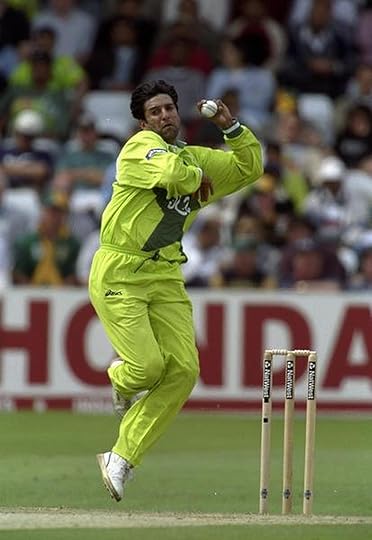
First off, the transliteration and copy editing/fact checking of this book really needed a more deft hand. Akhbaar-e-Watan is written as Akbari-e-Watan, ‘The Cricketer’ is constantly called ‘Pakistan Cricketer’. Landa Bazaar is, kind of hilariously, written as Lambda Bazaar. We are told they used some local word for reverse swing called ‘sibar’ which means the opposite way. I have no clue what word that could possibly be. Another one is about Pakistanis calling Sharjah, ‘har shehar’, which the author helpfully translates as ‘lose’, not even ‘to lose’ or the ‘city of losses’, which in itself would be strange considering it was the city of wins for Pakistan.
One exchange goes like this:
‘Salim aleikum Imran,’ I said haltingly.
‘Wale cum salaam, Wasim,’ he replied
🤣🤣
Wasim says he saw Indian films in the cinema as a child, which is just not possible. Pakistan did not show Indian films in the cinema till he was nearly at the end of his career. He is clearly confusing watching on VHS tapes with watching in the theatre. This is the constant pitfall of books written by goras and published by western publishing houses; there is simply no one to do a real fact check or copy edit. Everyone simply relies on the big name writer.
—-
About the book’s contents: a lot of narration of every single match and series Wasim has played and done well in. At the beginning of the book he sets himself up as a rare outsider in Pakistan’s cricketing fraternity, which, according to him, is infested with insiders like Babar Azam, Usman Qadir, Abdullah Shafique, Azam Khan and Imam ul Haq. This ignores how Babar never benefited from the Akmal brothers, and that at least three of the named players are complete non-entities.
While trying to clear his name re the match fixing scandal, he dwells at length on mutual hatred among everyone in the team, while in the post-cricket section, he talks about his battles with drug addiction, the gulf that opened up between him and Huma thanks to his ‘partying’, which, I suppose, is a euphemism for affairs, and his being a bad father. When it comes to his wives, he comes across as a particular lout. Even the Shaniera bit is discomfiting (with whom I thought he has a better relationship than his first wife), especially when he writes about the long period he left her hanging. I guess one could call it honesty, but it doesn’t seem like he fully understands or acknowledges his behaviour.
Wasim hates a lot of his teammates but none so much as Aamir Sohail and Rashid Latif, and I think he is able to build up a decent case against them. It’s sad to find confirmation here of his antagonistic relationship with Waqar, since I was such a huge Wasim/Waqar groupie as a kid. He clearly loves Imran and acknowledges Miandad’s role in discovering him (Miandad gets the most complex appraisal in the book, as a man who is both great but also insecure, caught in a power struggle with Imran, and then later as a coach unable to let go of his self-perception as someone who should still be out there playing).
The book is insightful about what fame does to you, and how impossible it is to adjust to life post-cricket for someone who is as great as Wasim Akram. By dwelling at length on the dressing room shenanigans and hate, Akram inadvertently casts a positive light on the current Pakistani team and its wholesomeness (may its tribe increase).