Jump to ratings and reviews
Rate this book

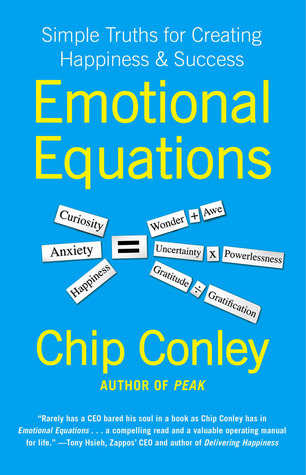
Emotional Equations: Simple Truths for Creating Happiness + Success

Rate this book
TONY HSIEH on Emotional Equations: "Rarely has a CEO bared his soul in a book as Chip Conley has in Emotional Equations. This powerfully authentic story makes for a compelling read and an invaluable operating manual for life. Chip’s stories are used to create emotional building blocks that define how we can understand and navigate our internal weather and emotions.

In business and in life, we tend to gravitate toward people who inspire trust and create positive emotional connections. Yet, we learn very little about emotional intelligence in formal education. That’s what makes reading Emotional Equations so enjoyable -- it’s like taking a fun college course in understanding Curiosity, Jealousy, Despair, Authenticity, Wisdom, and nearly twenty different emotions or emotional states that regularly show up in our lives.

Emotional Equations illustrates that the more unpredictable the world is, the more important it is to master our emotions in such a way that our internal world doesn’t mirror the chaos of the external world. Chip’s book amplifies the importance of creating that emotional space in our lives such that we don’t unconsciously react to everything.

Chip’s goal is to take the idea of emotional intelligence and transform it into emotional fluency. It’s one thing to study a foreign language in theory, but quite another to try to use it in our daily lives. Emotional Equations provides the tools for doing both.

Chip not only provides a comprehensive list of emotional equations that he’s derived, he also shows how to create your own emotional equations by encouraging readers to rethink their relationships with their own emotions and asking the question, “What is this emotion trying to tell me right now, and how can it serve me?”

Emotional Equationsis one of those rare books that combine research and theory with actual practice. If you’re interested in learning how to understand and manage emotions both in work and in life, this book will definitely provide some new perspectives and plenty of food for thought."

282 pages, Hardcover

First published May 1, 2012

188 people are currently reading
2151 people want to read

About the author

Chip Conley

25 books154 followers
At the age of 26, Chip Conley started his own hospitality company, Joie de Vivre (JDV), and, as CEO for two-dozen years, expanded it into a collection of over 35 award-winning hotels, restaurants and spas – the second largest boutique hotel company in the U.S. The bestselling author of PEAK, Chip is a veteran practitioner of emotional intelligence in business and in his latest book, EMOTIONAL EQUATIONS, he takes us from emotional intelligence to emotional fluency. The preeminent thought leader at the intersection of psychology and business, Chip speaks around the world on finding meaning at work, is a regular blogger on The Huffington Post and his own blog at http://www.emotionalequations.com . Chip has been honored with the highest accolade in the American hospitality industry, the coveted ISHC Pioneer award, and was named the Most Innovative CEO – and JDV the "2nd Best Place to Work" – in the entire Bay Area by The San Francisco Business Times. He received his BA and MBA from Stanford University, and holds an Honorary Doctorate in Psychology from Saybrook Graduate School & Research Center, where he is the school’s 2012 Scholar-Practitioner in residence.

Ratings & Reviews

What do you think?
Rate this book

Friends & Following

Create a free account to discover what your friends think of this book!

Community Reviews

5 stars
194 (27%)
4 stars
229 (32%)
3 stars
202 (28%)
2 stars
57 (8%)
1 star
18 (2%)
Displaying 1 - 30 of 67 reviews
Profile Image for Deb.
349 reviews89 followers
July 9, 2012
**There’s an equation for that**

At first impression, the title “Emotional Equations” may seem to be a bit of an oxymoron.
How could something as intangible and unquantifiable as an emotion possibly be captured in an equation? And, if an emotion could be explained by an equation, wouldn’t it take the emotionality of it anyway?

It turns out that emotions really can be represented by equations. But, don’t worry, you don’t have to be any kind of math whiz to understand them. In _Emotional Equations_, author Chip Conley (who admits that he’s no math wizard himself) does a masterful job in presenting a series of equations that can help you make sense of your emotions, life, and more. In Chip’s own words:
“Emotional Equations aren’t just a way to make sense of our lives; they are part of a bigger movement toward creating insight as we take off our psychological blindfolds.” (p. 248)

Emotional Equations can serve as a “psychological GPS” that can help “to navigate
difficult or unknown terrain. They help to detect and translate, harness and channel emotions productively so they become rational and purposeful, rather than scattered and chaotic. Anger can become courage, and envy can fuel resilience.” (pp. 21-22) Chip expresses his hope that:
“Emotional Equations will stretch you and create a better life for you and those around you. After using Emotional Equations, you will find that your emotions will no longer get the best of you. Instead, your emotions can *represent* the best in you.” (p. 13)

Whether you need to help in getting through a difficult time, you want to optimize your work life, you want to better define who you are, or you are seeking more contentment in your life (or all of the above!), these equations offer a unique and effective way of conceptualizing and understanding your emotions—and taking charge of your life. You’ll have to read the whole book to really get it, but for now, here’s a sampling of the equations that are presented and explored in the book:

→Dealing with Difficult Times:
***Despair = Suffering – Meaning
***Disappointment = Expectations – Reality
***Regret = Disappointment + Responsibility
***Jealousy = Mistrust/Self-Esteem and Envy = (Pride + Vanity)/Kindness
***Anxiety = Uncertainty x Powerlessness

→Getting the Most Out of Your Work Life
***Calling = Pleasure/Pain
***Workaholism = What Are You Running From?/What Are You Living For?
***Flow = Skill/Challenge
***Curiosity = Wonder + Awe

→Defining Who You Are:
***Authenticity = Self-Awareness x Courage
***Narcissism = (Self-Esteem)2 x Entitlement
***Integrity = Authenticity x Invisibility x Reliability

→ Finding Contentment
***Happiness = Wanting What You Have/Having What You Want
***Joy = Love – Fear
***Thriving = Frequency of Positive/Frequency of Negative
***Faith = Belief/Intellect
***Wisdom = (Square root of Experience)

In addition to presenting these equations, the book also offers a DIY guide for creating your own Emotional Equations. This final section of the book can help you understand the components of your own emotions and start developing a game plan to help you shift a debilitating emotion into something you can work with to reshape your life.

Although the title of the book might be a hard sell, the book sells itself. It’s well-written, well-researched, and appropriately and effectively supported by the author’s own psychological journey. (Finding meaning in his own suffering by writing this book would likely make Chip’s hero Viktor Frankl proud!)

Ever since I’ve finished this book, I’ve been coming up with my own equations. (It really does work!) So, of course, I’ve got to end this review with one:
Increased Peace of Mind = (Pages Read in This Book) x (Time Spent Applying Emotional Equations to Your Own Life)


Profile Image for Kim.
49 reviews
April 18, 2014
I loved this book and it's underlying message: that by creating your own emotional equations you can become more aware and in more control of how you react to whatever life throws you. Conley is a storyteller and through his struggles and lasting positivity, he empowers you with knowledge and inspires you to take action to change your own life. It's not the equations that matter, after all, it's what you do with them.

Change = emotional equations + action
Profile Image for Ypatios Varelas.
Author 2 books54 followers
July 11, 2016
Ο συγγραφέας αντιμετωπίζει όλες τις συναισθηματικές εξισώσεις εντελώς γνωσιακά, μέσα από ένα πρίσμα υποθετικής διαμόρφωσης των συναισθημάτων μέσω του επηρεασμού συγκεκριμένων παραγόντων. Σε κάποιες περιπτώσεις αυτές οι "εξισώσεις" έχουν μία χρησιμότητα, σε άλλες όχι. Δεν είναι εξισώσεις "σύνθεσης συναισθημάτων" (π.χ. ποια πρωτογενή συναισθήματα μπορεί να περιέχει η ζήλια ή η ευτυχία), αλλά διατυπώσεις εξάρτησης των αντιληπτών αισθημάτων από παράγοντες που μπορούμε να επηρεάσουμε.

Το βιβλίο στηρίζεται σε μία φαινομενικά καλή ιδέα, τελικά όμως χάνει σε πολλά σημεία, όπως:
- Ακατάσχετη φλυαρία του συγγραφέα. Πολλές ιστορίες θα μπορούσαν να ήταν πιο σύντομες ή να είχαν παραλειφθεί.
- Συστηματική περιαυτολογία. Αυτό συγχωρείται σε κάποιον που είναι διάσημος ή ξεχωριστός, αλλά όχι σε έναν συγγραφέα που απλώς ήταν CEO σε μία εταιρεία ξενοδοχείων στις ΗΠΑ και κάνει ομιλίες σε όλο τον κόσμο.
- Υπερανάλυση πολλών σημείων, κ.ά.

Τα δύο αστεράκια τα βάζω γιατί υπάρχουν και κάποια καλά σημεία, όπως κάποιες εύστοχες συμβουλές, αλλά και αρκετές παραπομπές σε αξιόλογη βιβιογραφία. Αλλά το βιβλίο είναι φλύαρο, κουραστικό και είναι εύκολο να χαθείς μέσα του και να ξεχάσεις τι διάβαζες και που θα καταλήξει.
Profile Image for Patrick.
189 reviews15 followers
July 13, 2012
I picked up this book since I'd seen a similar set of equations on Craig Damraur's New Math blog (http://www.morenewmath.com/). This book has a set of similar equations but adds a lot of psychological gobbledy-gook that I didn't find very satisfying.

Also, I didn't agree with some of the equations. For example, the author used:

Happiness = reality - expectations

Where I feel it should be more like this (since I don't like the concept of negative happiness):

Happiness = reality / expectations

or if you are more pessimistic:

Disappointment = expectations / reality

That is, if you had high expectations but reality was much lower, you would have a low level of happiness ( or a high level of disappointment). This basically sums up my feeling for this book.

Not a bad book overall, but just not for me. Do yourself a favor and check out the New Math blog (or one of the many summaries, e.g. http://www.mymodernmet.com/profiles/b...) before reading this.
Profile Image for Alyssa Greatbanks.
344 reviews5 followers
November 30, 2013
When I first started this book, the first chapter or two were very confusing. Once it became one chapter per "equation", everything was explained more thoroughly and was much easier to understand.

After reading this book, although it was not perfect, it did make a lot of really good points that I believe would help a lot of people to read. So I believe that everyone should read through this book once, every equation, so you really get the full benefit of the book.

I recieved this book through the GoodReads First Reads Giveaway. This has not affected my review in any way.
Profile Image for Sarah.
1 review4 followers
January 7, 2012
I received this book for free from Goodreads First Reads.

This book was very structured, each chapter being an equation, and each equation having a real-life story to begin, followed by an explanation, and how to work through the equation. Each equation is not just emotions, but personal values as well. This book can help some people who feel overwhelmed and are unsure of where they are or what they want.
28 reviews9 followers
Read
February 13, 2022
7. Many people are prisoners of their own minds. In this book I ask you. ‘What’s your prison?’ and I offer you some keys to unlock the door.
Winston Churchill: if you’re going through hell, keep going.
Kahlil Gibran: Your pain is the breaking of the shell that encloses your understanding.

9. The serenity prayer by theologian Reinhold Niebuhr: Grant me the serenity to accept the things I cannot change, the courage to change the things I can, and the wisdom to know the difference. This defines constants and variables.

16. William James may have been the first psychologist ever to create an emotional equation when he suggested that self-esteem equals success divided by pretensions. Pretensions are what we thought we should accomplish.

Victor Frankl: Between stimulus and response there is a space. In that space is our power to choose our response.

24. I presented one of my favourite equations at TED conference in 2010:
Happiness = (wanting what you have)/(having what you want)

The numerator is like practising gratitude, appreciating the good fortune in your life.
25. Emotional equations use math as a new lens to explore the mystery of the emotions inside you.

Suffering = Pain × Resistance
Resistance amplifies the pain. As Buddha said, it is our attachment to what was, or what we think should be that creates suffering.
Dan Millman: Suffering is our psychological resistance to what happens… Resistance creates suffering. Stress happens when your mind resists what is.

33. It has been said that the purpose of life is finding a life of purpose.
The same can be said for meaning: the meaning of life is to find a life of meaning.

42. Alex Michalos has studied people’s perceived quality of experience. He argues that people establish a perceived level of satisfaction based upon comparing 3 gaps: what you have versus what you want, what you have versus what you think other people have, and what you have versus the best experience of what you’ve had in the past. I would add a fourth, what you have and what you feel you deserve.
The hedonic treadmill: we adapt to our pleasure situation, we get used to it – and come to expect more from life.

51. Regret = Disappointment + Responsibility
I call regret a first world emotion. The more choices we have, the more possibility we have for regret.
58. Modern society, with all its choices, is exactly what a maximiser doesn’t need. It just adds to the investment that goes into each choice and leads to a greater potential for regret as a result. Become more comfortable with ‘good enough’.
What about a person who says he has lived a life with no regrets? There are 3 likely explanations. Either he is living an unexamined life and just says this to feel confident. Or he has a low baseline of expectations or an ability to reframe reality such that he never has disappointments. Or, he doesn’t take responsibility for anything.

197. Maya Angelou: I’ve learned that every day you should reach out and touch someone. ..I’ve learned that people will forget what you said, people will forget what you did, but people will never forget how you made them feel.
Rick Hanson suggests our brains are ‘Velcro for negativity and Teflon for positivity.

Helen Keller: When one door of happiness closes, another opens; but often we look so long at the closed door that we do not see the one which has opened for us.

176. Success and happiness are often mistaken for twins, but success is more of a maximisation strategy while happiness has more to do with satisfaction and appreciation. People who are maximizers tend to be less happy than satisficers.

178. Kahneman and Deaton showed that if you earn above $75k annually, your temperament and life circumstances have more influence on your contentment than money.
50% of happiness is an innate biological set point, 40% is due to intentional activities or way of thinking, 10% from life circumstances including salary.

184. Colette (French novelist): “What a wonderful life I had! I only wish I had realised it sooner”.
Recognise that your life is full of precious gifts whose value is often neglected until they’re gone.

Buddha: don’t be devoted to me purely out of faith, as it is best to investigate.

Mark Twain: I am old man and I have known many troubles, but most of them never happened.
Profile Image for Gary.
7 reviews
December 13, 2013
THIS BOOK + IT'S KEY TERMS TO YOUR EMOTIONS = better clarity in understanding how you can sort things out + work with them in order to create greater happiness + success.

I picked up 29 equations with more than half of them in the table of contents. Example: "Jealousy=mistrust÷ self-esteem and Envy=pride+vanity÷ kindness."

Some statements by the author that stand out to me in this Good Read:
-A shorthand means of correcting yourself emotionally in order to get clearer perspectives + more control during good times & bad.
-A grown-up version of finger painting - mixing primary emotions (terror/fear, rage/anger, grief/sadness, loathing/disgust, amazement/surprise & ecstasy/joy) to create secondary emotions (see Robert Plutchik's graph) that have subtle distinctions.
-Emotional fluency is the ability to sense, translate & effectively apply the power of emotions in a healthy, productive manner. Drivers ed. for your emotions.
-We all want a fully functioning heart + mind. Why shouldn't we want the same for our emotional state?
-Rather than let your emotions get the best of you-let your emotions represent the best in you.
-Emotions don't just happen to you as if you are a willing victim. Emotions are like clay and you can mold them into the work of art that is your life.
-Letting emotions move through you is healthy. Letting emotions define you is not healthy.
Profile Image for Anita Ashland.
278 reviews19 followers
March 1, 2016
If you want to strengthen your emotional intelligence this book will give you many practical steps to accomplish that.

In addition to drawing on stories of his own difficult experiences as a CEO, he includes stories about Abraham Lincoln, Mother Teresa, Victor Frankel, Andre Agassi, Oprah Winfrey, Charles Darwin, and many others.

The equations seem a bit dry at first but I appreciate the pithiness of them. They appeal to the left brained part of me.

He lists many questions throughout the first half of the book to help you dig deeper to solve your problems. Questions such as "If pondering whether to do something or not ask yourself: Is it repeatable? Can it be repaired if something goes wrong?"

He provides an unique exercise for working through fear: create a series of training steps that would help someone else understand how you obsess about a particular issue that gives you fear, such as financial issues.

Don't overlook the notes section at the very end. He suggests more books to read and additional insights.
Profile Image for Sheila.
539 reviews2 followers
June 10, 2014
A real-life story each chapter being an equation, each equation, followed by an explanation, and how to work through the equation. It is how to deal with emotions on daily bases either at work, home and other relationships. This book can help some people who feel overwhelmed and are unsure of where they are or what they want.

Interesting read about emotions and how it impacts people's daily life through people stories. Author developed the idea of combining emotions through the equivalent of math symbol to explain bigger emotions or behaviors. Backed up with examples of famous people it was interesting approach however, lot of repetition which make it unnecessarily too long.

There are several books with similar writing so I ended up rating 3 stars. I have read a few but there are always new ideas from this author that I could relate too. I would recommend to readers who enjoy psychology and sociology reading.

70 reviews176 followers
July 26, 2013
كتاب عظيم جدا. يستاهل أربع نقاط و نصف ..

فكرته: تبسيط كثير من الأفكار الرئيسية في علم النفس بطريقة المعادلات الرياضية! يعيد تعريف أهم المصطلحات بشكل جديد يسهل الفهم و الحفظ و التفعيل.

ما يميزه أيضا أنه يعتبر تلخيصا لأشهر ما كتب في علم النفس الغربي من أطروحات و أبحاث حول السعادة، القلق، الحسد، التدفق، الحكمة.

جدير بالذكر، أن به اختزال لأن كتابا أكبر من ذلك سيصبح مملا. لكن كل فصل بمعادلة واحدة كان كافيا. مع العلم أن كل فصل كان يحوي شرحا سريعا عن المفهوم العاطفي، ثم قصة، ثم تطبيقات عملية غير مغرقة في التفاصيل.

مرة أخرى، كتاب ذكي و مرتب، و مشاهدة أحاديثه في تيديكس أيضا ممتعة.
Profile Image for Lisa Gray.
Author 2 books19 followers
June 16, 2016
Well. This is one of my favorite books I've read in a very long time. Favorite like I want to buy 100 copies on Amazon and start giving it to everyone I meet. Written by the former CEO of the Joie de Vivre boutique hotel chain and geared towards business, it really is so applicable to just about everything. Basically distilling down difficult emotional situations and feelings to math equations. Like this one: Despair = Suffering - Meaning. Mmm hmm. Yes. You should read it. He even has a chapter at the end for how to write your own life's equations.
151 reviews1 follower
December 10, 2015
Took me a while to finish this book (was reading it from a list of recommended reading for work) and I thought it was pretty good. My biggest takeaway was the importance of positivity in the workplace and ideas of how to create it - not an easy thing to do by any stretch. Lots of other good insights too.
Profile Image for Shahidra.
33 reviews4 followers
August 11, 2021
4.5 bintang!
Ini buku pertama saya jumpa yang menghubungkait satu emosi dengan emosi yang lain menggunakan persamaan matematik. Sangat menarik dan membuka minda bahawa emosi kita boleh diuruskan walaupun mungkin bukan mudah. Kita perlu cerdik emosi (EQ)- memahaminya dan cari jalan untuk mengatasi emosi-emosi negatif yang menjerat diri dan memperkasakan diri dengan emosi-emosi positif.

Buku ini boleh dibaca secara bebas menurut keperluan pembaca..tidak terikat dari satu bab ke satu bab. Namun dianjurkan untuk membaca bab pertama terlebih dahulu bagi memahami emosi secara keseluruhan. Banyak persamaan yang membantu saya memahami emosi-emosi yang kompleks..namun, tidak semua pandangan dan persamaan penulis yang saya persetujui.

Pembaca tidak perlu jadi genius matematik untuk memahami persamaan-persamaan dalam buku ini kerana operasi yang digunakan kebanyakannya operasi asas (+ - × ÷). Apa yang perlu adalah sedikit masa untuk bereksperimen sendiri dengan meletakkan angka pada persamaan-persamaan yang dibincangkan bagi mendapat kefahaman yang lebih mendalam.

Di akhir buku ini, penulis memindahkan kemahiran berharga buat pembaca membina persamaan emosi sendiri - DIY. Jika inigin mengetahui lebih lanjut tentang emosi, buku-buku yang boleh dirujuk juga disenaraikan.

It is truly a self-help book. So, help yourself!
Profile Image for Katie.
1,159 reviews25 followers
July 28, 2020
This was recommended to me by one of my coaching advisors a few weeks ago (well months ago and then again a few weeks ago), and I’m so glad I picked it up. Chip walks through different elements that build other emotions.

The two that were the most enlightening for me was Anxiety = Uncertainty x Powerlessness and Disappointment = Expectations – Reality.

Putting the equations down as opportunities for digging deeper into the emotions was helpful. If I want to reduce my anxiety, focusing on the things that are known and putting myself in a position of power over them reduces the anxiety. The same for disappointment, being better about expectations so they coincide with reality – especially now. Being disappointed that something planned for 2020 isn’t what we thought it would be in 2019 is on us to adjust our expectations.

A great read – even with a few problematic chapters (the one on faith comes to mind) … although I’m not really a fan of people trying to critic faith who don’t subscribe to any faith. I think they’re talking about something else, like “faith in people” or “wishful thinking.”

⭐️⭐️⭐️⭐️
Profile Image for Alfie Yee.
108 reviews
January 4, 2025
My first book of 2025. Really enjoyed reading it after being introduced to it in my Navigating Transitions course

The main premise is to find practical ways to deal with your emotions and not to deny them. You are often to deal with your emotions but not told how. Do I suppress them or let them all flow out. That to me is not effectively dealing with it. Chip breaks down emotion into its component parts describes thru mathatical equation. The emotions he describes are far more layered that sadness, fear, shame... But ones with different intensities and context such as despair= suffering - meaning or authecity= self awareness x courage. He speaks thru the strategies of how to deal with them thru their component parts. A good book. Highly recommended!
Profile Image for JENNIFER.
20 reviews
January 15, 2023
I like this genre. I love to learn about how other people deal with life. This author has a unique take on it - he reduces pretty much every major emotion, or life situation to a simple mathematical equation. And it makes sense. He's inspiring, likable, and sincerely unpretentious, although by anyone's definition, wildly successful. I definitely came away with a couple of new tools under my belt. This book can only help you, kind of like eating some fruit. He also has a compelling and again, unique website, www.modernelderacademy.com, which, if it doesn't make you feel good about yourself and your fellow humans, nothing will.
117 reviews1 follower
December 26, 2019
"Anxiety = Uncertainty x Powerlessness"

What a great idea for a book: trying to distill our feelings down into simple formulas that help us better understand what's going on with ourselves. The list of equations themselves are worth the price of the book, but I also appreciated the content explaining the equations - stories, research, etc.

I feel like it was a bit long / meandering for what it was, but still quite worth the read. I've already referred to some of these equations in conversations!
Profile Image for Aaron Rodriguez Fonseca.
68 reviews
July 8, 2021
If you want to understand better different emotions this book is for you. The author describes with ecuations and in a precise way how you feel and why you feel that way. Also helps you taking action in how to handle your emotions or work on them in order to improve your emotional intelligence.

The only thing I would change on the book is making chapter a little bit shorter. Too much redundance in some chapters.
Profile Image for Tommy.
80 reviews10 followers
March 30, 2022
I don't have many words to say about a mediocre book. Not sure why the author thought he was qualified to write a book about emotional equations, and it showed. Further, lots of the equations he described weren't even for emotions (workaholism, narcissism, etc)!
I did find it marginally useful when he described happiness and (wanting what you have) / (having what you want). He also described jealousy as mistrust / self-esteem, whereas envy is (pride + vanity) / kindness
2.6/5 stars
Profile Image for Kalle Wescott.
838 reviews16 followers
April 20, 2022
I read /Emotional Equations: Simple Truths for Creating Happiness + Success/, by Chip Conley:

https://blog.dtssydney.com/book-revie...

Super-interesting subject, but it never "grabbed" me... other than Conley's writing about his first Joie de Vivre hotel, the Phoenix, and taking that risk, and also Conley's coming out to his father.

Profile Image for Riana Engelbrecht.
26 reviews
June 20, 2024
Emotional Equations for good relationship with self and others

I enjoyed this book immensely. Being able to break down emotions into its components parts on the feelings wheel is very helpful to understand the next go to. Also how to construct your own emotional equations is very powerful towards emotional regulation.
Profile Image for Jack Oughton.
Author 6 books27 followers
July 28, 2017
Great message from a very credible source (i.e a man who's gone on to do big things) - I didn't get too much out of it, it feels like stuff that many people have covered before. As I say, great message.
Profile Image for Alex Vasai.
116 reviews3 followers
April 30, 2018
Very interesting and consistent approach to emotions, just to describe them as equations containing other emotions. In this way you can control them better and overcome moments when you are not "in the mood". I also liked the idea of creating our own equations, is Math fashionable now?
28 reviews
July 26, 2018
I like math, logic, and psychology; so I loved this concept of emotional equations. I have picked up and put down the book for several years, but just recently more interested to learn more and finish reading. Overall it was interesting, insightful, and made me really think.
564 reviews5 followers
April 11, 2020
Inspiration and insights that transform businesses and lives. Achieve a higher level of happiness and success by applying these emotional equations. It is EQ that delivers happiness. Karen Briscoe, author and podcast host 5 Minute Success
2,103 reviews60 followers
January 29, 2018
There was less than a dozen equations, most of them seemed both trite and easy to understand
Profile Image for Rand Hall.
119 reviews
May 25, 2018
The equations themselves are the star. Or, more precisely, the concept of using equations in this manner is the star. The reflections of the author aren't particularly illuminating.
Displaying 1 - 30 of 67 reviews

Can't find what you're looking for?

Get help and learn more about the design.