This terse and startling novel, written just before The Spoils of Poynton and What Maisie Knew, is the story of a struggle for possession—and of its devastating consequences. Three women seek to secure the affections of one man, while he, in turn, tries to satisfy them all. But in the middle of this contest of wills stands his unwitting and vulnerable young daughter. The savage conclusion of The Other House makes it one of the most disturbing and memorable of Henry James’s depictions of the uncontrollable passions that lie beneath the polished veneer of civilized life.
"Oh blest Other House, which gives me thus at every step a precedent, a divine little light to walk by…" — Henry James
Henry James was an American-British author. He is regarded as a key transitional figure between literary realism and literary modernism, and is considered by many to be among the greatest novelists in the English language. He was the son of Henry James Sr. and the brother of philosopher and psychologist William James and diarist Alice James. He is best known for his novels dealing with the social and marital interplay between émigré Americans, the English, and continental Europeans, such as The Portrait of a Lady. His later works, such as The Ambassadors, The Wings of the Dove and The Golden Bowl were increasingly experimental. In describing the internal states of mind and social dynamics of his characters, James often wrote in a style in which ambiguous or contradictory motives and impressions were overlaid or juxtaposed in the discussion of a character's psyche. For their unique ambiguity, as well as for other aspects of their composition, his late works have been compared to Impressionist painting. His novella The Turn of the Screw has garnered a reputation as the most analysed and ambiguous ghost story in the English language and remains his most widely adapted work in other media. He wrote other highly regarded ghost stories, such as "The Jolly Corner". James published articles and books of criticism, travel, biography, autobiography, and plays. Born in the United States, James largely relocated to Europe as a young man, and eventually settled in England, becoming a British citizen in 1915, a year before his death. James was nominated for the Nobel Prize in Literature in 1911, 1912, and 1916. Jorge Luis Borges said "I have visited some literatures of East and West; I have compiled an encyclopedic compendium of fantastic literature; I have translated Kafka, Melville, and Bloy; I know of no stranger work than that of Henry James."
The Other House - this Henry James is one of the oddest novels I’ve ever read. The six main characters, three women and three men, all well-educated, well-spoken members of the English upper class, sip their tea, converse in the most highly polished civilized manor, but how civilized are they, really?
On one level, this is a novel of manners, the six characters interacting as if they were members of a string sextet playing in a minor key, say Tchaikovsky’s String sextet in D minor, yet on another level, James’ work can be viewed as the shocking consequences of life reduced to its selfish surface, that is, having no authentic aesthetic dimension, questionable morals and an abysmal lack of any trace of spiritual depth.
But perhaps I am being too harsh, since, when it comes to drama performed on stage, what has more power than raw passion – no refined aesthetics, no taking moral high ground, no deep reflection on the transcendental – just a massive dose of unchecked primal fury translated into direct action, the spirit of ancient Medea rearing her murderous, frenzied head? And please don’t be fooled by James’ arched, baroque description and dialogue I alluded to above – this is a novel of dark passion, the last one hundred pages contain some of the most disturbing and shocking scenes I’ve ever encountered.
I mention drama and the stage for a good reason: Henry James initially conceived of this story as a play and later reworked his material into The Other House as a novel. Incidentally, James spent a number of years attempting without success to be a first-rate playwright. Sorry, Henry, the muse can be fickle – you were a great novelist and teller of tales but far from an Ibsen. Perhaps that can be a lesson for us all – when it comes to artistic expression and creativity, we might want to think hard before we venture too far from our literary strengths.
Critics at the time of publication chimed in, calling the novel “distinctly unpleasant,” and “inhuman,” and even “the one altogether evil book that James ever wrote.” Later, Edmund Wilson had a one word pronouncement: “Dreadful.” Yet, there is something compelling about this novel in three parts, so much akin to a play’s three acts, that really makes it worth the read, and it is a short novel - this New York Review Book (NYRB) edition is three hundred pages of large font and wide margins – a more usual print size would come in at under two hundred pages, a novel that can be read in a few sittings.
Lastly, I would be derelict if I didn’t include a couple examples from the novel itself. Here are a few lines from the opening pages, where the narrator tells us what an older woman, Mrs. Beever, a mother, wishes for her son Paul:
“She was a woman indeed of many purposes; another of which was that on leaving Oxford the boy should travel and inform himself: she belonged to the age that regarded a foreign tour not as a hasty dip, but as a deliberate plunge. Still another had for its main feature that on his final return he should marry the nicest girl she knew: that too would be a deliberate plunge, a plunge that would besprinkle his mother.” Sense a tincture of a mother’s selfishness?
And here is Rose Armiger with Dennis, a man who arrives on the scene early to propose marriage to her:
“Rose manifested no further sense of this occasion than to go straight on with her idea. She placed her arm with frank friendship on his shoulder. It drew him closer, and he recovered his grasp of her free hand. With his want of stature and presence, his upward look at her, his small, smooth head, his seasoned sallowness and simple eyes, he might at this instant have struck a spectator as a figure actually younger and slighter than the ample, accomplished girl whose gesture protected and even a little patronized him. But in her vision of him she none the less clearly found full warrant for saying, instead of something he expected, something she wished and had her reasons for wishing, even if they represented but the gain of a minute of time.”
Now why does Rose Armiger want more time? You will have to take the readerly plunge into this Henry James black sheep to find out for yourself.
This is an interesting, odd book, if only because it seems so different from any other Henry James I've read. Here, he is forthright, less obtuse, less wordy and less allusive. The evil in the story is chilling, and the theme of the power and drive of sexual attraction seems contemporary.
He wrote this after his plays were widely panned, but he must've learned something about play-writing, as I can easily see this being turned into a play or a movie; the plotting and dialogue are especially fine. This is well worth reading for those interested in the work of Henry James.
Worst James I've read? Certainly. I recognize that there are reasons for that: this was meant to be a play, and he's much better at understated moral turmoil than understated murderous rage. And if you're interested in James' career you'll want to read this at some point. But in itself? It reads like a bad play, in the worst possible way. The stage can never be empty, there can never be time between conversations, nobody ever seems to do anything other than talk to each other. The film trailer for this book would be: "IN A WORLD, where every time you mention somebody's name they mysteriously appear and the person you were originally talking to says "And here she is" or "Speak of the devil" or "Tell her yourself" or something excruciatingly similar, a group of people calmly talk about love, life, and [plot spoiler]...
...the murder of a small child, and, for no apparent reason, cover up this awful crime. At your local cinema, now!"
The dialogue is great, but if you want great dialogue, just read Ivy Compton Burnett. The construction is clunky and terrifically awkward. I think Henry left some great stuff out of his New York edition, but he left this out for good reason. If you want to read something from this period, go read Poynton. If nothing else, reading this made me think, you know? I should go re-read Poynton.
It was the worst of James, it was the worst of James. A tale of two houses, with a fateful river and hundreds of pages between them until Sydney Carton Tony Bream sacrifices himself. Charles Dickens can fit the entire French Revolution into A Tale of Two Cities, James takes the same number of pages to
Brain is not working right now, so rough notes only. HJ is obviously transitioning from the play to the novel form, as shown in all the very clear scene delineations from one chapter to another. New character interaction = new scene. Difficult to get through, probably because it was hard to engage with the characters. Feels like they were written in a way that would allow actors some wide interpretation, shall we say. They were names and relationships more than characters per se. Also the whole "husband, I am dying! Vow never to marry another!" conceit is so trite and so unbelievable that a plot based so thoroughly on it just doesn't work. The book was well written and constructed, since it's Henry James, but it did not do it for me.
Read in the 70s in a graduate-level seminar I took as an undergraduate English major. In a study written for that class, I labeled this 1896 tale a "sensationalistic novel of thwarted love and murder" (which I see now should've read "murder and thwarted love") and went on to explore in detail how Ibsen's Rosmersholm, Hedda Gabler, and Little Eyolf had contributed to characters, relationships, plot elements, and one important setting. I'll recap a bit of that here.
Rose, this novel's central character, is fairly complex, in revolt against her circumstances, often struggling to maintain self-control and an appearance of calm, and capable of enthralling nearly any man she chooses--in all of which she resembles Hedda. And Rose's main destructive action, like Hedda's, involves the murder of a child, but in Ibsen's play that term is symbolic--Lovborg's manuscript is repeatedly referred to as a child--whereas in James's story the child is literal, as is the murder.
Further parallels need not be noted. The important point is that James had transposed the psychological realism of his sources into melodrama, creating a potted version of Ibsen that was relatively trashy. It illustrated what we undergraduates down South were just learning to call the anxiety of influence; Harold Bloom's field-advancing book of that name had come out four years before, but I at least hadn't yet studied it. Essentially, James had met the power of Ibsen and had come to grips with it first, in The Other House, through a kind of misreading, what Bloom called (among other things) a "self-saving caricature."
That fans of Henry James can be perplexed by this work is understandable. It has its value, though. Along with The Spoils of Poynton, which came next, it served as the bridge taking James from his commercially unsuccessful years in the theater back to fiction and began his development of the dramatic method: more shown and less told, at first frequently relying on dialogue (almost exclusively in The Awkward Age), etc. Guilt as a determining factor, which shows up here as in Rosmersholm, returns later, in The Wings of the Dove and possibly elsewhere. And Ibsen himself, in case you wondered, is detectable as a more refined influence in James's later work.
Incidentally, I read in the 70s a different edition from what's shown here, one obtained by my university's library through the Interlibrary Loan system. (Part of what one learns in a university is simply how to get hold of one's learning materials.) Nowadays, at least one scan of the novel is online, at Google Books, and used or even new copies of paperback editions of The Other House can easily be found as well. One can be glad for its accessibility while wondering whether the "classics" being republished by New York Review Books include anything else that's quite such a potboiler.
Well, little did I know when working on my project of reading all of Henry James's novels in chronological order that the reason for my having to skip this one because I was having trouble finding a copy, why I was having trouble finding a copy. Turns out it's because this novel is terrible; not only terribly by James's usual standards of excellence, but pretty much terrible by any standard. Wow.
The first thing you notice when reading is that this is a play wedged into the novel form simply by adding a paragraph of exposition near the opening of most of the chapters chapters, or in a moment of lull between pithy lines of dialogue. This is horrible; neither fish nor flesh, novel nor play. And even as a play it's awkward as the various characters run in and out of the play's location far too frequently so that James can mix and match the characters in various groups. Thus you have a badly written play transformed into a even worse-written novel. bad on top of bad.
The second thing you notice is that while the tone is breezy and practically comedic there's a(n offstage) character who claims to be dying. As a reader, given the breezy tone, you feel like they can't possibly die, that it's all wind, and begin to be uncomfortable because at the very least the text seems to be taking post-partum depression very lightly indeed. Then, spoiler alert, the character does die and you feel both cheated and outraged by the breezy tone. Not that it isn't realistic--people probably do try to make light of such things until the inevitable gloom falls after an actual death--but it just doesn't work in art. Either death is tragic or at the very least darkly comic but a new mother's death is really too pathetic to be made light of even in a black comedy and so this is just a terrible miscalculation in tone.
Then, in act two, you realize this is Henry James, justifiably famous for never succumbing to the lure of melodrama absolutely succumbing to the lure of melodrama. And even before the shock of that fact has worn off you realized that it's not even good melodrama, that, being a temperament far from melodramatic, he's terrible at writing it. This is an awful realization for one who admires James's art--it's like watching Michael Jordon play baseball: you just can't figure out how an athlete so good at one sport can be so totally inept at another--but it does give you a clue as to how hard each sport is in and of itself so I have a bit more respect now for the authors of melodrama, even if I still think the genre stinks. At least they don't mix these pathetic deaths with pithy dialogue. It's all in very bad taste--and good taste is James's forte, so this total lapse in good taste is weird to say the least.
That's about all there is to say about this "novel" (that wants to be a play) except that I still kind of recommend it. While even James's laundry and shopping lists are probably better written, I enjoyed seeing James show a human, fallible side--and a complete lapse of good taste and aesthetic judgement, thus proving that even he was human. Also reading the occasional stinker makes one appreciate great writing all the more. It made me admire the bulk of James's novels ever more than I did before--and now I can boast that I've read them all!
One of James' least-loved works, both as a novel and a play. I actually enjoyed it, but it does require some suspension of disbelief. The plot revolves around the mysterious murder of a child, a drama of abnormal psychology modelled after Ibsen. The trick (for me) was to mostly ignore these elements: these are regular James characters, subtle, sophisticated and passionate, caught in tragic circumstances. Obviously none of them are capable of murdering a child and covering it up. Taken literally, the plot is lurid and melodramatic; but as metaphor, it fits comfortably within the Jamesian wheelhouse.
I love how James’ here displayed his original style, dark and satiric humor, and often subtle insight into all of humanity’s worst qualities. As Begley’s introduction suggests, the short novel displays some great theatrical artisanship and sometimes even reads like a tragic Oscar Wilde play.
Продолжаю знакомиться с серией, совместно выпускаемой «Подписными изданиями» и «Я.Книгами». До этого ничего не читала у Генри Джеймса, поэтому было вдвойне интересно.
Англия. 19 век, два дома Истмид и Баунс, разделенные рекой. И много-много тайн, интрижек, любовных треугольник и недомолвок.
Сначала все кажется очень запутанным: кто кого на самом деле любит? кто какие интриги плетет? кто как и с кем на самом деле должен быть?
В одном из домов разворачивается трагедия - Джулия недавно родила и уверена в своей скорой смерти, а в другом доме планируется свести два сердца и организовать брак. И нам показывают, как герои по-разному реагируют на происходящее.
Понравились мне витиеватые диалоги, отражающие дух 19 века, сарказм, скрытый за интеллигентностью, очень меткие фразы, которые герои бросают, чтобы поставить друг друга на место.
Но сложилось впечатление, что этому произведению очень бы пошел формат пьесы. Я не смогла сопереживать героям, такое ощущение, что все персонажи отрицательные и под личиной дружелюбия и фарса скрывают свои настоящие мотивы и чувства. С любовью тут тоже все очень сложно: интриги, попытки обвести вокруг пальца и замолчать настоящие чувства друг к другу.
Tengo que decir que Henry James es un autor que me encanta y hasta ahora todos sus libros habían sido descubrimientos maravillosos, pero este me dejó decepcionada.
SPOILER ALERT
La historia inicia en casa de una pareja que acaba de tener una niña, y la esposa queda delicada, ese día llega la vecina con una joven de cabello rubio de una tonalidad única llamada Jean , y es recibida por la mejor amiga de la enferma de nombre Rose, en medio de una tormenta domestica debido a que la enfermedad no era tan grave, pero las cosas se tuercen cuando la enferma le dice a su marido que está moribunda y le hace prometer que nunca se casará mientras su hijita esté viva, para afianzar la promesa, hace pasar a la vecina a quien le hace prometer que informará a todos de su deseo, para que el marido no se eche para atrás, en ese mismo día lleno de tantas vicisitudes, llega el joven prometido de Rose para fijar su compromiso de bodas, no omito comentar que la vecina tiene el ojo puesto en Jean para que sea la esposa de su hijo. Al final ese mismo día muere la joven esposa, el viudo de nombre Anthony queda a Merced de su terrible promesa, Rose rechaza al novio.......
4 años después, en la misma fecha se vuelven a encontrar esos mismos personajes ahora en la casa de la vecina, y se descubren muchos secretos, entre ellos, y las cosas se van sucediendo en una espiral de sucesos que terminan en una tragedia mayúscula.
OPINIÓN: En aras de la anécdota esencial del libro, la prohibición al marido de casarse, aún cuando es asediado, adorado y deseado por al menos dos de las protagonistas, el cumple fielmente con su promesa, pero de repente todos los secretos se van desbordando de una manera abrupta, vulgar y prosaica, igual al comportamiento de, en especial el personaje de Rose, todo esto vuelve el relato muy crudo y pierde mucho sin la delicadeza que acostumbra en sus relatos, aunque sabemos que no alcanzan la vara inglesa, siempre esperamos, decoro, contención y buenas maneras en el actuar de los personajes, aquí se olvida todo esto y se trata al final de cubrir un terrible acontecimiento, sin que exista un motivo real, y tampoco exista una empatía hacia los personajes.
This entire review has been hidden because of spoilers.
J’aime tellement ce texte de James que je le lis régulièrement. Ce livre n’est ni tout à fait un roman, ni tout à fait une pièce de théâtre. L’ombre de Médée plane tout au long de la lecture. La cruauté est enroulée dans une langue raffinée, provoquant longtemps des frissons après la lecture. James est un des rares romancier de son temps a avoir regardé les enfants comme des personnes (Ce que savait Maisie, Le tour d’écrou).
IF LOS BOSTEENIES is my favourite Henry James, and Portrait is the most impactful, meaningful & mysterious, then The Other House is by the far the most entertaining.
There’s something darksided AF even about the title The Other House. And what about it? Other than a scene in Act 1, none of the drama even takes place at “The Other House”, which in this case is Bream, “other” to Eastmead, austere abode of House Beever, and the feared Matriarch Mrs Beever. It’s clear to me that the title is the reason for this story; it is the conceit of the novel, the overriding atmosphere (of terror) that James is ultimately concerned with, instead of a setting of any real importance. That’s not strange for James – he’s a Romantic, and it was always about something else, something other, that motivated James’ output, instead of characters or settings. Unless a character or place was that Romantic aim, it didn’t much matter to James what happened to them. That’s how he can break Bolaño’s rule that you never kill a child in your fiction – characters, and even people, are somewhat expendable to him. It illustrates a cruelty in James’ imagination.
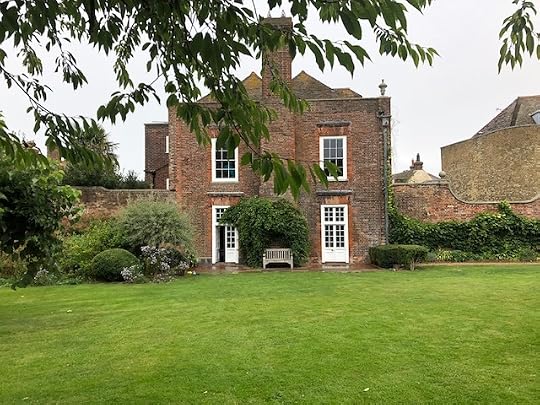
Lamb House, Rye, Sussex. James' Other House.
Take the dialog. He actually allows his characters to say what they feel this time, in actual words. This is crazy for HJ, who 99% of the time neeeeever just says what he’s thinking. (It becomes linked to his imaginative output, that renunciatory act, but nm). But here, he says it! The frank dialog between Rose and the hilariously-great named Dennis Vidal was really satisfying compared to other lovers’ spats elsewhere in James, esp. late-stage James (LSJ). Yet despite this level of clarity in dialog and believability, the guy (Vidal) still gets burned in the ultimate way as the “Bad Heroine” (James’ words) utterly obliterates his soul. Just when you think this time it’s different James twists a way you never saw coming because NO ONE would ever do what his characters do, or think how they think. It’s fucked up! James makes the unbelievable decision to punish these characters in really odd ways. There are victims all over this tale, even though only one kid actually dies. Darksided.
Then the plot – which brings up a very interesting mystery-book tactic: You tell the audience there is a murder, but by more than halfway through (here closer to ¾) no one has died yet, so the suspense begins to turn around not only whodunnit, but who gon get done, sun. It’s another way James makes something truly scary without literally much happening at all. That’s pretty gangster. It’s Lynchian – in that you get a vibe from a scene which is nbd on paper – but you believe that damn scene. An acquaintance of James, first Director of the US Geological Survey Mr Clarence King, might have put it best: “[Mr King] expressed admiration however for James’s ability to create ‘such airy webs and drape them over the objective facts of life, so that the dew shall sparkle on them and the amusing little insects glitter and tangle in them, like the fabrics of spiders.’” (Edel, Henry James: The Treacherous Years, 238). There are tons of these instances of lokkanet here. Pretty much every scene is that way – realism with a lace of revelation or twist or brutal conversation gently laid over top. Based on the marriage plots alone it feels like a murder tale; no one has to die for us to see how the social knife hurts just as much when you twist as does the umbrella dagger, or whichever sharp murder weapon you choose (or, ‘t wasn’t a knife wuzzit, wuz a nail> i thot…). Mrs Beever had my vote for villain early on, as she acts as the rest of the casts’ superego, battering down on them final pronouncements with complete impunity (she’s also HJ’s stand-in) – until she vanishes in the third act like a hologram. Then Rose Armiger and Vidal’s relationship dynamic is a tragedy/horror in itself, sadomasochistic to the core. I won’t even spoil but it’s insane – plus they actually touch one another, too! Scandalous! And then there’s good ol “Tony”... what the fuck is the story with that guy. Another pretty-boy dunce to serve as sacrifice to James’ Minotaur. And I haven’t even gotten into the plot at all. Book is nuts, dag.
If it’s your first James you might find it as obtuse as anything else, but for those who’ve read more – imho this is a cult classic. If you really wanna piss off your friends trick them into reading it – it’s a Molotov cocktail to any book club. Achtung 😊
4* The Turn of the Screw 3* The Jolly Corner 3* The Art of Fiction 3* Roderick Hudson 4* The American 4* The Beast in the Jungle 2* Lady Barbarina and Other Tales 3* The Madonna of the Future 4* A Little Tour in France 3* What Maisie Knew 4* The Aspern Papers 2* The Real Thing 2* The Bostonians 4* The Portrait of a Lady 4* The Wings of the Dove 4* The Ambassadors 3* Washington Square 4* Daisy Miller TR The Tragic Muse TR The Spoils of Poynton TR Hawthorne TR The Pupil TR The Princess Casamassima TR The Great Good Place TR Nona Vincent TR The Art of the Novel TR The Middle Years TR Ghost Stories TR The Ivory Tower TR Italian Hours TR Nona Vincent TR The Great Good Place
About Henry James: 3* Henry James: A Life in Letters 3* Henry James at Work 3* The Real Henry James TR A Private Life of Henry James: Two Women & His Art TR The Realists: Eight Portraits: Stendhal, Balzac, Dickens, Dostoevsky, Tolstoy, Galdos, Henry James, Proust TR The Great Tradition: George Eliot, Henry James, Joseph Conrad
I loved the way this book read because of the incredibly intelligent dialogue. It is also totally unpredictable - a big virtue to me. It concerns only a handful of people, so you get to know (or think you know) the characters pretty well. It is very well-written (James always is), and I didn't want to put it down. The one difficulty I had was that there are several sentences/paragraphs so long (Mark Twain style) that you have to pay close attention to be sure you didn't lose the original point.
I read the 1948 version that came into the bookstore, but would like to go back and read the ny review of books intro. It was like reading Jane Austin, but modernized slightly (100 years) and with a terrifying twist that reminds you that it's from the same author as The Turn of the Screw. I was reminded of Shirley Jackson, too. My god I hate author comparisons, but there you are: it's a Jane Jackson, or a Shirley Austin.
If you try and read every book by any author you're bound to run into a few duds; this is true even when the author was maybe the greatest novelist who ever lived. The Other House is mostly forgotten, and for good reason. Your time would be much better spent with What Maisie Knew, Spoils of Poynton, or even the Awkward Age (to name just the other late British novels).
I would tread lightly to recommend this longish novel to anyone not as hooked on James’s fiction as I am. James conceived this work as a play and so the characters come and go as if they were walking on and off a stage rather than, as is usual in James, moving about in a broad and meticulously described field of action.
You can see this difference by comparing The Other House to The Spoils of Poynton, a novel James published a year later (1897). Both are set in two English country houses, but the contrast between the two is much sharper in the second novel than the first, where the residing characters are monotonously similar. In the first book one house belongs to the Breams, the other to the Beevers—two families whose interests have already been commingled for years by their common ownership of a large bank. Tony Bream, a comparatively colorless “nice guy,” is nevertheless inexplicably loved not just by his dying wife, Julia, but by her longstanding friend, Rose Armiger, who has moved in with the Breams, and by Jean Martle, a live-in cousin of the neighboring Beevers.
Despite its comparative dullness, however, The Other House is important in helping us understand the consistency of James’s concerns as a fiction writer. The situation of a wife dictating how the husband surviving her should behave goes back nearly thirty years to “The Romance of Certain Old Clothes” (1868). In that story a sister, wary of her older sister’s marital designs on her husband after her death, makes him promise not to allow the trunk containing her wedding dress to be opened until their just born daughter herself is married. In The Other House the dying Julia Bream goes much further, insisting that Tony not marry a second time during the entire lifetime of their recently born daughter, Effie.
At issue in both stories is the extent to which our intimacy with another justifies our interference with the autonomy of that person. Too little interference ends in solitude; too much in boundary crossing. Excessive interference leads to an appalling death for Perdita Wingrave in “The Romance of Certain Old Clothes,” but it drives Rose Armiger in The Other House to a living death that may well be worse.
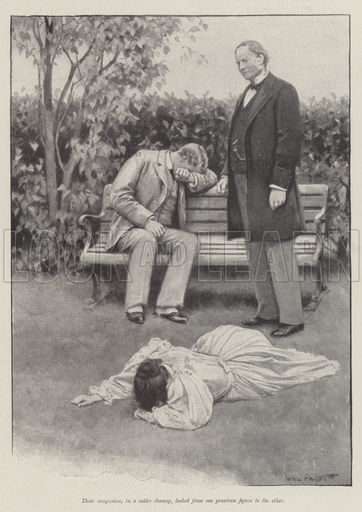
Looking for an opportunity to override Tony Bream’s promise to his wife and so make herself eligible to marry him, Rose murders little Effie during her fourth birthday party. Boundary crossing cannot go much beyond this. Rose’s punishment is to end up marrying not Tony but Dennis Vidal, who understands as well as Rose, along with both the Bream and Beevers households, what she has done and why. All these well mannered social high fliers agree to be complicit in Rose’s crime by covering it up. Their punishment is now to have to live with themselves. And nice guy Tony is now ironically free to marry—not Rose, but her rival for his affections, Jean Martle.
This was one of the strangest books I've read in a long time! When starting to read, I was unaware of the plot and the fact that James had intended it to be a play. The language from the outset was verbose, the protagonists seemingly talking in riddles. I'm very familiar with literature of this era and have read books by James before, so I am aware of the more wordy way some authors wrote their stories then, but this was something else! It felt to me as though he were trying to emulate the likes of Oscar Wilde, but an Oscar Wilde void of humour, wit or any brilliance whatsoever. To say the story turned from almost comedic banter to absolute shocking horror (horror in its true sense, not gory fiction or jump scare horror) is something of an understatement. The characters were mostly very unlikeable, from the bossy Mrs Beever, full of her own self importance, her docile complying son, the dashing dandy Tony and worst of all the conniving, unpleasant Rose. Dennis was almost tolerable. The only character I felt to be 'real' was Jean Martle, who at least showed some genuine human traits, such as affection and a modicum of common sense. The poor Effie, who was portrayed as some little frilled object of sacrifice throughout, became just that at the hands of the evil Rose! The ending was dire, with Jean being the only person who wanted to exact revenge on Rose for her evil murder of Effie, wanting to tear her to pieces for her heinous crime. How Tony, as a father, could want to let her get away with punishment is beyond belief, unless Rose had something 'on him', like a secret affair which could scandalise him so he wouldn't be 'alright', as they kept saying. Worst of all in some ways is the 'kindly' doctor and family friend, willing to cover up the murder, and to pronounce the death of natural causes, i.e. illness. I mean, what a load of bollocks. I suppose at least reading it inspired me to actually write a review, which I rarely do nowadays haha.
This entire review has been hidden because of spoilers.
Would anyone with a fair conscious name this as their favorite Henry James novel? No, they would not. But perhaps that is not the standard by which to judge this novel, which was presented as a murder mystery but which is barely a mystery and which drags on in the way that someone being paid by the word tends to extend it. The Other House is a story of Tony Bream, a man with whom multiple women find themselves infatuated. One, Rose Armiger, does to such a degree that she is willing to risk it all. This because the widower Mr. Bream promised his wife on her deathbed that he should not remarry as long as their daughter, Effie, remained alive. Rose finds a simple solution to this problem: she murders the girl. However, while this sounds like an exciting set-up, the major events of the novel unfurl slowly. There is much talk, talk, talk. James originally wrote the story as a play and then re-wrote it as a serial for the Illustrated London News. While James is a very adequate writer—his world is adeptly built out and the characters have a realness that is in keeping with the times—he gets bogged down in his writing. This man is given to fancy tricks that are at times marvelous and at others a real bore. My main issue with The Other House is that it is slow. It crawls like an infant toward its moments of excitement and leaves much to be desired in all the chit-chat of British aristocrats. I understand why the reviews at the time of its publication, in 1896, found it to be uneven. Why it was reissued as a great, underrated work of a genius I shall never know.
The gentility of the language and manners combined with the odiousness of the crime make for an eerie reading experience.
The plot, characters and situations are straightforward. What is fascinating about this story is the fleshing out of the characters, their feelings and relationships and what they understand and misunderstand about each other. This is revealed by their dialog. We learn about them by what they conceal and what they reveal, and to whom. None of the adult characters are completely sympathetic. They are:
Three men: One good looking, wealthy and emotional (Tony) One good looking and not wealthy, but with "expectations"; single (Dennis) One ugly, but with inherited wealth; single (Paul)
Two pretty unmarried women: One clever, scheming, dishonest (Rose) One smart and honest (Jean)
Tony's wife (Julia) dies shortly after the birth of their daughter (Effie).
Tony pledges to his wife that he will not marry anyone else while Effie lives.
Rose refuses Dennis' proposal of marriage. Jean refuses Paul's proposal of marriage.
The Other House is well crafted and beautifully written, but I'm not sure I know what it is. Originally, James planned for this to be a play, probably in some Russian fatalistic tragedy form, but through repeated rejections, it appeared as a hard to define novel. As a story, it is conspicuously bland with very little happening and, at times, is weighed down by turgid self-indulgent dialogue. But as a character study, it is far more interesting. James tries to draw out the psychology of his characters and their motivations and desires within an overly complicated tangled web of love, admiration, and desperation. Did I like it? In a strange way, yes. It is not a popular choice for a read and sits uncomfortably amid James' works, so I shall try a more popular book and give James the benefit of the doubt on The Other House.