

What do you think?

Making Sense of the Troubles: A History of the Northern Ireland Conflict
COMPLETELY REVISED AND UPDATED EDITION
Making Sense of the Troubles is David McKittrick and David McVea's classic history of the Troubles, now completely revised and updated.
First published ten years ago, Making Sense of the Troubles is widely regarded as the most 'comprehensive, considered and compassionate' (Irish Times) history of the Troubles in Northern Ireland. Written by a distinguished journalist and a teacher of history in Northern Ireland, it surveys the roots of the problems from 1921 onwards, the descent into violence in the late 60s, and the three terrible decades that followed. McKittrick and McVea have now fully updated the book to take into account the momentous events of the last ten years, including the disbanding of the IRA, Ian Paisley's deal with the Republicans and the historic power-sharing government in Belfast.
'An updated reissue of a collaborative study published 12 years ago to rave reviews as a frank, accurate and authoritative narrative of events which should be required reading for anyone hoping to understand what had been going on in the North' Irish Independent
'I would strongly advocate that it be made compulsory reading for everyone in Northern Ireland because for the first time it is our history, all of it warts and all, presented in a clear and understandable way' Irish News
'Extraordinarily well-balanced, sane, comprehensive and rich in sober understatement' Glasgow Herald
'Compellingly written and very even-handed. By far the clearest account of what happened in the Northern Ireland conflict and more importantly why it happened' Irish News
David McKittrick has reported on the Northern Ireland troubles since the 1970s. After working for the Irish Times and BBC he has been Ireland correspondent of the London Independent since 1985. Awards include the Orwell Prize, correspondent of the year and Belfast journalist of the year.
David McVea graduated in politics and modern history from Queen's University, Belfast, and has an MA from Sussex University. He was head of the politics department of a Belfast grammar school where he taught both history and political studies.
Making Sense of the Troubles is David McKittrick and David McVea's classic history of the Troubles, now completely revised and updated.
First published ten years ago, Making Sense of the Troubles is widely regarded as the most 'comprehensive, considered and compassionate' (Irish Times) history of the Troubles in Northern Ireland. Written by a distinguished journalist and a teacher of history in Northern Ireland, it surveys the roots of the problems from 1921 onwards, the descent into violence in the late 60s, and the three terrible decades that followed. McKittrick and McVea have now fully updated the book to take into account the momentous events of the last ten years, including the disbanding of the IRA, Ian Paisley's deal with the Republicans and the historic power-sharing government in Belfast.
'An updated reissue of a collaborative study published 12 years ago to rave reviews as a frank, accurate and authoritative narrative of events which should be required reading for anyone hoping to understand what had been going on in the North' Irish Independent
'I would strongly advocate that it be made compulsory reading for everyone in Northern Ireland because for the first time it is our history, all of it warts and all, presented in a clear and understandable way' Irish News
'Extraordinarily well-balanced, sane, comprehensive and rich in sober understatement' Glasgow Herald
'Compellingly written and very even-handed. By far the clearest account of what happened in the Northern Ireland conflict and more importantly why it happened' Irish News
David McKittrick has reported on the Northern Ireland troubles since the 1970s. After working for the Irish Times and BBC he has been Ireland correspondent of the London Independent since 1985. Awards include the Orwell Prize, correspondent of the year and Belfast journalist of the year.
David McVea graduated in politics and modern history from Queen's University, Belfast, and has an MA from Sussex University. He was head of the politics department of a Belfast grammar school where he taught both history and political studies.
369 pages, Kindle Edition
First published October 1, 2000
About the author
David McKittrick
8 books18 followersMcKittrick began his career as a reporter for the East Antrim Times. He joined the Irish Times in 1973 as a reporter in Belfast, becoming Northern editor in 1976 and London editor in 1981. He worked briefly for BBC Northern Ireland between 1985 and 1986, before joining The Independent. He has since worked as the paper's Irish correspondent.
Widely recognised for the scope of his knowledge and the balance of his reporting on Northern Ireland, he contributes regularly to overseas newspapers and journals. His many awards include the Christopher Ewart-Biggs Memorial Prize for the promotion of peace and understanding in Northern Ireland, 1989 and 2001; Correspondent of the Year, 1999; and the 2000 Orwell Prize for Journalism.
His book Lost Lives was made into a 2019 documentary by Michael Hewitt and Diarmuid Lavery.
Widely recognised for the scope of his knowledge and the balance of his reporting on Northern Ireland, he contributes regularly to overseas newspapers and journals. His many awards include the Christopher Ewart-Biggs Memorial Prize for the promotion of peace and understanding in Northern Ireland, 1989 and 2001; Correspondent of the Year, 1999; and the 2000 Orwell Prize for Journalism.
His book Lost Lives was made into a 2019 documentary by Michael Hewitt and Diarmuid Lavery.
Ratings & Reviews
Friends & Following
Create a free account to discover what your friends think of this book!
Community Reviews
Displaying 1 - 30 of 281 reviews

September 28, 2015
Catholics and Protestants kill each other for several decades. Then they stop.
This is the fourth book I've read about the Troubles since an Irish history class in college piqued my interest. Occasionally, in bars, I'll try to engage my fellow Americans in a discussion of this conflict, only to watch their eyes glaze over in boredom. Here's why you, as an American, should care about a convoluted war on the rainy edge of Europe that ended 15 years ago:
1. It proves that racism has nothing to do with race. If you think black/white racism in our country is stupid, imagine the inanity of racism in a country where the two bickering populations are genetically identical. You have to ask a stranger a few questions first before you can decide whether you hate them.
2. It offers hope. Do you think Palestine and Israel can ever get along? Do you think there will ever be an end to tribal warfare in Africa? The history of northern Ireland says yes. Even though Catholics and Protestants still regard each other with suspicion, and even though there is still a fierce climate of mistrust and fear, at least they have stopped shooting each other.
Basically, Irish history is thus: for a long time there were a bunch of clans running around in furs and kilts, and they used cows as money. Then the English invaded, and they were total dicks for about 500 years. The Irish rebelled like clockwork every century or so, but it wasn't until 1920ish that they won their independence.
But there was a problem, because in the northern part of Ireland, known as Ulster, there were a bunch of Protestants who didn't want to be part of Ireland. They hated Catholics and saw themselves as English. True, the reason they were in Ireland in the first place was because the English shipped them over to colonize the north in the 1600s, and that was totally unjust, but their ancestors had been living there for 400 years, so giving it back to the Republic of Ireland would be like giving Texas back to Mexico.
So Ireland was divided, with most of it becoming an independent country, but the north remaining part of the UK, where Catholics were treated as 2nd class citizens, denied jobs, education, housing, denied votes, etc. They never had it as bad as blacks in the American south, or Jews in Nazi Germany, but it was still oppressive, and if you were a Catholic in Northern Ireland you could basically work for minimum wage, live in a hovel, drink, and call it a life.
Then in the late 60s, inspired by the Civil Rights movement in America, the Catholics said, hey, can we vote and live in nice houses? The Protestants said no, freaked out and started cracking skulls. So the (Provisional) IRA came into existence, got some guns, and started shooting people. Then the British Army got involved, initially to keep the peace, like a school teacher trying to keep the bullies apart on the playground, but before long it was the IRA, the Protestants, and the British Army, all shooting and bombing each other for various reasons, and life sucked.
The IRA wanted a united Ireland, the Unionists wanted to remain part of the UK, the mainstream Catholics just wanted to live as they pleased, the mainstream Protestants wanted to keep treating Catholics like dirt, and the British Army was just trying to keep it from boiling over.
After a few decades of mayhem, everyone got tired of killing, and they decided that politics might be a better way forward. So there was a cease fire, and a Good Friday Agreement, and the British Government said that as soon as the Catholics have a majority they can vote to become part of Ireland.
This is the fourth book I've read about the Troubles since an Irish history class in college piqued my interest. Occasionally, in bars, I'll try to engage my fellow Americans in a discussion of this conflict, only to watch their eyes glaze over in boredom. Here's why you, as an American, should care about a convoluted war on the rainy edge of Europe that ended 15 years ago:
1. It proves that racism has nothing to do with race. If you think black/white racism in our country is stupid, imagine the inanity of racism in a country where the two bickering populations are genetically identical. You have to ask a stranger a few questions first before you can decide whether you hate them.
2. It offers hope. Do you think Palestine and Israel can ever get along? Do you think there will ever be an end to tribal warfare in Africa? The history of northern Ireland says yes. Even though Catholics and Protestants still regard each other with suspicion, and even though there is still a fierce climate of mistrust and fear, at least they have stopped shooting each other.
Basically, Irish history is thus: for a long time there were a bunch of clans running around in furs and kilts, and they used cows as money. Then the English invaded, and they were total dicks for about 500 years. The Irish rebelled like clockwork every century or so, but it wasn't until 1920ish that they won their independence.
But there was a problem, because in the northern part of Ireland, known as Ulster, there were a bunch of Protestants who didn't want to be part of Ireland. They hated Catholics and saw themselves as English. True, the reason they were in Ireland in the first place was because the English shipped them over to colonize the north in the 1600s, and that was totally unjust, but their ancestors had been living there for 400 years, so giving it back to the Republic of Ireland would be like giving Texas back to Mexico.
So Ireland was divided, with most of it becoming an independent country, but the north remaining part of the UK, where Catholics were treated as 2nd class citizens, denied jobs, education, housing, denied votes, etc. They never had it as bad as blacks in the American south, or Jews in Nazi Germany, but it was still oppressive, and if you were a Catholic in Northern Ireland you could basically work for minimum wage, live in a hovel, drink, and call it a life.
Then in the late 60s, inspired by the Civil Rights movement in America, the Catholics said, hey, can we vote and live in nice houses? The Protestants said no, freaked out and started cracking skulls. So the (Provisional) IRA came into existence, got some guns, and started shooting people. Then the British Army got involved, initially to keep the peace, like a school teacher trying to keep the bullies apart on the playground, but before long it was the IRA, the Protestants, and the British Army, all shooting and bombing each other for various reasons, and life sucked.
The IRA wanted a united Ireland, the Unionists wanted to remain part of the UK, the mainstream Catholics just wanted to live as they pleased, the mainstream Protestants wanted to keep treating Catholics like dirt, and the British Army was just trying to keep it from boiling over.
After a few decades of mayhem, everyone got tired of killing, and they decided that politics might be a better way forward. So there was a cease fire, and a Good Friday Agreement, and the British Government said that as soon as the Catholics have a majority they can vote to become part of Ireland.

September 24, 2014
In 1972 a total of 498 people were killed in Northern Ireland, which had a small population of around 1.5 million. It was a very violent place. The total body count of The Troubles is 3,739 between 1966 and 2012 (but the murders have not been in double figures since 2004.) Now – can anyone tell me how many people have died in Iraq’s complex internal wars since 2003? Is anyone counting? And that’s just one example. How long have you got?
Really, as civil wars go, it was not much to write home about. The United Nations estimated casualties of the Sri Lankan civil war as somewhere between 80 and 100,000 killed between 1982 and 2009. Now that’s what you call a civil war.
But I’ll say one thing for the Troubles – they kept your attention. Just when you were beginning to lose interest with the interminable tit-for-tat shootings ( see Alan Clarke’s grim but excellent film Elephant ) something really ghastly would happen.
FOR INSTANCE
In May 1981 a British soldier shot Julie Livingstone in the head with a plastic bullet. He alleged he was shooting at rioters. She died the following day. She was 14.
In the same month a rioting crowd began throwing stones at a passing milk lorry. The lorry crashed into a lamppost and the driver and his son, Desmond Guiney, were killed. Desmond was 14 too.
Julie was Catholic, Desmond was Protestant. That’s what you could call fearful symmetry.
THE TWO MINORITIES
People make out Irish politics were complex. Not really. The big reason for this low-level civil war was plain to see. If you consider Ireland as one country, the Protestants are a minority (maybe 20%). But the country was chopped up in 1922, and in Northern Ireland, a province of Great Britain, the Protestants are the majority (60%).
The Protestants wanted to keep being the majority, thank you very much, and the Catholics wanted Northern Ireland to re-join the Republic of Ireland so they could be in the majority. And it wasn’t just a whimsical notion either, it was a fight to get the hands of the strangler off their throats. There’s no doubt the Catholics were viciously denied every possible social and human right between 1922 and, well, the outbreak of peace in 2004. They were denied housing, jobs, votes, decent treatment by the police and courts, you name it. They had been kept down for so long. Well, isn't democracy the rule of the majority? If so, Northern Ireland 1922-2004 was intensely democratic.
Not so surprising that when the top shot off the kettle it went with a bang.
THE HUNGER STRIKE
The gruesome story of the Troubles never became boring because each side had a flair for original or striking twists. The hunger strikes were really something. For politicians, it was like being trapped in a horror film, only it was real. Here’s how it got to be that way. Imagine this.
IRA prisoners, hundreds of whom were behind bars in the Maze prison, (more IRA members inside prison than outside!), had long insisted that they were political prisoners and/or prisoners of war, and not criminals. The British government shilly-shallied about the issue. At first, to avoid trouble, they did grant “political status” to these prisoners, but then they changed their mind – by 1976 they could stomach it no more, they craved to stop coddling the murderous scum, so they decided to phase out the special privileges and make the IRA wear ordinary prison uniforms and carry out ordinary prison work.
Republican prisoners were determined to fight to maintain their special political status. So they decided to refuse to wear prison uniform. Prison officers would beat these guys, and in retaliation, the IRA began systematically killing off-duty prison officers (ten in 1979 alone).
The prisoners were refused any clothing if they refused to wear the uniforms. They were given a blanket and a mattress. By 1978 there were 300 such prisoners “on the blanket”. It was a classic battle of male egos. The problem for the prisoners was that no one much cared if they were naked. Their campaign went on for 18 months and got nowhere. So they hit on the idea of refusing to wash. Thus began the next phase, the dirty protest. They refused to leave their cells at all, either for food or to have a shower or, crucially, to empty their chamber pots:
leaving prison officers to empty the chamber pots. The clashes this led to meant that excrement and urine literally became weapons in the war between prisoners and prison officers. … Soon the protest was escalated again, prisoners spreading their excrement on the walls. As conditions reached dangerous levels, with maggot infestations and threat of disease, the prison authorities forcibly removed prisoners to allow their cells to be steam-cleaned with special equipment, (and) forcible baths, shaves and haircuts of protesting prisoners.
The British secretary of state for Northern Ireland, Roy Mason, wrote :
The image of prisoners naked in their cells with nothing for company but their own filth is undeniably potent, and it was being trumpeted round the world. But despite the adverse publicity I couldn’t give in. To do so would give the IRA its biggest victory in years. It would mean the abandonment of…the rule of law.
Then things went up another gear – seven prisoners went on hunger strike in October 1980. The IRA leadership was dismayed – they didn’t want any more of this, but they were not in control of their own members in prison. By now Margaret Thatcher was prime minister, and she said:
I want this to be utterly clear – the government will never concede political status to the hungerstrikers or to any others convicted of criminal offences.
The first hungerstrike quickly collapsed in confusion. The second one began on 1st March 1981. The first prisoner to refuse food was Bobby Sands. He was 27.
It's worth noting here that the Suffragettes, in the 1910s, also went on prison hungerstrike. They were force-fed. The government decided they would not do that with the Irish prisoners. Indeed, Margaret Thatcher said :
If Mr Sands persisted in his wish to commit suicide, that was his choice.
Then things went up another gear. A Nationalist MP died in Northern Ireland, and the IRA had the brilliant idea of putting up Bobby Sands as the candidate for the by-election. On 9 April 1981, when he was already losing his sight and was very ill, he was elected as Member of Parliament for Fermanagh and South Tyrone.
He died on 5th May.
The other hungerstrikers weren’t far behind. Seven days after Bobby Sands, Francis Hughes died, 9 days after him came Raymond McCreesh and Patsy O’Hara on the same day, 18 days later, Joe McDonnell, and so on…. Ten men, all in their mid-20s, dying of starvation one after another, between May and August. It was so gruesome.
How did it end? The families of the 13 other hungerstrikers, the ones who hadn’t yet died, insisted they stop – they were terrified, they were out of their minds, they knew the British government didn’t care a hoot, and the prisoners eventually listened to their families and stopped.
The authors sum it up :
There could have been no more definitive display of political motivation than the spectacle of ten men giving their lives in an awesome display of self-sacrifice and dedication. It was possible to view this as outlandish fanaticism, and many did; but it was not possible to claim that there were indistinguishable from ordinary criminals.
NUN'S MEN AND MONKS' WOMEN
There are some amazing quotes in this book. Here are two about the IRA. The first is from the Rev Dr Ian Paisley, who recently died. A very remarkable man. He was always good for a soundbite. This is him in 1994 :
Are we going to agree to a partnership with the IRA men of blood who have slain our loved ones, destroyed our country, burned our churches, tortured our people, and now demand that we should become slaves in a country fit only for nuns’ men and monks’ women to live in? We cannot bow the knee to these traitors in Whitehall, nor to those offspring of the Vatican who walk the corrupted corridors of power.
Here’s another from John Hume, a Catholic nationalist politician :
The IRA are more Irish than the rest of us, they believe. They are the pure master race of Irish. They are the keepers of the holy grail of the nation. That deep-seated attitude, married to their method, has all the hallmarks of undiluted fascism. They have all the other hallmarks of the fascist – the scapegoat – the Brits are to blame for everything, even their own atrocities!
You probably know this already, but 13 years after the first quote, Reverend Paisley became First Minister of Northern Ireland with none other than Martin McGuinness, former military leader of the IRA, as Deputy First Minister.
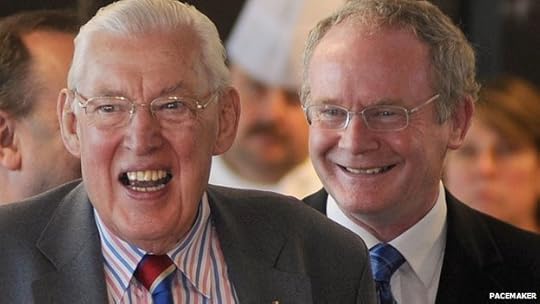
After all the horrors, the body parts, the misery, the existential hardcore never-surrender-never, never, the mutual slayings, the undisguised hatreds, the story winds its way into something which might, if you tilt it backwards and hold it up to the sun, be mistaken for peace by a myopic man without his glasses on. At least, when I go to London these days, I don’t have to worry about the IRA blowing me up randomly.* There’s some other people who’ve taken over that position now.
This is a great sober account of a little war in a little place. Really nothing much to bother about. Just a little normal sorrow, just some ordinary pity. Only 3,739 dead people. There’s probably more than that in two days in Syria or the Congo.
*Last fatal bombing in mainland Britain by the IRA : 1996.
Really, as civil wars go, it was not much to write home about. The United Nations estimated casualties of the Sri Lankan civil war as somewhere between 80 and 100,000 killed between 1982 and 2009. Now that’s what you call a civil war.
But I’ll say one thing for the Troubles – they kept your attention. Just when you were beginning to lose interest with the interminable tit-for-tat shootings ( see Alan Clarke’s grim but excellent film Elephant ) something really ghastly would happen.
FOR INSTANCE
In May 1981 a British soldier shot Julie Livingstone in the head with a plastic bullet. He alleged he was shooting at rioters. She died the following day. She was 14.
In the same month a rioting crowd began throwing stones at a passing milk lorry. The lorry crashed into a lamppost and the driver and his son, Desmond Guiney, were killed. Desmond was 14 too.
Julie was Catholic, Desmond was Protestant. That’s what you could call fearful symmetry.
THE TWO MINORITIES
People make out Irish politics were complex. Not really. The big reason for this low-level civil war was plain to see. If you consider Ireland as one country, the Protestants are a minority (maybe 20%). But the country was chopped up in 1922, and in Northern Ireland, a province of Great Britain, the Protestants are the majority (60%).
The Protestants wanted to keep being the majority, thank you very much, and the Catholics wanted Northern Ireland to re-join the Republic of Ireland so they could be in the majority. And it wasn’t just a whimsical notion either, it was a fight to get the hands of the strangler off their throats. There’s no doubt the Catholics were viciously denied every possible social and human right between 1922 and, well, the outbreak of peace in 2004. They were denied housing, jobs, votes, decent treatment by the police and courts, you name it. They had been kept down for so long. Well, isn't democracy the rule of the majority? If so, Northern Ireland 1922-2004 was intensely democratic.
Not so surprising that when the top shot off the kettle it went with a bang.
THE HUNGER STRIKE
The gruesome story of the Troubles never became boring because each side had a flair for original or striking twists. The hunger strikes were really something. For politicians, it was like being trapped in a horror film, only it was real. Here’s how it got to be that way. Imagine this.
IRA prisoners, hundreds of whom were behind bars in the Maze prison, (more IRA members inside prison than outside!), had long insisted that they were political prisoners and/or prisoners of war, and not criminals. The British government shilly-shallied about the issue. At first, to avoid trouble, they did grant “political status” to these prisoners, but then they changed their mind – by 1976 they could stomach it no more, they craved to stop coddling the murderous scum, so they decided to phase out the special privileges and make the IRA wear ordinary prison uniforms and carry out ordinary prison work.
Republican prisoners were determined to fight to maintain their special political status. So they decided to refuse to wear prison uniform. Prison officers would beat these guys, and in retaliation, the IRA began systematically killing off-duty prison officers (ten in 1979 alone).
The prisoners were refused any clothing if they refused to wear the uniforms. They were given a blanket and a mattress. By 1978 there were 300 such prisoners “on the blanket”. It was a classic battle of male egos. The problem for the prisoners was that no one much cared if they were naked. Their campaign went on for 18 months and got nowhere. So they hit on the idea of refusing to wash. Thus began the next phase, the dirty protest. They refused to leave their cells at all, either for food or to have a shower or, crucially, to empty their chamber pots:
leaving prison officers to empty the chamber pots. The clashes this led to meant that excrement and urine literally became weapons in the war between prisoners and prison officers. … Soon the protest was escalated again, prisoners spreading their excrement on the walls. As conditions reached dangerous levels, with maggot infestations and threat of disease, the prison authorities forcibly removed prisoners to allow their cells to be steam-cleaned with special equipment, (and) forcible baths, shaves and haircuts of protesting prisoners.
The British secretary of state for Northern Ireland, Roy Mason, wrote :
The image of prisoners naked in their cells with nothing for company but their own filth is undeniably potent, and it was being trumpeted round the world. But despite the adverse publicity I couldn’t give in. To do so would give the IRA its biggest victory in years. It would mean the abandonment of…the rule of law.
Then things went up another gear – seven prisoners went on hunger strike in October 1980. The IRA leadership was dismayed – they didn’t want any more of this, but they were not in control of their own members in prison. By now Margaret Thatcher was prime minister, and she said:
I want this to be utterly clear – the government will never concede political status to the hungerstrikers or to any others convicted of criminal offences.
The first hungerstrike quickly collapsed in confusion. The second one began on 1st March 1981. The first prisoner to refuse food was Bobby Sands. He was 27.
It's worth noting here that the Suffragettes, in the 1910s, also went on prison hungerstrike. They were force-fed. The government decided they would not do that with the Irish prisoners. Indeed, Margaret Thatcher said :
If Mr Sands persisted in his wish to commit suicide, that was his choice.
Then things went up another gear. A Nationalist MP died in Northern Ireland, and the IRA had the brilliant idea of putting up Bobby Sands as the candidate for the by-election. On 9 April 1981, when he was already losing his sight and was very ill, he was elected as Member of Parliament for Fermanagh and South Tyrone.
He died on 5th May.
The other hungerstrikers weren’t far behind. Seven days after Bobby Sands, Francis Hughes died, 9 days after him came Raymond McCreesh and Patsy O’Hara on the same day, 18 days later, Joe McDonnell, and so on…. Ten men, all in their mid-20s, dying of starvation one after another, between May and August. It was so gruesome.
How did it end? The families of the 13 other hungerstrikers, the ones who hadn’t yet died, insisted they stop – they were terrified, they were out of their minds, they knew the British government didn’t care a hoot, and the prisoners eventually listened to their families and stopped.
The authors sum it up :
There could have been no more definitive display of political motivation than the spectacle of ten men giving their lives in an awesome display of self-sacrifice and dedication. It was possible to view this as outlandish fanaticism, and many did; but it was not possible to claim that there were indistinguishable from ordinary criminals.
NUN'S MEN AND MONKS' WOMEN
There are some amazing quotes in this book. Here are two about the IRA. The first is from the Rev Dr Ian Paisley, who recently died. A very remarkable man. He was always good for a soundbite. This is him in 1994 :
Are we going to agree to a partnership with the IRA men of blood who have slain our loved ones, destroyed our country, burned our churches, tortured our people, and now demand that we should become slaves in a country fit only for nuns’ men and monks’ women to live in? We cannot bow the knee to these traitors in Whitehall, nor to those offspring of the Vatican who walk the corrupted corridors of power.
Here’s another from John Hume, a Catholic nationalist politician :
The IRA are more Irish than the rest of us, they believe. They are the pure master race of Irish. They are the keepers of the holy grail of the nation. That deep-seated attitude, married to their method, has all the hallmarks of undiluted fascism. They have all the other hallmarks of the fascist – the scapegoat – the Brits are to blame for everything, even their own atrocities!
You probably know this already, but 13 years after the first quote, Reverend Paisley became First Minister of Northern Ireland with none other than Martin McGuinness, former military leader of the IRA, as Deputy First Minister.
After all the horrors, the body parts, the misery, the existential hardcore never-surrender-never, never, the mutual slayings, the undisguised hatreds, the story winds its way into something which might, if you tilt it backwards and hold it up to the sun, be mistaken for peace by a myopic man without his glasses on. At least, when I go to London these days, I don’t have to worry about the IRA blowing me up randomly.* There’s some other people who’ve taken over that position now.
This is a great sober account of a little war in a little place. Really nothing much to bother about. Just a little normal sorrow, just some ordinary pity. Only 3,739 dead people. There’s probably more than that in two days in Syria or the Congo.
*Last fatal bombing in mainland Britain by the IRA : 1996.

December 8, 2018
This is exactly what I was after: a concise and easy to follow summary of the Troubles. I was born in the 90s and I've always felt that this was massive gap in my knowledge; I've grown up knowing how huge the impact of the Troubles have been and still are, but never feeling I had any understanding of it all. Too young to remember it at all, and too old (it seems) to have been told much about or informed in other ways. So I turned to this book, hoping for an informative introduction. In some ways, it's left me with more questions than answers, but the fact that I feel prepared to go on and learn more, rather than utterly overwhelmed by such a complicated period of history, is to this book's credit. As the authors say in their introduction, they sacrificed a lot detail to create this succinct and brief overview (complete with a massive chronology at the end of the book). I can tell a lot of background history was skipped over and the book also does not read as smooth or narrative based, instead feeling at times like a long, draining list of many deaths, destruction and terror. However, I think this all allowed the authors to clearly outline the many players, motivations and shifting alliances. Any more detail or divergence from the straight summery and I don't think the general reader could take it all in. I am determined to read further though, myself, and I would recommend this book to others as a starting point.

April 26, 2012
Good for accuracy, not so good for background
Making Sense stays true to its objective, to tell ‘a straightforward and gripping story … in an accessible way’. It is a straightforward read.
But is it a good read? Yes, if you don’t want to be bogged down with pre-Troubles history (too simplistically outlined in the book) or don’t need to understand the ideologies of unionism and nationalism per se. In this way, Making Sense feels written for a general English/benign foreign audience.
However, if you know some Irish history and/or can appreciate the ethno-nationalist competition in Northern Ireland, then you may very well be let down.
The factual reportage in Making Sense is flawless, but the story told is not neutral. Of course, no account of the Troubles can be. Yet after reading Making Sense, one leaves with a sense that: a) Northern Protestants really don’t like Catholics; b) republican violence stems from a ideological struggle while loyalist violence is just sectarian hatred; c) the British government could have done more from 1921 forward, but were frustrated by intransigent unionists. All entirely acceptable to believe if one wishes, but by no means a neutral or fair position.
Thus, I was disappointed that Making Sense didn’t try harder to place the Troubles in an all-Ireland context. This would require more history, but would help explain some unionist perspective as well as the sometimes variable relationship between the Irish Republican government and Northern nationalists.
For the general reader, I would recommend A Pocket History of Ulster, by Brian Bardon (ISBN 086278428x). For more detail, try A History of Northern Ireland 1920-1996, by Thomas Hennessey (ISBN 0717124002), who has also written a book on the Northern Ireland peace process (ISBN 0717129462).
Making Sense stays true to its objective, to tell ‘a straightforward and gripping story … in an accessible way’. It is a straightforward read.
But is it a good read? Yes, if you don’t want to be bogged down with pre-Troubles history (too simplistically outlined in the book) or don’t need to understand the ideologies of unionism and nationalism per se. In this way, Making Sense feels written for a general English/benign foreign audience.
However, if you know some Irish history and/or can appreciate the ethno-nationalist competition in Northern Ireland, then you may very well be let down.
The factual reportage in Making Sense is flawless, but the story told is not neutral. Of course, no account of the Troubles can be. Yet after reading Making Sense, one leaves with a sense that: a) Northern Protestants really don’t like Catholics; b) republican violence stems from a ideological struggle while loyalist violence is just sectarian hatred; c) the British government could have done more from 1921 forward, but were frustrated by intransigent unionists. All entirely acceptable to believe if one wishes, but by no means a neutral or fair position.
Thus, I was disappointed that Making Sense didn’t try harder to place the Troubles in an all-Ireland context. This would require more history, but would help explain some unionist perspective as well as the sometimes variable relationship between the Irish Republican government and Northern nationalists.
For the general reader, I would recommend A Pocket History of Ulster, by Brian Bardon (ISBN 086278428x). For more detail, try A History of Northern Ireland 1920-1996, by Thomas Hennessey (ISBN 0717124002), who has also written a book on the Northern Ireland peace process (ISBN 0717129462).
January 17, 2021
Should be in the NI curriculum. Very even handed + well written.

August 20, 2020
Born in 1999, into a post-troubles heavily Protestant east Antrim, there was a lot of my upbringing that I never questioned or considered.
I went to Protestant churches, schools and groups. I didn’t understand what Catholicism was or why there was one primary school with children we were discouraged from playing with, until high school when I found out a friend in my year was catholic, and later asked my parents about it. Politics was not discussed.
I never questioned my British Nationality, (Prince Charles opened a yatch club 5 minutes from my house), or the parades of July during which all the lampposts for miles around would fly the Union Jack and Ulster flag.
The names of Ian Paisley and Gerry Adams were mere boogymen. To be conjured as insult on the teenage playground. “You fancy Gerry Adams!” “Would you rather kiss Gerry Adams or marry Ian Paisley?”
3 years of high school history taught me of William the Conqueror, Black Death, Henry VIII and World War One.
This book filled the vastly empty hole of my own history, culture and perception. I finally found answers to what happened in my nation’s past, my people’s problems. I’m so great full for resources like this as the mere mention of cross-community can be taboo and off-putting. It doesn’t help that my legally required education contained none of this.
The ignorance and turning of ‘a blind-eye’ of the troubles is troubling (haha) to say the least. And not just in Northern Ireland. I still get ticked off when everyone outside of NI calls me Irish, despite me telling them why I would prefer it if they called me northern Irish. It’s been a long struggle of northern Irish people pining for Irish and British attention and both being disappointed by half-hearted commitments. (Northern Ireland, the forgotten child in the divorce) and we see a repeat of these problems in Brexit.
Anywayyyyyyyy sorry for the long rant. Basically my education and opinions still have room to grow, but this has been a great start. I hope the future of NI keeps on an upward path and that the stubbornness of communities dilutes over time. (One can only hope)
I went to Protestant churches, schools and groups. I didn’t understand what Catholicism was or why there was one primary school with children we were discouraged from playing with, until high school when I found out a friend in my year was catholic, and later asked my parents about it. Politics was not discussed.
I never questioned my British Nationality, (Prince Charles opened a yatch club 5 minutes from my house), or the parades of July during which all the lampposts for miles around would fly the Union Jack and Ulster flag.
The names of Ian Paisley and Gerry Adams were mere boogymen. To be conjured as insult on the teenage playground. “You fancy Gerry Adams!” “Would you rather kiss Gerry Adams or marry Ian Paisley?”
3 years of high school history taught me of William the Conqueror, Black Death, Henry VIII and World War One.
This book filled the vastly empty hole of my own history, culture and perception. I finally found answers to what happened in my nation’s past, my people’s problems. I’m so great full for resources like this as the mere mention of cross-community can be taboo and off-putting. It doesn’t help that my legally required education contained none of this.
The ignorance and turning of ‘a blind-eye’ of the troubles is troubling (haha) to say the least. And not just in Northern Ireland. I still get ticked off when everyone outside of NI calls me Irish, despite me telling them why I would prefer it if they called me northern Irish. It’s been a long struggle of northern Irish people pining for Irish and British attention and both being disappointed by half-hearted commitments. (Northern Ireland, the forgotten child in the divorce) and we see a repeat of these problems in Brexit.
Anywayyyyyyyy sorry for the long rant. Basically my education and opinions still have room to grow, but this has been a great start. I hope the future of NI keeps on an upward path and that the stubbornness of communities dilutes over time. (One can only hope)

September 25, 2019
This book is a chronological summary of more than 100 years of the troubles of Northern Ireland. In essence, "This is what happened in the 1920s, this is what happened in the 1960s, etc."
The chronology can be summed up like this: sectarian violence, despair, hope for peace, distrust of the peace process, sectarian violence... cycle repeats ad nauseum with a rotating cast of characters through the decades.
I felt the book would have been much improved had it opened with a scene far in the future, describing the carnage of a roadside bomb, leading up to the question: "So how did we get here?" That would be a dramatic way of setting up the book and making the reader more interested in how the ancient conflict began.
Instead, the book opens with this clunker of paragraph: "The observation that nothing is more remote than the recent past is particularly applicable to the Northern Ireland troubles, since the understandable instinct of many people has been to shy away from them. For very many people it was a terrible period, in which a generation grew up not knowing peace or stability."
Um, yeah. Thank you for stating the obvious.
In terms of providing an overview, the book does its job. But most of the time, it's dry reading. Furthermore, since I'm not familiar with Irish/British politics, the multitude of names, organizations, paramilitary groups, acronyms, and political positions are difficult to follow.
Some of the most engaging parts of the book are descriptions of paramilitary attacks, victim responses (direct quotations), and excerpts from the memoirs of former political leaders. But these are a small fraction of the book.
For example, deadly bombings that happened during the troubles may get a page or two at most, then it's on to something else. I wanted to know more about major events like these, but that would not be in keeping with the book's purpose, which is to provide a broad overview.
Anyway, I'm thankful that I understand more about the troubles now, but just wish the book hadn't been so dry and required so much effort to read.
The chronology can be summed up like this: sectarian violence, despair, hope for peace, distrust of the peace process, sectarian violence... cycle repeats ad nauseum with a rotating cast of characters through the decades.
I felt the book would have been much improved had it opened with a scene far in the future, describing the carnage of a roadside bomb, leading up to the question: "So how did we get here?" That would be a dramatic way of setting up the book and making the reader more interested in how the ancient conflict began.
Instead, the book opens with this clunker of paragraph: "The observation that nothing is more remote than the recent past is particularly applicable to the Northern Ireland troubles, since the understandable instinct of many people has been to shy away from them. For very many people it was a terrible period, in which a generation grew up not knowing peace or stability."
Um, yeah. Thank you for stating the obvious.
In terms of providing an overview, the book does its job. But most of the time, it's dry reading. Furthermore, since I'm not familiar with Irish/British politics, the multitude of names, organizations, paramilitary groups, acronyms, and political positions are difficult to follow.
Some of the most engaging parts of the book are descriptions of paramilitary attacks, victim responses (direct quotations), and excerpts from the memoirs of former political leaders. But these are a small fraction of the book.
For example, deadly bombings that happened during the troubles may get a page or two at most, then it's on to something else. I wanted to know more about major events like these, but that would not be in keeping with the book's purpose, which is to provide a broad overview.
Anyway, I'm thankful that I understand more about the troubles now, but just wish the book hadn't been so dry and required so much effort to read.

July 4, 2017
Like the Gaddis Cold War book, this is a great history primer: it explains what happened clearly and carefully, covers the key figures and what they did etc., without the mass of detail that might overwhelm the reader who – shamefully – saw all this stuff on the news for decades but had a minimal idea of the context.

July 5, 2020
Hard to see how it could be improved. Despite the grimness and forbidding complexity of the topic, a page-turner. Well balanced between analysis of political developments and bald descriptions of atrocities, with the occasional stories of individual victims all the more powerful for their relative sparseness. Objective perspective on the psychology of both sides without ever offering any apology for paramilitary violence.

July 10, 2025
I think you should read this book if you was the political summary of what happened in the troubles. It can be a tad dry in times but it really helped me learn and reinforce my knowledge. Pro tip there is a list of definitions of abbreviations in the back which I didnt realise until I got there which will help heaps with the acronyms and political parties with slightly different names.
December 29, 2025
Good primer on the core events and useful as a springboard into the more interesting topics. The narrative definitely focuses too much on the policymakers in the Stormont, British, and Free State governments and their various attempts to bring the occupied savages under control. For that reason I'd slot it in as a classic example of a Gentleman's History (as opposed to a People's History). There is only a limited insight into collusion and the key players and debates in the republican movement and the loyalist paramilitaries. For anyone with a basic knowledge of the key events, this absence will probably leave you feeling bored.
Read
May 3, 2024ciężko mi ocenić, ale mam nadzieję, że się czegoś dowiedziałam, on to rewatch derry girls now
April 11, 2015
This book started out slow, but then it picked up about halfway through. It provides important information for understanding the troubles in Northern Ireland. I learned so much about this part of Northern Ireland's history. I will definitely keep what I learned in mind when I am visiting Northern Ireland this month.

July 17, 2026
If you're a person who's born and raised in England, then your knowledge of the history and politics of Northern Ireland is likely to be pretty minimal. In fact, despite having studied a modern British history module at school, I don't remember my textbooks mentioning Northern Ireland once, not even as a textbox, which is pretty shocking if you ask me. I read this book as an attempt to remedy this ignorance.
This book is intended as an accessible introduction to the troubles and for me it has done a really great job. It covers the origins of the conflict, the key events, players and negotiations, and how the principles that underpin the power sharing arrangement today were gradually developed through the decades. I enjoyed the succinct, often quite dry writing style of the book, which fits well with the sometimes absurd aspects of the troubles. It's also evident how much effort it must have taken for the authors to take all this complex history, select the materials, and arrange it into a clear and accessible narrative.
I appreciated how the two Davids always balance the high politics with accounts of the the real and often deadly impacts of the troubles on ordinary people's lives, which were horrifying but important to learn about. While a lot of this history was depressing to read, I was also surprised and impressed by the innovation and collaboration that ultimately led to peace - a real example that politics can be a force for positive change. I wish we had more of these in 2026.
You won't become an expert in Northern Irish history by any means at the end of the book, but you'll be better informed than probably the vast majority of English people, and that counts for something.
This book is intended as an accessible introduction to the troubles and for me it has done a really great job. It covers the origins of the conflict, the key events, players and negotiations, and how the principles that underpin the power sharing arrangement today were gradually developed through the decades. I enjoyed the succinct, often quite dry writing style of the book, which fits well with the sometimes absurd aspects of the troubles. It's also evident how much effort it must have taken for the authors to take all this complex history, select the materials, and arrange it into a clear and accessible narrative.
I appreciated how the two Davids always balance the high politics with accounts of the the real and often deadly impacts of the troubles on ordinary people's lives, which were horrifying but important to learn about. While a lot of this history was depressing to read, I was also surprised and impressed by the innovation and collaboration that ultimately led to peace - a real example that politics can be a force for positive change. I wish we had more of these in 2026.
You won't become an expert in Northern Irish history by any means at the end of the book, but you'll be better informed than probably the vast majority of English people, and that counts for something.

December 31, 2019
I was looking for a clear, concise and easy-to-read history of the Northern Ireland Troubles, and Making Sense of the Troubles definitely delivered on that point. The book is as unconvoluted as a history of such a turbulent, eventful period can be. It covers a timespan of roughly 90 years, describing how the conflict came about and how decades of tension eventually escalated into a civil war that lasted for the better part of a century. Very informative for someone who only has a layman's knowledge of the conflict.
The book very much focuses on the bigger picture of the conflict, with a slight focus on the political aspects of it. While this was necessary and interesting, I would have appreciated more insight into the impact of the conflict on everyday society (also the impact it still has today, especially since this is a revised edition). Nevertheless, it is a good starting point for a study on the period, and I will definitely look for more material on the subject based on the questions that this book raised.
The book very much focuses on the bigger picture of the conflict, with a slight focus on the political aspects of it. While this was necessary and interesting, I would have appreciated more insight into the impact of the conflict on everyday society (also the impact it still has today, especially since this is a revised edition). Nevertheless, it is a good starting point for a study on the period, and I will definitely look for more material on the subject based on the questions that this book raised.

March 13, 2025
A bit tricky to rate this - it is a very informative account of the troubles and history in Northern Ireland. It did a good job of that but not exactly a page turner. I was wishing throughout it had a glossary because it was hard to keep track of all the acronyms and many many many people involved. I did find a small glossary once I had finished reading tucked between some numerical tables but it did not include the people. Still would have been nice to see that sooner though. As far as the content it really breaks down everything quite well. Very sad and tragic what happened and shocking that I knew so little about it. Most surprising to me was the amount of Protestants in the late nineties who still felt strongly that Catholics should not have any rights. Generational hate is a cruel and powerful force.

May 19, 2023
I became mildly interested in the topic of The Troubles after watching the first two seasons of Derry Girls, but my interest grew after visiting Ireland last summer, and then watching Belfast earlier this year. This book did a wonderful job of giving a brief exposition of the roots of the conflict, and then showing how each skirmish and clash led to the next event throughout the timeline of The Troubles. This book was easy to understand and follow along with, and I appreciated the “10,000 foot view” that the authors use to better give an overview of events. If you’re interested in The Troubles, I highly recommend this book.
July 8, 2022
Fantastic overview of the events in Northern Ireland, the Republic of Ireland and Great Britain relating to the Irish Troubles, covering the entire period from the 1920s right up to 2012.
I'm not convinced it was as even handed as it advertised itself to be, or as some people regard it, but I do believe a genuine effort was made to exam the facts fairly.
An perfect level of detail to be able to cover so much of such a complex history but still keeping it within a reasonable length.
I do feel for some highly important characters (particularly Hume), although their importance was acknowledged, did not recieve enough time in the historical narrative as I would like.
Overall fantastic book that I'd recommend to anyone who has an interest in this part of history, regardless of how much they know already.
I'm not convinced it was as even handed as it advertised itself to be, or as some people regard it, but I do believe a genuine effort was made to exam the facts fairly.
An perfect level of detail to be able to cover so much of such a complex history but still keeping it within a reasonable length.
I do feel for some highly important characters (particularly Hume), although their importance was acknowledged, did not recieve enough time in the historical narrative as I would like.
Overall fantastic book that I'd recommend to anyone who has an interest in this part of history, regardless of how much they know already.
November 16, 2018
I knew very little about the troubles. After visiting Belfast and taking a black taxi tour, I wanted to learn more. This book was fantastic: comprehensive, not overwhelming, and the perfect length. I highly recommend it.
April 11, 2014
As I finished this book, 'The Two Towers' was on in the background:
"It’s like in the great stories, Mr. Frodo, the ones that really mattered. Full of darkness and danger they were, and sometimes you didn’t want to know the end because how could the end be happy? How could the world go back to the way it was when so much bad had happened? But in the end, it’s only a passing thing, this shadow. Even darkness must pass. A new day will come, and when the sun shines, it’ll shine out the clearer. Those were the stories that stayed with you, that meant something even if you were too small to understand why. But I think Mr. Frodo, I do understand, I know now. Folk in those stories had lots of chances of turning back, only they didn’t. They kept going because they were holding on to something…. That there’s some good in the world, Mr. Frodo, and it’s worth fighting for." I can't think of a better summary for this book than that.
"It’s like in the great stories, Mr. Frodo, the ones that really mattered. Full of darkness and danger they were, and sometimes you didn’t want to know the end because how could the end be happy? How could the world go back to the way it was when so much bad had happened? But in the end, it’s only a passing thing, this shadow. Even darkness must pass. A new day will come, and when the sun shines, it’ll shine out the clearer. Those were the stories that stayed with you, that meant something even if you were too small to understand why. But I think Mr. Frodo, I do understand, I know now. Folk in those stories had lots of chances of turning back, only they didn’t. They kept going because they were holding on to something…. That there’s some good in the world, Mr. Frodo, and it’s worth fighting for." I can't think of a better summary for this book than that.

May 18, 2023
Everyone who grew up in Northern Ireland over the last 50 years has to a greater or lesser extent lived in the shadow of the conflict euphemistically referred to as "The Troubles". Differing historical perspectives, ingrained sectarian division, and the bitterness resulting from endemic violence make it a subject that is exceedingly difficult to write about with nuance and balance. David McKittrick and David McVea have managed to successfully walk that knife edge, and have written an overview of The Troubles that is thoughtful, clear and non-partisan. It isn't perfect, and I didn't agree with everything they said or every conclusion they reached, but they have managed to unpack a very complex and emotive topic in a way that is largely fair, reasonable and dispassionate. If I could attempt to summarise their narrative in a sentence, then it would be a story of division leading to violence that was eventually overcome by pursuing co-operation and consensus. The authors expand on this when they comment that, “The troubles can be seen as a more violent expression of existing animosities and unresolved issues of nationality, religion, power and territorial rivalry. They can be viewed in fact simply as a new phase in a continuum of division. The communities were differentiated primarily on the basis of conflicting national identities, but the various other important points of difference kept communal divisions fresh and potent… If there was a single central lesson drawn from the troubles, both by politicians and people, it was that cooperation was the key to creating a new and brighter era.”
One of the difficulties with writing about The Troubles, given our incredibly long historical memory here in Ireland, is knowing where to start in terms of background and context. The authors pick up the story at partition, and move fairly quickly through the period from the 1920s to the late 1960s. One helpful insight is the reminder that the north-east, around Belfast, differed from the rest of Ireland not only in terms of national identity, culture and religion, but also economically. Belfast was very much part of the British industrial economy, having much more in common with Glasgow and Liverpool than with Dublin. A second insight is the fact that the Unionist settlement was largely frozen in time for the 40 years after partition; the complaints raised by the Civil Rights movement in the 1960s directly related to those raised in the 1920s. On this point, the authors are particularly balanced: Northern Catholics were not facing persecution or extermination, but did live in a society that was deeply unfair and which was predicated on institutionalised discrimination. As David Trimble later commented, it was a solid house, but one that was very cold for Catholics.
The main historical events of The Troubles are structured into a clear and coherent narrative framework, meaning that the sections of analysis flow naturally and are set in the context of what was happening at the time. In brief, the Civil Rights movement led to a recognition by the Stormont government that serious reform was needed. Balancing this against widespread Unionist fears that compromise would lead to a united Ireland meant that government concessions could not keep pace with events on the ground, and were seen as too little and too late. Widespread violence erupted in 1969, particularly in Derry and Belfast. Loyalist and Republican paramilitaries began their campaigns of terror, the security forces ramped up their response, and the Stormont government collapsed, leading to direct rule from Westminster. The timeline of The Troubles is consistently grim, but two particularly low points stand out, both for their scale of violence and for their proximity to a complete breakdown of ordered society. One was in the early 1970s following the introduction of internment, Bloody Sunday, and the fall of the Northern Ireland government. The second was in the early 1980s, following the hunger strikes and the death of Bobby Sands - a watershed moment in the history of Northern Ireland. Alongside this, there are moments of miscarried hope, especially the Sunningdale Agreement in 1973 and the Anglo-Irish Agreement in 1985. Ultimately, elements of both would be crucial to the ongoing and successful peace process in the 1990s.
As well as the violence, it is crucial to understand the politics and the personalities of The Troubles. The authors do a particularly good job of tracing the changing thinking of both republicans, who gradually came to see the power of the ballot box as at least a complement to revolutionary violence, and of constitutional nationalists. The latter are personified in the towering figure of John Hume, who brought an “ability to combine theory with practical politics. He was among those who challenged the traditional nationalist assertion that the root of the problem was the British presence in Northern Ireland. He argued that the heart of the Irish question was not the British but the Protestants, that the problem was the divisions between Unionist and nationalist, and that partition was not the cause of division but a symptom of it. The mission of nationalism, he contended, was not to drive out the British but to convince Unionism that its concerns could be accommodated in an agreed Ireland.”
In parallel, the British and Irish governments “came to see the Northern Ireland question as a common problem which was best managed jointly.” Another important political figure, Irish Taoiseach Garret FitzGerald, later commented that “In the 1970s, London and Dublin were thought to be pursuing different policies with different attitudes, because the focus of attention in people’s minds was on Irish unity versus Northern Ireland remaining part of the UK. It was therefore thought to be a conflict of interest. But the reality, because of the IRA, has been that that long term divergence of interest has been subordinated to the common concern, the restoration of peace. That change from a position of polarised attitudes to one of common purpose has been the fundamental change of Anglo-Irish relations in the last twenty years.”
The fascinating conclusion is that "constitutional nationalism essentially redefined itself. This process was first seen in the civil rights campaign, which represented a major departure from old-style nationalist politics, and from the traditional nationalist assumption that the heart of the problem was the British presence. The previous nationalist recipe for solving the problem had therefore been to persuade the British to leave – or, in the view of the IRA, to force them to do so. The assumption was that Unionists, faced with an imminent British withdrawal, would embrace a new destiny as a minority in a united Ireland. The new nationalist theory, as evolved by Hume, FitzGerald and others, rejected many of the old assumptions. In this revised view, the key to the problem was not Britain but the Protestant community. The import was that the British presence was not imperialist but neutral, that the border was maintained not because of British interests but at the insistence of the Unionists, and that Irish unity could only come about with Protestant consent. The real border, it was now said, was not geographical but in men’s minds. Though very different from conventional Irish nationalism, this doctrine by no means jettisoned the idea that a united Ireland was the ultimate solution. Unity, the rhetoric had it, would come through reconciliation rather than coercion."
The later chapters were a tough read, as they recounted events that I can remember only too well. The Shankill bombing, Greysteel, Loughinisland, the IRA ceasefire, the Docklands bombing, Drumcree, decommissioning, and Omagh are events that punctuated my childhood and young adulthood. I was surprised at my emotional reaction to reading this, which I guess speaks to the impact that the Troubles had on everyone who lived through them. It also makes me reflect on the experience of my parents' generation, who also had to live through the 70s and 80s, and whose whole adult lives were overshadowed by the conflict.
If I had to highlight a weakness in the book, it would be that I would have liked to read more about the evolution of the Loyalist paramilitaries in parallel with the changing emphases of Republicanism. The transition of Loyalists from thuggish sectarian murder gangs to a wholehearted embracing of the peace process is jarring because it is presented in such a matter-of-fact way. This could also give the (unintentional) impression that Republican violence was somehow more legitimate, while in my view, the more sophisticated rhetoric of Republicanism is no more than a cloak for a movement that was every bit as sectarian and unjustified in its violence as its Loyalist counterparts. Events like the La Mon, Enniskillen and Warrington bombings are seen as regrettable - but only because of the damage the PR damage they did to the Republican movement. This is not a book that particularly aims to deliver moral judgements on the protagonists of The Troubles, but the extra space given to fleshing out the thinking and actions of the Republican movement is the closest the authors come to a lack of balance in their writing. I would also have liked to see the policing and military approaches to The Troubles articulated in more detail - apart from some references to the Ulsterisation of security, the coverage of this topic is very light.
Overall, these are very minor critiques of what is an excellent and worthwhile work of contemporary history. As an introduction to what is a complex and highly emotive topic, I don't think you can do better.
One of the difficulties with writing about The Troubles, given our incredibly long historical memory here in Ireland, is knowing where to start in terms of background and context. The authors pick up the story at partition, and move fairly quickly through the period from the 1920s to the late 1960s. One helpful insight is the reminder that the north-east, around Belfast, differed from the rest of Ireland not only in terms of national identity, culture and religion, but also economically. Belfast was very much part of the British industrial economy, having much more in common with Glasgow and Liverpool than with Dublin. A second insight is the fact that the Unionist settlement was largely frozen in time for the 40 years after partition; the complaints raised by the Civil Rights movement in the 1960s directly related to those raised in the 1920s. On this point, the authors are particularly balanced: Northern Catholics were not facing persecution or extermination, but did live in a society that was deeply unfair and which was predicated on institutionalised discrimination. As David Trimble later commented, it was a solid house, but one that was very cold for Catholics.
The main historical events of The Troubles are structured into a clear and coherent narrative framework, meaning that the sections of analysis flow naturally and are set in the context of what was happening at the time. In brief, the Civil Rights movement led to a recognition by the Stormont government that serious reform was needed. Balancing this against widespread Unionist fears that compromise would lead to a united Ireland meant that government concessions could not keep pace with events on the ground, and were seen as too little and too late. Widespread violence erupted in 1969, particularly in Derry and Belfast. Loyalist and Republican paramilitaries began their campaigns of terror, the security forces ramped up their response, and the Stormont government collapsed, leading to direct rule from Westminster. The timeline of The Troubles is consistently grim, but two particularly low points stand out, both for their scale of violence and for their proximity to a complete breakdown of ordered society. One was in the early 1970s following the introduction of internment, Bloody Sunday, and the fall of the Northern Ireland government. The second was in the early 1980s, following the hunger strikes and the death of Bobby Sands - a watershed moment in the history of Northern Ireland. Alongside this, there are moments of miscarried hope, especially the Sunningdale Agreement in 1973 and the Anglo-Irish Agreement in 1985. Ultimately, elements of both would be crucial to the ongoing and successful peace process in the 1990s.
As well as the violence, it is crucial to understand the politics and the personalities of The Troubles. The authors do a particularly good job of tracing the changing thinking of both republicans, who gradually came to see the power of the ballot box as at least a complement to revolutionary violence, and of constitutional nationalists. The latter are personified in the towering figure of John Hume, who brought an “ability to combine theory with practical politics. He was among those who challenged the traditional nationalist assertion that the root of the problem was the British presence in Northern Ireland. He argued that the heart of the Irish question was not the British but the Protestants, that the problem was the divisions between Unionist and nationalist, and that partition was not the cause of division but a symptom of it. The mission of nationalism, he contended, was not to drive out the British but to convince Unionism that its concerns could be accommodated in an agreed Ireland.”
In parallel, the British and Irish governments “came to see the Northern Ireland question as a common problem which was best managed jointly.” Another important political figure, Irish Taoiseach Garret FitzGerald, later commented that “In the 1970s, London and Dublin were thought to be pursuing different policies with different attitudes, because the focus of attention in people’s minds was on Irish unity versus Northern Ireland remaining part of the UK. It was therefore thought to be a conflict of interest. But the reality, because of the IRA, has been that that long term divergence of interest has been subordinated to the common concern, the restoration of peace. That change from a position of polarised attitudes to one of common purpose has been the fundamental change of Anglo-Irish relations in the last twenty years.”
The fascinating conclusion is that "constitutional nationalism essentially redefined itself. This process was first seen in the civil rights campaign, which represented a major departure from old-style nationalist politics, and from the traditional nationalist assumption that the heart of the problem was the British presence. The previous nationalist recipe for solving the problem had therefore been to persuade the British to leave – or, in the view of the IRA, to force them to do so. The assumption was that Unionists, faced with an imminent British withdrawal, would embrace a new destiny as a minority in a united Ireland. The new nationalist theory, as evolved by Hume, FitzGerald and others, rejected many of the old assumptions. In this revised view, the key to the problem was not Britain but the Protestant community. The import was that the British presence was not imperialist but neutral, that the border was maintained not because of British interests but at the insistence of the Unionists, and that Irish unity could only come about with Protestant consent. The real border, it was now said, was not geographical but in men’s minds. Though very different from conventional Irish nationalism, this doctrine by no means jettisoned the idea that a united Ireland was the ultimate solution. Unity, the rhetoric had it, would come through reconciliation rather than coercion."
The later chapters were a tough read, as they recounted events that I can remember only too well. The Shankill bombing, Greysteel, Loughinisland, the IRA ceasefire, the Docklands bombing, Drumcree, decommissioning, and Omagh are events that punctuated my childhood and young adulthood. I was surprised at my emotional reaction to reading this, which I guess speaks to the impact that the Troubles had on everyone who lived through them. It also makes me reflect on the experience of my parents' generation, who also had to live through the 70s and 80s, and whose whole adult lives were overshadowed by the conflict.
If I had to highlight a weakness in the book, it would be that I would have liked to read more about the evolution of the Loyalist paramilitaries in parallel with the changing emphases of Republicanism. The transition of Loyalists from thuggish sectarian murder gangs to a wholehearted embracing of the peace process is jarring because it is presented in such a matter-of-fact way. This could also give the (unintentional) impression that Republican violence was somehow more legitimate, while in my view, the more sophisticated rhetoric of Republicanism is no more than a cloak for a movement that was every bit as sectarian and unjustified in its violence as its Loyalist counterparts. Events like the La Mon, Enniskillen and Warrington bombings are seen as regrettable - but only because of the damage the PR damage they did to the Republican movement. This is not a book that particularly aims to deliver moral judgements on the protagonists of The Troubles, but the extra space given to fleshing out the thinking and actions of the Republican movement is the closest the authors come to a lack of balance in their writing. I would also have liked to see the policing and military approaches to The Troubles articulated in more detail - apart from some references to the Ulsterisation of security, the coverage of this topic is very light.
Overall, these are very minor critiques of what is an excellent and worthwhile work of contemporary history. As an introduction to what is a complex and highly emotive topic, I don't think you can do better.

January 11, 2014
I am a complete novice when it comes to the history of Ireland and Northern Ireland, so I come to the subject with an open mind and as a book with blank pages waiting to be filled in. I was born just a few years after the “The Troubles” began and while conscious that they were occurring, I never really knew much more about them than the violence that was reported on the evening news. I knew that there were problems but I didn’t know what those problems were. Throughout my education, mentions of “The Troubles” and details of Irish history were sparing. Truth be told, even though I’m of Irish heritage I really didn’t pay the subject much mind until I read A.F.N. Clarke’s book Contact last year. That book along with tweets from some Irish hams that I follow prompted me to want to read and learn more about the topic. I began searching for on Amazon and Making Sense of the Troubles: The Story of the Conflict in Northern Ireland by David McKittrick and David McVea caught my eye and it seemed to be a good comprehensive starting point on the Troubles.
"The Troubles have left behind a terrible legacy, of dead and wounded on all sides, scarring people it affected both directly and indirectly, not only in Northern Ireland but also across the British Isles, in a way that may take generations to heal. At one time many people thought the conflict was simply insoluble."
As I read about the players in Northern Ireland, the Unionists, Republicans, and Nationalists I was pleased that the authors didn’t favor one group over the other. There wasn’t any judgment of one over the others; there wasn’t any taking of sides. Where there was violence perpetrated by a group, it was attributed to them without an effort to justify why. The parties were presented warts and all. Prior to reading Making Sense of the Troubles and Contact before it, I knew that there was hostility and violence from both sides but I never knew the extent of it on the Unionist side. Before reading Making Sense of the Troubles I didn’t understand the extent of how the Catholics were repressed in Northern Ireland; marginalized and forced out of the political process, denied equal chances at housing and education, and generally repressed by the Protestant majority. Likewise, when it came to how Great Britain and Ireland became involved, there was no preference. Mistakes by the government weren’t glossed over. I wasn’t aware of how the British government put “The Troubles” on the back burner and overlooked Northern Ireland until things got to the point it could no longer be ignored. It seemed to me that the authors took as objective approach as possible on a topic in which it would be very easy to take sides.
"Peace came to Northern Ireland because the truculent parties got the best that was available to them after taking decades to work out that they had been pursuing political fantasies, not because Blair or anyone else showered them with wisdom and grace or applied any particular genius to contriving a deal."
McKittrick and McVea chronicled the acts of violence and how the effects that had on “The Troubles” and the relationships between the parties involved but they also placed an emphasis on personalities and how the various personalities had an effect on the development of “The Troubles” and the negotiations and peace process in Northern Ireland. O'Neill, Faulkner, Paisley, Trimble, Hume, Adams, and others are presented as objectively as possible with mention of the successes as well as failures and shortcomings. Hume, Adams, and Paisley are mentioned as the three dominant figures but I see Trimble as a fourth dominant figure. Once vehemently opposed to working with Sinn Fein, he came around and led his party to take part in the peace process. He and Hume are the two personalities I came away with the most respect for. Paisley, although dominant is one that I found difficulty in forming any respect for (quite honestly, he reminds me of some of the politicians in our government today). I would have to say that the jury is out on Adams; I don't know quite what to make of him - whether he was genuinely interested in the peace process or whether he was being opportunistic.
"Whether the new government system succeeds or fails, however, there is a widespread sense that a corner has been turned. It is too much to expect a future of friendship and harmony, for all those involved inflicted much damage on each other. Yet it is not too much to hope that the major campaigns of organised violence are in their last days, and that the death toll will continue to decline."
Ultimately, the authors conclude that while Nationalists have accepted the peace process, there is still a lot of skepticism on the part of the Unionists. While many Nationalists have accepted that the problems North Ireland faces are complex and are participating in the peace process, many Unionists are dissatisfied with it. Despite the uncertainty this indicates, McKittrick and McVea conclude that there is a "widespread feeling that a corner has been turned." While things aren't all unicorns and rainbows there is hope that the violence is ending and better times are ahead:
"Peace if there is to be peace, will always be imperfect, and there will always be controversy: yet for all that , it can be forecast with some confidence that the future will bring much improvement on the last three turbulent decades."
The rest of the book, A sizeable portion in fact, (from the 56% point in the Kindle version) consists of a chronology of the troubles. In the Kindle version, it isn’t as useful but in the print version I can see where it could be useful to keep a second bookmark in the chronology so you could flip back and forth between it and where you’re reading.
After reading Making Sense of the Troubles I know far more about them and far more about Northern Ireland in general. Do I understand “The Troubles” after reading the book? No, I don’t, but I don’t blame that on the book – I blame it on the subject matter itself. It isn’t an easy read, not because of the way it’s written but because what you read about is so often frustrating and depressing but you do come away from reading it with more knowledge on the “The Troubles” and the problems that Northern Ireland faced and continues to face, and will face in the future. As someone who didn’t have a lot of prior knowledge on the subject but wanted to learn more about it, I highly recommend this book to anyone who wants to do the same.
"The Troubles have left behind a terrible legacy, of dead and wounded on all sides, scarring people it affected both directly and indirectly, not only in Northern Ireland but also across the British Isles, in a way that may take generations to heal. At one time many people thought the conflict was simply insoluble."
As I read about the players in Northern Ireland, the Unionists, Republicans, and Nationalists I was pleased that the authors didn’t favor one group over the other. There wasn’t any judgment of one over the others; there wasn’t any taking of sides. Where there was violence perpetrated by a group, it was attributed to them without an effort to justify why. The parties were presented warts and all. Prior to reading Making Sense of the Troubles and Contact before it, I knew that there was hostility and violence from both sides but I never knew the extent of it on the Unionist side. Before reading Making Sense of the Troubles I didn’t understand the extent of how the Catholics were repressed in Northern Ireland; marginalized and forced out of the political process, denied equal chances at housing and education, and generally repressed by the Protestant majority. Likewise, when it came to how Great Britain and Ireland became involved, there was no preference. Mistakes by the government weren’t glossed over. I wasn’t aware of how the British government put “The Troubles” on the back burner and overlooked Northern Ireland until things got to the point it could no longer be ignored. It seemed to me that the authors took as objective approach as possible on a topic in which it would be very easy to take sides.
"Peace came to Northern Ireland because the truculent parties got the best that was available to them after taking decades to work out that they had been pursuing political fantasies, not because Blair or anyone else showered them with wisdom and grace or applied any particular genius to contriving a deal."
McKittrick and McVea chronicled the acts of violence and how the effects that had on “The Troubles” and the relationships between the parties involved but they also placed an emphasis on personalities and how the various personalities had an effect on the development of “The Troubles” and the negotiations and peace process in Northern Ireland. O'Neill, Faulkner, Paisley, Trimble, Hume, Adams, and others are presented as objectively as possible with mention of the successes as well as failures and shortcomings. Hume, Adams, and Paisley are mentioned as the three dominant figures but I see Trimble as a fourth dominant figure. Once vehemently opposed to working with Sinn Fein, he came around and led his party to take part in the peace process. He and Hume are the two personalities I came away with the most respect for. Paisley, although dominant is one that I found difficulty in forming any respect for (quite honestly, he reminds me of some of the politicians in our government today). I would have to say that the jury is out on Adams; I don't know quite what to make of him - whether he was genuinely interested in the peace process or whether he was being opportunistic.
"Whether the new government system succeeds or fails, however, there is a widespread sense that a corner has been turned. It is too much to expect a future of friendship and harmony, for all those involved inflicted much damage on each other. Yet it is not too much to hope that the major campaigns of organised violence are in their last days, and that the death toll will continue to decline."
Ultimately, the authors conclude that while Nationalists have accepted the peace process, there is still a lot of skepticism on the part of the Unionists. While many Nationalists have accepted that the problems North Ireland faces are complex and are participating in the peace process, many Unionists are dissatisfied with it. Despite the uncertainty this indicates, McKittrick and McVea conclude that there is a "widespread feeling that a corner has been turned." While things aren't all unicorns and rainbows there is hope that the violence is ending and better times are ahead:
"Peace if there is to be peace, will always be imperfect, and there will always be controversy: yet for all that , it can be forecast with some confidence that the future will bring much improvement on the last three turbulent decades."
The rest of the book, A sizeable portion in fact, (from the 56% point in the Kindle version) consists of a chronology of the troubles. In the Kindle version, it isn’t as useful but in the print version I can see where it could be useful to keep a second bookmark in the chronology so you could flip back and forth between it and where you’re reading.
After reading Making Sense of the Troubles I know far more about them and far more about Northern Ireland in general. Do I understand “The Troubles” after reading the book? No, I don’t, but I don’t blame that on the book – I blame it on the subject matter itself. It isn’t an easy read, not because of the way it’s written but because what you read about is so often frustrating and depressing but you do come away from reading it with more knowledge on the “The Troubles” and the problems that Northern Ireland faced and continues to face, and will face in the future. As someone who didn’t have a lot of prior knowledge on the subject but wanted to learn more about it, I highly recommend this book to anyone who wants to do the same.

March 16, 2026
This is a big one and I’ll try not make it into a rant that simply doesn’t need to be on Goodreads.
This is a history book and holds and promotes no political ideology. I read this after a trip to Belfast and with a small but now evidently tiny knowledge of the conflict in Northern Ireland wanting to learn more about what happened
You don’t learn about this stuff in school in England even though you should and all I was raised on through the news was a sense of past dread in Northern Ireland balanced alongside a distrust for the British Government from my family and peers. Much like other British-led mistakes you are either not told about it or not given the full picture unless you actively research it.
This book simply and very clearly lays out the developments from the 1920s through the violence and strife of the 50s-80s and beyond to peace time and allows the reader to make their own mind up.
It lays out the facts, events, key figures and societal and political changes in front of you. It sits on the fence because it has to, it’s an objective in-depth account and summary of the actions of all sides.
It offers no apology for paramilitary violence and keeps all accounts as objective as possible.
It highlights best that it took the people of Northern Ireland to want peace and to create peace and it highlights the inadequacy of the British Government trying to solve it alongside the brutality of everyday violence in the 60s-80s clearly and unfiltered.
Like many conflicts since the 1900s, the British Government are always to blame as decisions made during pre-ww2 and around the fall of the empire create domino effects to even bigger problems decades ahead for 1000s of innocent people.
This book is essential reading and I will continue to read more about the conflict.
This is a history book and holds and promotes no political ideology. I read this after a trip to Belfast and with a small but now evidently tiny knowledge of the conflict in Northern Ireland wanting to learn more about what happened
You don’t learn about this stuff in school in England even though you should and all I was raised on through the news was a sense of past dread in Northern Ireland balanced alongside a distrust for the British Government from my family and peers. Much like other British-led mistakes you are either not told about it or not given the full picture unless you actively research it.
This book simply and very clearly lays out the developments from the 1920s through the violence and strife of the 50s-80s and beyond to peace time and allows the reader to make their own mind up.
It lays out the facts, events, key figures and societal and political changes in front of you. It sits on the fence because it has to, it’s an objective in-depth account and summary of the actions of all sides.
It offers no apology for paramilitary violence and keeps all accounts as objective as possible.
It highlights best that it took the people of Northern Ireland to want peace and to create peace and it highlights the inadequacy of the British Government trying to solve it alongside the brutality of everyday violence in the 60s-80s clearly and unfiltered.
Like many conflicts since the 1900s, the British Government are always to blame as decisions made during pre-ww2 and around the fall of the empire create domino effects to even bigger problems decades ahead for 1000s of innocent people.
This book is essential reading and I will continue to read more about the conflict.

April 12, 2021
Making Sense Of The Troubles is a very good place to start if your knowledge of the events in Northern Ireland is poor or scattered like mine was. The text is easy to understand and follow. Essential reading at the moment when tensions are once again on the rise in NI. It was exactly what I was looking for to help me understand what took place. The authors also I thought managed to provide a very fair and neutral picture of the events.
The authors explain from the start that the book can only ever give a general overview of the events and that is indeed true. I was often left curious about finding out more about specific events, groups or people that this book can only gloss over (Bloody Sunday is rushed through in just a couple pages for example). I also struggled to truly understand what the IRA stood for,how it operated, how it's leaders controlled it ,or how it was deeply linked to other underground and illegal networks (drugs, guns, etc). If you're looking for something more focused on the IRA then this may not be the book you're looking for.
Nevertheless it was rich in information and successfully outlined the intricacies of the troubles from the 1920s to 2012. Would recommend for anybody looking to understand the Troubles.
The authors explain from the start that the book can only ever give a general overview of the events and that is indeed true. I was often left curious about finding out more about specific events, groups or people that this book can only gloss over (Bloody Sunday is rushed through in just a couple pages for example). I also struggled to truly understand what the IRA stood for,how it operated, how it's leaders controlled it ,or how it was deeply linked to other underground and illegal networks (drugs, guns, etc). If you're looking for something more focused on the IRA then this may not be the book you're looking for.
Nevertheless it was rich in information and successfully outlined the intricacies of the troubles from the 1920s to 2012. Would recommend for anybody looking to understand the Troubles.

July 18, 2024
I read the updated edition from 2012. It's a decent introduction to the events but it's basically a chronology in prose with some explanatory notes. There's a lot of events just described and there's no attempt to provide explanations or smooth the transitions. The IRA ceasefire appears basically out the blue and the loyalist paramilitary ceasefires very soon after are basically inexplicable in the context of what came before. Given how important this was I'd hope for at least a little more context. Weirdly, after being basically a chronology the back of the book is... a detailed chronology! Some new events are described but it mostly comes across as the rest of the book in short form. It's a weird use of space. Obviously lots of details can't be covered in a short introduction but I still feel a different approach would have been better here.
I hesitate to speak about whether the book is "neutral" enough but there's a reasonable attempt at balance - i do feel the British state and army gets off lightly quite often though.
There's a few other minor irritations - there are quite a few quotes from "a newspaper" but without a name and no indication of which community it's from, which is weird.
I hesitate to speak about whether the book is "neutral" enough but there's a reasonable attempt at balance - i do feel the British state and army gets off lightly quite often though.
There's a few other minor irritations - there are quite a few quotes from "a newspaper" but without a name and no indication of which community it's from, which is weird.

April 30, 2023
I found this really interesting.
I grew up with the Troubles on the TV news and as a child never really understood what the Troubles were all about. So when I saw this book I thought I'd buy it and educate myself. I'm glad that I did.
This is a well written book that I was able to follow and understand despite having only a rather sketchy idea of the problems in Northern Ireland.
The book talks the reader through the tensions and issues before the violence started, through the killings, riots, bombings and murders and efforts at peace-making. All is explained clearly and succinctly. We meet the various characters involved in the politics and violence of the era, eaach of them described quite clearly.
I suppose my only real complaint is that the book spends a lot more time and effort on describing the coming of peace than it does on the coming of violence. I suppose the peace process is more recent and better documented, but i was really hoping for a better understanding of how communal tensions and unease descended into bloody murder.
Never mind a good account that helped me understand much.
I grew up with the Troubles on the TV news and as a child never really understood what the Troubles were all about. So when I saw this book I thought I'd buy it and educate myself. I'm glad that I did.
This is a well written book that I was able to follow and understand despite having only a rather sketchy idea of the problems in Northern Ireland.
The book talks the reader through the tensions and issues before the violence started, through the killings, riots, bombings and murders and efforts at peace-making. All is explained clearly and succinctly. We meet the various characters involved in the politics and violence of the era, eaach of them described quite clearly.
I suppose my only real complaint is that the book spends a lot more time and effort on describing the coming of peace than it does on the coming of violence. I suppose the peace process is more recent and better documented, but i was really hoping for a better understanding of how communal tensions and unease descended into bloody murder.
Never mind a good account that helped me understand much.

January 21, 2024
I was originally going to rate this book 3 stars as I felt it was less accessible to a beginner as I’d hoped - however after completing it I feel that that speaks more to the depths of my ignorance than to the writing of the book.
Really really really interesting read - as someone who knew little to nothing of the troubles in Northern Ireland, this read was absolutely essential to me. McKittrick and McVea made a really complex issue as understandable as possible, so I’d recommend this to anyone who is as clueless as me!
Really really really interesting read - as someone who knew little to nothing of the troubles in Northern Ireland, this read was absolutely essential to me. McKittrick and McVea made a really complex issue as understandable as possible, so I’d recommend this to anyone who is as clueless as me!

May 25, 2025
A really impressively structured, very comprehensive retelling of a story that as someone raised in Britain with Irish family, I finally feel like I can understand. I have a few criticisms, about whether there could have been more detail about certain individuals, and have considered whether one side is criticised more than the other in a break from traditional retelling, but overall this probably isn’t the intention of the work. I think it’s given me a great base with which to go and read other things.

February 10, 2019
This is the second book I've read on the Troubles since a television show piqued my interest. Although I've read two books I still don't understand it and I probably never will but that was no fault of the book. It was detailed and I really appreciated the writing being sectioned by eras/dates. I also appreciated the chronology at the end and the charts. I rarely read non-fiction and I NEVER read history. Until now.

November 27, 2018
After visiting Belfast I got very interested in learning more about the Troubles. This book gives a good overview of the history. It does not dive too deep into specific events, which I think is a good thing when you wish to get a more general impression. Absolutely recommend if you wish to learn about the history of the Troubles.
Displaying 1 - 30 of 281 reviews