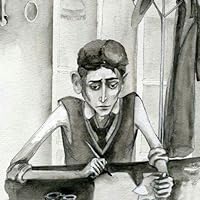
Евгений Арбенин — игрок, ловелас, «надменный баловень судьбы», всё перечувствовал, всё узнал, во всём успел разочароваться. И, наконец, увидя в юной красавице Нине идеал чистоты и доброты, женился на ней, стал вести жизнь уединённую и спокойную. Но это не может обмануть тех, кого он унизил, разорил, растоптал, они уверены, что чёрт по-прежнему сидит в его душе. Роковое стечение обстоятельств пробуждает в Арбенине жгучее чувство ревности, и он за несколько дней превращается из любящего мужа в злодея и убийцу. Он подсыпает яд в мороженое Нины и с чувством удовлетворения от свершённого правосудия смотрит на её предсмертные мучения. Но, получив доказательства её невиновности, сходит с ума.
Mikhail Yuryevich Lermontov (Михаил Юрьевич Лермонтов), a Russian Romantic writer, poet and painter, sometimes called "the poet of the Caucasus", was the most important Russian poet after Alexander Pushkin's death. His influence on later Russian literature is still felt in modern times, not only through his poetry, but also by his prose.
Lermontov died in a duel like his great predecessor poet, Aleksander Pushkin.
Even more so tragically strange (if not to say fatalistic) that both poets described in their major works fatal duel outcomes, in which the main characters (Onegin and Pechorin) were coming out victorious.
«بالماسکه» نمایشنامهای از شاعر و نویسنده نامدار روس، میخائیل یوریویچ لرمانتوف، در قرن نوزدهم است. لرمانتوف این نمایشنامه را به صورت منظوم سروده است، اما مترجم در مقدمه ذکر کرده که آن را به صورت منثور و با حفظ وفاداری به تکتک واژههای متن اصلی ترجمه کرده است.
لرمانتوف در «بالماسکه» به موضوعاتی همچون عشق، حسادت، شک، انتقام و عصیان پرداخته و فضایی آکنده از سوءظن و تنش را به تصویر کشیده است.
این نمایشنامه که نقد تیزی به جامعه ی اشراف روسیه هست به دلیل سانسور حکومت تزار، در زمان حیات نویسنده هرگز به روی صحنه نرفت .
When will men learn to listen to women they take to be their wives? When will they learn not to kill them? And without proof to boot? Ugh. I'm so tired of this trope.
But all in all, it was an interesting play with some mysterious aspects and I enjoyed it. If not for what I said above, I would've enjoyed it even more. The writing was clever and beautiful, I loved that a lot. Some phrases were definitely worth quoting.
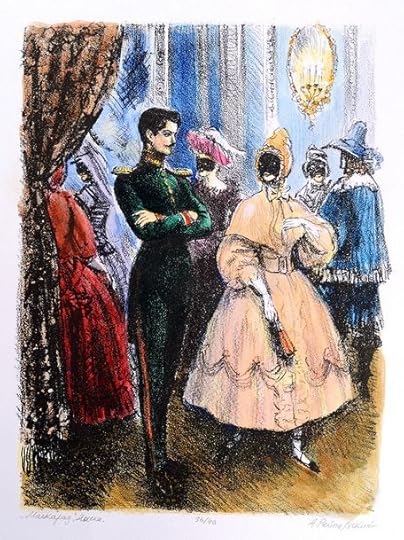
The Masquerade is Lermontov’s four act-play written in verse and set in the 1830s St. Petersburg. This very Shakespearean drama centres on Yevgeny Arbenin, once an immoral gambler and womaniser without scruples, but now it seems a decent man respected by society, especially since his marriage to a kind and beautiful young woman Nina. One day, however, Arbenin’s desire to rescue a man from financial disaster at a gambling table, malicious rumours, as well as his wife losing a bracelet during a masquerade ball set in motion a series of events that culminate in an unthinkable tragedy, as Arbenin’s jealous predisposition and his propensity to seek revenge overpower common sense, love and basic human considerations.
The title of the novel – the masquerade in the story – also carries a symbolic meaning. This will be a tale of appearances deceiving, and this theme runs throughout the story. Arbenin “wears a mask”(i.e. he is not what he seems to be), but so does almost every other character at least at some point in this story. In Act 1, Arbenin also starts to judge a new gambling companion Sprich by his appearance, and Kazarin is forced to defend Sprich, saying to Arbenin that it is not only by appearances we should judge people, and though Sprich “looks like a devil”, he is a “useful man”, after all.
Lermontov focuses on a number of themes in his story, among which are individual vs. society, and the individual self-interest triumphing over the concern for others. Arbenin cannot break his ties with his immoral past. His friends want him back in their gambling circle and Kazarin, in particular, desires to turn the developing situation concerning Nina to his advantage. Arbenin remains a villain at heart, but his gambling circle, the danger it poses and the people’s malicious tongues can worsen the situation considerably, and Arbenin’s hidden nature soon resurfaces to tragic consequences. But, it is not only Arbenin who egoistically seeks his “justice” – everyone sees the unfolding situation concerning Nina and her possible infidelity only from the perspective of their precious selves, without any regard as to how their actions may impact others, including the Baroness and Prince Zvezdich. It is the cowardice and apathy of others, as well the lack of both communication and desire to double-check “facts” that lead to the snowballing of one already precarious familial situation between Arbenin and Nina. The evil does not exist in a vacuum, and the conditions are slowly “set” for Arbenin’s horrific action. In the end, “the innocence is slaughtered”, and the culpable society hides away, being more concern with appearances than human lives.
The Masquerade can naturally be compared to Shakespeare’s Othello, but the theme of miscommunication (or communication gone astray) leading to a fatality present in Romeo & Juliet is also very much prominent in The Masquerade, and “To Be, or Not to Be” (Hamlet) speeches are also given by both Arbenin (“You are right, what is a life? A life is an empty thing”, starts Arbenin) and the Baroness (“Just think: Why do we live?”, starts the Baroness) in the play. Arbenin is a much more evil and brutal personality than the simply indifferent, even if egoistic Eugene Onegin in Pushkin’s narrative poem of the same name, but the main characters’ redemption through their meeting of one kind-hearted lady and then not knowing the true value of something or someone until they lost it are still the themes that unite both (with Pushkin’s Eugene Onegin being published only two years before Lermontov’s play).
Mikhail Lermontov was a great poet, so the original rhyme is brilliant, but, unfortunately, I cannot vouch for any English translation. It is also interesting to know that The Masquerade was never actually staged during Lermontov’s lifetime because the play did not pass the censors’ control for a number of reasons, including the depiction of the House of Engelhardt, even when Lermontov made substantial changes to the text.
The Masquerade is an ambitious, even if slightly forced, tragedy by Lermontov, who made his tale of passion, pride, jealousy and evil even more unforgettable through the characters’ thought-provoking monologues.
Бедняжка Нина... а с другой стороны - какая-то ерунда! Почему графиня после разговора с князем не пошла к Арбенину? Почему не догнала его тогда, при встрече? Раз уж решилася во всём открыться. Вот женщины! А что ещё делать Арбенину? У него были все основания. А так - потрясающий слог. Читается с удовольствием.
Shakespeare's Othello is more likeable than Arbenin. Arbenin is utterly self-righteous bastard. At the end he gets what he deserves but it does not bring his wife back from the dead and it doesn't improve her supposed lover's situation.
7/10 - at the end really got into this, i don't read that many plays but this was pretty fun, need to read more. Arbenin is completely insufferrable and killed the only likeable character in this book out of jealousy. I feel so bad for nina
This entire review has been hidden because of spoilers.
Buena obra teatral que trata sobre la aristocracia, la verdad y los celos enfermizos; me entretuvo y mantuvo cautivo hasta el final. Me impresiona la capacidad que tuvo el autor para concebir esta obra a los 21 años, lo que ya lleva a sacar conclusiones sobre su capacidad y talento.
Лермонтов великолепно выкрутил сюжет, для 19 века просто вау, и даже сегодня, история с какой-то случайностью, шуткой, приведшей к драме высокого порядка - это редкий и сильный ход. А еще все замешано с неизбывными вечными человеческими страстями - азартом и ревностью. С одной стороны неумением остановиться, с другой желанием поиграть, подразнить. Неуместно со всех сторон, но так знакомо! Когда читал в детстве не понимал этих подтекстов, а спустя 20 лет - Лермонтов очень тонко схватывает эмоции и раскручивает спираль недомолвок в трагедию. Великолепный стихотворный текст, читается влет, такой ритм, строка льется за строкой. Стоит прочитать тем кто пропустил в школе или перечитать если читали в далеком детстве.
Would have been 4 stars if not for the ending--the play works best as a depiction of a man driving himself mad due to pride and jealousy, and while Shprikh works well as an inciting force he's hardly as developed or as active as Iago (though I think that's the point?) Some wonderful poetry in the first 3 acts, though.
actually a 3.5, i just need to reread it in the future to appreciate it a bit more and make that 4 actually solid. Lermontov has a talent for writing amazing anti-heroes though, what a man
Major miscommunication trope. The whole plot would have been a big zero if people would have just been able to finish a sentence. Still, quite ravishing.
Lermontov never disappoints. We've got an incredibly unlikable protagonist who ruins everyone's lives around him, a whole lot of drama, battle of words, death, and beautiful writing
Произведение читается очень быстро, буквально за час, и оно не настолько захватывающее, чтобы чем бы то ни было выделяться. Оценку книга заслужила только за трагизм сюжета и за философичность. Как чтиво на вечер вполне подойдет.
What’s interesting (or odd) about this misplaced-vengeance play is the concerted effort by several of the characters to have Arbenin’s wife, Nina, murdered. With a ridiculously simple explanation, the entire situation could have been satisfactorily cleared up.
But the Baroness and the Prince stubbornly decide to say nothing. In fact, the extent to which they go to not say anything is rather contrived. And Sprich, Kazarin and the Stranger gleefully egg on Arbenin. And Nina is murdered.
The play seems to revolve on Arbenin’s evil past, which seems to consist of being an unmercifully good gambler and womanizer. While I condone neither, I hardly see the horror in Arbenin that deserves the death of his wife. The site of the masquerade is also blamed, but that seems too puritanical.
I’d like to see how an accomplished actor would play Arbenin. This has potential to be a good play in performance. It’s not necessarily revolutionary, but it is well constructed and Arbenin has some revealing speeches.
This is not, however, the best translation to use. The English is stiff and the rhyme is bit clumsy. It’s probably best to skip the rhyme altogether, or use it very sparingly. Rhyme in a tragedy is extremely difficult – if not impossible – to have success.