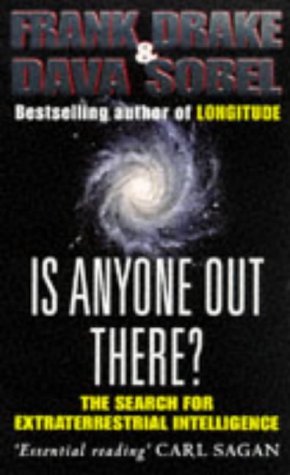
A pioneer in the study of extraterrestrial intelligence chronicles his thirty-year search for intelligent life in the universe, which culminated in the NASA-backed SETI Microwave Observing Project.
#Binge Reviewing my previous Reads # Aliens, UFOs, and life beyond Earth
Frank Drake’s Is Anyone Out There? The Scientific Search for Extraterrestrial Intelligence, written with the luminous prose of Dava Sobel, is one of those rare works that bridges the deep abyss between scientific rigor and poetic wonder.
It is a book about equations and radio telescopes, but also about dreams, curiosity, and the sheer audacity of asking one of humanity’s oldest questions: are we alone in the universe? In this sense, the book does not simply recount the milestones of the SETI (Search for Extraterrestrial Intelligence) movement—it dramatizes the intellectual and emotional odyssey of a scientist who turned a philosophical speculation into an organized program of inquiry.
Drake is, of course, famous for the “Drake Equation,” that elegant string of variables that attempts to estimate the number of civilizations in our galaxy with which humans might hope to communicate. In the public imagination, the equation stands as a kind of symbolic shorthand for the scientific search for aliens, appearing on T-shirts, coffee mugs, and in the scripts of countless science documentaries.
But in Is Anyone Out There?, the equation is revealed in its human context: born out of a need to structure a conversation among colleagues in 1961, it became less a literal tool for calculation than a framework for thinking, a way of breaking down an overwhelming question into manageable scientific components. Drake, with Sobel’s narrative finesse, takes us through each variable—star formation rates, planetary systems, habitable zones, the probability of life emerging, the likelihood of intelligence developing, and the stubborn question of technological longevity. What might have remained an abstraction is animated with stories from the front lines of radio astronomy, planetary science, and astrobiology.
The book excels in its storytelling. Drake recalls his early days at the National Radio Astronomy Observatory, where he dared to point radio dishes toward nearby stars, straining to capture the faintest whisper of an artificial signal. The sense of pioneering risk is palpable: he was, in many ways, venturing into intellectual terra incognita. No one knew if such an enterprise was scientifically sound, politically tenable, or career-safe. To search for extraterrestrials in the 1960s was to risk ridicule, to be mistaken for a crank rather than a professional astronomer. Yet Drake conveys the conviction that the question was worth asking, that the stakes were nothing less than cosmic perspective.
Sobel, known for her gift of rendering science into narrative—her later Longitude and Galileo’s Daughter testify to this—ensures that the prose flows with clarity and charm. Together, she and Drake craft a book that can be read as both memoir and manifesto. The memoir aspect shines in Drake’s recollections of colleagues, conferences, and moments of breakthrough; the manifesto resides in the steady assertion that SETI is not pseudoscience, not fringe speculation, but an extension of the scientific method into the largest possible domain.
One of the delights of the book is how it situates SETI within the broader arc of human history. Drake shows that the desire to know if we are alone stretches back to antiquity, to Epicurus and Lucretius, to Giordano Bruno, who speculated about innumerable worlds and was burned for his heresies. The scientific revolution re-shaped the debate, but it was not until the space age that speculation could be grounded in actual data—radio waves, exoplanets, chemical signatures of life. In this sense, Is Anyone Out There? is not merely about SETI as a technical program; it is about SETI as the culmination of centuries of human wondering, crystallized into antennas and computers.
The narrative also touches on the politics of science. SETI, for much of its history, has been underfunded, ridiculed, or marginalized by mainstream institutions. The “giggle factor” haunted congressional hearings and funding committees, and the phrase “little green men” was enough to derail serious discussions. Drake recounts these frustrations candidly, while also celebrating the persistence of scientists who continued the search, often on shoestring budgets and in the margins of larger astronomical projects. There is a quiet heroism in this perseverance, a conviction that the question was too profound to abandon simply because it invited laughter.
Equally compelling are the sections that describe the technological ingenuity of SETI efforts: the clever algorithms for sifting through noise, the strategic choice of target stars, and the vast data streams harvested by projects like Project Ozma and later initiatives. Drake explains the science without drowning the reader in jargon, showing how advances in computing, signal processing, and planetary science continually refined the search. The book was written in the 1990s, before the explosion of exoplanet discoveries that would later revolutionize the field, yet its foresight is striking. Drake anticipated that habitable planets would prove common, that the emergence of life was not a freak accident but a probable outcome under the right conditions. Today’s astronomy, with thousands of exoplanets catalogued, confirms his optimism.
Beyond the technical and historical, Is Anyone Out There? resonates on a philosophical level. Drake insists that the search itself is valuable, regardless of outcome. To look up at the sky with an ear tuned for signals is to remind ourselves of scale, humility, and possibility. Even if no signal ever arrives, SETI disciplines our imagination, forcing us to think about longevity, sustainability, and what it means to be a technological species. The question of whether civilizations survive long enough to send signals is not merely academic—it is a mirror for our own precarious situation on Earth. Will we last long enough to be heard by others, or will we drown ourselves in our own noise before we can join a galactic conversation?
The book does not overindulge in speculation. It avoids the sensationalism of UFO culture, steering firmly toward the empirical. Drake is careful to distinguish between searching for extraterrestrial intelligence through scientific means and indulging in conspiracy theories or anecdotal sightings. In this, Is Anyone Out There? sets an important boundary line: it grants the legitimacy of wonder while grounding it in method. It acknowledges mystery but insists on evidence.
Yet, Sobel and Drake also allow space for awe. They describe the shiver of possibility that accompanies a scan of the sky, the thrill that one day, in the midst of static, a patterned signal may emerge, a “ping” that carries across light-years. They invite the reader to imagine the enormity of that moment: confirmation that the universe contains not just stars and galaxies, but minds. It would be, as Drake suggests, the single greatest discovery in human history—not just scientific, but existential.
In literary terms, the book achieves a balance of accessibility and depth. The prose is clear enough for general readers, yet never condescending; it assumes curiosity, not expertise. The pacing alternates between personal anecdotes and scientific explanation, between the micro of Drake’s career and the macro of cosmic questions. Sobel’s touch is evident in the elegance of phrasing, the narrative scaffolding that prevents the book from collapsing into either dry textbook or overly romantic memoir.
Looking back from today’s vantage point, the book carries a double resonance. On the one hand, it captures SETI at a particular historical moment, when optimism and skepticism clashed in equal measure. On the other hand, it reads like a prophecy fulfilled: the discovery of exoplanets, the sophistication of modern radio arrays, and the rise of citizen science projects like SETI@home all vindicate Drake’s vision. The question remains open, but the tools have multiplied. If Is Anyone Out There? were to be updated now, it would be enriched by these discoveries, yet its core message would remain intact: the search is essential, because it keeps us honest about our place in the cosmos.
In sum, Is Anyone Out There? is more than a scientific memoir; it is a manifesto of curiosity. It demonstrates that science at its best is not about certainty but about disciplined wonder. Drake and Sobel invite us to think cosmically while acting terrestrially, to cultivate the patience of astronomers and the imagination of poets. For readers intrigued by the possibility of extraterrestrial life, it remains a foundational text, one that tempers dreams with rigor and yet never loses sight of the sheer romance of the question.
It is also a deeply human book. Drake emerges not as a distant genius but as a working scientist—fallible, hopeful, persistent. He speaks of disappointments and of moments when funding dried up, of listening to static for months without reward, and of returning because the question would not let him go. In that sense, the book embodies the very essence of science as perseverance against the silence of the unknown.
This book stands midway between the visionary speculations of Carl Sagan and the meticulous chronicles of later SETI scientists. It is both intimate and cosmic, both sober and soaring. To read it is to stand at the edge of a dark ocean, scanning the horizon for a light, knowing it may never come, but believing the act of looking is itself meaningful.
This is a fun scientific memoir, although not as gripping as some of the really great scientific memoirs, like James Watson's The Double Helix. Possibly because there is no great "aha!" moment of discovery in this book, on account of our not having actually detected anything that can be unambiguously identified as a signal from an extraterrestrial civilization. On the other hand, Frank Drake comes across as a really nice guy, which isn't always true of the scientists in great scientific memoirs like The Double Helix.
This book makes an excellent introduction to the search for extraterrestrial intelligence for a non-technical reader. Its main limitation in that respect is that it was published in 1992, and so doesn't cover more recent developments like the SETI At Home project.
The book is a fascinating blend of memoir and science, offering a personal window into the birth and evolution of SETI. Frank Drake shares not just the technical milestones but also the human side of the journey, his early experiments and the skepticism he faced. One part that stuck with me was his account of Project Ozma, the first serious attempt to detect alien signals using a radio telescope. It was both humble and historic. Then there's the WOW signal from the early 1970.... Compared to Ben Bova’s "Are We Alone in the Cosmos?", this book feels more grounded and less speculative. But I still found Ben Zuckerman’s "Extraterrestrials: Where Are They?" more compelling overall. Still, Drake and Sobel’s book is a must-read for anyone interested in the origins of SETI and the personal story behind the science. It’s engaging, historically rich, and gives you a real sense of the passion driving the search.
Though 25 years old (published in 1992), Is Anyone Out There? is a very good autobiography for Frank Drake & history of SETI (the Search for Extraterrestrial Intelligence).