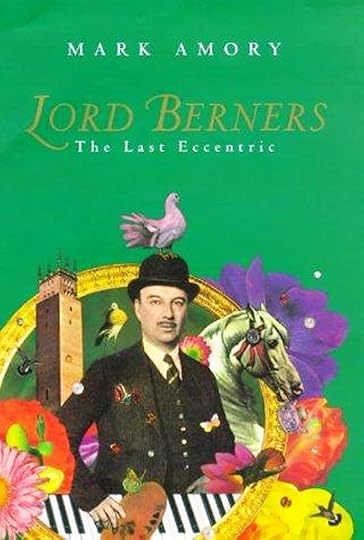
So reads the epitaph on the gravestone of Lord Berners. In its witty way, it hints at his range of accomplishment. He was a composer (admired by Stravinsky), writer, painter, aesthete and eccentric, indeed in Mark Amory's words 'The Last Eccentric', famously dyeing the pigeons at his house, Faringdon, in vibrant colours, and, for a time, having a giraffe as a pet and tea companion. His literary and artistic milieu was glittering: Stravinsky, Picasso, Salvador Dali, Siegfried Sassoon, John Betjeman, the Sitwells, Harold Nicolson, Frederick Ashton and Gertrude Stein - they all belonged to it.
In fiction, he was famously portrayed as Lord Merlin in Nancy Mitford's The Pursuit of Love.
'As social history and a chronicle of a mad-cap English eccentric this long awaited, much needed and beautifully written book is, to use a simple cliche, indispensable.' Alexander Waugh, "Literary Review"
'In Amory, this engaging character has found the ideal biographer. Getting the exact measure of its subject throughout, written in a dry, wittily ironic prose ... the biography offers of sheer bliss.' Gilbert Adair, "Sunday Times"
“Lady Lavery enhanced her acknowledged beauty with such imaginative make-up that Berners is said to have spread the rumour that the First Lord of the Admiralty, after lunching with her, entirely revised his plans for camouflaging the Mediterranean Fleet.”
Lord Berners had the money and the time to dabble in things – music, painting, writing – but he dabbled very well, and did so in remarkable company and with an impish sense of humour.
His autobiographies show that music – serious and avant-garde – was his first love, though I can hardly comment since it isn’t mine. His friend Igor Stravinsky considered Lord Berners the most interesting British composer of the twentieth century, which is a reasonable encomium, and he wrote music for Diaghilev and the Ballets Russes and later for Sir Frederick Ashton and Margot Fonteyn.
Stravinsky, Ashton, and Sir William Walton were among the many visitors to Lord Berners’ estate at Faringdon in Oxfordshire, and at times Mark Amory’s biography seems to slide into a long list of name-dropping. Here’s Cecil Beaton feeding the pigeons, H.G. Wells smiling on the steps, Gertrude Stein admiring the daffodils, Salvador Dali on the lawn, George Bernard Shaw, Siegfried Sassoon, Sir Max Beerbohm, E.M. Forster, Elizabeth Bowen, Evelyn Waugh, the Mitfords, Sir Oswald Mosley, Aneurin Bevan, old uncle John Betjeman and all.
Part of the problem is a comparative lack of letters and anecdotes beyond Lord Berners’ own very readable accounts of his boyhood and youth, starting with First Childhood. Gerald Berners seems to have attracted people to him, but was said to be quite quiet in company though capable of the occasional pithy comment. He was described as “a dormouse with a bite”. His eccentricity was sometimes bold – he commissioned the last folly tower in Britain, finishing it with the notice “Members of the Public committing suicide from this tower do so at their own risk” – but more often prankish. I like his invitation to guests at a time of wartime shortages: “ Would you join us for an orgy of tinned loaf, twice-cooked meat and an egg” and of colouring his fantail pigeons with vegetable dyes to brighten the place up. He had a Rolls-Royce, with clavichord installed by the rear seat, in which he was leisurely driven to his Venetian palace apartment each spring, returning equally sedately in the autumn (“His mother noticed the GB plate and asked him why he had had the car initialled”).
I had hoped for more anecdotes, memories, insights, and interpretation than Mark Amory’s biography provides, since at the end of the day Lord Berners remains a rather private and elusive figure, hovering around the edges of the scenarios he helped create. But perhaps that’s the way it was.
Lord Berners was a composer (which I know a little about) and a fantastic writer. Both fiction and memoir writing. And of course a dandy eccentric. A man who had his horse run free in his living room (there's a photograph of this) plus he liked to dye the feathers of his birds because when they fly it makes them book beautiful. How can this not be a fantastic biography? Mark Amory did a great job and it's truly a shame that Lord Berners is not more well-known in today's world.
A fascinating portrait of a gifted eccentric whom Nancy Mitford caught beautifully in her books. The biography evokes a lost age of indulgence by someone who was rich enough to do as he wished and not care.
I don’t think I’d ever heard of Lord Berners until I stumbled across something recently about this book, which sounded interesting: English eccentric. It’s an I terest8 g read, and often quite amusing.
"Here lies Lord Berners One of life's learners Thanks be to the Lord He never was bored" (gravestone epitaph)
Gerald Hugh Tyrwhitt-Wilson, the fourteenth Baron Berners, was one of the twentieth century's great eccentrics. He was also, as his gravestone truthfully reported, "never bored." Highly creative but also very frivolous, Lord Berner was famed for such stunts as dyeing the pigeons at his estate in rainbow hues and playing a clavichord placed in the back of his Rolls Royce. His social circle included members of the litterati such as Evelyn Waugh, Siegfried Sassoon, and Getrude Stein, as well as Igor Stravinsky, Cecil Beaton, and Salvador Dali. It's said that Nancy Mitford modeled her character Lord Merlin in The Pursuit of Love on him.
Lord Berners himself was a composer, novelist, playwright, and painter, with his work showing a strong surrealist and whimsical bent, never taking itself too seriously. He lived openly in a homosexual relationship on a vast estate that was something of a menagerie both socially and literally, with its numerous hangers-on and a pet giraffe roaming the grounds. Intent on a life of hedonism, he nevertheless produced some notable musical compositions (a friend was kind enough to send me a CD of Berner's music) and two memoirs (one of which I own but haven't yet read). His various short stories and novellas were posthumously published as Collected Tales and Fantasies, and it was this book that initially led to my interest in this notable eccentric and aesthete.
Armory's biography does a good job of detailing the swirl of people and events in Lord Berners' life, but it seems curiously inert, somehow, in comparison to its subject. I'd hoped for a little more insight into the person and less for the external facts of his life. Still, it's the only biography we have of a complex and talented man, and it does capture the sense of the time and social milieu. Among the book's illustrations and photographs is a marvelous picture of a group having tea in Lord Berners' drawing room -- all very proper and English, with the lace tableloth and nick-knacks on the bireplace mantle. But then there's the large white horse standing placidly between two of the ladies, looking for all the world as if he were about to contribute to the table conversation -- this unusual animal apparently had free range of the house.
Full of snippets of correspondence and thousands of references to titled personages, literary luminaries, avant-garde artists of the day, this makes for an entertaining and bustling biography, one that serves in a way as a portrait of a passing age. My one complaint is that it renders the age better than its ostensible subject.
Kind of an inverse story to that of Denton Welch: a brilliantly gifted man who suddenly finds himself rich and landed and as such seems to never quite develop as the skilful artist he could have been. I’ve been listening to his music at the end of this and it feels like such an extension of the man’s character: light and frothy, dark and maddening, twisty and unexpected and joyously unconventional. But there’s so little of it. Yet who are we to judge a life well lived? And Berners did that if nothing else, even if he does remind you of the huge gulf between the gentry and the rest of society (and how it’s nice that they have a choice to be politically naive and pal about with fascists until it suddenly becomes an awful thing to be caught doing)
Anyway. Amory’s book is very good and captures Berners’ ebbs and flows very nicely, but by god does it feel like he’s in a hurry at times. He dumps so many names at you and is in so little mood to explain who they are, and any attempts at context for much of Berners’ life and especially his death (which is so narratively abrupt it’s almost Poochy levels of incongruity) are just skimmed over. It’s like it was dashed off on commutes to work, but written really well during those patches. But boy it needs someone willing to stop and relax into the narrative a bit more
It's not possible to know what made Gerald Tyrwhitt-Wilson, 14th Baron Berners tick but everyone seemed to like him and his eccentric acts were mostly harmless; dyeing animals, driving around in grotesque masks, hiding under a bearskin rug to 'fool' tedious guests. A soft spoken aristocrat with a small but keen talent justifies this very readable and accomplished bio. And remember: "Red roses blow but thrice a year, in June, July and May. But those who have red noses can blow them every day."
I didn't find Lord Berners all that eccentric. I certainly don't think he was the last one. He was mostly eccentric in his tastes in music, art, etc. But this, of course, was mainly by the standards of the day. This isn't a deep biography and it doesn't delve much into his relationships, for instance. But it does give you a bit of a feel for the life he led.
Anecdotes on Evan Morgan by his contemporaries.. "Lord Berners: The Last Eccentric" Mark Amory Publisher: Sinclair-Stevenson Ltd, London Publication Date: 1998 .....or find them in the books on Evan @WilliamPCross