

What do you think?

Studs Lonigan #2
The Young Manhood of Studs Lonigan
Young Manhood of Studs Lonigan
424 pages, Hardcover
First published January 1, 1934
About the author
James T. Farrell
271 books91 followersJames Thomas Farrell was an American novelist. One of his most famous works was the Studs Lonigan trilogy, which was made into a film in 1960 and into a television miniseries in 1979. The trilogy was voted number 29 on the Modern Library's list of the 100 best novels of the 20th century.
Ratings & Reviews
Friends & Following
Create a free account to discover what your friends think of this book!
Community Reviews
Displaying 1 - 15 of 15 reviews

March 31, 2016
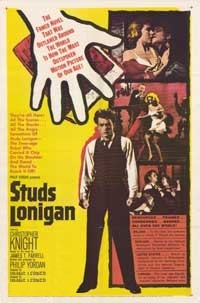
1960 movie starring Christopher Knight as Studs, Jack Nicholson as one of the 58th & Prairie boys, and Dick Foran as his old man.
Got a pretty decent review in the NYT
Farrell’s Structure
Farrell displays a seemingly obsessive concern with formally structuring this narrative, more so than in the first novel of the trilogy.
The novel has four sections, each with a year or years specified.
 SECTION ONE
 1917-1918-1919
There are 24 chapters:
 CHAPTER SIXTEEN
 I
That roman numeral indicates that most chapters (not all) are divided into any number of sections, always indicated by Roman Numerals, starting with I in each chapter. These separate sections of chapters are much more numerous than in the first book. In a couple chapters Farrell uses them to break the narrative into such small segments that they function as snapshots of the larger whole.
Finally, and this is new with this second book, Farrell has what I’ll call a chapter prologue. This precedes the “CHAPTER …” blurb, is announced by a somewhat larger Roman Numeral for the Chapter number, and has text in italics. The text in one case is only a single sentence. But usually it is at least a page or two long. Thus Preceding CHAPTER SIXTEEN is
XVI
”Say mister, could you help me get a bit to eat” ...
Timespan: Years of twentieth century, years of Studs
ONE: 1917-1918-1919. Studs is ~15-17 years old
TWO: 1922, Studs is 21
THREE: 1924, Studs is 22-3
FOUR: 1926-1929, Studs ~24-27
There are missing years in between the sections; Farrell is, I think, using the years to indicate that we needn’t worry about the missing time, it’s similar to what he just finished telling. Or at any rate, a few words in the next section can fill in a missing detail.
The “Chapter Prologues”
Farrell’s main narrative in the chapters is almost exclusively concerned with Studs himself. There are short passages in which Studs isn’t present, but you have to turn lots of pages to find them.
But Farrell wants to say things about other characters, other events, other aspects of the times. He must have felt that forcing Studs into these comments would have been artificial, if not impossible.
Here’s an example (my comments in parens). In the prologue to chapter three, he describes Mrs. Lonigan and Mrs. Reilley walking home together from Sunday mass. They notice each other’s appearance has worsened. Mrs. Reilley, in a thick brogue, says that her son Frank doesn’t like to keep company with “the likes of them that’s always at that poolroom on Fifty-eighth Street”. (Studs’ group.) Mrs. Lonigan asks if Frank is working (Studs is, of course), as the two mothers “glanced pointedly at each other”. Frank, she is told, will be sent off “to learn something technical”, as soon as he’s feeling well enough again. Mrs. Lonigan: “My William went to Loyola for one year (actually it was for about six weeks), and he made a fine record for himself (not). But we decided to keep him out this year and let him help his father with the business.” They both end the conversation by insisting that they have been saying to their husbands what a fine boy the other woman has (of course they haven’t).
The women parted, looking at each other in a way that women have. And in each mother’s heart was the gnawing of fear and disappointment because of a boy threatening to go wayward.
Ghosts from the Past, and one from the Future and the Past
A lad of Studs’ age, Davey Cohen, who had been one of the Fifty-eighth Street gang in the first book (even though he was Jewish, he managed to fit in most of the time). But he had run off in 1916, because of a violent argument with his father; also because he had grown heartsick with the frequent times the Irish lads turned against him; and particularly because a loose girl, who was letting the gang take turns with her, told Davey to get away, calling him kike. (142ff)
In the second novel, the fellows recall Davey once or twice, wonder what’s become of him. Farrell lets us know, in three extremely poignant chapter prologues, where Davey is in his hard wanderings, what it’s like to be a sensitive young man with no friends, nothing really, barely able to keep alive. These little vignettes allow us to know more about Davey than his old gang ever really find out when, in this novel, he finally makes his way back to South Chicago and makes contact again.
Three other chapter prologues are devoted to a fairly minor player, on the fringes of Studs’ group, Andy LaGare. In the first one, we read how Andy’s father, a waiter, has been blackballed because he led a waiter strike that crumbled into ruins almost immediately. Now LaGare’s life is in ruins. What we find, in two later prologues, is Andy writing letters from Los Angeles, where the LaGares have fled, to Danny O’Neill.
And who is Danny O’Neill? Another minor character. This is the ghost from the future. Danny O’Neill is, according to Alfred Kazin in On Native Grounds, basically James T. Farrell, or rather, Farrell’s fictional version of himself – or, as Kazin puts it “Danny James Farrell O’Neill”. One Prologue is devoted to a narrative that fills in details about O’Neill not otherwise known from the Studs story. And, when Farrell finished the Studs Trilogy, he set about writing five books dealing with the saga of two Irish immigrant families, the O’Neill’s and the Flahertys. The first of these, A World I Never Made, was published the year after the final Studs volume.
The sweep of the narrative
What Ferrell tells us about Studs Lonigan in this volume is exasperating. Studs, as he grows into "young manhood", is mostly a pretty sorry young man. His progress is halting, so slow, two steps forward – but one knows that the step backwards is coming. His friends, that drinking, whoring, racist gang of his youth, almost impossible for him to separate from, even as time moves them slowly into the past.
The book is a collection of sequential and broadly related scenes, but with time gaps, varying players (only Studs appearing faithfully in scene after scene), and a rotating pattern of themes – racial tension, venereal disease, alcoholism, family strife, a surprising allegiance to the religious (Catholic) roots of the immigrant Irish (even for the young, drinking and whoring, the sons of those immegrants) – a kaleidoscopic accounting of Studs, his environment, the passage of time. His sentimental fantasies about the future, the implausible dreamings of a kid, constantly thinkingwantingyearning to be a hero, to show everyone that he deserves to be looked up to, admired – that someday a wonderful girl will want him, give him all he wants and needs, no questions asked – this still-kid aimlessly riding the current down life’s river. The incidents, the conversations, the silly and sick and puffed-up and threatening and boasting words of Farrell’s close up microscopic view, which then pans back, opens into something wider and longer, where the reality of the day to day movement resolves into a view in which almost nothing moves, almost nothing changes, only time ticks forward, bringing for these South Side Irish neighborhood lads disintegration and personal aging and dying.
The denouement
The last section of the last chapter.
XXXIIYup. New Year’s morning. 1929. Will things ever get better for Studs? Well, we sure as hell know that they might get worse, without waiting too damn long.
The dirty grey dawn of the New Year came slowly. It was snowing. There was a drunken figure, huddled by the curb near the fireplug at Fifty-eighth and Prairie. A passing Negro studied it. He saw that the fellow wasn’t dead. He rolled it over, and saw it was a young man with a broad face, the eyes puffed black, and nose swollen and bent. He saw the the suit and coat were bloody, dirty, odorous with vomit. He laughed, the drunk stirred as the Negro said:
“Boy, you all has been celebratin’ a-plenty.”
He searched the unconscious drunk and pocketed eight dollars. He walked on.
The grey dawn spread, lightened. Snow fell more rapidly from the muggy sky of the New Year.
It was Studs Lonigan, who had once, as a boy, stood before Charley Bathcellar’s poolroom thinking that some day, he would grow up to be strong, and tough, and the real stuff.
Then, the last chapter prologue, with no chapter following.
XXV
A fourteen-year-old black, the comer of Fifty-eighth and Prairie, his thoughts tracing a path similar to those of one Studs Lonigan at a similar age.
He went on, kicking a tin can, imagining himself to be the hero of a high school soccer game, while Eliza May Smith, pretty as a picture, watched him.
. . . . . . . . . . . . . . . . . . . .
Previous review: Verbivoracious Festschrift 3 The Syllabus
Random review: Living with Music: Jazz Writings Ralph Ellison
Next review: Good Morning Midnight Jean Rhys
Previous library review: Young Lonigan
Next library review: Judgment Day

January 18, 2014
Apathy, racism, bigotry, repetition compulsion, whoring, violence, the denigration of women.... Studs Lonigan is the most "pathetic" & "apathetic" protagonist I've ever encountered. His tortured soul is due, in part, to his urban childhood and his conflicted feelings regarding both the Catholic Church & his strict Irish-Catholic upbringing. But placing total blame on his parents & his community for his bleak circumstances is absolutely ludicrous, considering the fact that several of his peers who grew up in the same Irish-Catholic community thrived by attaining jobs directly upon high school graduation, by enrolling in one of the many surrounding universities-- including the prestigious "University of Chicago"-- or by moving away & starting anew. Thus, the reader can conclude that Studs Lonigan's abysmal circumstances are also due, in part, to his innate laziness & the company that he keeps. He spends each day with friends who refuse to work or who refuse to further their education despite being given ample opportunities by their parents. Instead, these young men opt for a life of excessive drinking & hanging out at the pool hall. They malign their peers who have chosen to better their circumstances through hard work or education, & they abuse their girlfriends & wives by calling them "pigs," "whores" & "bitches."
By creating the character--William "Studs" Lonigan-- author James T. Farrell has created the perfect model for self-destruction. Despite the fact that I abhor this novel (800 pages of repetitive self-destructive behavior & abasement is just TOO MUCH to handle), I understand the literary significance of a novel such as this one. I just don't think, however, that this novel should be ranked as high as #29 on Modern Library's List of the "100 Best Novels of the 20th Century." Many writers have written about this generation (which F. Scott Fitzgerald dubbed the "Lost Generation"); many writers have addressed the same sociopolitical issues that Farrell addressed in the "Studs Lonigan" trilogy; many writers (such as Philip Roth, Jack Kerouac, & J.P. Donleavy) have written about self-destructive tortured souls; and in my opinion, many writers have done it better than James T. Farrell. *2/5 stars*
By creating the character--William "Studs" Lonigan-- author James T. Farrell has created the perfect model for self-destruction. Despite the fact that I abhor this novel (800 pages of repetitive self-destructive behavior & abasement is just TOO MUCH to handle), I understand the literary significance of a novel such as this one. I just don't think, however, that this novel should be ranked as high as #29 on Modern Library's List of the "100 Best Novels of the 20th Century." Many writers have written about this generation (which F. Scott Fitzgerald dubbed the "Lost Generation"); many writers have addressed the same sociopolitical issues that Farrell addressed in the "Studs Lonigan" trilogy; many writers (such as Philip Roth, Jack Kerouac, & J.P. Donleavy) have written about self-destructive tortured souls; and in my opinion, many writers have done it better than James T. Farrell. *2/5 stars*

April 22, 2015
This book has quite the sense of humor, and it's an interesting snapshot of another time. It's worth a read for the cultural zeitgeist. It's also worth noting the author's disdain for his protagonist. Poor Studs. What a buffoon.
That said, this book meanders... A LOT. It isn't so much of a story as it is a collection of passing thoughts tethered together in post World War I Chicago.
Read it for anthropology reasons. Skip it if you're looking for a good summer read.
That said, this book meanders... A LOT. It isn't so much of a story as it is a collection of passing thoughts tethered together in post World War I Chicago.
Read it for anthropology reasons. Skip it if you're looking for a good summer read.

June 22, 2016
Studs goes into fast decline. The drinking, tail chasing and Jew/black beating he did in high school he continues without being able to change, though he does try a few times. The neighborhood is no longer Irish and he is having trouble handling it. The family moves out by the end.
Very interesting to read a complex viewpoint of racism and xenophobia from the 30s in such a brash style.
Very interesting to read a complex viewpoint of racism and xenophobia from the 30s in such a brash style.

August 31, 2017
I dunno. Farrell started out with a bunch of stylistic flourishes, then settled down mostly into his "realism" style, which is, I will admit, exceptionally focused and detailed. The problem is that Studs, the character, while intricately portrayed, isn't really worth that much detail. He never changes in this book, if anything he becomes even more deplorable and dysfunctional than ever. If he'd been actually DOING anything for those 300 pages, it might have been more tolerable. But, no, it's the same Studs on every page. Yes, the work was conceptually one piece with the other two books, but it just doesn't work as a novel by itself. Studs obsesses over the past, wishes people thought something of him, and refuses to take risks except with his health. The neighborhood gets crummier. He still can't get over being a teenager. All of this is detailed to an obsessive degree in itself. And then, the book ends with a depraved night of New Year's revelry and obnoxious behavior that makes you lose what slight respect you might have had for him.
The most honest thing in this entire novel was a very brief section told from another character's point of view, a character who obsesses over getting even with his neighborhood and the people in it someday by becoming an author and writing a book about how much they suck. It's basically the entire point-- these Irish Catholic working class people suck, and I hate them, and I'm going to get even with them by exposing all their flaws as if no one else in the world has ever suffered from the exact same problems.
Hell, you could take the entire homily from the church and the dinnertime conversations and port them directly into 2017 and you'd lose nothing, because they haven't changed at all. So, Farrell, what did you accomplish? I mean, seriously, did it help him to vent his spleen like this?
The most honest thing in this entire novel was a very brief section told from another character's point of view, a character who obsesses over getting even with his neighborhood and the people in it someday by becoming an author and writing a book about how much they suck. It's basically the entire point-- these Irish Catholic working class people suck, and I hate them, and I'm going to get even with them by exposing all their flaws as if no one else in the world has ever suffered from the exact same problems.
Hell, you could take the entire homily from the church and the dinnertime conversations and port them directly into 2017 and you'd lose nothing, because they haven't changed at all. So, Farrell, what did you accomplish? I mean, seriously, did it help him to vent his spleen like this?

October 25, 2024
I read this because it was listed on the Book of the Month Club's list of what would be in a Well-Stocked Bookcase and Modern Library's list of the 100 best novels of the 20th century. (the Studs Lonigan trilogy is listed, and this is the second book of the trilogy.)
For me, this trilogy is not getting any better... too bad, because it's really well-done, but everyone in this series seems to be either a jerk or a non-entity, or on the fence between both. Also, if dated attitudes bother you, this book is absolutely COVERED in various racial/ethnic/sexist/whatever slurs. If you're looking for a slur, it's probably in there. I don't consider myself particularly sensitive and I know the book's about a time 100 years ago, but in some of the scenes, there practically aren't any other descriptions except slurs. Ugh.
On the good side, this entry into the trilogy also contains some REALLY lifelike descriptive passages - There is a long football game scene that I thought was extremely good, and a long description of a sermon, which doesn't sound like it'd be interesting, but it was.
I also learned the appealing phrase "coffee an'", which apparently is the Chicago version of the Swedish "fika", meaning having coffee (or tea or whatever) an' pastry (or cake or whatever) and shooting the breeze with your friends.
For me, this trilogy is not getting any better... too bad, because it's really well-done, but everyone in this series seems to be either a jerk or a non-entity, or on the fence between both. Also, if dated attitudes bother you, this book is absolutely COVERED in various racial/ethnic/sexist/whatever slurs. If you're looking for a slur, it's probably in there. I don't consider myself particularly sensitive and I know the book's about a time 100 years ago, but in some of the scenes, there practically aren't any other descriptions except slurs. Ugh.
On the good side, this entry into the trilogy also contains some REALLY lifelike descriptive passages - There is a long football game scene that I thought was extremely good, and a long description of a sermon, which doesn't sound like it'd be interesting, but it was.
I also learned the appealing phrase "coffee an'", which apparently is the Chicago version of the Swedish "fika", meaning having coffee (or tea or whatever) an' pastry (or cake or whatever) and shooting the breeze with your friends.

April 4, 2021
The Devolution of Studs Lonigan
The second novel of the trilogy can be very difficult to read as it is replete with virulent racism, sexism, homophobia and xenophobia. Taking it in context to both the period of the story and its writing and the social commentary it is making, you can't get around the beauty of the story telling which is as brutal as the story itself.
William "Studs" Lonigan is, in many ways the product of his parent's American dream. A third generation Irish American, Studs enjoys the fruits of his parent's labor. Though undereducated, they succeded with hard work and timing as Old Man Lonigan built a small house painting business into a thriving commercial painting company, scoring hundred thousand dollar deals throughout Chicago. Having plied those profits into the purchase of Southside apartment buildings, the Lonigans are the example of Roaring 20's success. Though Studs dropped out before starting High School, he has achieved a measure of financial success working for his father with a good prospect of taking over a thriving business.
The Lonigans are devout Catholics and their parish is thriving. But Studs battles his impulses to run the streets with his pals, drinking and hitting cathouses which conflicts with his attempts to live wholesomely and healthily. And while he can't get his impure impulses out of his mind he eternally wrestles with his passion for his Middle School crush who long ago fled the neighborhood.
And the neighborhood is changing. As more and more African Americans head north, the Southside experiences a population explosion, promoting a first wave of white flight as Irish and English immigrant families, enjoying a measure of affluence, press father south and north into expanding Chicago suburbs, simultaneously complaining about the changing racial mix while dramatically profiting from the sell of their properties to the people they demonize.
This period of postwar change, as immigration and migration explodes, finds a nation wrestling with its resistance to the inevitability of that change. While reading of this demographic shift in Chicago, I am drawn to thoughts of the final season of Shameless as African Americans now undergo their own flight from the Southside, profiting from a wave of white gentrification as, four generations later, the same groups that fled the Southside, have no limit in what they are willing to spend to return. It seems to me that the show's writers have an affection for Studs as the show's character Lip, seems so modeled by him.
Yes, it is sometimes a difficult read but it is a well written story as I prepare to dive into Judgement Day, Volume Three of the Studs Lonigan epic.
The second novel of the trilogy can be very difficult to read as it is replete with virulent racism, sexism, homophobia and xenophobia. Taking it in context to both the period of the story and its writing and the social commentary it is making, you can't get around the beauty of the story telling which is as brutal as the story itself.
William "Studs" Lonigan is, in many ways the product of his parent's American dream. A third generation Irish American, Studs enjoys the fruits of his parent's labor. Though undereducated, they succeded with hard work and timing as Old Man Lonigan built a small house painting business into a thriving commercial painting company, scoring hundred thousand dollar deals throughout Chicago. Having plied those profits into the purchase of Southside apartment buildings, the Lonigans are the example of Roaring 20's success. Though Studs dropped out before starting High School, he has achieved a measure of financial success working for his father with a good prospect of taking over a thriving business.
The Lonigans are devout Catholics and their parish is thriving. But Studs battles his impulses to run the streets with his pals, drinking and hitting cathouses which conflicts with his attempts to live wholesomely and healthily. And while he can't get his impure impulses out of his mind he eternally wrestles with his passion for his Middle School crush who long ago fled the neighborhood.
And the neighborhood is changing. As more and more African Americans head north, the Southside experiences a population explosion, promoting a first wave of white flight as Irish and English immigrant families, enjoying a measure of affluence, press father south and north into expanding Chicago suburbs, simultaneously complaining about the changing racial mix while dramatically profiting from the sell of their properties to the people they demonize.
This period of postwar change, as immigration and migration explodes, finds a nation wrestling with its resistance to the inevitability of that change. While reading of this demographic shift in Chicago, I am drawn to thoughts of the final season of Shameless as African Americans now undergo their own flight from the Southside, profiting from a wave of white gentrification as, four generations later, the same groups that fled the Southside, have no limit in what they are willing to spend to return. It seems to me that the show's writers have an affection for Studs as the show's character Lip, seems so modeled by him.
Yes, it is sometimes a difficult read but it is a well written story as I prepare to dive into Judgement Day, Volume Three of the Studs Lonigan epic.

May 30, 2012
This is the second part of the Studs Lonigan trilogy. In the first book Studs was a boy on the verge of adulthood, trying to act tough in an almost comical way. He wanted to be one of the big kids, and prove how tough he was. In this second book Studs becomes an adult, but it's not at all what he wanted to be. He is still incredibly immature and his greatest wish is to impress the crowd he hangs out with as strength and fearless. Instead he grows into a pathetic, fat, alcoholic. His biggest achievement was winning a fight in his youth and he brings it up constantly. He takes the one girl he really loves out on a date and ruins any chance he has at a relationship by remaining aloof and then trying to force himself on her sexually. Although he constantly tries to change himself, to stop drinking, get in shape and stay away from prostitutes, he always returns to his old ways.
Studs innocent bravado in the first book of the series was almost comedic. His immaturity was natural to his age as was his need to impress and act tough. In this book it is no longer comedic but just sort of sad. The book was rather depressing in that you kept expecting him to grown up but he just never did. The book covers 11 years, I believe from when he is 14-25, although you would never guess it by his behavior. He remains almost the same from the beginning to the end. I would have liked to see some growth, it began to feel less like a novel and more like a series of vignettes.
My other problem with these novels is that the writing does not stand the test of time. It's not that it's poorly written, it just feels dated, which of course, it is. I think there must be better stories like these from that era.
Studs innocent bravado in the first book of the series was almost comedic. His immaturity was natural to his age as was his need to impress and act tough. In this book it is no longer comedic but just sort of sad. The book was rather depressing in that you kept expecting him to grown up but he just never did. The book covers 11 years, I believe from when he is 14-25, although you would never guess it by his behavior. He remains almost the same from the beginning to the end. I would have liked to see some growth, it began to feel less like a novel and more like a series of vignettes.
My other problem with these novels is that the writing does not stand the test of time. It's not that it's poorly written, it just feels dated, which of course, it is. I think there must be better stories like these from that era.
July 1, 2011
This is the second book in the Studs Lonigan trilogy, and it's brutal. Set in the twenties, it follows the title character and his dozens of thuggish and not-so-thuggish friends as they try to stay Catholic in a very tempty Chicago. Vitriolic racial language and rough treatment of women herein, and while Farrell seems to revel in that a bit too much, his criticisms are clear, especially as he introduces radically progressive (and also dangerous) characters that he seems to sympathize with more.
The most interesting scene is the long, Portrait of an Artist-like sermon in which a mission priest slams (over-harshly) the behavior we've seen in the book and calls out famous writers of the day--Sinclair Lewis, H.L. Mencken, H.G. Wells--for being the instruments of the devil. So, carousing and anti-carousing both get a harsh light pointed at them here.
A very repetitive two novels so far. Studs loves Lucy, Studs loses Lucy, Studs wants to be a good guy, Studs is a bad guy, one of Studs'eses' friends gets "a dose," Studs gets "a does." And so on. Structurally, there's a little relief because Farrell includes so many short chapters about peripheral characters, and the final, chaotic New Year's scene is exhilaratingly jump-cutty and Scorsesish--all sorts of awful stuff leading into 1929, but there's still enough nostalgia and Victrolas in the book to imagine that the soundtrack for all that violence is something like "Hail, Hail, the Gang's All hHre."
A creepy mix of Americana and bile--ginny, invective bile.
The most interesting scene is the long, Portrait of an Artist-like sermon in which a mission priest slams (over-harshly) the behavior we've seen in the book and calls out famous writers of the day--Sinclair Lewis, H.L. Mencken, H.G. Wells--for being the instruments of the devil. So, carousing and anti-carousing both get a harsh light pointed at them here.
A very repetitive two novels so far. Studs loves Lucy, Studs loses Lucy, Studs wants to be a good guy, Studs is a bad guy, one of Studs'eses' friends gets "a dose," Studs gets "a does." And so on. Structurally, there's a little relief because Farrell includes so many short chapters about peripheral characters, and the final, chaotic New Year's scene is exhilaratingly jump-cutty and Scorsesish--all sorts of awful stuff leading into 1929, but there's still enough nostalgia and Victrolas in the book to imagine that the soundtrack for all that violence is something like "Hail, Hail, the Gang's All hHre."
A creepy mix of Americana and bile--ginny, invective bile.

March 28, 2019
It started off alright then seemed to lose steam at the end. The first part of trilogy was SO GOOD and the opening of this one kept that going for awhile. I just started losing the character, story and setting as it progressed. I mean the underlying feelings towards Lucy, his conflict with his faith, his battle with bettering himself and falling short or settling for less(lacking ambition) were all positive elements. But I just felt it lost a lot of its "conciseness" and seemed to lose me. Studs is unlikable... he isn't meant to be likable but where at first I thought "well he's a dumb 14 year old kid trying to figure things out." he turned into a dumb 25? year old who never grows up, is lazy with lazy loser friends, looks down on everybody else even though they are all a bunch of losers not doing anything but drinking and sleeping with hookers and professing how they as catholics are better people than all these other groups. I mean it wasn't all bad.. you see the conflict of faith and behavior and trying to figure things out. It just seemed to lose the powerful steam engine it was through the 1st book. I thought it was interesting how they viewed girls.. treated most like trash but always came back to finding a "nice pure catholic girl." even though they were "ruining" girls left and right with their exploits or got pissed when a girl resisted them. I'm hoping the 3rd book does a good job of wrapping up his story/life.

March 1, 2009
Studs Lonigan is simply the most pathetic and depressing protagonist of a major novel I've ever read. I'm still not sure, however, if Farrell refuses to give his loser a chance out of moralistic or sociological purposes, and I'm still not sure if the failings that continually haunt Studs (e.g., Lucy -- how long can a girl with whom you shared a single idyllic day at the age of fifteen remain the standard of romantic perfection, even for someone as simple as this Chicago Irishman?) are unrealistic shortcuts through the novel's otherwise incredibly bleak naturalistic detail (racism, the Church, the roustabout dissipation). The one element that makes it all work is access into the soft mental cognitions Studs hides behind his tough exterior -- I don't know any other writer who's so accurately depicted the slow torture of a self-conscious lack of self-esteem, dependent on the validations of others and the ego-buttress of fantasy. Reminds one of Franz Biberkopf, though I'm only familiar with him through Fassbinder's adaptation. Could I take another 800+ pages from a similarly arrested, unlearning viewpoint?
August 25, 2017
How do hard-nosed, poor young men achieve the religious when doing so forces them to adopt a feminine position? Hard-nosed, poor young Irish Catholic men that drink and fight are the epitome of masculine. It's impossible and this book is tragic. Would give it a higher rating if not for the tragic, and disturbing, ending. Is a tragedy though :(

December 25, 2019
This is book number two of the Studs Lonigan trilogy by James T. Farrell.
All I can say about Studs Lonigan is that he is the most pathetic protagonist I’ve ever met and I can’t think of anyone of my friends that I would recommend reading , however I will most likely read book number three sometime next year .
All I can say about Studs Lonigan is that he is the most pathetic protagonist I’ve ever met and I can’t think of anyone of my friends that I would recommend reading , however I will most likely read book number three sometime next year .
July 12, 2012
I'm not quite sure why this trilogy of books is on the 100 best English novels of the 20th century list. readability is not the issue with this book. I wouldn't recommend this book to anyone.

August 11, 2012
A mixed reaction: surprised by the frankness and candor; drawn in by the desolation and desperation; wearied by the repetitiveness; put of by some of the stylistic ham-handedness.
Displaying 1 - 15 of 15 reviews