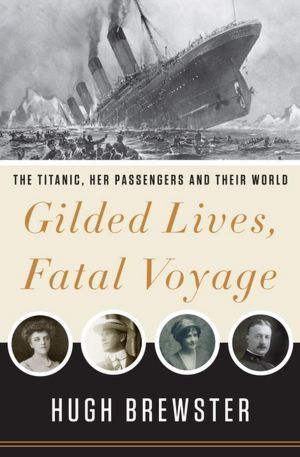
Gilded Lives, Fatal Voyage takes us behind the paneled doors of the Titanic’s elegant private suites to present compelling, memorable portraits of her most notable passengers. The intimate atmosphere onboard history’s most famous ship is recreated as never before.
The Titanic has often been called “an exquisite microcosm of the Edwardian era,” but until now, her story has not been presented as such. In Gilded Lives, Fatal Voyage, historian Hugh Brewster seamlessly interweaves personal narratives of the lost liner’s most fascinating people with a haunting account of the fateful maiden crossing. Employing scrupulous research and featuring 100 rarely-seen photographs, he accurately depicts the ship’s brief life and tragic denouement, presenting the very latest thinking on everything from when and how the lifeboats were loaded to the last tune played by the orchestra. Yet here too is a convincing evocation of the table talk at the famous Widener dinner party held in the Ritz Restaurant on the last night. And here we also experience the rustle of elegant undergarments as first-class ladies proceed down the grand staircase in their soigné evening gowns, some of them designed by Lady Duff Gordon, the celebrated couterière, who was also on board.
Another well-known passenger was the artist Frank Millet, who led an astonishing life that seemed to encapsulate America’s Gilded Age—from serving as a drummer boy in the Civil War to being the man who made Chicago’s White City white for the 1893 World Exposition. His traveling companion Major Archibald Butt was President Taft’s closest aide and was returning home for a grueling fall election campaign that his boss was expected to lose. Today, both of these once-famous men are almost forgotten, but their ship-mate Margaret Tobin Brown lives on as “the Unsinkable Molly Brown,” a name that she was never called during her lifetime.
Millionaires John Jacob Astor and Benjamin Guggenheim, writer Helen Churchill Candee, movie actress Dorothy Gibson, aristocrat Noelle, the Countess of Rothes, and a host of other travelers on this fateful crossing are also vividly brought to life within these pages. Through them, we gain insight into the arts, politics, culture, and sexual mores of a world both distant and near to our own. And with them, we gather on the Titanic’s sloping deck on that cold, starlit night and observe their all-too-human reactions as the disaster unfolds. More than ever, we ask ourselves, “What would we have done?”
Being able to create books about history is a dream job for me since I’ve always been enthralled by history. When I was growing up in Georgetown, Ontario, our house was just around the corner from the town library. And I haunted its children’s section—reading sometimes four or five books a week. Historical fiction titles by writers like Geoffrey Trease and Rosemary Sutcliffe were particular favourites. I still treasure a copy of Ernest Thompson Seton’s Two Little Savages that I was given as a prize in a library reading contest in 1960.
Since ours was the only house in the neighbourhoood without a TV antenna on the roof, reading was my primary form of entertainment. My parents thought their four children would read more without a television to distract us. And they were right, we did — though we also showed up at our friends’ houses whenever our favourite shows were on!
Our family had moved to Georgetown from a small town in Scotland in 1956, when I was six years old. When I was thirteen we moved to Guelph, Ontario, and I went to high school and university there. My first real job after graduating with an English degree in 1971 was with Scholastic – then a fairly new publishing company in Canada. As an editor for Scholastic Inc. from 1972 to 1984 in both Toronto and New York, I was involved in the creation of Scholastic’s Canadian children’s publishing program as well as in the selecting of books for Scholastic’s school book clubs. (One of our early discoveries was the teenaged author Gordon Korman and his Bruno and Boots books.)
Between 1984 and 2004 I was the Editorial Director and Publisher of Madison Press Books in Toronto. While there, I helped to create a number of successful books for both adults and young readers including Robert Ballard’s The Discovery the Titanic, that has sold over 1.5 million copies, and TITANIC: An Illustrated History a book that provided inspiration for James Cameron’s epic movie. Among the award-winning children’s books that I edited and compiled are: Polar the Titanic Bear, On Board the Titanic, First to Fly, and Journey to Ellis Island.
The first children’s book that I actually both wrote and compiled was Anastasia’s Album: The Last Tsar’s Youngest Daughter Tells Her Own Story, which was published in 1996 and won a number of awards. In 1997 I wrote the text for Inside the Titanic, which featured amazing cutaway illustrations by Ken Marschall. The next year, with Laurie Coulter, I compiled a book filled with fascinating facts about the Titanic entitled 882 1/2 Amazing Answers to Your Questions About the Titanic. Laurie and I went on to write To Be A Princess in 2001 which was a Silver Birch and Red Cedar nominee. In 2004, the 60th anniversary of D-Day, I wrote On Juno Beach which won the Children’s Literature of Canada Information Book Award in 2005. The success of that book encouraged me to write At Vimy Ridge which appeared in 2007 and won the Norma Fleck Award in 2008.
In 2005, I decided to devote myself to writing full-time and have produced seven books since then: The Other Mozart: The Life of the Famous Chevalier de Saint George published Fall 2006; Carnation, Lily, Lily Rose: The Story of a Painting and Breakout Dinosaurs. DIEPPE: Canada’s Darkest Day of World War II was released in 2009 and was followed by the novel Prisoner of Dieppe in Scholastic’s new I Am Canada series. A second novel, Deadly Voyage appeared in Fall ’11 and for the 100th anniversary of the Titanic, I produced a large adult book entitled Gilded Lives, Fatal Voyage in Spring 2012.
Not since Walter Lord's classic "A Night to Remember," have I been so captivated by a book on the fabled Titanic. This book focuses on the first class passengers and their lives prior to and after the disaster. Sort of "Downton Abbey" meets the Titanic. You will meet John Jacob Astor and his young teen bride and many others from the elite wealthy that traveled in first class on the doomed ship. I was fascinated to read that many of the survivors were so traumatized by the sinking that it signicantly impacted their post-Titanic lives. Several survivors committed suicide. One young child rescued from the Titanic died at the age of 18 of ptomaine poisoning.
I would highly recommend this well-written and fascinating book to those interested in the Titanic. A good book to feature as we approach the 100th anniversary of the tragedy.
In February of 1912, twenty-four year old Alice Fortune had her palms read while vacationing in Egypt with her family. While gazing at her palms the fortune teller proclaimed, "You are in danger every time you travel on the sea, for I see you adrift on the ocean on an open boat. You will lose everything but your life. You will be saved but others will be lost." Two months later Alice, her two sisters and mother would live to tell the story of that fateful night but her father and brother would not survive the icy waters of the North Atlantic.
This and hundreds of other stories like it are retold in Hugh Brewster's "Gilded Lives, Fatal Voyage: The Titanic's First-Class Passengers and Their World."
While I knew the ending before ever reading the first word, this book was an amazing read that I couldn't put down. In fact,last Sunday, I found myself clutching the book and reading in the car on the way to church. With a great deal of reluctance I left the book in the car to continue reading on my way home. I must admit, I was tempted to sneak the book into the pew in case I got bored with the pastor's sermon.
I appreciated the author's attempt to focus on one social level traveling aboard the Titanic but he seemed to have little idea of what to do with the story beyond the initial concept. I picked up Lives hoping to learn reams of details about Edwardian food, fashion, parties and travel. I wanted to lose myself in a book that would make me feel like a privileged passenger on the Titanic.
Unfortunately, I finished the book without any new understanding of what upper-class passengers talked about on their journeys, the etiquette and dress involved. It all proceeded as most Titanic stories do - take a range of characters, give short intros to their lives before the disaster and then keep their stories running as the clock ticks down to the inevitable sinking. I felt that Brewster missed a golden opportunity to examine the last moments of a legendary means of travel and a time that was about to disappear with the first guns firing in World War One.
I was particularly confused by his odd digressions speculating on passengers' sexual orientation. I think Brewster was trying to make the point about how much moral values have changed in the time since the sinking but that point ultimately had little to do with the sinking or Edwardian society and ended up diluting the power and interest of the book's main focus.
While I enjoyed this quick read, I remain unsure of who would be interested in reading Gilded Lives, Fatal Voyage. The dedicated Titanic fan will already be familiar with the scandal of John Jacob Astor's marriage, the devotion of the Strauss couple and the dignity of Captain Smith. Downton Abbey types looking for glamour and scandal will not find much to chew on here and very little detail.
There are a limited number of people and angles you take on the Titanic tragedy and - given the depth of media coverage - any author would be hard-pressed to come up with something new. I respect the fact that Brewster was already working from a disadvantage but this book could have been so much more. If you're interested, the author's fluid writing style makes this the kind of book you can pick up one day, devote minimal amounts of time and attention and have it easily finished a few days later.
There are hundreds of books about the Titanic disaster but this one touches on the personal lives of the rich, famous, and not so famous first class passengers on the ill-fated liner. It is a different approach from most of the Titanic books I have read and it makes for fascinating reading.
The author has done an amazing amount of research and never attempts to insert fiction into the actions of the passengers....instead he uses terms such as "it may have then happened that Mrs. Astor left the room...." but he lets the reader know that it is only a surmise on his part since it cannot be proven that certain things were said and done. I appreciated that approach.
The characters are complex, not always likable, sometimes extremely brave, but always human in their responses and actions. They could not grasp that the "unsinkable" was indeed "sinking" and many waited too long to react. Others chose to go down with the ship, believing in the "women and children first" credo or the fact that women would not leave their husbands. It is a heartbreaking story which does not try to answer the question of "how did it happen" but rather how do humans who have lived in the lap of luxury all their lives respond to a situation over which they have no control. Recommended.
There are many books on the Titanic, and I have read many of them, and many of them repeat what is already commonly known. This book is a little bolder, and a little different. Many books have tried to present the stories of lesser known passengers, from lower classes, or crewmembers; this book pulls no punches in saying it will focus mostly on the wealthy passengers, and it does that, and to good effect. It tells the stories of some of the wealthiest and most powerful passengers, laying bare how they behaved. Some of the names you will know; some will be far less familiar, but this book does a great job of providing an intimate insider type telling of the experiences of some of these people as each day and hour of the voyage and sinking go along. Just because these folks were wealthy, and just because many of them were saved, does not make their stories unremarkable or uninteresting. Some of these people come across as pathetic; others as noble and brave; others as pure heroic. I think in too many books on the Titanic, the experiences of the wealthy have been written off simply because they were wealthy and many were saved.
Even though I have read many books on the Titanic, I learned a lot from this book. It is a very interesting and worthwhile read on an important aspect of the tragedy. Like them or hate them, the very wealthy played a large role in the voyage and sinking and to fully understand the Titanic, you must understand them also.
The only real problem I had with this book was its small and delicate typeset; at age 47 I find my eyes aren't as good as they once were, and the particular type used in this book I found a challenge to read. The photos also are lower quality and not on glossy stock as in many other books, and some are small, which is a shame because the book includes many Father Browne images not often seen in other books. Father Browne's onboard images are some of the best of the very few photos of the ship during the voyage.
Author Hugh Brewster met Dr. Robert Ballard in 1984 when Mr. Brewster was the Editorial Director and Publisher of Madison Press Books in Toronto. He began working with Ballard to produce the international bestseller The Discovery of the Titanic and subsequently oversaw the creation of Titanic: An Illustrated History which inspired James Cameron's epic movie. While working on these books and others about the Titanic, he became acquainted with the many dedicated, knowledgeable Titanic historians and researchers. After twenty five years, Brewster decided to write Gilded Lives Fatal Voyage.
Drawing on the information, suggestions, and photos provided by experts, as well as letters and diaries of the passengers, this meticulously researched and documented book gives the reader a fascinating close up view of the lives, thoughts, relationships, culture, and last days of the first class passengers who sailed on the ill-fated Titanic. The decor and accommodations of the Titanic reflected the lifestyles that the wealthy passengers expected during the Edwardian Age. Secrets and scandals are revealed as the reader is drawn into this rarified world. Many people have expressed thoughts that the tragedy of the Titanic signaled the beginning of the end of the Gilded Age. World War I followed, and the world of wealth and privilege was forever changed.
This book was hard to put down. Aside from a few famous names, the reader does not know who will survive the sinking until the very end. Mr. Brewster's postscript provides additional information about what happened to the survivors in the years following the tragedy. The book includes some never before published photos that were provided by families of the passengers. Gilded Lives Fatal Voyage is an absorbing book for anyone who enjoys reading about the social history of the early 20th Century and about the doomed Titanic.
What a smashing read! You might think the topic of The Titanic has been overdone. I did before reading this book. But I love books like this that are impeccably researched down to all the intimate, juicy, fascinating details. I have a special soft spot for authors who painstakingly research the beejuzzus out of an historical event, person or era, and then manage to present you with all these details in a fascinating and compelling manner. Brewster does just this. You will learn a lot that you didn’t know about the Titanic. And you will be enthralled in the process. The details on the lives of the first class passengers, their foibles, accommodations on the ship etc., are just fascinating. I bet you didn’t know about the two wealthy female passengers who devoted their time after the sinking to the welfare of the immigrant passengers and continued this involvement throughout their lives? Interesting stuff. Many more fascinating details are revealed. Highly recommend.
This is a difficult book to rate. It was well-written and captivating. But the author goes on a needless digression discussing the sexual orientation of some of the people on board, as if trying to figure out who was or wasn’t gay, and it ultimately had nothing to do with anything. It was needless and tasteless.
[A review copy of this book was provided to me by the publisher upon my request.]
It has been almost 100 years since the Titanic's ill-fated maiden voyage that took the lives of over 1,500 people. Since that fateful night, the story of the Titanic has been told again and again (and again) through books and film and even a successful Broadway musical. The question on many people's minds as the anniversary of the Titanic disaster looms is: Do we really need more books about Titanic?
Gilded Lives, Fatal Voyage: The Titanic's First-Class Passengers and Their World by Hugh Brewster answers this question with a resounding "yes." Although hundreds of studies have been published on the Titanic disaster, Hugh Brewster's newest book is not a rehashing of the same old "Titanic" story that we have heard time and time again. In many books, the story of the Titanic is the story of the ship itself: how big she was, how many people were aboard her, how she struck the iceberg and ultimately, how she sank. Gilded Lives, Fatal Voyage avoids making the Titanic center stage and instead thrusts the reader into the world of the most famous and noteworthy of Titanic's passengers. The story of the Titanic presented here is not a cold tally of the dead or a countdown of her lifeboats, but a human story about real people who lived and died and made human decisions that night, allowing the reader to "... place ourselves on that sloping deck and ask, 'What would we do?'"
It's clear from the outset that Brewster has done his research, not only on the Titanic (he has published previous works about the ship) but on the world of its first-class passengers and most remarkably, their personal lives. After all, it is one thing to read about the disaster and see an offhand remark about "Lucile Duff Gordan, a popular designer," or "Frank Millet, a popular artist and writer," who survived and did not survive the disaster, respectively. It is quite another to be presented a history of their lives--their loves, their losses, their passions and their personality--while eventually learning of their actions during the voyage and the impact that their life or death had on their world. Some readers may notice that Brewster sometimes has to rely on speculation, such as remarking that perhaps Lucille Duff Gordon wore a certain dress on a particular evening. Most of his speculations are based on research (in the previous example, Brewster is referring to a dress which was included in Lucille's cargo inventory) and, in my opinion, are simply a necessity of writing about what is ultimately a human story.
Brewster's writing is always engaging, always clear, and a pleasure to read. There are black and white photos related to the narrative included throughout the book, including some more uncommon photos of the passengers and first-class rooms. Included in the postscript of the book is a concise guide to the passengers mentioned in the book, with basic information about their lives, whether or not they survived the sinking, and (when applicable) their fate after the Titanic disaster.
I highly recommended Gilded Lives, Fatal Voyage to anyone who has an interest in the Titanic, whether they are picking up their very first books about the incident or have been studying the ship for years. It is definitely a worthy addition to the long list of Titanic studies, and I would say it's one of the most interesting and important newer Titanic books to come out in recent years. I would also recommend this to anyone with an interest in the end of the Edwardian age, especially early 20th century American politics, Edwardian fashion and social history.
I loved the idea of this extremely well-researched novel, but the actual reading experience fell short for me.
In the beginning the author did a good job of introducing the illustrious passengers, giving for each a short history of who they were and what they had accomplished, and then describing what their shipboard activities were likely to have been and who they probably hung out with. I also appreciated the many photographs included in the book. The chapters often included a picture of the person who was described, and I had not seen many of these before. Like many (most?) people I am endlessly fascinated by the Titanic and this section was very effective for me, giving me a real sense of the passengers as living breathing people with lives outside the context of the iconic disaster.
But eventually my interest level waned. For some reason the author felt compelled to devote a substantial chunk of time to a boring and unnecessary outing of many of the passengers; the chapter could have been subtitled "The following people, in addition to the interesting accomplishments I have already described, were probably or certainly gay, and here is the evidence."
In other ways as well - and this is probably more a fault of my aging brain than the author's technique - it was a case of too much information. There was so much detail. By the time the sinking happened I could no longer remember who was who and whether or not a person whose earlier story caught my fancy was one of those who made it. The author closed with a brief description of the post-Titanic lives of some of the key survivors; which again would have been more interesting to me if I could have kept their stories straight.
Note: It's not exactly new information, but one thing that struck me powerfully in this account is what an awesome lady Margaret Brown was. I am off to Amazon to see if I can find a biography.
I have never understood why Cameron decided he had to create fictional characters for his movie when the stories of so many of the people who were really there were so interesting! I'd probably rate this book a lot higher if so much of it wasn't review for me, and even with the review it was an enjoyable read.
Lots of black-and-white pictures interlaced with the text, which I appreciated. Most of the other Titanic books I've read either had very few pictures (i.e., Walter Lord's two) or are mostly pictures with little text (books on Ballard's or Cameron's explorations/movies). This one had a nice balance of text to pictures, although in the first few chapters the author kept discussing pictures he didn't include, which was kind of annoying. But I've seen most of the pictures not there, and so will have most Titanic fans, so not a big deal.
The book focuses on the First-Class passengers, and has pictures of a fair percentage of the people he discusses. He also gives brief biographies on many of them, touching on everything from "the girl on the red velvet swing" to the Lincoln Memorial, and grounding the Titanic in its time better than any other book I've read. Worth reading for any Titanic fan, I'd say.
Very interesting book. I knew most of the material from other sources, except for the details about the first-class passengers. I know most had privileged lives, but I can understand why the author concentrated on them, especially since material could be found as opposed to those of the third class.
As tragic as the sinking of the TITANIC was, it palls in comparison to the tremendous losses of the 1914-1918 war. Still, I'm sure there are many people who know more about the great ship as a result of movies and books than the Great War.
As an avid Titanic buff, who owns shelves upon shelves of books on this topic, I have high expectations for anything written about the disaster. And I can say with full conviction that I was not the least bit disappointed in Gilded Lives, Fatal Voyage! This book was extraordinary in so many ways...
As a Titanic buff, who owns shelves upon shelves of book on the topic, I knew the centennial of the sinking would mean scores of new tomes on the ill-fated liner (and a new bookshelf would definitely be a necessity!), but I, like others I am sure, wondered how these new works were going to approach a 100-year-old disaster that has already been the subject of countless books. You can easily spout off that it has all been covered. And let's face it: writers today needed a new approach since they don't have access to the same resources as past writers. Survivors for example. Millvina Dean was the last survivor of the tragedy, and she passed away in 2009. She was also only a few weeks old in 1912, so much of her contribution to the narrative of Titanic was second-hand anyway. And, as a personal aside: I firmly believe the best work on the disaster is still Walter Lord's 1955 book, A Night to Remember. His was the first scientific and thorough approach to those terrifying hours in the north Atlantic, and aside from having access to the most survivors -- when he started researching the book in the 1930s - 1940s, many of the ship's survivors were still alive -- his final product is one of the first holistic approaches to the disaster. There is a reason why A Night to Remember is considered the Bible of the Titanic tragedy.
All that said, I was anxious to see how these centennial works were going to approach Titanic, and I was very excited to learn that many of them were focusing more on the people on board. The night of April 14-15, 1912 became a backdrop for the lives of the passengers and crew, and, in the case of the survivors, a turning point for their futures. And I am most fascinated with the people on board, so I greedily consumed every new book on the topic I could get my hands on. However, with a few exceptions -- John Welshman's The Last Night of a Small Town and Andrew Wilson's The Shadow of the Titanic are excellent -- I was disappointed in some of these newer works. They read like encyclopedias. If I wanted a Wikipedia overview of these people, I would look them up on ... yeah.
But Gilded Lives, Fatal Voyage was a breath of fresh air. Not only did Brewster bring these people to life for the 280+ pages of the book, but he plunked you down right in the midst of the Gilded Age, and contextualized these people in their own environment. So many works on Titanic write about the disaster in a vacuum, with little to no social and cultural context. And, therefore, it is so easy to look back on the Titanic disaster with late 20th century - early 21st century eyes and wonder why people behaved as they did. Why did it take the ship's bow disappearing beneath the water and the slant of the deck reaching 20 degrees before the passengers realized something was truly wrong? Why were the men who survived, especially 1st class passengers, so vilified? Brewster doesn't necessarily answer these questions, but he makes the world in which Titanic sailed that much more real, and helps you come to your own conclusions. The passengers believed in the invincibility of technology -- many of the male passengers knew the ship was sinking, but staunchly believed it would stay afloat long enough for help to arrive -- and in a world that worshipped heroism, the stories of those male passengers who bravely escorted their wives and children to the lifeboats and then stepped back to "await their fate" captured the world's imagination in the days after the sinking. Those who did not die such a noble death were cowards. It is interesting to note however what one passenger stated with true vitriol during the subsequent inquiries: if the male passengers had known the ship was going to sink, these stories of heroism would have been pure fantasy since they would have thrown themselves into the lifeboats from the beginning.
And the people themselves. Brewster's real gift in this work is the attention he pays to the passengers. You close the book feeling like you really know champion tennis player Norris Williams, writer Edith Rosenbaum, President Taft's military aide Archie Butt, author Jacques Futrelle, and artist (and possibly Archie Butt's lover), Frank Millet. For those of us who have come to cherish these names as we have read the Titanic disaster over and over again, it is great to finally get to know them as people a little better.
It has been a long time since I have read a Titanic book, but even so I think this one is a little different than the ones I remember reading. One can tell a great amount of research has gone into this very readable and informative book, centering on the many of the people on board the Titanic and their backs stories. The usual descriptions of the dinners and the luxury found on the boat is there as well, but it also covers what many of the people did while on the boat. Somehow or another getting to know a little more about these people made the evacuation and the sinking even more personal and tragic. This is a good albeit chilling read.
As a 6-year old, at bedtime, I would have my mother read to me from Walter Lord's A Night To Remember. It's unclear how I even knew about the Titanic, but freaky little me loved tragic stories. That book has stuck though, because it was all I could think about reading this one. Unfair, but there it is. If you want to know about the people on board, go for it. They're interesting for sure.
With the obvious focus on the first class passengers here, what I need is a miniseries set right after The Gilded Age where Bertha Russell is on this ship and meets Lady Mary's husband to be so that we can jump right into the Downton Abbey Timeline
I question why I read things like this since I find them upsetting and know going into them, I will find it upsetting. This is the stuff from which my nightmares are made. I have suffered all my life from intense nightmares but they are never about vampires, zombies, ghosts, the supernatural in general. I love reading the horror genre and watching horror movies and never have nightmares based on any of that. Mine are always rooted in reality of some horrible sort. I wouldn't be surprised if my nightmares in the next few days are based on ships, icebergs, the ocean, drowning. I think I am highly empathetic and reading about tragedies like this pierce the armor I surround myself in and make me feel so sad for all those whose fate was so wretched.
I learned a great deal about the passengers that were on the Titanic. There are some great pictures in this book as well. How inconceivable that a ship of its size and opulence could sink within a couple of hours of hitting an iceberg. How incompetent to only have 16 life boats for a ship that held several thousand people. And, the pièce de résistance, as far as I'm concerned, was that the telegraph operator on the ship closest to the Titanic (that could have saved everyone on board) had gone to bed and did not receive the SOS messages sent out.
If you are interested in the sinking of the Titanic, this book focuses on the first class passengers. There were many prominent names on board and all the money in the world (which some of them almost had by any standard) doesn't make one any less vulnerable to the fancies of fate. Human error and over confidence (as usual by men who should have known better) were the cause of this tragedy. Recklessly, speeding through an ocean full of icebergs is about as safe as driving 100 mph on ice covered streets. Awful than an irresponsible captain and crew members took so many innocents along with them to the bottom of the ocean.
Things I liked about this book: -informative -gave clear and concise bios of the people on the ship -well researched -the back stories of everyone
Things I hated and wish had gone down with the ship -the author's love of repeating catch phrases, such as referring to Dorothy Simpson as "the prettiest girl" because someone on the ship called her that. Once or twice...cute. About the twentieth, it was starting to make me a bit seasick (see what I did there) -sometimes the "omigod foreboding music" got old -I think I would have liked more about how different their lives were compared to the third class
The thing about the Titanic that is always so heart-numbing to me is how the people in the boats, some boats not even half full, didn't go back to get some people out of the water, even though they could hear the victims screaming and dying just yards away.
Overall, it's a good book, a fun read (well as fun as a read about how over a thousand people needlessly froze to death in icy waters can be).
If you don't come out of this liking Margaret Brown (and kudos to the author for calling her Margaret and not Molly, as no one called her Molly until after her death) more than you already did, there's something wrong with you.
Many of the scenes in this book will be familiar to anyone who has read A Night to Remember, because why reinvent the wheel when the master has already done it? But everything from the passengers' lives before boarding the ship to shipboard activities is much more fleshed out in this book, which I appreciated, not knowing much about any of these people aside from, of course, Margaret Brown, the Astors, Ismay and a bit about the Strauses. I tend to focus more on the crew in my Titanic activities, so a lot of this was welcome information.
The usual heavy-hitters are all here - the Astors, Colonel Gracie, the Duff-Gordons. I appreciated the focus on Archie Butt and Frank Millet, having spent the first few chapters thinking this book would gloss over the likely probability that they were lovers like so many other Titanic books do. Happily, it did not - even more happily, there was an entire chapter devoted to LGBTQ Titanic. Some passengers who usually do not get a lot of attention were focused on, like Helen Churchill Candee, the Harrises and Major Peuchen, which I enjoyed since I didn't know much about them aside from what Walter Lord mentioned. I also appreciated the specific focus on Canadian passengers; it's so often thought of as a British disaster that heavily affected the United States that I think people sometimes forget Canada was as involved as any other country.
The only thing I can say is that the absence of the Hudson-Allisons was conspicuous. In a night full of strange coincidences and just plain bizarre occurrences, they might actually be able to lay claim to being the strangest of them all, and I would have thought a book focusing on the first class passengers might have thought to include more about the only first-class child to die in the sinking. They are mentioned, but briefly, and I would have liked to see their story get the same kind of detailed fleshing out that Norris Williams and Butt and Millet got.
la storia del titanic, dalla partenza allo scontro con l'iceberg all'arrivo dei superstiti a new york, raccontata tramite le storie di vari personaggi. 729 sopravvissuti su 2200 persone. 1471 vite perse per una serie di errori evitabilissimi causati dall'arroganza e dalla negligenza umana. - il titanic era stato avvertito della presenza dell'iceberg ma, nonostante l'avvertimento e la presenza di nebbia aveva i motori al massimo - le scialuppe avevano una capacità massima di circa 1300 posti contro i 2200 passeggeri del titanic - al momento dell'impatto i passeggeri non sono stati avvertiti della reale gravità della situazione e quindi le scialuppe sono state riempite a metà (729/1300 posti) - gli SOS e i segnali d'allarme sono stati lanciati dopo molto, troppo tempo e si potrebbe andare avanti ancora per molto con la lista di errori evitabili che hanno spezzato la vita di più di 2/3 delle persone e rovinato irrimediabilmente la vita delle restanti (spesso vedove e orfani, ma anche 14 suicidi) infine bisogna dire che Hugh Brewster ha fatto un ottimo lavoro nell'umanizzare questa tragedia (considerata la più grande tragedia dell'800 e 900 prima della guerra mondiale). raccontare la storia del titanic tramite le vite, le emozioni e i pensieri di passeggeri di tutti i tipi (maschi, femmine, prima classe, terza classe...) ha reso tutto molto più coinvolgente!!
3.5 Es una lectura que me ha descubierto datos que desconocía, siempre es una temática que me llamo la atención por la trágica que fue ,y ahí nos cuenta detalles que creo que no se conocían, y me parece que está bien documentando, es cierto que es el primer libro que leo acerca de la temática
I appreciate the amount of research Hugh Brewster put into the book - the level of detail is impressive (though sometimes eye-glazing). But the writing isn’t particularly compelling, and much of the book felt to me like lists of not-terribly-interesting details.
There were a few characters whose lives Brewster described more fully, which made those people much more compelling. Rather than try to give some tidbits of information about so, so many of the Titanic’s passengers, I wish Brewster had focused on a smaller number and then really fleshed out their lives and stories. And Brewster chooses some strange phrasing: for example, he refers to Dorothy Gibson as “the prettiest girl” and then uses that same term to describe her probably thirty or so times. Just not that artfully written.
Gilded Lives isn’t a terrible book, and I imagine it’s on the reading list of a lot of people fascinated by the Titanic saga, but it could have been so much better.
Book Description: "Gilded Lives, Fatal Voyage takes us behind the paneled doors of the Titanic’s elegant private suites to present compelling, memorable portraits of her most notable passengers. The intimate atmosphere onboard history’s most famous ship is recreated as never before.
The Titanic has often been called “an exquisite microcosm of the Edwardian era,” but until now, her story has not been presented as such. In Gilded Lives, Fatal Voyage, historian Hugh Brewster seamlessly interweaves personal narratives of the lost liner’s most fascinating people with a haunting account of the fateful maiden crossing. Employing scrupulous research and featuring 100 rarely-seen photographs, he accurately depicts the ship’s brief life and tragic denouement, presenting the very latest thinking on everything from when and how the lifeboats were loaded to the last tune played by the orchestra."
*********************************************** "It was a brilliant crowd...a rare gathering of beautiful women and splendid men." ---Lily May Futrelle
This quote at the very beginning of the book is probably why so many of us love Titanic stories: we are sad that these beautiful people had to experience such horrible tragedy. We are also the tiniest bit reassured when we are reminded that tragedy is not a respecter of persons and is often left to chance. Horrible things can happen no matter how rich and famous one is.
Books like this take me forever to read, not because they're dull but because I usually can't go two pages without finding a reason to stop and research something. I really enjoyed reading the mini biographies constructed around an in depth look at high society before WWI destroyed the Gilded Age of America and Great Britain.
Less than a day, on April 10, 1912, at 12 PM, marks the 110th anniversary of RMS Titanic's departure from Southampton and the start of its maiden voyage.
I don't think that I can say anything that hasn't been said already about the Titanic's sinking, but I can still tell you about my relationship with "the Unsinkable Ship". Having read a total of six books about Titanic within the span of exactly 2 years, and watched the 1997 movie more times than I could count, my fascination only grows and intensifies. So why Titanic? Why this endless interest in a disaster that happened 82 years before I was even born?
Well, something that grabbed you by the throat since your boyhood and showcased the emotional damage that 2,240 people had gone through on one fateful night was not something easy to forget or even completely fathom.
How can 2,2240 people go from point A to point B, alive to dead, happy to traumatized, poor to poorer, in only seconds shy of 2h 40 mins and not get affected, especially while watching the movie, that what you are seeing right in front of you on the screen, the cries and the suffering, the destruction of lives, had really happened and that real people died . . . mostly especially those whose lives' economical misfortunes (3rd-Class passengers) led to their demise through the Class-distinction during the Edwardian Era. With time, to tragedies that happened in the past, especially hundreds and more years ago, some of us become desensitized and our feelings turn neutral at what we're seeing or reading.
However, we're all onboard our own "Titanic" catastrophic journey, one way or the other.
When I picture Titanic in my mind, the icebergs, the collision, the ship itself & how it held on its board the rich and poor, many nationalities, people of great importance and others of far less significance to the world around them, the exclusion of the ship on the Atlantic ocean, and the multiple iceberg warnings that Captain Smith had received and still persevered with increasing the speed of the ship in order to break the Tuesday night arrival headlines . . . all this tells you that Titanic was a micro-version of our own world and that despite the warnings that we receive around us from global-warming, the arrogance of the man perseveres, foolishly knowing of the danger surrounding him and still deciding to follow his extravagance, which would lead him to the inevitable disaster.
Gilded Lives, Fatal Voyage: The Titanic's First-Class Passengers and Their World, by Hugh Brewster, is, as the title suggests, a study of those first-class passengers who boarded the ill-fated Titanic on April 10, 1912, in Cherbourg, France, and their lives aboard the ship until it struck the iceberg on April 14 and sank. There are also chapters concerning the aftermath of that event, including what happened to the survivors afterwards. Hugh Brewster worked with explorer Robert Ballard, who found the sunken vessel in 1986, and had extensive access to artifacts, journals, letters and other sources to flesh out his story, making this volume both accurate about the actual events and personal in terms of individual stories, albeit focusing primarily on the stories of the very wealthy elite and mostly ignoring those in "steerage," many of whom died in the disaster. There are fascinating bits of information here: for example, the first several lifeboats carried at best only half the number of passengers that they could have carried because nobody thought the situation was as serious as it proved to be, and of the 425 women on board, some 74% survived whereas only about 20% of the 1,667 men lived. Whether or not the orchestra played "Nearer My God to Thee" as the ship sank is moot, although Brewster uncovers the fact that this hymn was probably played at some point during the night of April 14-15. Brewster does a good job of describing the individuals with whom he deals, and more importantly, in enabling the reader to keep each profile separately in mind without mixing them up, and his writing style is both respectful of the subject matter and easy to comprehend. Really interesting stuff, especially if like me the reader knew only the broad outlines of the disaster prior to finding this book. Recommended!
Hugh Brewster starts out by saying that in most examinations of the Titanic disaster, the ship is the main character and all the crew and passengers merely supporting characters – here he flips it. Yes, Titanic is the main event, but the focus is on all the people on the boat – who they were, what they did before getting on the ship, why they happened to be on that voyaged, and what happened after to those that survived.
It’s a fascinating look at a world since past – a microcosm of the Edwardian age in almost every sense; one last glittering dinner party before the combination of hubris and 20trh century technology showed just how ugly it could get.
The most horrifying part of the book was that, by all accounts, most people didn’t know they were going to die right up until the moment they died – death was a truly unexpected blow.
I was a little annoyed that it was often unclear what Brewster’s sources were, and in the hands of a master writer it could have been more suspenseful who would live and who would die, but overall, a very good read.