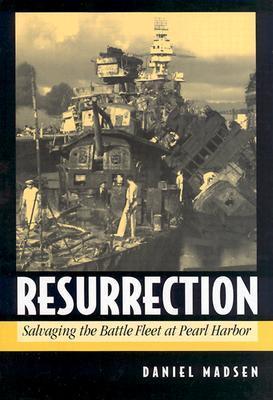
The attack on Pearl Harbor is a topic of perennial interest to the American public, and a long line of popular books and movies have focused on the attack or events leading up to it. This work takes an entirely new perspective. Aimed at the general reader with an interest in World War II and the U.S. Navy, the book looks at the massive salvage effort that followed the attack, beginning with the damage control efforts aboard the sinking and damaged ships in the harbor on 7 December 1941 and ending in March 1944 when salvage efforts on the USS Utah were finally abandoned. The author tells the story in a narrative style, moving from activity to activity as the days and months wore on, in what proved to be an incredibly difficult and complex endeavor. But rather than writing a dry operational report, Dan Madsen describes the Navy's dramatic race to clear the harbor and repair as many ships as possible so they could return to the fleet ready for war. Numerous photographs, many never before published in books for the general public, give readers a real appreciation for the momentous task involved, from the raising of the USS Oglala in 1942 and the USS Oklahoma in 1943 to the eventual dismantling of the above-water portions of the USS Arizona. Madsen explains how a salvage organization was first set up, how priorities were scheduled, what specific plans were made and how they worked or, in many cases, did not work. His book is based almost entirely on primary sources, including the records of the fleet salvage unit and the Pearl Harbor Naval Shipyard. 264 PAGES. 90 photographs. 11 line drawings. Appendixes. Notes. Bibliography. Index. Hardcover. 7 x 10 inches.
"It is well for Salvage Officers to remember that ships are designed to float, and they will float if given half a chance" -- Homer N. Wallin, head of Pearl Harbor salvage operation.
The Japanese raid on Pearl Harbor sunk three battleships, and left two more serious damaged and sinking. Of those five wrecked ships, four were raised, and three were eventually returned to service. Of the smaller ships damaged or sunk, all but one were returned to service. This book is the story of the salvage.
The salvage is quite interesting as an engineering story, and the context -- what was Pearl Harbor like just after the raid, and during the war -- was even more so. Raising a sunk ship is always a big job -- and it's a an awful job when the ships were sunk with fuel and supplies on board, dead crew on board, and so forth. The conditions during the salvage were horrendous and the author includes just the right amount of detail to let the reader imagine it in its misery and horror.
The author does a good job with framing. He avoids describing the raid itself, and likewise avoids becoming a broader history of the war or the ships in question. The prose is competent but at a few points I was wishing for more explanation. Often the author will casually refer to "damage at such-and-such a frame number" and it's not clear to a non-expert where that is.
The story of the efforts to recover the ships sunk at Pearl Harbor on December 7th, which was an impressive task.
I found many engineering-related matters going over my head. Some things could have been explained a little better for people unfamiliar with the details of the secondary armaments of battleships or the workings of a dry dock. While it was also technically outside the scope of the book, an epilogue about the fate of the ships salvaged would have been nice (especially since the book is well under 300 pages). Overall, I did manage to understand enough to not be lost but I can definitely see other readers having a problem. And I did find it informative and interesting.
Massive amount of research and a noble effort, but Madsen (for me) bogs down in detail while leaving many naval terms unexplained. The human dimension is slighted in favor of the technical details. I greatly enjoyed a first-person account of the salvage in Edward Raymer's Descent into Darkness. Madsen must not think much of Raymer's account, for while he refers to the work in footnotes, he never mentions Raymer directly, an odd omission.
I had previous read "Descent Into Darkness: Pearl Harbor, 1941: A Navy Diver's Memoir" which was a fantastic book in description of the daily toll of those tasked with recovery of ships and men after the attack. This book is the big picture of the entire recovery operation. The planning and organization that went into not only recovery the ships but turning Pearl Harbor back into a fully functional naval base as the US headed into war. Ship by ship, Madsen covers want went into re-floating these ships whether it was the behemoth battleships or a mine layer that just happen to sink at one of the most crucial docks in the harbor. Step-by-step, in a timeline narrative, Madsen covers what was does to resurrect those that could be saved and those that could not. The changes over those first few months for what ships that thought to be beyond salvage and those that were not. One interesting point for me was that in the grand scale of causalities of WWII were the several that died while working on the ships. Given the hazardous conditions of the entire operation, I was surprised the number was as low as it was. The two most heartbreaking details, though, was the incident in which the rescuers accidentally suffocated those they were trying to rescue and the estimated death of the last sailor entrapped in USS West Virginia on Dec 23, 1941. This book examines in great detail and with numerous photos the almost forgotten salvage operation of unprecedented scale and urgency that was being carried out. The need to recover ships to a navy in desperate need of them. My only "disappointment" with the book is that it would have been a nice closure to have included an epilogue that gave a final disposition to all the ships that were raised and returned to service. What happened to them? Did they survive the war. Madsen did write that in one way this came full circle when the USS West Virginia was in Tokyo Bay for the surrender ceremony on September 02, 1945.
As the Japanese planes were leaving Pearl Harbor, there were a number of challenges that had to be solved - a rescue mission for possible trapped survivors, dealing with the wreckage and bodies, clearing the facilities around Pearl Harbor (including dry docks and berths), determining what to try to salvage, and salvaging ships. Madsen lays out the process of how the US Navy sorted through these missions, all the while maintaining Pearl Harbor as an important base for the US Pacific fleet. He gives visibility into the challenges of organizing and prioritizing - how, for instance, do you feed and house the men you need to do this work? He describes the efforts that enabled the raising and/or repair of a number of battleships such as the California and West Virginia so that they could fight again, describing the challenges and setbacks faced along the way. It's a fascinating story. One drawback for me is that it often felt like Madsen skipped around too much - here are 2 pages on the West Virginia, now a page on the Utah, now 2 pages on the Arizona, etc. I also would have liked more background on the salvage techniques used such as cofferdams, etc. A book that nicely covers an important, interesting element of WW2 in the Pacific (and pairs nicely with Edward Raymer's memoir Descent into Darkness.)
I do not know who would enjoy this book. (This might not go over the head of say an engineer.) I just found this book boring. I would have liked some type of chart or graphic showing the damage, what was needed to fix etc. and the results. Ex. "X ship" hit by x bombs and a torpedo, x dead, x injured, x damage. Took X to repair. Date X rejoined fleet action and X's service record and ultimate retirement date. A summary if you will. Nope. This book was a very dry read. Started skipping pages, then chapters, then last chapter.
An excellent read, concerning an impossible task...
Every senior military leader has seen the aftermath of Pearl Harbor; however, how many know the Herculan effort to amend the damage, sending battered ships back to sea while clearing our forward operating base for the war to come...this is a must read for higher level leaders as it demonstrates the accomplishment of the seemingly impossible. Simply said, American resilience...
I never thought about what a huge recovery effort was mounted after the Japanese surprise attack. The story of these engineering geniuses and thousands of workers who were able to recover these massively damaged ships is miraculous. A very moving and heroic story.
A remarkable story of the salvaging of ships sunk and damaged at Pearl Harbor on December 7, 1941. These salvaging operations were an amazing engineering feat. The text is accompanied by many interesting photographs.
The effort to repair the Pacific fleet virtually destroyed at Pearl Harbor began immediately with superbly trained professionals that made do with the knowledge and materials at hand. This book has a highly technical aspect that some may not fully understand, but it’s a great story.
Interesting story of the salvage of the ships sunk at Pearl Harbor. This was a nasty, deadly, unheralded job. Salvage of the USS Oklahoma, which capsized after several bomb and topedo hits on 7 Dec, was particularly compelling. Many sailors were trapped in the lower spaces when the ship capsized. Rescue attempts were made in response to tapping sounds by cutting through the ship's hull. A macabre detail: when the ship was righted and inspected, several bodies were found in a space near the bottom. The calendar had been marked through 28 December.
One deficiency in the book is its use of obscure (at least to me) nautical and salvage terminology without a glossary or explanatory footnotes. A minor fault, but one that could have been easily remedied.
The salvage was successful. The docks and harbor was cleared, the primary objective, and several of the ships were eventually restored to fleet duty. In fact, several of the battleships were part of Oldendorf's battle line at the Battle of Surigao Strait, during the Battle of Leyte Gulf. Here, the battle line at "crossed the T" on the Japanese, effectively destroying the two forces attempting to penetrate the strait to contest the US landings at Leyte Gulf.
Resurrection, by Daniel Madsen, is a book about the salvaging of the battle fleet after the attack on Pearl Harbor. This is a tough review. The material is very interesting, but this is not a good book. It is full of information, but to a fault. A lot of it reads as if the weekly damage reports were merely transcribed. The story is sorely lacking, and no attempt is made at translating jargon. I was on a carrier and I don’t know what a “kingpost” is, and although it seems integral to ship construction, I’m not inclined to look it up, or any of the other numerous terms used but not explained. There are places where we do get to know some of the amazing officers in charge, and other places where real suspense and drama unfold as 57,000 ton battleships are salvaged. But too little, too far apart. As I said, a lot of very interesting information, just poorly written.
This book does an excellent job of covering and detailing the little known but vital chapter of how the USN Pacific Fleet was recovered after the attack on Pearl Harbor on 7 December, 1941. Most books that I have read casually mention that "[ship-name] rejoined the fleet for [action/battle] after having been salvaged and repaired of her damage from Pearl Harbor." This book tells the courageous, heroic, and oft ignored story of the men and their ingenuity in bringing all of those ships back to life.
This was a very good accounting of the massive salvage effort after Pearl Harbor. It's pretty detailed and not for your average reader. You'll need to have some understanding of ship construction to make the most of this book. As always, I'd prefer more pictures.