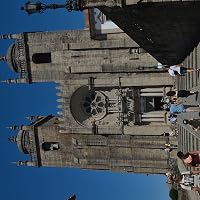
In its first thousand years―from the revelations to Muhammad in the seventh century to the great Islamic empires of the sixteenth--Islamic civilization flourished. While Europeans suffered through the Dark Ages, Muslims in such cities as Jerusalem, Damascus, Alexandria, Fez, Tunis, Cairo, and Baghdad made remarkable advances in philosophy, science, medicine, literature, and art. This engrossing and accessible book explores the first millennium of Islamic culture, shattering stereotypes and enlightening readers about the events and achievements that have shaped contemporary Islamic civilization.
Jonathan Bloom and Sheila Blair examine the rise of Islam, the life of Muhammad, and the Islamic principles of faith. They describe the golden age of the Abbasids, the Mongol invasions, and the great Ottoman, Safavid, and Mughal empires that emerged in their wake. Their narrative, complemented by excerpts of the Koran, poetry, biographies, inscriptions, travel guides, and even a thirteenth-century recipe, concludes with a brief epilogue that takes us to the twenty-first century. Colorfully illustrated, this book is a wonderful introduction to the rich history of a civilization that still radically affects the world.
Bottom line summary: A fairly good place to start if you have no background in the beliefs of or cultural history of Islam. Somewhat uneven because it was originally written as a companion book for a TV series. _________________________________
The choice to select Professors Bloom and Blair's Islam: A Thousand Years of Faith and Power should consider that
1. It is a companion book for a Television miniseries intended to showcase Ancient Muslim history and culture from the point of view of Muslim cultural achievements.
2. Both the program and the original book predate the events of 9/11. In the general US population there were some varying levels of concern over what was understood to be a small, murderous sub population among the Muslims but no sense of immediate threat from this group.
3. There remains in the US a very uneven understanding of what the Muslim religion is about, what it followers believe and what its history includes.
Islam: A Thousand Years of Faith and Power is a reasonable place to start if your interest is to answer these kinds of initial questions. If you already feel comfortable with this level of discussion or are in need of a more sophisticated education this is not your book. If you have come to the conclusion that the Muslim Extremists are the only part of the religion you care to consider, or that the entire community of believers is suspect or worse, this is not the book that will confirm your opinions.
Among my several disappointment with this book is the fact that every topic seems to result in a discussion of building and architecture. This make sense given the fact that the book is bound to the not presently available visuals of the TV broadcast, but leads a serious student with more questions than answers.
Muhammad is the father of this religion and his life is dealt with in much less than a chapter. There are a few details about the almost immediate splintering of the religion, but this discussion is neither deep nor especially informative. The religion he inspired no functions via interpretations and rulings contained in a variety of the sayings collected into the Koran. Very little of these books and the functions, characteristics and methods of Sharia law are discussed.
What we get is a series of travelogues, identifying places then or now ruled by various Islamic courts. Some loyal to a remote Caliphate, others beholding to only local authorities. There is almost no military history, very little about daily life for the people in the various locations and always more about buildings, mosques, colleges and palaces. There are scatted and scant biographies of some local Pashas and Caliphs, a few writers or philosophers. Much beyond who had been playboys and which ones had been empire builders we get little.
Between the lines we get glimpses of the internal struggles among the various Islamic political powers and would be powers. There is no analysis to explain why these struggles existed and which ones fit where in a modern rubric of fundamentalist, or tolerant.
Please note that this history ends in the late 1600's. Europe as a continent is becoming dominant among the larger world of competing powers. The various Islamic powers are or have peaked in their respective roles at the top of this competition. Where extremists exists they have no ability to project threats into the daily awareness of most Europeans, or the not yet independent United States.
Ultimately what makes this book what it is; is that it was intended as a intro to Islamic Culture. It was not designed to discuss many of the things about which I had hoped to learn. I cannot down star it for the fact that it is designed to be less than my needs.
I recommend Islam: A Thousand Years of Faith and Power as a starting place. I caution that it is incomplete, selective and purpose built to highlight topics easily conveyed in video.
As per the subtitle, Islam covers roughly the first thousand years of Islamic history, from the age of Muhammad to the pinnacle of the Ottoman Empire. Although the authors state from the beginning that this is not intended to be a scholarly work, the content rides the line nicely between academic merit and accessibility. A reader looking for a more in-depth or rigorous study will be disappointed, as might anyone already possessed of a general background in Middle Eastern Studies. For someone new to the subject (the book’s intended audience), however, this text will help guide them through the history without the fluff that tends to taint other books seeking only to cash in on the public’s newfound fascination with the region. While not totally eliminating bias, the book’s pre-modern scope helps it avoid becoming embroiled in contemporary debates, another refreshing change from other works. Serving as an introduction to the topic, it provides a solid foundation of knowledge about the major empires (and some of the minor ones as well) and provides decent biographical sketches of all of the major political and cultural players. I personally found certain parts, such as Chapter 8, “The Flowering of Intellectual Life”, to drag on a little, but perhaps that is because I am more interested in the political and military history (of which there is plenty) than the cultural one. Those who do prefer the latter, however, will no doubt find its contents rich and eclectic. In any case, the reader is unlikely to find any glaring omissions in the narrative and the book is well-written enough to hold their attention. Beyond this, I have little to say; I consider it a solid initiation for the uninformed into Islam’s storied past.
Dit boek was een van de handboeken voor de cursus 'Byzantine and Islamic Worlds' die ik voor mijn minor gevolgd heb. Shoutout to Emilios for lending me this book because I was too stingy to buy it myself <3
Het is een erg fijn handboek om te lezen. Ik lees normaal nooit handboeken helemaal uit dus dat het bij deze wel is gelukt zegt al genoeg. Het is een beknopt boekje maar dat maakt het juist zo fijn. De hoofdstukken waren niet al te lang en ik las er snel doorheen. Bovendien wist ik vrijwel niets over het onderwerp buiten wat standaard 'Islam-kennis', maar dit boek wist de kern wel goed uit te leggen.
Er waren echter wel een paar hoofdstukken waar ik echt niet doorheen kwam, aangezien de hoeveelheid onleesbare namen (ja sorry, Arabische namen zijn gewoon lastig) me soms te veel werd.
Uiteindelijk ben ik blij dat ik hem uitgelezen heb, maar ik zou niet super snel weer een boek over de Islam oppakken denk ik.
I read this book for a class dealing with Islamic art and history and found this book to be informative and interesting. I learned a great deal about this subject which I knew very little about before this class. I found the book so unique in showing how each civilization has borrowed from another civilization in art, literature, science and medicine etc. and continues to do so today, we are all part of a fascinating world.
A comprehensive and readable history of the first thousand years of Islamic history. Useful as a broad overview but could have been more so by offering theses on the reasons for certain changes and being willing to be critical of some actors of the past.
I wish I could give this 3.5 stars. it's an interesting book, dense but not so dry you can't make it through the information. the first portion of the book focuses on the creation of the caliphate and the Sunni Shia schism. that portion of the book I found far less interesting as it was a lot of then he killed these folks, then these folks conquered these folks, then there people were side eyeing these people. the middle of the book focuses on the golden age, with its leaps in culture, luxury, mathematics and science. which I found very interesting. I will have to find more books on the subject. Then the last portion of the book mentioned many a name of a ruler or kingdom I was familiar with or at least had heard before. funding out just how far reaching Islam was in its effects historically was very interesting. the book is well done, dense, but I wish it was longer.
I recommend this book if you are interested in learning about the political history of Islam - that is about "Islam." I don't recommend this book if you're primarily interested in learning about Islamic ideology - that is about "Muslims." There's a lot of names and dates in this book, almost too much. I would have maybe preferred if some of the lesser players were left out with more information given to some of the more significant characters. However, overall this is a good place to start if you're interested in learning more about Islam and the Islamic world (you won't learn much about Muslim culture).
Buena introducción a la historia de la civilización musulmana. Ideal para romper con los estereotipos y aprender más acerca de una cultura poco conocida.
A good introduction to the tale of the Islamic empire. Not entirely impersonal for an academic work. Interesting to read, objective and well researched.