Lyman Frank Baum was an American author best known for his children's fantasy books, particularly The Wonderful Wizard of Oz, part of a series. In addition to the 14 Oz books, Baum penned 41 other novels (not including four lost, unpublished novels), 83 short stories, over 200 poems, and at least 42 scripts. He made numerous attempts to bring his works to the stage and screen; the 1939 adaptation of the first Oz book became a landmark of 20th-century cinema. Born and raised in Chittenango, New York, Baum moved west after an unsuccessful stint as a theater producer and playwright. He and his wife opened a store in South Dakota and he edited and published a newspaper. They then moved to Chicago, where he worked as a newspaper reporter and published children's literature, coming out with the first Oz book in 1900. While continuing his writing, among his final projects he sought to establish a film studio focused on children's films in Los Angeles, California. His works anticipated such later commonplaces as television, augmented reality, laptop computers (The Master Key), wireless telephones (Tik-Tok of Oz), women in high-risk and action-heavy occupations (Mary Louise in the Country), and the ubiquity of advertising on clothing (Aunt Jane's Nieces at Work).
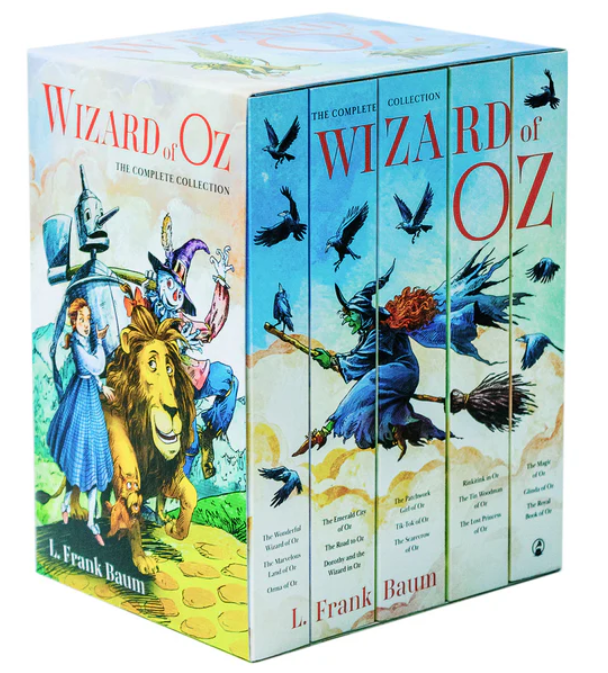
This box set is a must-buy. You will never regret it for the following reasons:
1) This collection contains 5 unabridged books with big text prints.
2) Each book is called a Volume, and each volume has 3 books. In total, there are 15 books.
3) The front cover of each volume is a colored artwork of a character.
Volume 1 is Dorothy and the Flying Monkeys. Volume 2 is the Emerald City. Volumes 3, 4 and 5 feature Scarecrow, Tinman and the Cowardly Lion.
4) Each book opens with a table of contents before Chapter 1. This way, it is easier to tell the direction of the story.
AUTHOR'S WRITING STYLE: 5 stars.
Yay: L. Frank Baum's writing style is unique, clear and easy to read. It is written in third person past exclusively made for kids and kids at heart, especially Books 1, 2 and 3.
After Book 6 onwards, Baum includes himself in the narrative. He calls himself as The Royal Historian of Oz.
Dialogues are the bread and butter of the series. These add a layer of excitement and enthusiasm to the vivid descriptions. You can also learn new lessons when they talk with each other.
Nay: The dialogues of some added characters are annoying, hurtful but honest.
The talking animals such as Mr. HM Woggle Bug, T.E., Billina and Glass Cat behave this way. They simply say what they feel.
Yet, if you put themselves on their shoe, you realize they are only animals with zero filter and kind of relatable if you think about it.
CHARACTERS' DEVELOPMENT: 5 stars.
"In an emergency, it is always a good thing to pause and reflect (Book 1, Vol 1, page 201)."
Yay: Lead and supporting characters are diverse, unforgettable and smart. The balance between human beings and magical creatures is stupendous.
Along the way, you will realize this is a strong women empowerment series. You will notice the maturity of Dorothy as the story progresses.
She is around 11 when the series began. She is younger than the other girls such as Princess Ozma and Betsy, but the way she carries herself in times of trouble, Dorothy learns how to be strong, strategic and resilient.
Princess Ozma is a stand-out character. She is a well-developed supporting all throughout.
Most of the time, you perceive her as an all-powerful leader but once you get in The Lost Princess of Oz (Book 11, Vol 4), you get to discover her vulnerability.
All men characters are supporting.
The roles of the Wizard, Scarecrow (my favorite), Tinman, Cowardly Lion, Shaggy Man, Ojo and Tip are essential to shape the development of Dorothy and Princess Ozma.
Without them, the direction of the story can be one dimensional.
Nay:
It seems a mystery why the character of the Cowardly Lion goes south after The Wonderful Wizard of Oz (Book 1, Vol 1).
Throughout the series, the Cowardly Lion receives no grand spotlight to remember him.
He is always supporting and many times, his identity is completely forgotten once you get in the middle books.
PLOT: 4 stars.
"With your permission, I will keep the excellent body I now have and will abdicate in favor of my eldest son and return to my friends to Oz. For in Oz, I belong (Book 15, Vol 5, page 440)."
Like Percy Jackson, The Lord of the Rings and Narnia, travel and rescue mission are the backbone of Oz.
For a better evaluation, it is better to divide the 15 books in 3 groups based on likeability:
Top-tier.
The following books are the most unforgettable. The plots are filled with outstanding magic systems, memorable new characters and great worldbuilding that will put a permanent mark in your mind and heart.
1) The Marvelous of Oz (Book 2, Vol 1) 2) The Wonderful Wizard of Oz (Book 1, Vol 1) 3) The Lost Princess of Oz (Book 11, Vol 4) 4) The Emerald City of Oz (Book 6, Vol 2) 5) Glinda of Oz (Book 14, Vol 5)
Middle-tier.
The following are not as good as the top-tier group but are not as bad either. Most are fillers, simply making the story longer but unnecessary. Thankfully, the plot is saved by strong endings.
6) The Scarecrow of Oz (Book 9, Vol 3) 7) Ozma of Oz (Book 3, Vol 1) 8) The Tin Woodman of Oz (Book 12, Vol 4) 9) The Patchwork Girl of Oz (Book 7, Vol 3) 10) The Royal Book of Oz (Book 15, Vol 5)
Expecting it to be the finale of the series, the Royal Book contrastingly serves as the beginning of a new era.
This book is entirely written by Ruth Plumly Thompson after Baum's death in 1919.
Below-tier.
Without offense, the following are forgetful. It requires research to remember what these books are about.
11) The Magic of Oz (Book 13, Vol 5) 12) Dorothy & the Wizard of Oz (Book 4, Vol 2) 13) The Road to Oz (Book 5, Vol 2) 14) Rinkitink in Oz (Book 10, Vol 4) 15) Tik-Tok of Oz (Book 8, Vol 3)