

What do you think?

The Soviet Sixties
The story of a remarkable era of reform, controversy, optimism, and Cold War confrontation in the Soviet Union
Beginning with the death of Stalin in 1953, the “sixties” era in the Soviet Union was just as vibrant and transformative as in the West. The ideological romanticism of the revolutionary years was revived, with renewed emphasis on egalitarianism, equality, and the building of a communist utopia. Mass terror was reined in, great victories were won in the space race, Stalinist cultural dogmas were challenged, and young people danced to jazz and rock and roll.
Robert Hornsby examines this remarkable and surprising period, showing that, even as living standards rose, aspects of earlier days endured. Censorship and policing remained tight, and massacres during protests in Tbilisi and Novocherkassk, alongside invasions of Hungary and Czechoslovakia, showed the limits of reform. The rivalry with the United States reached perhaps its most volatile point, friendship with China turned to bitter enmity, and global decolonization opened up new horizons for the USSR in the developing world. These tumultuous years transformed the lives of Soviet citizens and helped reshape the wider world.
Beginning with the death of Stalin in 1953, the “sixties” era in the Soviet Union was just as vibrant and transformative as in the West. The ideological romanticism of the revolutionary years was revived, with renewed emphasis on egalitarianism, equality, and the building of a communist utopia. Mass terror was reined in, great victories were won in the space race, Stalinist cultural dogmas were challenged, and young people danced to jazz and rock and roll.
Robert Hornsby examines this remarkable and surprising period, showing that, even as living standards rose, aspects of earlier days endured. Censorship and policing remained tight, and massacres during protests in Tbilisi and Novocherkassk, alongside invasions of Hungary and Czechoslovakia, showed the limits of reform. The rivalry with the United States reached perhaps its most volatile point, friendship with China turned to bitter enmity, and global decolonization opened up new horizons for the USSR in the developing world. These tumultuous years transformed the lives of Soviet citizens and helped reshape the wider world.
496 pages, Hardcover
Published October 31, 2023
Ratings & Reviews
Friends & Following
Create a free account to discover what your friends think of this book!
Community Reviews
Displaying 1 - 16 of 16 reviews

September 2, 2025
The Soviet Sixties de Robert Hornsby (2023)
Robert Hornsby mărturisea într-un interviu că a scris această carte pentru ca studenții săi să găsească într-un singur volum reperele politice, culturale și sociale necesare înțelegerii perioadei sovietice de după Stalin. Ambiția lui nu a fost să ofere doar o istorie politică a URSS, ci o frescă densă, unde literatura, arta, știința și viața cotidiană se împletesc cu deciziile de partid.
M-a interesat în mod deosebit secțiunea despre scriitori. Vasili Grossman, cu manuscrisele confiscate de KGB, ilustrează intoleranța regimului față de adevărul incomod. Boris Pasternak rămâne, chiar și după moarte, un dizident prin Doctor Jivago. Aleksandr Soljenițîn, cu O zi din viața lui Ivan Denisovici, prezintă pentru prima oară adevărul lagărelor, dar este rapid redus la tăcere. Iosif Brodski trece prin procesul absurd pentru „parazitism social”, în timp ce Andrei Siniavski și Iuli Daniel plătesc cu ani de lagăr pentru publicarea unor texte satirice în Occident. Evgheni Evtușenko ( care mi-a amintit de Păunescu și Cenaclul Flacăra) devine un poet al mulțimilor, capabil să umple stadioane cu recitalurile sale, oscilând între spirit critic și loialitatea față de regim.
Cartea aduce în prim-plan și figuri despre care nu auzisem, dar cu povești tulburătoare: Iuri Galanskov și Aleksandr Ginzburg. Galanskov, poet cu voce puternică și nerăbdătoare, a visat să adune într-o singură antologie (Phoenix-66) texte despre libertate. A plătit scump: arestat, trimis în lagăr, a murit tânăr, în 1972, după o intervenție chirurgicală banală transformată în tragedie de indiferența autorităților. Prietenul și tovarășul lui, Ginzburg, a fost la rândul său condamnat, dar a supraviețuit. După ani de detenție, a fost eliberat într-un schimb de prizonieri și a dus mai departe, în exil, povestea samizdatului sovietic.
Hornsby surprinde și pulsul cultural mai larg: muzica occidentală care începe să circule pe discuri copiate pe radiografii medicale, filmele care aduceau un aer de libertate, festivalurile și serile de poezie care adunau tineri în piețe pline. Aceste momente au creat impresia unei respirații noi, chiar dacă efemere, după epoca stalinistă.
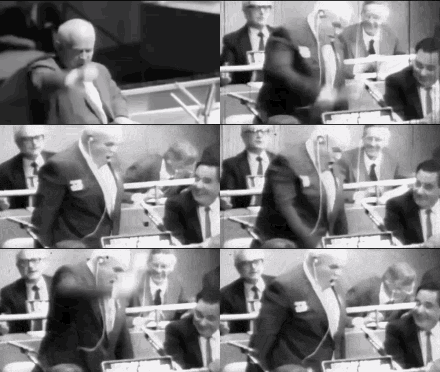
Pe plan politic, cartea descrie tranziția de la figura lui Hrușciov, perceput la început ca liderul care îndrăznise să critice crimele lui Stalin și să promită comunismul în câteva decenii, la imaginea lui Brejnev, simbol al rigidității și al stagnării. Popular, Hrușciov era privit ca impulsiv, uneori grotesc (gestul cu pantoful la ONU a rămas în istorie ), dar asociat cu ideea de schimbare.
Brejnev, în schimb, se conturează ca liderul care a transformat promisiunile de schimbare într-o stabilitate imobilă. Sub conducerea lui, entuziasmul „dezghețului” a fost înlocuit de ritualuri rigide: congresele de partid cu aplauze interminabile, paradele de pe Piața Roșie, discursurile monotone pline de clişee ideologice.
Dacă Hrușciov fusese asociat cu reforme îndrăznețe și gesturi teatrale, Brejnev era perceput mai degrabă prin imaginea cultului personalității cultivate artificial – medaliile pe care și le acorda singur, busturile ridicate în orașe de provincie, volumele de „memorii” despre Marele Război pentru Apărarea Patriei, tipărite pe bandă rulantă. Pentru cetățenii obișnuiți, anii lui Brejnev însemnau lipsuri constante, cozi, corupție mică și o atmosferă de stagnare, în care orice speranță de liberalizare părea suspendată.
Momentul de apogeu al optimismului colectiv a fost cucerirea cosmosului. Lansarea lui Iuri Gagarin în 1961 și zborul primei femei cosmonaut, Valentina Tereșkova, au fost trăite ca dovezi că URSS era în fruntea lumii moderne. În același timp, aceste succese spectaculoase coexistau cu lipsurile zilnice și cu cozile interminabile, creând un contrast între triumful cosmic și realitatea terestră.
Originalitatea volumului constă în modul în care îmbină aceste planuri: arhivele de partid, documentele cenzurii, presa oficială, literatura samizdat și mărturiile scriitorilor.
The Soviet Sixties este o lucrare de referință: o carte care reconstituie nu doar istoria unei puteri, ci și atmosfera unei generații care a visat la stele, dar a descoperit mereu limitele impuse de pământul sovietic.
Robert Hornsby mărturisea într-un interviu că a scris această carte pentru ca studenții săi să găsească într-un singur volum reperele politice, culturale și sociale necesare înțelegerii perioadei sovietice de după Stalin. Ambiția lui nu a fost să ofere doar o istorie politică a URSS, ci o frescă densă, unde literatura, arta, știința și viața cotidiană se împletesc cu deciziile de partid.
M-a interesat în mod deosebit secțiunea despre scriitori. Vasili Grossman, cu manuscrisele confiscate de KGB, ilustrează intoleranța regimului față de adevărul incomod. Boris Pasternak rămâne, chiar și după moarte, un dizident prin Doctor Jivago. Aleksandr Soljenițîn, cu O zi din viața lui Ivan Denisovici, prezintă pentru prima oară adevărul lagărelor, dar este rapid redus la tăcere. Iosif Brodski trece prin procesul absurd pentru „parazitism social”, în timp ce Andrei Siniavski și Iuli Daniel plătesc cu ani de lagăr pentru publicarea unor texte satirice în Occident. Evgheni Evtușenko ( care mi-a amintit de Păunescu și Cenaclul Flacăra) devine un poet al mulțimilor, capabil să umple stadioane cu recitalurile sale, oscilând între spirit critic și loialitatea față de regim.
Cartea aduce în prim-plan și figuri despre care nu auzisem, dar cu povești tulburătoare: Iuri Galanskov și Aleksandr Ginzburg. Galanskov, poet cu voce puternică și nerăbdătoare, a visat să adune într-o singură antologie (Phoenix-66) texte despre libertate. A plătit scump: arestat, trimis în lagăr, a murit tânăr, în 1972, după o intervenție chirurgicală banală transformată în tragedie de indiferența autorităților. Prietenul și tovarășul lui, Ginzburg, a fost la rândul său condamnat, dar a supraviețuit. După ani de detenție, a fost eliberat într-un schimb de prizonieri și a dus mai departe, în exil, povestea samizdatului sovietic.
Hornsby surprinde și pulsul cultural mai larg: muzica occidentală care începe să circule pe discuri copiate pe radiografii medicale, filmele care aduceau un aer de libertate, festivalurile și serile de poezie care adunau tineri în piețe pline. Aceste momente au creat impresia unei respirații noi, chiar dacă efemere, după epoca stalinistă.
Pe plan politic, cartea descrie tranziția de la figura lui Hrușciov, perceput la început ca liderul care îndrăznise să critice crimele lui Stalin și să promită comunismul în câteva decenii, la imaginea lui Brejnev, simbol al rigidității și al stagnării. Popular, Hrușciov era privit ca impulsiv, uneori grotesc (gestul cu pantoful la ONU a rămas în istorie ), dar asociat cu ideea de schimbare.
Brejnev, în schimb, se conturează ca liderul care a transformat promisiunile de schimbare într-o stabilitate imobilă. Sub conducerea lui, entuziasmul „dezghețului” a fost înlocuit de ritualuri rigide: congresele de partid cu aplauze interminabile, paradele de pe Piața Roșie, discursurile monotone pline de clişee ideologice.
Dacă Hrușciov fusese asociat cu reforme îndrăznețe și gesturi teatrale, Brejnev era perceput mai degrabă prin imaginea cultului personalității cultivate artificial – medaliile pe care și le acorda singur, busturile ridicate în orașe de provincie, volumele de „memorii” despre Marele Război pentru Apărarea Patriei, tipărite pe bandă rulantă. Pentru cetățenii obișnuiți, anii lui Brejnev însemnau lipsuri constante, cozi, corupție mică și o atmosferă de stagnare, în care orice speranță de liberalizare părea suspendată.
Momentul de apogeu al optimismului colectiv a fost cucerirea cosmosului. Lansarea lui Iuri Gagarin în 1961 și zborul primei femei cosmonaut, Valentina Tereșkova, au fost trăite ca dovezi că URSS era în fruntea lumii moderne. În același timp, aceste succese spectaculoase coexistau cu lipsurile zilnice și cu cozile interminabile, creând un contrast între triumful cosmic și realitatea terestră.
Originalitatea volumului constă în modul în care îmbină aceste planuri: arhivele de partid, documentele cenzurii, presa oficială, literatura samizdat și mărturiile scriitorilor.
The Soviet Sixties este o lucrare de referință: o carte care reconstituie nu doar istoria unei puteri, ci și atmosfera unei generații care a visat la stele, dar a descoperit mereu limitele impuse de pământul sovietic.
November 3, 2023
Eminently readable account of a pivotal period in recent history. From Stalin’s death to the Prague Spring, the book details how the Soviet gov’t and society teetered back and forth between liberalization and return to more Stalin-like characteristics. Full of details on cultural life, science, space, and key political fights and underground activities. Highly recommend.

December 2, 2023
I found the book fascinating, and persuasive in arguing for a notion of a sixties movement in the Soviet Union. This is a period of Soviet history I knew less about, I found this book engaging and informative, and ended with a clearer picture of how the period played out.
December 11, 2023
5 stars for being very informative and readable at the same time. I confess that I do not know much about this period of the cold war so my rating is not about how faithful the account is to the actual events and the treatment of the available sources. It is a book I will surely return to as my knowledge of this period broadened.
I intend to deepen my knowledge of this period by reading the following as soon as possible:
1. Khrushchev by William Taubman
2. Lumumba Plot by Stuart Reid
3. Into the Whirlwind by Eugenia Semenovna Ginzburg
4. One day in the life of Ivan Denisovich by Aleksandr Solzhenitsyn
5. The Abyss by Max Hastings
6. Stalin's Daughter by Rosemary Sullivan
7. Gulag by Anne Applebaum
8. Gulag Archipelago by Aleksandr Solzhenitsyn
I intend to deepen my knowledge of this period by reading the following as soon as possible:
1. Khrushchev by William Taubman
2. Lumumba Plot by Stuart Reid
3. Into the Whirlwind by Eugenia Semenovna Ginzburg
4. One day in the life of Ivan Denisovich by Aleksandr Solzhenitsyn
5. The Abyss by Max Hastings
6. Stalin's Daughter by Rosemary Sullivan
7. Gulag by Anne Applebaum
8. Gulag Archipelago by Aleksandr Solzhenitsyn

December 17, 2025
In the introduction, the author promises not to dwell too long on the most well-known political events of the USSR, in order to focus instead on the lived experience of its citizens during the period. He proceeds to do precisely the opposite, offering an unrigorous and needlessly lengthy account of the Stalin era and the early Khrushchev reckoning with it, complete with more citations of Solzhenitsyn than anyone concerned with historical accuracy should be able to stomach. That said, he does deserve some praise for not shying away from the reality that, even during this tumultuous period, the Soviet project still enjoyed the support of innumerable people, and that not everyone welcomed the wholesale denunciation of Stalin.
From about halfway through chapter four onward, the introductory promise begins to approach fulfillment, although the reliance on the ever-so-cliched “Soviet anecdote,” which lazy historians love to fall back on, is disappointing.
The merits some credit for occasionally pointing out American hypocrisy or misconduct. However, in the chapter dealing with Soviet efforts to aid the liberation of colonized and underdeveloped nations, a reflexive pro-Americanism becomes as sickening as America’s actual role during the period—a role the author notably avoids detailing (the most charitable explanation being that he assumes it is already known to the reader). This tendency is exemplified by his reference to Jacobo Árbenz’s developmentalist government in Guatemala as a “regime,” one of the many thought-terminating enemy epithets on which liberal authors so often rely.
While this work has been deservedly cited as a balanced account of Soviet history it nevertheless follows the predictable trajectory of treating Soviet history primarily as a history of dissent. This is a problem common to social histories of official enemy states. While attention to dissent is unavoidable in a period when such tensions were becoming more visible, the book ultimately has more to say about what some Soviet people wanted to do—but could not, or had to postpone—than about what Soviet people actually did. The struggle of a handful of writers is especially repetitive and the author keeps returning to it, I was not particularly invested.
Although I have to give the book some credit, one personal metric I use when reading bourgeois histories of the socialist camp is how many commonly held beliefs—particularly those prevalent among propagandized Western audiences—it manages to challenge. By that measure, this work performs reasonably well. Among other things, it acknowledges that many dissidents were not, in fact, opposed to Soviet power; that opposition was often motivated by the very communist ideals the government itself professed; and that the Brezhnev years can hardly be described as an “era of stagnation” by most empirical metrics.
From about halfway through chapter four onward, the introductory promise begins to approach fulfillment, although the reliance on the ever-so-cliched “Soviet anecdote,” which lazy historians love to fall back on, is disappointing.
The merits some credit for occasionally pointing out American hypocrisy or misconduct. However, in the chapter dealing with Soviet efforts to aid the liberation of colonized and underdeveloped nations, a reflexive pro-Americanism becomes as sickening as America’s actual role during the period—a role the author notably avoids detailing (the most charitable explanation being that he assumes it is already known to the reader). This tendency is exemplified by his reference to Jacobo Árbenz’s developmentalist government in Guatemala as a “regime,” one of the many thought-terminating enemy epithets on which liberal authors so often rely.
While this work has been deservedly cited as a balanced account of Soviet history it nevertheless follows the predictable trajectory of treating Soviet history primarily as a history of dissent. This is a problem common to social histories of official enemy states. While attention to dissent is unavoidable in a period when such tensions were becoming more visible, the book ultimately has more to say about what some Soviet people wanted to do—but could not, or had to postpone—than about what Soviet people actually did. The struggle of a handful of writers is especially repetitive and the author keeps returning to it, I was not particularly invested.
Although I have to give the book some credit, one personal metric I use when reading bourgeois histories of the socialist camp is how many commonly held beliefs—particularly those prevalent among propagandized Western audiences—it manages to challenge. By that measure, this work performs reasonably well. Among other things, it acknowledges that many dissidents were not, in fact, opposed to Soviet power; that opposition was often motivated by the very communist ideals the government itself professed; and that the Brezhnev years can hardly be described as an “era of stagnation” by most empirical metrics.

February 18, 2024
A good book, providing a history of the Soviet Union’s “long 1960s” and Russia’s transformation after the years of Stalin’s dictatorship. The author, historian Robert Hornsby, argues that the period from Stalin’s death in 1953 to the Czech Invasion of 1968 saw significant transitions within the Soviet Union. Not only did the political environment drastically reform (with the opening of the Gulags and a lessening of the power & influence of the state security organizations) but , more significantly, the foundational economic and cultural underpinnings of the Soviet state also advanced. The book covers a wide swathe of topics, from the political machinations of senior leaders and hectic international relations through to scientific advancements and the policies taken to improve life for the average citizen. Hornsby does not shy away from the many deficiencies of this transitional era. The Soviet state’s inability to overcome its own bureaucratic inertia and security paranoia despite a desire for economic growth and increased political opening is a major part of the narrative. Especially interesting was the description of culture and art within the bounds of this evolved Soviet state - many of what the west saw as “protest” works were not envisioned as such by their creators. A great book for understanding the mechanics of transformation in a centralized state. Highly recommended for anyone wanting to better understand a foundational period for modern Russia. A good book for comparing Russia’s transition to modernity with the slightly later transformation of the Chinese state.

January 7, 2025
Great for anyone who is interested in slightly less popularly covered areas of Soviet history (in the Western perspective), i.e. not Lenin, Stalin, or Gorbachev. Hornsby pays attention to many different aspects of the USSR that are often ignored (most notably the fact that there are other countries in the USSR besides Russia...), and provides a good view of how society adapted from Stalin to Khrushchev and then to Brezhnev.
The section on Khrushchev's era was definitely the best. It is what most of the book is spent discussing, and also was made much more interesting and solidly contextualised by beginning the book discussing Stalinist life. The title of the book is a little inaccurate, because I feel like the majority of the book was more focused on the 1950s, and hardly anything was covered over the beginning of the Brezhnev period. Hornsby claims that the first decade or so of his leadership was much different to how it is now perceived as stagnated and restrictive, but then doesn't actually delve into it. I think creating a longer book would have benefitted this work.
Good research and written in an accessible and approachable style. I think it's suitable for both beginners and those who are more experienced.
The section on Khrushchev's era was definitely the best. It is what most of the book is spent discussing, and also was made much more interesting and solidly contextualised by beginning the book discussing Stalinist life. The title of the book is a little inaccurate, because I feel like the majority of the book was more focused on the 1950s, and hardly anything was covered over the beginning of the Brezhnev period. Hornsby claims that the first decade or so of his leadership was much different to how it is now perceived as stagnated and restrictive, but then doesn't actually delve into it. I think creating a longer book would have benefitted this work.
Good research and written in an accessible and approachable style. I think it's suitable for both beginners and those who are more experienced.

September 18, 2024
4.6/5
Very interesting and revealing read! After becoming interested in this area of history after the 2017 film ‘The Death of Stalin’, I was interested to understand how the Soviet System worked and what was it like to live within the regime during this period, and this book goes above and beyond in explaining these things, using extensive first hand experiences and humanising what often is believed about the Soviet Union here in the west.
The Soviet Sixties (1954-1968) was such an interesting period to focus on, as it saw sweeping reforms, a tug of war of economic and societal liberalisation fighting against controlled Stalin-era conservatism, a Soviet Union at the height of its powers as a global superpower, the living standards of the soviet people reach new heights and the de-Russification and multi-ethnic embrace of the many differing republics within the Union. But also the lows, such as the political repressions that still plagued the country, a bureaucratic class that failed to participate in forwarding the goal of the nation and consistently abused their powers and the leadership of the party that failed to act to stop the bureaucratic class, as many of them benefitted from it.
Kruschev is an absolute g tho fr
Very interesting and revealing read! After becoming interested in this area of history after the 2017 film ‘The Death of Stalin’, I was interested to understand how the Soviet System worked and what was it like to live within the regime during this period, and this book goes above and beyond in explaining these things, using extensive first hand experiences and humanising what often is believed about the Soviet Union here in the west.
The Soviet Sixties (1954-1968) was such an interesting period to focus on, as it saw sweeping reforms, a tug of war of economic and societal liberalisation fighting against controlled Stalin-era conservatism, a Soviet Union at the height of its powers as a global superpower, the living standards of the soviet people reach new heights and the de-Russification and multi-ethnic embrace of the many differing republics within the Union. But also the lows, such as the political repressions that still plagued the country, a bureaucratic class that failed to participate in forwarding the goal of the nation and consistently abused their powers and the leadership of the party that failed to act to stop the bureaucratic class, as many of them benefitted from it.
Kruschev is an absolute g tho fr

March 25, 2026
The Soviet Sixties by Robert Hornsby covers the era between the death of Stalin in 1953 and the suppression of the Prague Spring in 1968. It follows, in roughly chronological order, the vast social, cultural, economic, and political changes that occurred in the Soviet Union during this period.
One focus is on the changes in the highest echelons of the Soviet leadership and ideology with the resulting tug-of-war between liberal reforms and the relapses into Stalinist orthodoxy.
Another focus is the changing dynamics between the Soviet Union and its satellite states, as well as ethnic tensions in the constituent republics of the Union.
The slowly emerging dissident movement receives the most detailed attention, as it was essentially a product of the expanded latitude in public cultural life during the period in question.
Other events of the era, such as the Virgin Lands program, the Space Race and the 1957 Moscow Youth Festival are also examined.
Given the breadth of the covered topics, most examinations have to, by necessity, remain rather superficial. Entire books have been written on many of the topics addressed in this book, so this work can either serve as a worthwhile overview of what life in the Soviet Union in the 15 years after Stalin’s death was like or as a starting point for further reading into the topics that the reader has found most interesting. The examination of the Soviet literary scene inspired me to delve into the science-fiction novels of the Strugatsky brothers.
I would gladly read a follow-up book about what Mr. Hornsby calls "the long Soviet Seventies" from 1968 until the beginning of the Gorbachev era.
One focus is on the changes in the highest echelons of the Soviet leadership and ideology with the resulting tug-of-war between liberal reforms and the relapses into Stalinist orthodoxy.
Another focus is the changing dynamics between the Soviet Union and its satellite states, as well as ethnic tensions in the constituent republics of the Union.
The slowly emerging dissident movement receives the most detailed attention, as it was essentially a product of the expanded latitude in public cultural life during the period in question.
Other events of the era, such as the Virgin Lands program, the Space Race and the 1957 Moscow Youth Festival are also examined.
Given the breadth of the covered topics, most examinations have to, by necessity, remain rather superficial. Entire books have been written on many of the topics addressed in this book, so this work can either serve as a worthwhile overview of what life in the Soviet Union in the 15 years after Stalin’s death was like or as a starting point for further reading into the topics that the reader has found most interesting. The examination of the Soviet literary scene inspired me to delve into the science-fiction novels of the Strugatsky brothers.
I would gladly read a follow-up book about what Mr. Hornsby calls "the long Soviet Seventies" from 1968 until the beginning of the Gorbachev era.
February 10, 2024
Not five stars because its a bit too superficial. So many things glossed over that would have been amazing to get into in detail, if only in a footnote. On that note: Not a single footnote that contains anything but a bibliographic citation!!! Unbelievable missed opportunity from that point of view. Sorry I'm not gonna acquire a random 2017 paper in Russian to learn more about what some actor said at some meeting. Just tell me us he said!

July 28, 2024
Just finished this. Despite the title, it covers the period after Joseph Stalin's up until 1968.
Still, it's a great read about everything that happened in the Soviet Union including politics, culture, science, and social and economic issues.
Definitely recommended for those who study post WWII history.
Still, it's a great read about everything that happened in the Soviet Union including politics, culture, science, and social and economic issues.
Definitely recommended for those who study post WWII history.
May 17, 2025
I learned a lot about a time in Soviet history I was previously ignorant of. The writing was solid and I never felt bored. Russian names are still hard for me to follow sometimes, but that is on me. My only major qualm is that the narrative moved through back and forth through time in a way that made me confused. A tighter focus on each chapter would have helped.

July 17, 2024
Amazing book - incredibly informative but also a very smooth and easy read compared to most history books.

December 4, 2025
Excellent and incredibly detailed work
June 9, 2025
Amazing, well written and learned a lot. This book deserves much more attention.
Anyways,
Anyways,

May 3, 2025
Detailed, well-written, and engaging summary of the Khrushchev and early Brezhnev years of the Soviet Union. Enjoyable and thought provoking read. Highly recommend if this topic interests you
Displaying 1 - 16 of 16 reviews