Jump to ratings and reviews
Rate this book

Noitavaimo

Rate this book
Norman Saylor on pienen uusienglantilaisen collegen sosiologian professori. Hän löytää sattumalta vaimonsa, Tamsyn, lipaston laatikosta hautausmaan multaa, hiuksia, kynnen kappaleita ja muita todisteita noituudesta. Tamsy tunnustaa miehelleen, että kuuluu collegen opettajien vaimojen muodostamaan noitapiiriin. Se yrittää mm. edistää miestensä menestystä akateemisilla urillaan.

Norman saa vaimonsa vakuuteuksi siitä, että noituus on silkkaa taikauskoa. Noitapiirin muut jäsenet ovat kuitenkin eri mieltä ja pian koittaa noitien keskenäinen taistelu, joka huipentuu kaupungin hautausmaalla.

Fritz Leiber (1910-1992) oli arvostettu amerikkalainen fantasia- ja kauhukirjailija. Noitavaimo sai Hugo-palkinnon prarhaasta pienoisromaanista vuonna 1944. Noitavaimon romaaniversio ilmestyi 1953. Se on filmattu kaksi kertaa, vuosina 1944 ja 1962.

Leiberilta on ilmestynyt suomeksi fantasianovelleja ja yksi romaani.

223 pages, Hardcover

First published April 1, 1943

247 people are currently reading
5081 people want to read

About the author

Fritz Leiber

1,337 books1,051 followers
Fritz Reuter Leiber Jr. was one of the more interesting of the young writers who came into HP Lovecraft's orbit, and some of his best early short fiction is horror rather than sf or fantasy. He found his mature voice early in the first of the sword-and-sorcery adventures featuring the large sensitive barbarian Fafhrd and the small street-smart-ish Gray Mouser; he returned to this series at various points in his career, using it sometimes for farce and sometimes for gloomy mood pieces--The Swords of Lankhmar is perhaps the best single volume of their adventures. Leiber's science fiction includes the planet-smashing The Wanderer in which a large cast mostly survive flood, fire, and the sexual attentions of feline aliens, and the satirical A Spectre is Haunting Texas in which a gangling, exo-skeleton-clad actor from the Moon leads a revolution and finds his true love. Leiber's late short fiction, and the fine horror novel Our Lady of Darkness, combine autobiographical issues like his struggle with depression and alcoholism with meditations on the emotional content of the fantastic genres. Leiber's capacity for endless self-reinvention and productive self-examination kept him, until his death, one of the most modern of his sf generation.

Used These Alternate Names: Maurice Breçon, Fric Lajber, Fritz Leiber, Jr., Fritz R. Leiber, Fritz Leiber Jun., Фриц Лейбер, F. Lieber, フリッツ・ライバー

Ratings & Reviews

What do you think?
Rate this book

Friends & Following

Create a free account to discover what your friends think of this book!

Community Reviews

5 stars
697 (24%)
4 stars
1,126 (40%)
3 stars
719 (25%)
2 stars
198 (7%)
1 star
50 (1%)
Displaying 1 - 30 of 352 reviews
Profile Image for Bill Kerwin.
Author 2 books84.3k followers
June 20, 2020

The premise of this book must have seemed remarkably clever--and unusual--when it appeared in 1943.

What if all the women are witches and keep their craft secret from their husbands? What if their husbands' success in the workplace--their good performance reviews, their promotions, their smallest political victories--are due to their spouses' spells and circles of protection? And what would happen if one of the men found out, and persuaded his wife to renounce magic?

Many novels and films--and an infinity of TV dramas and sitcoms--have used Leiber's idea, but few of them have produced a book as absorbing and well plotted as this one. It is set in a small American college filled with pseudo-gothic architecture (keep your eye on those gargoyles--they may be important later!) and where the petty politics are so nasty they remind me of an old joke: "Why are academic politics so vicious?" "Because the stakes are so small."

For the first half of the book, the premise pretty much writes itself as we observe the harrying of nice young sociology prof Norman Saylor and his wife Tansy--poor, bare forked animals deprived of the comforts of witchcraft.

It is then that the book becomes even more interesting. Norman casts a spell at the behest of an endangered Tansy, and he completes it on time--well, almost on time, and then. . .

Go read the book for yourself.
Profile Image for Scott Rhee.
2,310 reviews161 followers
November 1, 2025
A surprisingly adorable hidden gem from the Golden Age of Science Fiction/Fantasy, Fritz Leiber's 1943 horror classic "Conjure Wife", while rather sexist by today's more-enlightened standards, tells a heart-warming story of witchcraft, the occult, and marriage.


Norman and Tansy Saylor are a cute young married couple living in a small New England college town, where Norman is a successful professor of anthropology on the rise. Their evenings are spent playing bridge and having dinner parties with fellow faculty members. Then, one night, Norman walks into Tansy's closet and discovers something that will change their staid little lives: Tansy is a witch!


Norman puts his foot down, as witchcraft is absolutely not allowed in the Saylor household. Tansy gives it up, of course, because she adores Norman, and he knows best.

Except, maybe he doesn't. In the days and weeks following Tansy's repudiation of witchcraft, a series of negative events nearly topples Norman's career. A secretary accuses him of sexual impropriety. A disguntled former student tries to kill him. Worst of all, the promotion he figured he was a shoe-in for is given to Hervey Sawtelle, the campus joke of a professor. What the Hell?

On top of all that, Tansy's life is threatened by a supernatural force. Unable to go to the police or his fellow professors, Norman must face the facts: only witchcraft can save his career, his marriage, and his wife's sanity!

The horror in this is so subtle to the point of being humorous, although the humor is almost certainly purposeful. This novel reads like "Rosemary's Baby" meets "Bewitched". There are very few scenes of knuckle-biting terror, but there are plenty of surprisingly romantic scenes in which Norman realizes how selfish he has been in the marriage and how little he has appreciated his wife. This would make a cute little horror rom-com starring Chris Evans and Rachel Brosnahan; directed by Tim Burton.

Profile Image for Craig.
6,339 reviews178 followers
December 8, 2024
Conjure Wife has been marketed as a horror novel, a Gothic, an urban fantasy, a satire, and who knows what all else. It's all of those, and a lot more. It was first published in 1943, in John W. Campbell's Unknown Worlds magazine, and since then has been published with an amazingly diverse range of covers. It's also been filmed at least thrice and won a retro-Hugo in 2019 for the best novel of the year, beating books by C.S. Lewis, Hermann Hesse, A.E. van Vogt, C.L. Moore & Henry Kuttner, not to mention Leiber's own Gather, Darkness!. It's the story of Norman Saylor, who discovers that his wife Tansy is a witch, and makes her stop. Sounds like Bewitched, but it gets dark and surprising from there. As one would expect from a story from over eighty years ago there's some serious dating in the attitudes of gender and roles, but I think it's still a terrific story. (This'll sound like one those click-bait captions, but you'll be chilled and shocked by the end of chapter fourteen.) Leiber was a very accomplished writer, with a profound sense of the dramatic, a slick command of the language, and serious storytelling skills.
Profile Image for Warren Fournier.
842 reviews152 followers
September 11, 2025
One of the most brilliant novels about witchcraft I've ever read, this is the stunning debut novel of everyone's favorite fantasy writer that is a perfect Halloween read.

A young professor of sociology at a posh university has been enjoying six years of success at his job. He is well-liked by his colleagues and students. He is a stand-up member of his community. One night, he discovers that his beautiful wife has been practicing witchcraft that she picked up from his own studies in American folk magic. She admits that she started dabbling in these rituals and collecting fetishes as a curiosity, but it became an obsession in response to her anxiety to help protect and maintain her husband's career success. He convinces her to purge the house of all her spells and baubles, which she does, and shortly afterwards his luck begins to change. Everything from nicking himself with a razor while shaving to getting me-too'd by a jealous student starts making his life a living hell. Are these just coincidences? Or were his wife's spells really protecting him? And if so, protecting him from what?

Leiber does a great job at comparing superstition to obsessive-compulsive anxiety, born from a need to control a seemingly chaotic and even malevolent world. All of us have our own little rituals, whether it be folding our laundry a specific way or making sure to avoid cracks in the sidewalk. These rituals amplify in magical thinking the more a person is under chronic stress. But Leiber doesn't dismiss the power of ritual. Ritual changes perception of reality, diverts attention to the purpose of the ritual, and invests the act with importance and reverence, thus creating a nexus of an entire network of perceptual changes in those around us which has an exponential effect on choices and outcomes. Therefore, the reader spends much of the novel not knowing if the professor is just getting paranoid or if magic is truly manipulating his life.

I got a little annoyed with the unnecessary secrecy in the book. Once bad things start happening to the professor, he doesn't want to admit them to his wife. This drags on to a ridiculous level, even when things get so crazy and dangerous as to demand that he discuss it with her. I understand why Leiber made this narrative choice, but it becomes frustrating.

So, the book is not perfect, but the wonderful psychological analysis of witchcraft, the beautiful writing, the realistic and memorable characters, the clever humor, the palpable suspense, and the spooky atmosphere all more than make up for the slight imperfections.

Leiber has a curious command of language. For example, when the main character is trying to go about his day, he has intrusive thoughts and anxieties that he tries to wall off, and Leiber brilliantly refers to them as "thought-cysts".

Also, this is a surprisingly grounded novel despite the goofiness of the premise. His characterization of the two married protagonists is very sweet, but not overly sentimental, a perfect depiction of a couple who love each other very much despite their flaws. The novel also feels very contemporary, tackling some very modern issues with Leiber's characteristic feminist tack, and at times I forgot that this book was written in the Forties.

Even if you are not a fan of genre fiction, I think most readers will enjoy this novel. So put it on your TBR for this spooky season!

SCORE: 4.5, rounded to 5 bewitched husbands out of 5

SUGGESTED MUSICAL PAIRING: Piano Sonata No. 9, Op. 68 by Alexander Scriabin
Profile Image for Char.
1,949 reviews1,873 followers
March 29, 2012
This was a fun novel about a witch.

The professor of a small college discovers that his wife is practicing magic.
He's disgusted that his wife, superstitious and flighty as she is, would do such a thing and orders her to immediately discontinue her practices.
Unfortunately, he does not consider that there could have been benefits associated with her charms.
I enjoyed the book very much despite the prejudices against women. Since this book was published in the 50's, I guess that type of thing is par for the course.
All in all, I enjoyed the prose, the story and the ending.
Profile Image for Nandakishore Mridula.
1,348 reviews2,696 followers
March 25, 2017
Fritz Leiber is an absolute pleasure to read. The narrative moves on at such a fast clip that you will miss the beauty of the language and the craft of the writer unless you purposefully take time to savour it: like the beauty of the countryside is wasted on an impatient traveller seated in a fast train. He is that rare thing, a literary fantasy writer who is exciting as well.

Leiber's plots are always unique and this short novel is no exception. Norman Saylor and his beautiful young wife Tansy are residents of a small academic township in America, in whose college Norman is a professor. He is unconventional and disliked by the college's conservative intelligentsia, but has still somehow managed to climb to the top: Tansy, looked down upon by the professors' prim wives, has also managed to survive and become quite popular. Norman is happy about it, a bit too pleased with himself, one can say - we meet him at the beginning of the novel in a moment of perfect contentment which feels too good to be real, and which he feels must pass, as such moments are too good to last.

It does - as he steps into his wife's dressing room on a whimsy and goes randomly through her drawers, and discovers that she is a witch.

Norman is aghast and so is Tansy that her secret is discovered: however, he manages to convince her that it is just a temporary aberration and persuades her to destroy her charms. But this proves to be disastrous, as all the other professors' wives are also witches, see... and it is only Tansy's protective magic which has kept Norman's career, and even life, safe. As he faces imminent annihilation, Tansy takes the curse upon herself and now it is up to Norman to save her and normalcy in a desperate race against time.

-------------------------------

College politics is extremely spiteful and petty, and surprisingly passionate for the people who indulge in it. The Masters by C. P. Snow is classic case in point. Leiber highlights the cruelty and pettiness by juxtaposing conjure magic on to it. The hatred that the liberals Tansy and Norman engender in the straitlaced academic society is very real (even now); if the conservatives had access to black magic, no doubt they would use it any time! And the pseudo-gothic architecture makes the perfect setting for reality to suddenly come apart at the seams... just look at those gargoyles...

However, a fantastic first half was spoilt for me, in a way, by the rather predictable second half. To be fair to Leiber, he wrote this book in 1943, so it must have been fresh then - but it has since then been the staple of countless fantasy and horror novels, this race against time to lift a curse. Also, the long discourse on magic towards the last quarter was a trifle snooze-inducing.

3.5 stars, not quite reaching 4.
Profile Image for Leah.
804 reviews48 followers
April 10, 2012
Rating: 3.5 of 5

Everyone knows the saying, "Behind every great man, there's a great woman." Well, in Conjure Wife, the great woman is a witch, and her great man doesn't know that. And it's worldwide: all women are witches, and they either know of or practice witchcraft.

Here's the gist:

One day, feeling good and taking a moment to reflect on his life, Norman Saylor, a professor of sociology at Hempnell College, begins to ponder his successes, one of which he considers his wife, Tansy. How did I get so lucky? Norman wonders. How did Tansy fare so well as a professor's wife? Those questions prompt Norman to snoop through his wife's closet and drawers. And what should he discover? The tell-tale signs of someone dabbling in "conjure magic." He's shocked!
If he had ever wondered about Tansy and superstitions at all, it had only been to decide, with a touch of self-congratulation, that for a woman she was almost oddly free from irrationality (p. 22).
A confrontation with Tansy ensues, turns into a nearly four-hour long discussion, at the end of which Norman demands Tansy stop her "neurotic" behavior at once. Tansy reluctantly agrees; after all, she was only ever doing magic to protect Norman.

That's when the unlucky "coincidences" begin piling up on Norman: threats from an expelled student; charges of a sexual relationship with a female student; scrutiny of his personal life and friends by the college's trustees, and on and on. The "coincidences" culminate with the disappearance of his wife.

But to rescue Tansy, Norman will have to practice a little conjure magic himself. The problem is, of course, he finds the whole idea ridiculous. Will Norman save Tansy? If he does, what will be the implications? The consequences?

Here are my two cents:

The sexism, oh the sexism. Because Conjure Wife is told in a limited third-person narrative, Norman Saylor could make or break the story. After reading a couple chapters of his thoughts, I feared I may not be able to finish. In fact, I forced myself to remember the setting - 40s/50s - and cut Norman some slack for his stereotypical, insensitive, often laughable assessments of people, especially women. (For example, see the above quote from page 22 in addition to the below.)
...(in a similar situation would he have dared try reasoned argument on any other woman?)(p. 31).
Once I decided to ignore that part of Norman's personality, I realized he still wasn't very likeable. But it was interesting to see the world through Norman's eyes, especially when he filtered everything through the rules of science. Although, I'll admit, it did get a tad annoying to have him go back and forth, back and forth. And even to go so far as to see if there was a mathematical formula for spells.

I liked Tansy, though, and the premise was an interesting one.

But it's not really new, is it? Men throughout history have feared "woman." Suspected her of being connected to some secret force, nature, even the Devil. Possibly in a conspiratorial capacity with other women. Wondered about her intuition. Faulted her for being more emotional than man. It's inherent for most, fearing what we do not understand.

However, I don't think fear of witchcraft or even a secret alliance among women was Norman's deepest fear. I think what he most feared was not really knowing his wife. That he could live with someone for so many years - I believe it was 15 years they'd been together - trust her, think he had her all figured out, only to discover she wasn't exactly who he imagined. Hell, that's scary for anyone in a relationship.
He looked at her, trying to comprehend it. It was almost impossible to take at one gulp the realization that in the mind of this trim modern creature he had known in completest intimacy, there was a whole great area he had never dreamed of...(p.21-22).
Once I saw that Norman did, in fact, love his wife, it was easier for me to sit back and enjoy the story. He used science the way many people use religion: a way to make sense of (or cope with) all the craziness, all the chaos, that is life. A constant in the ever shifting variables. And, for most, it's an unshakeable, unchangeable belief system.

Here's what you might not like about Conjure Wife:

* Sexism
* Racism
* The protagonist (Norman)
* Norman's always-on scientific filter
* Not "urban fantasy" as boasted on this edition's cover
* Falls under psychological or literary horror; there's nothing overtly scary or gory

Final thoughts

While its horror elements are mild and slow-building, Conjure Wife is most frightening for what's going on below the surface rather than its stated premise. I recommend it to fans of the slow burn style of supernatural horror, who are willing to overlook the (hopefully) outdated viewpoints and plan to take the time to think about the story once they close the book.

Note: This review was originally published on my blog, Unleash the Flying Monkeys!
Profile Image for Fiona Knight.
1,448 reviews295 followers
January 4, 2022
That was the sort of idea with which a clever satirical writer could do a lot. Just carry it a step further - picture most women as glamor-conscious witches, carrying on their savage warfare of deathspell and countercharm, while their reality-befuddled husbands went blithely about their business. Let's see, Barrie had written What Every Woman Knows to show that men never realize how their wives were responsible for their successes. Being that blind, would men be any more apt to realize that their wives used witchcraft for the purpose?

Fritz Leiber had it right, this is the kind of idea that could go a long way in the right hands. And while Conjure Wife does absolutely carry some 1940s attitudes that are best left there, it's also got moments of surprisingly progressive idealogy.

Norman is an appealing main character, in the way of being someone who needs taking care of - he's first oblivious, then reluctant to admit to himself what's going on, forcing himself to accompany every moment of giving in to the truth with the caveat that he doesn't really believe this, of course he doesn't, he's just humouring those involved to return to his normal life. The author doesn't allow him to be unlikeable, but he is also more than happy to set up Norman's weaknesses for gentle mockery - his need for a rationality that can no longer count as rational in the face of what he's seen in particular. Some of the more 1940s-esque attitudes are similarly presented in a way that shows their absurdity in the framework of the story, so I'm inclined to leeway on those too. Plus, above all, it's well-written and much more readable than plenty of other novels from the same period, and a nice quick read. I do wish I could read this from the point of view of someone without almost 80 years of media between them and the publication date - it must have been absolutely mind-blowing.
Profile Image for Anissa.
993 reviews324 followers
October 26, 2020
I picked this because it's the novel that Burn, Witch, Burn! aka Night of the Eagle is based on. Ever since I came across the movie (five or so years ago), it is one of my October/Halloween flicks.

The story of Tansy, a professor's wife who uses witchcraft to protect and further his career at Hempnell College. Things go well until Norman happens upon her craft and beinb the officious and logical man, he insists Tansy cease as it's beneath sensible people (and best left to the backward indigenous people of his past research). More fool, Norman because Hempnell is practically a witches coven and they're coming for he and Tansy. She gets rid of all her charms and talismans and almost immediately, Norman's fortunes take a decided downturn. Tansy suffers a particularly harrowing situation as well. The task then is to not just keep a job but survive, Norman finds that mansplaining it away won't work and the only thing for it is witchcraft.

The story here has somde differing elements than the movie and I liked that. It made for a more engaging read. One plot point in particular had me sit up in surprise. It should also be said that it's seriously dated and Norman tended to irritate me more here likely because there's so much time spent in his thoughts and opinions. Still I'm glad to have read this.

Recommended (the book and the film).
Profile Image for Laurie  (barksbooks).
1,951 reviews797 followers
December 11, 2009
When Norman Saylor discovers that his wife Tansy has been dabbling in witchcraft he demands that she cease all witchy activity and then demands that she remove all of her protective spells placed upon their home.

This is a mistake Norman will soon live to regret as his comfortable life begins to unravel. See, it seems that Tansy wasn’t the only one practicing witchcraft and the grasping wives of Norman’s colleagues at the college have been practicing as well. Now, what with the protections ceasing to exist, the Saylor’s are wide open to dangerous forces that do not wish them well!

Initially I found this book very interesting and it pleasantly reminded me of those old black and white creepy movies I used watch during my childhood. Sadly, as I continued to read I somehow lost my way and found it difficult to maintain my enthusiasm to turn the pages. The story mainly consists of Norman’s internal monologue and his attempt to find a solution to the heart-rending predicament in which he finds himself. Maybe it was my mood, maybe it was the dated feel of the story or maybe it was the format but I found the book a tad too slow moving and too easy to put down. Though it was exceptionally creepy at times it just didn’t click with me.
Profile Image for George K..
2,759 reviews370 followers
July 2, 2018
Πριν κάμποσα χρόνια (για την ακρίβεια τον Απρίλιο του 2013) διάβασα ένα άλλο βιβλίο τρόμου/αστικής φαντασίας του Φριτς Λάιμπερ, το πολύ καλό "Η κυρά του σκοταδιού". Θυμάμαι ότι είχε πολλές και ενδιαφέρουσες πληροφορίες και αναφορές σχετικά με διάφορα θέματα του υπερφυσικού/μεταφυσικού, καθώς και φοβερή ατμόσφαιρα, αλλά λίγες χαρακτηριστικές σκηνές "δράσης". Τώρα τα πράγματα είναι λίγο διαφορετικά, το βιβλίο έχει μια καλή και αρκετά ιντριγκαδόρικη πλοκή, με τις απαραίτητες σκηνές έντασης και ανατριχίλας, ενώ η ατμόσφαιρα είναι και πάλι φοβερή, αρκούντως κλειστοφοβική και σκοτεινή.

Η γενική ιδέα έχει το ενδιαφέρον της: Ας πούμε ότι κατά τα φαινόμενα οι γυναίκες ασκούν κάθε είδους μαγεία, με τους άντρες να κάνουν τις δουλειές τους και να πιστεύουν ότι είναι οι αποκλειστικοί υπεύθυνοι των επιτυχιών ή των αποτυχιών τους. Εδώ πεδίο δράσης είναι ένα κολέγιο και πρωταγωνιστές το προσωπικό του (καθηγητές, διευθυντές κλπ), καθώς και οι γυναίκες τους. Γινόμαστε μάρτυρες του τρόπου λειτουργίας και του μικρόκοσμου του, στον οποίο κυριαρχούν οι μικροπολιτικές αντιδικίες και η ζηλοφθονία. Εδώ όμως υπεισέρχεται και το στοιχείο της μαγείας - ή μήπως όχι; Ο καθηγητής Νόρμαν Σέιλορ, ο οποίος πιστεύει ότι η μαγεία δεν είναι τίποτα περισσότερο από μια απλή γραφική δεισιδαιμονία, θα γίνει μάρτυρας κάποιων πολύ παράξενων γεγονότων, με αρχή αυτά που θα ανακαλύψει στο μπουντουάρ της γυναίκας του. Με την πράξη αυτή οι ισορροπίες θα διαταραχτούν...

Η γραφή του Λάιμπερ είναι πολύ καλή, ευκολοδιάβαστη και συνάμα με βάθος σε νοήματα και εικόνες, ενώ δεν λείπουν κάποια ενδιαφέροντα πραγματάκια γύρω από την μαγεία και τις ανθρώπινες δεισιδαιμονίες. Φυσικά το βιβλίο δείχνει έως ένα βαθμό τα εβδομήντα πέντε χρόνια του (άλλες εποχές, άλλες συνήθειες και άλλα ήθη), όμως για την εποχή του ήταν σίγουρα αρκετά πρωτοποριακό και πρωτότυπο, ενώ καταφέρνει να συγκινήσει και τον σύγχρονο αναγνώστη βιβλίων τρόμου/αστικής φαντασίας. Το βιβλίο κυκλοφορεί στα ελληνικά από τις εκδόσεις Locus 7, σε μετάφραση του Γιώργου Μπαλάνου. Ακριβούτσικη έκδοση και με λίγα λαθάκια επιμέλειας, αλλά η μετάφραση είναι κλασικά πολύ καλή και γλαφυρή.
Profile Image for Ayz.
151 reviews57 followers
January 8, 2024
what a discovery.

this vintage will scare the soul right out of you.

up there with lovecraft, burnt offerings, the shining, or the haunting of hill house.

domestic occult horror at its finest.
Profile Image for Jamie.
1,435 reviews221 followers
November 7, 2025
There's no questioning Leiber's writing chops, and while I found parts taut and suspenseful, overall it felt rather hokey and dated. When it comes to his non-SFF work, I much prefer Gather, Darkness! and Our Lady of Darkness.
Profile Image for Coos Burton.
913 reviews1,570 followers
August 5, 2024
Hace muchísimos años vi "Burn, witch, burn!" de 1962, y la amé profundamente. Otros tantos años después, me enteré de que está inspirada en una novela: se trataba de "Esposa hechicera", de Fritz Leiber. Poco recuerdo la película, pero la historia de Leiber me resultó súper divertida. Me encanta la paranoia de la época con todo el tema de la brujería y el ocultismo, y creo que acá está muy bien plasmado. Hay varios aspectos que, al día de hoy, quedaron un poco desactualizados, pero bueno, es muy normal.
Profile Image for Mike (the Paladin).
3,148 reviews2,162 followers
September 8, 2010
This was an interesting and attention holding book, with a strange little "hook". The idea here is that "all women" are really part of a worldwide (seemingly)sorority. They're all witches.

A little disturbing for a guy to read....

However I liked it quite a lot. It caused me to read Our Lady of Darkness...a more complex book , but with an inferior story I believe. This one is just better "story-telling".

I found the story catching me quickly and pulling me along toward the climax. Imaginative and an original idea.
Profile Image for Skallagrimsen  .
398 reviews104 followers
Read
August 12, 2023
I note with interest that many positive and negative reviews of Conjure Wife posted here agree it's sexist. There may be something to that--although, if so, I think it's an open question as to which sex it's sexist against.

The plot involves a young male university professor who stumbles upon the world's greatest and best kept secret: women--all women--are witches, gifted with supernatural powers and the ability to cast spells. Men might understand the universe to be ultimately governed by rational principles, but they are wrong. Men might foolishly believe themselves dominant in society and civilization, but that's just what women want them to think: in reality, they've always been the unwitting pawns of feminine power.

It's a delightfully paranoid premise, light-hearted on the surface, but reaching down to a deep level of symbolic resonance. This is probably Fritz Leiber's most thorough expression of his fascination with the feminine, a theme that reoccurs throughout his work. I also found it to be an excellent supernatural thriller, skillfully written and difficult to put down.

Conjure Wife is fantasy, of course, but with its mid-twentieth century university setting and theme of the war between the sexes, it's never reminded me of anything so much as Edward Albee's brilliant play Who's Afraid of Virginia Woolf?

As to the knee-jerk charge of misogyny, my only defense of Conjure Wife is that Joanna Russ, the original icon of radical feminist science fiction, admired both this novel and Leiber's work in general. While that's not proof of anything, of course--anyone might be mistaken about anything--her opinion, in this case, at least seems worth taking into account.
Profile Image for Phil.
2,434 reviews236 followers
June 5, 2021
Before there was the genre of urban fantasy there was Leiber, writing an urban fantasy tale back in 1943. I am more familiar with Leiber's Fafhrd and the Gray Mouser fantasies (really good), but CW demonstrates that Leiber was really a gifted author outside of 'traditional' sword and sorcery tales. Our lead, Norman, is a sociology professor at a small, traditional liberal arts college in New England somewhere. The story starts with Norman reflecting on good his luck has been over the last few years and his wife Tansy. Tansy has a dressing room that Norman has never really investigated, and after finishing up some work, he decides to check it out (what the heck, right?). Going through her dresser he finds some strange objects he (unbelievably) recognizes as tools of witch craft-- grave yard dirt (labelled), odd herbs, lodestones, bits of silver and other assorted metal and so forth. When his wife catches him in the act, she freezes and walks away. They finally calm down enough to talk about it and yes, she confesses that she makes little charms and such to avoid bad luck and so forth and has been doing it for years. Norman, the scientifically minded rationalist convinces her to give it up and finally she agrees; they burn all the 'totems' and such and call it a day. Then, right after the last charm is burned, Norman receives some strange phone calls (at 2AM!) and the next day at work, all kinds of ugliness comes Norman's way...

The mark of a classic is how it stands up over time, and the CW fits the bill nicely. Lieber (through Norman) puzzles over new modern anxieties like the A-bomb (remember, this was written in 1943!) and changing social dynamics. He pretty much nails the old school liberal arts college, some vestiges which still survive today. Norman and Tansy are both great characters and Leiber does a masterful job with how Norman begins to shed his disbelief regarding magic. A fun, fast read with some nostalgia tossed in! Lieber does demonstrate some 'old school' gender beliefs here, like men are more rational than women, but does so in a way that fits the story . This 80 year old classic still delivers! 4 stars!
Profile Image for Nancy Oakes.
2,019 reviews917 followers
October 6, 2016
http://www.oddlyweirdfiction.com/2016...

actually, somewhere between 4 and 5, but this is one hell of a good novel.

before Matthew knocks on our door and while we still have power I figured I'd post about this book. I did a flip-flop on this one, and watched the movie prior to reading the novel, but I can tell you that the movie follows the book pretty closely.

Norman Saylor is a professor of sociology who finds himself caught up in supernatural forces that he's built a career denying. Norman teaches sociology at a small university, more specifically, his work centers on the "parallelisms of primitive superstition and modern neurosis," even coming up with a book about it. He believes that magic is just a product of superstition -- in short he doesn't believe in it. However, his wife Tansy does, and has been, unknown to Norman, putting up protective magical shields to keep Norman safe from a trio of women who see him as a threat to their own interests. When Norman discovers that Tansy's been doing this, he makes her get rid of everything, and that's when all of the trouble begins. Suddenly things start taking a turn for the worse, but level-headed Norman tries to rationalize every weird occurrence -- until he can no longer afford to do so.

Super book, and really, anyone who loves older supernatural novels should read this -- it's still quite relevant, masterfully written, and just downright scary.

Profile Image for Bill.
1,882 reviews132 followers
August 14, 2016
I can see where this one would be (and should be) considered a classic. It’s hard to believe it was penned in 1943 as it stands up extremely well. You can see the influence Fritz Leiber has had on many of today’s modern horror authors. Well done. 3.5+ Stars
Profile Image for  Danielle The Book Huntress .
2,756 reviews6,615 followers
October 18, 2012
I read this out of the Dark Ladies: Conjure Wife/Our Lady of Darkness duology, but I wanted to jot down my thoughts separately for this one before I finish the volume.

I found the writing clever. I was transplanted into the cutthroat world of college politics. Who knew that the wives could be just as fierce as their faculty husbands? And that they would resort to sorcery and witchcraft to keep their husbands (and themselves by relation) in power? Things get pretty nasty!

I think that there is some very interesting commentary about male and female relationships here. That old Venus Versus Mars argument. I felt at first that Norman was a rampant sexist (in a way that is very common even today). He had a superior attitude towards his wife, while simultaneously being in awe of her at the same time. He seemed to view her as an alien creature, constantly analyzing the way her mind worked, as if it was so different from his. I liked how his feelings of mental superiority over her backfired when he realized that she was in fact the one who was right about what was really going on, and how he had to rely on her knowledge of the situation. I liked how things turned around and it was clear how much he did care for his wife. How he fought for her well-being, willingly putting aside his hard-headed scientific skeptical thought processes to save her.

I feel that there is a heavy tone of satire cleverly mixed in with well-executed psychological horror. Norman's internal dialogue engenders a tone that is analytical and observational (although he doesn't seem to be as observant as one would think for a sociologist), wry and sarcastic at other times and quite laden with a menace that sneaks up on the reader. At first, I found him to be a bit of a pompous twit. I admit I can't stand when men treat women like their brains and mental capacities are limited. But I couldn't stay angry at him. He learned the hard way not to underestimate women, particularly his own wife. I think in this, Leiber is making a point. For all the men did have a tendency to view their spouses through a skewed lens, not realizing just how much power the women truly had in their lives and over them. Leiber seems to throw sexist ideas out with a wink and a nod, as if he expects the readers to reject those thoughts, or perhaps to poke fun at those who believe what he's saying. My take, anyway.

I wonder what the reception was to this book in the 1940s. The ideas of male/female relations are probing and insightful in a way that seems a bit subversive. But what do I know? At any rate, I liked this story very much. It's beautifully subtle in the slow building of menace and fear, and the ideas about society seem to be relevant today in how men and women and spouses relate to and view each other. Also it speaks to the often venomous way that women can sometimes turn against each other, belying what some (including myself) naively believe about the sisterhood of women. On the horror level, the truly heinous and scary nature of witchcraft used as a tool for power and control is enough to send a shiver down my spine. It makes you wonder just how much witchcraft may be going on behind the scenes today.

Overall rating: 4.25/5.0 stars.
Profile Image for Charles Dee Mitchell.
854 reviews69 followers
March 23, 2015
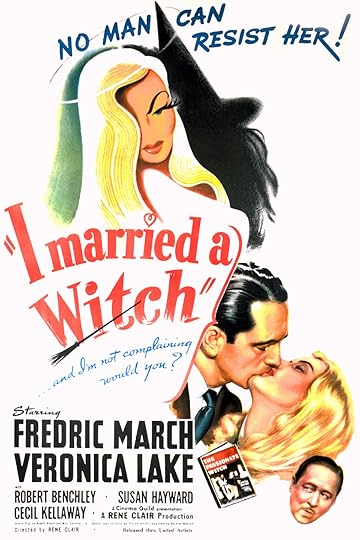
Before I knew better, I assumed that Fritz Leiber's Conjure Wife was the basis for Rene Clair's film I Married a Witch. But no. Clair's 1942 film is based on Thorne Smith's The Passionate Witch, published posthumously in 1941. Leiber's novel came out in 1943 and therefore is neither the source of Clair's classic film or, by extension, the long-running 1960's sitcom Bewitched. I could apply the "classic:" modifier to the TV program as well, but it would only prove how pliable a term "classic" can be. Both Clair's film and the sitcom are comedies, although of a very different order, and from what I have read about Smith's novel it has darker undertones than its subsequent adaptations. Leiber's novel is not lacking in dark comedy, but it plays out as a classic horror story.

Brilliant, dedicated academic Norman Saylor -- and you have to love that name. Norman/Normal, get it? -- Norman Saylor is a direct descendent of the antiquarians and academics M.R. James subjected to supernatural horrors at the turn of the 20th century. He is the young, hotshot professor of sociology and anthropology at stuffy Hempnell College, the sort of institution somewhere in the northeastern United States where students attend daily chapel and most of the professors' wives practice witchcraft. Saylor comes to learn this last fact when he uncovers that his own wife, Tansy -- another name you have to love, along with the fact that Saylor had an affair with her while he was an instructor and she a student at another institution -- when he discovers that Tansy has filled the house with charms and potions to protect him in the overwhelmingly hostile environment of Hempnell. Saylor, good husband and practical scientist that he is, orders Tansy to dispose of all her magic geegaws, which she does. All hell breaks loose.

Saylor cannot help but be condescending when he considers his wife's practices. "If he had ever wondered about Tansy and superstition at all, it had only been to decide, with a touch of self-congratulation, that for a woman she was oddly free from irrationality." As evidence mounts that witchcraft, often of a most malevolent kind, is rampant among faculty wives, Saylor, lubricated with alcohol, thinks, "Why shouldn't the women be the witches? They're the intuitionalists, the traditionalists, the irrationalists. They're superstitious to start with." A few drinks later, he is on another tack:

The strange thing was that these thoughts were not altogether unpleasant. They has a wild, black, poisonous beauty of their own, a lovely deadly shimmer. They possessed the fascination of the impossible, the incredible. They hinted at unimaginable vistas. Even while they terrorized, they did not lose that chillingly poignant beauty. They were like the visions conjured up by some forbidden drug. They had the lure of an unknown sin and an ultimate blasphemy. Norman could understand the force that compelled the practitioners of black magic to take any risk.


(The paragraph above offers proof that Leiber was both a fan and a correspondent of H.P. Lovecraft.)

Conjure Wife is a novel of male anxiety provoked by confrontation with female power, but it does not have the unpleasant panic response of similar tales that become popular a few decades later. I'm thinking of Stephen King's Misery, Clint Eastwood's early directorial effort Play Misty for Me, or Adrian Lynne's paean to female homicidal mania, Fatal Attraction. These are stories of healthy, red-blooded American males under assault by irrational, homicidal females. My God, in Fate Attraction, Glen Close is so sex-maddened that she destroys Michael Douglas's Mercedes. These are women who must not only be stopped, they must be obliterated, and they are. Thank God, things can get back to normal.

Saylor learns to respect his wife's power and even to master enough of it to save her life. He must step completely out of the world he knows and expose himself to dangerous forces where the outcome is anything but certain. And things will never return to normal. "Normal," to the extent that it retains any meaning at all, will always be open to question.


Profile Image for Jon Von.
580 reviews82 followers
November 28, 2024
3.5 A funky little time capsule of witchcraft and sort of occult male/female sexuality pulp noir. Originally published in parts during the forties and re-edited as this book in the fifties. It’s both progressive with women’s rights and hugely reductive because women are both strange spell casters and hysterical, beautiful creatures in need of rescuing. A college professor finds his gorgeous wife has been using some spells he found during archeological research and making charms to help him. Naturally, he tries to disprove superstition and smash the trinkets, and, naturally his luck plummets. Soon, in order to save his wife, he has to survive a battle of wits with another female cultist and other supernatural forces. The first half is more of a comedy and the second half is sort of a sci-fi fantasy thing. It’s rare you get to point out when something is sexist in an interesting way. Horny and politically incorrect college professor pulp forties magic-and-witches nonsense is a little more intellectual than you might expect.
Profile Image for Ignacio.
1,441 reviews303 followers
October 12, 2019
Leiber se ríe con saña del mundo heteropatriarcal universitario, con sus profesores abstraídos por sus cuitas internas, el miedo al plagio o a que alguno de sus líos se vuelva en su contra. Mientras, su apacible vida conyugal y sus esposas trofeo, figurantes imprescindibles de ese juego de ajedrez en que se convierte cada acontecimiento público, revela la magnitud de la farsa cuando se descubre cómo estas los modelan para lograr sus fines, más superficiales, altruistas, humanos o egoístas dependiendo del personaje. Y lo consigue mediante un relato certero y desacomplejado (qué bonitos aquellos tiempos en los que la pareja protagonista podía pillar una melopea sin parecer unos depravados), con esa mala hostia y esa riqueza estética marcas de la casa, más ligeras que en la última etapa de su carrera. No es Nuestra señora de las tinieblas, pero 75 años después de publicarse conserva su frescura.
Profile Image for Strega Di Gatti.
154 reviews17 followers
May 2, 2025
It’s been a rough week for Norman Saylor, a professor of Anthropology at a small private liberal arts college in the 1950s.

Stressed about departmental politics. Living under the threat of the atom bomb. Brilliance wasted on a classroom of unserious baby boomers. And now this … His wife is a witch!

No, she's worse than a witch. She’s superstitious! :(

No wonder he rids his house (and person) of ethnographically suspicious objects. Absolutely the sensible thing to do.

It’s just a coincidence that the terrifying gargoyle outside his office window appears to be creeping closer and closer…

Conjure Wife is a standout in the canon of “Dude messes with The Female Mysteries, experiences comeuppance” tales.

What a satisfying read! In particular, Norman's late stage reunion with his wife was genuinely scary. Sure, that little "surprise" at the end has been referenced in subsequent movies/tv shows, but can we credit Fritz Leiber, rather than Tales from the Crypt?
Profile Image for Linda.
496 reviews1 follower
November 3, 2019
4.5 stars

My second book by Fritz Leiber, and it’s another winner. Many creepy scenes and a couple of twists that I didn’t see coming.
Profile Image for Stefan.
414 reviews172 followers
October 26, 2009
Conjure Wife is a 1943 horror novel by master fantasist Fritz Leiber, who is best known for his excellent FAFHRD AND THE GRAY MOUSER stories. While Conjure Wife is usually labeled as horror, the recently released trade paperback edition from Orb is marketed as "the classic of urban fantasy" — maybe to latch on to the recent surge in popularity of that sub-genre? Regardless of which genre it's placed in, Conjure Wife is an excellent novel that definitely deserved a re-release.

Norman Saylor is a sociology professor at the small — and as far as I can tell, entirely fictional — college of Hempnell. Early on in the novel, Saylor discovers that his wife Tansy has been attempting to practice magic. Saylor, a very rational and cerebral man, attempts to convince Tansy that magic isn't real, but after she destroys all the protective magical artifacts hidden around their house, Saylor's life suddenly takes a turn for the worse: old and new enemies appear, small accidents start to happen, his tenure at the college suddenly is in danger...

As this subtly terrifying story progresses, Conjure Wife does an excellent job at contrasting the different personalities of the characters. Saylor is supremely rational and always tries to find a logical explanation for even the most bizarre situations and actions. His wife Tansy is a more intuitive and passionate soul. Saylor's colleagues, and their wives, are all fully realized characters. Throughout private meetings, bridge games, lectures, and the inevitable conflicts, Fritz Leiber does an amazing job making these people feel realistic and real. This novel, barely 220 pages long, has a very high signal-to-noise ratio — an extremely enjoyable and fast read that will reveal more details upon re-reading.

For a novel written more than 60 years ago, Conjure Wife isn't nearly as dated as it could be. Aside from the distinct fact that the entire teaching staff is male, and a few other societal values that have changed, this novel could be set in any small college today. More proof of the timeless adaptability of this story: the three movies that were based on this novel were made in 1944, 1962 and 1980 — and I could easily see a 4th movie, set in the present day.

For newcomers to Fritz Leiber, I would still recommend FAFHRD AND THE GRAY MOUSER first, but Conjure Wife is an excellent standalone novel — and a great book to curl up with on Halloween!

This review is also published at www.fantasyliterature.com - come visit!
Profile Image for Lena.
1,216 reviews332 followers
October 15, 2020
8-E40-CBFA-6-D52-47-DE-A596-8-E6-BB22-AC049
An ethnology professor specializing in primitive superstition stumbles upon his wife’s occult hobby. As Norman (for Normal?) loses his secular certainty his life unravels.

Sometimes the book caught me off guard:

“There’ve been enough times when I’ve wanted to stop,” she added. “Just like there’ve been times I’ve wanted to stop being a woman.”


Did a man really write that in 1943?!?!?


Overall, the story was slow and misty. I would have given it a higher rating but in the end
Profile Image for Marie Helene.
74 reviews18 followers
January 26, 2020
I'm finished, I'm finished, I'm finished!
Oh joy, because I thought I would never finish it 😴
So why the 4-star rating? Because Mr Leiber's writing is superb (as simple as that).
And the stray stone gargoyle was pretty cool too, I want one for my birthday.
Profile Image for Jenna.
333 reviews14 followers
November 3, 2025
What a weird little book. Surprisingly cozy in a New England college town, with a shocking twist to the genre--a married couple actually loving each other--this book stands out. I was at first thinking it would be a comfy little amusing book, but as many reviewers say, there is something that happens that sends this straight into the horror category. There are some dated ideas, but I think this book is actually more progressive than one would expect. Fun Halloween read.
Displaying 1 - 30 of 352 reviews

Can't find what you're looking for?

Get help and learn more about the design.