

What do you think?

Dark Waters #1
Ghouls of the Miskatonic
It is the roaring twenties - a time of jazz, gin, and g-men. But a shocking murder has upset the tranquility of Arkham, Massachusetts. When the mutilated body of a student is found on the grounds of Miskatonic University, the baffled authorities struggle to determine who - or what - is responsible. When two more students go missing, is it the work of the same killer, or something much darker?While a Miskatonic professor seeks answers in the ramblings of an insane former colleague, nightmares of a terrifying sunken city plague his most gifted student. Meanwhile, a down-on-his-luck reporter trawls the dark underbelly of the town for clues, while a bootlegger escapes a deal gone horribly wrong in possession of a strange, otherworldly device. Now, these unlikely investigators must come together to face horrors beyond comprehension, as they seek answers to a mystery that threatens to destroy all they hold dear!Ghouls of the Miskatonic is the first novel in The Dark Waters Trilogy by New York Times bestselling author Graham McNeill.
336 pages, Kindle Edition
First published August 23, 2011
About the author
Graham McNeill
326 books967 followersHailing from Scotland, Graham McNeill narrowly escaped a career in surveying to work for Games Workshop as a games designer. He has a strong following with his novels Nightbringer, Warriors of Ultramar, Dead Sky, Black Sun and Storm of Iron.
Ratings & Reviews
Friends & Following
Create a free account to discover what your friends think of this book!
Community Reviews
Displaying 1 - 30 of 75 reviews

April 22, 2024
Actual rating is 3.5 stars.
This is a book based on the Arkham Horror board game. In this one we visit Miskatonic University during the 1920's. Something strange is happening and it is more than girls disappearing.
I have to give a little caveat before I start my review. I know absolutely nothing about the board game or this universe. I came by this book as a recommendation because I enjoyed a different book and I thought it sounded interesting. I will say after reading it that it was interesting and I enjoyed it. Right away I loved the atmosphere and the mood of the setting. The author does a good job depicting the pall and the gloom that is beset over the university. As for the characters I liked them even though they came across as a trope for characters during this time. There were a lot of them too. For the story I thought the author did a really good depiction of carrying out the vibe of H.P. Lovecraft. Granted I do not have the most extensive experience with his work so once again I have a caveat with my review. The reason I could not go higher with my rating is that this book never totally grabbed me and demanded that I not let go. It was on the cusp of doing it but never achieved it. I believe this could be attributed to that this is the first book and there was a lot of set up.
Overall I enjoyed this book and I am going to read the second book of this trilogy. I wonder if my lack of knowledge of this universe affected my enjoyment of this book. If I had existing history with the characters or universe maybe I would have had more of a connection. That being said I look forward to the second book and seeing what happens at this university.
This is a book based on the Arkham Horror board game. In this one we visit Miskatonic University during the 1920's. Something strange is happening and it is more than girls disappearing.
I have to give a little caveat before I start my review. I know absolutely nothing about the board game or this universe. I came by this book as a recommendation because I enjoyed a different book and I thought it sounded interesting. I will say after reading it that it was interesting and I enjoyed it. Right away I loved the atmosphere and the mood of the setting. The author does a good job depicting the pall and the gloom that is beset over the university. As for the characters I liked them even though they came across as a trope for characters during this time. There were a lot of them too. For the story I thought the author did a really good depiction of carrying out the vibe of H.P. Lovecraft. Granted I do not have the most extensive experience with his work so once again I have a caveat with my review. The reason I could not go higher with my rating is that this book never totally grabbed me and demanded that I not let go. It was on the cusp of doing it but never achieved it. I believe this could be attributed to that this is the first book and there was a lot of set up.
Overall I enjoyed this book and I am going to read the second book of this trilogy. I wonder if my lack of knowledge of this universe affected my enjoyment of this book. If I had existing history with the characters or universe maybe I would have had more of a connection. That being said I look forward to the second book and seeing what happens at this university.

February 13, 2021
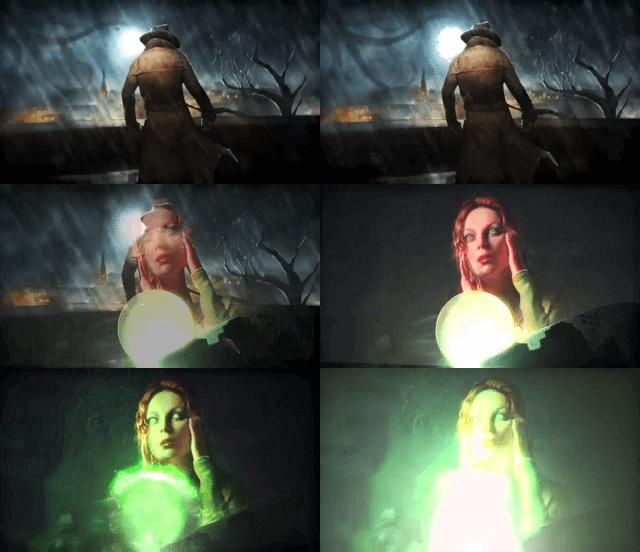
Swirling water-borne sandstorms engulfed her, but not before she saw something gigantic and monstrous moving in the shadow of the great archway. Too vast to be anything living, too hideous to be anything of this earth, it moved with great lumbering steps, gelatinous and fashioned from matter beyond human conception.
And finally Amanda screamed.

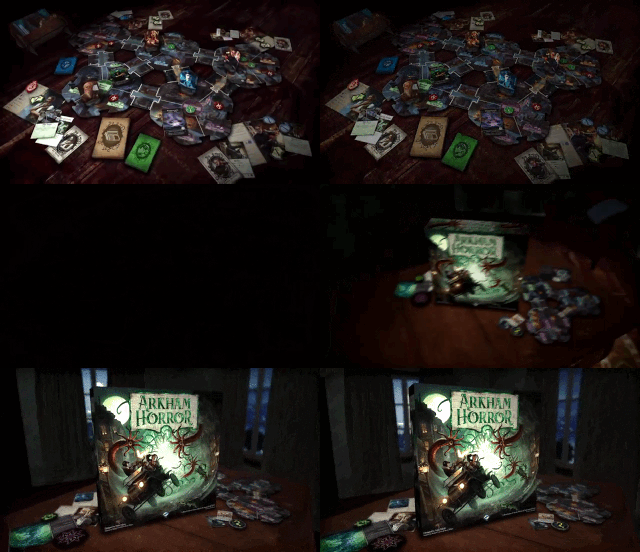
Arkham Horror is a cooperative board game, originally published in 1987, based on Chaosium's roleplaying game Call of Cthulhu, which is set in the Cthulhu Mythos of H.P. Lovecraft and other horror writers, where players take on the role of investigators and work together to stop the spread of doom across the fictional Massachusetts town of Arkham in 1926, hoping to stop the rise of an ancient evil who will destroy the city and then the world.
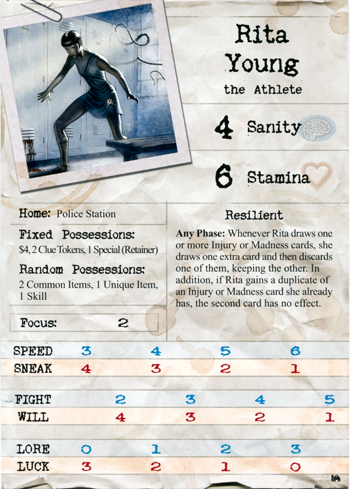
The cloth was torn, as if it had been cut up with long pinking scissors, and Rita saw it was wet with a sticky liquid. Pink and red lumps laced with wriggling insects protruded from the arms and bottom of the dress.
A moment later Rita saw the bloody remains of the girl wrapped in the dress.
And this time it was her turn to scream.
I've read H.P. Lovecraft for the first time when I was a kid, too young and naive to undertand the despicable racism filling his scripts, but totally loving and enjoying the works and style of the father of modern horror, the man who inspired movies, music, games and notable authors including Alan Moore, Clive Barker, Neil Gaiman, Robert E. Howard and Stephen King, or artists like H.R. Giger to name just a few.
"Heck, I dont blame you, sir. I ain't never seen nothing like this, neither," said Muldoon, his face as blanched of color as the dead girl's. "The instructors at the Police Academy told us we
might see some hinky stuff, but this...this is just about as nasty as l could imagine."
"Trust me," said Vincent. "This is Arkham. You'll see nastier and stranger before long."

Having said that, I played with friends both the 1987 and 2005 editions of the Arkham Horror board game from Chaosium and Fantasy Flight Games for years, having many hours of entertainment and fun.
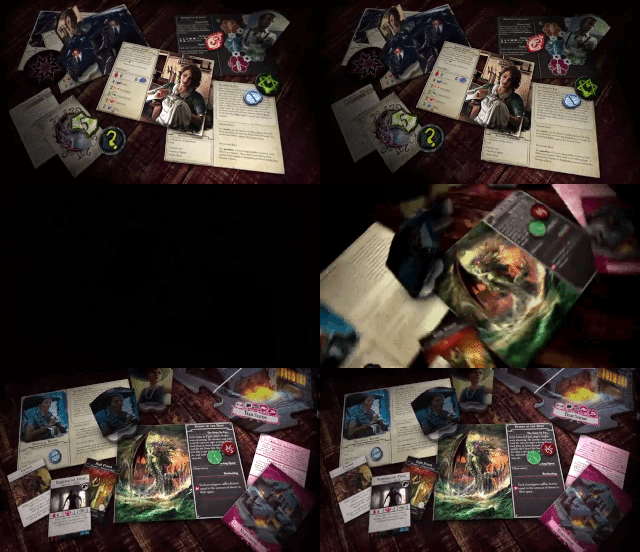
"Yeah," said Gabriel. "I work for the Pinkertons, but I'm here for myself. My little girl got killed, and I'm here to find out who did it and see he gets what's coming to him."
"What does that mean?" asked Minnie, pushing her unfinished lunch away.
"It means whatever I want it to mean," said Stone. "Now are you going to help me or not?"
"Sure, Gabe," said Rex, flipping the pages of his notebook.
"It's Gabriel."

Sadly I sold my old copy of the original game, but second edition with all of its expansions is packed in the attic waiting for my daughter being old enough to play it with her dad sooner or later... unless we buy first the 2018 third edition or future ones.

"I found out he's done this a bunch of times before, and if we don't find him, then a whole lot more girls are gonna die. Someone gets a taste for this shit, he's not gonna stop."
"Yeah, your daughter was the sixth girl in three years," said Rex.
"Sixth?" said Stone, shaking his head. "Try twenty-fourth."
Rex and Minnie looked at one another, unsure whether or not to entertain such an absurdly high figure.

But I'm just rambling, so let's talk about this book before boring you to death, o gentle reader of this review.

The book Alexander had given him sat in his briefcase like a guilty secret, its contents fabulous and hideous in equal measure.
Oliver had read the book cover to cover, and had lost several nights sleep over its profane revelations. What sleep he had managed was
fitful and filled with amorphous nightmares of guttural chants, slimy-skinned savages, and bloody altars draining into the sea.

This take on Cthulhu Mythos from mr. Graham McNeill was a very interesting one for me, having already read and appreciated many of his sci-fi/fantasy novels for Black Library in the past, main storyline was a page-turning thrilling one, and author made a real good job putting on paper Arkham and its locations, lots of characters from the game, every sort of lovecraftian references and vibes, and that sense of impending doom hanging over the group of main characters, a band of investigators struggling against crazy cultists, cannibal creatures and much more, risking their lives and mental health while clock is ticking and a certain Great Old One is going to awaken and devour the world.

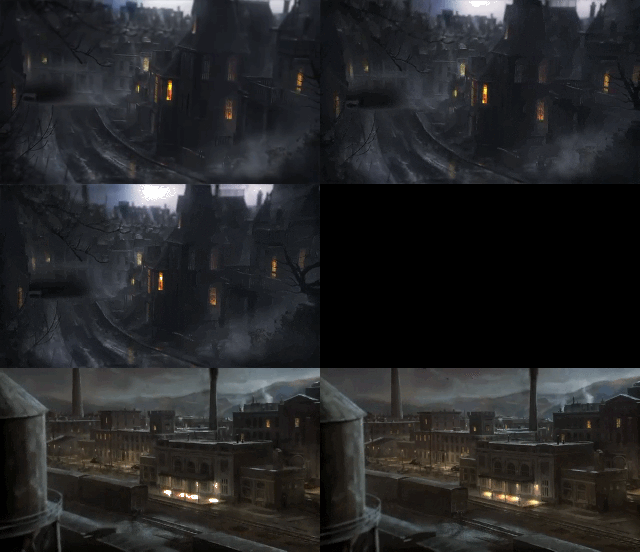
Darkness closed in on Arkham, and though people told themselves that this night was no different than any other, they knew, via forgotten and atrophied senses, that it was not. It began in
mid-evening, when a wave of nausea spread through the town, surging outward from the grounds of the university to encompass the entire town and locales as far away as Dunwich to the west and Innsmouth to the east.
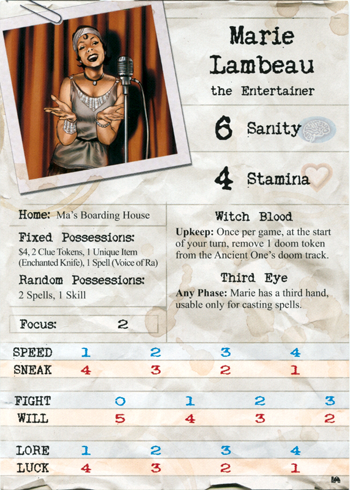
There are a few minor historical mistakes like a main female character having her laboratory at Miskatonic University in 20s male dominant society, or the book being set in September of 1926 and Oliver Grayson having seen in a theatre The Great Gatsby movie, but while there was already a theatrical adaption since February of that year, the silent film was released for the first time only on November 2.

In the normal run of things, Oliver would never expect to deal with a Pinkerton agent and two reporters, but there was an energy to this gathering he could see reflected on every face around the table.
This was right. This was the beginning of something.
It wasn't much to oppose the dreadful forces at work in Arkham.
But it was a start.

Besides that, this novel is still a well made pulp and weird fictional adaption from a table-top game based on a RPG who in turn is based on H. P. Lovecraft's tales and other authors' Cthulhu Mythos writings, so I'm just nitpicking here.
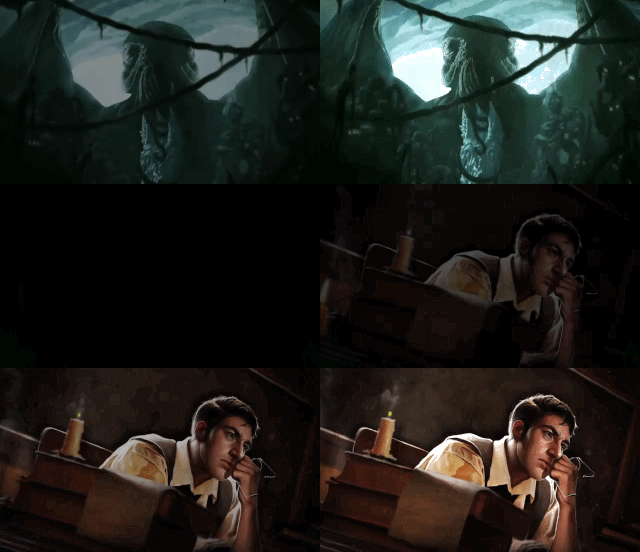
"You two are the professors, and here's me the clever one. Who'd a thought it?"
With that, Finn shook off their supporting arms and lurched like a drunk at closing time toward the edge of the tower as another bolt of lightning flashed. A broken field of fallen tombstones and weeping angels worked in granite appeared within the clouds.
"Only one way home!" shouted Finn. "A leap of faith!"
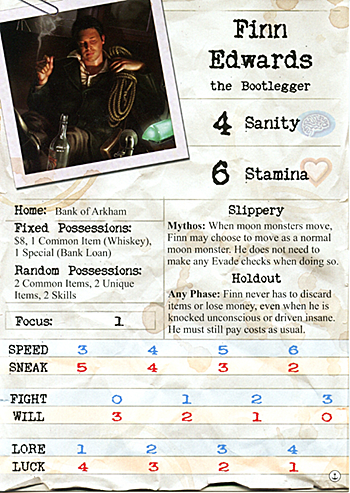
I can't recommend it to everyone, but I had lots of fun and fond memories while reading this book, and if you ever played Arkham Horror or Call of Cthulhu this is just a real must read.

Three stars and an half rounded up to four.

April 6, 2012
The most frustrating books are those you read and don’t like but can’t figure out exactly why. Ghouls of the Miskatonic by Graham McNeil is one of those books. There’s every reason it should be right down my alley. It’s unapologetically Lovecraftian, set in the mid-1920s in Arkham, Massachusetts at Miskatonic University. There are lots of ghouls, ancient gods, and cultists creeping around. And I love the cover (In all honesty, that’s why I bought the book. Happens a lot.) But while all the elements were there, somehow the magic was missing.
Ghouls of the Miskatonic tells the story of a whole host of characters. There’s Amanda and Rita, students at Miskatonic University. Oliver Grayson and Alexander (I forget his last name because he only shows up when certain plot points need to be revealed) are professors at Miskatonic whose mutual friend, Professor Henry Cartright, is in an insane asylum. Rex and Minnie work for the Newspaper, and Gabrial Stone is a hard-bitten Pinkerton detective whose daughter has been murdered. Finally there’s Charles Warren, an apparent bad guy, and Finn Edwards, a man with a criminal past and a heart of gold. Apparently these characters are originally from the role playing game, Call of Cthulhu. The plot involves efforts to resurrect that greatest of Great Old Ones, Cthulhu, from the depths of the South Pacific. There are some kidnappings, strange technological devices, and an appearance by a Great Old One who has an affinity for fire.
So what’s the problem? I’ll start with the general and work my way down to specifics. Something about the writing doesn’t pop. I’m not sure what it is, and I don’t know how I would fix it. The book is technically proficient, but somehow, the heart is missing. It reminds me (and this is probably a weird allusion) of that scene in Black Swan when Padme is auditioning for the title role. Her dancing is perfect, but it lacks the fire, the passion that is necessary for the part. I felt the same way about this book. The fire is missing.
But it’s more than that. There are some more specific problems as well. The book has a few parts that are woefully anachronistic. First, the presence of women at Miskatonic University. I’m as forward thinking as the next guy, but facts are facts, and there is no way that an Ivy League university (which Miskatonic more or less is) would admit women in the 1920s. Wouldn’t happen. Sorry. Harvard University did not become co-educational until 1973(!). Yale was way ahead of its time, admitting female undergraduates all the way back in 1969. And yet, not only does Miskatonic admit women, but one of them, Kate Winthrop, has her own laboratory. But it gets better. One of our main characters, Rita, is an African American student from New Orleans . . . who is on the track team. Oh yeah, the white captain of the football team asks her out on a date. And I repeat, this is the 1920s. That’s the sort of thing that pulls you right out of the narrative.
It wouldn’t have been hard to fix the problem. Just mention that Miskatonic, being a strange place, was EXTREMELY ahead of its time on race and gender relations. Shoot, it might even serve to make the place seem all the more unusual than it already is. Just give me something so that every time Rita is mentioned I’m not questioning the fact that schools didn’t have women’s sports until Title IX. (And at one point the author mentions “the girls at Princeton.” Once again, 1969.)
But there’s more. People say funny things that they shouldn’t be saying. One cop says to one of the doctors, “You might have come up from Boston with your fancy Yale degree, but this is my town.” Now, maybe the guy was in Boston and happened to go to Yale, but it seems more like the author wants us to chuckle at the cop’s stupidity. Harvard is in Boston (or just across the river at least), and here this silly cop thinks Yale is there. But no New Englander, much less someone from Massachusetts, would make such a mistake. So it just comes off as wrong. Later, the book mentions a “faded photograph from 1917.” Now, I know photographic technology has improved, but were things so bad back then that pictures faded in less than a decade?
Then there are the plot points that are never answered (spoilers ahead!). Why are all the young girls disappearing? Who exactly is Charles Warren? Why was Stone’s daughter killed? Surely it’s not just to feed beasts. Were there not less conspicuous people to kill? Drifters, hobos. Who is the man in red? Why are all the apparently bad guys killed by the fire demon at the end, and why would the man in red, whoever he is, do that? What was the purpose of the sphere? Where is it going? Now, I understand this is the first book in a trilogy, but leaving so many questions—many of them basic—unanswered is extremely dissatisfying. A book in a trilogy should work as one book. (Imagine if Hunger Games ended right before the games started). I fear this book does not.
Unfortunately I cannot recommend Ghouls of the Miskatonic to anyone other than the most devoted fan of Lovecraft or the gaming series on which it was based. There is much that is good about the book, but it simply feel incomplete. A shame, too. The cover is awesome.
Ghouls of the Miskatonic tells the story of a whole host of characters. There’s Amanda and Rita, students at Miskatonic University. Oliver Grayson and Alexander (I forget his last name because he only shows up when certain plot points need to be revealed) are professors at Miskatonic whose mutual friend, Professor Henry Cartright, is in an insane asylum. Rex and Minnie work for the Newspaper, and Gabrial Stone is a hard-bitten Pinkerton detective whose daughter has been murdered. Finally there’s Charles Warren, an apparent bad guy, and Finn Edwards, a man with a criminal past and a heart of gold. Apparently these characters are originally from the role playing game, Call of Cthulhu. The plot involves efforts to resurrect that greatest of Great Old Ones, Cthulhu, from the depths of the South Pacific. There are some kidnappings, strange technological devices, and an appearance by a Great Old One who has an affinity for fire.
So what’s the problem? I’ll start with the general and work my way down to specifics. Something about the writing doesn’t pop. I’m not sure what it is, and I don’t know how I would fix it. The book is technically proficient, but somehow, the heart is missing. It reminds me (and this is probably a weird allusion) of that scene in Black Swan when Padme is auditioning for the title role. Her dancing is perfect, but it lacks the fire, the passion that is necessary for the part. I felt the same way about this book. The fire is missing.
But it’s more than that. There are some more specific problems as well. The book has a few parts that are woefully anachronistic. First, the presence of women at Miskatonic University. I’m as forward thinking as the next guy, but facts are facts, and there is no way that an Ivy League university (which Miskatonic more or less is) would admit women in the 1920s. Wouldn’t happen. Sorry. Harvard University did not become co-educational until 1973(!). Yale was way ahead of its time, admitting female undergraduates all the way back in 1969. And yet, not only does Miskatonic admit women, but one of them, Kate Winthrop, has her own laboratory. But it gets better. One of our main characters, Rita, is an African American student from New Orleans . . . who is on the track team. Oh yeah, the white captain of the football team asks her out on a date. And I repeat, this is the 1920s. That’s the sort of thing that pulls you right out of the narrative.
It wouldn’t have been hard to fix the problem. Just mention that Miskatonic, being a strange place, was EXTREMELY ahead of its time on race and gender relations. Shoot, it might even serve to make the place seem all the more unusual than it already is. Just give me something so that every time Rita is mentioned I’m not questioning the fact that schools didn’t have women’s sports until Title IX. (And at one point the author mentions “the girls at Princeton.” Once again, 1969.)
But there’s more. People say funny things that they shouldn’t be saying. One cop says to one of the doctors, “You might have come up from Boston with your fancy Yale degree, but this is my town.” Now, maybe the guy was in Boston and happened to go to Yale, but it seems more like the author wants us to chuckle at the cop’s stupidity. Harvard is in Boston (or just across the river at least), and here this silly cop thinks Yale is there. But no New Englander, much less someone from Massachusetts, would make such a mistake. So it just comes off as wrong. Later, the book mentions a “faded photograph from 1917.” Now, I know photographic technology has improved, but were things so bad back then that pictures faded in less than a decade?
Then there are the plot points that are never answered (spoilers ahead!). Why are all the young girls disappearing? Who exactly is Charles Warren? Why was Stone’s daughter killed? Surely it’s not just to feed beasts. Were there not less conspicuous people to kill? Drifters, hobos. Who is the man in red? Why are all the apparently bad guys killed by the fire demon at the end, and why would the man in red, whoever he is, do that? What was the purpose of the sphere? Where is it going? Now, I understand this is the first book in a trilogy, but leaving so many questions—many of them basic—unanswered is extremely dissatisfying. A book in a trilogy should work as one book. (Imagine if Hunger Games ended right before the games started). I fear this book does not.
Unfortunately I cannot recommend Ghouls of the Miskatonic to anyone other than the most devoted fan of Lovecraft or the gaming series on which it was based. There is much that is good about the book, but it simply feel incomplete. A shame, too. The cover is awesome.

October 6, 2011
Ghouls of the Miskatonic is two novellas and a guidebook in one book. The first novella is about some missing girls, some bootlegging operations, and jazz clubs. It has Irish dock workers, Pinkerton agents, Irish bootleggers, rundown boarding houses, and wise-cracking newsagents with cute photographers. The second one is a massive amalgamation pastiche of many, many Lovecraftian and Lovecraft-esque ideas, with changes made to make things a bit more "peppy" (screw ghouls that only eat on the dead and carry on conversations in the Dreamlands, we need something that snarls and hunts and attacks). This second novella has college professors, scientists with flux stabilizers, hidden (in plain sight) cults, and references to as many and all of Lovecraft's short stories as possible. The cutest aspect of this is that the "At the Mountains of Madness" expedition seems to have been slated for the mid-20s but due to events that happen in this novel, get pushed back to the late-20's, early 30's. The final part, the guidebook, has placenames and people names from various Arkham Horror (the board game) with varying degrees of background information stapled in here or there as needed. Mush all three of those together with the two novellas being tied together towards their middle, and you have a good idea of what to expect.
In defense of Ghouls, you must understand that this is a book, the first in a trilogy, which is meant to explore the people and place names and game play style of a board game, Arkham Horror, which is based mostly on a role-playing game, Call of Cthulhu, which is based on the writings of H.P. Lovecraft and the various homages and pastiches and rip-offs of his writings up through the 1980s and beyond. And, the trilogy it starts, The Dark Waters Trilogy, is one of two trilogies planned to be set in the Arkham Horror universe, and as such can neither stray too far from any source material. Instead it is bound to include more of it than might be healthy, since the setting [Arkham + Miskatonic] and the time period [1920s] are a particularly crazy time for the Mythos universe with much of the reference and research being handled by faculty at Miskatonic University. There is so much going on there and then that any story set in such must spend a good chunk of its effort just avoiding toe stepping.
It makes a fair read. In the year 1926, a string of missing girls—missing after adopting a lifestyle of visiting speakeasies and listening to jazz—is being covered up by the Arkham police, who just want a bit of quiet and normalcy. Some might be runaways, but others are showing up dead. One particular corpse, found near the athletic field of MU, brings a reporter and photographer—Rex and Minnie—unto the scene. Here they meet Gabriel Stone, a Pinkerton agent acting above and beyond his duty on the matter, and start tracking down clues. Several of their clues lead to Oliver Grayson, a professor at MU who has spent years with a tribe on the South Pacific seas only to have the whole tribe disappear before he could publish his findings. His friend, Henry Cartwright, has recently be put into Arkham Asylum as an insane arsonist and some of his other dealings make them suspicious. All the while, Grayson is learning more and more about the underworkings of cults and other eldritch things, partially to help a student, Amanda Sharpe, overcome bad dreams. Once Amanda and her roommate, Rita Young, go missing, the whole thing takes on a more sinister bent. While these things are brewing, Finn Edwards, an Irish bootlegger, is involved in a whiskey exchange gone bad as otherworldly beings intervene. He escapes, the only person at the exchange to do so, and brings with him a strange silver orb that seems to warp reality. And, during all these storyline elements, some unknown group is using ghouls for an unknown purpose, and seem to be readying a deep-sea expedition that needs a certain silver orb, and some further information, in order to get underway.
Much like John Jacob Horner's recent Southern Gods, in the battle between subtle, Lovecraftian vibes and more blunt edged noir/mystery ones, the subtle vibes go out the window and creatures that were designed intelligently and are mostly malevolent through being inhuman are recast as near mindless, tortured killing things. This could be forgiven if McNeill did not spend so much time effectively copy-pasting descriptions and concepts from source materials, giving the whole thing a patchwork quilt vibe with some patches being a overly bright and notably garish for the mix (as a note: the over-the-top Mythos bits were meant to be the bright spots in the slow beat of the original materials, when these bits are now presented as the low-hum of background, it makes you wonder how Armitage simply hasn't blown his own brains out already). This is a board game's book, though, and had that been dialed down, it might have made for a more compelling read but would have felt out of sync with the tertiary source it pulls from.
So, even that could be forgiven if McNeill did not so often re-use sections of the novel itself, occasionally with glitches/alterations. We get Rex wondering why Minnie had not found a man at least two or three times. We get "despite being noon, the light started to dim" two or three times. We get two or three times of Finn being infested with the spirit Cúchulain. Then, like I said, we get glitches. Earlier, when a fellow professor is asked about Grayson's ex-mentor, Morley Dean, the response is "Dean protected you [from eldritch things]". Later, when the same professor is asked about Dean, he responds that he only knows him by reputation. When Stone is first talking about Arkham police, he describes them as incompetent and implies they are looking the other way. Later he describes them as being mostly alright, just maybe not up to [the events of the novel].
Final verdict, I thought it was "ok" but could use a rewrite. Will give the second book in this trilogy a spin, not sure if this book has sold me on the concept of multiple trilogies set in this same universe, though.
In defense of Ghouls, you must understand that this is a book, the first in a trilogy, which is meant to explore the people and place names and game play style of a board game, Arkham Horror, which is based mostly on a role-playing game, Call of Cthulhu, which is based on the writings of H.P. Lovecraft and the various homages and pastiches and rip-offs of his writings up through the 1980s and beyond. And, the trilogy it starts, The Dark Waters Trilogy, is one of two trilogies planned to be set in the Arkham Horror universe, and as such can neither stray too far from any source material. Instead it is bound to include more of it than might be healthy, since the setting [Arkham + Miskatonic] and the time period [1920s] are a particularly crazy time for the Mythos universe with much of the reference and research being handled by faculty at Miskatonic University. There is so much going on there and then that any story set in such must spend a good chunk of its effort just avoiding toe stepping.
It makes a fair read. In the year 1926, a string of missing girls—missing after adopting a lifestyle of visiting speakeasies and listening to jazz—is being covered up by the Arkham police, who just want a bit of quiet and normalcy. Some might be runaways, but others are showing up dead. One particular corpse, found near the athletic field of MU, brings a reporter and photographer—Rex and Minnie—unto the scene. Here they meet Gabriel Stone, a Pinkerton agent acting above and beyond his duty on the matter, and start tracking down clues. Several of their clues lead to Oliver Grayson, a professor at MU who has spent years with a tribe on the South Pacific seas only to have the whole tribe disappear before he could publish his findings. His friend, Henry Cartwright, has recently be put into Arkham Asylum as an insane arsonist and some of his other dealings make them suspicious. All the while, Grayson is learning more and more about the underworkings of cults and other eldritch things, partially to help a student, Amanda Sharpe, overcome bad dreams. Once Amanda and her roommate, Rita Young, go missing, the whole thing takes on a more sinister bent. While these things are brewing, Finn Edwards, an Irish bootlegger, is involved in a whiskey exchange gone bad as otherworldly beings intervene. He escapes, the only person at the exchange to do so, and brings with him a strange silver orb that seems to warp reality. And, during all these storyline elements, some unknown group is using ghouls for an unknown purpose, and seem to be readying a deep-sea expedition that needs a certain silver orb, and some further information, in order to get underway.
Much like John Jacob Horner's recent Southern Gods, in the battle between subtle, Lovecraftian vibes and more blunt edged noir/mystery ones, the subtle vibes go out the window and creatures that were designed intelligently and are mostly malevolent through being inhuman are recast as near mindless, tortured killing things. This could be forgiven if McNeill did not spend so much time effectively copy-pasting descriptions and concepts from source materials, giving the whole thing a patchwork quilt vibe with some patches being a overly bright and notably garish for the mix (as a note: the over-the-top Mythos bits were meant to be the bright spots in the slow beat of the original materials, when these bits are now presented as the low-hum of background, it makes you wonder how Armitage simply hasn't blown his own brains out already). This is a board game's book, though, and had that been dialed down, it might have made for a more compelling read but would have felt out of sync with the tertiary source it pulls from.
So, even that could be forgiven if McNeill did not so often re-use sections of the novel itself, occasionally with glitches/alterations. We get Rex wondering why Minnie had not found a man at least two or three times. We get "despite being noon, the light started to dim" two or three times. We get two or three times of Finn being infested with the spirit Cúchulain. Then, like I said, we get glitches. Earlier, when a fellow professor is asked about Grayson's ex-mentor, Morley Dean, the response is "Dean protected you [from eldritch things]". Later, when the same professor is asked about Dean, he responds that he only knows him by reputation. When Stone is first talking about Arkham police, he describes them as incompetent and implies they are looking the other way. Later he describes them as being mostly alright, just maybe not up to [the events of the novel].
Final verdict, I thought it was "ok" but could use a rewrite. Will give the second book in this trilogy a spin, not sure if this book has sold me on the concept of multiple trilogies set in this same universe, though.

May 7, 2012
I did not think that this was a bad attempt of trying to re-create something similar to Lovecraftian style horror. Sure its not a replacement for the real thing but I thought the author did a decent attempt to set the stage and create a enjoyable storyline. I am also a fan of the FFG Arkham Horror boardgame and it was neat to see some of the various characters in the game used in the book.

April 8, 2016
No matter what you think of his works, McNeill is one of those authors who will always stick to his guns. He’ll certainly experiment, reinvent and reconsider certain ideas, but for the most part the man will stick to certain character archetypes over others, and the same factions. As such, even counting his work in Starcraft, it’s more than a little surprising to see his name attached to a Call of Cthulhu trilogy.
The story here focuses upon an increasingly cryptic string of murders throughout Arkham, Massachusetts. Even among the increasingly macabre and horrifying turns of the late 1920s, the discovery of a badly mauled student on grounds of Miskatonic University leaves the authorities horrified and baffled. Only one thing is clear – Whatever inflicted the wounds on her body was not human.
Lacking the more overt explosions, massed armies and gods found in the Warhammer universes, this is about as far from M41 and the Old World as you can get. The horror is hidden behind everyday life and old values, and the closest you really come to Chaos is the presence of secret societies associating themselves with alien beings of unimaginable power. Naturally, this is the aspect McNeill focuses on the most, but what needs to be commented upon is how well he paces himself. Rather than turning Arkham into a freak-show war zone which would make Yharnam look tame by comparison, the actual horror is subdued at first. It’s kept to brief flashes, moments of violence and half-hidden suggestions of ancient forces which run throughout much of the book.
While the opening passages grip the reader’s attention with an extremely vivid and truly horrifying vision of Cthulhu’s impending resurgence, many of the following chapters largely stick to everyday life. It builds up enough of an image that life is relatively normal here still and that, even with the high strung roaring twenties going on, normality is still largely dominant. It’s only just starting to wane at long last, and the real horrors are starting to truly creep in, with mentions thrown about here and there of bizarre scientific discoveries and unnatural events in the night. While it certainly drags out chapters, the way in which it builds up the world and its atmosphere before it’s gradually stripped away, nailing the feeling of impending dread Lovecraft so valued.
The characters themselves fit together in a manner akin to an RPG group, with each fitting into a specific class. You have the Pinkerton agent, the journalists, the professor, the students and the criminal among others, which can certainly be hit an miss. On the one hand it means that, if you have any basic preconceptions about their personality and role you’re going to largely be right, leading to some unfortunately predictable moments. On the other however, this helps to create the trappings of a more traditional horror story while still leaving it open enough to emphasise the surprise of something truly otherworldly. When you hear about a group of bootleggers working in an abandoned facility, spewing off more than a few cliches, you know they’re dead meat. However, it’s just traditional enough to excuse some of the more tired stereotypes, and well worth enduring once they bump into the abominations which are the titular ghouls.
This is definitely a book aiming to be a very accessible version of Lovecraft’s works, and on that front it does succeed. While it lacks the purple prose of the original writer himself, few have been able to truly mimic his style and prior attempts have been mixed indeed, as Hive proved. Instead Ghouls of the Miskatonic makes for a much more general read on the whole, sticking largely to the standard prose and style you would expect and only breaking out the overt descriptions in brief moments. While this can certainly be seen as a strength by some, it’s unfortunately one of the book’s greatest flaws. Yes, its more modern take on a prose style and character types is certainly easier to read and can still be fun, but those drawn in with promises of deep, dark descriptions will be sadly disappointed. McNeill attempts to make up for this with a variety of shout-outs to bigger stories, but this honestly reads more like desperate pandering than truly working the story into the universe. Yes, it offers shout outs to new readers hinting at the bigger stories, but it can just leave you wanting to read those bigger tales.
As much of the book is a massive build-up to impending doom there naturally needed to be some definite payoff, though this came with an unfortunate side effect. At a certain point, the novel stops being a slow burning murder mystery with occult elements and rapidly starts turning into a full blown war. Okay, no one starts summoning legions of Star Spawn and we don’t see someone pulling a full Old Man Henderson, but the action and violence definitely goes up notch after notch. This might have even worked were it not for the fact the story abruptly shifts gears and seems to become another tale entirely. It’s not like McNeill hasn’t pulled off stories of this like before with smoother transitions, the Ambassador duology alone proves that, and the failure here is just perplexing.
When all is said and done, this is one which can be marked down as just okay. Nothing special to be sure and lacking in a few areas, but it retains a few interesting ideas which will keep you going to the last page. A lot of it is definitely step-up and with so much groundwork laid down for later books, it should probably be best regarded as the first part of a greater tale. Give it a look if you’re after a more modern take on Lovecraft literature with a nice, classic feel, but don’t expect another At the Mountains of Madness.
The story here focuses upon an increasingly cryptic string of murders throughout Arkham, Massachusetts. Even among the increasingly macabre and horrifying turns of the late 1920s, the discovery of a badly mauled student on grounds of Miskatonic University leaves the authorities horrified and baffled. Only one thing is clear – Whatever inflicted the wounds on her body was not human.
Lacking the more overt explosions, massed armies and gods found in the Warhammer universes, this is about as far from M41 and the Old World as you can get. The horror is hidden behind everyday life and old values, and the closest you really come to Chaos is the presence of secret societies associating themselves with alien beings of unimaginable power. Naturally, this is the aspect McNeill focuses on the most, but what needs to be commented upon is how well he paces himself. Rather than turning Arkham into a freak-show war zone which would make Yharnam look tame by comparison, the actual horror is subdued at first. It’s kept to brief flashes, moments of violence and half-hidden suggestions of ancient forces which run throughout much of the book.
While the opening passages grip the reader’s attention with an extremely vivid and truly horrifying vision of Cthulhu’s impending resurgence, many of the following chapters largely stick to everyday life. It builds up enough of an image that life is relatively normal here still and that, even with the high strung roaring twenties going on, normality is still largely dominant. It’s only just starting to wane at long last, and the real horrors are starting to truly creep in, with mentions thrown about here and there of bizarre scientific discoveries and unnatural events in the night. While it certainly drags out chapters, the way in which it builds up the world and its atmosphere before it’s gradually stripped away, nailing the feeling of impending dread Lovecraft so valued.
The characters themselves fit together in a manner akin to an RPG group, with each fitting into a specific class. You have the Pinkerton agent, the journalists, the professor, the students and the criminal among others, which can certainly be hit an miss. On the one hand it means that, if you have any basic preconceptions about their personality and role you’re going to largely be right, leading to some unfortunately predictable moments. On the other however, this helps to create the trappings of a more traditional horror story while still leaving it open enough to emphasise the surprise of something truly otherworldly. When you hear about a group of bootleggers working in an abandoned facility, spewing off more than a few cliches, you know they’re dead meat. However, it’s just traditional enough to excuse some of the more tired stereotypes, and well worth enduring once they bump into the abominations which are the titular ghouls.
This is definitely a book aiming to be a very accessible version of Lovecraft’s works, and on that front it does succeed. While it lacks the purple prose of the original writer himself, few have been able to truly mimic his style and prior attempts have been mixed indeed, as Hive proved. Instead Ghouls of the Miskatonic makes for a much more general read on the whole, sticking largely to the standard prose and style you would expect and only breaking out the overt descriptions in brief moments. While this can certainly be seen as a strength by some, it’s unfortunately one of the book’s greatest flaws. Yes, its more modern take on a prose style and character types is certainly easier to read and can still be fun, but those drawn in with promises of deep, dark descriptions will be sadly disappointed. McNeill attempts to make up for this with a variety of shout-outs to bigger stories, but this honestly reads more like desperate pandering than truly working the story into the universe. Yes, it offers shout outs to new readers hinting at the bigger stories, but it can just leave you wanting to read those bigger tales.
As much of the book is a massive build-up to impending doom there naturally needed to be some definite payoff, though this came with an unfortunate side effect. At a certain point, the novel stops being a slow burning murder mystery with occult elements and rapidly starts turning into a full blown war. Okay, no one starts summoning legions of Star Spawn and we don’t see someone pulling a full Old Man Henderson, but the action and violence definitely goes up notch after notch. This might have even worked were it not for the fact the story abruptly shifts gears and seems to become another tale entirely. It’s not like McNeill hasn’t pulled off stories of this like before with smoother transitions, the Ambassador duology alone proves that, and the failure here is just perplexing.
When all is said and done, this is one which can be marked down as just okay. Nothing special to be sure and lacking in a few areas, but it retains a few interesting ideas which will keep you going to the last page. A lot of it is definitely step-up and with so much groundwork laid down for later books, it should probably be best regarded as the first part of a greater tale. Give it a look if you’re after a more modern take on Lovecraft literature with a nice, classic feel, but don’t expect another At the Mountains of Madness.
August 25, 2020
I have to admit that I can understand the off putting origins of this book, and in fact, the entire series released in this universe. This is, in effect, a story based on the series of board games released through Fantasy Flight Games (FFG) which were based on the works of H. P. Lovecraft. A derivative of a derivative if you will. And knowing this going in can leave you with a jaded view of the premise alone.
And I will admit that I felt this way.
However, once you can put this behind you, you will find some solid writing offered up by the author, exploring a universe that was once only as wide as the confines of the board game mechanics. Reading this homage to the Pulp Horror/Mystery genre I was very much transported to the squalid streets of Arkham and thoroughly enjoyed being able to revisit Lovecraftian tropes and terrors.
Is this a perfect book? No. It suffers at times from a lack of pace, from somewhat predictable plot devices and you can argue that a few too many characters from the universe have been thrown in, leaving them underdeveloped and with as much likability as a blister. But it is a good story, set in an established but fascinating setting and does exactly what it sets out to do. Reacquaint and fascinate you with Cthulhu Mythos.
And I will admit that I felt this way.
However, once you can put this behind you, you will find some solid writing offered up by the author, exploring a universe that was once only as wide as the confines of the board game mechanics. Reading this homage to the Pulp Horror/Mystery genre I was very much transported to the squalid streets of Arkham and thoroughly enjoyed being able to revisit Lovecraftian tropes and terrors.
Is this a perfect book? No. It suffers at times from a lack of pace, from somewhat predictable plot devices and you can argue that a few too many characters from the universe have been thrown in, leaving them underdeveloped and with as much likability as a blister. But it is a good story, set in an established but fascinating setting and does exactly what it sets out to do. Reacquaint and fascinate you with Cthulhu Mythos.

May 17, 2020
I seemingly liked this book more than some. While not perfect I thought this was a really Pulp Cthulhu style offering (like all of Arkham Horror Files fiction and board games are). The name drops don't feel out of place, the threats don't feel neutered, and it was cool reading about the characters I've been playing in Fantasy Flight's Arkham Horror games for the last 15 years almost. Your mileage may vary but I thought it was fun. The biggest gripe I had was that it clearly isn't a complete story but certainly feels like a larger Act 1 overall. Not the biggest deal but still you're only going to get a minor resolution from this book.
I would give this 3 1/2 stars if possible but 4 is fine.
I would give this 3 1/2 stars if possible but 4 is fine.

September 21, 2011
Even after reading this book, it is hard to know how much I enjoyed it. It comes down to a split for me on it. From a plot stand point, it was very interesting. Seeing how the different characters introduced are weaved towards the ending. Also, how I imagined things were going to happening, changed on me.
The problem I had with the story is trying to place the setting and characters. It was suppose to take place in 1928, yet the way the author was describing some characters it felt like modern day. The other part is the character felt like stereotypes.
Overall, it was enjoyable to read, but had some negatives that caused problems with the start of the story.
The problem I had with the story is trying to place the setting and characters. It was suppose to take place in 1928, yet the way the author was describing some characters it felt like modern day. The other part is the character felt like stereotypes.
Overall, it was enjoyable to read, but had some negatives that caused problems with the start of the story.

September 16, 2020
After finishing up the Aliens books (and good riddance), I remembered I had some Arkham Horror novels that I bought from Fantasy Flight Games during one of their Christmas sales, and I figured I'd keep that licensed-novel-series project going with these. Ghouls of the Miskatonic was the first of those, and also the first of a trilogy within the world of the game.
I'll admit I'm not well versed in the minutiae of the Cthulhu mythos, nor am I familiar enough with the board game to recognize character names, but I recognized enough to know I was in familiar territory. McNeill weaves together a serviceable story, but it's not enough to make it overly memorable. His prose suffers from being dry and tell-y (boy, I've been saying that a lot lately), and while his dialogue is a bit laughable in places, I can overlook that to some extent because I think he's trying to capture the language of the 1920s. The thing is, is comes across as cliched, and it doesn't do much to make his characters feel lifelike.
Still, once the story started to reach its end, I found myself caught up enough to want to finish it. The rest of the book didn't feel that way, but somewhere along the way I had invested enough into the characters to see what happened to them. I hope that carries on through the rest of the series.
I'll admit I'm not well versed in the minutiae of the Cthulhu mythos, nor am I familiar enough with the board game to recognize character names, but I recognized enough to know I was in familiar territory. McNeill weaves together a serviceable story, but it's not enough to make it overly memorable. His prose suffers from being dry and tell-y (boy, I've been saying that a lot lately), and while his dialogue is a bit laughable in places, I can overlook that to some extent because I think he's trying to capture the language of the 1920s. The thing is, is comes across as cliched, and it doesn't do much to make his characters feel lifelike.
Still, once the story started to reach its end, I found myself caught up enough to want to finish it. The rest of the book didn't feel that way, but somewhere along the way I had invested enough into the characters to see what happened to them. I hope that carries on through the rest of the series.

October 26, 2017
I got about half way through this, but I kept drifting off, I just couldn't work up much enthusiasm for it and had to force myself to pick it up. After a bit I decided not to force myself to pick it up again. Life's too short and I have a "to read" pile that is huge!
Also, where were the ghouls? I was promised ghouls.
Also, where were the ghouls? I was promised ghouls.

November 14, 2024
This one took a bit to get going, but once the plot kicked in I had a great time. Some truly spooky sequences that really make me excited to dive into the cosmic weirdness the rest of this series is sure to provide.
Graham McNeill tells a good cosmic tale whether it be in the 1920s or the 41st Millennium.
Graham McNeill tells a good cosmic tale whether it be in the 1920s or the 41st Millennium.

January 4, 2012
When I first saw this novel, I was pretty sure that it was going to be another role-playing game tie-in novel. I was pleasantly surprised. While the beginning is a bit slow, once we get past the introductions of all the characters the action begins to pick up. It turns out to be a well-written novel that could very well have been written without the Arkham Horror imprint. As you may well learn if you've read one or two of my reviews, I'm a fan of horror author H.P. Lovecraft. Of course that's a bit like saying that Cookie Monster from Sesame Street appreciates an after dinner treat. So I gave into my addiction and was rewarded for it. Dang! That's gonna make it harder to quit!
One of the things that made this novel a bit better that others of its ilk, is that McNeill isn't a "cosmic name-dropper." Many tales of Lovecraftian horror are simply litanies of various vowel challenged names of gods and monsters. One novel which shall remain nameless, and no, the title is not "Nameless" or "The Unnameable" or "The Great One Who Must Not Be Named" (speaking of which look for a short video called "Professor Peabody's Last Lecture" part of the Night Gallery TV series from the 70's). Anyway the novel I was talking about before the rambling started spends most of its time listing the names of demons, monsters and gods created by HPL and his correspondents. Now this body of mythology behind the story is what helped make HPL and the others that wrote to and with him create a rich environment for the stories that they wrote, but many modern day authors think that if you say "Cthulhu" you've just written a Lovecraftian story. McNeill rises above this, OK, so he does mention Cthulhu by name, but that's not what he uses to justify his claim of Lovecraftian horror. This novel breathes of atmosphere of suspense and fear that has nothing to do with which Lovecraftian creature or dark deity he invokes and more about what he doesn't say about them and how helpless the characters seem in the face of these extra-dimensional horrors.
McNeill also uses a large cast of characters. He is somehow able to use all of them to great effect without relegating any of them to a secondary role, although the student named Amanda does seem to get the damsel in distress card in the third act. Each of the other characters seems to get some depth to their characterizations. However, I feel like the character of Rita, who's a black female student on an athletic scholarship, from New Orleans and knows about voodoo, is a bit stereotypical. This is not the sole defining feature of her character though and she's developed from the very outset on different grounds, the touch about experience with voodoo seems a bit tacked on.
One more bit of praise for this novel. No gratuitous sex. I'm sorry, I know it's frowned upon, but I'm glad to see that there were no heaving bosoms, no passionate assignations in the velvety darkness, and know angsty inner monologues on how all-encompassing someone's love for someone else was and how it was threatening to sweep them away in a sea of doubt, fear and confessions of adoration from deep within the pit of their soul. Sorry, I'm male, and let's face it no one who is not between the ages of 12 and 17 acts that way. There was some sexual tension between the reporter character and his photographer, but while it was evident that there was interest both ways, the shutterbug didn't need him in her pants, well, skirts, this was set in the '20s after all. Plus there was the whole monstrous devolved humanoids eating young women in Arkham situation, that can put the ole relationship railroad right off the rails.
As much fun as I had with this novel, not everyone will enjoy it quite as well. Fans of HPL will probably get a kick out of it. This is not the break out novel of 2011, but it's an enjoyable addition to a specific sub genre of horror. It's not Gone With the Wendigo, but it is fun.
January 16, 2019
I had such a good time with this one.
It has all the makings of a fun pulpy Mythos adventure: ghouls, Cthulhu references, creepy Arkham, Cthugha, Mi-Go, gug, cultists…. What else could a Mythos fan want??
I wouldn’t really call it a mystery, though there are characters trying to figure out what in the fudge ripples is going on in this creepy town even though most of us readers are in the know of creepy cultists doing shady shit. It’s how all of the threads come together with a bang (literally) that’s so fun.
And can I just say that I really appreciated all of the Derleth shoutouts in here? References to Professor Laban Shrewsbury and his famous book and a big role for Cthugha. A part of me is afraid recent Mythos works are going to avoid using beings like Ithaqua or Cthugha just because they’re a Derleth creation. As well as the general paradigm of malign Great Old Ones and more benign Elder Gods; say what you will about these things not adhering to Lovecraft’s nihilism, but they’re just some great fun. (And besides I don’t think Derleth made the Elder Gods actually good but just wanting to keep the Great Old Ones down which happens to align to humanity’s best interest but that’s a conversation for another time.)
There are a number of characters here that are also characters in the Arkham Horror game and some new ones made just for this series, a big one being our main character Oliver Grayson. Full disclosure, I have not played that game but I do find it fun that these characters have a background in that game and are also given background stories in the beautiful book ]. Just a neat little extra.
I didn’t expect to have such a good time, but I did. I realize it’s been a long time since I’ve had an action packed Mythos adventure (minus the few recent Titus Crow books and I bless them for that). Most modern Lovecraftian or Mythos stories of recent years in trad publishing has been of a ‘literary’ bent trying to tackle social issues and taking itself quite seriously. And while I do appreciate my more serious Lovecraftian stories, you gotta remember that the original Lovecraft Circle did also have fun with their creations, sharing their esoteric tomes and cosmic monsters with one another. And that was something I enjoyed here: references to other authors’ creations, which I hope continues as that will keep letting the Cthulhu Mythos grow.
Wow, now I’m just rambling.
One con I will say I had with this is everyone seems to talk and behave…. Modernly? When I first began the book I almost forgot that it took place in the twenties. Social norms were very different back then, and though the book didn’t need to make things unpleasant it sometimes almost didn’t feel like a historical period piece.
Time to get back to more stories with tommy guns and tentacles.
It has all the makings of a fun pulpy Mythos adventure: ghouls, Cthulhu references, creepy Arkham, Cthugha, Mi-Go, gug, cultists…. What else could a Mythos fan want??
I wouldn’t really call it a mystery, though there are characters trying to figure out what in the fudge ripples is going on in this creepy town even though most of us readers are in the know of creepy cultists doing shady shit. It’s how all of the threads come together with a bang (literally) that’s so fun.
And can I just say that I really appreciated all of the Derleth shoutouts in here? References to Professor Laban Shrewsbury and his famous book and a big role for Cthugha. A part of me is afraid recent Mythos works are going to avoid using beings like Ithaqua or Cthugha just because they’re a Derleth creation. As well as the general paradigm of malign Great Old Ones and more benign Elder Gods; say what you will about these things not adhering to Lovecraft’s nihilism, but they’re just some great fun. (And besides I don’t think Derleth made the Elder Gods actually good but just wanting to keep the Great Old Ones down which happens to align to humanity’s best interest but that’s a conversation for another time.)
There are a number of characters here that are also characters in the Arkham Horror game and some new ones made just for this series, a big one being our main character Oliver Grayson. Full disclosure, I have not played that game but I do find it fun that these characters have a background in that game and are also given background stories in the beautiful book
]. Just a neat little extra. I didn’t expect to have such a good time, but I did. I realize it’s been a long time since I’ve had an action packed Mythos adventure (minus the few recent Titus Crow books and I bless them for that). Most modern Lovecraftian or Mythos stories of recent years in trad publishing has been of a ‘literary’ bent trying to tackle social issues and taking itself quite seriously. And while I do appreciate my more serious Lovecraftian stories, you gotta remember that the original Lovecraft Circle did also have fun with their creations, sharing their esoteric tomes and cosmic monsters with one another. And that was something I enjoyed here: references to other authors’ creations, which I hope continues as that will keep letting the Cthulhu Mythos grow.
Wow, now I’m just rambling.
One con I will say I had with this is everyone seems to talk and behave…. Modernly? When I first began the book I almost forgot that it took place in the twenties. Social norms were very different back then, and though the book didn’t need to make things unpleasant it sometimes almost didn’t feel like a historical period piece.
Time to get back to more stories with tommy guns and tentacles.
July 9, 2019
Over the years, I've tended to steer clear of media tie-in novels that are based off other entertainment platforms (aside from Star Wars novels). They tend to have a stigma surrounding them that they are just in it for a quick buck with no real effort put into the actual storytelling or characters.
In this case though, I'm a big fan of not only HP Lovecraft in general, but also of the Arkham Horror universe created by Fantasy Flight Games. I play Arkham Horror related board games such as Mansion of Madness, and am familiar with the lore and characters involved with the games. Therefore, I chose to take a chance of these books (it also helped that I got a whole bunch of them off a clearance sale at a gaming store). So here we go.
The first book in the Dark Waters trilogy, Ghouls of the Miskatonic, like most Lovecraftian goodness, takes place during the roaring 20s. Arkham has had a string of gruesome murders, and when a pair of university girls go missing, the hunt for a killer begins.
We are introduced to a bunch of Arkham Horror characters, notably Oliver Grayson, Gabriel Stone, Amanda Sharpe, Rita Young, Rex Murphy, Finn Edwards, and others. This is where my main problem with the book begins. Though I'm a fan of said characters, there are just so many of them in this story it feels kind of crowded. They were definitely all used as fan service, and I really feel it could have done a tighter job by keeping that cast list a bit smaller. There are many more characters in the mythos though, so i'm sure that the books moving forward will only have more and more at any given time. Not sure if I like that.
Some people complain about this installment regarding the priest in the red robes, and just what Elder God of fire is involved. Keep in mind this is the first of a trilogy, so I'm sure those questions are addressed later on.
I enjoyed how much it played out as a detective story though, even though most of the investigating was done by a university professor instead of the actual Pinkerton agent in the story, but that's ok. I hope it continues this vibe, as that's totally the feel of good Lovecraftian work.
Another minor issue I found was the ignoring of certain societal elements that would have been in effect during New England of the 1920s. There are a few plot points that occur that would work fine in today's day, but not so much back then. It was like a 1920 city was simply written as though it was in today's standards, and that pulled me out of the story a bit. Perhaps they get a reign in on those kinds of things in the next books?
Overall it's an OK story, entertaining enough, but really only capable of carrying itself via the fact it's set in a pre-built universe that fans of the games can appreciate more.
Join the RK King readers' list for an exclusive FREE short story, plus inside info, musings, promos and more: RK King Writes
In this case though, I'm a big fan of not only HP Lovecraft in general, but also of the Arkham Horror universe created by Fantasy Flight Games. I play Arkham Horror related board games such as Mansion of Madness, and am familiar with the lore and characters involved with the games. Therefore, I chose to take a chance of these books (it also helped that I got a whole bunch of them off a clearance sale at a gaming store). So here we go.
The first book in the Dark Waters trilogy, Ghouls of the Miskatonic, like most Lovecraftian goodness, takes place during the roaring 20s. Arkham has had a string of gruesome murders, and when a pair of university girls go missing, the hunt for a killer begins.
We are introduced to a bunch of Arkham Horror characters, notably Oliver Grayson, Gabriel Stone, Amanda Sharpe, Rita Young, Rex Murphy, Finn Edwards, and others. This is where my main problem with the book begins. Though I'm a fan of said characters, there are just so many of them in this story it feels kind of crowded. They were definitely all used as fan service, and I really feel it could have done a tighter job by keeping that cast list a bit smaller. There are many more characters in the mythos though, so i'm sure that the books moving forward will only have more and more at any given time. Not sure if I like that.
Some people complain about this installment regarding the priest in the red robes, and just what Elder God of fire is involved. Keep in mind this is the first of a trilogy, so I'm sure those questions are addressed later on.
I enjoyed how much it played out as a detective story though, even though most of the investigating was done by a university professor instead of the actual Pinkerton agent in the story, but that's ok. I hope it continues this vibe, as that's totally the feel of good Lovecraftian work.
Another minor issue I found was the ignoring of certain societal elements that would have been in effect during New England of the 1920s. There are a few plot points that occur that would work fine in today's day, but not so much back then. It was like a 1920 city was simply written as though it was in today's standards, and that pulled me out of the story a bit. Perhaps they get a reign in on those kinds of things in the next books?
Overall it's an OK story, entertaining enough, but really only capable of carrying itself via the fact it's set in a pre-built universe that fans of the games can appreciate more.
Join the RK King readers' list for an exclusive FREE short story, plus inside info, musings, promos and more: RK King Writes

February 21, 2013
I actually bumped this book--"Ghouls of the Miskatonic"--up from three to four stars, which is rare for me. I'm a big H.P. Lovecraft fan from way back, and I'm also a big fan of the Arkham Horror universe of board gaming (Arkham Horror, Mansions of Madness, Elder Sign, etc.).
Though I do warn you, if picking up this Arkham Horror book--"Ghouls of the Miskatonic"--is your introduction to the world of Lovecraft, Arkham Horror and the Cthulhu Mythos, be prepared to be a bit confused.
So...yeah...this is a book based on a board game which is based on a series of horror books from nearly 100 years ago...it's all rather "meta." But despite that, "Ghouls of the Miskatonic" is a good read. It's not too dense for neophytes, but it's not overly simplistic for veterans of the Mythos.
What I found cool is how many characters from the board game universe...whom, if you play Arkham Horror, you get attached to...came out to play in this novel. Some of them are main characters and others merely pass through the story.
One of the coolest things? You can send away for an Ally card for Arkham Horror featuring one of the main characters of this novel. Check the last page of the book.
The basic story is this...something "bad" is happening in Arkham, Massachusetts. Big surprise. Something bad is always happening in Arkham. This time, it's evil cultists and their icky pet ghouls whose endgame seems to be raising dread Cthulhu from his sunken city of R'lyeh and, you know, the end of humanity.
But in the short term, that means that the cultists (and other strange beings) are working in Arkham doing unspeakable things involving cannibalism and human sacrifice. In particular, pretty young female college students are going missing or turning up dead. Eventually, that draws the attention of some stalwart (and shady) Arkham residents as well as some of the students and faculty of Miskatonic University--as well as one grieving, well-armed father. Working together in small groups, they figure out what's going on in Arkham and eventually band together as "Investigators" in an attempt to stop the cultists and their nefarious scheme.
Of course, since this is the first book in a series, you're not going to have everything wrapped up in a neat little package by the end. I was surprised that the one big plot twist I was expecting to happen never did. And a few of the little plot twists surprised me as well. But if you're paying attention, who the bad guys are should be no large surprise.
I would definitely recommend "Ghouls of the Miskatonic" to any Arkham Horror fan or any Lovecraft fan.
Though I do warn you, if picking up this Arkham Horror book--"Ghouls of the Miskatonic"--is your introduction to the world of Lovecraft, Arkham Horror and the Cthulhu Mythos, be prepared to be a bit confused.
So...yeah...this is a book based on a board game which is based on a series of horror books from nearly 100 years ago...it's all rather "meta." But despite that, "Ghouls of the Miskatonic" is a good read. It's not too dense for neophytes, but it's not overly simplistic for veterans of the Mythos.
What I found cool is how many characters from the board game universe...whom, if you play Arkham Horror, you get attached to...came out to play in this novel. Some of them are main characters and others merely pass through the story.
One of the coolest things? You can send away for an Ally card for Arkham Horror featuring one of the main characters of this novel. Check the last page of the book.
The basic story is this...something "bad" is happening in Arkham, Massachusetts. Big surprise. Something bad is always happening in Arkham. This time, it's evil cultists and their icky pet ghouls whose endgame seems to be raising dread Cthulhu from his sunken city of R'lyeh and, you know, the end of humanity.
But in the short term, that means that the cultists (and other strange beings) are working in Arkham doing unspeakable things involving cannibalism and human sacrifice. In particular, pretty young female college students are going missing or turning up dead. Eventually, that draws the attention of some stalwart (and shady) Arkham residents as well as some of the students and faculty of Miskatonic University--as well as one grieving, well-armed father. Working together in small groups, they figure out what's going on in Arkham and eventually band together as "Investigators" in an attempt to stop the cultists and their nefarious scheme.
Of course, since this is the first book in a series, you're not going to have everything wrapped up in a neat little package by the end. I was surprised that the one big plot twist I was expecting to happen never did. And a few of the little plot twists surprised me as well. But if you're paying attention, who the bad guys are should be no large surprise.
I would definitely recommend "Ghouls of the Miskatonic" to any Arkham Horror fan or any Lovecraft fan.
August 20, 2020
Do you like horror pulp fiction? Do you like the Arkham Horror board or card games? Do you like Lovecraft?
If the answer to any of those questions is yes, then this is the book for you.
You can skim through a bunch of negative reviews here from people who think they're literary masterminds for putting down a piece of board game tie-in fiction. Really, people?
This is a good book. It is also a book that has to be understand for what it is trying to do: expand upon the mythos of a popular game franchise. These are not mutually exclusive.
Pre-bits over, here's the actual review.
I liked the pacing of this book, particularly in the second half. This book starts off a little slow, but it definitely delivers. The ending is a riot of good horror action. You're not bored for long.
It captures what I love about playing Arkham Horror: a spooky, existential dread set amongst the soft glow of gaslamps in a drizzly corner of Massachusetts. Perfect. The 1920s references can be a little bit on the nose (we get it, the bootleggers are very Irish, Graham!), but hey, this is pulp fiction. If it wasn't hammy, I'd ask for my money back.
I love Lovecraft's work and his mythos, but frankly I don't really enjoy actually reading his work. He's not a great writer. He suffers from a Victorian obsession with word bloat and Puritanical morals. I don't think he's that clear either, at least not to the modern reader. McNeill has done a great job of making all that cool Cthulu stuff and made it palatable. Kudos, because many writers have tried and failed.
I didn't quite like the female characters in this book. Amanda in particular is a bit sappy and pathetic. If we're going to throw historical accuracy to the wind (and rightly so, this is weird fiction after all) then we could have done with some tougher broads. Rita is a better character, but sometimes it feels like she's a walking soundboard of Southern black clichés.
Will I read the next book in the series? Yeah, most likely. I had good fun reading this. The world would be a better place if we read more stuff because it was fun, not because we had some abstract idea of good.
If the answer to any of those questions is yes, then this is the book for you.
You can skim through a bunch of negative reviews here from people who think they're literary masterminds for putting down a piece of board game tie-in fiction. Really, people?
This is a good book. It is also a book that has to be understand for what it is trying to do: expand upon the mythos of a popular game franchise. These are not mutually exclusive.
Pre-bits over, here's the actual review.
I liked the pacing of this book, particularly in the second half. This book starts off a little slow, but it definitely delivers. The ending is a riot of good horror action. You're not bored for long.
It captures what I love about playing Arkham Horror: a spooky, existential dread set amongst the soft glow of gaslamps in a drizzly corner of Massachusetts. Perfect. The 1920s references can be a little bit on the nose (we get it, the bootleggers are very Irish, Graham!), but hey, this is pulp fiction. If it wasn't hammy, I'd ask for my money back.
I love Lovecraft's work and his mythos, but frankly I don't really enjoy actually reading his work. He's not a great writer. He suffers from a Victorian obsession with word bloat and Puritanical morals. I don't think he's that clear either, at least not to the modern reader. McNeill has done a great job of making all that cool Cthulu stuff and made it palatable. Kudos, because many writers have tried and failed.
I didn't quite like the female characters in this book. Amanda in particular is a bit sappy and pathetic. If we're going to throw historical accuracy to the wind (and rightly so, this is weird fiction after all) then we could have done with some tougher broads. Rita is a better character, but sometimes it feels like she's a walking soundboard of Southern black clichés.
Will I read the next book in the series? Yeah, most likely. I had good fun reading this. The world would be a better place if we read more stuff because it was fun, not because we had some abstract idea of good.

November 25, 2012
I've always had a hard time reading books based on games and books set in "worlds" that the author isn't the original creator of. Arkham Horror: Ghouls of the Miskatonic had both of those working against it. But, overall, it was an enjoyable read. Once I overcame my slightly negative reaction to this being based on the Arkham Horror board game (a game, I might add, that I love deeply), I was able to read it without problem. Graham McNeill does an acceptable job of weaving this original story into both the existing world of the game and the existent world established by H.P. Lovecraft and the other writers that have contributed to the Cthulhu Mythos. I look forward to reading the other books in the series eventually.

August 1, 2021
Took me a minute to realize why I recognized the authors name. I had read A Thousand Sons by him earlier this year and enjoyed that. I love the universe of the Cthulu mythos, even if this is based upon it and set in the games universe(which is a fantastic series of games). I enjoyed this book, fun read with some things I really enjoy. My favorite part though was when he described the night at the speak easy. I enjoy jazz ever since a friend of mine invited me to a jazz concert he was performing in. That part was absolutely fantastic and I felt it was a great representation of the scene and really captured the feel of it.

December 25, 2012
Very decent "Lovecraft-lite" (and I don't mean that in a bad way). The author seems to forget from time to time that the story is supposed to take place in the 1920s, both in terms of societal attitudes and language, but the book is a pleasant read. Ignore the fact that it's based on the board game, you wouldn't know it if you didn't look at the cover.

June 8, 2017
Ghouls of the Miskatonic is one of a series of games tied in to the Arkham Horror line of games and, as such, did not have a right to be as good as it is. It did start slow, but once you get past the buildup and into the action it goes fast becoming a literal page-turner. I hope the rest of the series can live up to the energy this one produced.

September 23, 2026
"Ghouls of the Miskatonic" is the kind of story that will be enjoyed mostly for those who are already fans of the original universe, and even then is not enough to call it that good of a book.
In a way, this novel heavely relies on constant infodumping and change of storylines to become more appealing and deep, but what it does instead is stretching the length of the novel a little further than necessary. Along with this, "Ghouls of the Miskatonic" commits one of the crimes no mystery novel should do, and that is having a predictable and simple plot. From early in the novel and throughout, it becomes absolutely odvious where the author is trying to get you, repeating plot points and plot twist that many authors have both done before and better. Futhermore, "Ghouls of the Miskatonic" tries so hard to be a similar experience to a lovecraftian story by telling you how you are supposed to feel instead of putting you in a place where you can feel the pain and madness the people in the novel are experiencing.
To give some credit to the book, the last third is focused more on the adventure and action of the story, which works at its favor since for a cosiderably long stretch we, as readers, did not have anything all that exiting or enthraling before that.
Overall, "Arkham Files" fans may enjoy it, but it is not a good book per se.
Final score: 4/10
In a way, this novel heavely relies on constant infodumping and change of storylines to become more appealing and deep, but what it does instead is stretching the length of the novel a little further than necessary. Along with this, "Ghouls of the Miskatonic" commits one of the crimes no mystery novel should do, and that is having a predictable and simple plot. From early in the novel and throughout, it becomes absolutely odvious where the author is trying to get you, repeating plot points and plot twist that many authors have both done before and better. Futhermore, "Ghouls of the Miskatonic" tries so hard to be a similar experience to a lovecraftian story by telling you how you are supposed to feel instead of putting you in a place where you can feel the pain and madness the people in the novel are experiencing.
To give some credit to the book, the last third is focused more on the adventure and action of the story, which works at its favor since for a cosiderably long stretch we, as readers, did not have anything all that exiting or enthraling before that.
Overall, "Arkham Files" fans may enjoy it, but it is not a good book per se.
Final score: 4/10

April 1, 2018
Honestly, the overall impression that I got of this book was that I just didn't really care about it. It wasn't a bad book and I didn't want to slam it into a wall in irritation, but it just wasn't something I ever actively WANTED to read. I finished this book just to get the book off of my shelves. I'll give it 3 stars.
I felt the characters were weak in the story. There were a ton of them, and while it was generally pretty easy to tell them apart, I didn't ever have a reason to care about them which made reading this hard. All the characters had the same sort of tone to them, which made the reading a bit monotonous.
The plot wasn't bad, although I didn't know going into this that it was about Cthulhu and related cults. Ultimately, it's a book that took forever and a day to get to the climax of the story and then dropped IMMEDIATELY into the epilogue.
I definitely won't be reading further into this series. This may be your thing if you really, REALLY love Elderitch terrors, but honestly I think there are better stories relating to them out there.
I felt the characters were weak in the story. There were a ton of them, and while it was generally pretty easy to tell them apart, I didn't ever have a reason to care about them which made reading this hard. All the characters had the same sort of tone to them, which made the reading a bit monotonous.
The plot wasn't bad, although I didn't know going into this that it was about Cthulhu and related cults. Ultimately, it's a book that took forever and a day to get to the climax of the story and then dropped IMMEDIATELY into the epilogue.
I definitely won't be reading further into this series. This may be your thing if you really, REALLY love Elderitch terrors, but honestly I think there are better stories relating to them out there.

February 15, 2021
I was familiar with Graham McNeill as a Warhammer 40k author and was interested to see he had written a Cthulhu Mythos novel. That's another one of my fandoms and its cosmic horror is a big reason I got into 40k. I didn't know this book was actually tie-in fiction for the Arkham Horror board game, which I've never played so even though I'm familiar with the setting, I don't know any of the characters. Luckily they're mostly conventional Types: the Intrepid Reporters, Heroic Smuggler, Professor Badass, the Strong Black Woman, Deranged Cultists, the Asylum Inmate Gone Mad from the Revelation, and the Hardened Detective combined with Tough Guy with a Soft Spot for His Little Girl. (I will say there was one character who I thought was going to turn traitor, but didn't.) The story in general is pretty tropey if you already know your Lovecraft, but then again, that's probably the point of Arkham Horror.
Lot of fun to read, though. Maybe I should try the game. Sure sounds more affordable than Warhammer 40k.
Lot of fun to read, though. Maybe I should try the game. Sure sounds more affordable than Warhammer 40k.

June 8, 2021
An exceptional well-written story with a diverse and interesting cast of characters. The horror is on point, and there are enough references give any Lovecraftian fan plenty to chew on. 3.6 out of 5 because at its core, its a pulpy horror story. Some of the pacing is a bit off, and it seems like just a tad too much of scenes/chapters are in the service of a sequel that the reader may or may not never actually get to. If your a fan of the 1920's era, lovecraft lore and Arkham horror in general, this is a fun and easy 300 pages with relatable characters you can invest in. If that's not your thing, maybe skip it.
February 26, 2020
This book was... Not very good. The entirety of part one could have been left out, along with several characters that were introduced and talked about endlessly for a small portion of a chapter only to never appear again.
It's clear the author tried to tie some of the very loose threads together at the end, but it just ended up feeling anticlimactic and meh.
I did like how some parts of the book related directly to the board game... So... There's that.
It's clear the author tried to tie some of the very loose threads together at the end, but it just ended up feeling anticlimactic and meh.
I did like how some parts of the book related directly to the board game... So... There's that.

August 3, 2019
Occasionally stilted and contrived, but still an enjoyable pastiche set in the Arkham Files world. For a novel adapted from Lovecraftian themes by way of a board game set in that shared universe, this novel exceeds expectations.
October 3, 2020
A decent story.
While none of the characters are very memorable and the story suffers from a bad case of first act syndrome, the love craft mythos keeps you just interested enough to keep reading.
While none of the characters are very memorable and the story suffers from a bad case of first act syndrome, the love craft mythos keeps you just interested enough to keep reading.
December 10, 2021
This is a quick, engaging romp through the Lovecraftian mythos. The characters are all archetypes— one supposes to enhance game sales— but the writing is solid enough to carry the reader along. I look forward to the remaining books in the series.
June 28, 2023
A smooth and exciting read for me. I picked this title up because I played the board games on which the book was based. Seeing some game characters come to life through the story was great. Love it. Now to hunt down the illusive books 2 and 3 of the series.
Displaying 1 - 30 of 75 reviews