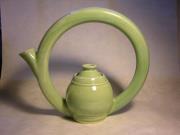
In A Potter's Workbook, renowned studio potter and teacher Clary Illian presents a textbook for the hand and the mind. Her aim is to provide a way to see, to make, and to think about the forms of wheel-thrown vessels; her information and inspiration explain both the mechanics of throwing and finishing pots made simply on the wheel and the principles of truth and beauty arising from that traditional method. Each chapter begins with a series of exercises that introduce the principles of good form and good forming for pitchers, bowls, cylinders, lids, handles, and every other conceivable functional shape. Focusing on utilitarian pottery created on the wheel, Illian explores sound, lively, and economically produced pottery forms that combine an invitation to mindful appreciation with ease of use. Charles Metzger's striking photographs, taken under ideal studio conditions, perfectly complement her vigorous text.
The first half was helpful now and the second half will be helpful after I practice more. I feel excited about pöt. The author had this nice “here are some recs but also nothing is wrong unless the pot doesn’t work” attitude.
I'm a beginner at pottery, and have been taking classes for a few months. I haven't had a chance yet to work through the exercises, but even just the descriptions have changed how I look at pots.
My academic background is about as far from art as you can get. I knew when I liked a curve I had created, but didn't have any vocabulary to talk about why I liked it. This book started giving me that vocabulary, allowing me to talk about the pieces in a way that goes beyond my gut-feeling preference. Being told to pay attention to how my eyes move around a piece was obvious in retrospect, yet revelatory. As was the discussion about how the location of volume changes our perception of heaviness, and the demonstration of how tightening or widening a curve's radius changes its energy.
I am sure that these are all basic artistic principles, but I needed to encounter them, and this book was a great way to do so! I would love to find more resources that help me learn how to appreciate art in terms of what elements of a piece work together to create a given effect, rather than just in terms of aesthetic preferences.
Some reviews mention the black-and-white photos as a liability -- for me, they were a very effective pedagogical choice. They made it very easy to focus purely on the form of the pieces presented, which is the whole point! The goal isn't beauty, it is clear exposition.
this is such a neat book for potters!! there were a lot of fun throwing exercises clary suggests that were super useful!! clary breaks down traditional forms in such a technical way which helped me understand a ware's functionally a bit better. i'm excited to pot!!!
I found this book at the arts centre I learn wheel throwing at, and often flick through it as we wait to start our class. It’s actually quite handy as a beginner, sadly I can’t take the book home. I’m saving it here incase I can get my hands on it at a library some point down the line LOL
This excellent and highly focused book is intended to help a potter see the form, shapes, contours, etc., in pottery making. Author Clary Illian apprenticed to Leach Pottery (aka studio of influential British potter Bernard Leach), and she shares what she drew from that training along with her own extensive experience to teach how to merge the mechanics of wheel-thrown pottery with making decisions about form. It’s not just a technical approach but one to help the maker see what shapes and contours are being created as the object is being created. Then, she discusses how those decisions about rims, feet, proportions, etc., act upon the pot and its intended use. What does a cylinder with a narrow base and wide open rim suggest about the volume inside of the pot and its potential uses?
She also breaks down how decisions about the anatomy of pots can ultimately be used to establish a style; sometimes, the maker is conscious of those decisions, and sometimes not. However, these factors can be better recognized with careful visual examination. Sticking to black-and-white photography and line drawings helps the reader see Illian's analysis without the distraction of color or visual texture. The book is organized mainly by object type (cylinders, bowls, pots with lids) and offers exercises related to those shapes. But even without doing the exercises, a reader of this book can significantly benefit by building their visual vocabulary of form in pottery — I know I did!