

What do you think?

Some People Need Killing
About a nation careening into violent autocracy—told through harrowing stories of the Philippines’ state-sanctioned killings of its citizens—from a reporter of international renown
“My job is to go to places where people die. I pack my bags, talk to the survivors, write my stories, then go home to wait for the next catastrophe. I don’t wait very long.”
Journalist Patricia Evangelista came of age in the aftermath of a street revolution that forged a new future for the Philippines. Three decades later, in the face of mounting inequality, the nation discovered the fragility of its democratic institutions under the regime of strongman Rodrigo Duterte.
Some People Need Killing is Evangelista’s meticulously reported and deeply human chronicle of the Philippines’ drug war. For six years, Evangelista chronicled the killings carried out by police and vigilantes in the name of Duterte’s war on drugs—a war that has led to the slaughter of thousands—immersing herself in the world of killers and survivors and capturing the atmosphere of fear created when an elected president decides that some lives are worth less than others.
The book takes its title from a vigilante whose words seemed to reflect the psychological accommodation that most of the country had “I’m really not a bad guy,” he said. “I’m not all bad. Some people need killing.”
A profound act of witness and a tour de force of literary journalism, Some People Need Killing is also a brilliant dissection of the grammar of violence and an important investigation of the human impulses to dominate and resist.
“My job is to go to places where people die. I pack my bags, talk to the survivors, write my stories, then go home to wait for the next catastrophe. I don’t wait very long.”
Journalist Patricia Evangelista came of age in the aftermath of a street revolution that forged a new future for the Philippines. Three decades later, in the face of mounting inequality, the nation discovered the fragility of its democratic institutions under the regime of strongman Rodrigo Duterte.
Some People Need Killing is Evangelista’s meticulously reported and deeply human chronicle of the Philippines’ drug war. For six years, Evangelista chronicled the killings carried out by police and vigilantes in the name of Duterte’s war on drugs—a war that has led to the slaughter of thousands—immersing herself in the world of killers and survivors and capturing the atmosphere of fear created when an elected president decides that some lives are worth less than others.
The book takes its title from a vigilante whose words seemed to reflect the psychological accommodation that most of the country had “I’m really not a bad guy,” he said. “I’m not all bad. Some people need killing.”
A profound act of witness and a tour de force of literary journalism, Some People Need Killing is also a brilliant dissection of the grammar of violence and an important investigation of the human impulses to dominate and resist.
433 pages, ebook
First published October 17, 2023
About the author
Patricia Evangelista
2 books199 followersPatricia Evangelista is a trauma journalist and former investigative reporter for the Philippine news company Rappler. Her reporting on armed conflict and disaster was awarded the Kate Webb Prize for exceptional journalism in dangerous conditions. She was a Headlands Artist in Residence, a New America ASU Future Security Fellow, and a fellow of the Logan Nonfiction Program, the Civitella Ranieri Foundation, and the Dart Center for Journalism and Trauma. Her work has earned local and international acclaim. She lives in Manila.
Ratings & Reviews
Friends & Following
Create a free account to discover what your friends think of this book!
Community Reviews
Displaying 1 - 30 of 1,793 reviews
November 12, 2023
I don’t know. But can I just summarize this into: putangina mo Rodrigo Roa Duterte?

October 15, 2023
In the first two years of the drug war, Simon killed two more men. By kill, he meant he pulled the trigger. He had other roles in other operations. He conducted surveillance. He acted as a lookout. He drove the getaway van. There was very little he was unwilling to do, because success at what he calls “the job” meant one less criminal threatening the future of his children. Simon claims he was never paid, but he stayed on anyway. He believed in the cause.
“I’m really not a bad guy,” said Simon. “I’m not all bad. Some people need killing.”
Filipina journalist Patricia Evangelista was working for the online news agency Rappler as Rodrigo Duterte (known by many nicknames from his days as a small city mayor, including “the Butcher'' and “the Punisher'') was running for and then won the Presidency of the Philippines in 2016. From day one of Duerte’s reign, both police and vigilante groups began lethally enforcing his promised war on drugs throughout the country, executing purported drug users and drug pushers — on the flimsiest of evidence and rumour — and Evangelista found herself joining the “night shift”: those brave journalists who arrived at the sites of these executions, looking for the truth and recording the stories of the dead. Evangelista began working on Some People Need Killing during a nonfiction writers’ residency in upstate New York in 2018 (an effort she describes as objective reportage, “cold and precise”), but she eventually returned home to Manila, continued to collect the truth, and has crafted her narrative into something more than mere reportage: “This is a book about the dead, and the people who are left behind. It is also a personal story, written in my own voice, as a citizen of a nation I cannot recognize as my own. The thousands who died were killed with the permission of my people. I am writing this book because I refuse to offer mine.”
Some People Need Killing is a remarkable work of witnessing: Evangelista brings many of the forgotten dead out of the shadows — often poor young men who had used drugs at some point; often shot point blank by police officers who would then plant a cheap gun on the victim and report that he had shot first — and she tells the stories of the people who loved them and the lack of consequences for their murderers. And this matters — not just because the world should be aware that this was happening (how did I not know that this was happening?), but because despite losing his bid for reelection in 2022 (to Ferdinand “Bongbong” Marcos; son of the corrupt and brutal dictators), Duerte still rides a populist wave in his home country (I googled Rappler and a tweet from them today reads: “In a rare move, party leaders of the House of Representatives pushed back against former President Rodrigo Duterte’s violent tirades against Congress, its leader Speaker Martin Romualdez, and for threatening to kill one member.” How does this man still walk the streets?) Truth matters and witnessing matters and getting a warning out to the rest of the world matters, and Evangelista has written a harrowing, sensitive, and fact-filled account that ought to matter to everyone. Highest rating and recommendation. (Note: I read an ARC through NetGalley and passages quoted may not be in their final form.)
Rodrigo Duterte was not the first politician in the world to declare war on a domestic issue. Wars on poverty, pornography, hunger, obesity, cancer, and drugs have been launched and fought by presidents and potentates long before Duterte moved into Malacañang Palace. None of these wars have so far been won. None of that matters, because for the politician, the declaration is a victory all its own. The headlines are printed. The campaigns get their slogans. The solution is left to whoever comes next, or to God. But metaphorical wars were of no interest to Rodrigo Duterte, as he is a man who has no love for metaphor. He declared a war on drugs, and when he said kill, he meant dead.
In the course of detailing Duterte’s rise and reign, Evangelista shares the history of the Philippines — from its “discovery” by Ferdinand Magellan, through its “liberation” by the USA, and the string of strongman rulers seen over the past few decades (googling the Philippines' current president, I learned that two days ago Bongbong cancelled the annual public holiday that commemorated the toppling of his father’s reign) — and she shares enough about herself (I especially enjoyed her story of winning an International Public Speaking Competition in the United Kingdom as a college sophomore; leading to brief fame and strangers calling her a “national treasure”) that we understand she is an engaged citizen who loves her country and who was appalled by the frequent “extrajudicial killings” she was witness to in the course of her reportage. Nearly half of this book is made up of footnotes and attributions, and each section is finely detailed (for instance: “The district of Santa Ana, population roughly 195,000, was established by Franciscan priests in the sixteenth century in the name of Saint Anne. The police station, PS-6, hunkers under the stone shadow of the Church of Our Lady of the Abandoned, whose bells rang to signal the Philippines’ liberation from the Japanese occupation.”) and I believed every bit of it. Evangelista also discusses grammar and vocabulary in a few places (for instance, using the verb “to salvage” in the Philippines to denote a summary execution), and while I see some reviewers think this is extraneous information, I appreciated it: the truth matters, and how one writes about it matters, too.
I cannot, with any certainty, report the true toll of Rodrigo Duterte’s war against drugs. Numbers cannot describe the human cost of this war, or adequately measure what happens when individual liberty gives way to state brutality. Even the highest estimate — over 30,000 dead — is likely insufficient to the task.
And mostly: This is the story of President Rodrigo Duterte’s war on drugs; where life became cheap, ordinary citizens were conditioned to believe that “some people need killing” and that, as Evangelista writes, the unending executions by police officers and vigilante groups was “the natural consequence of violent rhetoric from above and wholesale impunity below.” This is a horrifying work of witnessing and I am grateful to Evangelista for risking her life to write it all down.

September 10, 2023
I received this book through a Goodreads giveaway. I honestly learned so much surrounding the Philippines and the murders that took place because of this book. Prior to reading this, I had no knowledge as to these events even happening! It really opened my mind as to what was going on and how these events affected those living in the Philippines. The material was really throughly researched and you can tell the author really cares about this material. There was so much information and it was great to be able to learn something new.
November 3, 2023
We write so we may not forget.
A sobering account of the horrors of the last administration, Patricia Evangelista writes with such precision that each word feels like a gut punch.
A sobering account of the horrors of the last administration, Patricia Evangelista writes with such precision that each word feels like a gut punch.

November 14, 2023
"What I want to do is instill fear."
—Mayor Rodrigo Roa Duterte
"This is a book about the dead, and the people who are left behind. It is also a personal story, written in my own voice, as a citizen of a nation I cannot recognize as my own. The thousands who died were killed with the permission of my people. I am writing this book because I refuse to offer mine..."
Some People Need Killing sounded interesting enough and covering this subject matter is an important historical record. However, the delivery left much to be desired for me... For such rich source material, the final product was not up to scratch. More below.
Author Patricia Chanco Evangelista is a Filipina journalist and documentary filmmaker based in Manila, whose coverage focuses mostly on conflict, disaster and human rights. She is a multimedia reporter for online news agency Rappler and is a writer-at-large for Esquire magazine.
Patricia Evangelista:
Unfortunately, and despite the attention-grabbing title, this one just did not meet my expectations. I am admittedly extremely picky about how interesting and/or engaging the books I read are, and I just did not enjoy the overall formatting of this book.
The author writes in a very long-winded, verbose fashion that makes the book really drag on. She layers on many unnecessary literary accouterments here; there are extensive descriptions of trees, surroundings, and other irrelevant assorted minutia that take away from the bigger picture. It was also just a very long book to begin with - the audio version I have clocked in at a hefty almost 12 hours. The PDF; well over 400 pages. Way too long. There are many long-winded tangents that the author goes off on that manage to effectively lose the forest for the trees. I am really not a fan of writing styles like this...
She talks about the background of the book in this quote:
The author is a disaster journalist by trade, and drops this quote about the nature of her job:
********************
I did not enjoy the presentation of this book. For such an important historical record, I felt like the telling needed to be more coherent. A subjective take; to be sure.
It was also too long; in general. The writing got tedious and long-winded quite often here. The final product is in dire need of a more rigorous editing. There's far too much superfluous writing here. IMO, ~half of the book could have been edited out without a loss to the finished product.
2 stars.
—Mayor Rodrigo Roa Duterte
"This is a book about the dead, and the people who are left behind. It is also a personal story, written in my own voice, as a citizen of a nation I cannot recognize as my own. The thousands who died were killed with the permission of my people. I am writing this book because I refuse to offer mine..."
Some People Need Killing sounded interesting enough and covering this subject matter is an important historical record. However, the delivery left much to be desired for me... For such rich source material, the final product was not up to scratch. More below.
Author Patricia Chanco Evangelista is a Filipina journalist and documentary filmmaker based in Manila, whose coverage focuses mostly on conflict, disaster and human rights. She is a multimedia reporter for online news agency Rappler and is a writer-at-large for Esquire magazine.
Patricia Evangelista:
Unfortunately, and despite the attention-grabbing title, this one just did not meet my expectations. I am admittedly extremely picky about how interesting and/or engaging the books I read are, and I just did not enjoy the overall formatting of this book.
The author writes in a very long-winded, verbose fashion that makes the book really drag on. She layers on many unnecessary literary accouterments here; there are extensive descriptions of trees, surroundings, and other irrelevant assorted minutia that take away from the bigger picture. It was also just a very long book to begin with - the audio version I have clocked in at a hefty almost 12 hours. The PDF; well over 400 pages. Way too long. There are many long-winded tangents that the author goes off on that manage to effectively lose the forest for the trees. I am really not a fan of writing styles like this...
She talks about the background of the book in this quote:
"From the beginning of the Duterte era, recording these deaths became my job. As a field correspondent for Rappler in Manila, I was one of then reporters covering the results of the president’s pledge to destroy anyone— without charge or trial—whom he or the police or any of a number of vigilantes suspected of taking or selling drugs. The volume of Duterte’s dead was at times overwhelming, as was covering the powerful in a country nwhere the powerful refuse to be held to account."
The author is a disaster journalist by trade, and drops this quote about the nature of her job:
"My job is to go to places where people die. I pack my bags, talk to the survivors, write my stories, then go home to wait for the next catastrophe. I don’t wait very long.
I can tell you about those places. There have been many of them in the last decade. They are the coastal villages after typhoons, where babies were zipped into backpacks after the body bags ran out. They are the hillsides in the south, where journalists were buried alive in a layer cake of cars and corpses. They are the cornfields in rebel country and the tent cities outside blackened villages and the backrooms where mothers whispered about the children that desperation had forced them to abort.
It’s handy to have a small vocabulary in my line of work. The names go first, then the casualty counts. Colors are good to get the description squared away. The hill is green. The sky is black. The backpack is purple, and so is the bruising on the woman’s left cheek.
Small words are precise. They are exactly what they are and are faster to type when the battery is running down..."
"...Kill, for example. It’s a word my president uses often. He said it at least 1,254 times in the first six months of his presidency, in a variety of contexts and against a range of enemies. He said it to four-year-old Boy Scouts, promising to kill people who got in the way of their future. He said it to overseas workers, telling them there were jobs to be had killing drug addicts at home. He told mayors accused of drug dealing to repent, resign, or die.
He threatened to kill human rights activists if the drug problem worsened. He told cops he would give them medals for killing. He told journalists they could be legitimate targets of assassination.
“I’m not kidding,” he said in a campaign rally in 2016. “When I become president, I’ll tell the military, the police, that this is my order: find these people and kill them, period.”
I know only a few dozen of the dead by name. It doesn’t matter to the president. He has enough names for them all. They are addicts, pushers, users, dealers, monsters, madmen."
********************
I did not enjoy the presentation of this book. For such an important historical record, I felt like the telling needed to be more coherent. A subjective take; to be sure.
It was also too long; in general. The writing got tedious and long-winded quite often here. The final product is in dire need of a more rigorous editing. There's far too much superfluous writing here. IMO, ~half of the book could have been edited out without a loss to the finished product.
2 stars.
January 17, 2024
I wanted more from this book, or maybe I wanted a different book. While it did cover a lot of Filipino history early on, the narrative got muddled the further I got into the book. I was expecting more of a non-fiction, big-picture overview of the killings and repercussions of the drug war in the Philippines, but was surprised how much memoir and personal history was present throughout. No offense to the author, but I did not come to read about her childhood and brief international fame.
Some other issues I have with the book in no particular order:
- The writing style is very stilted and can be hard to read, which may be an artifact of the author's training as a journalist. Evangelista puts a lot of emphasis on the importance of active voice, but it makes some of the scenes read like stop motion photography.
- The author makes a lot of grammatical asides and parallels that do not add to the narrative. There is the aforementioned active/passive voice discussion, several lecture on intransitive verbs etc. Not sure what she was trying to accomplish with these but it did not work for me.
- The author investigated several personal stories that highlighted the experiences of victims and their families, but I these did not blend into a cohesive narrative. So many of the killings were similar that it became easy to lose track of the year or the incident.
I will note that Patricia Evangelista deserves some major props for being willing to go at night as a woman to dangerous parts of her country and interview men who were killing with impunity. Her writing in this book is the only memorial some of the victims will ever get and she is noble for seeking to preserve and remember their names.
My main question after finishing the book was "So what happened?" Did President Duterte meet any of his stated goals through his regime of terror? Did killing thousands of drug addicted people, drug dealers, and innocents amount to a deepened stigma around drug use, a reduction in imports, anything? If not, I wanted the author to come out and say that. Rub my nose in the fact that this was all for naught. If he did see results, draw my attention to the fact that this has perpetuated his family's popularity and that we may see a recurrence of this in the future.
I wanted more from this book.
Some other issues I have with the book in no particular order:
- The writing style is very stilted and can be hard to read, which may be an artifact of the author's training as a journalist. Evangelista puts a lot of emphasis on the importance of active voice, but it makes some of the scenes read like stop motion photography.
- The author makes a lot of grammatical asides and parallels that do not add to the narrative. There is the aforementioned active/passive voice discussion, several lecture on intransitive verbs etc. Not sure what she was trying to accomplish with these but it did not work for me.
- The author investigated several personal stories that highlighted the experiences of victims and their families, but I these did not blend into a cohesive narrative. So many of the killings were similar that it became easy to lose track of the year or the incident.
I will note that Patricia Evangelista deserves some major props for being willing to go at night as a woman to dangerous parts of her country and interview men who were killing with impunity. Her writing in this book is the only memorial some of the victims will ever get and she is noble for seeking to preserve and remember their names.
My main question after finishing the book was "So what happened?" Did President Duterte meet any of his stated goals through his regime of terror? Did killing thousands of drug addicted people, drug dealers, and innocents amount to a deepened stigma around drug use, a reduction in imports, anything? If not, I wanted the author to come out and say that. Rub my nose in the fact that this was all for naught. If he did see results, draw my attention to the fact that this has perpetuated his family's popularity and that we may see a recurrence of this in the future.
I wanted more from this book.
December 12, 2023
Wowowowowow. Unbelievable. Ever since reading Patron Saints of Nothing, I've wanted to find a book that covered Duterte's drug war in this way, and I literally couldn't put this down. It's wild how many times it's casually mentioned that the author risked her life in the process of researching this book.
Not something I expected at all, but probably my favorite part of the book, is how many times she delves into analysis of the language and rhetoric surrounding Duterte's administration. Her recognition of the power of language to shape the legal and cultural landscape in the Philippines is so interesting, and offers such unique insight into how a democratically-elected official gets away with the extrajudicial killings of tens of thousands of people. The focus on transitive vs. intransitive verbs, active vs. passive voice, the different words and phrases police use to describe the murder of suspected drug users, etc. were so thought-provoking and genuinely unlike anything I've ever read. Truly nonfiction writing at its finest!!!
Not something I expected at all, but probably my favorite part of the book, is how many times she delves into analysis of the language and rhetoric surrounding Duterte's administration. Her recognition of the power of language to shape the legal and cultural landscape in the Philippines is so interesting, and offers such unique insight into how a democratically-elected official gets away with the extrajudicial killings of tens of thousands of people. The focus on transitive vs. intransitive verbs, active vs. passive voice, the different words and phrases police use to describe the murder of suspected drug users, etc. were so thought-provoking and genuinely unlike anything I've ever read. Truly nonfiction writing at its finest!!!

January 19, 2024
‘Some People Need Killing: A Memoir of Murder in my Country’ by Patricia Evangelista is a scream of frustration and rage. She does not hold back in writing of her disgust and horror about ex-President Rodrigo Duterte and his open support for the murdering of addicts and dealers of drugs, encouraging neighbors and police to kill addicts on sight, without a trial. She writes of eyewitness declarations, videos of speeches and murders, and a lot of reporting by reputable journalists as proof. Not to mention the piles of tied-up dead bodies that were found everywhere in neighborhoods, seen by any of the locals who cared enough to take a look.
She has good reasons for her frustration and rage. Philippine people were not only openly murdered by police with the encouragement of their former President Rodrigo Duterte. Victims were murdered with the full-throated support of many of the Philippine people.
Evangelista writes of some of the history of previous Presidents of the Philippines as well as a brief biography of Duterte. She writes of how his campaign of supporting the street murders of accused drug addicts by police played out. While the author provides proofs of the murders, she also shows how Duterte and others, such as the police, used verbal semantics to avoid being arrested for murder. I was flabbergasted. What Philippine politicians and police do linguistically to lie and coverup crimes in a democracy makes other politicians the world over look like amateurs.
I have copied the book blurb:
”About a nation careening into violent autocracy—told through harrowing stories of the Philippines’ state-sanctioned killings of its citizens—from a reporter of international renown.
“My job is to go to places where people die. I pack my bags, talk to the survivors, write my stories, then go home to wait for the next catastrophe. I don’t wait very long.”
Journalist Patricia Evangelista came of age in the aftermath of a street revolution that forged a new future for the Philippines. Three decades later, in the face of mounting inequality, the nation discovered the fragility of its democratic institutions under the regime of strongman Rodrigo Duterte.
Some People Need Killing is Evangelista’s meticulously reported and deeply human chronicle of the Philippines’ drug war. For six years, Evangelista chronicled the killings carried out by police and vigilantes in the name of Duterte’s war on drugs—a war that has led to the slaughter of thousands—immersing herself in the world of killers and survivors and capturing the atmosphere of fear created when an elected president decides that some lives are worth less than others.
The book takes its title from a vigilante whose words seemed to reflect the psychological accommodation that most of the country had “I’m really not a bad guy,” he said. “I’m not all bad. Some people need killing.”
A profound act of witness and a tour de force of literary journalism, Some People Need Killing is also a brilliant dissection of the grammar of violence and an important investigation of the human impulses to dominate and resist.”
While I understand the frustration, pain and losses of those injured by the criminal behaviors of the chronic drug- and alcohol- addicted, should such destructive activities be handled with addicts being shot to death or tortured to death by police officers acting as judge, jury and executioner in neighborhood streets? If a country decides through voting for a guy with a policy to murder anyone of any age linked to either the selling or using of drugs, no matter if such use or selling is even occasional or in the past, is this thus legal, even if the crime info is based on gossip only, as well as a past of arrests for drug use or sales? Is such a policy of murder by street justice worth it even if the cost includes the murder of innocents mistakingly shot dead in the killing of the one addict or ex-addict in a family? If the policy does not actually punish the top-of-the-chain drug lords, but only destroys permanently the alleged addict or seller and their innocent family/friends caught being in the vicinity of the murdering, is it still a public Good? And if people are still becoming addicted to drugs and alcohol which are still being produced or imported and sold by drug lords, so that the numbers of addicted, as well as those who occasionally indulge at a party, are forever being added to the list of the numbers of drug users, it is still worthwhile to kill all of the people who might be addicts or are said to be addicts in a neighborhood?
Most who voted for Duterte really did want the addicts and the pushers to be murdered by street justice, no trial. Full stop. They did not know Duterte lied about being “one of them” when he talked to the poor. He came from a privileged family. His reputation as having been a mayor of a town where addicts and pushers were murdered by the police was true, though. Duterte allegedly did personally kill drug users and pushers. Voters did not know police officials contacted local thugs and desperately poor men to form off-the-books kill squads, who then killed people with the permission of the real police. The police gave the vigilante death squads permission, awarding them with titles of being police adjuncts, because Duterte gave the police permission to kill drug users and pushers in many public speeches and private visits by him, supposedly justified as long as the purported pusher or addict “resisted arrest.” Vigilantes were paid money by the police for killing “addicts.” Many police and vigilantes ended up killing “addicts” in the night, without witnesses or lights, for some reason.
Voters did not know that the murdered included people innocent of being drug users or pushers, including children. Gossip about suspected drug use was enough for a person to be placed on a police kill list. Speaking out against the police or Duterte by a reporter or a neighbor was enough to be accused of being a drug dealer, and thus added to the police kill list. Grudges against a person for reasons unconnected to any actual drug or alcohol use could get an innocent added to a kill list. Coveting a business or being a political competitor was enough reason for someone to accuse someone else of being a drug addict, and thus people were added to the police kill list. A payment system of collecting a payment per murder from local officials was incentive. The death squads and police often provided false evidence like putting a gun in the hand of a murdered unarmed kid.
In time, as evidence of videos showing police and masked gun men on bikes or in vans killing unarmed young kids and innocents without cause began to circulate, Duterte began to speak out against “corrupt police officers” murdering non-addicted or non-violent, unresisting people. Many people continued to support Duterte because he said he did not, apparently, want the innocent or young children murdered. He still only wanted those who were said to be addicts murdered. However, the alluring thrill of street justice, as the kidnapping/torture/murder of unresisting and unarmed young kids was filmed on cellphone and camera video and passed around until some of it made it to TV, it all became kind of tarnished in the eyes of law-and-order believers anyway. Grieving families crying and young skinny unarmed small men/children being videoed as police or vigilantes beat them up and shot them bloodily dead in front of your eyes changed many minds about vigilante justice.
How is it a law-abiding democracy of mostly low-income uneducated Catholic voters, who voted knowingly for a self-described braggart of off-the-books murders of poor people (maybe some of whom were addicts who were accused of crimes mostly without evidence) who were purportedly addicted to drugs, supported a wealthy liar and self-outed politician who confessed to murder on camera? How is it the majority of Filipinos voted for such a man who hoped more people would become murderers into the office of the President? Idk.
How is it that American voters, mostly religious Protestants, mostly low-income, mostly high-school graduates, many self-declared constitutionalists who know nothing about lawyering or have ever read the Constitution much less the Bibles they supposedly live by, who want to “Make America Great Again” - vote for an easily proved liar, a convicted conman of for-profit fake colleges and charities and illegal tax breaks, a married sexual predator of many women who brags of it on tape, who has many divorces, a tax and military dodger, with a history of constant business failures, who is living off his father’s wealth and a lot of still ongoing cons like his political PAC (funded by supporting taxpayers) which he is using to pay off his personal bills, with a personal reputation of not paying or slow-paying the bills of small businesses and his employees, forcing them into bankruptcy, and a racist, and a rapist, all witnessed and spoken of by close associates in the room, with a lot of the evidence against him having been proved in a court of law? Again, idk.
I am very very sad for the Human race. No wonder we are in an environmental spiral of heat and pollution heading for extinction.
She has good reasons for her frustration and rage. Philippine people were not only openly murdered by police with the encouragement of their former President Rodrigo Duterte. Victims were murdered with the full-throated support of many of the Philippine people.
Evangelista writes of some of the history of previous Presidents of the Philippines as well as a brief biography of Duterte. She writes of how his campaign of supporting the street murders of accused drug addicts by police played out. While the author provides proofs of the murders, she also shows how Duterte and others, such as the police, used verbal semantics to avoid being arrested for murder. I was flabbergasted. What Philippine politicians and police do linguistically to lie and coverup crimes in a democracy makes other politicians the world over look like amateurs.
I have copied the book blurb:
”About a nation careening into violent autocracy—told through harrowing stories of the Philippines’ state-sanctioned killings of its citizens—from a reporter of international renown.
“My job is to go to places where people die. I pack my bags, talk to the survivors, write my stories, then go home to wait for the next catastrophe. I don’t wait very long.”
Journalist Patricia Evangelista came of age in the aftermath of a street revolution that forged a new future for the Philippines. Three decades later, in the face of mounting inequality, the nation discovered the fragility of its democratic institutions under the regime of strongman Rodrigo Duterte.
Some People Need Killing is Evangelista’s meticulously reported and deeply human chronicle of the Philippines’ drug war. For six years, Evangelista chronicled the killings carried out by police and vigilantes in the name of Duterte’s war on drugs—a war that has led to the slaughter of thousands—immersing herself in the world of killers and survivors and capturing the atmosphere of fear created when an elected president decides that some lives are worth less than others.
The book takes its title from a vigilante whose words seemed to reflect the psychological accommodation that most of the country had “I’m really not a bad guy,” he said. “I’m not all bad. Some people need killing.”
A profound act of witness and a tour de force of literary journalism, Some People Need Killing is also a brilliant dissection of the grammar of violence and an important investigation of the human impulses to dominate and resist.”
While I understand the frustration, pain and losses of those injured by the criminal behaviors of the chronic drug- and alcohol- addicted, should such destructive activities be handled with addicts being shot to death or tortured to death by police officers acting as judge, jury and executioner in neighborhood streets? If a country decides through voting for a guy with a policy to murder anyone of any age linked to either the selling or using of drugs, no matter if such use or selling is even occasional or in the past, is this thus legal, even if the crime info is based on gossip only, as well as a past of arrests for drug use or sales? Is such a policy of murder by street justice worth it even if the cost includes the murder of innocents mistakingly shot dead in the killing of the one addict or ex-addict in a family? If the policy does not actually punish the top-of-the-chain drug lords, but only destroys permanently the alleged addict or seller and their innocent family/friends caught being in the vicinity of the murdering, is it still a public Good? And if people are still becoming addicted to drugs and alcohol which are still being produced or imported and sold by drug lords, so that the numbers of addicted, as well as those who occasionally indulge at a party, are forever being added to the list of the numbers of drug users, it is still worthwhile to kill all of the people who might be addicts or are said to be addicts in a neighborhood?
Most who voted for Duterte really did want the addicts and the pushers to be murdered by street justice, no trial. Full stop. They did not know Duterte lied about being “one of them” when he talked to the poor. He came from a privileged family. His reputation as having been a mayor of a town where addicts and pushers were murdered by the police was true, though. Duterte allegedly did personally kill drug users and pushers. Voters did not know police officials contacted local thugs and desperately poor men to form off-the-books kill squads, who then killed people with the permission of the real police. The police gave the vigilante death squads permission, awarding them with titles of being police adjuncts, because Duterte gave the police permission to kill drug users and pushers in many public speeches and private visits by him, supposedly justified as long as the purported pusher or addict “resisted arrest.” Vigilantes were paid money by the police for killing “addicts.” Many police and vigilantes ended up killing “addicts” in the night, without witnesses or lights, for some reason.
Voters did not know that the murdered included people innocent of being drug users or pushers, including children. Gossip about suspected drug use was enough for a person to be placed on a police kill list. Speaking out against the police or Duterte by a reporter or a neighbor was enough to be accused of being a drug dealer, and thus added to the police kill list. Grudges against a person for reasons unconnected to any actual drug or alcohol use could get an innocent added to a kill list. Coveting a business or being a political competitor was enough reason for someone to accuse someone else of being a drug addict, and thus people were added to the police kill list. A payment system of collecting a payment per murder from local officials was incentive. The death squads and police often provided false evidence like putting a gun in the hand of a murdered unarmed kid.
In time, as evidence of videos showing police and masked gun men on bikes or in vans killing unarmed young kids and innocents without cause began to circulate, Duterte began to speak out against “corrupt police officers” murdering non-addicted or non-violent, unresisting people. Many people continued to support Duterte because he said he did not, apparently, want the innocent or young children murdered. He still only wanted those who were said to be addicts murdered. However, the alluring thrill of street justice, as the kidnapping/torture/murder of unresisting and unarmed young kids was filmed on cellphone and camera video and passed around until some of it made it to TV, it all became kind of tarnished in the eyes of law-and-order believers anyway. Grieving families crying and young skinny unarmed small men/children being videoed as police or vigilantes beat them up and shot them bloodily dead in front of your eyes changed many minds about vigilante justice.
How is it a law-abiding democracy of mostly low-income uneducated Catholic voters, who voted knowingly for a self-described braggart of off-the-books murders of poor people (maybe some of whom were addicts who were accused of crimes mostly without evidence) who were purportedly addicted to drugs, supported a wealthy liar and self-outed politician who confessed to murder on camera? How is it the majority of Filipinos voted for such a man who hoped more people would become murderers into the office of the President? Idk.
How is it that American voters, mostly religious Protestants, mostly low-income, mostly high-school graduates, many self-declared constitutionalists who know nothing about lawyering or have ever read the Constitution much less the Bibles they supposedly live by, who want to “Make America Great Again” - vote for an easily proved liar, a convicted conman of for-profit fake colleges and charities and illegal tax breaks, a married sexual predator of many women who brags of it on tape, who has many divorces, a tax and military dodger, with a history of constant business failures, who is living off his father’s wealth and a lot of still ongoing cons like his political PAC (funded by supporting taxpayers) which he is using to pay off his personal bills, with a personal reputation of not paying or slow-paying the bills of small businesses and his employees, forcing them into bankruptcy, and a racist, and a rapist, all witnessed and spoken of by close associates in the room, with a lot of the evidence against him having been proved in a court of law? Again, idk.
I am very very sad for the Human race. No wonder we are in an environmental spiral of heat and pollution heading for extinction.

January 27, 2024
This is the second book on Philippine's Rodrigo Duterte and his war on drugs that I've read in the last year. It's also the second written by journalists at Rappler (the other is Maria Ressa's How to Stand Up To a Dictator). I did not plan this, but both journalists impressed me with the courage of Rappler's staff. I love reading anything written by passionate, courageous authors excelling at what they do. Ressa won a Nobel Prize for her work as a journalist.
Although the Philippines has a drug abuse problem half that of the world average, Dutarte called a war on drugs: "“Hitler massacred three million Jews,” he said. [It was more like six million Jews and five million Soviets, Romany, Jehovah Witnesses, communists, and homosexuals.] “Now there are three million drug addicts. I’d be happy to slaughter them”" (p. 12). He was not calling for their capture and imprisonment, but for outright slaughter on the streets, what has been called extrajudicial killings (EJK).
So is it the goal (removing drug abuse) or the means (slaughter or imprisonment) that matters? In the US, we have engaged in mass imprisonment as a strategy for clearing the streets and, while it is not as despicable as EJKs, the impact on families and communities has also been horrific.
Duterte has been a popular president, although this has been a popularity built on lies. "“I have no pretensions,” he said. “I am a small-town boy,” he said. “I am an ordinary Filipino,” he said. “I know the sentiment of the ordinary people. I can talk to them because that’s where I come from.”" (p. 61). And yet, he had enjoyed a privileged upbringing, surrounded by guns and bodyguards, flying his father’s plane, and hanging out with the sons of the local elite in his Jesuit-run boys’ school. Who was the real Duterte?
To believe in Rodrigo Duterte, you had to believe he was a killer, or that he was joking when he said he was a killer. You had to believe in the specter of a narco state, or you had to believe that he was only playing to the crowd. You had to believe drug addiction is criminal, that drug addicts are not human, and that their massacre can be considered acceptable public policy. You had to believe he could make crime and corruption and illegal drugs disappear in three to six months. You had to believe that a mayor who kept peace by ordering undesirables out of his city could succeed in a country where undesirables were citizens too. You had to believe the intended dead would be drug lords and rapists, only drug lords and rapists, and not your cousins who go off into Liguasan Marsh to pick up their baggies of meth. You had to believe there would be a warning before the gunshots ring out. (p. 118).
One of the things I liked best about Some People Need Killing was Patricia Evangelista's focus on language. Were speakers using passive or active voice – and what were the implications of that choice? Who and what was the sentence's subject and object? What words were chosen? ""They would be drowned, stabbed, shot, buried, dropped into Manila Bay, fed to fishes, and sent to purgatory, and none of it would be murder because it was not murder, only justice…. “Simple justice,” he said. “Not murder-murder"” (p. 147).
And, it was not just Duterte who played with language. We are all guilty of Crimes Against Language, when it is convenient.
In Filipino, maganda means “beautiful.” It can also mean “good.” It was unclear what the president meant that afternoon in August, but there was a reason every English-language local news organization chose to use the word good instead of beautiful. Good, as egregious a judgment as it was, was far less outrageous than beautiful. Beautiful would have offered an element of pleasure, a romanticizing of brutality, the impression that the commander in chief of a democratic republic was not just pleased but delighted by the ruthless killing of his citizens. (p. 168).
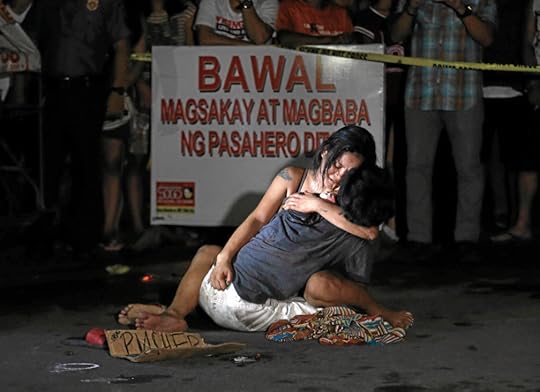
The Philippine "Pietà": Jennelyn Olaires holding her husband, killed as an alleged drug dealer. Source: Philippine Daily Inquirer / Raffy Lerma
We must see the humanity of the people killed before we can say no: ""You know, he’s a young kid,” Jason says. An innocent boy who didn’t look like an addict, didn’t look like a squatter, was a student who could have been Jason’s brother or sister or son. “And that’s when I had to look back,” he said. “I had to question how many of those who died before, like the Pietà, were similar to Kian [a 17-year-old killed, who only wanted to complete his homework]—even if they didn’t look like Kian.” (pp. 318-319)
None of us are immune: “We love your adherence to democratic principle,” Vice President George H. W. Bush raising a toast to President Marcos (p. 26).
Although the Philippines has a drug abuse problem half that of the world average, Dutarte called a war on drugs: "“Hitler massacred three million Jews,” he said. [It was more like six million Jews and five million Soviets, Romany, Jehovah Witnesses, communists, and homosexuals.] “Now there are three million drug addicts. I’d be happy to slaughter them”" (p. 12). He was not calling for their capture and imprisonment, but for outright slaughter on the streets, what has been called extrajudicial killings (EJK).
So is it the goal (removing drug abuse) or the means (slaughter or imprisonment) that matters? In the US, we have engaged in mass imprisonment as a strategy for clearing the streets and, while it is not as despicable as EJKs, the impact on families and communities has also been horrific.
Duterte has been a popular president, although this has been a popularity built on lies. "“I have no pretensions,” he said. “I am a small-town boy,” he said. “I am an ordinary Filipino,” he said. “I know the sentiment of the ordinary people. I can talk to them because that’s where I come from.”" (p. 61). And yet, he had enjoyed a privileged upbringing, surrounded by guns and bodyguards, flying his father’s plane, and hanging out with the sons of the local elite in his Jesuit-run boys’ school. Who was the real Duterte?
To believe in Rodrigo Duterte, you had to believe he was a killer, or that he was joking when he said he was a killer. You had to believe in the specter of a narco state, or you had to believe that he was only playing to the crowd. You had to believe drug addiction is criminal, that drug addicts are not human, and that their massacre can be considered acceptable public policy. You had to believe he could make crime and corruption and illegal drugs disappear in three to six months. You had to believe that a mayor who kept peace by ordering undesirables out of his city could succeed in a country where undesirables were citizens too. You had to believe the intended dead would be drug lords and rapists, only drug lords and rapists, and not your cousins who go off into Liguasan Marsh to pick up their baggies of meth. You had to believe there would be a warning before the gunshots ring out. (p. 118).
One of the things I liked best about Some People Need Killing was Patricia Evangelista's focus on language. Were speakers using passive or active voice – and what were the implications of that choice? Who and what was the sentence's subject and object? What words were chosen? ""They would be drowned, stabbed, shot, buried, dropped into Manila Bay, fed to fishes, and sent to purgatory, and none of it would be murder because it was not murder, only justice…. “Simple justice,” he said. “Not murder-murder"” (p. 147).
And, it was not just Duterte who played with language. We are all guilty of Crimes Against Language, when it is convenient.
In Filipino, maganda means “beautiful.” It can also mean “good.” It was unclear what the president meant that afternoon in August, but there was a reason every English-language local news organization chose to use the word good instead of beautiful. Good, as egregious a judgment as it was, was far less outrageous than beautiful. Beautiful would have offered an element of pleasure, a romanticizing of brutality, the impression that the commander in chief of a democratic republic was not just pleased but delighted by the ruthless killing of his citizens. (p. 168).
The Philippine "Pietà": Jennelyn Olaires holding her husband, killed as an alleged drug dealer. Source: Philippine Daily Inquirer / Raffy Lerma
We must see the humanity of the people killed before we can say no: ""You know, he’s a young kid,” Jason says. An innocent boy who didn’t look like an addict, didn’t look like a squatter, was a student who could have been Jason’s brother or sister or son. “And that’s when I had to look back,” he said. “I had to question how many of those who died before, like the Pietà, were similar to Kian [a 17-year-old killed, who only wanted to complete his homework]—even if they didn’t look like Kian.” (pp. 318-319)
None of us are immune: “We love your adherence to democratic principle,” Vice President George H. W. Bush raising a toast to President Marcos (p. 26).

Read
May 9, 2026No rating because I don't give star ratings to memoirs, but wow was that beautifully done!
I really enjoyed that Evangelista was not the self aggrandizing type in this book and that she went out of her way to underline the humanity of victims and occasionally that of the perpetrators too. She came across as very honest about what the life of a journalist is like.
I have to admit that I don't know too much about the Philippines, a couple content creators whose content does not center what's happening over there, a few articles here and there enough to know a little about Duterte's "war on drugs" and to get the impression that he is somehow a crude kind of populist. You know just enough to realize that I don't know Jack, so Evangelista taking the time to give us a sense of how things work politically was really helpful for me to understand how things got where they are.
For all the history covered things never got dry, this book really didn't feel like it was as long as it really was.
I really enjoyed that Evangelista was not the self aggrandizing type in this book and that she went out of her way to underline the humanity of victims and occasionally that of the perpetrators too. She came across as very honest about what the life of a journalist is like.
I have to admit that I don't know too much about the Philippines, a couple content creators whose content does not center what's happening over there, a few articles here and there enough to know a little about Duterte's "war on drugs" and to get the impression that he is somehow a crude kind of populist. You know just enough to realize that I don't know Jack, so Evangelista taking the time to give us a sense of how things work politically was really helpful for me to understand how things got where they are.
For all the history covered things never got dry, this book really didn't feel like it was as long as it really was.

February 13, 2024
Undoubtedly a brave piece of journalism, but I didn't feel like I learned anything about Duterte other than he was a murderous monster and liked to say "sonofabitch." Having 300 pages of brutal murders described in detail had the opposite effect than I imagine the author wanted. After the first dozen events, I was horrified. By the 100th, I was just craving some kind of conclusion. There really wasn't one.

February 9, 2024
I'm conflicted about this one. It taught me a lot about what went on during the Philippines' War on Drugs as well as what caused the inauguration of Rodrigo Duterte—the main champion of the so-called war—possible in the first place.
On the other hand, the writing style chosen by the author gradually made the memoir felt repetitive, causing the murders and victim names to blur together after a while. The thing is though, something told me that the stylistic choice is done, well, by choice, in order to better place the readers in Patricia Evangelista's shoes as she faced those long months and years of endless killings—the confusion, the numbness she most probably had gone through at some point.
In conclusion it is an interesting choice. The writing style didn't end up fully working for me but when it did, there were parts of this memoir that really hit me hard.
On the other hand, the writing style chosen by the author gradually made the memoir felt repetitive, causing the murders and victim names to blur together after a while. The thing is though, something told me that the stylistic choice is done, well, by choice, in order to better place the readers in Patricia Evangelista's shoes as she faced those long months and years of endless killings—the confusion, the numbness she most probably had gone through at some point.
In conclusion it is an interesting choice. The writing style didn't end up fully working for me but when it did, there were parts of this memoir that really hit me hard.

November 25, 2023
031325 Edit: i hope that the victims and the families of the victims find peace and justice, given that rodrigo duterte has finally been arrested by the icc.
My heart breaks and breaks for home
My heart breaks and breaks for home
January 16, 2024
Content was interesting and certainly important but book could benefit from way sharper editing. The writing is very self indulgent and painful to wade through. Would have preferred a non-fiction without all the navel gazing of an unknown narrator.

July 18, 2024
Actual rating: 4.5
An incredible snapshot of not just Duterte's drug war but also recent Philippine history written in a manner that effectively contextualizes many memorable events often reduced to soundbites and TikToks. Evangelista's command of language is astonishing and her ability to show the bigger picture without losing the necessary emotion of more intimate moments is worthy of thunderous applause. The accounts herein are as harrowing, frustrating, and tragic as much as they ring with clarion truth. All that said, while I understand that this was written with an international audience in mind, I do feel that a lot of things are lost in translation and are portrayed through a more Western lens. Much of Evangelista's sentiments and the way in which she frames certain behaviors, language, or events doesn't feel like it would be relatable to the average Filipino. There was also something about one of the latter chapters, touching on the contrition of previous Duterte supporters, that felt a bit off-putting. Overall though, a highly recommended read for anyone, whether from the homeland or abroad, who wants to make sense of the countless murders that took place during the time of Duterte, if sense at all could be made of them.
An incredible snapshot of not just Duterte's drug war but also recent Philippine history written in a manner that effectively contextualizes many memorable events often reduced to soundbites and TikToks. Evangelista's command of language is astonishing and her ability to show the bigger picture without losing the necessary emotion of more intimate moments is worthy of thunderous applause. The accounts herein are as harrowing, frustrating, and tragic as much as they ring with clarion truth. All that said, while I understand that this was written with an international audience in mind, I do feel that a lot of things are lost in translation and are portrayed through a more Western lens. Much of Evangelista's sentiments and the way in which she frames certain behaviors, language, or events doesn't feel like it would be relatable to the average Filipino. There was also something about one of the latter chapters, touching on the contrition of previous Duterte supporters, that felt a bit off-putting. Overall though, a highly recommended read for anyone, whether from the homeland or abroad, who wants to make sense of the countless murders that took place during the time of Duterte, if sense at all could be made of them.

September 1, 2024
im done, im spent 😪 mixed emotions of galit, guilt, sadness, disappointment and embarrassment but im glad i pushed through, i read every word and chapter slowly and took long pauses in between, i tried my best to remember the events especially the names,
i loved her focus on the details because i’m that kind of person too, i can remember and appreciate things more when I have something specific to focus on, as an english teacher i also appreciated her effective and precise use of language and emphasis on words like “salvage” and “encounter” and how some phrases are said and what they really mean in our native language, how I wish we can have a Filipino version of this and make it more accessible to all,
i’ve heard and watched some of these stories before but it feels/hits different when they are compiled in complete accounts like this, ika nga ni new york times “a journalistic masterpiece!” 👏🏻✨
i can feel that there is always more to the story but Patricia did her best to put in what she can, I want to read more from her, grabeh! ang tapang tapang nya! I admire and commend her courage for putting in this tangible account of the horrific tragedy that happened to our country and ultimately, by writing this book, sabi nga ni Philip Bennet on their interview, Pat has restored the humanity for these people who have been robbed of their lives.
im glad that by reading this, in a way, it makes me part of that battlecry, that circles and shouts for justice sa mga taong kausap at makakausap ko in the future. I will definitely be sharing and talking about this book more yes!
nung una I was so hesitant and scared to read this talaga, I can’t even look at the front cover, tinataob ko ung book or binabalot ko ng booksleeve kasi triggered talaga ko, but by the end, parang gusto ko nang magbigay ng copies each sa bawat makasalubong ko,
get pass chapter 1, its hard and heavy but when you do parang gusto mo na syang basahin ng tuloy tuloy, but again, yes please, take a breather whenever you can and read when talagang ramdam mo na handa ka nah, naghhintay lang lahat dito ung other side ng storya, mahirap pero kailangan.
this. is. such. a. brave and important. book and I hope every Filipino here and abroad would have the guts to read it and be changed by it! 💯❤️🔥
i loved her focus on the details because i’m that kind of person too, i can remember and appreciate things more when I have something specific to focus on, as an english teacher i also appreciated her effective and precise use of language and emphasis on words like “salvage” and “encounter” and how some phrases are said and what they really mean in our native language, how I wish we can have a Filipino version of this and make it more accessible to all,
i’ve heard and watched some of these stories before but it feels/hits different when they are compiled in complete accounts like this, ika nga ni new york times “a journalistic masterpiece!” 👏🏻✨
i can feel that there is always more to the story but Patricia did her best to put in what she can, I want to read more from her, grabeh! ang tapang tapang nya! I admire and commend her courage for putting in this tangible account of the horrific tragedy that happened to our country and ultimately, by writing this book, sabi nga ni Philip Bennet on their interview, Pat has restored the humanity for these people who have been robbed of their lives.
im glad that by reading this, in a way, it makes me part of that battlecry, that circles and shouts for justice sa mga taong kausap at makakausap ko in the future. I will definitely be sharing and talking about this book more yes!
nung una I was so hesitant and scared to read this talaga, I can’t even look at the front cover, tinataob ko ung book or binabalot ko ng booksleeve kasi triggered talaga ko, but by the end, parang gusto ko nang magbigay ng copies each sa bawat makasalubong ko,
get pass chapter 1, its hard and heavy but when you do parang gusto mo na syang basahin ng tuloy tuloy, but again, yes please, take a breather whenever you can and read when talagang ramdam mo na handa ka nah, naghhintay lang lahat dito ung other side ng storya, mahirap pero kailangan.
this. is. such. a. brave and important. book and I hope every Filipino here and abroad would have the guts to read it and be changed by it! 💯❤️🔥
December 19, 2023
I could not for the life of me not think of my father who voted for Duterte, a maniac and murderer. It went against all the virtues we value.
Supplementary audio references:
Patricia Evangelista on this book
Part 1: https://open.spotify.com/episode/3bT1...
Part 2: https://open.spotify.com/episode/5YqQ...
Supplementary audio references:
Patricia Evangelista on this book
Part 1: https://open.spotify.com/episode/3bT1...
Part 2: https://open.spotify.com/episode/5YqQ...

April 8, 2024
Patricia Evangelista spent years as a “nightcrawler,” one of the journalists in the Philippines who worked at night chronicling the slew of extrajudicial killings (“salvagings”) that characterized populist leader Rodrigo Duterte’s ‘war on drugs.’ Elected on a groundswell of support, Duterte promised to replicate what he had done as mayor of Davao City, where police and vigilantes under his leadership killed ‘drug pushers’ with impunity. Voters, even religious people, liberals, and those with recovering addicts in their own families, reacted positively to Duterte’s profanity-laced tirades, interspersed with rape jokes - they didn’t dream that their own loved ones might be targeted, or understand that the categories of ‘user’ and ‘pusher’ and ‘criminal’ become dangerously elastic when the rule of law is broken. When particularly egregious examples caught the public imagination, the government and police deployed various tactics of deniability, characterizing them as the acts of single bad apples in the police force or unsanctioned vigilante gangs.
Important, valuable content, seemingly impeccably researched and documented. The writing style was not my favourite- repetitive and staccato - but the content is important. The Philippines is far from unique in how it reacts to populism and the delicious promise of violence against those who are despised and feared.
Important, valuable content, seemingly impeccably researched and documented. The writing style was not my favourite- repetitive and staccato - but the content is important. The Philippines is far from unique in how it reacts to populism and the delicious promise of violence against those who are despised and feared.

April 13, 2024
Some People Need Killing: A Memoir of Murder in My Country, without a shadow of a doubt deserved to be in The New York Times 10 Best Books of 2023 list. The book centers about the extrajudicial killings happened during President Duterte's administration. The rampant war on drugs in the Philippines caught attention all over the world.
Please be minded that this book is incredibly descriptive and you may need to take a deep breath. It has heavy themes about violence and murder.
Some people called this book an anti-Duterte. You're wrong. Patricia Evangelista's brutally honest take on this is incredibly descriptive. She never sugarcoated as the victims' families shared their side of story. About their grief, trauma and loss of their love ones. I find myself pausing once in a while because it's heart-wrenching. I rarely read nonfiction books and I like annotating on this one. I am loss of words for what I have just read.
Please be minded that this book is incredibly descriptive and you may need to take a deep breath. It has heavy themes about violence and murder.
Some people called this book an anti-Duterte. You're wrong. Patricia Evangelista's brutally honest take on this is incredibly descriptive. She never sugarcoated as the victims' families shared their side of story. About their grief, trauma and loss of their love ones. I find myself pausing once in a while because it's heart-wrenching. I rarely read nonfiction books and I like annotating on this one. I am loss of words for what I have just read.
December 11, 2023
I still find it appalling that as Duterte proclaimed/promised killing drug addicts and drug users in our country and that this platform is that one that pushed him to his presidency. I still wonder how fellow Filipinos approved the execution of their own people and voted for him with thunderous applause.
I am still angry that he is not held accountable, that most families won’t see the light of justice, that we can never really put an exact number to all the EJKs that happened and that continue to happen.
I feel uneasy rating this book — because the mourning continues and the people who should be held liable remain free, some are elected officials even.
All I know is that it's is a book that needed to be written, it is a book that needs to be read because we need to remember and we need to stay angry.
I am still angry that he is not held accountable, that most families won’t see the light of justice, that we can never really put an exact number to all the EJKs that happened and that continue to happen.
I feel uneasy rating this book — because the mourning continues and the people who should be held liable remain free, some are elected officials even.
All I know is that it's is a book that needed to be written, it is a book that needs to be read because we need to remember and we need to stay angry.
January 26, 2024
Absolutely shocking. The book recounts the numerous instances of extrajudicial killings of Philippine citizens, and in a style that is disorienting and confusing. The narration moves between a personal biography of the author, a history of the Philippines, the political history of President Duarte that led him from mayor to president, the corruption and vigilante mentality of governments and every day people trying to solve a problem but going about it in a way that creates more problems than it solves, and a deep dive into the lives of every day Philippine citizens and the many that met a gruesome and tragic end. Hard to read and not sure if I developed a better understanding of the conflict that is helpful, but if nothing else it was eye opening.

September 21, 2026
It is surreal to read this book in September 2026 while Rodrigo Roa Duterte sits in a courtroom in The Hague, facing the International Criminal Court. After years of hearing his name attached to speeches, killings, statistics, arguments, memes, praise, fear and political mythology, there is something almost unnerving about seeing the man himself reduced to a figure sitting in a courtroom. Duterte made his first in-person appearance before the ICC on September 16, 2026, after being transferred to ICC custody in March 2025, where he faces crimes-against-humanity charges connected to the killings associated with his “war on drugs.” Reading this book at this exact moment feels like being reminded that behind every courtroom proceeding, every official statement, every statistic and every political argument are people whose lives actually happened.
I don’t think it’s an understatement to say that this was a difficult read. Evangelista is not simply documenting a period in Philippine history but constantly fighting against the way history can flatten suffering into numbers. There is a section where she examines the government’s use of the word “only” when talking about people killed in the drug war. Only this many. Only that many. Only twenty-three deaths a week. Only thousands. The repetition is horrifying precisely because of how ordinary it sounds. Eventually, numbers become administrative language and administrative language makes it possible to look at death without seeing a person.
I was in high school during Duterte’s presidency, young enough to be impressionable and old enough to absorb the atmosphere around me without really understanding where it came from. I remember turning on the television and hearing about bodies being found, about people being “salvaged,” about being told not to go outside at night because it was dangerous even in our own village. It became background noise. That might be one of the most frightening things about this period for me now: how easily violence could become normal.
I even have this embarrassingly specific memory from 9th grade. Our class had some kind of roleplay and because I wanted to be an actor at the time, I was thrilled when I somehow ended up playing Rodrigo Duterte (do not ask). I remember practicing his famous hand-on-the-face pose, my classmates laughing and telling me, “That’s it!” During the actual performance, I improvised, mouthing curse words into every sentence as though I were censoring myself, pointing at the audience like I was speaking directly to them. Our Filipino teacher loved it. I can’t forget seeing how her face lit up. Our group got the highest score. Everyone thought I was funny and creative.
What unsettles me is that I was very good at imitating him because I knew exactly what the performance was supposed to look like with the cursing, the swagger, the threats, the posture, the theatrical cruelty. At the time, I understood him as the complicated president, some sort of complex anti-hero, the necessary evil, the “Tatay Digong” figure who was supposedly willing to do what softer presidents would not. I was not even a voter yet. I had never seriously examined the politics behind what I was repeating. I simply absorbed the atmosphere around me. I thought the country needed someone who could be frightening. I thought perhaps being frightening was the same thing as being strong. I look back on that now and realize how deeply brainwashed we were, cheering for a killer because we were convinced that the country required a monster to save it from itself.
That is one reason Some People Need Killing feels so important to me. It makes it much harder to hide behind the comfortable distance of “those people” or “those criminals” or “those statistics.” Evangelista keeps dragging the human being back into the sentence. Kian delos Santos was seventeen. He was a student. He had an exam the next day. His story became one of the most recognizable cases of the drug war after witnesses contradicted the police account of his death. Evangelista’s reporting also follows former Duterte supporters who eventually confronted their own reasons for believing in him. Their stories are uncomfortable because they complicate the convenient idea that everyone who supported Duterte at the time was simply monstrous or stupid but some were afraid, some were angry, some believed they were choosing safety and some eventually experienced “pagsisisi,” a word that carries the weight of regret, guilt and contrition. That self-examination matters because it asks a much more difficult question than “How could they have supported him?” It asks how easily any of us can be persuaded that violence is justified when someone gives us a sufficiently convincing reason.
What frightened me most while reading was not simply the violence described in these pages but the machinery around it, with the euphemisms, the official statements, the repetition, and the ability of institutions and ordinary people to keep functioning while something terrible is happening next door. Violence does not perpetuate itself only through the person pulling the trigger. It can be perpetuated through language, indifference, bureaucracy, political loyalty, selective empathy and the gradual decision that some deaths deserve less mourning than others.
That feels especially difficult to ignore right now. The terrifying truth is that “the monster” might finally be facing justice in an international courtroom but he left behind a soft of psychological rot. Between June and September of 2026, our country experienced a historically unprecedented wave of separate fatal school shootings within a mere four-month span. There are obviously multiple factors involved in school violence, including online radicalization, violent subcultures, bullying, mental health and access to weapons. But I find it frustrating when public conversations immediately search for the easiest villain, whether that is a video game, a website or some piece of internet culture, without asking what kind of society children have actually inherited.
I am not saying those things caused nothing. I am saying that I am deeply suspicious of any conversation about violence that is willing to search everywhere except the culture that taught us to accept violence in the first place. What happens when an entire country is repeatedly taught that violence is an acceptable answer to social problems? What happens when powerful people can speak casually about killing and those words become entertainment, political branding even something children can imitate in a classroom?
There is something deeply hypocritical about wringing our hands over the mental health crisis among young people, worrying about what Gen Z is consuming online and blaming video games for the things that frighten us about our children while refusing to reckon with how thoroughly Duterte’s politics popularized and normalized the casual language of killing. The same political dynasty whose rhetoric turned human beings into pests, criminals, enemies and acceptable casualties is so often left outside these conversations, as though the violent imagination of an entire generation appeared out of nowhere on the internet. We are perfectly willing to ask what video games are teaching children, what social media is doing to them and what corners of the internet are radicalizing them, yet somehow far less willing to ask what children learned from watching a president publicly threaten people with death and hearing millions of adults cheer him on for it.
At the same time, I do not think a video game or an online community can simply be substituted for the much larger social and political conditions surrounding violence. The point is not that every violent act can be traced neatly to one political figure, one administration or one ideology. That would be far too easy, and this is a book that resists easy explanations. The point is that cultures of violence do not appear out of nowhere. They are built gradually, through language and policy and repetition, through the casual dehumanization of certain people and the constant insistence that some lives are worth less than others. Evangelista gives us a devastating record of one period in which violence was publicly normalized, defended, bureaucratized and repeatedly justified. That matters when we start asking what kind of society our young people have inherited.
You cannot spend years telling a country that certain people are disposable and then act surprised when violence becomes part of the country’s moral vocabulary. You cannot perpetuate the idea that killing is an acceptable solution to social problems and then wash your hands of the consequences when the next generation grows up surrounded by that language. Of course the internet matters. Of course access to guns matters. Of course bullying, isolation, extremist communities and other factors matter. But this book asks us to look at the larger ecosystem that makes violence imaginable, permissible and eventually ordinary. Before we decide that the moral collapse belongs entirely to our young people, I think we should have the courage to examine the society that taught them what violence looks like, whose violence gets celebrated, whose violence gets condemned, and whose deaths we have been trained to consider acceptable.
“The truth of the numbers might disappear into official lies, can be wrongly confirmed, badly certified, and misprinted in historical accounts, but that truth is not unknowable, only unknown, now, today. It is truth nonetheless. And truth will outlive the killers.”
That feels like the entire purpose of this book. People die, governments issue statements, statistics change, headlines disappear, elections move on, new controversies replace old ones. And eventually, there is a danger that we remember the era as a collection of political arguments rather than as a collection of dead people.
In two years, the Philippines will enter another presidential election cycle. That makes this book something I desperately want people to read before we get there. It’s almost like a shield against our worst collective habit: historical amnesia. It’s not because I think a book can tell anyone how to vote but because a democracy cannot make meaningful choices about its future if it keeps forgetting what happened in its past. Some People Need Killing asks us to remember the people who were reduced to numbers, the families who had to keep living after the gunfire stopped, the supporters who eventually confronted their own choices and the journalists and witnesses who insisted on recording what happened.
I finished this book thinking about that ninth-grade version of myself, standing in front of a classroom and happily pretending to be Duterte because I thought the performance was funny. I think about how easily I could reproduce the mannerisms of a man whose government’s violence I did not understand. I think about how many adults around me were also performing something, whether that was fearlessness, loyalty, toughness, patriotism or certainty. And I think about how frightening it is that a country can become accustomed to the language of killing before it fully understands what that language is doing to it.
This book is about remembering, about refusing to let the dead disappear into paperwork, about insisting that Djastin with a D was not “only” a statistic, that Kian was not “only” a suspect, that every mother mourning a child is not “only” part of a death toll. Evangelista writes a record of violence, yes, but also a record of resistance against forgetting.
I highly recommend this to both Filipinos who need to confront the ghosts of their recent past and global readers who want to understand how easily democracy can be dismantled from within. It is a gorgeous, poetic and necessary piece of witness testimony that refuses to let the dead vanish into nonexistence a second time.
The gunfire eventually stops and the headlines move on. Governments change and politicians leave office, but the people who were killed remain dead and the people who loved them remain alive with the memory. That is the part I don’t think we are allowed to forget.
I don’t think it’s an understatement to say that this was a difficult read. Evangelista is not simply documenting a period in Philippine history but constantly fighting against the way history can flatten suffering into numbers. There is a section where she examines the government’s use of the word “only” when talking about people killed in the drug war. Only this many. Only that many. Only twenty-three deaths a week. Only thousands. The repetition is horrifying precisely because of how ordinary it sounds. Eventually, numbers become administrative language and administrative language makes it possible to look at death without seeing a person.
I was in high school during Duterte’s presidency, young enough to be impressionable and old enough to absorb the atmosphere around me without really understanding where it came from. I remember turning on the television and hearing about bodies being found, about people being “salvaged,” about being told not to go outside at night because it was dangerous even in our own village. It became background noise. That might be one of the most frightening things about this period for me now: how easily violence could become normal.
I even have this embarrassingly specific memory from 9th grade. Our class had some kind of roleplay and because I wanted to be an actor at the time, I was thrilled when I somehow ended up playing Rodrigo Duterte (do not ask). I remember practicing his famous hand-on-the-face pose, my classmates laughing and telling me, “That’s it!” During the actual performance, I improvised, mouthing curse words into every sentence as though I were censoring myself, pointing at the audience like I was speaking directly to them. Our Filipino teacher loved it. I can’t forget seeing how her face lit up. Our group got the highest score. Everyone thought I was funny and creative.
What unsettles me is that I was very good at imitating him because I knew exactly what the performance was supposed to look like with the cursing, the swagger, the threats, the posture, the theatrical cruelty. At the time, I understood him as the complicated president, some sort of complex anti-hero, the necessary evil, the “Tatay Digong” figure who was supposedly willing to do what softer presidents would not. I was not even a voter yet. I had never seriously examined the politics behind what I was repeating. I simply absorbed the atmosphere around me. I thought the country needed someone who could be frightening. I thought perhaps being frightening was the same thing as being strong. I look back on that now and realize how deeply brainwashed we were, cheering for a killer because we were convinced that the country required a monster to save it from itself.
That is one reason Some People Need Killing feels so important to me. It makes it much harder to hide behind the comfortable distance of “those people” or “those criminals” or “those statistics.” Evangelista keeps dragging the human being back into the sentence. Kian delos Santos was seventeen. He was a student. He had an exam the next day. His story became one of the most recognizable cases of the drug war after witnesses contradicted the police account of his death. Evangelista’s reporting also follows former Duterte supporters who eventually confronted their own reasons for believing in him. Their stories are uncomfortable because they complicate the convenient idea that everyone who supported Duterte at the time was simply monstrous or stupid but some were afraid, some were angry, some believed they were choosing safety and some eventually experienced “pagsisisi,” a word that carries the weight of regret, guilt and contrition. That self-examination matters because it asks a much more difficult question than “How could they have supported him?” It asks how easily any of us can be persuaded that violence is justified when someone gives us a sufficiently convincing reason.
What frightened me most while reading was not simply the violence described in these pages but the machinery around it, with the euphemisms, the official statements, the repetition, and the ability of institutions and ordinary people to keep functioning while something terrible is happening next door. Violence does not perpetuate itself only through the person pulling the trigger. It can be perpetuated through language, indifference, bureaucracy, political loyalty, selective empathy and the gradual decision that some deaths deserve less mourning than others.
That feels especially difficult to ignore right now. The terrifying truth is that “the monster” might finally be facing justice in an international courtroom but he left behind a soft of psychological rot. Between June and September of 2026, our country experienced a historically unprecedented wave of separate fatal school shootings within a mere four-month span. There are obviously multiple factors involved in school violence, including online radicalization, violent subcultures, bullying, mental health and access to weapons. But I find it frustrating when public conversations immediately search for the easiest villain, whether that is a video game, a website or some piece of internet culture, without asking what kind of society children have actually inherited.
I am not saying those things caused nothing. I am saying that I am deeply suspicious of any conversation about violence that is willing to search everywhere except the culture that taught us to accept violence in the first place. What happens when an entire country is repeatedly taught that violence is an acceptable answer to social problems? What happens when powerful people can speak casually about killing and those words become entertainment, political branding even something children can imitate in a classroom?
There is something deeply hypocritical about wringing our hands over the mental health crisis among young people, worrying about what Gen Z is consuming online and blaming video games for the things that frighten us about our children while refusing to reckon with how thoroughly Duterte’s politics popularized and normalized the casual language of killing. The same political dynasty whose rhetoric turned human beings into pests, criminals, enemies and acceptable casualties is so often left outside these conversations, as though the violent imagination of an entire generation appeared out of nowhere on the internet. We are perfectly willing to ask what video games are teaching children, what social media is doing to them and what corners of the internet are radicalizing them, yet somehow far less willing to ask what children learned from watching a president publicly threaten people with death and hearing millions of adults cheer him on for it.
At the same time, I do not think a video game or an online community can simply be substituted for the much larger social and political conditions surrounding violence. The point is not that every violent act can be traced neatly to one political figure, one administration or one ideology. That would be far too easy, and this is a book that resists easy explanations. The point is that cultures of violence do not appear out of nowhere. They are built gradually, through language and policy and repetition, through the casual dehumanization of certain people and the constant insistence that some lives are worth less than others. Evangelista gives us a devastating record of one period in which violence was publicly normalized, defended, bureaucratized and repeatedly justified. That matters when we start asking what kind of society our young people have inherited.
You cannot spend years telling a country that certain people are disposable and then act surprised when violence becomes part of the country’s moral vocabulary. You cannot perpetuate the idea that killing is an acceptable solution to social problems and then wash your hands of the consequences when the next generation grows up surrounded by that language. Of course the internet matters. Of course access to guns matters. Of course bullying, isolation, extremist communities and other factors matter. But this book asks us to look at the larger ecosystem that makes violence imaginable, permissible and eventually ordinary. Before we decide that the moral collapse belongs entirely to our young people, I think we should have the courage to examine the society that taught them what violence looks like, whose violence gets celebrated, whose violence gets condemned, and whose deaths we have been trained to consider acceptable.
“The truth of the numbers might disappear into official lies, can be wrongly confirmed, badly certified, and misprinted in historical accounts, but that truth is not unknowable, only unknown, now, today. It is truth nonetheless. And truth will outlive the killers.”
That feels like the entire purpose of this book. People die, governments issue statements, statistics change, headlines disappear, elections move on, new controversies replace old ones. And eventually, there is a danger that we remember the era as a collection of political arguments rather than as a collection of dead people.
In two years, the Philippines will enter another presidential election cycle. That makes this book something I desperately want people to read before we get there. It’s almost like a shield against our worst collective habit: historical amnesia. It’s not because I think a book can tell anyone how to vote but because a democracy cannot make meaningful choices about its future if it keeps forgetting what happened in its past. Some People Need Killing asks us to remember the people who were reduced to numbers, the families who had to keep living after the gunfire stopped, the supporters who eventually confronted their own choices and the journalists and witnesses who insisted on recording what happened.
I finished this book thinking about that ninth-grade version of myself, standing in front of a classroom and happily pretending to be Duterte because I thought the performance was funny. I think about how easily I could reproduce the mannerisms of a man whose government’s violence I did not understand. I think about how many adults around me were also performing something, whether that was fearlessness, loyalty, toughness, patriotism or certainty. And I think about how frightening it is that a country can become accustomed to the language of killing before it fully understands what that language is doing to it.
This book is about remembering, about refusing to let the dead disappear into paperwork, about insisting that Djastin with a D was not “only” a statistic, that Kian was not “only” a suspect, that every mother mourning a child is not “only” part of a death toll. Evangelista writes a record of violence, yes, but also a record of resistance against forgetting.
I highly recommend this to both Filipinos who need to confront the ghosts of their recent past and global readers who want to understand how easily democracy can be dismantled from within. It is a gorgeous, poetic and necessary piece of witness testimony that refuses to let the dead vanish into nonexistence a second time.
The gunfire eventually stops and the headlines move on. Governments change and politicians leave office, but the people who were killed remain dead and the people who loved them remain alive with the memory. That is the part I don’t think we are allowed to forget.

September 5, 2023
This fascinating and informative memoir is a journal of the drug war in the Philippines that was orchestrated by Rodrigo Duterte, president of the Philippines from 2016 to 2022.
Under his regime, thousands of people were extrajudicially killed by police and vigilantes presumably on drug-related offences that couldn’t always be proved.
Duterte was elected to the office of the President based on his promises to end corruption and poverty, and “to find those people involved in drugs and kill them.” What many of his supporters did not expect was the blood bath and the vigilante lawlessness that overtook the streets following his election.
In this book, journalist Patricia Evangelista takes a long and lingering look at some of the many killings Duterte is responsible for and recounts the stories of the victims and their loved ones.
The writing style does tend to get repetitive at times and unnecessarily elaborating the grammar behind certain words for far too long takes away from the flow of the story. However, this is a well-researched book that documents Duterte’s rise to power and the lives that were taken in his name.
⭐️⭐️⭐️
Thank you @randomhouse for the ARC.
Under his regime, thousands of people were extrajudicially killed by police and vigilantes presumably on drug-related offences that couldn’t always be proved.
Duterte was elected to the office of the President based on his promises to end corruption and poverty, and “to find those people involved in drugs and kill them.” What many of his supporters did not expect was the blood bath and the vigilante lawlessness that overtook the streets following his election.
In this book, journalist Patricia Evangelista takes a long and lingering look at some of the many killings Duterte is responsible for and recounts the stories of the victims and their loved ones.
The writing style does tend to get repetitive at times and unnecessarily elaborating the grammar behind certain words for far too long takes away from the flow of the story. However, this is a well-researched book that documents Duterte’s rise to power and the lives that were taken in his name.
⭐️⭐️⭐️
Thank you @randomhouse for the ARC.

January 28, 2024
During Rodrigo Duterte’s presidency in The Philippines from 2016 to 2022, he ordered en masse extrajudicial killings to combat drugs. While the violence is shocking, Evangelista’s writing jumped around, was repetitive and jumbled, contained bizarre grammar lessons (e.g., active v. passive voice), and lacked memoir elements as a journalist. At first, I thought my confusion was due to my ignorance of Filipino history, but, alas, I ultimately chalked it up to the author. I would have loved for Patrick Radden Keefe to recount these historical events.

November 7, 2023
Incredibly informative and engaging. The research done for this work was impressive and the author deserves her flowers for the work she has done following this drug war.
It has been a long time since I sat down and read a nonfiction book and I am happy to have jumped back into it with such a masterpiece!
It has been a long time since I sat down and read a nonfiction book and I am happy to have jumped back into it with such a masterpiece!
November 26, 2023
Gnarly yet necessary content. Solid audiobook performance.

June 6, 2026
This book is devastating.
Patricia Evangelista, a Filipino journalist, spent six years documenting the extrajudicial killings carried out during Rodrigo Duterte's "war on drugs", a campaign that killed thousands of mostly poor Filipinos, often with police complicity or direct involvement. She interviewed survivors, families of the dead, and even the killers themselves. The title comes from a vigilante's justification: "I'm not all bad. Some people need killing."
Evangelista writes like a poet who became a reporter because poetry wasn't enough. She also refuses to pretend neutrality. This is a witness's testimony, and the stakes are her own safety and sanity.
That said, it's not an easy reading experience. I had to put it down multiple times. The violence is relentless, and the organization is sometimes more associative than linear, which can be disorienting. This is essential reading for anyone who believes journalism matters. It is also a warning about what happens when a leader decides that some lives are worth less than others ... and a crowd cheers.
Five stars, with a warning to pace yourself. Thanks to the publishers and NetGalley for the ARC.
Patricia Evangelista, a Filipino journalist, spent six years documenting the extrajudicial killings carried out during Rodrigo Duterte's "war on drugs", a campaign that killed thousands of mostly poor Filipinos, often with police complicity or direct involvement. She interviewed survivors, families of the dead, and even the killers themselves. The title comes from a vigilante's justification: "I'm not all bad. Some people need killing."
Evangelista writes like a poet who became a reporter because poetry wasn't enough. She also refuses to pretend neutrality. This is a witness's testimony, and the stakes are her own safety and sanity.
That said, it's not an easy reading experience. I had to put it down multiple times. The violence is relentless, and the organization is sometimes more associative than linear, which can be disorienting. This is essential reading for anyone who believes journalism matters. It is also a warning about what happens when a leader decides that some lives are worth less than others ... and a crowd cheers.
Five stars, with a warning to pace yourself. Thanks to the publishers and NetGalley for the ARC.

June 15, 2024
4.5 rounded up.
Ah damn, the yap trap has been opened. RTC
Ah damn, the yap trap has been opened. RTC

Read
December 27, 2023Compelling storytelling about the victims of Duterte's drug war, but not enough grounding in the political history of the Philippines in the latter half of the 20th century to provide context for what the conditions were that allowed people to buy into Duterte's bloodlust in recent years. It's notable that Evangelista only interviews Duterte supporters who eventually renounce their support for him—for me, this had the narrative effect of furnishing a "happy ending," though it's less than clear what the political aftermath has been. I wondered if some of the same criticisms of liberal journalism during the Trump era were also applicable here—that in focusing on the incompetence of the ruling regime and the bigotry that sprung up during the years it was in power it neglects a more systemic look at violence and the fragility of electoral democracy.

November 23, 2023
One of the best Southeast Asia books I've ever read and the best one on the Philippines. Staggering work.
Displaying 1 - 30 of 1,793 reviews