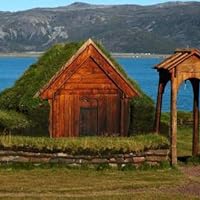
For four hundred years, Norse settlers battled to make southern Greenland a new, sustainable home. They strove against gales and winter cold, food shortages and in the end a shifting climate. The remnants they left behind speak of their determination to wrest an existence at the foot of this vast, icy and challenging wilderness. Yet finally, seemingly suddenly, they vanished; and their mysterious disappearance in the fifteenth century has posed a riddle to scholars ever since. What happened to the lost Viking colonists? For centuries people assumed their descendants could still be living, so expeditions went to find to no avail. Robert Rix tells the gripping story of the missing pioneers, placing their poignant history in the context of cultural discourse and imperial politics. Ranging across fiction, poetry, navigation, reception and tales of exploration, he expertly delves into one of the most contested questions in the annals of colonization.
Greenland was settled, in two areas, by the Norse back in the early 10th Century but suddenly, after 400 years, they completely disappeared. The speculation and mystery of their disappearance has lingered and found acclaim among other elusive and unsolved mysteries of history.
Robert Rix's book is a methodically researched study that offers explanations of how and why the 'lost colony' of Greenland morphed and perpetuated into such legendary proportions. His historiography includes overlaying primary sources with European politics and religious agendas of the intervening period between the original colony disappearing and the commencement of Danish rule over Greenland in the 18th Century. It quickly becomes apparent that perpetuating misinformation and the unquestionable acceptance of convoluted tales 'galvanised colonial desire' and funded religious missions, 'Making public textual and visual representations of Greenland's past was not only about writing history; it also formed a political index of possession'.
I thought, when I picked up this title that I would learn more about the settlers themselves, whilst gaining a more comprehensive understanding of why they may have disappeared. Rix makes it clear at the outset that this book is not about that. Rix does, however, offer an in-depth study of the political and religious power plays of European countries interested in colonial conquest and resource management at that time. The mythical story of Greenland needed to exist and persist in order to serve a wider agenda. To that end, this is a useful and insightful academic text for those historians looking for a unique study into the European race to conquer the Arctic.
The scholarly tome is not a "search for" but a "look at" how this particular settlement of Greenland - or rather it vanished Norse settlement - became a cultural memory. This book provides a study of ".. how the memory of Greenland's "lost colony" was transmitted, interpreted and negotiated from the late sixteenth to the early twentieth century." In short, it looks at the Wests fascination and imagination of the Arctic and its peoples; it is a study of European misconceptions, legends, folklores; and of how contemporary scholarship fueled the germination of these legends. Rix then examines the cultivation of memories of the past and how they are often driven by national and geographical motivations before considering the "master trope" of the fabled lost settlement.
Robert Rix's "The Vanished Settlers of Greenland" is a look at how people obsess over stories about the struggle to survive in the Arctic. I am one of those people. This book is for me and I enjoyed the hell out of it.
It should be noted this book is on the scholarly side of things as you might imagine. Rix looks at the disappearance of the Greenland settlers in the 1400s through various forms of literature. Rix states in the introduction that he is not trying to solve the mystery of their disappearance, but how that disappearance was presented and discussed in the years after. If you are looking for a narrative history about adventure, then this book may not be your cup of tea. If you are looking for a book which tackles an old riddle in a comprehensive way (again, me) then you will greatly appreciate Rix's take on the Greenland settlers. And don't worry, there are still plenty of adventure tales within.
(This book was provided as an advance copy by Netgalley and Cambridge University Press.)
I’m probably like most people in that I don’t really think about Greenland so often. Maybe the last time most of us Americans did is when that guy who used to be president got angry when Denmark wouldn’t sell it to him. If only he knew what I know now. Greenland has a long history, not only as a territory that has changed possession several times and been a quasi colonial space for Norse settlers, but as a place in the cultural imagination of white Europeans and North Americans. Greenland, and it’s mystery of its missing settlements, was well into the 20th century a place where White Europeans could imagine it as the next frontier to colonize and seize wealth from (amusingly, most explorers mistook the east and west coasts and therefore found nothing). Others viewed the lost colony as a paragon of white Christian values in a sea of heathen Inuits and therefore were set on “rescuing” them even long after the possibility that any remained became almost non-existent. That the local population had very little input into any of the decisions about the fate of their country is perhaps not surprising in the age of colonialism, yet still disappointing
This is a very academic look at a community that disappeared in Greenland. I enjoyed learning about the information around them but I struggled to intake the facts. The delivery went over my head as I’m not a scholar or researcher. I think that I’m not correct reader for this through, factual book. It did impact my enjoyment so I can’t give it more than three stars even though I can see others enjoying it more.
I received an arc via Netgalley in exchange for a honest review.
"The Norse Settlements of South-Western Greenland began as a westward relocation of Icelandic farmers..." living for more than 400 years, on the Southwest coast from the year 985. What happened to these vanished settlers? Their disappearance in the 15th century was a "...mystery [that] makes speculation so enticing...". Perhaps the Norse Greenlanders chose "isolation as a means to preserve the primordial purity of a white, ancestral past." Perhaps the inhabitants intermarried with the Inuit thereby becoming a "mixed-breed population." No ancestors of medieval Scandinavian descent have been discovered.
In his thesis, author Robert Rix floats his take on the culture and livelihood of the settlers up until the 15th century and the later attempted recolonization by Dano-Norwegian missionaries like Hans Egede who, in 1721, tried to "establish a combined mission/trading station near present-day Nuuk [the home of the Inuit in 1721]." The colony "lived on in the Western imagination...was transmitted, interpreted and negotiated from the late sixteenth century entering into to the early twentieth." Rix's analysis encompasses the year 985, up to and including, 1920.
The Eastern Settlement of Greenlanders [erroneously named] was actually located on the western coast of Greenland. Archaeologists identified the ruins of hundreds of farms and fourteen churches. Only approximately six percent of Greenland was suitable for human habitation, in areas pocketed by fjords. The uninhabitable eastern shore was filled with pack ice. Exploration in this area failed to penetrate the ice walls.
For years, trade routes were maintained with the Norse Greenlanders who were exporters of walrus ivory and whale oil, a commodity used for lamp oil and soap. As the market for elephant tusks increased, a decrease in trade was noted and essentials might not have been supplied to the settlers. Would they have had ample resources to survive?
Expeditions to find the Viking descendants were undertaken by both Denmark and England. "In Anglophone fiction, the imagination of a 'lost colony' found its most fertile ground." "Greenland's unsolved mystery intrigued a twenty year old...Arthur Conan Doyle [who] enlisted as a surgeon onboard a Greenland whaler...In one of his articles, 'The Glamour of the Arctic' [1892] he speculates about the potential that the 'ancient city' of Greenland, imprisoned behind sea ice, holds for the imagination."
Europe never lost sight of Greenland. "Greenland was part of an imperial geography." England asserted its naval dominance by trying to explore the east coast of Greenland, only to have been thwarted by pack ice. "Lost colony" fiction included comparisons to Robinson Crusoe. Additionally, Inuit Legends that "contained a memory of the European colony [were possibly]...adapted traditional storylines to fit the request for stories about the Norse...a 'remembering back' against colonizers...the stories committed to paper...".
"The Vanished Settlers of Greenland" by Robert Rix is a heavily footnoted, scholarly historical work that explores the legacy of the settlers presented within the context of ethnological speculation, imperialistic politics, and environmental and geophysical theory and as represented in 'lost colony' fiction and adventure stories. Author Rix has written a fascinating, expansive non-fiction read sure to please history buffs and lovers of Icelandic sagas.
Thank you Cambridge University Press and Net Galley for the ARC in exchange for an honest review.
This work by Robert Rix has a very clear thesis, where he studies the "multifaceted and shifting functions that the myth of the vanished settlers assumed". From the cover of the book, I assumed and others may have too that this would have focused on the settlement of Greenland and uts history. While it did that, especially in the first two chapters, the rest of the work focuses specifically on the communal memory of Greenland and the part it played in European Imperialism, indigenous identity, and in the mythos of unknown lands from the 16th century to 19th.
It is a postmodern approach, deconstructing textual evidence and the minutiae found within Scandinavian, English, and other European texts. This book is clearly geared towards academics, those studying history and those interested in North Atlantic history. The dialogue between primary sources is a masterclass in historiography and this impeccable scholarship should be lauded by historians or any discipline. Overall, while this book is very dense, I enjoyed the interplay between Danish and English interests over the island, as well as the collective memories of indigenous, shedding light on the importance of native voices when discussing colonization.
If you are a historian interested in the North Atlantic, this is the book for you. If you are a casual reader who enjoys history, this one may be a bit tougher because it is not truly narrative based and more thematic.
Important: this is NOT about the Norse colonies in Greenland, but about what happened after they were already gone. It’s about historiography and colonialism. There’s a brief intro that gives some background on Norse Greenland itself, but 90% of the book is about how people thought about Norse Greenland after the fact, from the late Middle Ages to the present day.
It has a simplistic but formal writing style that reads like an unimaginative college essay -- lots of “This chapter will discuss…” and “This section has been about…” It is essential scholarship, though, because it fills a huge gap in how Norse Greenland and its supposedly “lost” settlers were viewed by later generations of explorers, missionaries, and politicians. It is not possible to fully understand Greenland’s (modern) exploration and colonization without this book.
Yet another book that misuses the word "Inuit." Inuit doesn't need an article because it already means "the people," yet it's example number one million of a scholar saying "THE Inuit" anyway. I cannot figure out why no one, not even world class experts, can get this right.
NONFICTION This volume is the result of incredibly meticulous research complete with understanding of the way in which different European countries vied for the riches they perceived as belonging to the largest island in the world and the indigenous peoples inhabiting all of the frozen North. There are visual reproductions which suffer in the electronic version but all of the books and articles used in the research are fully documented. This is a fantastic resource in itself for scholars and aficionados alike. I geek history and Pop was born in Norway, so of course I am biased. I requested and received an EARC from Cambridge University Press via NetGalley. Thank you!
A well-researched and well-written exploration into the earliest non-indigenous settlers of Greenland! Not having seen many books about the early recorded days of Greenland, I was excited to read this. Rix presents the information factually, and acknowledging the bias of the time, the bias of translation, and the bias of “history is written by the victors.”
A great read for anyone interested in the deep history of Greenland!